Recognition: 2 theorem links
· Lean TheoremConstraints on Anomalous Quartic Gauge Couplings via γγ and Zγ Vector Boson Scattering at Muon Colliders
Pith reviewed 2026-05-15 20:48 UTC · model grok-4.3
The pith
A 10 TeV muon collider sets tighter limits on anomalous quartic gauge couplings than the LHC or future hadron colliders.
A machine-rendered reading of the paper's core claim, the machinery that carries it, and where it could break.
Core claim
Simulations of neutral vector boson scattering at muon colliders show that the 10 TeV machine yields substantially stronger projected bounds at 95 percent confidence level on the coefficients of dimension-8 field-strength operators for anomalous quartic gauge couplings than those reported by ATLAS at the LHC or projected for future hadron colliders.
What carries the argument
Dimension-8 effective operators for anomalous quartic gauge couplings, analyzed through boosted decision tree discrimination of simulated gamma-gamma and Z-gamma vector boson scattering events at muon colliders.
If this is right
- The 10 TeV muon collider provides stronger projected limits on aQGCs than current LHC results from ATLAS.
- These stronger limits persist even when 10 percent systematic uncertainties are included.
- Muon colliders outperform projected sensitivities from future hadron colliders for these neutral channels.
- Tighter bounds would more stringently restrict possible beyond-Standard-Model contributions to electroweak gauge boson interactions.
Where Pith is reading between the lines
- Improved aQGC limits could help narrow the space of ultraviolet completions that generate modified gauge boson self-interactions.
- The multivariate analysis techniques developed here may transfer to other neutral or charged scattering processes at high-energy lepton colliders.
- The unitarity clipping procedure could serve as a template for EFT analyses at future facilities operating above several TeV.
Load-bearing premise
The effective field theory with only dimension-8 operators remains valid at the muon collider energies and the energy clipping preserves unitarity without biasing the signal limits.
What would settle it
An actual measurement at a 10 TeV muon collider that finds anomalous quartic coupling coefficients larger than the projected 95 percent CL bounds would show the sensitivity claims are not realized.
Figures


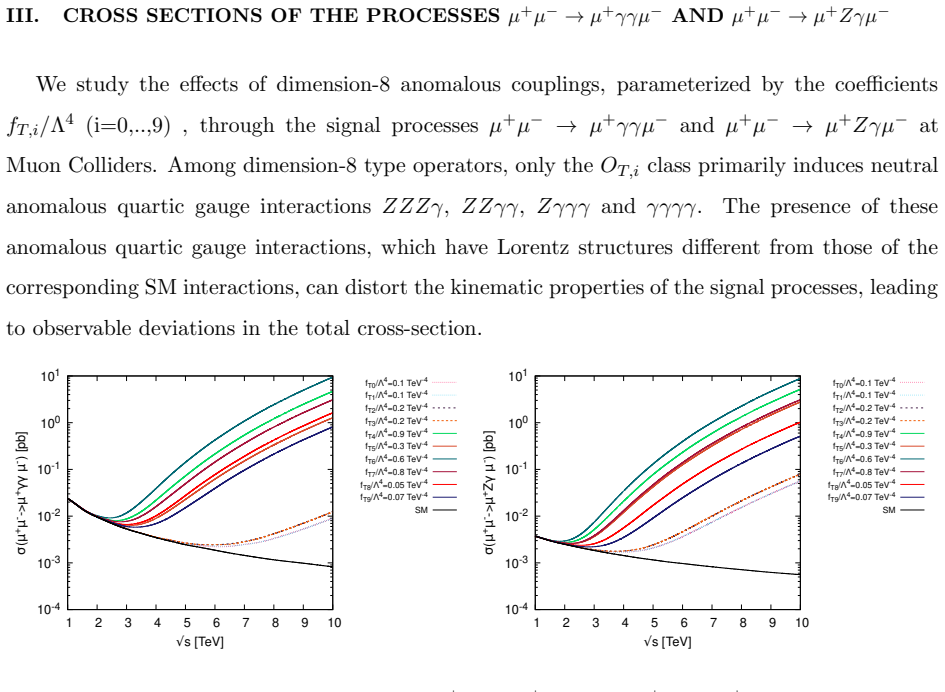


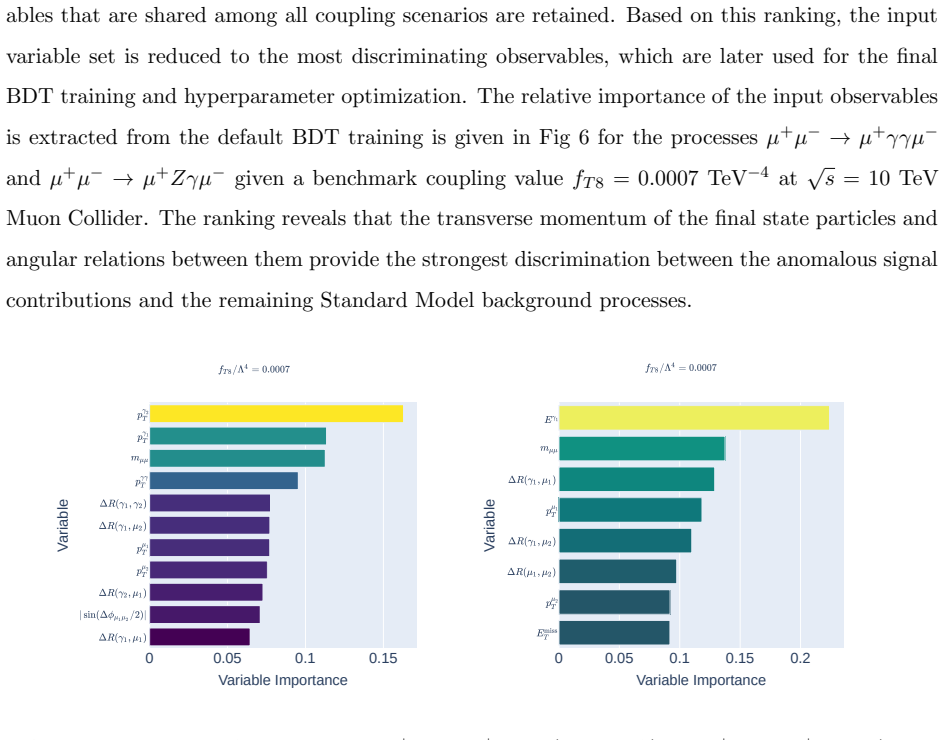


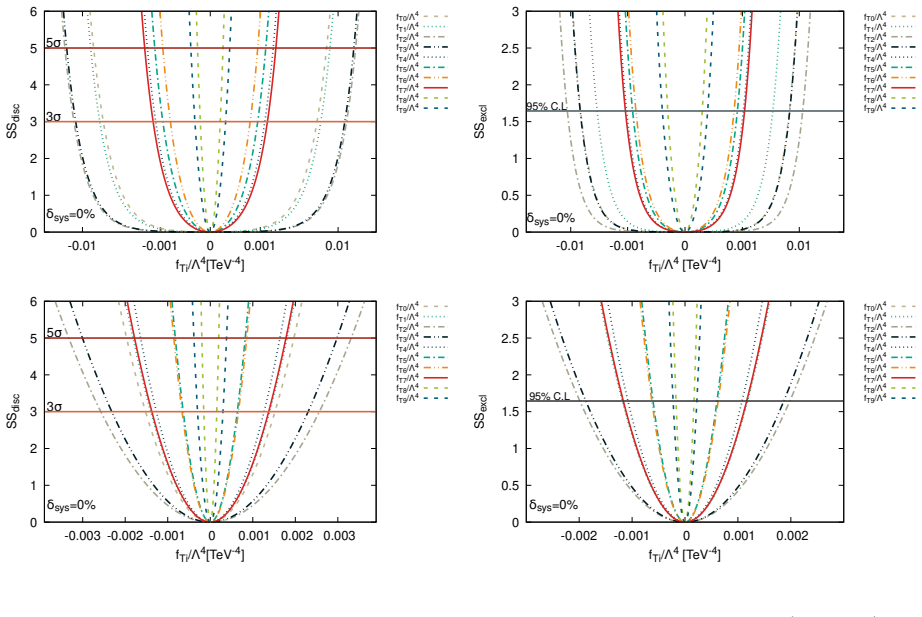
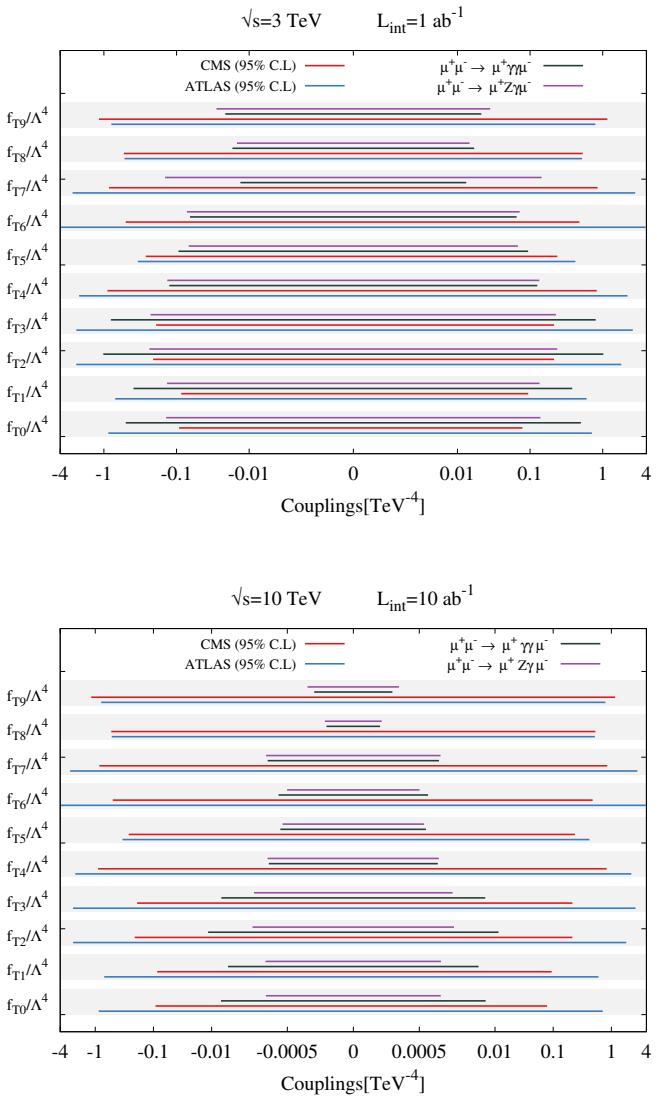
read the original abstract
In the Standard Model, the couplings between gauge bosons are tightly constrained by the principles of gauge symmetry and renormalizability. However, the presence of anomalous couplings suggests the possibility of new physics beyond the Standard Model (BSM). In this study, we focus on the sensitivities of anomalous quartic gauge couplings (aQGCs), specially the dimension-8 operators associated with field-strength tensor structures within the effective field theory (EFT) framework, at future Muon Colliders. Our analysis targets the neutral aQGC-sensitive processes $\mu^{+}\mu^{-} \to \mu^+ \gamma \gamma \mu^-$ and $\mu^{+} \mu^{-} \to \mu^+ Z \gamma \mu^-$, simulated at center-of-mass energies of 3 TeV and 10 TeV. Signal and background events are generated using {\sc MadGraph5\_aMC@NLO}, interfaced with Pythia8 for parton showering and hadronization, and Delphes for fast detector simulation. A multivariate analysis based on Boosted Decision Trees (BDTs) is employed to enhance signal-to-background discrimination, utilizing a comprehensive set of kinematic and reconstructed observables from the final-state particles. Unitarity is preserved through the application of an energy-dependent clipping procedure within the EFT validity regime. Our findings indicate that future muon colliders offer significant sensitivity improvements over current experimental constraints on aQGCs. Furthermore, a comparison with other future collider scenarios shows that the 10 TeV Muon Collider, even with a 10\% systematic uncertainty, provides substantially stronger projected limits at 95\% confidence level than those currently reported by the ATLAS collaboration at the LHC as well as projected limits by future hadron colliders. These results underscore the enhanced potential of high-energy muon collider to probe new physics in the electroweak sector through precision measurements of aQGCs.
Editorial analysis
A structured set of objections, weighed in public.
Referee Report
Summary. The paper investigates projected constraints on dimension-8 anomalous quartic gauge couplings (aQGCs) in neutral vector boson scattering processes μ⁺μ⁻ → μ⁺γγμ⁻ and μ⁺μ⁻ → μ⁺Zγμ⁻ at future muon colliders with √s = 3 and 10 TeV. It employs a standard simulation chain (MadGraph5_aMC@NLO + Pythia8 + Delphes), applies Boosted Decision Tree multivariate analysis on kinematic observables, and uses an energy-dependent clipping procedure to enforce unitarity within the EFT regime. The central claim is that the 10 TeV muon collider yields substantially stronger 95% CL limits than current ATLAS results or projections for future hadron colliders, even allowing for 10% systematic uncertainty.
Significance. If the projected limits prove robust, the work would strengthen the physics case for high-energy muon colliders by demonstrating their potential to outperform hadron colliders in constraining electroweak operators. The methodological approach follows established practices in collider phenomenology, providing a reproducible baseline for future studies.
major comments (3)
- [Methods (unitarity clipping subsection)] The energy-dependent clipping procedure used to restore unitarity (described in the methods and applied to the high-energy tails of the kinematic distributions) is load-bearing for the 10 TeV limits. Without a dedicated study quantifying how variations in the clipping threshold or functional form propagate into the BDT discriminant and the extracted 95% CL bounds, it remains unclear whether the claimed improvement over ATLAS and hadron-collider projections is driven by the underlying operator coefficients or by the regularization choice.
- [Results section] The abstract asserts 'substantially stronger projected limits at 95% confidence level' with 10% systematics, yet the manuscript provides no numerical values, error budgets, or tables of operator coefficients in the summary. The results section must include explicit 95% CL intervals (with and without systematics) and direct numerical comparisons to ATLAS and future hadron-collider projections to substantiate the central claim.
- [EFT framework and validity discussion] The assumption that the dim-8 EFT remains valid at 10 TeV center-of-mass energies is stated but not quantitatively justified. A discussion of the implied cutoff scale, or a comparison of limits obtained with and without clipping, is needed to assess whether the projected sensitivity is within the regime where the effective theory is self-consistent.
minor comments (2)
- [Abstract] The abstract would benefit from including at least one representative numerical limit or a brief statement of the improvement factor to allow readers to gauge the strength of the claims without reading the full text.
- [Introduction and Lagrangian section] Notation for the dimension-8 operators should be standardized (e.g., explicit listing of the relevant Wilson coefficients) and cross-referenced to the Lagrangian definition to avoid ambiguity in the results tables.
Simulated Author's Rebuttal
We thank the referee for the careful reading of our manuscript and the constructive comments. We address each major point below and will revise the manuscript to incorporate additional studies, numerical results, and discussions as outlined.
read point-by-point responses
-
Referee: The energy-dependent clipping procedure used to restore unitarity (described in the methods and applied to the high-energy tails of the kinematic distributions) is load-bearing for the 10 TeV limits. Without a dedicated study quantifying how variations in the clipping threshold or functional form propagate into the BDT discriminant and the extracted 95% CL bounds, it remains unclear whether the claimed improvement over ATLAS and hadron-collider projections is driven by the underlying operator coefficients or by the regularization choice.
Authors: We agree that a dedicated sensitivity study on the clipping procedure is warranted to demonstrate robustness. In the revised manuscript we will add a new subsection (or appendix) that varies the clipping energy threshold by ±20% and tests an alternative linear functional form, recomputing the BDT training and 95% CL limits for the dominant operators. This will quantify the propagation into the final bounds and confirm that the improvement relative to ATLAS and hadron-collider projections is not an artifact of the regularization choice. revision: yes
-
Referee: The abstract asserts 'substantially stronger projected limits at 95% confidence level' with 10% systematics, yet the manuscript provides no numerical values, error budgets, or tables of operator coefficients in the summary. The results section must include explicit 95% CL intervals (with and without systematics) and direct numerical comparisons to ATLAS and future hadron-collider projections to substantiate the central claim.
Authors: We acknowledge that the current presentation lacks explicit numerical values. The revised results section will contain a new table listing the 95% CL intervals on each dimension-8 operator coefficient for both the 3 TeV and 10 TeV muon-collider scenarios, with and without the 10% systematic uncertainty. The table will also include side-by-side numerical comparisons to the latest ATLAS limits and to the projected sensitivities from HL-LHC, FCC-hh, and other future hadron-collider studies cited in the manuscript. revision: yes
-
Referee: The assumption that the dim-8 EFT remains valid at 10 TeV center-of-mass energies is stated but not quantitatively justified. A discussion of the implied cutoff scale, or a comparison of limits obtained with and without clipping, is needed to assess whether the projected sensitivity is within the regime where the effective theory is self-consistent.
Authors: We will expand the EFT validity discussion in the revised manuscript. We will provide a quantitative estimate of the implied cutoff scale by comparing the unitarity bounds derived from the partial-wave analysis to the 10 TeV center-of-mass energy, and we will add a direct comparison of the extracted limits with and without the clipping procedure. This will clarify the range of operator coefficients for which the EFT remains self-consistent at the muon-collider energies. revision: yes
Circularity Check
No significant circularity in projected limits from simulation and BDT analysis
full rationale
The paper generates signal and background events via MadGraph5_aMC@NLO + Pythia8 + Delphes at 3 and 10 TeV, applies BDTs on kinematic observables, and imposes an energy-dependent clipping procedure to restore unitarity within the dim-8 EFT regime. Projected 95% CL limits are then extracted from the resulting signal-background separation and compared to ATLAS and other collider projections. No parameter is fitted to the target observable and then presented as a prediction; the clipping is an external regularization step whose functional form is stated independently of the final limits. No load-bearing self-citations, uniqueness theorems, or ansatzes imported from prior author work are used to force the central result. The derivation chain is therefore self-contained against external benchmarks and receives score 0.
Axiom & Free-Parameter Ledger
axioms (2)
- domain assumption Dimension-8 operators in the EFT framework accurately parametrize possible anomalous quartic gauge couplings
- domain assumption Energy-dependent clipping preserves unitarity within the EFT validity regime without distorting the signal extraction
Lean theorems connected to this paper
-
IndisputableMonolith/Cost/FunctionalEquation.leanwashburn_uniqueness_aczel unclear?
unclearRelation between the paper passage and the cited Recognition theorem.
Unitarity is preserved through the application of an energy-dependent clipping procedure within the EFT validity regime.
-
IndisputableMonolith/Foundation/RealityFromDistinction.leanreality_from_one_distinction unclear?
unclearRelation between the paper passage and the cited Recognition theorem.
dimension-8 operators ... f_{T,i}/Λ⁴
What do these tags mean?
- matches
- The paper's claim is directly supported by a theorem in the formal canon.
- supports
- The theorem supports part of the paper's argument, but the paper may add assumptions or extra steps.
- extends
- The paper goes beyond the formal theorem; the theorem is a base layer rather than the whole result.
- uses
- The paper appears to rely on the theorem as machinery.
- contradicts
- The paper's claim conflicts with a theorem or certificate in the canon.
- unclear
- Pith found a possible connection, but the passage is too broad, indirect, or ambiguous to say the theorem truly supports the claim.
Reference graph
Works this paper leans on
- [1]
- [2]
- [3]
-
[4]
C. Accettura, D. Adams, R. Agarwal, C. Ahdida, C. Aim` e, N. Amapane, D. Amorim, P. Andreetto, F. Anulli and R. Appleby,et al.Eur. Phys. J. C83(2023) no.9, 864 [erratum: Eur. Phys. J. C84 (2024) no.1, 36] [arXiv:2303.08533 [physics.acc-ph]]. 27
-
[5]
de Blaset al.[Muon Collider], [arXiv:2203.07261 [hep-ph]]
J. de Blaset al.[Muon Collider], [arXiv:2203.07261 [hep-ph]]
-
[6]
Stratakiset al.[Muon Collider], doi:10.2172/1881942 [arXiv:2203.08033 [physics.acc-ph]]
D. Stratakiset al.[Muon Collider], doi:10.2172/1881942 [arXiv:2203.08033 [physics.acc-ph]]
- [7]
- [8]
- [9]
-
[10]
A. Gutierrez-Rodrıguez, V. Cetinkaya, M. Koksal, E. Gurkanli, V. Ari and M. A. Hernandez-Ruız, Eur. Phys. J. Plus140(2025), 5 [arXiv:2312.06329 [hep-ph]]
- [11]
-
[12]
Study of the gluonic quartic gauge couplings at muon colliders,
J. C. Yang, Y. C. Guo and Y. F. Dong, “Study of the gluonic quartic gauge couplings at muon colliders,” Commun. Theor. Phys.75(2023) no.11, 115201 [arXiv:2307.04207 [hep-ph]]
- [13]
- [14]
- [15]
-
[16]
H. Amarkhail, S. C. Inan and A. V. Kisselev, Nucl. Phys. B1005(2024), 116592 [arXiv:2306.03653 [hep-ph]]
-
[17]
H. Amarkhail, S. C. ˙Inan and A. V. Kisselev, J. Phys. G52(2025) no.1, 015001 [arXiv:2403.07689 [hep-ph]]
-
[18]
Accetturaet al.[International Muon Collider], CERN Yellow Rep
C. Accetturaet al.[International Muon Collider], CERN Yellow Rep. Monogr.2/2024(2024), 1 CERN, 2024, ISBN 978-92-9083-667-4, 978-92-9083-668-1 [arXiv:2407.12450 [physics.acc-ph]]
-
[19]
K. Hagiwara, S. Ishihara, R. Szalapski and D. Zeppenfeld, Phys. Rev. D48, 2182-2203 (1993)
work page 1993
-
[20]
C. Degrande, O. Eboli, B. Feigl, B. J¨ ager, W. Kilian, O. Mattelaer, M. Rauch, J. Reuter, M. Sekulla and D. Wackeroth, [arXiv:1309.7890 [hep-ph]]
work page internal anchor Pith review Pith/arXiv arXiv
-
[21]
C. Degrande, J. L. Holzbauer, S. C. Hsu, A. V. Kotwal, S. Li, M. Marx, O. Mattelaer, J. Metcalfe, M. A. Pleier and C. Pollard,et al.[arXiv:1309.7452 [physics.comp-ph]]
work page internal anchor Pith review Pith/arXiv arXiv
-
[22]
G. Perez, M. Sekulla and D. Zeppenfeld, Eur. Phys. J. C78, no.9, 759 (2018) [arXiv:1807.02707 [hep- ph]]
work page internal anchor Pith review Pith/arXiv arXiv 2018
- [23]
-
[24]
Aadet al.[ATLAS], JHEP06, 082 (2023) [arXiv:2208.12741 [hep-ex]]
G. Aadet al.[ATLAS], JHEP06, 082 (2023) [arXiv:2208.12741 [hep-ex]]
-
[25]
G. Aadet al.[ATLAS], [arXiv:2503.17461 [hep-ex]]
work page internal anchor Pith review Pith/arXiv arXiv
-
[26]
Hayrapetyanet al.[CMS], [arXiv:2510.00118 [hep-ex]]
A. Hayrapetyanet al.[CMS], [arXiv:2510.00118 [hep-ex]]
-
[27]
A. Tumasyanet al.[CMS], Phys. Rev. D108, no.3, 032017 (2023) [arXiv:2212.12592 [hep-ex]]
-
[28]
A. Tumasyanet al.[CMS], Phys. Rev. D104(2021), 072001 [arXiv:2106.11082 [hep-ex]]
-
[29]
J. Alwall, R. Frederix, S. Frixione, V. Hirschi, F. Maltoni, O. Mattelaer, H. S. Shao, T. Stelzer, 28 P. Torrielli and M. Zaro, JHEP07(2014), 079 [arXiv:1405.0301 [hep-ph]]
work page internal anchor Pith review Pith/arXiv arXiv 2014
-
[30]
UFO - The Universal FeynRules Output
C. Degrande, C. Duhr, B. Fuks, D. Grellscheid, O. Mattelaer and T. Reiter, Comput. Phys. Commun. 183(2012), 1201-1214 [arXiv:1108.2040 [hep-ph]]
work page internal anchor Pith review Pith/arXiv arXiv 2012
-
[31]
FeynRules 2.0 - A complete toolbox for tree-level phenomenology
A. Alloul, N. D. Christensen, C. Degrande, C. Duhr and B. Fuks, Comput. Phys. Commun.185(2014), 2250-2300 [arXiv:1310.1921 [hep-ph]]
work page internal anchor Pith review Pith/arXiv arXiv 2014
-
[32]
T. Sj¨ ostrand, S. Ask, J. R. Christiansen, R. Corke, N. Desai, P. Ilten, S. Mrenna, S. Prestel, C. O. Ras- mussen and P. Z. Skands, Comput. Phys. Commun.191(2015), 159-177 [arXiv:1410.3012 [hep-ph]]
work page internal anchor Pith review Pith/arXiv arXiv 2015
-
[33]
DELPHES 3, A modular framework for fast simulation of a generic collider experiment
J. de Favereauet al.[DELPHES 3], JHEP02(2014), 057 [arXiv:1307.6346 [hep-ex]]
work page internal anchor Pith review Pith/arXiv arXiv 2014
-
[34]
Asymptotic formulae for likelihood-based tests of new physics
G. Cowan, K. Cranmer, E. Gross and O. Vitells, Eur. Phys. J. C71, 1554 (2011) [erratum: Eur. Phys. J. C73, 2501 (2013)] [arXiv:1007.1727 [physics.data-an]]
work page internal anchor Pith review Pith/arXiv arXiv 2011
-
[35]
Vectorlike leptons at the Large Hadron Collider
N. Kumar and S. P. Martin, Phys. Rev. D92, no.11, 115018 (2015) [arXiv:1510.03456 [hep-ph]]. 29
work page internal anchor Pith review Pith/arXiv arXiv 2015
discussion (0)
Sign in with ORCID, Apple, or X to comment. Anyone can read and Pith papers without signing in.