Recognition: 2 theorem links
· Lean TheoremInferring the population properties of galactic binaries from LISA's stochastic foreground
Pith reviewed 2026-05-15 20:36 UTC · model grok-4.3
The pith
LISA's stochastic gravitational-wave foreground encodes enough information to recover galactic binary population parameters including their total number.
A machine-rendered reading of the paper's core claim, the machinery that carries it, and where it could break.
Core claim
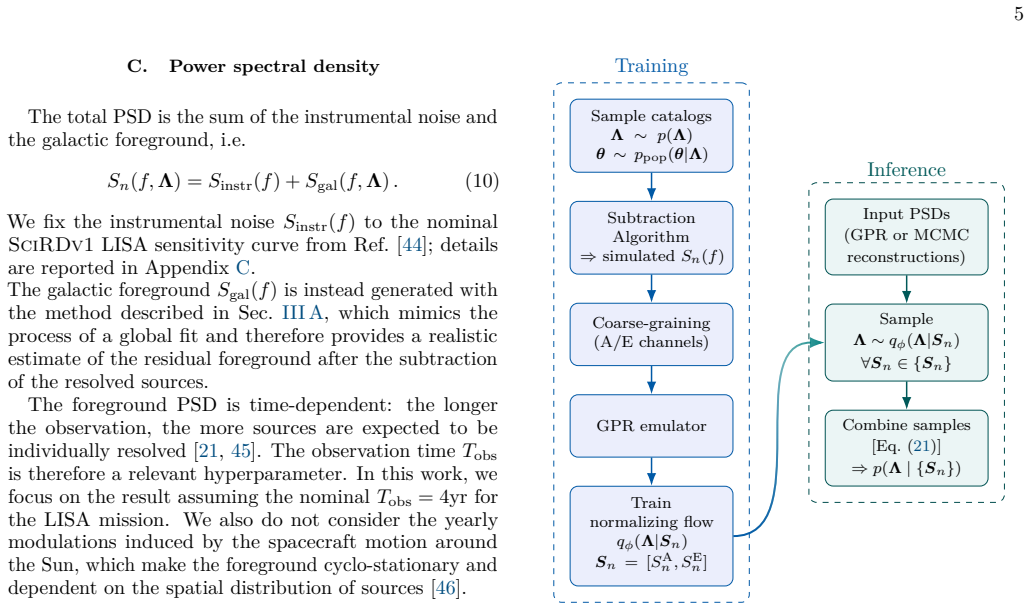
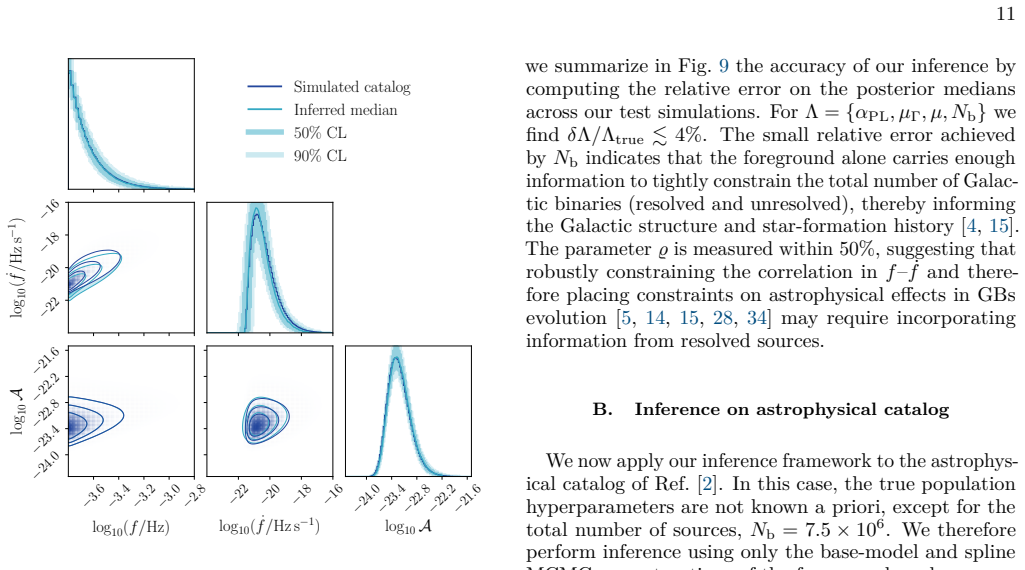
The stochastic foreground alone carries significant information about the Galactic binary population; a neural posterior estimator trained on spectra generated by a global-fit-inspired subtraction algorithm recovers the population parameters with good accuracy, including the total number of binaries.
What carries the argument
A neural posterior estimator trained to map reconstructed foreground spectra to population parameters in an observable-space parametrization of amplitude, frequency, and frequency derivative.
If this is right
- Population parameters including total binary count can be recovered directly from the unresolved foreground.
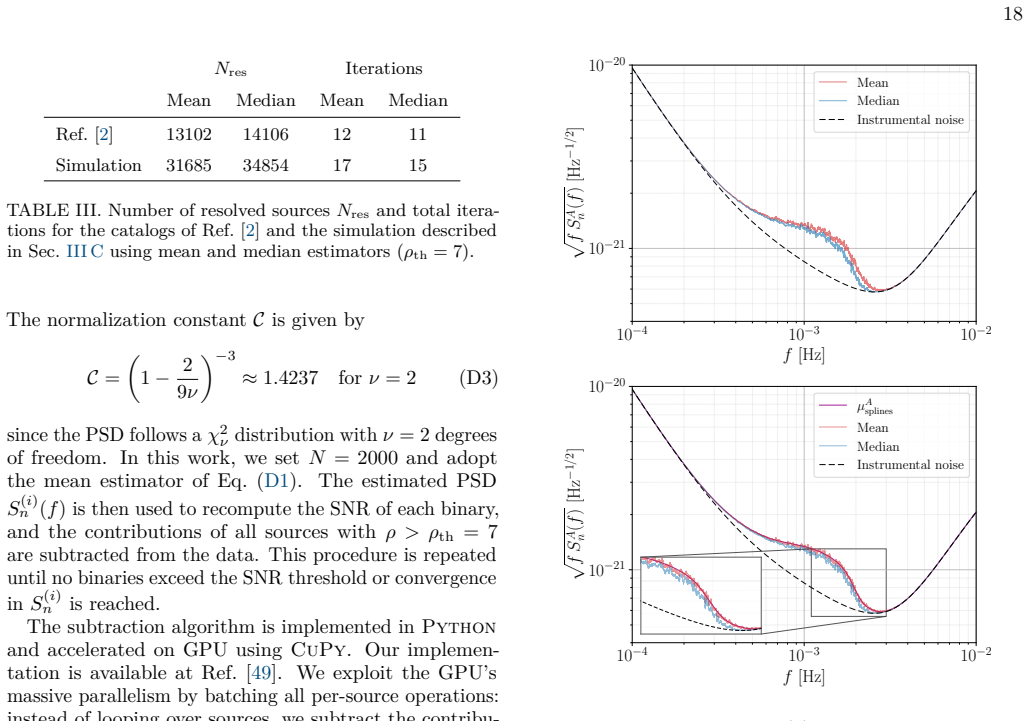
- The GPU-accelerated subtraction algorithm reduces computation time by roughly two orders of magnitude.
- The framework provides a practical route toward joint inference that combines resolved and unresolved sources.
- Foreground-based inference becomes feasible even when full global-fit analyses remain computationally expensive.
Where Pith is reading between the lines
- Future LISA pipelines could treat foreground population inference as an early, low-cost step before attempting source resolution.
- The method could be tested on mock data sets that include additional noise sources or instrumental artifacts to check robustness.
- Extending the parametrization to include higher-order derivatives might capture more subtle population features.
Load-bearing premise
The synthetic catalogs and foreground spectra generated via the global-fit-inspired subtraction algorithm faithfully represent the statistical properties of real LISA observations without introducing systematic biases.
What would settle it
Applying the trained estimator to actual LISA foreground data and obtaining population parameters that conflict with those derived from resolved sources or independent astrophysical models would falsify the claim.
Figures






read the original abstract
Galactic binaries are expected to be the most numerous LISA sources and to produce a stochastic gravitational-wave foreground whose spectral shape encodes information about the underlying population. Extracting this information with standard hierarchical methods is challenging due to the high dimensionality of the problem and the computational cost of global-fit analyses. We present a simulation-based inference framework to measure the population properties of galactic binaries directly from the reconstructed foreground. Adopting an astrophysically agnostic parametrization in the observable space -- defined by signal amplitude, frequency, and frequency derivative -- we generate synthetic catalogs and foreground spectra using a global-fit-inspired subtraction algorithm. We then train a neural posterior estimator to map spectra to population parameters. We validate our method on simulated data and recover population parameters with good accuracy, including the total number of binaries. As a by-product, we present a GPU-accelerated version of the subtraction algorithm, which delivers a ~100X speed-up compared to previous implementations in the literature. Our results demonstrate that LISA's stochastic foreground alone carries significant information about the Galactic binary population and provide a practical step toward joint inference from resolved and unresolved sources.
Editorial analysis
A structured set of objections, weighed in public.
Referee Report
Summary. The paper presents a simulation-based inference framework to extract Galactic binary population properties (including total number) directly from LISA's stochastic foreground. Synthetic catalogs are generated in an observable-space parametrization (amplitude, frequency, frequency derivative); foreground spectra are produced with a global-fit-inspired subtraction algorithm; a neural posterior estimator is trained to map spectra to parameters; and the method is validated on simulated data, recovering parameters with good accuracy. A GPU-accelerated subtraction algorithm (~100X speedup) is provided as a by-product.
Significance. If the validation holds under realistic conditions, the work demonstrates that the unresolved foreground alone encodes usable information about the Galactic binary population, offering a computationally lighter alternative to full hierarchical global fits. The GPU-accelerated subtraction routine is a concrete practical contribution. Strengths include training and validation on independent simulations and the use of an astrophysically agnostic observable-space parametrization.
minor comments (3)
- [Abstract] Abstract: the statement that parameters are recovered 'with good accuracy' should be accompanied by at least one quantitative metric (bias, coverage probability, or credible-interval width) and a brief note on checks for subtraction-induced biases or overfitting.
- [Neural posterior estimation section] The description of the neural posterior estimator would benefit from explicit reporting of training/validation split sizes, any regularization or early-stopping criteria, and at least one diagnostic (e.g., posterior calibration plot or coverage test) on the held-out realizations.
- [Results and figures] Figure captions and text should clarify whether the reported recovery includes the full posterior or only point estimates, and whether the subtraction algorithm's residual spectrum is used as the sole input or combined with other observables.
Simulated Author's Rebuttal
We thank the referee for their positive evaluation of our manuscript and for recommending minor revision. We appreciate the recognition that the unresolved foreground encodes usable information about the Galactic binary population and that the GPU-accelerated subtraction routine constitutes a practical contribution.
Circularity Check
No significant circularity; derivation is self-contained simulation-based inference
full rationale
The paper generates synthetic catalogs and foreground spectra from population models via a subtraction algorithm, then trains a neural posterior estimator on those simulations to recover parameters from spectra. Validation occurs on held-out realizations, with no equations or steps where a fitted parameter is renamed as a prediction, no self-definitional loops, and no load-bearing self-citations that reduce the central claim to unverified inputs. The framework is externally falsifiable via simulation benchmarks and does not import uniqueness theorems or ansatzes from prior author work in a circular manner. This matches the standard non-circular structure of SBI pipelines.
Axiom & Free-Parameter Ledger
axioms (1)
- domain assumption Synthetic foreground spectra generated from the observable-space parametrization and subtraction algorithm statistically match the properties of real LISA stochastic signals.
Lean theorems connected to this paper
-
IndisputableMonolith/Cost/FunctionalEquation.leanwashburn_uniqueness_aczel unclear?
unclearRelation between the paper passage and the cited Recognition theorem.
We present a simulation-based inference framework to measure the population properties of galactic binaries directly from the reconstructed foreground. Adopting an astrophysically agnostic parametrization in the observable space—defined by signal amplitude, frequency, and frequency derivative—we generate synthetic catalogs and foreground spectra using a global-fit-inspired subtraction algorithm. We then train a neural posterior estimator to map spectra to population parameters.
-
IndisputableMonolith/Foundation/RealityFromDistinction.leanreality_from_one_distinction unclear?
unclearRelation between the paper passage and the cited Recognition theorem.
Our population model depends on eight dimensionless parameters Λ={αPL, αΓ, βΓ, µΓ, µ, σ, ϱ, Nb}
What do these tags mean?
- matches
- The paper's claim is directly supported by a theorem in the formal canon.
- supports
- The theorem supports part of the paper's argument, but the paper may add assumptions or extra steps.
- extends
- The paper goes beyond the formal theorem; the theorem is a base layer rather than the whole result.
- uses
- The paper appears to rely on the theorem as machinery.
- contradicts
- The paper's claim conflicts with a theorem or certificate in the canon.
- unclear
- Pith found a possible connection, but the passage is too broad, indirect, or ambiguous to say the theorem truly supports the claim.
Reference graph
Works this paper leans on
-
[1]
M. Colpiet al., ESA-SCI-DIR-RP-002 (2024), arXiv:2402.07571 [astro-ph.CO]
work page internal anchor Pith review Pith/arXiv arXiv 2024
-
[2]
A. Lamberts, S. Blunt, T. B. Littenberg, S. Garrison- Kimmel, T. Kupfer, and R. E. Sanderson, Mon. Not. R. Astron. Soc.490, 5888 (2019), arXiv:1907.00014 [astro- ph.HE]
- [3]
- [4]
-
[5]
A. Toubiana, N. Karnesis, A. Lamberts, and M. C. Miller, Astron. Astrophys.692, A165 (2024), arXiv:2403.16867 [astro-ph.SR]
-
[6]
G. Nelemans, L. R. Yungelson, and S. F. Porte- gies Zwart, Astron. Astrophys.375, 890 (2001), arXiv:astro-ph/0105221
work page internal anchor Pith review Pith/arXiv arXiv 2001
-
[7]
A. J. Ruiter, K. Belczynski, M. Benacquista, S. L. Lar- son, and G. Williams, Astrophys. J.717, 1006 (2010), arXiv:0705.3272 [astro-ph]
work page internal anchor Pith review Pith/arXiv arXiv 2010
-
[8]
K. Breivik, K. Kremer, M. Bueno, S. L. Larson, S. Cough- lin, and V. Kalogera, Astrophys. J. Lett.854, L1 (2018), arXiv:1710.08370 [astro-ph.SR]
work page internal anchor Pith review Pith/arXiv arXiv 2018
-
[9]
T. B. Littenberg, N. J. Cornish, K. Lackeos, and T. Rob- son, Phys. Rev. D101, 123021 (2020)
work page 2020
- [10]
- [11]
- [12]
- [13]
-
[14]
V. Delfavero, K. Breivik, S. Thiele, R. O’Shaughnessy, and J. G. Baker, Astrophys. J.981, 66 (2025), arXiv:2409.15230 [gr-qc]
-
[15]
M. Georgousi, N. Karnesis, V. Korol, M. Pieroni, and N. Stergioulas, Mon. Not. R. Astron. Soc.519, 2552 (2022), arXiv:2204.07349 [astro-ph.GA]
-
[16]
A framework for LISA population inference
A. Toubiana and J. Gair, (2026), arXiv:2601.04168 [gr-qc]
work page internal anchor Pith review Pith/arXiv arXiv 2026
-
[17]
R. Srinivasan, E. Barausse, N. Korsakova, and R. Trotta, Phys. Rev. D112, 103043 (2025), arXiv:2506.22543 [astro- ph.GA]
- [18]
-
[19]
M. Deistler, J. Boelts, P. Steinbach, G. Moss, T. Moreau, M. Gloeckler, P. L. C. Rodrigues, J. Linhart, J. K. Lap- palainen, B. K. Miller, P. J. Gonçalves, J.-M. Lueckmann, C. Schröder, and J. H. Macke, (2025), arXiv:2508.12939 [stat.ML]
- [20]
-
[21]
N. Karnesis, S. Babak, M. Pieroni, N. Cornish, and T. Littenberg, Phys. Rev. D104, 043019 (2021), arXiv:2103.14598 [astro-ph.IM]
-
[22]
A. Santini, M. Muratore, J. Gair, and O. Hartwig, Phys. Rev. D112, 084050 (2025), arXiv:2507.06300 [gr-qc]
-
[23]
L. Hellström, M. Giersz, A. Askar, A. Hypki, Y. Zhao, Y. Lu, S. Zhang, V. Vázquez-Aceves, and G. Wiktorowicz, Astron. Astrophys.702, A131 (2025), arXiv:2506.13122 [astro-ph.SR]
- [24]
-
[25]
N. J. Cornish and T. B. Littenberg, Phys. Rev. D76, 083006 (2007), arXiv:0704.1808 [gr-qc]
work page internal anchor Pith review Pith/arXiv arXiv 2007
-
[26]
Long-term evolution of double white dwarf binaries accreting through direct impact
K. Kremer, J. Sepinsky, and V. Kalogera, Astrophys. J. 806, 76 (2015), arXiv:1502.06147 [astro-ph.SR]
work page internal anchor Pith review Pith/arXiv arXiv 2015
- [27]
-
[28]
J. R. Hurley, C. A. Tout, and O. R. Pols, Mon. Not. R. Astron. Soc.329, 897 (2002), arXiv:astro-ph/0201220 [astro-ph]
work page internal anchor Pith review Pith/arXiv arXiv 2002
-
[29]
J. E. Solheim, Publ. Astron. Soc. Pac.122, 1133 (2010)
work page 2010
-
[30]
K. J. Shen, Astrophys. J. Lett.805, L6 (2015), arXiv:1502.05052 [astro-ph.SR]
work page internal anchor Pith review Pith/arXiv arXiv 2015
-
[31]
D. Maoz, F. Mannucci, and G. Nelemans, Annu. Rev. Astron. Astrophys.52, 107 (2014), arXiv:1312.0628 [astro- ph.CO]
work page internal anchor Pith review Pith/arXiv arXiv 2014
-
[32]
K. J. Shen, D. Kasen, B. J. Miles, and D. M. Townsley, Astrophys. J.854, 52 (2018), arXiv:1706.01898 [astro- ph.HE]
work page internal anchor Pith review Pith/arXiv arXiv 2018
-
[33]
Prospects for detection of detached double white dwarf binaries with Gaia, LSST and LISA
V. Korol, E. M. Rossi, P. J. Groot, G. Nelemans, S. Too- nen, and A. G. A. Brown, Mon. Not. R. Astron. Soc.470, 1894 (2017), arXiv:1703.02555 [astro-ph.HE]
work page internal anchor Pith review Pith/arXiv arXiv 2017
-
[34]
J. McMillan, A. Ingram, C. Dashwood Brown, A. Igoshev, M. Middleton, G. Wiktorowicz, and S. Scaringi, (2026), arXiv:2602.11765 [astro-ph.HE]
-
[35]
T. R. Marsh, G. Nelemans, and D. Steeghs, Mon. Not. R. Astron. Soc.350, 113 (2004), arXiv:astro-ph/0312577 [astro-ph]
work page internal anchor Pith review Pith/arXiv arXiv 2004
- [36]
-
[37]
Predicting the binary black hole population of the Milky Way with cosmological simulations
A. Lamberts, S. Garrison-Kimmel, P. F. Hopkins, E.Quataert, J. S.Bullock, C.-A. Faucher-Giguère, A.Wet- zel, D. Kereš, K. Drango, and R. E. Sanderson, Mon. Not. R. Astron. Soc.480, 2704 (2018), arXiv:1801.03099 [astro- ph.GA]
work page internal anchor Pith review Pith/arXiv arXiv 2018
-
[38]
D. Maoz, C. Badenes, and S. J. Bickerton, Astrophys. J. 751, 143 (2012), arXiv:1202.5467 [astro-ph.SR]
work page internal anchor Pith review Pith/arXiv arXiv 2012
-
[39]
The Merger Rate of Binary White Dwarfs in the Galactic Disk
C. Badenes and D. Maoz, Astrophys. J. Lett.749, L11 (2012), arXiv:1202.5472 [astro-ph.SR]
work page internal anchor Pith review Pith/arXiv arXiv 2012
-
[40]
The binary fraction, separation distribution, and merger rate of white dwarfs from SPY
D. Maoz and N. Hallakoun, Mon. Not. R. Astron. Soc. 467, 1414 (2017), arXiv:1609.02156 [astro-ph.SR]
work page internal anchor Pith review Pith/arXiv arXiv 2017
-
[41]
D. Maoz, N. Hallakoun, and C. Badenes, Mon. Not. R. Astron. Soc.476, 2584 (2018), arXiv:1801.04275 [astro- ph.SR]
work page internal anchor Pith review Pith/arXiv arXiv 2018
-
[42]
C. Adamcewicz and E. Thrane, Mon. Not. R. Astron. Soc. 517, 3928 (2022), arXiv:2208.03405 [astro-ph.HE]
-
[43]
A. R. Wetzel, P. F. Hopkins, J.-h. Kim, C.-A. Faucher- Giguere, D. Keres, and E. Quataert, Astrophys. J. Lett. 827, L23 (2016), arXiv:1602.05957 [astro-ph.GA]
work page internal anchor Pith review Pith/arXiv arXiv 2016
-
[44]
LISA Science Study Team, ESA-L3-EST-SCI-RS001 www.cosmos.esa.int/documents/678316/1700384/SciRD.pdf (2018)
work page 2018
-
[45]
R. Buscicchio, F. Pozzoli, D. Chirico, and A. Sesana, 20 (2025), arXiv:2511.03604 [astro-ph.IM]
-
[46]
F. Pozzoli, R. Buscicchio, A. Klein, V. Korol, A. Sesana, and F. Haardt, Phys. Rev. D111, 063005 (2025), arXiv:2410.08274 [astro-ph.GA]
-
[47]
T.A.Prince, M.Tinto, S.L.Larson,andJ.W.Armstrong, Phys. Rev. D66, 122002 (2002), arXiv:gr-qc/0209039
work page internal anchor Pith review Pith/arXiv arXiv 2002
-
[48]
O. Hartwig and M. Muratore, Phys. Rev. D105, 062006 (2022), arXiv:2111.00975 [gr-qc]
-
[49]
F. De Santi and N. Karnesis, doi.org/10.5281/zenodo.18710899, Fast LISA Sub- traction (2026)
-
[50]
M. L. Katz, doi.org/10.5281/zenodo.6500434, github.com/mikekatz04/gbgpu (2025)
- [51]
-
[52]
M. Tinto and S. V. Dhurandhar, Living Rev. Relativ.8, 4 (2005), arXiv:gr-qc/0409034
- [53]
-
[54]
O. Hartwig, M. Lilley, M. Muratore, and M. Pieroni, Phys. Rev. D107, 123531 (2023), arXiv:2303.15929 [gr-qc]
-
[55]
Reconstructing the spectral shape of a stochastic gravitational wave background with LISA,
C. Caprini, D. G. Figueroa, R. Flauger, G. Nardini, M. Peloso, M. Pieroni, A. Ricciardone, and G. Tasi- nato, J. Cosmology Astropart. Phys.11, 017 (2019), arXiv:1906.09244 [astro-ph.CO]
-
[56]
R. Flauger, N. Karnesis, G. Nardini, M. Pieroni, A. Ric- ciardone, and J. Torrado, J. Cosmology Astropart. Phys. 01, 059 (2021), arXiv:2009.11845 [astro-ph.CO]
-
[57]
M. Pieroni and E. Barausse, J. Cosmology Astropart. Phys.07, 021 (2020), [Erratum: J. Cosmology Astropart. Phys. 09, E01 (2020)], arXiv:2004.01135 [astro-ph.CO]
-
[58]
C. E. Rasmussen and C. K. I. Williams,Gaussian Pro- cesses for Machine Learning(MIT, 2006)
work page 2006
-
[59]
M. D. McKay, R. J. Beckman, and W. J. Conover, Tech- nometrics21, 239 (1979)
work page 1979
-
[60]
S. R. Taylor and D. Gerosa, Phys. Rev. D98, 083017 (2018), arXiv:1806.08365 [astro-ph.HE]
work page internal anchor Pith review Pith/arXiv arXiv 2018
-
[61]
A. G. d. G. Matthews, M. van der Wilk, T. Nickson, K. Fujii, A. Boukouvalas, P. León-Villagrá, Z. Ghahra- mani, and J. Hensman, J. Mach. Learn. Res.18, 1 (2017), arXiv:1610.08733 [stat.ML]
work page internal anchor Pith review Pith/arXiv arXiv 2017
-
[62]
M. van der Wilk, V. Dutordoir, S. John, A. Artemev, V. Adam, and J. Hensman, arXiv:2003.01115 (2020)
-
[63]
G. Papamakarios, E. Nalisnick, D. Jimenez Rezende, S. Mohamed, and B. Lakshminarayanan, J. Mach. Learn. Res.22, 1 (2021), arXiv:1912.02762 [stat.ML]
-
[64]
L. Dinh, J. Sohl-Dickstein, and S. Bengio, Interna- tional Conference on Learning Representations (2016), arXiv:1605.08803 [cs.LG]
work page internal anchor Pith review Pith/arXiv arXiv 2016
-
[65]
F. De Santi, M. Razzano, F. Fidecaro, L. Muccillo, L. Pa- palini, and B. Patricelli, Phys. Rev. D109, 102004 (2024)
work page 2024
-
[66]
De Santi, github.com/fdesanti/hyperion (2024)
F. De Santi, github.com/fdesanti/hyperion (2024)
work page 2024
- [67]
-
[68]
D. P. Kingma and J. Ba, International Conference for Learning Representations (2017), arXiv:1412.6980 [cs.LG]
work page internal anchor Pith review Pith/arXiv arXiv 2017
-
[69]
The construction and use of LISA sensitivity curves
T. Robson, N. J. Cornish, and C. Liu, Class. Quantum Grav.36, 105011 (2019), arXiv:1803.01944 [astro-ph.HE]
work page internal anchor Pith review Pith/arXiv arXiv 2019
-
[70]
E. S. Phinney, (2001), arXiv:astro-ph/0108028 [astro- ph]
work page internal anchor Pith review Pith/arXiv arXiv 2001
-
[71]
P. J. Green, Biometrika82, 711 (1995)
work page 1995
-
[72]
N. Karnesis, M. L. Katz, N. Korsakova, J. R. Gair, and N. Stergioulas, Mon. Not. R. Astron. Soc.526, 4814 (2023), arXiv:2303.02164 [astro-ph.IM]
- [73]
-
[74]
Consequences of Disk Scale Height on LISA Confusion Noise from Close White Dwarf Binaries
M. Benacquista and K. Holley-Bockelmann, Astrophys. J. 645, 589 (2006), arXiv:astro-ph/0504135
work page internal anchor Pith review Pith/arXiv arXiv 2006
- [75]
-
[76]
S. Rinaldi, A. Toubiana, and J. R. Gair, J. Cosmology Astropart. Phys.12, 031 (2025), arXiv:2506.05153 [gr-qc]
-
[77]
A. G. Abacet al., (2025), arXiv:2508.18083 [astro- ph.HE]
work page internal anchor Pith review Pith/arXiv arXiv 2025
- [78]
-
[79]
C. J. Moore, R. H. Cole, and C. P. L. Berry, Class. Quan- tum Grav.32, 015014 (2015), arXiv:1408.0740 [gr-qc]
work page internal anchor Pith review Pith/arXiv arXiv 2015
- [80]
discussion (0)
Sign in with ORCID, Apple, or X to comment. Anyone can read and Pith papers without signing in.