Probing the Milky Way Halo with RR Lyrae Stars from Gaia Data Release 3
Pith reviewed 2026-05-15 20:34 UTC · model grok-4.3
The pith
RR Lyrae stars from Gaia data show distinct metallicities for major accreted substructures in the Milky Way halo.
A machine-rendered reading of the paper's core claim, the machinery that carries it, and where it could break.
Core claim
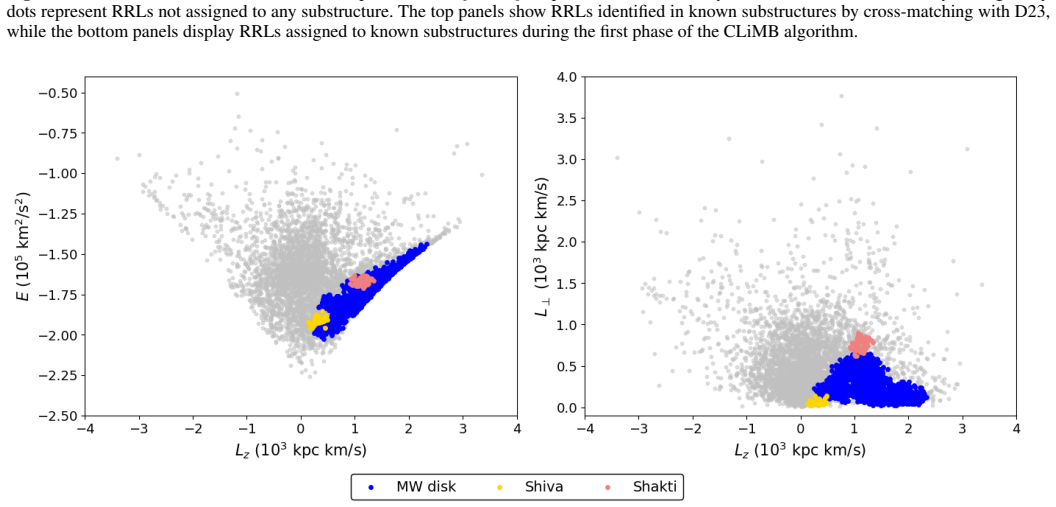
Applying the CLiMB framework to the integrals of motion and orbital parameters of 4933 RR Lyrae stars identifies their membership in Milky Way substructures, enabling calculation of weighted mean metallicities of [Fe/H] = −1.57 ± 0.25 dex for Gaia Sausage/Enceladus, −1.64 ± 0.26 dex for Sequoia, −1.66 ± 0.19 dex for the Helmi streams, and a bimodal distribution in Thamnos with a metal-poor peak at −1.94 ± 0.20 dex representing the accreted population, while showing high contamination by thick disc stars in ED-1 and L-RL3 and suggesting in-situ origins for Shiva and Shakti.
What carries the argument
The CLiMB (CLustering in Multiphase Boundaries) framework, a domain-informed novelty detection clustering method applied to integrals of motion and orbital parameters of RR Lyrae stars to assign substructure membership.
Load-bearing premise
The CLiMB framework correctly assigns RR Lyrae stars to specific accreted substructures with minimal contamination from the thick disk or in-situ populations based on orbital parameters.
What would settle it
Spectroscopic iron-abundance measurements for stars assigned to Gaia Sausage/Enceladus that yield a mean metallicity differing by more than 0.3 dex from -1.57 or show many stars on disk-like orbits would falsify the membership assignments.
Figures



read the original abstract
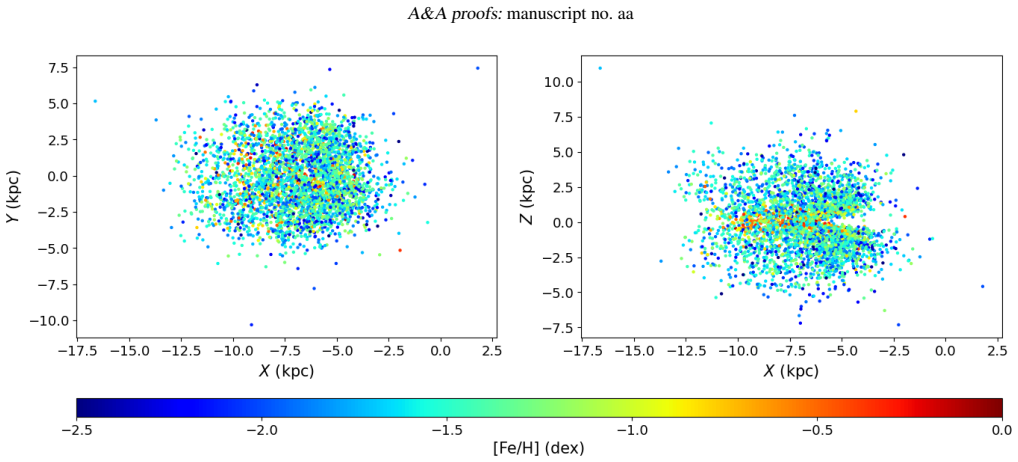
The Milky Way (MW) stellar halo, containing debris from past accretion events, serves as a fossil record of hierarchical mass assembly. Due to their distinct properties, RR Lyrae stars (RRLs) serve as excellent tracers for identifying and characterising the halo's substructures. We analysed a sample of 4933 RRLs, for which we calculated the integrals of motion and orbital parameters. We applied the domain-informed novelty detection CLustering in Multiphase Boundaries (CLiMB) framework to identify RRL membership in the MW substructures. We analysed the metallicity distributions of RRLs in major accreted system remnants as a snapshot of their chemical evolutionary status during early epochs. We calculated the weighted mean metallicity ([Fe/H]) and the corresponding standard deviation for Gaia Sausage/Enceladus ([Fe/H] = $-1.57 \pm 0.25$ dex), Sequoia ([Fe/H] =$ -1.64\pm0.26$ dex), and the Helmi streams ([Fe/H] = $-1.66\pm0.19$ dex). The metallicity distribution of RRLs in Thamnos was found to be bimodal, with the metal-poor peak likely representing the genuine accreted Thamnos population ([Fe/H] = $-1.94\pm0.20$ dex), in agreement with recent works based on spectroscopic abundances. Our analysis shows that the substructures ED-1 and L-RL3 are highly contaminated by thick disc stars. However, the metal-poor tails in their metallicity distributions may be signatures of remnants from small accreted systems. We also identify over-densities of RRLs in correspondence with the recently reported substructures Shiva and Shakti, which we suggest are of in-situ origin. Finally, we applied the RRL-based mass-metallicity relation of galaxies to test the nature of the identified dynamical substructures.
Editorial analysis
A structured set of objections, weighed in public.
Referee Report
Summary. The manuscript analyzes a sample of 4933 RR Lyrae stars from Gaia DR3, computes integrals of motion and orbital parameters, and applies the CLiMB novelty-detection framework to assign memberships to Milky Way halo substructures. It reports weighted mean metallicities of [Fe/H] = −1.57±0.25 dex for Gaia Sausage/Enceladus, −1.64±0.26 dex for Sequoia, −1.66±0.19 dex for the Helmi streams, and a bimodal distribution for Thamnos with a metal-poor peak at −1.94±0.20 dex, while noting thick-disk contamination in ED-1 and L-RL3, suggesting in-situ origins for Shiva and Shakti, and testing a mass-metallicity relation.
Significance. If the CLiMB assignments prove reliable, the work supplies chemical characterizations of accreted halo substructures using RR Lyrae tracers, which offer precise distances and thus improved orbital constraints; the reported metallicities and the identification of a metal-poor Thamnos component align with spectroscopic studies and could constrain early galaxy assembly models.
major comments (1)
- [Abstract and CLiMB application section] The weighted-mean [Fe/H] values and their uncertainties for GSE, Sequoia, Helmi streams, and the Thamnos peaks are load-bearing results that depend directly on the correctness of the CLiMB membership assignments; however, the manuscript provides no purity/completeness metrics, simulation-based validation, or cross-matches against independent membership catalogs, leaving open the possibility that thick-disk or in-situ contamination (explicitly flagged for ED-1 and L-RL3) shifts the reported means at the quoted precision level.
minor comments (1)
- [Abstract] The abstract lists specific [Fe/H] values and standard deviations but does not indicate how photometric or spectroscopic metallicities were obtained or how uncertainties were propagated into the weighted means.
Simulated Author's Rebuttal
We thank the referee for the constructive feedback on our manuscript. We address the major comment regarding validation of the CLiMB membership assignments below, and we will incorporate additional checks in the revised version to strengthen the presentation of the results.
read point-by-point responses
-
Referee: [Abstract and CLiMB application section] The weighted-mean [Fe/H] values and their uncertainties for GSE, Sequoia, Helmi streams, and the Thamnos peaks are load-bearing results that depend directly on the correctness of the CLiMB membership assignments; however, the manuscript provides no purity/completeness metrics, simulation-based validation, or cross-matches against independent membership catalogs, leaving open the possibility that thick-disk or in-situ contamination (explicitly flagged for ED-1 and L-RL3) shifts the reported means at the quoted precision level.
Authors: We agree that explicit purity/completeness metrics and simulation-based validation for the CLiMB assignments are not presented in the current manuscript, and that this leaves room for discussion of possible contamination effects on the reported metallicities. The CLiMB framework relies on domain-informed boundaries in integrals-of-motion space to reduce contamination, and we already flag thick-disk contamination explicitly for ED-1 and L-RL3 while noting that the metal-poor tails may trace accreted material. For the primary structures (GSE, Sequoia, Helmi streams, and the metal-poor Thamnos peak), the derived means are consistent with independent spectroscopic studies. To address the referee's concern directly, we will add cross-matches against published membership catalogs (e.g., from APOGEE or other spectroscopic surveys) and report overlap fractions in the revised manuscript. We will also include a brief discussion of how residual contamination could affect the quoted uncertainties. We do not have new simulation-based validation to add at this stage, but the cross-matches will provide an empirical check on assignment reliability. revision: partial
Circularity Check
No significant circularity; results are direct computations from Gaia data and external CLiMB assignments
full rationale
The derivation applies the CLiMB framework (described as domain-informed novelty detection on integrals of motion and orbital parameters) to assign 4933 RRLs to substructures, then computes weighted mean [Fe/H] values and standard deviations from those assignments. No equations, definitions, or steps in the provided text reduce the reported metallicities to fitted inputs or self-referential constructions. CLiMB is invoked as an external method without load-bearing self-citation chains or uniqueness theorems from the same authors. The analysis is self-contained against public Gaia observations and standard orbital calculations, with no renaming of known results or ansatz smuggling.
Axiom & Free-Parameter Ledger
axioms (1)
- domain assumption RR Lyrae stars serve as excellent tracers for identifying and characterising the halo's substructures due to their distinct properties.
Lean theorems connected to this paper
-
IndisputableMonolith/Cost/FunctionalEquation.leanwashburn_uniqueness_aczel unclear?
unclearRelation between the paper passage and the cited Recognition theorem.
We applied the domain-informed novelty detection CLustering in Multiphase Boundaries (CLiMB) framework to identify RRL membership in the MW substructures... calculated the weighted mean metallicity ([Fe/H]) ... for Gaia Sausage/Enceladus ([Fe/H] = −1.57±0.25 dex)
-
IndisputableMonolith/Foundation/DimensionForcing.leanalexander_duality_circle_linking unclear?
unclearRelation between the paper passage and the cited Recognition theorem.
We analysed a sample of 4933 RRLs, for which we calculated the integrals of motion and orbital parameters.
What do these tags mean?
- matches
- The paper's claim is directly supported by a theorem in the formal canon.
- supports
- The theorem supports part of the paper's argument, but the paper may add assumptions or extra steps.
- extends
- The paper goes beyond the formal theorem; the theorem is a base layer rather than the whole result.
- uses
- The paper appears to rely on the theorem as machinery.
- contradicts
- The paper's claim conflicts with a theorem or certificate in the canon.
- unclear
- Pith found a possible connection, but the passage is too broad, indirect, or ambiguous to say the theorem truly supports the claim.
Reference graph
Works this paper leans on
-
[1]
Abolfathi, B., Aguado, D. S., Aguilar, G., et al. 2018, ApJS, 235, 42
work page 2018
-
[2]
Aguado, D. S., Belokurov, V ., Myeong, G. C., et al. 2021, ApJ, 908, L8
work page 2021
-
[3]
Amarante, J. A. S., Beraldo e Silva, L., Debattista, V . P., & Smith, M. C. 2020, ApJ, 891, L30
work page 2020
-
[4]
Amarante, J. A. S., Debattista, V . P., Beraldo e Silva, L., Laporte, C. F. P., & Deg, N. 2022, ApJ, 937, 12 Astropy Collaboration, Price-Whelan, A. M., Lim, P. L., et al. 2022, ApJ, 935, 167 Astropy Collaboration, Price-Whelan, A. M., Sip˝ocz, B. M., et al. 2018, AJ, 156, 123 Astropy Collaboration, Robitaille, T. P., Tollerud, E. J., et al. 2013, A&A, 558, A33
work page 2022
-
[5]
Bailer-Jones, C. A. L., Rybizki, J., Fouesneau, M., Demleitner, M., & Andrae, R. 2021, AJ, 161, 147
work page 2021
- [6]
-
[7]
Baumgardt, H., Hilker, M., Sollima, A., & Bellini, A. 2019, MNRAS, 482, 5138
work page 2019
- [8]
-
[9]
Bellazzini, M., Massari, D., De Angeli, F., et al. 2023, A&A, 674, A194
work page 2023
-
[10]
2025, arXiv e-prints, arXiv:2503.04925
Bellazzini, M., Muraveva, T., & Garofalo, A. 2025, arXiv e-prints, arXiv:2503.04925
-
[11]
Belokurov, V ., Erkal, D., Evans, N. W., Koposov, S. E., & Deason, A. J. 2018, MNRAS, 478, 611
work page 2018
- [12]
-
[13]
Belokurov, V ., Sanders, J. L., Fattahi, A., et al. 2020, MNRAS, 494, 3880
work page 2020
- [14]
-
[15]
Bobrick, A., Iorio, G., Belokurov, V ., et al. 2024, MNRAS, 527, 12196
work page 2024
-
[16]
Bono, G., Caputo, F., Castellani, V ., et al. 2003, MNRAS, 344, 1097
work page 2003
- [17]
-
[18]
2021, MNRAS, 506, 150 Cabrera Garcia, J., Beers, T
Buder, S., Sharma, S., Kos, J., et al. 2021, MNRAS, 506, 150 Cabrera Garcia, J., Beers, T. C., Huang, Y ., et al. 2024, MNRAS, 527, 8973
work page 2021
- [19]
-
[20]
Ceccarelli, E., Massari, D., Mucciarelli, A., et al. 2024, A&A, 684, A37
work page 2024
-
[21]
2025, arXiv e-prints, arXiv:2510.06332
Ceccarelli, E., Massari, D., Palla, M., et al. 2025, arXiv e-prints, arXiv:2510.06332
-
[22]
M., Muzzin, A., Dufton, Q., et al
Clement, C. M., Muzzin, A., Dufton, Q., et al. 2001, AJ, 122, 2587
work page 2001
-
[23]
Clementini, G., Gratton, R., Bragaglia, A., et al. 2003, AJ, 125, 1309
work page 2003
-
[24]
Clementini, G., Ripepi, V ., Garofalo, A., et al. 2023, A&A, 674, A18
work page 2023
- [25]
- [26]
-
[27]
2012, Research in Astronomy and Astrophysics, 12, 1197
Cui, X.-Q., Zhao, Y .-H., Chu, Y .-Q., et al. 2012, Research in Astronomy and Astrophysics, 12, 1197
work page 2012
-
[28]
Davies, D. L. & Bouldin, D. W. 2009, IEEE transactions on pattern analysis and machine intelligence, PAMI-1, 224
work page 2009
-
[29]
Y ., Vasiliev, E., Belokurov, V ., Evans, N
Davies, E. Y ., Vasiliev, E., Belokurov, V ., Evans, N. W., & Dillamore, A. M. 2023, MNRAS, 519, 530 De Leo, M., Massari, D., Bellazzini, M., et al. 2025, arXiv e-prints, arXiv:2511.05655 De Silva, G. M., Freeman, K. C., Bland-Hawthorn, J., et al. 2015, MNRAS, 449, 2604 Deepak. 2024, Journal of Astrophysics and Astronomy, 45, 25 Di Matteo, P., Haywood, M....
-
[30]
Dillamore, A. M., Belokurov, V ., Evans, N. W., & Davies, E. Y . 2023, MNRAS, 524, 3596
work page 2023
-
[31]
Dodd, E., Callingham, T. M., Helmi, A., et al. 2023, A&A, 670, L2
work page 2023
-
[32]
2025a, arXiv e-prints, arXiv:2502.17353
Dodd, E., Matsuno, T., Helmi, A., et al. 2025a, arXiv e-prints, arXiv:2502.17353
-
[33]
2025b, A&A, 698, A277 D’Orazi, V ., Storm, N., Casey, A
Dodd, E., Ruiz-Lara, T., Helmi, A., et al. 2025b, A&A, 698, A277 D’Orazi, V ., Storm, N., Casey, A. R., et al. 2024, MNRAS, 531, 137 Gaia Collaboration, Brown, A. G. A., Vallenari, A., et al. 2018, A&A, 616, A1 Gaia Collaboration, Brown, A. G. A., Vallenari, A., et al. 2021, A&A, 649, A1 Gaia Collaboration, Montegriffo, P., Bellazzini, M., et al. 2023a, A...
work page 2024
-
[34]
Gallart, C., Bernard, E. J., Brook, C. B., et al. 2019, Nature Astronomy, 3, 932
work page 2019
-
[35]
K., Chaboyer, B., Marengo, M., et al
Gilligan, C. K., Chaboyer, B., Marengo, M., et al. 2021, MNRAS, 503, 4719 Gómez, F. A., Helmi, A., Cooper, A. P., et al. 2013, MNRAS, 436, 3602 González-Koda, Y . K., Ruiz-Lara, T., Gallart, C., et al. 2025, arXiv e-prints, arXiv:2502.20439 GRA VITY Collaboration, Abuter, R., Amorim, A., et al. 2018, A&A, 615, L15
- [36]
- [37]
- [38]
- [39]
-
[40]
Helmi, A., White, S. D. M., de Zeeuw, P. T., & Zhao, H. 1999, Nature, 402, 53
work page 1999
-
[41]
Horta, D., Schiavon, R. P., Mackereth, J. T., et al. 2021, MNRAS, 500, 1385
work page 2021
-
[42]
Horta, D., Schiavon, R. P., Mackereth, J. T., et al. 2023, MNRAS, 520, 5671
work page 2023
-
[43]
Ibata, R. A., Gilmore, G., & Irwin, M. J. 1994, Nature, 370, 194
work page 1994
-
[44]
V ., Hernquist, L., & Bolte, M
Johnston, K. V ., Hernquist, L., & Bolte, M. 1996, ApJ, 465, 278
work page 1996
- [45]
-
[46]
Kepley, A. A., Morrison, H. L., Helmi, A., et al. 2007, AJ, 134, 1579
work page 2007
- [47]
- [48]
-
[49]
Kruijssen, J. M. D., Pfeffer, J. L., Chevance, M., et al. 2020, MNRAS, 498, 2472
work page 2020
-
[50]
Kunder, A., Kordopatis, G., Steinmetz, M., et al. 2017, AJ, 153, 75
work page 2017
- [51]
-
[52]
2024, arXiv e-prints, arXiv:2407.01515
Kunder, A., Prudil, Z., Skaggs, C., et al. 2024, arXiv e-prints, arXiv:2407.01515
- [53]
-
[54]
Lane, J. M. M., Bovy, J., & Mackereth, J. T. 2023, MNRAS, 526, 1209
work page 2023
-
[55]
Li, X.-Y ., Huang, Y ., Liu, G.-C., Beers, T. C., & Zhang, H.-W. 2023, ApJ, 944, 88
work page 2023
-
[56]
Liu, G. C., Huang, Y ., Zhang, H. W., et al. 2020, ApJS, 247, 68
work page 2020
-
[57]
Longmore, A. J., Fernley, J. A., & Jameson, R. F. 1986, MNRAS, 220, 279 Lövdal, S. S., Ruiz-Lara, T., Koppelman, H. H., et al. 2022, A&A, 665, A57
work page 1986
- [58]
- [59]
- [60]
-
[61]
Matsuno, T., Koppelman, H. H., Helmi, A., et al. 2022, A&A, 661, A103
work page 2022
-
[62]
McMillan, P. J. 2017, MNRAS, 465, 76
work page 2017
-
[63]
Monty, S., Venn, K. A., Lane, J. M. M., Lokhorst, D., & Yong, D. 2020, MNRAS, 497, 1236
work page 2020
- [64]
-
[65]
Moreno, E., Pichardo, B., & Schuster, W. J. 2015, MNRAS, 451, 705
work page 2015
- [66]
-
[67]
Mori, A., Di Matteo, P., Salvadori, S., et al. 2024, A&A, 690, A136
work page 2024
-
[68]
2025, arXiv e-prints, arXiv:2509.13408
Mori, A., Di Matteo, P., Salvadori, S., et al. 2025, arXiv e-prints, arXiv:2509.13408
work page internal anchor Pith review arXiv 2025
-
[69]
Muraveva, T., Delgado, H. E., Clementini, G., Sarro, L. M., & Garofalo, A. 2018, MNRAS, 481, 1195
work page 2018
-
[70]
Muraveva, T., Giannetti, A., Clementini, G., Garofalo, A., & Monti, L. 2025, MNRAS, 536, 2749
work page 2025
-
[71]
Myeong, G. C., Evans, N. W., Belokurov, V ., Sanders, J. L., & Koposov, S. E. 2018, ApJ, 863, L28
work page 2018
-
[72]
C., Vasiliev, E., Iorio, G., Evans, N
Myeong, G. C., Vasiliev, E., Iorio, G., Evans, N. W., & Belokurov, V . 2019, MNRAS, 488, 1235
work page 2019
-
[73]
P., Conroy, C., Bonaca, A., et al
Naidu, R. P., Conroy, C., Bonaca, A., et al. 2020, ApJ, 901, 48
work page 2020
- [74]
- [75]
- [76]
-
[77]
P., Agertz, O., Starkenburg, T
Rey, M. P., Agertz, O., Starkenburg, T. K., et al. 2023, MNRAS, 521, 995
work page 2023
- [78]
-
[79]
K., Heiger, M., Badenes, C., et al
Sarbadhicary, S. K., Heiger, M., Badenes, C., et al. 2021, ApJ, 912, 140 Skúladóttir, Á., Ernandes, H., Feuillet, D. K., et al. 2025, ApJ, 986, L21
work page 2021
-
[80]
Sollima, A., Cacciari, C., Arkharov, A. A. H., et al. 2008, MNRAS, 384, 1583 Soszy´nski, I., Udalski, A., Szyma´nski, M. K., et al. 2014, Acta Astron., 64, 177 Soszy´nski, I., Udalski, A., Wrona, M., et al. 2019, Acta Astron., 69, 321
work page 2008
discussion (0)
Sign in with ORCID, Apple, or X to comment. Anyone can read and Pith papers without signing in.