Recognition: no theorem link
Testing models for fully and partially stripped low-mass stars with Gaia: Implications for hot subdwarfs, binary RR Lyrae, and black hole impostors
Pith reviewed 2026-05-15 19:35 UTC · model grok-4.3
The pith
Gaia astrometry shows models overpredict binary hot subdwarfs and RR Lyrae from stripped stars but match red clump stars as black hole impostors.
A machine-rendered reading of the paper's core claim, the machinery that carries it, and where it could break.
Core claim
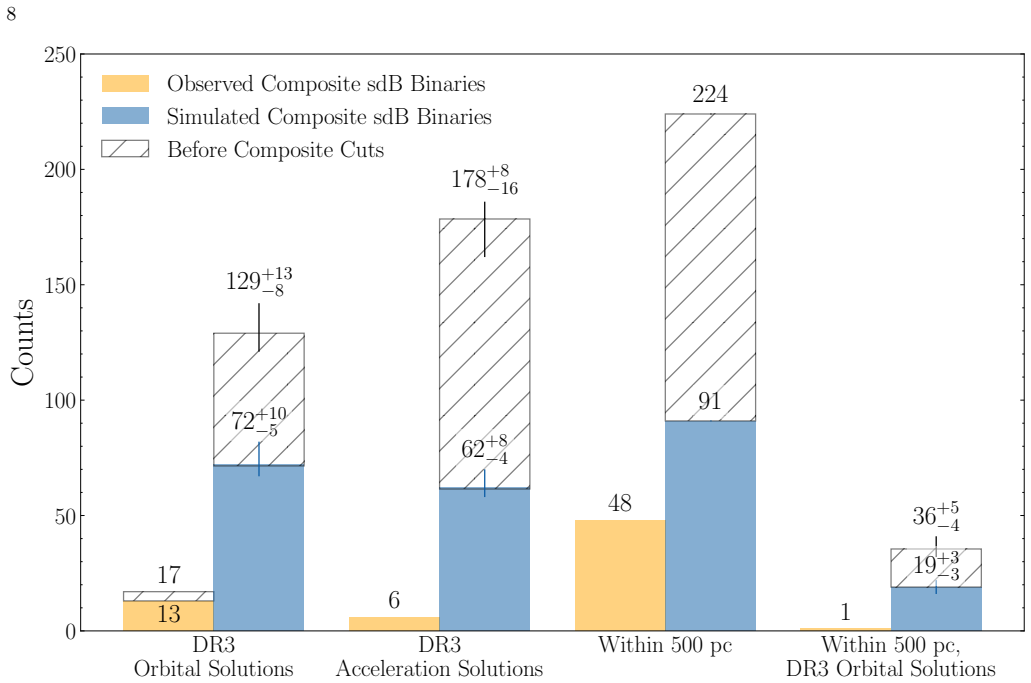
By generating synthetic Gaia observations of a population of stripped-star binaries in a simulated Milky Way, the authors show that current models overpredict astrometric binaries among hot subdwarfs and predict many binary RR Lyrae where none are observed, while plausibly explaining high-mass-function red clump stars as potential black hole companions.
What carries the argument
Binary population synthesis of envelope stripping combined with forward-modeling of Gaia epoch astrometry and DR3-style orbit fitting.
If this is right
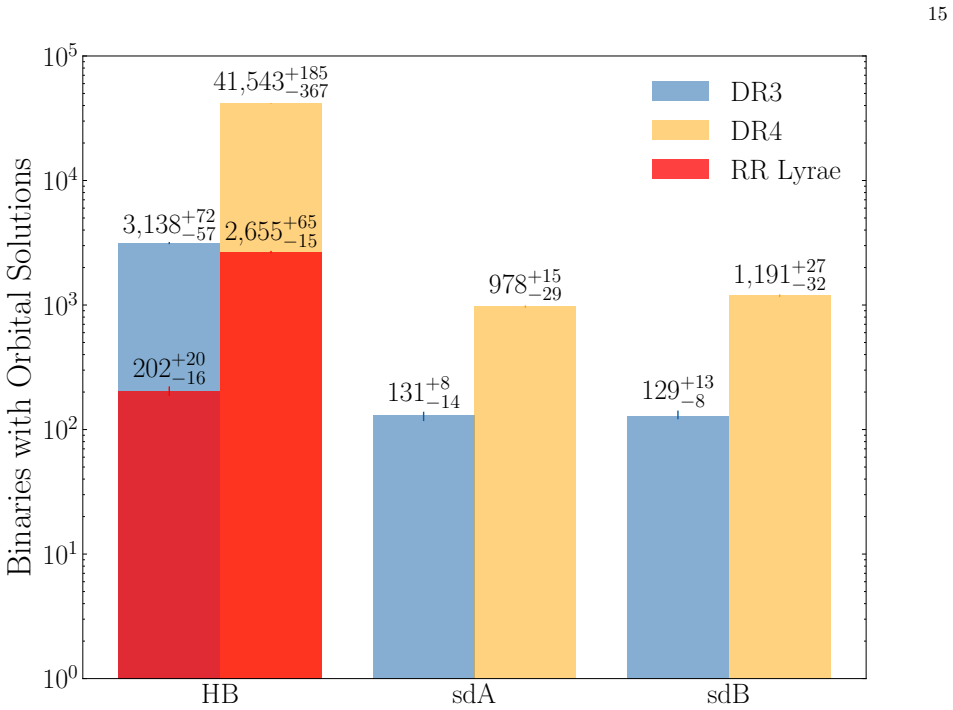
- Ten times more stripped-star binaries should become detectable in Gaia DR4 because of its longer time baseline.
- RR Lyrae stars in au-scale binaries must be substantially rarer than current population synthesis predicts.
- Red clump stars with high astrometric mass functions are likely black hole impostors produced by partial stripping.
- Hot subdwarf binary models require revised flux-ratio distributions to match the observed fraction with astrometric solutions.
Where Pith is reading between the lines
- Revisions to mass-transfer efficiency or timing in binary evolution codes may be needed to reduce the predicted numbers of certain stripped products.
- This approach supplies a concrete baseline for separating true black hole binaries from stripped-star impostors in future astrometric surveys.
- Non-detections of binary RR Lyrae can constrain the metallicities or evolutionary phases where partial stripping occurs.
- Wider-orbit systems will be tested more stringently once DR4 and later releases become available.
Load-bearing premise
The binary population synthesis accurately reproduces the orbital periods, mass ratios, and flux contrasts of fully and partially stripped stars, including the placement of helium-burning stars inside the RR Lyrae instability strip.
What would settle it
Detection of even a modest number of RR Lyrae with DR3 or DR4 astrometric orbital solutions, or a much larger number of hot subdwarf binaries than predicted, would undermine the claim that the models overpredict these populations.
Figures






read the original abstract
When low-mass ($\lesssim 2$ $M_{\odot}$) red giants lose their envelopes to a companion just before the helium flash, the resulting mass transfer can produce binaries hosting hot subdwarfs, horizontal branch stars, and undermassive red clump stars. Recent work predicts a continuum of such products, from fully stripped hot subdwarfs to partially stripped horizontal branch and red clump stars, and suggests that young, metal-rich RR Lyrae can form when partial stripping leaves a helium-burning star in the instability strip. To enable direct comparison with observations, we model these binaries in a simulated Milky Way-like galaxy with a realistic metallicity-dependent star formation history and 3D dust map, generate epoch astrometry using Gaia's scanning law, and fit it with the cascade of astrometric models applied in Gaia DR3. We compare the simulated population to DR3 observations of hot subdwarfs, RR Lyrae, and red giants with high astrometric mass functions. The model significantly overpredicts the number of hot subdwarfs with astrometric binary solutions, partly because the predicted flux ratios are more unequal than observed. It also predicts $\gtrsim 100$ RR Lyrae with DR3 astrometric orbital solutions, while none are observed. We conclude that RR Lyrae in au-scale binaries may be substantially rarer than predicted. In contrast, the model plausibly explains the population of red clump stars with high astrometric mass functions, which we interpret as potential black hole impostors. We predict that $\sim 10 \times$ more stripped-star binaries will be detectable in DR4, whose sensitivity to longer periods will more strongly test wide-orbit systems.
Editorial analysis
A structured set of objections, weighed in public.
Referee Report
Summary. The paper develops a binary population synthesis model for low-mass stars that undergo full or partial envelope stripping by a companion, embeds the resulting systems in a simulated Milky Way with realistic star-formation history and 3D dust, generates epoch astrometry according to Gaia’s scanning law, and applies the DR3 cascade of astrometric models. Direct comparison to Gaia DR3 shows that the model overpredicts the number of hot subdwarfs with astrometric binary solutions (partly because predicted flux ratios are too unequal), predicts ≳100 RR Lyrae stars with DR3 orbital solutions while none are observed, and can account for the observed population of red-clump stars with high astrometric mass functions as black-hole impostors. The work forecasts an order-of-magnitude increase in detectable stripped-star binaries in DR4.
Significance. If the reported discrepancies survive closer scrutiny of the synthesis parameters, the paper supplies a concrete, observationally anchored constraint on the efficiency and timing of mass transfer that produces partially stripped horizontal-branch and red-clump stars. The direct simulation of Gaia’s scanning law and model cascade is a methodological strength that enables falsifiable predictions for DR4. The interpretation of high-mass-function red-clump stars as impostors is presented as plausible rather than definitive and therefore does not over-claim.
major comments (2)
- [Results (RR Lyrae comparison)] The central claim that RR Lyrae in au-scale binaries are substantially rarer than predicted rests on the simulated yield of ≳100 systems with DR3 astrometric solutions. This number is set by the fraction of partially stripped helium-burning stars placed inside the instability strip, which depends on the assumed post-mass-transfer envelope mass, the core-mass–luminosity relation at the metallicities of the adopted star-formation history, and the resulting period and mass-ratio distributions. The manuscript does not report a sensitivity study varying these quantities, so it is unclear whether the zero observed count demonstrates true rarity or an overproduction inherent to the synthesis prescription.
- [Hot-subdwarf comparison] The explanation that unequal predicted flux ratios contribute to the hot-subdwarf overprediction is plausible but remains qualitative. A direct histogram or cumulative distribution of predicted versus observed flux contrasts (or G-band magnitude differences) for the simulated hot-subdwarf binaries would allow the reader to judge how much of the discrepancy is attributable to this effect versus other factors such as the overall normalization of the binary population.
minor comments (2)
- [Methods] The abstract states that the model uses a “realistic metallicity-dependent star formation history and 3D dust map,” but the main text does not tabulate the specific SFH parameters or dust-map reference, making it difficult to reproduce the exact counts.
- [Figures] Figure captions should explicitly state the number of simulated systems shown and whether they are weighted by selection probability or raw counts.
Simulated Author's Rebuttal
We thank the referee for their constructive and detailed report. The comments highlight important aspects of our analysis that we will clarify in revision. We respond point-by-point below.
read point-by-point responses
-
Referee: The central claim that RR Lyrae in au-scale binaries are substantially rarer than predicted rests on the simulated yield of ≳100 systems with DR3 astrometric solutions. This number is set by the fraction of partially stripped helium-burning stars placed inside the instability strip, which depends on the assumed post-mass-transfer envelope mass, the core-mass–luminosity relation at the metallicities of the adopted star-formation history, and the resulting period and mass-ratio distributions. The manuscript does not report a sensitivity study varying these quantities, so it is unclear whether the zero observed count demonstrates true rarity or an overproduction inherent to the synthesis prescription.
Authors: We agree that the absence of a sensitivity study leaves some ambiguity in the robustness of the predicted RR Lyrae yield. The envelope masses, core-mass–luminosity relation, and resulting orbital distributions follow from standard MESA-based binary evolution calculations calibrated to match known populations of hot subdwarfs and horizontal-branch stars; the star-formation history is taken from an observationally anchored Milky Way model. Performing a full grid of variations would require substantial additional computational resources beyond the scope of the current work. In the revised manuscript we will add a dedicated paragraph discussing the impact of plausible variations in post-mass-transfer envelope mass (0.01–0.1 M⊙) on the fraction of stars entering the instability strip, and we will note that even modest increases in envelope mass move most systems out of the strip. We will also tone the language of the conclusion to state that the model overpredicts rather than claiming a definitive demonstration of rarity, while still highlighting that the factor-of-100 discrepancy is difficult to reconcile with the data under our fiducial assumptions. revision: partial
-
Referee: The explanation that unequal predicted flux ratios contribute to the hot-subdwarf overprediction is plausible but remains qualitative. A direct histogram or cumulative distribution of predicted versus observed flux contrasts (or G-band magnitude differences) for the simulated hot-subdwarf binaries would allow the reader to judge how much of the discrepancy is attributable to this effect versus other factors such as the overall normalization of the binary population.
Authors: We thank the referee for this concrete suggestion. We will add a new figure (or panel in an existing figure) that shows both the histogram and cumulative distribution of G-band magnitude differences between the two components for the simulated hot-subdwarf binaries, directly overlaid on the corresponding distribution for the observed Gaia DR3 sample. This will make quantitative the contribution of flux-ratio mismatch and allow readers to assess the residual discrepancy attributable to overall binary-population normalization. The revised text will reference this figure when discussing the overprediction. revision: yes
Circularity Check
No significant circularity; central claims rest on direct comparison to independent Gaia DR3 observations
full rationale
The paper generates simulated populations using binary population synthesis with external galactic structure, metallicity-dependent star formation history, and 3D dust maps, then applies Gaia's scanning law and DR3 astrometric fitting pipeline to produce testable predictions. These are compared to observed counts of hot subdwarfs with binary solutions, RR Lyrae with orbital solutions, and red clump stars with high mass functions. The overpredictions and interpretations (rarer RR Lyrae binaries, plausible black hole impostors) are falsifiable against the external dataset rather than reducing to internally fitted parameters or self-citation chains. No load-bearing step equates a prediction to its own input by construction, and the synthesis assumptions are stated as testable rather than self-defining the outcome.
Axiom & Free-Parameter Ledger
free parameters (1)
- mass-transfer efficiency and timing parameters
axioms (1)
- domain assumption The simulated Milky Way has a realistic metallicity-dependent star formation history and 3D dust map.
Forward citations
Cited by 1 Pith paper
-
No country for old stars -Spectroscopic confirmation of the first intermediate-age RR Lyrae in the open cluster Trumpler 5
Spectroscopic confirmation establishes the first intermediate-age RR Lyrae star as a member of open cluster Trumpler 5, with velocity and [Fe/H] matching the cluster but some element depletions.
Reference graph
Works this paper leans on
-
[1]
Abt, H. A. 1983, ARA&A, 21, 343, doi: 10.1146/annurev.aa.21.090183.002015 Astropy Collaboration, Robitaille, T. P., Tollerud, E. J., et al. 2013, Astronomy and Astrophysics, 558, A33, doi: 10.1051/0004-6361/201322068 Astropy Collaboration, Price-Whelan, A. M., Sip˝ ocz, B. M., et al. 2018, The Astronomical Journal, 156, 123, doi: 10.3847/1538-3881/aabc4f ...
-
[2]
1946, PASP, 58, 249, doi: 10.1086/125835
Baade, W. 1946, PASP, 58, 249, doi: 10.1086/125835
-
[3]
Barlow, B. N., Liss, S. E., Wade, R. A., & Green, E. M. 2013, ApJ, 771, 23, doi: 10.1088/0004-637X/771/1/23
-
[4]
Bellm, E. C., Kulkarni, S. R., Graham, M. J., et al. 2019, Publications of the Astronomical Society of the Pacific, 131, 018002, doi: 10.1088/1538-3873/aaecbe
-
[5]
2024, MNRAS, 527, 12196, doi: 10.1093/mnras/stad3996
Bobrick, A., Iorio, G., Belokurov, V., et al. 2024, MNRAS, 527, 12196, doi: 10.1093/mnras/stad3996
-
[6]
2020, A&A, 641, A43, doi: 10.1051/0004-6361/202038682 21
Bodensteiner, J., Shenar, T., Mahy, L., et al. 2020, A&A, 641, A43, doi: 10.1051/0004-6361/202038682 21
-
[7]
C., M´ esz´ aros, S., Fleming, S
Bohlin, R. C., M´ esz´ aros, S., Fleming, S. W., et al. 2017, The Astronomical Journal, 153, 234, doi: 10.3847/1538-3881/aa6ba9
-
[8]
Finkbeiner, D. P. 2016, ApJ, 818, 130, doi: 10.3847/0004-637X/818/2/130
-
[9]
Brown, W. R., Kilic, M., & Gianninas, A. 2017, ApJ, 839, 23, doi: 10.3847/1538-4357/aa67e4
-
[10]
Burrows, A., Wang, T., Vartanyan, D., & Coleman, M. S. B. 2024, The Astrophysical Journal, 963, 63, doi: 10.3847/1538-4357/ad2353
-
[11]
Cardelli, J. A., Clayton, G. C., & Mathis, J. S. 1989, The Astrophysical Journal, 345, 245, doi: 10.1086/167900
-
[12]
2016, The Astrophysical Journal, 823, 102, doi: 10.3847/0004-637X/823/2/102
Choi, J., Dotter, A., Conroy, C., et al. 2016, The Astrophysical Journal, 823, 102, doi: 10.3847/0004-637X/823/2/102
work page internal anchor Pith review doi:10.3847/0004-637x/823/2/102 2016
-
[13]
2023, A&A, 674, A18, doi: 10.1051/0004-6361/202243964
Clementini, G., Ripepi, V., Garofalo, A., et al. 2023, A&A, 674, A18, doi: 10.1051/0004-6361/202243964
-
[14]
2022, A&A, 662, A40, doi: 10.1051/0004-6361/202243337
Culpan, R., Geier, S., Reindl, N., et al. 2022, A&A, 662, A40, doi: 10.1051/0004-6361/202243337
-
[15]
2025, A&A, 704, A326, doi: 10.1051/0004-6361/202557007
Culpan, R., Dorsch, M., Pelisoli, I., et al. 2025, A&A, 704, A326, doi: 10.1051/0004-6361/202557007
-
[16]
Cusano, F., Moretti, M. I., Clementini, G., et al. 2021, MNRAS, 504, 1, doi: 10.1093/mnras/stab901
-
[17]
2014, A&A, 564, A102, doi: 10.1051/0004-6361/201322139
Haywood, M. 2014, A&A, 564, A102, doi: 10.1051/0004-6361/201322139
-
[18]
2024, A&A, 686, A25, doi: 10.1051/0004-6361/202348319
Dawson, H., Geier, S., Heber, U., et al. 2024, A&A, 686, A25, doi: 10.1051/0004-6361/202348319
-
[19]
Deschamps, R., Siess, L., Davis, P. J., & Jorissen, A. 2013, A&A, 557, A40, doi: 10.1051/0004-6361/201321509 D’Orazi, V., Storm, N., Casey, A. R., et al. 2024, MNRAS, 531, 137, doi: 10.1093/mnras/stae1149
-
[20]
2003, A&A, 409, 205, doi: 10.1051/0004-6361:20031070
Drimmel, R., Cabrera-Lavers, A., & L´ opez-Corredoira, M. 2003, A&A, 409, 205, doi: 10.1051/0004-6361:20031070
-
[21]
2024, New Astronomy Reviews, 98, 101694, doi: 10.1016/j.newar.2024.101694
El-Badry, K. 2024, New Astronomy Reviews, 98, 101694, doi: 10.1016/j.newar.2024.101694
-
[22]
El-Badry, K., & Burdge, K. B. 2022, Monthly Notices of the Royal Astronomical Society, 511, 24, doi: 10.1093/mnrasl/slab135
-
[23]
2024, The Open Journal of Astrophysics, 7, 100, doi: 10.33232/001c.125461
El-Badry, K., Lam, C., Holl, B., et al. 2024, The Open Journal of Astrophysics, 7, 100, doi: 10.33232/001c.125461
-
[24]
2022, Monthly Notices of the Royal Astronomical Society, 515, 1266, doi: 10.1093/mnras/stac1797
El-Badry, K., & Rix, H.-W. 2022, Monthly Notices of the Royal Astronomical Society, 515, 1266, doi: 10.1093/mnras/stac1797
-
[25]
El-Badry, K., Seeburger, R., Jayasinghe, T., et al. 2022, Monthly Notices of the Royal Astronomical Society, 512, 5620, doi: 10.1093/mnras/stac815 Gaia Collaboration, Prusti, T., de Bruijne, J. H. J., et al. 2016, Astronomy and Astrophysics, 595, A1, doi: 10.1051/0004-6361/201629272 Gaia Collaboration, Vallenari, A., Brown, A. G. A., et al. 2023a, Astrono...
-
[26]
2023, A&A, 677, A11, doi: 10.1051/0004-6361/202346407
Geier, S., Dorsch, M., Dawson, H., et al. 2023, A&A, 677, A11, doi: 10.1051/0004-6361/202346407
-
[27]
Geier, S., Raddi, R., Gentile Fusillo, N. P., & Marsh, T. R. 2019, A&A, 621, A38, doi: 10.1051/0004-6361/201834236
-
[28]
Giesers, B., Dreizler, S., Husser, T.-O., et al. 2018, Monthly Notices of the Royal Astronomical Society, 475, L15, doi: 10.1093/mnrasl/slx203 G¨ otberg, Y., de Mink, S. E., Groh, J. H., et al. 2018, A&A, 615, A78, doi: 10.1051/0004-6361/201732274
-
[29]
A 3D Dust Map Based on Gaia, Pan-STARRS 1 and 2MASS
Finkbeiner, D. 2019, The Astrophysical Journal, 887, 93, doi: 10.3847/1538-4357/ab5362
work page internal anchor Pith review doi:10.3847/1538-4357/ab5362 2019
-
[30]
2025, A&A, 702, A11, doi: 10.1051/0004-6361/202555002
Guo, Y., Chen, K., Li, Z., et al. 2025, A&A, 702, A11, doi: 10.1051/0004-6361/202555002
-
[31]
2023, Astronomy and Astrophysics, 674, A9, doi: 10.1051/0004-6361/202243969
Halbwachs, J.-L., Pourbaix, D., Arenou, F., et al. 2023, Astronomy and Astrophysics, 674, A9, doi: 10.1051/0004-6361/202243969
-
[32]
Han, Z., Podsiadlowski, P., Maxted, P. F. L., & Marsh, T. R. 2003, MNRAS, 341, 669, doi: 10.1046/j.1365-8711.2003.06451.x
-
[33]
Han, Z., Podsiadlowski, P., Maxted, P. F. L., Marsh, T. R., & Ivanova, N. 2002, MNRAS, 336, 449, doi: 10.1046/j.1365-8711.2002.05752.x
- [34]
-
[35]
2016, PASP, 128, 082001, doi: 10.1088/1538-3873/128/966/082001
Heber, U. 2016, PASP, 128, 082001, doi: 10.1088/1538-3873/128/966/082001
-
[36]
sdA in SDSS DR12 are Overwhelmingly Not Extremely Low-Mass (ELM) White Dwarfs
Hermes, J. J., G¨ ansicke, B. T., & Breedt, E. 2017, in Astronomical Society of the Pacific Conference Series, Vol. 509, 20th European White Dwarf Workshop, ed. P. E. Tremblay, B. Gaensicke, & T. Marsh, 453, doi: 10.48550/arXiv.1702.07370
work page internal anchor Pith review Pith/arXiv arXiv doi:10.48550/arxiv.1702.07370 2017
-
[37]
Hjellming, M. S., & Webbink, R. F. 1987, ApJ, 318, 794, doi: 10.1086/165412
-
[38]
2021, MNRAS, 502, 5686, doi: 10.1093/mnras/stab005
Iorio, G., & Belokurov, V. 2021, MNRAS, 502, 5686, doi: 10.1093/mnras/stab005
-
[39]
2026, https://arxiv.org/abs/2603.20429
Iorio, G., Nagarajan, P., Bobrick, A., et al. 2026, https://arxiv.org/abs/2603.20429
-
[40]
Jermyn, A. S., Bauer, E. B., Schwab, J., et al. 2023, The Astrophysical Journal Supplement Series, 265, 15, doi: 10.3847/1538-4365/acae8d 22
-
[41]
2017, MNRAS, 466, 2842, doi: 10.1093/mnras/stw3286
Karczmarek, P., Wiktorowicz, G., I lkiewicz, K., et al. 2017, MNRAS, 466, 2842, doi: 10.1093/mnras/stw3286
-
[42]
O., Pelisoli, I., Koester, D., et al
Kepler, S. O., Pelisoli, I., Koester, D., et al. 2016, MNRAS, 455, 3413, doi: 10.1093/mnras/stv2526
-
[43]
The IMF of simple and composite populations
Kroupa, P. 2008, in Astronomical Society of the Pacific Conference Series, Vol. 390, Pathways Through an Eclectic Universe, ed. J. H. Knapen, T. J. Mahoney, & A. Vazdekis, 3, doi: 10.48550/arXiv.0708.1164
work page internal anchor Pith review Pith/arXiv arXiv doi:10.48550/arxiv.0708.1164 2008
-
[44]
Lechien, T., de Mink, S. E., Valli, R., et al. 2025, ApJL, 990, L51, doi: 10.3847/2041-8213/adfdd4
-
[45]
1997, Astronomy and Astrophysicss, 125, 229, doi: 10.1051/aas:1997373
Lejeune, T., Cuisinier, F., & Buser, R. 1997, Astronomy and Astrophysicss, 125, 229, doi: 10.1051/aas:1997373
-
[46]
1998, Astronomy and Astrophysicss, 130, 65, doi: 10.1051/aas:1998405
Lejeune, T., Cuisinier, F., & Buser, R. 1998, Astronomy and Astrophysicss, 130, 65, doi: 10.1051/aas:1998405
-
[47]
Li, Y., Bedding, T. R., Murphy, S. J., et al. 2022, Nature Astronomy, 6, 673, doi: 10.1038/s41550-022-01648-5
-
[48]
Lindegren, L., Klioner, S. A., Hern´ andez, J., et al. 2021, Astronomy and Astrophysics, 649, A2, doi: 10.1051/0004-6361/202039709
-
[49]
Lomb, N. R. 1976, Astrophysics and Space Science, 39, 447, doi: 10.1007/BF00648343
-
[50]
2006, A&A, 453, 635, doi: 10.1051/0004-6361:20053842
Picaud, S. 2006, A&A, 453, 635, doi: 10.1051/0004-6361:20053842
-
[51]
First direct detection of an RR Lyrae star conclusively associated with an intermediate-age cluster
Mateu, C., Cuevas-Otahola, B., & Jos´ e Downes, J. 2025, arXiv e-prints, arXiv:2509.22336, doi: 10.48550/arXiv.2509.22336 M´ esz´ aros, S., Bohlin, R., Allende Prieto, C., et al. 2024, A&A, 688, A197, doi: 10.1051/0004-6361/202449306
work page internal anchor Pith review Pith/arXiv arXiv doi:10.48550/arxiv.2509.22336 2025
-
[52]
Moe, M., Kratter, K. M., & Badenes, C. 2019, ApJ, 875, 61, doi: 10.3847/1538-4357/ab0d88
-
[53]
2026, arXiv e-prints, arXiv:2602.05008, doi: 10.48550/arXiv.2602.05008
Molina, F., Vos, J., Bobrick, A., & Vuˇ ckovi´ c, M. 2026, arXiv e-prints, arXiv:2602.05008, doi: 10.48550/arXiv.2602.05008
-
[54]
2018, MNRAS, 473, 3131, doi: 10.1093/mnras/stx2514
Muraveva, T., Subramanian, S., Clementini, G., et al. 2018, MNRAS, 473, 3131, doi: 10.1093/mnras/stx2514
-
[55]
Nagarajan, P., Weisz, D. R., & El-Badry, K. 2022, The Astrophysical Journal, 932, 19, doi: 10.3847/1538-4357/ac69e6
-
[56]
2025a, PASP, 137, 044202, doi: 10.1088/1538-3873/adc839
Nagarajan, P., El-Badry, K., Chawla, C., et al. 2025a, PASP, 137, 044202, doi: 10.1088/1538-3873/adc839
-
[57]
2025b, PASP, 137, 094202, doi: 10.1088/1538-3873/adffb7 N´ emeth, P., Kawka, A., & Vennes, S
Nagarajan, P., El-Badry, K., Reggiani, H., et al. 2025b, PASP, 137, 094202, doi: 10.1088/1538-3873/adffb7 N´ emeth, P., Kawka, A., & Vennes, S. 2012, MNRAS, 427, 2180, doi: 10.1111/j.1365-2966.2012.22009.x
-
[58]
Otani, T., Oswalt, T. D., Lynas-Gray, A. E., et al. 2018, ApJ, 859, 145, doi: 10.3847/1538-4357/aab9bf
-
[59]
1991, ApJ, 370, 597, doi: 10.1086/169846 Paczy´ nski, B., & Sienkiewicz, R
Paczynski, B. 1991, ApJ, 370, 597, doi: 10.1086/169846 Paczy´ nski, B., & Sienkiewicz, R. 1972, AcA, 22, 73
-
[60]
2011, The Astrophysical Journal Supplement Series, 192, 3, doi: 10.1088/0067-0049/192/1/3
Paxton, B., Bildsten, L., Dotter, A., et al. 2011, The Astrophysical Journal Supplement Series, 192, 3, doi: 10.1088/0067-0049/192/1/3
-
[61]
2013, The Astrophysical Journal Supplement Series, 208, 4, doi: 10.1088/0067-0049/208/1/4
Paxton, B., Cantiello, M., Arras, P., et al. 2013, The Astrophysical Journal Supplement Series, 208, 4, doi: 10.1088/0067-0049/208/1/4
work page internal anchor Pith review doi:10.1088/0067-0049/208/1/4 2013
-
[62]
2015, The Astrophysical Journal Supplement Series, 220, 15, doi: 10.1088/0067-0049/220/1/15
Paxton, B., Marchant, P., Schwab, J., et al. 2015, The Astrophysical Journal Supplement Series, 220, 15, doi: 10.1088/0067-0049/220/1/15
work page internal anchor Pith review doi:10.1088/0067-0049/220/1/15 2015
-
[63]
Paxton, B., Schwab, J., Bauer, E. B., et al. 2018, The Astrophysical Journal Supplement Series, 234, 34, doi: 10.3847/1538-4365/aaa5a8
-
[64]
2019, The Astrophysical Journal Supplement Series, 243, 10, doi: 10.3847/1538-4365/ab2241
Paxton, B., Smolec, R., Schwab, J., et al. 2019, The Astrophysical Journal Supplement Series, 243, 10, doi: 10.3847/1538-4365/ab2241
-
[65]
Pelisoli, I., Bell, K. J., Kepler, S. O., & Koester, D. 2019, MNRAS, 482, 3831, doi: 10.1093/mnras/sty2979
-
[66]
Pelisoli, I., Kepler, S. O., & Koester, D. 2018a, MNRAS, 475, 2480, doi: 10.1093/mnras/sty011
-
[67]
Pelisoli, I., Kepler, S. O., Koester, D., et al. 2018b, MNRAS, 478, 867, doi: 10.1093/mnras/sty1101
-
[68]
2015, ApJ, 811, 113, doi: 10.1088/0004-637X/811/2/113 Pietrzy´ nski, G., Thompson, I
Pietrukowicz, P., Koz lowski, S., Skowron, J., et al. 2015, ApJ, 811, 113, doi: 10.1088/0004-637X/811/2/113 Pietrzy´ nski, G., Thompson, I. B., Gieren, W., et al. 2012, Nature, 484, 75, doi: 10.1038/nature10966
-
[69]
1991, ApJ, 370, 604, doi: 10.1086/169847
Popham, R., & Narayan, R. 1991, ApJ, 370, 604, doi: 10.1086/169847
-
[70]
Preston, G. W. 1959, ApJ, 130, 507, doi: 10.1086/146743
-
[71]
Riley, J., Agrawal, P., Barrett, J. W., et al. 2022, The Astrophysical Journal Supplement Series, 258, 34, doi: 10.3847/1538-4365/ac416c
-
[72]
C., Reyl´ e, C., Derri` ere, S., & Picaud, S
Robin, A. C., Reyl´ e, C., Derri` ere, S., & Picaud, S. 2003, A&A, 409, 523, doi: 10.1051/0004-6361:20031117 Rodr´ ıguez-Segovia, N., & Ruiter, A. J. 2025, MNRAS, 539, 3273, doi: 10.1093/mnras/staf710 Rodr´ ıguez-Segovia, N., Ruiter, A. J., & Seitenzahl, I. R. 2025, PASA, 42, e012, doi: 10.1017/pasa.2024.135
-
[73]
Rui, N. Z., & Fuller, J. 2024, The Open Journal of Astrophysics, 7, 81, doi: 10.33232/001c.123878
-
[74]
1970, ApJ, 162, 841, doi: 10.1086/150715
Sandage, A. 1970, ApJ, 162, 841, doi: 10.1086/150715
-
[75]
Savino, A., Weisz, D. R., Skillman, E. D., et al. 2022, ApJ, 938, 101, doi: 10.3847/1538-4357/ac91cb
-
[76]
Schlegel, D. J., Finkbeiner, D. P., & Davis, M. 1998, ApJ, 500, 525, doi: 10.1086/305772
work page internal anchor Pith review doi:10.1086/305772 1998
-
[77]
2024, MNRAS, 529, 3729, doi: 10.1093/mnras/stae773
Shahaf, S., Hallakoun, N., Mazeh, T., et al. 2024, MNRAS, 529, 3729, doi: 10.1093/mnras/stae773
-
[78]
2020, A&A, 639, L6, doi: 10.1051/0004-6361/202038275
Shenar, T., Bodensteiner, J., Abdul-Masih, M., et al. 2020, A&A, 639, L6, doi: 10.1051/0004-6361/202038275
-
[79]
2022, Nature Astronomy, 6, 1085, doi: 10.1038/s41550-022-01730-y 23
Shenar, T., Sana, H., Mahy, L., et al. 2022, Nature Astronomy, 6, 1085, doi: 10.1038/s41550-022-01730-y 23
-
[80]
Stability Criteria for Mass Transfer in Binary Stellar Evolution
Soberman, G. E., Phinney, E. S., & van den Heuvel, E. P. J. 1997, Astronomy and Astrophysics, 327, 620, doi: 10.48550/arXiv.astro-ph/9703016
work page internal anchor Pith review Pith/arXiv arXiv doi:10.48550/arxiv.astro-ph/9703016 1997
discussion (0)
Sign in with ORCID, Apple, or X to comment. Anyone can read and Pith papers without signing in.