Recognition: no theorem link
Global structure of the time delay likelihood
Pith reviewed 2026-05-15 19:08 UTC · model grok-4.3
The pith
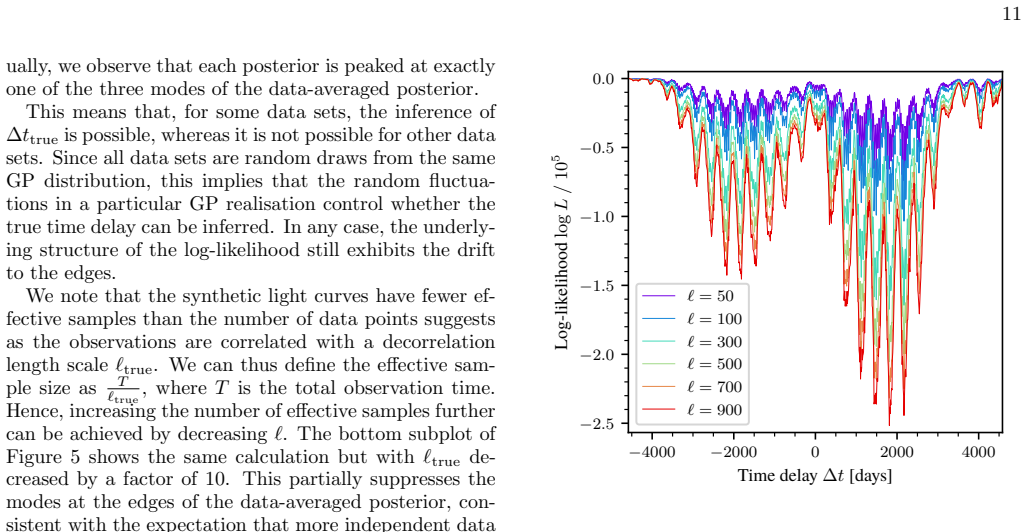
The likelihood for time delay inference develops a generic boundary-driven W-shape with a global maximum at the true delay.
A machine-rendered reading of the paper's core claim, the machinery that carries it, and where it could break.
Core claim
The likelihood for time delay inference with Gaussian process light curve models generically develops a boundary-driven W-shape with a global maximum at the true delay and gradual rises towards the edges of the observation window, because time delay estimation is intrinsically extrapolative.
What carries the argument
The W-shaped likelihood surface driven by boundary extrapolation in finite observation windows for time delay estimation.
If this is right
- Global samplers like nested sampling are steered towards spurious edge modes unless strict convergence criteria are adopted.
- Increasing the number of live points ensures proper convergence to the true delay maximum.
- Optimisers and local MCMC methods that favour small delays induce bias towards larger Hubble constant values.
- The boundary effect strengthens with higher data density over a fixed time span.
Where Pith is reading between the lines
- Similar boundary-driven pathologies may arise in other delay or shift estimation tasks in time series analysis.
- In real applications, this effect could be mitigated by extending the model to account for window boundaries explicitly.
- The findings suggest that previous time delay inferences using standard methods may need re-examination for potential edge bias.
Load-bearing premise
The Gaussian process light curve models used are representative enough of real data that the boundary effects dominate other systematics in practice.
What would settle it
Plotting the full likelihood surface for simulated data with known true delays and confirming the presence of the W-shape and the location of its global maximum.
Figures




read the original abstract
We identify a fundamental pathology in the likelihood for time delay inference which challenges standard inference methods. By analysing the likelihood for time delay inference with Gaussian process light curve models, we show that it generically develops a boundary-driven "W"-shape with a global maximum at the true delay and gradual rises towards the edges of the observation window. This arises because time delay estimation is intrinsically extrapolative. In practice, global samplers such as nested sampling are steered towards spurious edge modes unless strict convergence criteria are adopted. We demonstrate this with simulations and show that the effect strengthens with higher data density over a fixed time span. To ensure convergence, we provide concrete guidance, notably increasing the number of live points. Further, we show that methods implicitly favouring small delays, for example optimisers and local MCMC, induce a bias towards larger $H_0$. Our results clarify failure modes and offer practical remedies for robust fully Bayesian time delay inference.
Editorial analysis
A structured set of objections, weighed in public.
Referee Report
Summary. The manuscript claims that the likelihood for time-delay inference using Gaussian-process models of light curves generically exhibits a boundary-driven 'W' shape, featuring a global maximum at the true delay and gradual rises toward the edges of the observation window. This pathology is attributed to the intrinsically extrapolative character of time-delay estimation. Simulations show the effect strengthens with higher data density over fixed spans; global samplers such as nested sampling are steered toward spurious edge modes unless strict convergence criteria are adopted. Practical guidance (e.g., increasing live points) is offered, and methods implicitly favoring small delays are shown to bias H0 estimates upward.
Significance. If the central claim holds, the result is significant for Bayesian time-delay cosmography: it identifies a previously under-appreciated failure mode in likelihood surfaces that can compromise fully Bayesian inference and H0 recovery. Credit is due for the direct examination of the likelihood surface, the reproducible simulation framework, and the concrete convergence remedies. The work is proportionate in scope and addresses a practical issue in an active observational field.
major comments (2)
- [Simulations and likelihood analysis sections] The genericity claim (abstract and main text) rests on simulations with a single stationary GP kernel class; no kernel-variation experiments or analytic isolation of the extrapolation mechanism are provided. If non-stationary kernels or signals with sharper features are used, the boundary rise can be suppressed, undermining the 'generic' assertion.
- [Simulation results] Quantitative evidence for the W-shape (e.g., likelihood values, error analysis, or tabulated maxima locations) is referenced but not fully detailed in the visible methods; without these, it is impossible to judge whether the global-max property survives realistic noise levels or model misspecification.
minor comments (2)
- [Methods] Add explicit statements of the GP kernel hyperparameters and covariance function in the methods to allow readers to reproduce the boundary effect.
- [Figures] Figure captions should state the number of live points used in the nested-sampling runs and the convergence diagnostic thresholds applied.
Simulated Author's Rebuttal
We thank the referee for their careful and constructive review, which highlights important points about the scope of our genericity claim and the presentation of quantitative results. We address each major comment below and will implement targeted revisions to strengthen the manuscript while preserving its core findings on the boundary-driven W-shape in time-delay likelihoods.
read point-by-point responses
-
Referee: [Simulations and likelihood analysis sections] The genericity claim (abstract and main text) rests on simulations with a single stationary GP kernel class; no kernel-variation experiments or analytic isolation of the extrapolation mechanism are provided. If non-stationary kernels or signals with sharper features are used, the boundary rise can be suppressed, undermining the 'generic' assertion.
Authors: We agree that our simulations focus on the squared-exponential kernel, which is the standard stationary choice in time-delay cosmography. The W-shape is driven by the extrapolative character of GP predictions outside the data window, a mechanism that follows directly from any covariance function whose correlations decay with separation. We will add a concise analytic derivation in the revised likelihood analysis section isolating this boundary effect for stationary kernels. We acknowledge that non-stationary kernels or signals with sharp features could suppress the rise and will explicitly note this as a limitation of the genericity claim, restricting it to the stationary models prevalent in the field. No new simulations will be added, but the discussion will be expanded. revision: partial
-
Referee: [Simulation results] Quantitative evidence for the W-shape (e.g., likelihood values, error analysis, or tabulated maxima locations) is referenced but not fully detailed in the visible methods; without these, it is impossible to judge whether the global-max property survives realistic noise levels or model misspecification.
Authors: We regret that the methods section did not present the quantitative details with sufficient clarity. The manuscript already contains likelihood values, maxima locations, and results across noise realizations in the simulation figures and text. In revision we will expand the methods section with a new table summarizing likelihood maxima, their locations relative to the true delay, and error metrics under varying noise levels. We will also add a short subsection on robustness to model misspecification (e.g., added outliers), confirming that the global maximum at the true delay persists. These additions will make the evidence fully explicit and reproducible. revision: yes
Circularity Check
No significant circularity in the likelihood analysis
full rationale
The paper directly examines the time-delay likelihood surface under Gaussian process light-curve models and reports the boundary-driven W-shape as an observed property of extrapolative inference. No equation reduces the claimed global maximum or edge rises to a fitted parameter, self-referential definition, or load-bearing self-citation. The derivation chain consists of explicit likelihood evaluation and simulation outcomes that remain independent of the target result; the central claim therefore does not collapse by construction to its inputs.
Axiom & Free-Parameter Ledger
axioms (1)
- domain assumption Gaussian process models accurately represent astronomical light curve variability
Reference graph
Works this paper leans on
-
[1]
Likelihood or log-likelihoood? Firstly, we should actually consider the likelihood in- stead of the log-likelihood since by Jensen’s inequality, EyL≥exp(E y logL), the data-averaged log-likelihood only provides a lower bound on the log of the data- averaged likelihood. Therefore, the data-averaged like- lihood may be larger at any time delay, in particula...
-
[2]
Non-perturbative effects Secondly, the above derivation assumed that the noiseσis small, allowing a perturbative treatment. If σis comparable toAor larger,y 1 andy 2 lose their mu- tual correlation, which does not align with the real data sets considered here. A more pressing concern, however, is that we fixed all (hyper)parameters to their true val- ues ...
-
[3]
This error propagates to the numerical value of the likelihood itself
Numerical conditioning Thirdly, we note that the covariance matrix used in the calculation of the likelihood can become rather ill- conditioned. This error propagates to the numerical value of the likelihood itself. We rule out a systematic in- fluence of this error in Appendix F, showing that the full covariance matrixKexhibits large condition numbers at...
-
[4]
Beyond stationarity Fourthly, if we allow for a non-stationary kernel, the error bars of the interpolation may not necessarily in- crease to their maximum value over the decorrelation length scale. More generally, non-stationary GPs with non-constant mean functions can extrapolate trends and we could expect that the problem with the drift disap- pears. Ho...
-
[5]
for each light curve, we subtract the mean and divide the magni- tudes by the standard deviation
While the data-generating GP is unknown in this case, we choose the exponential kernel and remove the choice of the mean function and amplitude hyperparam- eter by whitening the pair of light curves, i.e. for each light curve, we subtract the mean and divide the magni- tudes by the standard deviation. We then plot the log- likelihood as a function of the ...
work page 2000
-
[6]
S. Refsdal, On the possibility of determining hubble’s pa- rameter and the masses of galaxies from the gravitational lens effect, Monthly Notices of the Royal Astronomical Society128, 307 (1964)
work page 1964
-
[7]
T. Treu and P. J. Marshall, Time delay cosmography, The Astronomy and Astrophysics Review24, 1 (2016)
work page 2016
- [8]
-
[9]
T. Treu, S. H. Suyu, and P. J. Marshall, Strong lensing time-delay cosmography in the 2020s, The Astronomy and Astrophysics Review30, 8 (2022)
work page 2022
- [10]
-
[11]
B. M. Peterson, Reverberation mapping of active galactic nuclei, Publications of the Astronomical Society of the Pacific105, 247 (1993)
work page 1993
-
[12]
E. M. Cackett, M. C. Bentz, and E. Kara, Reverberation mapping of active galactic nuclei: from x-ray corona to dusty torus, Iscience24(2021)
work page 2021
-
[13]
H. Netzer and B. M. Peterson, Reverberation map- ping and the physics of active galactic nuclei, inAstro- nomical Time Series: Proceedings of The Florence and George Wise Observatory 25th Anniversary Symposium held in Tel-Aviv, Israel, 30 December 1996–1 January 1997(Springer, 1997) pp. 85–108
work page 1996
-
[14]
P. A. Abell, J. Allison, S. F. Anderson, J. R. Andrew, J. R. P. Angel, L. Armus, D. Arnett, S. J. Asztalos, T. S. Axelrod, S. Bailey,et al., Lsst science book, version 2.0 (2009), technical report
work page 2009
-
[15]
ˇZ. Ivezi´ c, S. M. Kahn, J. A. Tyson, B. Abel, E. Acosta, R. Allsman, D. Alonso, Y. AlSayyad, S. F. Anderson, J. Andrew,et al., Lsst: from science drivers to reference design and anticipated data products, The Astrophysical Journal873, 111 (2019)
work page 2019
-
[16]
J. Kollmeier, S. Anderson, G. Blanc, M. Blanton, K. Covey, J. Crane, N. Drory, P. Frinchaboy, C. Fron- ing, J. Johnson,et al., Sdss-v pioneering panoptic spec- troscopy, Bulletin of the American Astronomical Society (2019)
work page 2019
-
[17]
A. Almeida, S. F. Anderson, M. Argudo-Fern´ andez, C. Badenes, K. Barger, J. K. Barrera-Ballesteros, C. F. Bender, E. Benitez, F. Besser, J. C. Bird,et al., The eighteenth data release of the sloan digital sky surveys: Targeting and first spectra from sdss-v, The Astrophysi- cal Journal Supplement Series267, 44 (2023)
work page 2023
-
[18]
C. Grier, J. R. Trump, Y. Shen, K. Horne, K. Kine- muchi, I. D. McGreer, D. Starkey, W. Brandt, P. Hall, C. Kochanek,et al., The sloan digital sky survey rever- beration mapping project: Hαand hβreverberation mea- surements from first-year spectroscopy and photometry, The Astrophysical Journal851, 21 (2017)
work page 2017
- [19]
-
[20]
I. Jennifer, H. Li, Y. Shen, W. Brandt, C. Grier, P. Hall, L. Ho, Y. Homayouni, K. Horne, D. Schneider,et al., The sloan digital sky survey reverberation mapping project: comparison of lag measurement methods with simulated observations, The Astrophysical Journal884, 119 (2019)
work page 2019
-
[21]
Y. Homayouni, J. R. Trump, C. Grier, K. Horne, Y. Shen, W. Brandt, K. S. Dawson, G. F. Alvarez, P. J. Green, P. Hall,et al., The sloan digital sky survey reverberation mapping project: Mg ii lag results from four years of monitoring, The Astrophysical Journal901, 55 (2020)
work page 2020
-
[22]
H. McDougall, B. J. Pope, and T. M. Davis, Litmus: Bayesian lag recovery in reverberation mapping with fast differentiable models, Publications of the Astronomical Society of Australia , 1 (2025)
work page 2025
-
[23]
A. Hojjati, A. G. Kim, and E. V. Linder, Robust strong lensing time delay estimation, Physical Review D87, 123512 (2013)
work page 2013
- [24]
-
[25]
Y. Zu, C. Kochanek, and B. M. Peterson, An alternative approach to measuring reverberation lags in active galac- tic nuclei, The Astrophysical Journal735, 80 (2011)
work page 2011
- [26]
-
[27]
A. Pancoast, B. J. Brewer, and T. Treu, Modelling re- verberation mapping data–i. improved geometric and dy- namical models and comparison with cross-correlation re- sults, Monthly Notices of the Royal Astronomical Society 445, 3055 (2014)
work page 2014
-
[28]
A. Pancoast, B. J. Brewer, T. Treu, D. Park, A. J. Barth, M. C. Bentz, and J.-H. Woo, Modelling reverberation mapping data–ii. dynamical modelling of the lick agn monitoring project 2008 data set, Monthly Notices of the Royal Astronomical Society445, 3073 (2014)
work page 2008
-
[29]
D. Starkey, K. Horne, M. Fausnaugh, B. Peterson, M. C. Bentz, C. Kochanek, K. Denney, R. Edelson, M. Goad, G. De Rosa,et al., Space telescope and optical reverber- ation mapping project. vi. reverberating disk models for ngc 5548, The Astrophysical Journal835, 65 (2017)
work page 2017
-
[30]
C. Vanderriest, J. Schneider, G. Herpe, M. Chevreton, M. Moles, and G. Wlerick, The value of the time de- lay delta t (a, b) for the’double’quasar 0957+ 561 from optical photometric monitoring, Astronomy and Astro- physics (ISSN 0004-6361), vol. 215, no. 1, May 1989, p. 20 1-13.215, 1 (1989)
work page 1989
- [31]
-
[32]
W. H. Press, G. B. Rybicki, and J. N. Hewitt, The time delay of gravitational lens 0957+ 561. i-methodology and analysis of optical photometric data. ii-analysis of radio data and combined optical-radio analysis, Astrophysical Journal, Part 1 (ISSN 0004-637X), vol. 385, Feb. 1, 1992, p. 404-420.385, 404 (1992)
work page 1992
-
[33]
J. Pelt, R. Kayser, S. Refsdal, and T. Schramm, The light curve and the time delay of qso 0957+ 561, arXiv preprint astro-ph/9501036 (1995)
work page internal anchor Pith review Pith/arXiv arXiv 1995
-
[34]
T. Kundic, E. L. Turner, W. N. Colley, J. R. Gott, J. E. Rhoads, Y. Wang, L. E. Bergeron, K. A. Gloria, D. C. Long, S. Malhotra,et al., A robust determination of the time delay in 0957+ 561a, b and a measurement of the global value of hubble’s constant, arXiv preprint astro- ph/9610162 (1996)
-
[35]
S. Suyu, P. Marshall, R. Blandford, C. Fassnacht, L. Koopmans, J. McKean, and T. Treu, Dissecting the gravitational lens b1608+ 656. i. lens potential recon- struction, The Astrophysical Journal691, 277 (2009)
work page 2009
-
[36]
S. Suyu, P. Marshall, M. Auger, S. Hilbert, R. Blandford, L. Koopmans, C. Fassnacht, and T. Treu, Dissecting the gravitational lens b1608+ 656. ii. precision measurements of the hubble constant, spatial curvature, and the dark energy equation of state, The Astrophysical Journal711, 201 (2010)
work page 2010
-
[37]
L. Koopmans, T. Treu, C. Fassnacht, R. Blandford, and G. Surpi, The hubble constant from the gravitational lens b1608+ 656, The Astrophysical Journal599, 70 (2003)
work page 2003
- [38]
-
[39]
K. Liao, T. Treu, P. Marshall, C. D. Fassnacht, N. Rumbaugh, G. Dobler, A. Aghamousa, V. Bonvin, F. Courbin, A. Hojjati,et al., Strong lens time delay challenge. ii. results of tdc1, The Astrophysical Journal 800, 11 (2015)
work page 2015
-
[40]
S. R. Kumar, M. Tewes, C. Stalin, F. Courbin, I. As- fandiyarov, G. Meylan, E. Eulaers, T. Prabhu, P. Mag- ain, H. Van Winckel,et al., Cosmograil: the cosmological monitoring of gravitational lenses-xiv. time delay of the doubly lensed quasar sdss j1001+ 5027, Astronomy & Astrophysics557, A44 (2013)
work page 2013
-
[41]
F. Courbin, V. Bonvin, E. Buckley-Geer, C. Fassnacht, J. Frieman, H. Lin, P. Marshall, S. Suyu, T. Treu, T. An- guita,et al., Cosmograil xvi: Time delays for the quadru- ply imaged quasar des j0408-5354 with high-cadence pho- tometric monitoring, arXiv preprint arXiv:1706.09424 (2017)
work page internal anchor Pith review Pith/arXiv arXiv 2017
-
[42]
Skilling, Nested sampling for general Bayesian compu- tation, Bayesian Analysis1, 833 (2006)
J. Skilling, Nested sampling for general Bayesian compu- tation, Bayesian Analysis1, 833 (2006)
work page 2006
-
[43]
G. Ashton, N. Bernstein, J. Buchner, X. Chen, G. Cs´ anyi, A. Fowlie, F. Feroz, M. Griffiths, W. Han- dley, M. Habeck, E. Higson, M. Hobson, A. Lasenby, D. Parkinson, L. B. P´ artay, M. Pitkin, D. Schneider, J. S. Speagle, L. South, J. Veitch, P. Wacker, D. J. Wales, and D. Yallup, Nested sampling for physical scientists, Nature Reviews Methods Primers2, ...
work page 2022
-
[44]
Buchner, Nested sampling methods, Statistic Surveys 17, 169 (2023)
J. Buchner, Nested sampling methods, Statistic Surveys 17, 169 (2023)
work page 2023
- [45]
-
[46]
S. Chib, Marginal likelihood from the gibbs output, Journal of the american statistical association90, 1313 (1995)
work page 1995
-
[47]
A. Gelman and X.-L. Meng, Simulating normalizing con- stants: From importance sampling to bridge sampling to path sampling, Statistical science , 163 (1998)
work page 1998
-
[48]
N. Lartillot and H. Philippe, Computing bayes factors using thermodynamic integration, Systematic biology55, 195 (2006)
work page 2006
-
[49]
R. J. Urick,Principles of underwater sound-2(McGraw- Hill, 1975)
work page 1975
-
[50]
G. L. Turin, Introduction to spread-spectrum antimul- tipath techniques and their application to urban digital radio, Proceedings of the IEEE68, 328 (2005)
work page 2005
-
[51]
J. Chen, J. Benesty, and Y. Huang, Time delay esti- mation in room acoustic environments: An overview, EURASIP Journal on Advances in Signal Processing 2006, 026503 (2006)
work page 2006
-
[52]
K. Gedalyahu and Y. C. Eldar, Time-delay estimation from low-rate samples: A union of subspaces approach, IEEE Transactions on Signal Processing58, 3017 (2010)
work page 2010
-
[53]
A. Quazi, An overview on the time delay estimate in active and passive systems for target localization, IEEE Transactions on Acoustics, Speech, and Signal Processing 29, 527 (2003)
work page 2003
- [54]
-
[55]
D. P. Schaff and F. Waldhauser, Waveform cross- correlation-based differential travel-time measurements at the northern california seismic network, Bulletin of the Seismological Society of America95, 2446 (2005)
work page 2005
-
[56]
M. Hoffmann, M. Rosenbaum, and N. Yoshida, Esti- mation of the lead-lag parameter from non-synchronous data, Bernoulli19, 426 (2013)
work page 2013
-
[57]
S. Bjorklund and L. Ljung, A review of time-delay estimation techniques, in42nd IEEE International Conference on Decision and Control (IEEE cat. no. 03CH37475), Vol. 3 (IEEE, 2003) pp. 2502–2507
work page 2003
-
[58]
L. B. P´ artay, G. Cs´ anyi, and N. Bernstein, Nested sam- pling for materials, The European Physical Journal B94, 159 (2021)
work page 2021
-
[59]
P. Y. Chew and A. Reinhardt, Phase diagrams—why they matter and how to predict them, The Journal of Chemical Physics158(2023)
work page 2023
-
[60]
C. E. Rasmussen and C. K. I. Williams,Gaussian Pro- cesses for Machine Learning(The MIT Press, 2005)
work page 2005
-
[61]
C. L. MacLeod, ˇZ. Ivezi´ c, C. Kochanek, S. Koz lowski, B. Kelly, E. Bullock, A. Kimball, B. Sesar, D. Westman, K. Brooks,et al., Modeling the time variability of sdss stripe 82 quasars as a damped random walk, The Astro- physical Journal721, 1014 (2010)
work page 2010
-
[62]
Y. Zu, C. Kochanek, S. Koz lowski, and A. Udalski, Is quasar optical variability a damped random walk?, The Astrophysical Journal765, 106 (2013)
work page 2013
- [63]
-
[64]
L. T. Hergt, W. J. Handley, M. P. Hobson, and A. N. Lasenby, Bayesian evidence for the tensor-to-scalar ratio r and neutrino masses mν: Effects of uniform versus log- arithmic priors, Physical Review D103, 123511 (2021)
work page 2021
-
[65]
H. Jeffreys, An invariant form for the prior probability in estimation problems, Proceedings of the Royal Society of London. Series A. Mathematical and Physical Sciences 186, 453 (1946)
work page 1946
-
[66]
W. Handley, M. Hobson, and A. Lasenby, Polychord: nested sampling for cosmology, Monthly Notices of the Royal Astronomical Society: Letters450, L61 (2015)
work page 2015
-
[67]
W. J. Handley, M. P. Hobson, and A. N. Lasenby, polychord: next-generation nested sampling, Monthly Notices of the Royal Astronomical Society453, 4384 (2015), https://academic.oup.com/mnras/article- pdf/453/4/4384/8034904/stv1911.pdf
work page 2015
-
[68]
anesthetic: nested sampling visualisation
W. Handley, anesthetic: nested sampling visualisation, arXiv preprint arXiv:1905.04768 (2019)
work page internal anchor Pith review Pith/arXiv arXiv 1905
- [69]
-
[70]
Nested Slice Sampling: Vectorized Nested Sampling for GPU-Accelerated Inference
D. Yallup, N. Kroupa, and W. Handley, Nested slice sam- pling: Vectorized nested sampling for gpu-accelerated in- ference, arXiv preprint arXiv:2601.23252 (2026)
work page internal anchor Pith review Pith/arXiv arXiv 2026
-
[71]
R. Frostig, M. J. Johnson, and C. Leary, Compiling ma- chine learning programs via high-level tracing, Systems for Machine Learning4(2018)
work page 2018
-
[72]
W. H. Press,Numerical recipes 3rd edition: The art of scientific computing(Cambridge university press, 2007)
work page 2007
-
[73]
K. C. Wong, S. H. Suyu, M. W. Auger, V. Bonvin, F. Courbin, C. D. Fassnacht, A. Halkola, C. E. Rusu, D. Sluse, A. Sonnenfeld,et al., H0licow–iv. lens mass model of he 0435- 1223 and blind measurement of its time-delay distance for cosmology, Monthly Notices of the Royal Astronomical Society465, 4895 (2017)
work page 2017
-
[74]
R. Barkana, Fastell: Fast calculation of a family of ellip- tical mass gravitational lens models, Astrophysics Source Code Library , ascl (1999)
work page 1999
-
[75]
N. D. Morgan, C. S. Kochanek, O. Pevunova, and P. L. Schechter, The lens redshift and galaxy environment for he 0435- 1223, The Astronomical Journal129, 2531 (2005)
work page 2005
- [76]
-
[77]
S. Birrer and A. Amara, lenstronomy: Multi-purpose gravitational lens modelling software package, Physics of the Dark Universe22, 189 (2018)
work page 2018
- [78]
-
[79]
Lectures on Gravitational Lensing
R. Narayan and M. Bartelmann, Lectures on gravita- tional lensing, arXiv preprint astro-ph/9606001 (1996)
work page internal anchor Pith review Pith/arXiv arXiv 1996
-
[80]
K. Hukushima and K. Nemoto, Exchange monte carlo method and application to spin glass simulations, Journal of the Physical Society of Japan65, 1604 (1996)
work page 1996
discussion (0)
Sign in with ORCID, Apple, or X to comment. Anyone can read and Pith papers without signing in.