Recognition: no theorem link
Space Syntax-guided Post-training for Residential Floor Plan Generation
Pith reviewed 2026-05-15 19:36 UTC · model grok-4.3
The pith
Space syntax integration scores can be used as post-training feedback to improve configurational quality in generated residential floor plans.
A machine-rendered reading of the paper's core claim, the machinery that carries it, and where it could break.
Core claim
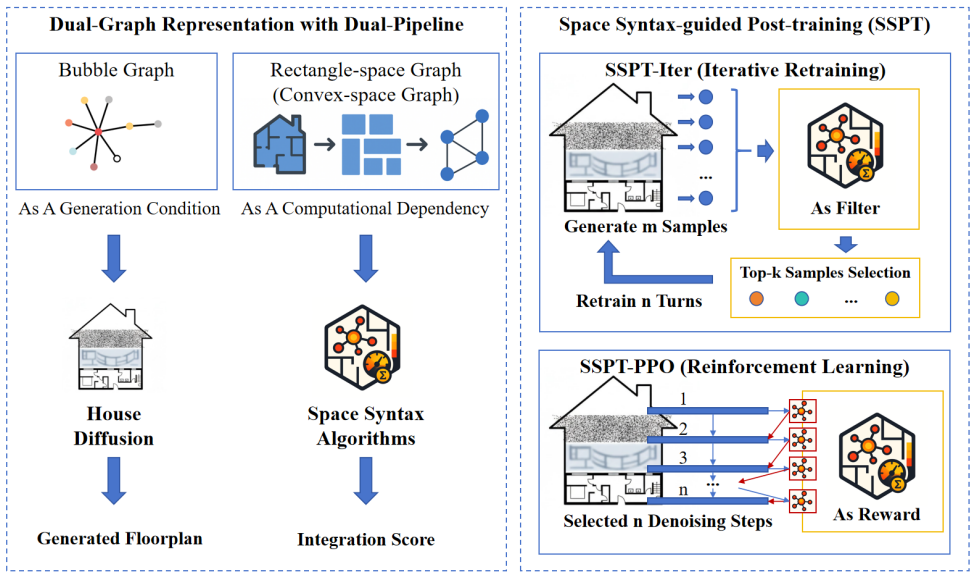
The authors establish that the Space Syntax Integration Oracle converts generated rectangle layouts into graphs and supplies integration scores that serve as actionable targets for post-training, producing measurable gains in public-space dominance and functional-hierarchy alignment over unpost-trained baselines, with the PPO strategy outperforming iterative retraining.
What carries the argument
The Space Syntax Integration Oracle (SSIO), which converts generated layouts into rectangle-space graphs and computes integration values to quantify public-space dominance and functional hierarchy.
If this is right
- Post-trained generators produce layouts whose configurational statistics align more closely with empirical references from real residential data.
- The PPO-based post-training route achieves larger gains, lower variance, and higher efficiency than iterative generate-filter-retrain.
- Output-side configurational evaluation can function as effective feedback for existing floor plan generation backbones.
- Architectural theory can be injected into generative models through post-training rather than input-side conditioning alone.
Where Pith is reading between the lines
- The same oracle-driven feedback loop could be tested on other building types whose spatial logic is also governed by accessibility hierarchies.
- Combining the post-training signal with existing room-relation graph inputs might compound the observed improvements.
- Whether higher oracle scores translate into measurable differences in occupant navigation or satisfaction remains an open empirical question.
Load-bearing premise
Space syntax integration scores computed on simplified rectangle layouts reliably indicate desirable configurational qualities in actual residential buildings.
What would settle it
A controlled comparison of architect or resident ratings for layouts that score high versus low on the Space Syntax Integration Oracle.
Figures


read the original abstract
Residential floor plan generation requires not only geometric fidelity but also spatial configurational logic: shared living spaces should be integrative, while private spaces should remain segregated. Existing generators increasingly use room-relation graphs as input-side conditions, but generated layouts are rarely evaluated on the output side for configurational quality, and such evaluation is rarely fed back into model optimization. We propose Space Syntax-guided Post-training (SSPT), a framework that turns space-syntax integration from a post-hoc analysis tool into a computable feedback signal for already-trained floor plan generators. SSPT introduces the Space Syntax Integration Oracle (SSIO), which converts generated layouts into rectangle-space graphs and measures public-space dominance and functional hierarchy. SSIO is first applied to real residential data to establish empirical configurational references, then connected to two SSPT strategies: SSPT-Iter, a basic generate-filter-retrain route, and SSPT-PPO, the first RL-based post-training route for floor plan generation. We also introduce SSPT-Bench, a new evaluation system for measuring the output-side spatial configurational quality of post-trained generators under an out-of-distribution setting. Experiments show that both strategies improve public-space dominance and functional-hierarchy alignment over the unpost-trained baseline. SSPT-PPO achieves stronger gains, lower variance, and higher efficiency than iterative retraining. These results show that output-side configurational evaluation can serve as actionable post-training feedback, offering a practical path for injecting architectural theory into existing floor plan generation backbones.
Editorial analysis
A structured set of objections, weighed in public.
Referee Report
Summary. The paper proposes Space Syntax-guided Post-training (SSPT) to improve configurational quality in residential floor plan generators. It introduces the Space Syntax Integration Oracle (SSIO) that converts generated rectangle layouts into graphs and computes scores for public-space dominance and functional hierarchy. These scores are used as feedback in two post-training strategies (SSPT-Iter and SSPT-PPO) and evaluated on a new SSPT-Bench under out-of-distribution conditions, with experiments claiming that both methods improve alignment over the baseline and that SSPT-PPO yields stronger, lower-variance gains.
Significance. If the central claims hold after addressing validation gaps, the work provides a concrete mechanism for injecting established architectural theory (space syntax) into existing ML generators via post-training rather than retraining from scratch. The RL-based SSPT-PPO route and the SSPT-Bench evaluation protocol are potentially useful contributions for the floor-plan generation community. The significance is currently limited by insufficient experimental detail and lack of independent checks on whether SSIO scores reliably proxy desirable real-world configurational properties.
major comments (3)
- [Experimental Evaluation] Experimental Evaluation section: The reported gains (stronger performance, lower variance, higher efficiency for SSPT-PPO) are presented without sample sizes, statistical significance tests, exact baseline architectures, or details on how the out-of-distribution splits in SSPT-Bench were constructed. These omissions prevent assessment of whether the improvements are robust or reproducible.
- [§3] SSIO definition (§3): No independent validation is provided (e.g., correlation with human expert ratings, alternative metrics such as visibility graphs, or failure-case analysis) showing that SSIO scores computed on rectangle graphs correspond to desirable real-world configurational quality rather than artifacts of the rectangle approximation or the oracle itself.
- [SSPT-Bench] SSPT-Bench and reference construction: Because the same SSIO is used both to derive empirical references from real data and as the optimization target/feedback signal, it is unclear whether observed OOD improvements reflect genuine generalization of configurational logic or optimization to metric-specific properties; an ablation or cross-metric check is needed.
minor comments (2)
- [§3] The conversion process from generated layouts to rectangle-space graphs is described at a high level; a diagram or pseudocode would improve clarity of the SSIO pipeline.
- [Abstract] Notation for the two SSPT strategies (SSPT-Iter vs. SSPT-PPO) should be introduced consistently in the abstract and early sections to avoid reader confusion.
Simulated Author's Rebuttal
We thank the referee for the constructive and detailed comments. We address each major point below with specific plans for revision, focusing on improving experimental rigor, validation, and clarity without overstating current results.
read point-by-point responses
-
Referee: [Experimental Evaluation] Experimental Evaluation section: The reported gains (stronger performance, lower variance, higher efficiency for SSPT-PPO) are presented without sample sizes, statistical significance tests, exact baseline architectures, or details on how the out-of-distribution splits in SSPT-Bench were constructed. These omissions prevent assessment of whether the improvements are robust or reproducible.
Authors: We agree these omissions limit assessment of robustness. In the revised manuscript we will expand the Experimental Evaluation section to report exact sample sizes for all metrics, include statistical significance tests (paired t-tests with p-values and confidence intervals), specify the precise baseline architectures and hyperparameters used, and detail the construction of OOD splits in SSPT-Bench including selection criteria, data partitioning method, and any filtering steps. These additions will be placed in the main text and supplementary material as needed. revision: yes
-
Referee: [§3] SSIO definition (§3): No independent validation is provided (e.g., correlation with human expert ratings, alternative metrics such as visibility graphs, or failure-case analysis) showing that SSIO scores computed on rectangle graphs correspond to desirable real-world configurational quality rather than artifacts of the rectangle approximation or the oracle itself.
Authors: We acknowledge the need for stronger validation of SSIO. The manuscript grounds SSIO in established space-syntax theory and empirical references derived from real residential data. In revision we will add to §3 a failure-case analysis together with quantitative comparisons against an alternative metric (visibility-graph integration). New human-expert rating collection lies outside the feasible scope of this revision cycle; we will therefore add an explicit limitations paragraph noting this gap and suggesting it for future work. We maintain that the current empirical grounding provides a defensible starting point but accept that deeper independent checks are required. revision: partial
-
Referee: [SSPT-Bench] SSPT-Bench and reference construction: Because the same SSIO is used both to derive empirical references from real data and as the optimization target/feedback signal, it is unclear whether observed OOD improvements reflect genuine generalization of configurational logic or optimization to metric-specific properties; an ablation or cross-metric check is needed.
Authors: We agree this circularity concern must be addressed. We will add an ablation experiment to the revised SSPT-Bench evaluation that measures post-training gains using an independent configurational metric (visibility-graph analysis) not derived from SSIO. Results will be reported alongside the original SSIO-based scores to demonstrate whether improvements persist under cross-metric evaluation, thereby supporting claims of genuine generalization rather than metric-specific overfitting. revision: yes
Circularity Check
No significant circularity in derivation chain
full rationale
The paper defines SSIO as a new oracle that converts rectangle layouts to graphs and computes integration values drawn from established space-syntax literature. References are built by applying SSIO to real residential data, then used as targets for two post-training strategies whose gains are measured experimentally on SSPT-Bench. No equation reduces a claimed prediction to a fitted parameter by construction, no load-bearing premise rests on self-citation, and the central empirical claim (improved public-space dominance and hierarchy alignment) is not definitionally equivalent to the input metrics. The derivation therefore remains self-contained against external benchmarks.
Axiom & Free-Parameter Ledger
axioms (1)
- domain assumption Space-syntax integration metrics computed on rectangle-space graphs accurately reflect desirable public-private hierarchy in residential layouts.
invented entities (2)
-
Space Syntax Integration Oracle (SSIO)
no independent evidence
-
SSPT-Bench
no independent evidence
Reference graph
Works this paper leans on
-
[1]
Aalaei, M., Saadi, M., Rahbar, M., Ekhlassi, A., 2023. Architectural layout generation using a graph-constrained conditional generative adversarial network (gan). Automation in Construction 155, 105053
work page 2023
-
[2]
The applica- tion of space syntax to enhance sociability in public urban spaces: A systematic review
Askarizad, R., Lamíquiz Daudén, P.J., Garau, C., 2024. The applica- tion of space syntax to enhance sociability in public urban spaces: A systematic review. ISPRS International Journal of Geo-Information
work page 2024
-
[3]
URL:https://www.mdpi.com/2220-9964/13/7/227, doi:10.3390/ ijgi13070227
-
[4]
The complexity of testing all properties of planar graphs, and the role of isomorphism
Basu, S., Kumar, A., Seshadhri, C., 2021. The complexity of testing all properties of planar graphs, and the role of isomorphism. ArXiv abs/2108.10547. URL:https://api.semanticscholar.org/CorpusID: 237278741
-
[5]
In-between spaces and social interaction: a morphological analysis of izmir using space syntax
Can, I., Heath, T., 2016. In-between spaces and social interaction: a morphological analysis of izmir using space syntax. Journal of Housing and the Built Environment 31, 31–49. URL:https://api. semanticscholar.org/CorpusID:55678336
work page 2016
-
[6]
Principles for public space design, planning to do better
Carmona, M., 2018. Principles for public space design, planning to do better. URBAN DESIGN International 24, 47–59. URL: https://api.semanticscholar.org/CorpusID:115439896
work page 2018
-
[7]
Deep reinforcement learning from human preferences
Christiano, P.F., Leike, J., Brown, T., Martic, M., Legg, S., Amodei, D., 2017. Deep reinforcement learning from human preferences. Advances in neural information processing systems 30
work page 2017
-
[8]
Credo, A., Fabri, G., Villani, M., Popescu, M., 2020. Adopting the topology optimization in the design of high-speed synchronous reluctancemotorsforelectricvehicles.IEEETransactionsonIndustry Applications 56, 5429–5438. doi:10.1109/TIA.2020.3007366
-
[9]
Cruz,S.,Hutchcroft,W.,Li,Y.,Khosravan,N.,Boyadzhiev,I.,Kang, S.B.,2021. Zillowindoordataset:Annotatedfloorplanswith360deg panoramas and 3d room layouts, in: Proceedings of the IEEE/CVF conference on computer vision and pattern recognition, pp. 2133– 2143
work page 2021
-
[10]
Deitke, M., VanderBilt, E., Herrasti, A., Weihs, L., Salvador, J., Ehsani, K., Han, W., Kolve, E., Farhadi, A., Kembhavi, A., et al., 2022.Procthor:Large-scaleembodiedaiusingproceduralgeneration. arXiv e-prints , arXiv–2206
work page 2022
-
[11]
Relation of domestic space preferences with space syntax parameters
Edgü, E., Ünlü, A., 2003. Relation of domestic space preferences with space syntax parameters. URL:https://api.semanticscholar. org/CorpusID:146403316
work page 2003
-
[12]
Transforminghousingtypologies.space syntax evaluation and shape grammar generation
Eloy,S.,Guerreiro,R.,2016. Transforminghousingtypologies.space syntax evaluation and shape grammar generation. arq.urb , 86–114
work page 2016
-
[13]
Dpok: Reinforcement learning for fine-tuning text-to-image diffusion models
Fan, Y., Watkins, O., Du, Y., Liu, H., Ryu, M., Boutilier, C., Abbeel, P., Ghavamzadeh, M., Lee, K., Lee, K., 2023. Dpok: Reinforcement learning for fine-tuning text-to-image diffusion models. Advances in Neural Information Processing Systems 36, 79858–79885
work page 2023
-
[14]
Completely derandomized self- adaptation in evolution strategies
Hansen, N., Ostermeier, A., 2001. Completely derandomized self- adaptation in evolution strategies. Evolutionary computation 9, 159– 195
work page 2001
- [15]
-
[16]
He, F., Huang, Y., Wang, H., 2022. iplan: Interactive and procedural layout planning, in: Proceedings of the IEEE/CVF Conference on Computer Vision and Pattern Recognition, pp. 7793–7802. :Preprint submitted to Elsevier Page 18 of 20
work page 2022
-
[17]
Spatial configuration: Semi- automatic methods for layout generation in practice
Helme, L., Derix, C., Izaki, Å., 2014. Spatial configuration: Semi- automatic methods for layout generation in practice. The Journal of Space Syntax 5, 35–49. URL:https://api.semanticscholar.org/ CorpusID:59127252
work page 2014
-
[18]
Space is the machine: A configurational theory of architecture
Hillier, B., 1996. Space is the machine: A configurational theory of architecture. URL:https://api.semanticscholar.org/CorpusID: 60919128
work page 1996
-
[19]
Hu, R., Huang, Z., Tang, Y., Van Kaick, O., Zhang, H., Huang, H.,
-
[20]
ACM Transactions on Graphics (TOG) 39, 118–1
Graph2plan:Learningfloorplangenerationfromlayoutgraphs. ACM Transactions on Graphics (TOG) 39, 118–1
-
[21]
Advancing ar- chitecturalfloorplandesignwithgeometry-enhancedgraphdiffusion
Hu, S., Wu, W., Wang, Y., Xu, B., Zheng, L., 2024. Advancing ar- chitecturalfloorplandesignwithgeometry-enhancedgraphdiffusion. arXiv preprint arXiv:2408.16258 8
-
[22]
Integration of space syntax into gis for modelling urban spaces
Jiang, B., Claramunt, C., Klarqvist, B., 2000. Integration of space syntax into gis for modelling urban spaces. Interna- tional Journal of Applied Earth Observation and Geoinformation 2, 161–171. URL:https://www.sciencedirect.com/science/article/ pii/S0303243400850102, doi:https://doi.org/10.1016/S0303-2434(00) 85010-2
-
[23]
Kalervo, A., Ylioinas, J., Häikiö, M., Karhu, A., Kannala, J., 2019. Cubicasa5k:Adatasetandanimprovedmulti-taskmodelforfloorplan image analysis, in: Scandinavian Conference on Image Analysis, Springer. pp. 28–40
work page 2019
-
[24]
Kiyota, Y., 2018. Promoting open innovations in real estate tech: Provision of the lifull home’s data set and collaborative studies, in: Proceedings of the 2018 ACM on International Conference on Multimedia Retrieval, pp. 6–6
work page 2018
-
[25]
Liu,J.,Xue,Y.,Duarte,J.,Shekhawat,K.,Zhou,Z.,Huang,X.,2022. End-to-end graph-constrained vectorized floorplan generation with panoptic refinement, in: European Conference on Computer Vision, Springer. pp. 547–562
work page 2022
-
[26]
Floorplangan:Vectorresidentialfloorplan adversarial generation
Luo,Z.,Huang,W.,2022. Floorplangan:Vectorresidentialfloorplan adversarial generation. Automation in construction 142, 104470
work page 2022
-
[27]
Luo, Z.H., Lara, L., Luo, G.Y., Golemo, F., Beckham, C., Pal, C.,
-
[28]
arXiv preprint arXiv:2407.15723
Dstruct2design:Dataandbenchmarksfordatastructuredriven generative floor plan design. arXiv preprint arXiv:2407.15723
-
[29]
Mehrinejad Khotbehsara, E., Yu, R., Somasundaraswaran, K., Askarizad, R., Kolbe-Alexander, T., 2025. The walkable envi- ronment: a systematic review through the lens of space syntax as an integrated approach. Smart and Sustainable Built Environment doi:10.1108/SASBE-02-2024-0049
-
[30]
Conditional Generative Adversarial Nets
Mirza, M., Osindero, S., 2014. Conditional generative adversarial nets. arXiv preprint arXiv:1411.1784
work page internal anchor Pith review Pith/arXiv arXiv 2014
-
[31]
Illuminating search spaces by mapping elites
Mouret,J.B.,Clune,J.,2015. Illuminatingsearchspacesbymapping elites. arXiv preprint arXiv:1504.04909
work page internal anchor Pith review Pith/arXiv arXiv 2015
-
[32]
Nauata,N.,Chang,K.H.,Cheng,C.Y.,Mori,G.,Furukawa,Y.,2020. House-gan: Relational generative adversarial networks for graph- constrained house layout generation, in: Computer Vision – ECCV 2020:16thEuropeanConference,Glasgow,UK,August23–28,2020, Proceedings,Part I,Springer-Verlag, Berlin,Heidelberg.p. 162–177. URL:https://doi.org/10.1007/978-3-030-58452-8_1...
-
[33]
Nauata, N., Hosseini, S., Chang, K.H., Chu, H., Cheng, C.Y., Fu- rukawa, Y., 2021. House-gan++: Generative adversarial layout refinement network towards intelligent computational agent for pro- fessional architects, in: Proceedings of the IEEE/CVF conference on computer vision and pattern recognition, pp. 13632–13641
work page 2021
-
[34]
Training language models to follow instructions with human feedback
Ouyang,L.,Wu,J.,Jiang,X.,Almeida,D.,Wainwright,C.,Mishkin, P., Zhang, C., Agarwal, S., Slama, K., Ray, A., et al., 2022. Training language models to follow instructions with human feedback. Ad- vances in neural information processing systems 35, 27730–27744
work page 2022
- [35]
-
[36]
Rafailov, R., Sharma, A., Mitchell, E., Manning, C.D., Ermon, S., Finn,C.,2023. Directpreferenceoptimization:Yourlanguagemodel issecretlyarewardmodel.Advancesinneuralinformationprocessing systems 36, 53728–53741
work page 2023
-
[37]
A room for living: Private and public as- pects in the experience of the living room
Rechavi, T.B., 2009. A room for living: Private and public as- pects in the experience of the living room. Journal of Environ- mental Psychology 29, 133–143. URL:https://www.sciencedirect. com/science/article/pii/S027249440800042X,doi:https://doi.org/10. 1016/j.jenvp.2008.05.001
work page 2009
-
[38]
Deep generative models in engineering design: A review
Regenwetter, L., Nobari, A.H., Ahmed, F., 2021. Deep generative models in engineering design: A review. CoRR abs/2110.10863. URL:https://arxiv.org/abs/2110.10863,arXiv:2110.10863
-
[39]
Ren, A.Z., Lidard, J., Ankile, L.L., Simeonov, A., Agrawal, P., Ma- jumdar, A., Burchfiel, B., Dai, H., Simchowitz, M., 2024. Diffusion policy policy optimization. arXiv preprint arXiv:2409.00588
-
[40]
Ross, S., Gordon, G., Bagnell, D., 2011. A reduction of imitation learning and structured prediction to no-regret online learning, in: Proceedings of the fourteenth international conference on artificial intelligenceandstatistics,JMLRWorkshopandConferenceProceed- ings. pp. 627–635
work page 2011
-
[41]
Schulman, J., Wolski, F., Dhariwal, P., Radford, A., Klimov, O.,
-
[42]
Proximal Policy Optimization Algorithms
Proximal policy optimization algorithms. arXiv preprint arXiv:1707.06347
work page internal anchor Pith review Pith/arXiv arXiv
-
[43]
Shabani, M.A., Hosseini, S., Furukawa, Y., 2023. Housediffusion: Vector floorplan generation via a diffusion model with discrete and continuous denoising, in: Proceedings of the IEEE/CVF conference on computer vision and pattern recognition, pp. 5466–5475
work page 2023
-
[44]
Beyondhuman data:Scalingself-trainingforproblem-solvingwithlanguagemodels
Singh, A., Co-Reyes, J.D., Agarwal, R., Anand, A., Patil, P., Garcia, X.,Liu,P.J.,Harrison,J.,Lee,J.,Xu,K.,etal.,2023. Beyondhuman data:Scalingself-trainingforproblem-solvingwithlanguagemodels. arXiv preprint arXiv:2312.06585
-
[45]
Wallplan:synthesizingfloorplansbylearningtogeneratewallgraphs
Sun, J., Wu, W., Liu, L., Min, W., Zhang, G., Zheng, L., 2022. Wallplan:synthesizingfloorplansbylearningtogeneratewallgraphs. ACM Transactions on Graphics (TOG) 41, 1–14
work page 2022
-
[46]
Tang, H., Zhang, Z., Shi, H., Li, B., Shao, L., Sebe, N., Timofte, R., Van Gool, L., 2023. Graph transformer gans for graph-constrained house generation, in: Proceedings of the IEEE/CVF Conference on Computer Vision and Pattern Recognition, pp. 2173–2182
work page 2023
-
[47]
Upadhyay, A., Dubey, A., Arora, V., Kuriakose, S.M., Agarawal, S.,
-
[48]
Flnet: graph constrained floor layout generation, in: 2022 IEEE International Conference on Multimedia and Expo Workshops (ICMEW), IEEE. pp. 1–6
work page 2022
-
[49]
Buildinginformationmodelling(bim)application for an existing road infrastructure
Vignali,V.,Acerra,E.M.,Lantieri,C.,DiVincenzo,F.,Piacentini,G., Pancaldi,S.,2021. Buildinginformationmodelling(bim)application for an existing road infrastructure. Automation in Construction 128,103752. URL:https://www.sciencedirect.com/science/article/ pii/S092658052100203X, doi:https://doi.org/10.1016/j.autcon.2021. 103752
-
[50]
Wang, Y., Kordi, Y., Mishra, S., Liu, A., Smith, N.A., Khashabi, D., Hajishirzi, H., 2023. Self-instruct: Aligning language models with self-generated instructions, in: Proceedings of the 61st annual meeting of the association for computational linguistics (volume 1: long papers), pp. 13484–13508
work page 2023
-
[51]
Data-driven interior plan generation for residential buildings
Wu, W., Fu, X.M., Tang, R., Wang, Y., Qi, Y.H., Liu, L., 2019. Data-driven interior plan generation for residential buildings. ACM Trans. Graph. 38. URL:https://doi.org/10.1145/3355089.3356556, doi:10.1145/3355089.3356556
-
[52]
Multimodal image synthesis and editing: The generative ai era
Zhan, F., Yu, Y., Wu, R., Zhang, J., Lu, S., Liu, L., Kortylewski, A., Theobalt, C., Xing, E., 2023. Multimodal image synthesis and editing: The generative ai era. URL:https://arxiv.org/abs/2112. 13592,arXiv:2112.13592
-
[53]
Zhang, L., Rao, A., Agrawala, M., 2023. Adding conditional control to text-to-image diffusion models, in: Proceedings of the IEEE/CVF international conference on computer vision, pp. 3836–3847
work page 2023
-
[54]
Zhao, H., Chen, H., Zhang, J., Yao, D.D., Tang, W., 2024. Scores as actions: a framework of fine-tuning diffusion models by continuous- time reinforcement learning. arXiv preprint arXiv:2409.08400
-
[55]
Zheng, J., Zhang, J., Li, J., Tang, R., Gao, S., Zhou, Z., 2020. Struc- tured3d:Alargephoto-realisticdatasetforstructured3dmodeling,in: European Conference on Computer Vision, Springer. pp. 519–535. :Preprint submitted to Elsevier Page 19 of 20
work page 2020
-
[56]
Neural-guided room layout generation with bubble diagram constraints
Zheng, Z., Petzold, F., 2023. Neural-guided room layout generation with bubble diagram constraints. Automation in construction 154, 104962. :Preprint submitted to Elsevier Page 20 of 20
work page 2023
discussion (0)
Sign in with ORCID, Apple, or X to comment. Anyone can read and Pith papers without signing in.