Recognition: 2 theorem links
· Lean TheoremCalibrating Eruptive Mass Loss in Red Supergiants with Local Group Data
Pith reviewed 2026-05-15 17:55 UTC · model grok-4.3
The pith
Calibrated eruptive mass loss in red supergiants prevents stars above 20 solar masses from reaching that phase.
A machine-rendered reading of the paper's core claim, the machinery that carries it, and where it could break.
Core claim
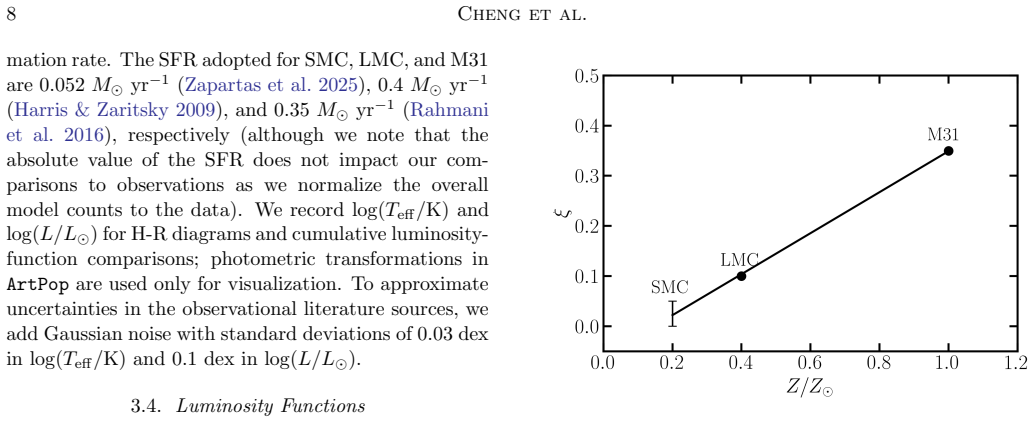
Models incorporating eruptive mass loss scaled by a metallicity-dependent parameter ξ reproduce the observed luminosity functions of red supergiants when ξ is set near zero in the SMC, 0.1 in the LMC, and 0.35 in M31. With this calibration, stars whose initial masses exceed roughly 20 solar masses shed enough mass that they never enter the red supergiant region of the Hertzsprung-Russell diagram.
What carries the argument
The free scaling parameter ξ multiplying a super-Eddington eruptive mass-loss rate in MESA stellar evolution tracks.
Load-bearing premise
By-eye comparison of model luminosity functions to data inside a narrow temperature and luminosity window isolates the eruptive mass-loss scaling without contamination from other uncertainties in the stellar models.
What would settle it
A statistically significant population of red supergiants with initial masses well above 20 solar masses in a metal-rich galaxy such as M31 would falsify the calibrated scaling.
Figures


read the original abstract
We calibrate a physically motivated, super-Eddington eruptive mass-loss prescription for red supergiants (RSGs) using Local Group stellar populations. Building on MESA models that add eruptive mass loss with a free scaling parameter $\xi$, we generate stellar evolution tracks and isochrones, and synthesize mock populations at metallicities of $Z/Z_\odot=0.2,\ 0.4$, and $1.0$. We compare model luminosity functions to observations of RSGs in the SMC, LMC, and M31, restricting to $3.5<\log T_{\rm eff}/K<3.75$ and $\log(L/L_\odot)>4.5$. By-eye fits to the observations yield values of $\xi_\mathrm{SMC}=0.0-0.05$, $\xi_\mathrm{LMC}=0.1$, and $\xi_\mathrm{M31}=0.35$, implying a positive, linear trend between the strength of eruptive mass-loss and metallicity. This calibrated eruptive mass loss prevents stars with initial masses $\gtrsim 20~M_\odot$ from evolving to become red supergiants, with implications for the mass spectrum of core-collapse progenitors, compact remnants, early supernova interaction signatures, and the spectral energy distributions of unresolved galaxies.
Editorial analysis
A structured set of objections, weighed in public.
Referee Report
Summary. The paper calibrates a super-Eddington eruptive mass-loss prescription for red supergiants in MESA models by introducing a free scaling parameter ξ. Synthetic luminosity functions are generated at SMC, LMC, and M31 metallicities and compared by eye to observations restricted to 3.5 < log Teff/K < 3.75 and log(L/L⊙) > 4.5. The resulting ξ values (0–0.05, 0.1, 0.35) imply a linear increase with metallicity, from which the authors conclude that eruptive mass loss prevents stars with initial masses ≳20 M⊙ from reaching the RSG phase, with consequences for core-collapse progenitors, compact remnants, and supernova signatures.
Significance. If the calibration is robust, the work supplies a physically motivated explanation for the observed upper luminosity limit of RSGs and carries broad implications for the initial-mass distribution of supernova progenitors, the formation channels of black holes and neutron stars, early-time supernova interaction, and the integrated light of unresolved stellar populations. The reported metallicity trend also yields falsifiable predictions for RSG populations in galaxies of varying Z.
major comments (3)
- [model-observation comparison] The ξ values are determined exclusively by visual comparison of synthetic and observed luminosity functions in the narrow window 3.5 < log Teff/K < 3.75 and log(L/L⊙) > 4.5. No quantitative goodness-of-fit statistic (χ², KS, or likelihood) is applied and Poisson errors on the binned counts are not propagated, rendering the calibration and the derived linear ξ–Z relation sensitive to subjective judgment.
- [high-mass cutoff discussion] The central claim that initial masses ≳20 M⊙ are prevented from evolving to the RSG phase follows directly from the adopted ξ without marginalization over other MESA parameters (mixing length, overshooting, semiconvection) or independent cross-checks against supernova progenitor statistics or direct mass measurements.
- [results and discussion] Because the same observational luminosity functions are used both to tune ξ and to support the metallicity trend and high-mass cutoff, the analysis contains a circularity that is not quantified; a sensitivity test that varies ξ while holding other inputs fixed would be required to demonstrate uniqueness.
minor comments (2)
- [methods] The eruptive mass-loss rate scaling with ξ should be given an explicit equation number to facilitate reference in the text.
- [figures] Luminosity-function figures would benefit from inclusion of observational error bars or shaded Poisson uncertainty regions to allow visual assessment of fit quality.
Simulated Author's Rebuttal
We thank the referee for their constructive and detailed report. We address each major comment below with point-by-point responses. Revisions have been made to incorporate sensitivity tests, expanded uncertainty discussions, and quantitative illustrations where feasible, while preserving the core calibration approach justified by the data characteristics.
read point-by-point responses
-
Referee: The ξ values are determined exclusively by visual comparison of synthetic and observed luminosity functions in the narrow window 3.5 < log Teff/K < 3.75 and log(L/L⊙) > 4.5. No quantitative goodness-of-fit statistic (χ², KS, or likelihood) is applied and Poisson errors on the binned counts are not propagated, rendering the calibration and the derived linear ξ–Z relation sensitive to subjective judgment.
Authors: We acknowledge the reliance on visual comparison and the absence of formal statistical metrics such as χ² or KS tests. This approach was adopted because the observed samples in the selected Teff and luminosity window are small, with Poisson errors dominating the binned counts; formal fits without full modeling of IMF and SFH uncertainties can be misleading. In the revised manuscript we add a dedicated sensitivity section that varies ξ in 0.05 increments, overlays the resulting luminosity functions on the data with explicit Poisson error bars, and reports the range of ξ that produces acceptable matches. This quantifies the subjective element while retaining the by-eye calibration as the primary method for this initial study. revision: partial
-
Referee: The central claim that initial masses ≳20 M⊙ are prevented from evolving to the RSG phase follows directly from the adopted ξ without marginalization over other MESA parameters (mixing length, overshooting, semiconvection) or independent cross-checks against supernova progenitor statistics or direct mass measurements.
Authors: The high-mass cutoff is a direct outcome of the calibrated eruptive mass-loss rates in our standard MESA setup. A full marginalization over mixing length, overshooting, and semiconvection is computationally prohibitive for the multi-metallicity grid and is not performed here. In revision we expand the discussion to include a qualitative assessment of how plausible variations in these parameters (using literature standard values) would shift the cutoff mass by at most ~2–3 M⊙. We also add explicit comparisons to supernova progenitor statistics from pre-explosion imaging and the observed “red supergiant problem,” noting consistency with the absence of high-mass RSG progenitors. revision: partial
-
Referee: Because the same observational luminosity functions are used both to tune ξ and to support the metallicity trend and high-mass cutoff, the analysis contains a circularity that is not quantified; a sensitivity test that varies ξ while holding other inputs fixed would be required to demonstrate uniqueness.
Authors: The calibration is performed independently at each metallicity, so the linear ξ–Z trend is an emergent result rather than an imposed assumption. To address the circularity concern we have added a sensitivity test in the revised manuscript: we fix ξ to a single constant value across all three metallicities and demonstrate that no single value simultaneously reproduces the observed luminosity functions in the SMC, LMC, and M31. This shows that metallicity dependence is required by the data. The high-mass cutoff remains robust within the range of ξ values that provide acceptable fits at each metallicity. revision: yes
Circularity Check
No significant circularity in the derivation chain
full rationale
The paper calibrates the free scaling parameter ξ for eruptive mass loss by generating MESA tracks and synthetic luminosity functions, then performing by-eye comparison to observed RSG luminosity functions in the SMC, LMC, and M31 within the window 3.5 < log Teff/K < 3.75 and log(L/L⊙) > 4.5. The resulting ξ values (0–0.05, 0.1, 0.35) directly imply the reported linear metallicity trend. Applying these same ξ values in the evolution tracks then yields the model outcome that initial masses ≳20 M⊙ do not reach the RSG phase. This is a straightforward consequence of the stellar-structure calculations with the calibrated parameter, not a redefinition, a fitted quantity renamed as an independent prediction, or a result forced by self-citation. The derivation chain is self-contained: the observational LFs serve as an external benchmark to fix ξ, after which the models produce new statements about progenitor masses and remnant spectra.
Axiom & Free-Parameter Ledger
free parameters (1)
- xi =
0.0-0.05 (SMC), 0.1 (LMC), 0.35 (M31)
axioms (1)
- domain assumption MESA stellar evolution models with the added eruptive mass-loss term accurately reproduce observed RSG luminosity functions when xi is adjusted.
Lean theorems connected to this paper
-
IndisputableMonolith/Cost/FunctionalEquationwashburn_uniqueness_aczel unclear?
unclearRelation between the paper passage and the cited Recognition theorem.
By-eye fits to the observations yield values of ξ_SMC=0.0-0.05, ξ_LMC=0.1, and ξ_M31=0.35, implying a positive, linear trend between the strength of eruptive mass-loss and metallicity.
-
IndisputableMonolith/Foundation/RealityFromDistinctionreality_from_one_distinction unclear?
unclearRelation between the paper passage and the cited Recognition theorem.
This calibrated eruptive mass loss prevents stars with initial masses ≳20 M⊙ from evolving to become red supergiants
What do these tags mean?
- matches
- The paper's claim is directly supported by a theorem in the formal canon.
- supports
- The theorem supports part of the paper's argument, but the paper may add assumptions or extra steps.
- extends
- The paper goes beyond the formal theorem; the theorem is a base layer rather than the whole result.
- uses
- The paper appears to rely on the theorem as machinery.
- contradicts
- The paper's claim conflicts with a theorem or certificate in the canon.
- unclear
- Pith found a possible connection, but the passage is too broad, indirect, or ambiguous to say the theorem truly supports the claim.
Reference graph
Works this paper leans on
-
[1]
Antoniadis, K., Bonanos, A. Z., de Wit, S., et al. 2024, A&A, 686, A88, doi: 10.1051/0004-6361/202449383
-
[2]
Banerjee, S., Belczynski, K., Fryer, C. L., et al. 2020, A&A, 639, A41, doi: 10.1051/0004-6361/201935332
-
[3]
R., Davies, B., Smith, N., et al
Beasor, E. R., Davies, B., Smith, N., et al. 2020, MNRAS, 492, 5994, doi: 10.1093/mnras/staa255 —. 2023, MNRAS, 524, 2460, doi: 10.1093/mnras/stad1818
-
[4]
Belczynski, K., Bulik, T., Fryer, C. L., et al. 2010, ApJ, 714, 1217, doi: 10.1088/0004-637X/714/2/1217
-
[5]
Bessell, M. S., & Brett, J. M. 1988, Publications of the Astronomical Society of the Pacific, 100, 1134, doi: 10.1086/132281
-
[6]
J., Gal-Yam, A., Yaron, O., et al
Bruch, R. J., Gal-Yam, A., Yaron, O., et al. 2023, ApJ, 952, 119, doi: 10.3847/1538-4357/acd8be
-
[7]
Castor, J. I., Abbott, D. C., & Klein, R. I. 1975, ApJ, 195, 157, doi: 10.1086/153315
-
[8]
2009, ApJ, 695, 292, doi: 10.1088/0004-637X/695/1/292
Ceverino, D., & Klypin, A. 2009, ApJ, 695, 292, doi: 10.1088/0004-637X/695/1/292
-
[9]
Cheng, S. J., Goldberg, J. A., Cantiello, M., et al. 2024, ApJ, 974, 270, doi: 10.3847/1538-4357/ad701e
-
[10]
2016, The Astrophysical Journal, 823, 102, doi: 10.3847/0004-637X/823/2/102
Choi, J., Dotter, A., Conroy, C., et al. 2016, ApJ, 823, 102, doi: 10.3847/0004-637X/823/2/102
work page internal anchor Pith review doi:10.3847/0004-637x/823/2/102 2016
-
[11]
Choudhury, S., Subramaniam, A., & Cole, A. A. 2016, MNRAS, 455, 1855, doi: 10.1093/mnras/stv2414
-
[12]
Chun, S.-H., Yoon, S.-C., Jung, M.-K., Kim, D. U., & Kim, J. 2018, ApJ, 853, 79, doi: 10.3847/1538-4357/aa9a37
-
[13]
Conroy, C., & Gunn, J. E. 2010, ApJ, 712, 833, doi: 10.1088/0004-637X/712/2/833
work page internal anchor Pith review doi:10.1088/0004-637x/712/2/833 2010
-
[14]
Dalcanton, J. J., Williams, B. F., Lang, D., et al. 2012, ApJS, 200, 18, doi: 10.1088/0067-0049/200/2/18 de Jager, C., Nieuwenhuijzen, H., & van der Hucht, K. A. 1988, A&AS, 72, 259
-
[15]
Decin, L., Richards, A. M. S., Marchant, P., & Sana, H. 2024, A&A, 681, A17, doi: 10.1051/0004-6361/202244635
-
[16]
Delbroek, L., Sundqvist, J. O., Debnath, D., et al. 2025, A&A, 704, A104, doi: 10.1051/0004-6361/202556421
-
[17]
Dessart, L., Hillier, D. J., Waldman, R., & Livne, E. 2013, MNRAS, 433, 1745, doi: 10.1093/mnras/stt861
-
[18]
2012, ApJ, 759, 52, doi: 10.1088/0004-637X/759/1/52
Dominik, M., Belczynski, K., Fryer, C., et al. 2012, ApJ, 759, 52, doi: 10.1088/0004-637X/759/1/52
-
[19]
2016, ApJS, 222, 8, doi: 10.3847/0067-0049/222/1/8 Ekstr¨ om, S., Georgy, C., Eggenberger, P., et al
Dotter, A. 2016, ApJS, 222, 8, doi: 10.3847/0067-0049/222/1/8 Ekstr¨ om, S., Georgy, C., Eggenberger, P., et al. 2012, A&A, 537, A146, doi: 10.1051/0004-6361/201117751
-
[20]
Fields, C. E., & Couch, S. M. 2021, ApJ, 921, 28, doi: 10.3847/1538-4357/ac24fb
-
[21]
Fragos, T., Andrews, J. J., Bavera, S. S., et al. 2023, ApJS, 264, 45, doi: 10.3847/1538-4365/ac90c1
-
[22]
2015, MNRAS, 448, 3248, doi: 10.1093/mnras/stv251
Geen, S., Rosdahl, J., Blaizot, J., Devriendt, J., & Slyz, A. 2015, MNRAS, 448, 3248, doi: 10.1093/mnras/stv251
-
[23]
Glebbeek, E., Gaburov, E., de Mink, S. E., Pols, O. R., & Portegies Zwart, S. F. 2009, A&A, 497, 255, doi: 10.1051/0004-6361/200810425
-
[24]
Goldman, S. R., van Loon, J. T., Zijlstra, A. A., et al. 2017, MNRAS, 465, 403, doi: 10.1093/mnras/stw2708 Gonz´ alez-Tor` a, G., Sander, A. A. C., Sundqvist, J. O., et al. 2025, A&A, 694, A269, doi: 10.1051/0004-6361/202452241
-
[25]
Greco, J. P., & Danieli, S. 2022, ApJ, 941, 26, doi: 10.3847/1538-4357/ac75b7
-
[26]
2009, The Astronomical Journal, 138, 1243, doi: 10.1088/0004-6256/138/5/1243
Harris, J., & Zaritsky, D. 2009, The Astronomical Journal, 138, 1243, doi: 10.1088/0004-6256/138/5/1243
-
[27]
Heckman, T. M., Armus, L., & Miley, G. K. 1990, ApJS, 74, 833, doi: 10.1086/191522
-
[28]
Humphreys, R. M., & Davidson, K. 1984, Science, 223, 243, doi: 10.1126/science.223.4633.243
-
[29]
Iglesias, C. A., & Rogers, F. J. 1993, ApJ, 412, 752, doi: 10.1086/172958 Jacobson-Gal´ an, W. V., Dessart, L., Davis, K. W., et al. 2024, arXiv e-prints, arXiv:2403.02382, doi: 10.48550/arXiv.2403.02382
-
[30]
Jermyn, A. S., Bauer, E. B., Schwab, J., et al. 2023, ApJS, 265, 15, doi: 10.3847/1538-4365/acae8d
-
[31]
2015, ApJ, 813, 74, doi: 10.1088/0004-637X/813/1/74
Blaes, O. 2015, ApJ, 813, 74, doi: 10.1088/0004-637X/813/1/74
-
[32]
2018, Nature, 561, 498, doi: 10.1038/s41586-018-0525-0
Jiang, Y.-F., Cantiello, M., Bildsten, L., et al. 2018, Nature, 561, 498, doi: 10.1038/s41586-018-0525-0
-
[33]
Johnston, C., Michielsen, M., Anders, E. H., et al. 2024, ApJ, 964, 170, doi: 10.3847/1538-4357/ad2343
-
[34]
Kroupa, P. 2001, MNRAS, 322, 231, doi: 10.1046/j.1365-8711.2001.04022.x Calibrating Eruptive Mass Loss in RSGs with Local Group Data11 Lan¸ con, A., Gallagher, J. S., de Grijs, R., et al. 2007, in IAU Symposium, Vol. 241, Stellar Populations as Building Blocks of Galaxies, ed. A. Vazdekis & R. Peletier, 152–155, doi: 10.1017/S1743921307007673
-
[35]
2025, arXiv e-prints, arXiv:2510.14875, doi: 10.48550/arXiv.2510.14875
Ma, J.-Z., Justham, S., Pakmor, R., et al. 2025, arXiv e-prints, arXiv:2510.14875, doi: 10.48550/arXiv.2510.14875
-
[36]
Collisions versus stellar winds in the runaway merger scenario: place your bets
Mapelli, M. 2016, Mem. Soc. Astron. Italiana, 87, 567, doi: 10.48550/arXiv.1606.03370
work page internal anchor Pith review Pith/arXiv arXiv doi:10.48550/arxiv.1606.03370 2016
-
[37]
Massey, P., Neugent, K. F., Levesque, E. M., Drout, M. R., & Courteau, S. 2021, AJ, 161, 79, doi: 10.3847/1538-3881/abd01f
-
[38]
Massey, P., & Olsen, K. A. G. 2003, AJ, 126, 2867, doi: 10.1086/379558
-
[39]
2011, A&A, 526, A156, doi: 10.1051/0004-6361/201013993
Mauron, N., & Josselin, E. 2011, A&A, 526, A156, doi: 10.1051/0004-6361/201013993
-
[40]
2003, A&A, 404, 975, doi: 10.1051/0004-6361:20030512
Meynet, G., & Maeder, A. 2003, A&A, 404, 975, doi: 10.1051/0004-6361:20030512
-
[41]
2015, A&A, 575, A60, doi: 10.1051/0004-6361/201424671
Meynet, G., Chomienne, V., Ekstr¨ om, S., et al. 2015, A&A, 575, A60, doi: 10.1051/0004-6361/201424671
-
[42]
Moriya, T. J., & Yoon, S.-C. 2022, MNRAS, 513, 5606, doi: 10.1093/mnras/stac1271
-
[43]
Morozova, V., Piro, A. L., & Valenti, S. 2017, ApJ, 838, 28, doi: 10.3847/1538-4357/aa6251
-
[44]
F., Massey, P., Georgy, C., et al
Neugent, K. F., Massey, P., Georgy, C., et al. 2020, ApJ, 889, 44, doi: 10.3847/1538-4357/ab5ba0
-
[45]
F., Massey, P., Skiff, B., & Meynet, G
Neugent, K. F., Massey, P., Skiff, B., & Meynet, G. 2012, ApJ, 749, 177, doi: 10.1088/0004-637X/749/2/177
- [46]
-
[47]
Nugis, T., & Lamers, H. J. G. L. M. 2000, A&A, 360, 227
work page 2000
-
[48]
Owocki, S. P., Gayley, K. G., & Shaviv, N. J. 2004, ApJ, 616, 525, doi: 10.1086/424910
-
[49]
Pastorello, A., Smartt, S. J., Mattila, S., et al. 2007, Nature, 447, 829, doi: 10.1038/nature05825
-
[50]
2011, The Astrophysical Journal Supplement Series, 192, 3, doi: 10.1088/0067-0049/192/1/3
Paxton, B., Bildsten, L., Dotter, A., et al. 2011, ApJS, 192, 3, doi: 10.1088/0067-0049/192/1/3
-
[51]
2013, The Astrophysical Journal Supplement Series, 208, 4, doi: 10.1088/0067-0049/208/1/4
Paxton, B., Cantiello, M., Arras, P., et al. 2013, ApJS, 208, 4, doi: 10.1088/0067-0049/208/1/4
work page internal anchor Pith review doi:10.1088/0067-0049/208/1/4 2013
-
[52]
2015, The Astrophysical Journal Supplement Series, 220, 15, doi: 10.1088/0067-0049/220/1/15
Paxton, B., Marchant, P., Schwab, J., et al. 2015, ApJS, 220, 15, doi: 10.1088/0067-0049/220/1/15
work page internal anchor Pith review doi:10.1088/0067-0049/220/1/15 2015
-
[53]
Paxton, B., Schwab, J., Bauer, E. B., et al. 2018, ApJS, 234, 34, doi: 10.3847/1538-4365/aaa5a8
-
[54]
2019, The Astrophysical Journal Supplement Series, 243, 10, doi: 10.3847/1538-4365/ab2241
Paxton, B., Smolec, R., Schwab, J., et al. 2019, ApJS, 243, 10, doi: 10.3847/1538-4365/ab2241
-
[55]
W., Janot-Pacheco, E., Emilio, M., et al
Pereira, A. W., Janot-Pacheco, E., Emilio, M., et al. 2024, A&A, 686, A20, doi: 10.1051/0004-6361/202346439
-
[56]
2016, Monthly Notices of the Royal Astronomical Society, 456, 4128, doi: 10.1093/mnras/stv2951
Rahmani, S., Lianou, S., & Barmby, P. 2016, Monthly Notices of the Royal Astronomical Society, 456, 4128, doi: 10.1093/mnras/stv2951
-
[57]
2021, ApJ, 923, 232, doi: 10.3847/1538-4357/ac307b
Ren, Y., Jiang, B., Yang, M., Wang, T., & Ren, T. 2021, ApJ, 923, 232, doi: 10.3847/1538-4357/ac307b
-
[58]
Renzo, M., Ott, C. D., Shore, S. N., & de Mink, S. E. 2017, A&A, 603, A118, doi: 10.1051/0004-6361/201730698
-
[59]
Russell, S. C., & Dopita, M. A. 1992, ApJ, 384, 508, doi: 10.1086/170893
-
[60]
E., Caldwell, N., McDowell, J., & Harding, P
Sanders, N. E., Caldwell, N., McDowell, J., & Harding, P. 2012, ApJ, 758, 133, doi: 10.1088/0004-637X/758/2/133
-
[61]
Schlegel, E. M. 1990, MNRAS, 244, 269
work page 1990
-
[62]
2024, ApJ, 962, 168, doi: 10.3847/1538-4357/ad0e0a
Shiber, S., Chatzopoulos, E., Munson, B., & Frank, J. 2024, ApJ, 962, 168, doi: 10.3847/1538-4357/ad0e0a
-
[63]
2014, ARA&A, 52, 487, doi: 10.1146/annurev-astro-081913-040025 —
Smith, N. 2014, ARA&A, 52, 487, doi: 10.1146/annurev-astro-081913-040025 —. 2017, Philosophical Transactions of the Royal Society of London Series A, 375, 20160268, doi: 10.1098/rsta.2016.0268
-
[64]
Smith, N., & Owocki, S. P. 2006, ApJL, 645, L45, doi: 10.1086/506523
-
[65]
Steinwandel, U. P., & Goldberg, J. A. 2023, arXiv e-prints, arXiv:2310.11495, doi: 10.48550/arXiv.2310.11495
-
[66]
J., Genzel, R., & Sternberg, A
Tacconi, L. J., Genzel, R., & Sternberg, A. 2020, ARA&A, 58, 157, doi: 10.1146/annurev-astro-082812-141034
-
[67]
2019, PhRvD, 99, 041302, doi: 10.1103/PhysRevD.99.041302 van Loon, J
Uchida, H., Shibata, M., Takahashi, K., & Yoshida, T. 2019, PhRvD, 99, 041302, doi: 10.1103/PhysRevD.99.041302 van Loon, J. T., Cioni, M. R. L., Zijlstra, A. A., & Loup, C. 2005, A&A, 438, 273, doi: 10.1051/0004-6361:20042555
-
[68]
Vink, J. S., de Koter, A., & Lamers, H. J. G. L. M. 2001, A&A, 369, 574, doi: 10.1051/0004-6361:20010127
-
[69]
Vink, J. S., Higgins, E. R., Sander, A. A. C., & Sabhahit, G. N. 2021, MNRAS, 504, 146, doi: 10.1093/mnras/stab842
-
[70]
Vink, J. S., & Sabhahit, G. N. 2023, A&A, 678, L3, doi: 10.1051/0004-6361/202347801
-
[71]
Wood, P. R., Bessell, M. S., & Fox, M. W. 1983, ApJ, 272, 99, doi: 10.1086/161265
-
[72]
Wood, P. R., Whiteoak, J. B., Hughes, S. M. G., et al. 1992, ApJ, 397, 552, doi: 10.1086/171812
-
[73]
Yang, M., Bonanos, A. Z., Jiang, B.-W., et al. 2020, A&A, 639, A116, doi: 10.1051/0004-6361/201937168
-
[74]
Yang, M., Bonanos, A. Z., Jiang, B., et al. 2023, A&A, 676, A84, doi: 10.1051/0004-6361/202244770
-
[75]
2025, A&A, 697, A167, doi: 10.1051/0004-6361/202452401
Zapartas, E., de Wit, S., Antoniadis, K., et al. 2025, A&A, 697, A167, doi: 10.1051/0004-6361/202452401
-
[76]
M., Mapelli, M., Branchesi, M., & Tormen, G
Ziosi, B. M., Mapelli, M., Branchesi, M., & Tormen, G. 2014, MNRAS, 441, 3703, doi: 10.1093/mnras/stu824
discussion (0)
Sign in with ORCID, Apple, or X to comment. Anyone can read and Pith papers without signing in.