Recognition: 1 theorem link
· Lean TheoremA broadband search for coherent radio emission in cataclysmic variables
Pith reviewed 2026-05-15 16:20 UTC · model grok-4.3
The pith
Radio observations of cataclysmic variables detect highly polarized variable emission consistent with coherent processes.
A machine-rendered reading of the paper's core claim, the machinery that carries it, and where it could break.
Core claim
The central claim is that spectro-temporal analysis of VLA data reveals both broad- and narrow-band, highly polarized, variable radio emission from cataclysmic variables that matches the expected signatures of electron-cyclotron maser emission or plasma radiation, rather than solely incoherent synchrotron processes.
What carries the argument
Spectro-temporal analysis of broadband VLA observations that isolates polarization fraction, bandwidth, and rapid variability to distinguish coherent emission signatures.
If this is right
- Coherent radio emission occurs in cataclysmic variables outside of outburst-driven jets.
- Narrow-band signals trace isolated emission regions with uniform magnetic field strength.
- Broad-band signals trace regions containing gradients in magnetic field or plasma density.
- Minute-scale unpolarized variability in systems like V2400 Oph can trace magnetospheric interactions with diamagnetic blobs.
- Radio polarization and variability provide a new probe of magnetic fields and plasma conditions around accreting white dwarfs.
Where Pith is reading between the lines
- Confirmation would motivate targeted radio monitoring of additional cataclysmic variables to map their magnetic environments across evolutionary stages.
- The same observational signatures could be searched for in other accreting compact objects to test whether coherent emission is a general feature of magnetized accretion flows.
- Higher-resolution or multi-frequency follow-up could localize the emission site relative to the white dwarf and accretion disk.
- Models of angular momentum loss in cataclysmic variables may need to incorporate energy carried away by coherent radio waves.
Load-bearing premise
The observed combination of high polarization, restricted or varying bandwidth, and rapid variability arises uniquely from coherent mechanisms and cannot be produced by incoherent synchrotron emission or other processes.
What would settle it
Finding that the polarized emission shows no frequency dependence matching cyclotron harmonics or plasma frequencies, or that it persists unchanged during periods when coherent processes should be suppressed, would falsify the interpretation.
Figures




read the original abstract
Radio observations of cataclysmic variables have revealed a variety of behavior. From some systems, we see bright unpolarized radio flares occurring during dwarf nova outbursts, consistent with synchrotron emission from jets. In others, we see highly polarized emission, restricted in frequency, superimposed on a flat-spectrum continuum, suggesting a coherent emission process. Here, we present spectro-temporal analysis of 2--4 GHz and 8--12 GHz VLA observations of 6 cataclysmic variables. Our results show both broad- and narrow-band, highly polarized, variable radio emission. We suggest that this emission is consistent with electron-cyclotron maser emission or plasma radiation. This could be from an isolated emission region in the case of the narrow-band emission, or a region with varying magnetic field strength or density in the case of the broad-band emission. In one target, V2400 Oph, we see largely unpolarized emission changing on minute timescales, that may coincide with interactions between the white dwarf's magnetosphere and diamagnetic blobs.
Editorial analysis
A structured set of objections, weighed in public.
Referee Report
Summary. The manuscript presents VLA observations at 2-4 GHz and 8-12 GHz of six cataclysmic variables. It reports detections of broad- and narrow-band highly polarized variable radio emission, interpreted as consistent with electron-cyclotron maser emission or plasma radiation from isolated or varying emission regions. For V2400 Oph, largely unpolarized minute-scale variable emission is noted and linked to possible magnetosphere-diamagnetic blob interactions, contrasting with unpolarized synchrotron flares seen in other CVs during outbursts.
Significance. If the interpretation holds, the work adds observational evidence for coherent radio processes in CVs alongside known incoherent synchrotron emission from jets. The spectro-temporal data from broadband VLA observations provide constraints on emission variability and polarization that could inform models of magnetic fields and plasma in accreting white dwarf systems, particularly if future modeling confirms the mechanism.
major comments (2)
- In the results and discussion sections, the classification of the polarized emission as consistent with coherent mechanisms (ECM or plasma radiation) relies on qualitative descriptors of polarization degree, bandwidth, and variability without quantitative support such as brightness temperature estimates derived from the reported minute-scale variability timescales or spectral index fits to distinguish flat/inverted coherent spectra from steep synchrotron spectra.
- For the V2400 Oph target, the suggested link between unpolarized variable emission and magnetosphere-blob interactions is presented without timing correlations, model predictions, or exclusion of alternative origins, weakening the distinction from other incoherent processes noted elsewhere in the manuscript.
minor comments (3)
- The abstract and introduction would benefit from explicitly listing which of the six targets showed polarized emission versus unpolarized flares to clarify the sample statistics.
- Figure captions for the spectro-temporal plots should include details on the exact frequency resolution, time binning, and polarization calibration methods used.
- Additional references to prior radio observations of CVs (e.g., studies of dwarf nova outbursts) would better contextualize the new detections.
Simulated Author's Rebuttal
We thank the referee for their constructive comments on our manuscript. We address each major point below and have revised the paper to incorporate quantitative support where feasible while clarifying the tentative nature of certain interpretations.
read point-by-point responses
-
Referee: In the results and discussion sections, the classification of the polarized emission as consistent with coherent mechanisms (ECM or plasma radiation) relies on qualitative descriptors of polarization degree, bandwidth, and variability without quantitative support such as brightness temperature estimates derived from the reported minute-scale variability timescales or spectral index fits to distinguish flat/inverted coherent spectra from steep synchrotron spectra.
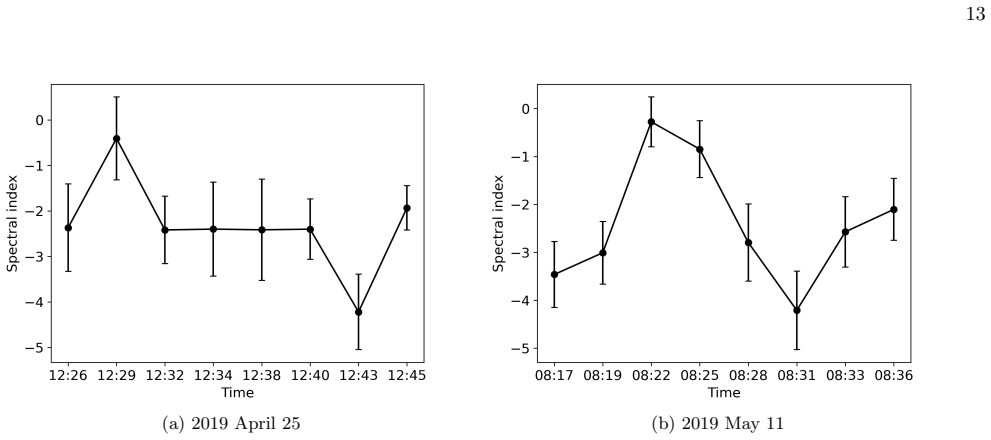
Authors: We agree that quantitative measures strengthen the case for coherent emission. In the revised manuscript we now derive brightness temperatures from the reported minute-scale variability timescales, obtaining values exceeding 10^10 K that are incompatible with incoherent synchrotron processes. We have also added spectral index measurements across the observed bands, which are flat or inverted and thus inconsistent with the steep spectra characteristic of synchrotron emission. These calculations and fits are presented in the updated Results and Discussion sections. revision: yes
-
Referee: For the V2400 Oph target, the suggested link between unpolarized variable emission and magnetosphere-blob interactions is presented without timing correlations, model predictions, or exclusion of alternative origins, weakening the distinction from other incoherent processes noted elsewhere in the manuscript.
Authors: The proposed connection for V2400 Oph is offered only as a possible scenario, as indicated by the phrasing 'may coincide' in the original text. We have expanded the relevant paragraph to explicitly note the absence of timing correlations and model predictions, and we now discuss alternative origins such as low-level incoherent emission. The distinction from polarized coherent emission in the other targets and from outburst-related synchrotron flares is retained but framed with additional caveats to reflect the speculative character of the interpretation. revision: partial
Circularity Check
No circularity: purely observational data interpretation
full rationale
The paper reports VLA observations of six cataclysmic variables and presents direct spectro-temporal analysis of 2-4 GHz and 8-12 GHz data, describing observed polarization fractions, bandwidths, and variability timescales. Claims of consistency with electron-cyclotron maser or plasma radiation rest on qualitative comparison to established signatures in the literature, without any equations, parameter fits, or derivations. No self-citations are used to justify uniqueness, no ansatzes are smuggled, and no fitted inputs are relabeled as predictions. The analysis chain is empirical and self-contained against external benchmarks of known radio emission types.
Axiom & Free-Parameter Ledger
axioms (1)
- standard math Standard radio interferometry calibration and imaging techniques apply to VLA data
Lean theorems connected to this paper
-
IndisputableMonolith/Foundation/RealityFromDistinctionreality_from_one_distinction unclear?
unclearRelation between the paper passage and the cited Recognition theorem.
We suggest that this emission is consistent with electron-cyclotron maser emission or plasma radiation. This could be from an isolated emission region in the case of the narrow-band emission, or a region with varying magnetic field strength or density in the case of the broad-band emission.
What do these tags mean?
- matches
- The paper's claim is directly supported by a theorem in the formal canon.
- supports
- The theorem supports part of the paper's argument, but the paper may add assumptions or extra steps.
- extends
- The paper goes beyond the formal theorem; the theorem is a base layer rather than the whole result.
- uses
- The paper appears to rely on the theorem as machinery.
- contradicts
- The paper's claim conflicts with a theorem or certificate in the canon.
- unclear
- Pith found a possible connection, but the passage is too broad, indirect, or ambiguous to say the theorem truly supports the claim.
Reference graph
Works this paper leans on
-
[1]
2021, The Astronomical Journal, 161, 147, doi: 10.3847/1538-3881/abd806
Demleitner, M., & Andrae, R. 2021, The Astronomical Journal, 161, 147, doi: 10.3847/1538-3881/abd806
work page internal anchor Pith review doi:10.3847/1538-3881/abd806 2021
-
[2]
Singh, K. P. 2020, Advances in Space Research, 66, 1226, doi: 10.1016/j.asr.2020.04.007 17
-
[3]
Barrett, P. E. 2022, The Astronomical Journal, 163, 58, doi: 10.3847/1538-3881/ac3ed9
-
[4]
Mason, P. A. 2017, The Astronomical Journal, 154, 252, doi: 10.3847/1538-3881/aa93ff
-
[5]
Bastian, T. S., Dulk, G. A., & Chanmugam, G. 1988, ApJ, 324, 431, doi: 10.1086/165906
-
[6]
Beuermann, K., Euchner, F., Reinsch, K., Jordan, S., & G¨ ansicke, B. T. 2007, A&A, 463, 647, doi: 10.1051/0004-6361:20066332
-
[7]
Beuermann, K., Wheatley, P., Ramsay, G., Euchner, F., & G¨ ansicke, B. T. 2000, A&A, 354, L49, doi: 10.48550/arXiv.astro-ph/0001183
work page internal anchor Pith review Pith/arXiv arXiv doi:10.48550/arxiv.astro-ph/0001183 2000
-
[8]
Callingham, J. R., Pope, B. J. S., Kavanagh, R. D., et al. 2024, Nature Astronomy, 8, 1359, doi: 10.1038/s41550-024-02405-6 CASA Team, Bean, B., Bhatnagar, S., et al. 2022, Publications of the ASP, 134, 114501, doi: 10.1088/1538-3873/ac9642
-
[9]
Chanmugam, G., & Dulk, G. A. 1982, ApJLetters, 255, L107, doi: 10.1086/183779
-
[10]
Coppejans, D. L., & Knigge, C. 2020, NewAR, 89, 101540, doi: 10.1016/j.newar.2020.101540
-
[11]
Coppejans, D. L., K¨ ording, E. G., Miller-Jones, J. C. A., et al. 2015, MNRAS, 451, 3801, doi: 10.1093/mnras/stv1225
-
[12]
Dulk, G. A. 1985, Annual Review of A&A, 23, 169, doi: 10.1146/annurev.aa.23.090185.001125
-
[13]
Dulk, G. A., Bastian, T. S., & Chanmugam, G. 1983, ApJ, 273, 249, doi: 10.1086/161363
-
[14]
Ferrario, L., Bailey, J., & Wickramasinghe, D. T. 1993, MNRAS, 262, 285, doi: 10.1093/mnras/262.2.285
-
[15]
Hales, C. A. 2017, CASA Interferometric Pipeline Polarization Calibration, Imaging Requirement, & Design
work page 2017
-
[16]
2024, Monthly Notices of the Royal Astornomical Society, 528, L112, doi: 10.1093/mnrasl/slad178
Jiang, P., Cui, L., Liu, X., et al. 2024, Monthly Notices of the Royal Astornomical Society, 528, L112, doi: 10.1093/mnrasl/slad178
-
[17]
Khangale, Z. N., Potter, S. B., Woudt, P. A., et al. 2020, MNRAS, 492, 4298, doi: 10.1093/mnras/staa080
-
[18]
2022, The Astronomical Journal, 163, 4, doi: 10.3847/1538-3881/ac3010
Langford, A., Littlefield, C., Garnavich, P., et al. 2022, The Astronomical Journal, 163, 4, doi: 10.3847/1538-3881/ac3010
-
[19]
1996, MNRAS, 279, 389, doi: 10.1093/mnras/279.2.389
Lynden-Bell, D. 1996, MNRAS, 279, 389, doi: 10.1093/mnras/279.2.389
-
[20]
Meintjes, P. J., & Venter, L. A. 2003, Monthly Notices of the Royal Astornomical Society, 341, 891, doi: 10.1046/j.1365-8711.2003.06459.x
-
[21]
R., McKinley, B., Hurley-Walker, et al
Offringa, A. R., McKinley, B., Hurley-Walker, et al. 2014, MNRAS, 444, 606, doi: 10.1093/mnras/stu1368
-
[22]
Ramaila, A. J., Smirnov, O., & Heywood, I. 2023, breizorro: Image masking tool,, Astrophysics Source Code Library, record ascl:2305.009 http://ascl.net/2305.009
work page 2023
-
[23]
Ridder, M. E., Heinke, C. O., Sivakoff, G. R., & Hughes, A. K. 2023, MNRAS, 519, 5922, doi: 10.1093/mnras/stad038
-
[24]
Ridder, M. E., Hughes, A. K., Heinke, C. O., Sivakoff, G. R., & Sydora, R. D. 2025, A&A, 695, A96, doi: 10.1051/0004-6361/202452711
-
[25]
2003, A&A, 404, 301, doi: 10.1051/0004-6361:20030330
Ritter, H., & Kolb, U. 2003, A&A, 404, 301, doi: 10.1051/0004-6361:20030330
-
[26]
Rousseau, T., Fischer, A., Beuermann, K., & Woelk, U. 1996, A&A, 310, 526
work page 1996
-
[27]
Rybicki, G. B., & Lightman, A. P. 1979, Radiative processes in astrophysics (Wiley)
work page 1979
-
[28]
Sanad, M. R., & Bobrowsky, M. 2015, New Astronomy, 36, 110, doi: 10.1016/j.newast.2014.10.003
-
[29]
D., Beuermann, K., Jordan, S., & Thomas, H
Schwope, A. D., Beuermann, K., Jordan, S., & Thomas, H. C. 1993, A&A, 278, 487
work page 1993
-
[30]
Sion, E. M., Godon, P., & Bisol, A. 2015, The Astronomical Journal, 150, 36, doi: 10.1088/0004-6256/150/1/36
-
[31]
Suleymanov, V. F. 1992, Soviet Astronomy Letters, 18, 104
work page 1992
-
[32]
Treumann, R. A. 2006, A&AReviews, 13, 229, doi: 10.1007/s00159-006-0001-y van der Laan, H. 1966, Nature, 211, 1131, doi: 10.1038/2111131a0
-
[33]
Vedantham, H. K. 2021, MNRAS, 500, 3898, doi: 10.1093/mnras/staa3373
-
[34]
Wynn, G. A., King, A. R., & Horne, K. 1997, MNRAS, 286, 436, doi: 10.1093/mnras/286.2.436
-
[35]
Yiu, T. W. H., Vedantham, H. K., Callingham, J. R., & G¨ unther, M. N. 2024, A&A, 684, A3, doi: 10.1051/0004-6361/202347657
discussion (0)
Sign in with ORCID, Apple, or X to comment. Anyone can read and Pith papers without signing in.