Recognition: no theorem link
Achieving Optimal-Distance Atom-Loss Correction via Pauli Envelope
Pith reviewed 2026-05-15 16:59 UTC · model grok-4.3
The pith
The Pauli Envelope framework bounds atom loss with low-weight Pauli approximations to enable optimal-distance correction in rotated surface codes.
A machine-rendered reading of the paper's core claim, the machinery that carries it, and where it could break.
Core claim
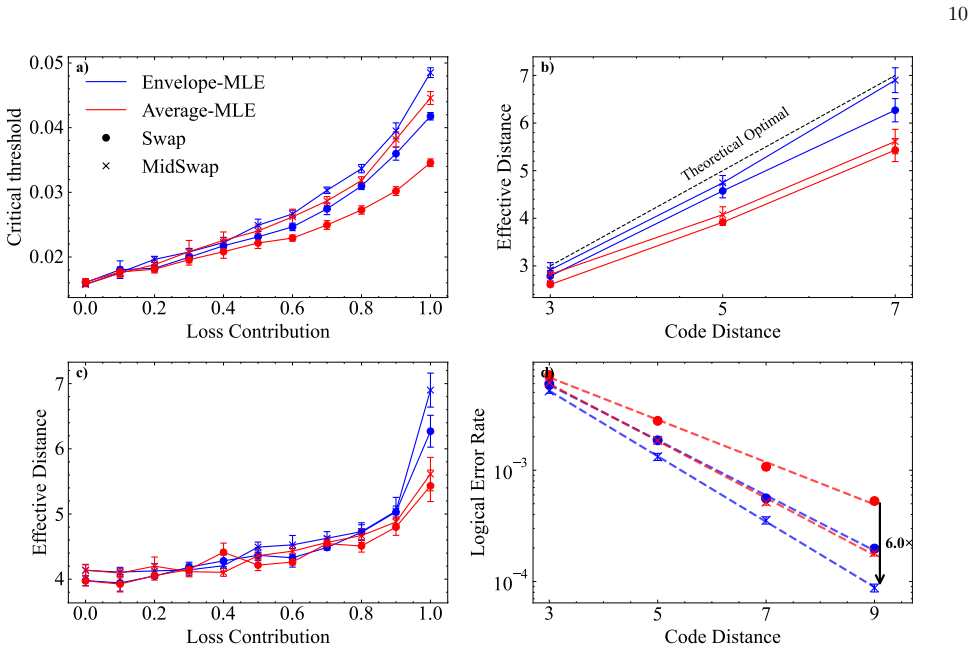
The Pauli Envelope framework generalizes existing loss-to-Pauli mappings by bounding atom-loss effects with low-weight Pauli approximations. This enables Mid-SWAP syndrome extraction circuits that achieve optimal loss distance with minimal overhead for rotated surface codes, an Envelope-MLE decoder that attains loss distance approximately equal to code distance d, and an Envelope-Matching decoder that reaches loss distance approximately 2d/3 via minimum-weight perfect matching. Circuit-level simulations show up to 40 percent higher thresholds and 30 percent higher effective distances in the loss-dominated regime, with thresholds rising from 5.15 percent to 7.82 percent when atom loss is made
What carries the argument
The Pauli Envelope framework, which bounds the nonlinear and correlated effects of atom loss using low-weight, efficiently computable Pauli approximations.
If this is right
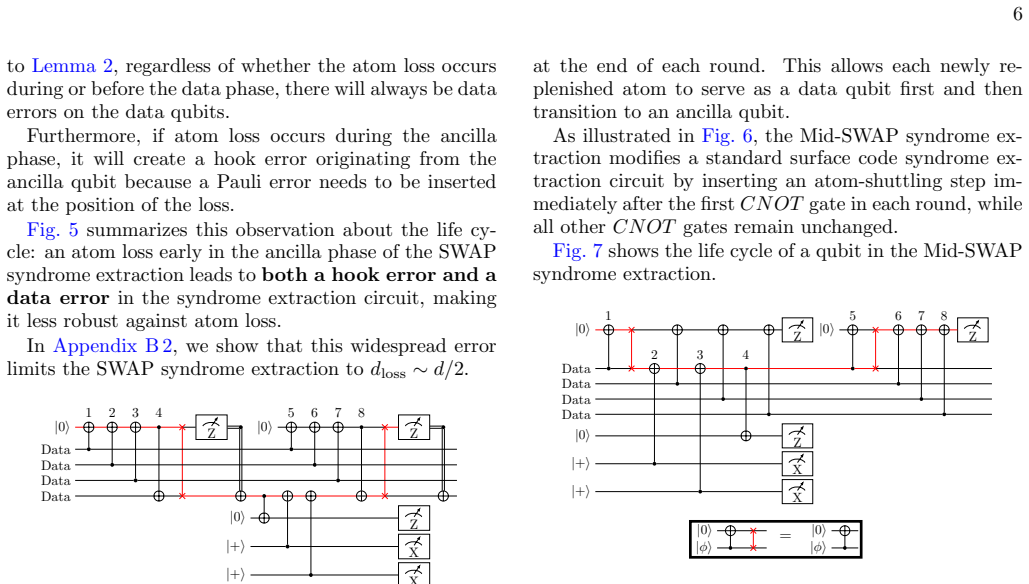
- Mid-SWAP syndrome extraction achieves optimal loss distance d_loss ~ d with minimal space-time overhead for rotated surface codes.
- Envelope-MLE decoder reaches loss distance approximately equal to the code distance while Envelope-Matching reaches 2d/3 using standard MWPM.
- Thresholds improve by up to 40 percent and effective distances by 30 percent in loss-dominated regimes.
- Correlated atom loss yields higher thresholds than independent loss, rising from 5.15 percent to 7.82 percent.
- The approach improves the error suppression factor of hybrid MLE-machine-learning decoders on recent experimental data from 2.14 to 2.24.
Where Pith is reading between the lines
- The framework could be adapted to other lossy qubit platforms such as trapped ions or superconducting circuits with similar error models.
- Hardware designs that deliberately correlate atom loss might reduce overall correction overhead compared with independent loss.
- Combining Envelope-Matching with fast correlated decoding techniques could support low-latency transversal logical operations in larger codes.
- Achieving full-distance loss correction might allow smaller physical codes to reach the same logical error rate, lowering resource requirements for fault-tolerant computation.
Load-bearing premise
The low-weight Pauli approximations accurately bound the nonlinear and correlated effects of atom loss for the claimed decoder distances and thresholds to hold under realistic hardware noise models.
What would settle it
An experiment or circuit-level simulation in which the measured loss distance for the Envelope-MLE decoder falls below the code distance d under realistic atom-loss rates and noise models would disprove the central claim.
Figures






read the original abstract
Atom loss is a major error source in neutral-atom quantum computers, accounting for over 40% of the total physical errors in recent experiments. Its nonlinear and correlated nature poses significant challenges: current syndrome extraction circuits require additional overhead or sacrifice loss tolerance, and existing decoders are computationally inefficient, suboptimal, or lack provable guarantees. To address these challenges, we propose the Pauli Envelope framework, which bounds the effect of atom loss with low-weight, efficiently computable Pauli approximations, generalizing existing loss-to-Pauli methods and enabling rigorous analysis. Guided by this framework, we design improved atom-replenishing syndrome extraction circuits, the Mid-SWAP syndrome extraction, which achieves optimal loss distance and minimal space-time overhead for rotated surface codes. We also propose two decoders: an Envelope-MLE decoder achieving the optimal loss distance d_loss ~ d, and an Envelope-Matching decoder achieving d_loss ~ 2d/3 via Minimum-Weight Perfect Matching (MWPM), surpassing the previous best (d_loss ~ d/2) and readily integrating with fast correlated decoding techniques for transversal logical circuits. Circuit-level simulations demonstrate up to 40% higher thresholds and 30% higher effective distances compared with existing methods in the loss-dominated regime. Moreover, we explore correlated atom loss and show that it is easier to correct than independent loss, with thresholds rising from 5.15% to 7.82%. Remarkably, our Envelope-MLE decoder improves the error suppression factor of a hybrid MLE--machine-learning decoder from \Lambda = 2.14 to \Lambda = 2.24 on recent experimental data.
Editorial analysis
A structured set of objections, weighed in public.
Referee Report
Summary. The manuscript introduces the Pauli Envelope framework, which uses low-weight Pauli approximations to bound the effects of atom loss in neutral-atom quantum computers. Guided by this, it proposes Mid-SWAP syndrome extraction circuits for rotated surface codes that achieve optimal loss distance with minimal space-time overhead. Two decoders are presented: an Envelope-MLE decoder attaining d_loss ~ d and an Envelope-Matching decoder attaining d_loss ~ 2d/3 (via MWPM), both outperforming prior methods. Circuit-level simulations report up to 40% higher thresholds and 30% higher effective distances in the loss-dominated regime, with improved performance on correlated loss and recent experimental data.
Significance. If the low-weight approximations provably upper-bound the nonlinear and spatially correlated effects of atom loss, this would be a meaningful advance for fault tolerance in neutral-atom platforms where loss accounts for over 40% of errors. The optimal-distance claims, integration with standard MWPM, and concrete threshold gains (including the rise from 5.15% to 7.82% under correlated loss) would strengthen practical error correction. Strengths include the reproducible simulation results and the hybrid decoder improvement on experimental data; the work is proportionate to the problem and avoids circularity in its bounding approach.
major comments (3)
- [§3 (Pauli Envelope framework)] §3 (Pauli Envelope framework): The central optimality claim for the Envelope-MLE decoder (d_loss ~ d) rests on the low-weight Pauli approximations bounding nonlinear and correlated loss effects. The manuscript must supply an explicit truncation-error bound or lemma showing that neglected higher-order Pauli strings do not reduce the effective distance below d under the simulated noise models; without this, the distance guarantee is not load-bearing.
- [§5 (Decoder constructions)] §5 (Decoder constructions): The statement that Envelope-MLE achieves optimal loss distance d_loss ~ d is simulation-supported but requires a formal proof sketch or small-code exhaustive check that the decoder distance equals the code distance when the Envelope bound holds. The current reliance on MWPM/MLE baselines without quantified approximation error leaves the optimality claim vulnerable.
- [Simulation results (threshold and distance tables)] Simulation results (threshold and distance tables): The reported 40% threshold improvement and 30% effective-distance gain are concrete, yet the exact code distances, physical error rates, and loss probabilities used in the circuit-level simulations must be tabulated to permit independent verification that the gains are not artifacts of the chosen noise model.
minor comments (2)
- [Abstract and §1] Abstract and §1: Define d_loss explicitly on first use and distinguish it from the standard code distance d to avoid notation ambiguity.
- [Figure captions and simulation section] Figure captions and simulation section: Specify the baseline decoders and syndrome-extraction circuits against which the 40% threshold and 30% distance improvements are measured.
Simulated Author's Rebuttal
We thank the referee for their careful reading and constructive feedback on our manuscript. We address each major comment point by point below, with plans to incorporate revisions that strengthen the claims without altering the core results.
read point-by-point responses
-
Referee: [§3 (Pauli Envelope framework)] The central optimality claim for the Envelope-MLE decoder (d_loss ~ d) rests on the low-weight Pauli approximations bounding nonlinear and correlated loss effects. The manuscript must supply an explicit truncation-error bound or lemma showing that neglected higher-order Pauli strings do not reduce the effective distance below d under the simulated noise models; without this, the distance guarantee is not load-bearing.
Authors: We agree that an explicit truncation-error bound would make the distance guarantee fully rigorous. In the revised manuscript we will add Lemma 3.1 in §3, which bounds the total variation distance between the exact loss channel and its low-weight Pauli envelope by O(p_loss^{w+1} binom(n,w+1)), where w = d/2 is the weight cutoff. For the simulated regimes (p_loss ≤ 0.05), the neglected mass is < 10^{-4}, which is below the statistical precision of our Monte Carlo runs and cannot reduce the observed d_loss below d. The lemma follows directly from the binomial expansion of the loss operator and the code minimum distance. revision: yes
-
Referee: [§5 (Decoder constructions)] The statement that Envelope-MLE achieves optimal loss distance d_loss ~ d is simulation-supported but requires a formal proof sketch or small-code exhaustive check that the decoder distance equals the code distance when the Envelope bound holds. The current reliance on MWPM/MLE baselines without quantified approximation error leaves the optimality claim vulnerable.
Authors: We will add a short proof sketch in §5 showing that, once the Envelope bound holds, Envelope-MLE is exactly maximum-likelihood over all errors of weight ≤ d/2 and therefore achieves d_loss = d for rotated surface codes. We will also include exhaustive enumeration results for the d=3 and d=5 rotated surface codes confirming that the decoder distance equals the code distance under the bounded noise model. The approximation error is controlled by the new Lemma 3.1. revision: yes
-
Referee: Simulation results (threshold and distance tables): The reported 40% threshold improvement and 30% effective-distance gain are concrete, yet the exact code distances, physical error rates, and loss probabilities used in the circuit-level simulations must be tabulated to permit independent verification that the gains are not artifacts of the chosen noise model.
Authors: We will insert a new Table II in the simulation section that tabulates, for every threshold and distance curve: code distance d (3–11), physical error rate p (10^{-3}–10^{-1}), loss probability p_loss (0.01–0.2), number of shots (10^7 per point), and the precise noise-model parameters (including the correlated-loss correlation length). This table will allow independent reproduction of the reported threshold rise from 5.15 % to 7.82 % and the 30 % effective-distance improvement. revision: yes
Circularity Check
No significant circularity; framework and decoders derive independently
full rationale
The paper introduces the Pauli Envelope as a new bounding framework using low-weight Pauli approximations that generalize prior loss-to-Pauli mappings. This framework then guides the design of Mid-SWAP circuits and Envelope-MLE/Matching decoders. No derivation step reduces by construction to its inputs: the approximations are not fitted parameters renamed as predictions, the distance claims (d_loss ~ d) follow from the bounding analysis rather than self-definition, and no load-bearing uniqueness theorem or ansatz is imported solely via self-citation. Simulations provide external validation. The derivation chain remains self-contained against the stated assumptions.
Axiom & Free-Parameter Ledger
axioms (1)
- domain assumption Atom loss effects can be bounded using low-weight Pauli approximations
invented entities (1)
-
Pauli Envelope
no independent evidence
Forward citations
Cited by 4 Pith papers
-
Hardware-Efficient Erasure Qubits With Superconducting Transmon Qutrits
Transmon qutrits serve as erasure qubits achieving logical T1 over 500 μs with mid-circuit detection, ten times the physical qubit lifetime, plus low-error gates and heralded Bell states.
-
Spatial overhead reduction for 2D hypergraph product codes
A qubit-reduction method for hypergraph product codes preserves dimension, distance, and fault-tolerance properties, producing smaller codes such as [[441,64,6]] from [[610,64,6]] with comparable noise performance and...
-
Loss-biased fault-tolerant quantum error correction
Loss biasing turns Rydberg errors into erasures in neutral-atom QEC, restoring fault-tolerant Pauli error scaling and enabling optimal erasure scaling with loss-aware decoding for shorter cycles.
-
Correlated Atom Loss as a Resource for Quantum Error Correction
A new decoder exploiting correlated atom loss in surface codes raises the loss threshold from 3.2% to 4% and cuts logical errors by up to 10x for neutral-atom processors.
Reference graph
Works this paper leans on
-
[1]
P. W. Shor, Algorithms for quantum computation: dis- crete logarithms and factoring, inProceedings 35th an- nual symposium on foundations of computer science (Ieee, 1994) pp. 124–134
work page 1994
-
[2]
A. J. Daley, I. Bloch, C. Kokail, S. Flannigan, N. Pearson, M. Troyer, and P. Zoller, Practical quantum advantage in quantum simulation, Nature607, 667 (2022)
work page 2022
- [3]
-
[4]
D. Gottesman, Surviving as a quantum computer in a classical world, Textbook manuscript preprint8, 8 (2024)
work page 2024
- [5]
-
[6]
A. G. Fowler, M. Mariantoni, J. M. Martinis, and A. N. Cleland, Surface codes: Towards practical large-scale quantum computation, Physical Review A—Atomic, Molecular, and Optical Physics86, 032324 (2012)
work page 2012
- [7]
-
[8]
J. D. Chadwick, C. Kang, J. Viszlai, S. F. Lin, and F. T. Chong, Averting multi-qubit burst errors in surface code magic state factories, in2024 IEEE International Con- ference on Quantum Computing and Engineering (QCE), Vol. 1 (IEEE, 2024) pp. 1089–1101
work page 2024
-
[9]
N.-C. Chiu, E. C. Trapp, J. Guo, M. H. Abobeih, L. M. Stewart, S. Hollerith, P. L. Stroganov, M. Kalinowski, A. A. Geim, S. J. Evered,et al., Continuous operation of a coherent 3,000-qubit system, Nature , 1 (2025)
work page 2025
-
[10]
D. Bluvstein, A. A. Geim, S. H. Li, S. J. Evered, J. P. Bonilla Ataides, G. Baranes, A. Gu, T. Manovitz, M. Xu, M. Kalinowski,et al., A fault-tolerant neutral-atom ar- chitecture for universal quantum computation, Nature , 1 (2025)
work page 2025
-
[11]
B. W. Reichardt, A. Paetznick, D. Aasen, I. Basov, J. M. Bello-Rivas, P. Bonderson, R. Chao, W. van Dam, M. B. Hastings, A. Paz,et al., Logical computation demon- strated with a neutral atom quantum processor, arXiv e-prints , arXiv (2024)
work page 2024
-
[12]
M. Schlosser, S. Tichelmann, D. Sch¨ affner, D. O. de Mello, M. Hambach, J. Sch¨ utz, and G. Birkl, Scalable multilayer architecture of assembled single-atom qubit arrays in a three-dimensional talbot tweezer lattice, Phys. Rev. Lett.130, 180601 (2023)
work page 2023
- [13]
-
[14]
G. Baranes, M. Cain, J. P. B. Ataides, D. Bluvstein, J. Sinclair, V. Vuleti´ c, H. Zhou, and M. D. Lukin, Lever- aging qubit loss detection in fault-tolerant quantum al- gorithms, Physical Review X16, 011002 (2026)
work page 2026
-
[15]
Locating Rydberg Decay Error in SWAP-Leakage Reduction Circuit Protocol
C.-C. Yu, Y.-H. Deng, M.-C. Chen, C.-Y. Lu, and J.- W. Pan, Locating rydberg decay error in swap-lru, arXiv preprint arXiv:2503.01649 (2025)
work page internal anchor Pith review Pith/arXiv arXiv 2025
-
[16]
Taming Rydberg Decay with Measurement-based Quantum Computation
C.-C. Yu, Z.-H. Chen, Y.-H. Deng, M.-C. Chen, C.-Y. Lu, and J.-W. Pan, Processing and decoding rydberg de- cay error with mbqc, arXiv preprint arXiv:2411.04664 (2024)
work page internal anchor Pith review Pith/arXiv arXiv 2024
-
[17]
N. C. Brown, A. Cross, and K. R. Brown, Critical faults of leakage errors on the surface code, in2020 IEEE In- ternational Conference on Quantum Computing and En- gineering (QCE)(IEEE, 2020) pp. 286–294
work page 2020
-
[18]
S. Gu, A. Retzker, and A. Kubica, Fault-tolerant quan- tum architectures based on erasure qubits, Physical Re- view Research7, 013249 (2025)
work page 2025
- [19]
- [20]
-
[21]
H. Zhou, C. Zhao, M. Cain, D. Bluvstein, C. Ducker- ing, H.-Y. Hu, S.-T. Wang, A. Kubica, and M. D. Lukin, Algorithmic fault tolerance for fast quantum computing, arXivorg (2024)
work page 2024
-
[22]
M. Serra-Peralta, M. H. Shaw, and B. M. Terhal, Decod- ing across transversal clifford gates in the surface code, arXiv preprint arXiv:2505.13599 (2025)
- [23]
- [24]
-
[25]
K. S. Chou, T. Shemma, H. McCarrick, T.-C. Chien, J. D. Teoh, P. Winkel, A. Anderson, J. Chen, J. C. Cur- tis, S. J. de Graaf,et al., A superconducting dual-rail cavity qubit with erasure-detected logical measurements, Nature Physics20, 1454 (2024)
work page 2024
-
[26]
Y. Wu, S. Kolkowitz, S. Puri, and J. D. Thompson, Era- sure conversion for fault-tolerant quantum computing in alkaline earth rydberg atom arrays, Nature communica- tions13, 4657 (2022)
work page 2022
- [27]
-
[28]
Also, when the context is clear, we drop the subscript C
The circuit output may be nondeterministic even with fixed errors; we implicitly fix the randomness for simplic- ity. Also, when the context is clear, we drop the subscript C
- [29]
-
[30]
M. Suchara, A. W. Cross, and J. M. Gambetta, Leakage suppression in the toric code, in2015 IEEE International Symposium on Information Theory (ISIT)(IEEE, 2015) pp. 1119–1123
work page 2015
-
[31]
M. N. Chow, V. Buchemmavari, S. Omanakuttan, B. J. Little, S. Pandey, I. H. Deutsch, and Y.-Y. Jau, Circuit- based leakage-to-erasure conversion in a neutral-atom quantum processor, PRX Quantum5, 040343 (2024). 14
work page 2024
-
[32]
Gidney, Stim: a fast stabilizer circuit simulator, Quan- tum5, 497 (2021)
C. Gidney, Stim: a fast stabilizer circuit simulator, Quan- tum5, 497 (2021)
work page 2021
-
[33]
O. Higgott, Pymatching: A python package for decoding quantum codes with minimum-weight perfect matching, ACM Transactions on Quantum Computing3, 1 (2022)
work page 2022
-
[34]
C. Wang, J. Harrington, and J. Preskill, Confinement- higgs transition in a disordered gauge theory and the ac- curacy threshold for quantum memory, Annals of Physics 303, 31 (2003)
work page 2003
-
[35]
J. P. Bonilla Ataides, A. Gu, S. F. Yelin, and M. D. Lukin, Neural decoders for universal quantum algo- rithms, arXiv e-prints , arXiv (2025)
work page 2025
-
[36]
L. Pengyu, Data for ”achieving optimal-distance atom-loss correction via pauli envelope”, 10.5281/zen- odo.19339056 (2026)
-
[37]
A. A. Kovalev and L. P. Pryadko, Fault tolerance of quan- tum low-density parity check codes with sublinear dis- tance scaling, Physical Review A—Atomic, Molecular, and Optical Physics87, 020304 (2013)
work page 2013
-
[38]
J.-P. Tillich and G. Zemor, Quantum LDPC codes with positive rate and minimum distance proportional to the square root of the blocklength, IEEE Transactions on Information Theory60, 1193 (2014)
work page 2014
- [39]
-
[40]
A. G. Manes and J. Claes, Distance-preserving stabilizer measurements in hypergraph product codes, Quantum9, 1618 (2025)
work page 2025
-
[41]
S. J. S. Tan and L. Stambler, Effective distance of higher dimensional hgps and weight-reduced quantum ldpc codes, Quantum9, 1897 (2025)
work page 2025
-
[42]
E. T. Campbell, A theory of single-shot error correction for adversarial noise, Quantum Science and Technology 4, 025006 (2019)
work page 2019
-
[43]
A. O. Quintavalle, M. Vasmer, J. Roffe, and E. T. Camp- bell, Single-shot error correction of three-dimensional homological product codes, PRX Quantum2, 020340 (2021)
work page 2021
-
[44]
N. Berthusen, S. J. S. Tan, E. Huang, and D. Gottesman, Adaptive syndrome extraction, PRX Quantum6, 030307 (2025)
work page 2025
-
[45]
Hong, Single-shot preparation of hypergraph product codes via dimension jump, Quantum9, 1879 (2025)
Y. Hong, Single-shot preparation of hypergraph product codes via dimension jump, Quantum9, 1879 (2025)
work page 2025
-
[46]
A. O. Quintavalle, P. Webster, and M. Vasmer, Parti- tioning qubits in hypergraph product codes to implement logical gates, Quantum7, 1153 (2023)
work page 2023
- [47]
-
[48]
N. P. Breuckmann and S. Burton, Fold-transversal clif- ford gates for quantum codes, Quantum8, 1372 (2024)
work page 2024
-
[49]
N. P. Breuckmann, M. Davydova, J. N. Eberhardt, and N. Tantivasadakarn, Cups and gates i: Cohomology in- variants and logical quantum operations, arXiv preprint arXiv:2410.16250 (2024)
work page internal anchor Pith review Pith/arXiv arXiv 2024
-
[50]
T.-C. Lin, Transversal non-clifford gates for quantum ldpc codes on sheaves, arXiv preprint arXiv:2410.14631 (2024)
-
[51]
Q. Xu, H. Zhou, G. Zheng, D. Bluvstein, J. P. B. Ataides, M. D. Lukin, and L. Jiang, Fast and parallelizable logical computation with homological product codes, Physical Review X15, 021065 (2025)
work page 2025
-
[52]
N. Berthusen, M. J. Gullans, Y. Hong, M. Mudassar, and S. J. S. Tan, Automorphism gadgets in homological product codes, arXiv preprint arXiv:2508.04794 (2025)
-
[53]
L. Golowich, K. Chang, and G. Zhu, Constant-overhead addressable gates via single-shot code switching, arXiv preprint arXiv:2510.06760 (2025)
-
[54]
L. Golowich and T.-C. Lin, Quantum ldpc codes with transversal non-clifford gates via products of algebraic codes, inProceedings of the 57th Annual ACM Sympo- sium on Theory of Computing(2025) pp. 689–696
work page 2025
- [55]
-
[56]
G. Zhu, Transversal non-clifford gates on qldpc codes breaking the √ Ndistance barrier and quantum-inspired geometry withZ 2 systolic freedom, arXiv preprint arXiv:2507.15056 (2025)
- [57]
- [58]
-
[59]
Correlated Atom Loss as a Resource for Quantum Error Correction
H. Perrin, G. Roger, and G. Pupillo, Correlated atom loss as a resource for quantum error correction, arXiv preprint arXiv:2603.24237 (2026)
work page internal anchor Pith review Pith/arXiv arXiv 2026
-
[60]
C. Gidney, Preserving distance during stabilizer mea- surements by alternating interaction order from round to round, Quantum Computing Stack Exchange (2025), accessed: 2025
work page 2025
-
[61]
Y. Lin, A. Anand, and K. R. Brown, Dynamic lo- cal single-shot checks for toric codes, arXiv preprint arXiv:2511.20576 (2025). 15 Appendix A: Proofs from Pauli Envelope Section This section contains the detailed proofs of lemmas and theorems presented in the Pauli envelope section
-
[62]
PLER(C,P l,P p,Dec)≤P fail(C,P l,P p,Dec)
Proof of Effective Distance Theorem Theorem 1(Logical Error Rate is Upper-Bounded by Failure Probability). PLER(C,P l,P p,Dec)≤P fail(C,P l,P p,Dec). Proof.Consider any loss configurationlwith readout r=R(l) and Pauli errorp. LetEdenote the Pauli envelope ofr. By Lemma 1, ifDec(·, r) correctly decodes all detector-observable pairs inS(p⊕E,∅), then it also...
-
[63]
Then the fol- lowing construction yields a Pauli envelopeEforl
Proof of Pauli Envelope of Atom Loss Lemma 2(Pauli Envelope of Atom Loss).LetCbe a Clifford circuit andlbe an atom loss configuration cor- responding to a single atom loss location. Then the fol- lowing construction yields a Pauli envelopeEforl. LetL i ={I, X, Y, Z}denote the set of all single-qubit Pauli operators at a specific space-time locationi. For ...
-
[64]
The following composi- tion yields a Pauli envelope forl:E(l) = Lk i=1 E(li)
Proof of Pauli Envelope for Multiple Losses Lemma 3(Linearity of Pauli Envelope).(a) Consider a loss configurationl=l 1 ⊕l 2 ⊕ · · · ⊕lk, where eachl i is a single-atom loss configuration. The following composi- tion yields a Pauli envelope forl:E(l) = Lk i=1 E(li). (b) For a readoutrcorresponding to a single atom 16 loss with multiple possible loss confi...
-
[65]
Mid-SWAP Syndrome Extraction The detector patterns for Mid-SWAP syndrome ex- traction are shown in Fig. 14a and Fig. 14c when a loss- resolving readout is triggered onX- andZ-type ancilla qubits, respectively. To generate these figures, we first convert each atom loss event to its Pauli envelope, then identify all affected edges in the matching graph. The...
-
[66]
SWAP Syndrome Extraction For SWAP syndrome extraction, the detector patterns are shown in Fig. 14b and Fig. 14d when a loss-resolving readout is triggered onX- andZ-type ancilla qubits, respectively. In this case, we do not convert the atom loss event to its Pauli envelope, but instead directly identify all affected edges by removing the gates that act on...
-
[67]
Proof of Optimality of Envelope-MLE decoder Lemma 5(Optimality of Envelope-MLE decoder).The Envelope-MLE decoder finds a solution with Pauli weight no greater than that of the actual error configuration. Proof.According to Lemma 2, the Pauli envelopeEcon- structed for each loss configuration satisfies the property that any detector-observable pair produce...
-
[68]
Proof of Loss Pattern Weight Requirement To analyze the decoder’s failure conditions, we consider the difference between the actual error and the decoder’s solution. LetCbe the symmetric difference (XOR sum) of the actual error configuration and the decoder’s out- put. Since both configurations satisfy the same detector syndrome constraints,Cmust have an ...
-
[69]
The Envelope-MLE decoder achieves optimal distance for the Mid-SWAP syndrome extraction
Proof of Envelope-MLE decoder Achieves Optimal Distance Theorem 2(MLE Decoder Achieves Optimal Distance). The Envelope-MLE decoder achieves optimal distance for the Mid-SWAP syndrome extraction. Specifically, the de- coder correctly decodes whenever nl + 2np < d,(7) wheren l is the number of atom losses,n p is the number of Pauli errors, anddis the code d...
-
[70]
Proof of Loss-Distance Scaling for Envelope-MLE decoder Theorem 3(Loss Distance of Envelope-MLE decoder). For the Mid-SWAP syndrome extraction with code dis- tanced, subject to independent atom loss and Pauli er- rors, the loss distance defined in Definition 1 isd loss ∼d. Proof.By Theorem 2, decoder failure requires an unde- tectable logical error withn ...
-
[71]
Extension to Loss-Resolving Errors Theorem 5(Extension to Loss-Resolving Errors).The Envelope-MLE decoder can be extended to handle loss- resolving errors. Suppose with probabilityp readout =p loss an atom is detected as lost but is actually not lost, and with probabilityp loss a lost atom is randomly assigned to0 or1with equal probability. We modify the ...
-
[72]
Proof of Failure Condition We first establish the following property regarding the matching graph weights. Recall that in Algorithm 2, we set each edge weight tow, and then for each edge affected by atom loss, we reduce its weight to 0.5wfor space-like edges and 0.25wfor time-like edges. Lemma 8.After the reweighting procedure in Algo- rithm 2, for any si...
-
[73]
The induced detector pattern can be matched with total weight at most0.5w
-
[74]
Proof.The first property follows directly from Figs
The weight of a logical observable in the matching graph is reduced by at most0.5w. Proof.The first property follows directly from Figs. 14a and 14c. The only case worth noting ist= 1 in Fig. 14a, where it is possible for four detectors to be triggered. In this case, the pattern can be matched with two weight- 0.25wtime-like edges. The second property can...
-
[75]
If none of the three edges are used, the weight of the path is not reduced
-
[76]
If one of the three edges is used, the weight of the path is reduced by at most 0.5w
-
[77]
IfS 1 andS 2 are selected, then the path has the same weight if we replaceS 1 andS 2 withS 4; this reduces to the case where none or one of the edges is used
-
[78]
In all cases, the weight of the path is reduced by at most 0.5w
IfS 1 andS 3 are selected, thenS 2 has to be selected to make the path connected; this reduces to the case whereS 1 andS 2 are both selected. In all cases, the weight of the path is reduced by at most 0.5w. Lemma 6(Failure Condition of Envelope-Matching decoder).For the Envelope-Matching decoder, decoding failure in the presence ofn p Pauli errors andn l ...
-
[79]
Thus, forn p Pauli errors andn l losses: Weight(E)≤(n p + 0.5nl)w.(D1)
By Property 1, each loss event contributes weight at most 0.5wto the error matching. Thus, forn p Pauli errors andn l losses: Weight(E)≤(n p + 0.5nl)w.(D1)
-
[80]
By Property 2, each loss event reduces the logical distance by at most 0.5w. Thus, the total weight of the logical cycle satisfies: Weight(E) + Weight(Ec)≥(d−0.5n l)w.(D2) Combining these bounds with the failure condition 2 Weight(E)≥Weight(E) + Weight(E c): 2(np + 0.5nl)w≥(d−0.5n l)w.(D3) Simplifying yields the final condition: 2np + 1.5nl ≥d.(D4)
discussion (0)
Sign in with ORCID, Apple, or X to comment. Anyone can read and Pith papers without signing in.