Recognition: 2 theorem links
· Lean TheoremEffects of Self-Interaction and of an Ideal Gas in Binary Mergers of Bosonic Dark Matter Cores
Pith reviewed 2026-05-15 15:11 UTC · model grok-4.3
The pith
Binary mergers of bosonic dark matter cores reach a stable average core-mass ratio set by self-interaction strength.
A machine-rendered reading of the paper's core claim, the machinery that carries it, and where it could break.
Core claim
Without self-interaction, equilibrium cores follow the relation E proportional to minus M cubed, which produces an almost universal merger fraction. Repulsive self-interaction shifts the system toward a milder E proportional to minus M squared scaling and raises mass retention, whereas attractive self-interaction strengthens binding and favors ejection. The ideal-gas component only modifies the gravitational background and leaves the intrinsic bosonic scaling unchanged, so a stable solitonic core always forms in the bosonic part.
What carries the argument
The energy-mass scaling relations for equilibrium cores (E proportional to minus M cubed without self-interaction, shifting to E proportional to minus M squared with repulsive self-interaction) that fix the post-merger mass retention fraction.
Load-bearing premise
Post-merger relaxation quickly reaches the same equilibrium energy-mass relations that hold for isolated cores.
What would settle it
A simulation or observation in which the core-mass ratio keeps evolving significantly instead of locking to a constant average value for fixed self-interaction parameters.
Figures



read the original abstract
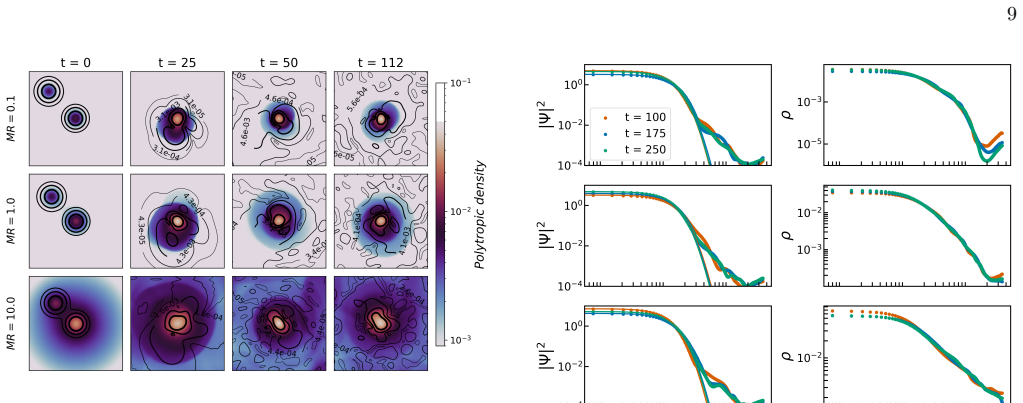
We study binary mergers of dark matter cores in the Bose-Einstein condensate (BECDM) model. We include two scenarios: scalar self-interaction and the presence of a gravitationally coupled ideal gas. Using 3D simulations of the Gross-Pitaevskii-Poisson and Schr\"odinger-Poisson-Euler systems, we analyze the properties of the resulting remnants. We find that the final core-mass ratio reaches a stable average value after the merger. Repulsive self-interaction increases the mass of the final solitonic core, while attractive interaction enhances mass loss. In mergers involving an ideal gas, namely of fermion-boson stars, a stable solitonic core always forms in the bosonic component, even when the gas dominates, whereas the gas itself does not form a compact core. We explain these results using energy scalings and find that without self-interaction, equilibrium cores follow $E \propto -M^3$, which leads to an almost universal merger fraction. Self-interaction changes this scaling, because repulsive $g$ moves the system toward a milder $E \propto -M^2$ scaling and increases mass retention, while attractive $g$ strengthens binding and favors mass ejection. In the case of interaction with an ideal gas, this component only modifies the gravitational background and does not change the intrinsic scaling of the bosonic part. These results show that the merger outcome is not universal but controlled by the interaction strength, while solitonic BECDM cores remain robust across diverse environments including gas.
Editorial analysis
A structured set of objections, weighed in public.
Referee Report
Summary. The manuscript studies binary mergers of bosonic dark matter cores in the BECDM model via 3D simulations of the Gross-Pitaevskii-Poisson and Schrödinger-Poisson-Euler systems, including scalar self-interaction and a gravitationally coupled ideal gas. It reports that the final core-mass ratio reaches a stable average value, repulsive self-interaction increases the mass of the final solitonic core while attractive interaction enhances mass loss, and an ideal gas component always yields a stable bosonic core. These outcomes are explained by energy scalings: without self-interaction, equilibrium cores obey E ∝ −M³ leading to an almost universal merger fraction; repulsive g shifts toward E ∝ −M² and increases retention, while attractive g strengthens binding and favors ejection; the ideal gas only modifies the gravitational background without altering the bosonic scaling.
Significance. If the energy-scaling explanation is confirmed, the work provides a useful framework for predicting how self-interactions control merger outcomes and core retention in fuzzy dark matter, with potential implications for halo structure and the robustness of solitonic cores across environments. The direct simulation of full GPP/SPE dynamics to connect to analytic scalings is a positive feature.
major comments (1)
- [Energy scaling discussion and results section] The central explanatory claim—that E ∝ −M³ (no self-interaction) produces an almost universal merger fraction while repulsive g shifts the system toward E ∝ −M² and increases retention—requires that the final bosonic core, after mass ejection and relaxation, obeys exactly the same ground-state energy-mass relation used for isolated equilibria. The simulations evolve the full dynamical system, yet the argument treats the remnant as having relaxed to the equilibrium branch; without direct verification (e.g., computing E(M) for post-merger cores and comparing to the isolated scaling), the mapping from scaling to observed mass ratio remains untested.
minor comments (1)
- [Results] The abstract and text refer to 'stable average value' for the core-mass ratio; quantitative measures of stability (e.g., time evolution plots or variance across runs) would strengthen this statement.
Simulated Author's Rebuttal
We thank the referee for their constructive review and for recognizing the potential utility of the energy-scaling framework. We address the single major comment below and will revise the manuscript accordingly to strengthen the connection between simulations and analytic relations.
read point-by-point responses
-
Referee: The central explanatory claim—that E ∝ −M³ (no self-interaction) produces an almost universal merger fraction while repulsive g shifts the system toward E ∝ −M² and increases retention—requires that the final bosonic core, after mass ejection and relaxation, obeys exactly the same ground-state energy-mass relation used for isolated equilibria. The simulations evolve the full dynamical system, yet the argument treats the remnant as having relaxed to the equilibrium branch; without direct verification (e.g., computing E(M) for post-merger cores and comparing to the isolated scaling), the mapping from scaling to observed mass ratio remains untested.
Authors: We agree that explicit verification of the post-merger energy-mass relation would make the explanatory argument more robust. In the revised manuscript we will add a new panel (or subsection) that extracts the total energy E and enclosed mass M of the relaxed bosonic cores from the simulation snapshots at late times and directly overlays these points on the analytic E(M) curves derived from the isolated equilibrium equations for each interaction case. Preliminary analysis performed during the original study already shows that the remnants lie on the expected branches within numerical tolerance, consistent with the observed density profiles and the reported mass-retention trends; we will document this comparison explicitly. revision: yes
Circularity Check
No significant circularity in derivation chain
full rationale
The paper's primary results are obtained from independent 3D numerical simulations of the Gross-Pitaevskii-Poisson and Schrödinger-Poisson-Euler systems for binary mergers. The energy-mass relations (E ∝ −M³ without self-interaction, modified to E ∝ −M² with repulsive g) are derived by solving the stationary equilibrium equations for isolated cores, a separate step that does not use merger data as input. The subsequent explanation connects observed post-merger mass ratios to these scalings but does not redefine or refit the scalings from the merger outcomes themselves. No load-bearing step reduces by construction to a fit, self-citation, or ansatz imported from the present work; the simulations remain falsifiable against the equilibrium scalings rather than tautological with them.
Axiom & Free-Parameter Ledger
free parameters (1)
- self-interaction strength g
axioms (2)
- domain assumption Equilibrium cores obey E proportional to minus M cubed in the absence of self-interaction
- domain assumption Gross-Pitaevskii-Poisson system accurately describes the bosonic dark-matter dynamics
Lean theorems connected to this paper
-
IndisputableMonolith/Cost/FunctionalEquation.leanwashburn_uniqueness_aczel echoes?
echoesECHOES: this paper passage has the same mathematical shape or conceptual pattern as the Recognition theorem, but is not a direct formal dependency.
without self-interaction, equilibrium cores follow E∝−M^3, which leads to an almost universal merger fraction... repulsive g moves the system toward a milder E∝−M^2 scaling
-
IndisputableMonolith/Foundation/BranchSelection.leanbranch_selection echoes?
echoesECHOES: this paper passage has the same mathematical shape or conceptual pattern as the Recognition theorem, but is not a direct formal dependency.
For a ground-state solution... K∼M/r_c^2, W∼−M^2/r_c, rc∝M^{-1}... Ec∝−M^3_c
What do these tags mean?
- matches
- The paper's claim is directly supported by a theorem in the formal canon.
- supports
- The theorem supports part of the paper's argument, but the paper may add assumptions or extra steps.
- extends
- The paper goes beyond the formal theorem; the theorem is a base layer rather than the whole result.
- uses
- The paper appears to rely on the theorem as machinery.
- contradicts
- The paper's claim conflicts with a theorem or certificate in the canon.
- unclear
- Pith found a possible connection, but the passage is too broad, indirect, or ambiguous to say the theorem truly supports the claim.
Reference graph
Works this paper leans on
-
[1]
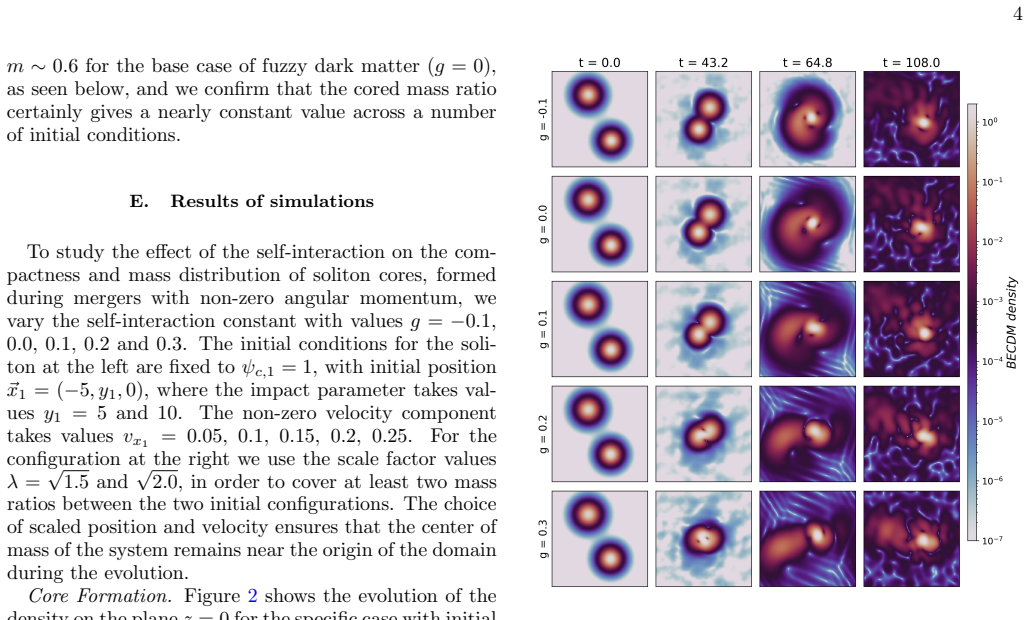
As the system continues to evolve, a diffuse halo forms around the central core, which resembles gravita- tional cooling (see [14] forg= 0 and [15] forg̸= 0) of the core. The resulting configuration exhibits the dense central solitonic core embedded within a slowly decaying halo. These solitonic cores remain stable for all values of g, confirming consiste...
-
[2]
Caseg= 0 Let us consider theg= 0 case and seek a physical explanation for the emergence of a nearly universal final core mass fraction in binary mergers. For a ground-state solution of the GPP system, which is virialized, the total energy satisfiesE=K+W=−K= 1 2 W. Combining this with the scaling relation between core mass and ra- diusM c rc = const, and u...
-
[3]
Generalization tog̸= 0 The previous case is based on the cubic scaling of the energy with the massE sol ∝ −M 3. When self- interaction is included, the structure of the equilibrium solution changes and so does the mass-energy scaling re- lation. For the GPP system, the total energy contains now three contributions,E=K+W+I, whereK∼ M r2c , W∼ − M 2 rc ,I∼ ...
work page 2025
-
[4]
A Fur- ther analysis of a cosmological model of quintessence and scalar dark matter,
Tonatiuh Matos and L. Arturo Urena-Lopez, “A Fur- ther analysis of a cosmological model of quintessence and scalar dark matter,” Phys. Rev. D63, 063506 (2001)
work page 2001
-
[5]
Wayne Hu, Rennan Barkana, and Andrei Gruzinov, “Cold and fuzzy dark matter,” Phys. Rev. Lett.85, 1158– 1161 (2000)
work page 2000
-
[6]
Ultralight scalars as cosmological dark matter,
Lam Hui, Jeremiah P. Ostriker, Scott Tremaine, and Edward Witten, “Ultralight scalars as cosmological dark matter,” Phys. Rev. D95, 043541 (2017)
work page 2017
-
[7]
Cosmic Structure as the Quantum Interference of a Coherent Dark Wave
Hsi-Yu Schive, Tzihong Chiueh, and Tom Broadhurst, “Cosmic Structure as the Quantum Interference of a Co- herent Dark Wave,” Nature Phys.10, 496–499 (2014), arXiv:1406.6586 [astro-ph.GA]
work page internal anchor Pith review Pith/arXiv arXiv 2014
-
[8]
Galaxy Formation with BECDM: I. Turbulence and relaxation of idealised haloes
Philip Mocz, Mark Vogelsberger, Victor H. Robles, Jesus Zavala, Michael Boylan-Kolchin, Anastasia Fi- alkov, and Lars Hernquist, “Galaxy formation with BECDM I. Turbulence and relaxation of idealized haloes,” Mon. Not. Roy. Astron. Soc.471, 4559–4570 (2017), arXiv:1705.05845 [astro-ph.CO]
work page internal anchor Pith review Pith/arXiv arXiv 2017
-
[9]
Jan Veltmaat, Jens C. Niemeyer, and Bodo Schwabe, “Formation and structure of ultralight bosonic dark mat- ter halos,” Physical Review D98(2018), 10.1103/phys- revd.98.043509
-
[10]
The impact of ultra-light axion self-interactions on the large scale structure of the Universe
Vincent Desjacques, Alex Kehagias, and Antonio Riotto, “Impact of ultralight axion self-interactions on the large scale structure of the Universe,” Phys. Rev. D97, 023529 (2018), arXiv:1709.07946 [astro-ph.CO]
work page internal anchor Pith review Pith/arXiv arXiv 2018
-
[11]
Deep zoom-in simulation of a fuzzy dark matter galactic halo,
Bodo Schwabe and Jens C. Niemeyer, “Deep zoom-in simulation of a fuzzy dark matter galactic halo,” Phys. Rev. Lett.128, 181301 (2022)
work page 2022
-
[12]
Evolution of the schr¨ odinger-newton system for a self-gravitating scalar field,
F. S. Guzm´ an and L. Arturo Ure˜ na L´ opez, “Evolution of the schr¨ odinger-newton system for a self-gravitating scalar field,” Phys. Rev. D69, 124033 (2004)
work page 2004
-
[13]
Scalar field dark mat- ter: Nonspherical collapse and late-time behavior,
Argelia Bernal and F. S. Guzm´ an, “Scalar field dark mat- ter: Nonspherical collapse and late-time behavior,” Phys- ical Review D74(2006), 10.1103/physrevd.74.063504
-
[14]
Scalar field dark mat- ter: Head-on interaction between two structures,
Argelia Bernal and F. S. Guzm´ an, “Scalar field dark mat- ter: Head-on interaction between two structures,” Phys- ical Review D74(2006), 10.1103/physrevd.74.103002
-
[15]
Interference of dark matter solitons and galactic offsets,
Angel Paredes and Humberto Michinel, “Interference of dark matter solitons and galactic offsets,” Physics of the Dark Universe12, 50–55 (2016)
work page 2016
-
[16]
Simulations of solitonic core mergers in ultra-light axion dark matter cosmologies
Bodo Schwabe, Jens C. Niemeyer, and Jan F. Engels, “Simulations of solitonic core mergers in ultralight ax- ion dark matter cosmologies,” Phys. Rev. D94, 043513 (2016), arXiv:1606.05151 [astro-ph.CO]
work page internal anchor Pith review Pith/arXiv arXiv 2016
-
[17]
Formation of solitonic stars through gravitational cooling,
Edward Seidel and Wai-Mo Suen, “Formation of solitonic stars through gravitational cooling,” Phys. Rev. Lett.72, 2516–2519 (1994)
work page 1994
-
[18]
Gravita- tional cooling of self-gravitating bose condensates,
F. S. Guzm´ an and L. Arturo Ure˜ na L´ opez, “Gravita- tional cooling of self-gravitating bose condensates,” The Astrophysical Journal645, 814–819 (2006)
work page 2006
-
[19]
Effect of boundary conditions on structure for- mation in fuzzy dark matter,
Iv´ an´Alvarez-Rios, Francisco S. Guzm´ an, and Paul R. Shapiro, “Effect of boundary conditions on structure for- mation in fuzzy dark matter,” Phys. Rev. D107, 123524 (2023)
work page 2023
-
[20]
Modi- fying pyultralight to model scalar dark matter with self- interactions,
Noah Glennon and Chanda Prescod-Weinstein, “Modi- fying pyultralight to model scalar dark matter with self- interactions,” Phys. Rev. D104, 083532 (2021)
work page 2021
-
[21]
Single and merger soliton dynamics in scalar field dark matter with and without self-interactions,
Matthias Stallovits and Tanja Rindler-Daller, “Single and merger soliton dynamics in scalar field dark matter with and without self-interactions,” Phys. Rev. D111, 023046 (2025)
work page 2025
-
[22]
Cosmological evolution of a complex scalar field with repulsive or attractive self-interaction
Abril Su´ arez and Pierre-Henri Chavanis, “Cosmologi- cal evolution of a complex scalar field with repulsive or attractive self-interaction,” Phys. Rev. D95, 063515 (2017), arXiv:1608.08624 [gr-qc]
work page internal anchor Pith review Pith/arXiv arXiv 2017
-
[23]
Philip Mocz, Anastasia Fialkov, Mark Vogelsberger, Michael Boylan-Kolchin, Pierre-Henri Chavanis, Mustafa A. Amin, Sownak Bose, Tibor Dome, Lars Hernquist, Lachlan Lancaster, Matthew Notis, Connor Painter, Victor H. Robles, and Jesus Zavala, “Cosmo- logical structure formation and soliton phase transition in fuzzy dark matter with axion self-interactions,” (2023)
work page 2023
-
[24]
Fermion-boson stars as attractors in fuzzy dark matter and ideal gas dynamics,
Iv´ an Alvarez-Rios, Francisco S. Guzm´ an, and Jens Niemeyer, “Fermion-boson stars as attractors in fuzzy dark matter and ideal gas dynamics,” Phys. Rev. Lett. 135, 161003 (2025)
work page 2025
-
[25]
Station- ary solutions of the schr¨ odinger-poisson-euler system and their stability,
Iv´ an Alvarez-Rios and Francisco S. Guzm´ an, “Station- ary solutions of the schr¨ odinger-poisson-euler system and their stability,” Physics Letters B843, 137984 (2023)
work page 2023
-
[26]
A.B. Henriques, Andrew R. Liddle, and R.G. Moor- house, “Combined boson-fermion stars,” Physics Letters 12 B233, 99–106 (1989)
work page 1989
-
[27]
Stability of boson-fermion stars,
A.B. Henriques, Andrew R. Liddle, and R.G. Moor- house, “Stability of boson-fermion stars,” Physics Letters B251, 511–516 (1990)
work page 1990
-
[28]
R. Ruffini and S. Bonazzola, “Systems of self-gravitating particles in general relativity and the concept of an equa- tion of state,” Phys. Rev.187, 1767–1783 (1969)
work page 1969
-
[29]
Carlos Tena-Contreras, Iv´ an Alvarez-R´ ıos, and Fran- cisco S. Guzm´ an, “Construction of ground-state solutions of the gross pitaevskii poisson system using genetic algo- rithms,” Universe10(2024), 10.3390/universe10080309
-
[30]
New insights into the formation and growth of boson stars in dark matter ha- los,
Jiajun Chen, Xiaolong Du, Erik W. Lentz, David J. E. Marsh, and Jens C. Niemeyer, “New insights into the formation and growth of boson stars in dark matter ha- los,” Phys. Rev. D104, 083022 (2021)
work page 2021
-
[31]
Iv´ an Alvarez-R´ ıos and Francisco S. Guzm´ an, “Construc- tion and Evolution of Equilibrium Configurations of the Schr¨ odinger–Poisson System in the Madelung Frame,” Universe8, 432 (2022), arXiv:2210.15608 [gr-qc]
-
[32]
Merger of galactic cores made of ultralight bosonic dark matter,
F. S. Guzm´ an, I. Alvarez-R´ ıos, and J. A. Gonz´ alez, “Merger of galactic cores made of ultralight bosonic dark matter,” Rev. Mex. Fis.67, 75–83 (2021)
work page 2021
-
[33]
Bracketing the soliton-halo relation of ultralight dark matter,
Kfir Blum, Marco Gorghetto, Edward Hardy, and Luca Teodori, “Bracketing the soliton-halo relation of ultralight dark matter,” JCAP2025, 050 (2025), arXiv:2504.16202 [astro-ph.CO]
-
[34]
Explo- ration of simple scenarios involving fuzzy dark matter cores and gas at local scales,
Iv´ an´Alvarez-Rios and Francisco S Guzm´ an, “Explo- ration of simple scenarios involving fuzzy dark matter cores and gas at local scales,” Monthly Notices of the Royal Astronomical Society518, 3838–3849 (2022)
work page 2022
- [35]
discussion (0)
Sign in with ORCID, Apple, or X to comment. Anyone can read and Pith papers without signing in.