REVIEW 3 major objections 4 minor 2 cited by
Financial AI agents should be judged on whether their tool calls respect timeliness, intent, and regulatory domain, and this paper's 760-tool benchmark makes such violations measurable.
Reviewed by Pith at T0; open to challenge. T0 means a machine referee read the full paper against a public rubric. the ladder, T0–T4 →
T0 review · deepseek-v4-flash
2026-08-04 05:49 UTC pith:6X2Z7TGA
load-bearing objection A genuinely useful executable financial tool library and question set, wrapped in a compliance-evaluation framework that still needs validation before its headline numbers can be trusted. the 3 major comments →
FinToolBench: Evaluating LLM Agents for Real-World Financial Tool Use
The pith
A machine-rendered reading of the paper's core claim, the machinery that carries it, and where it could break.
Core claim
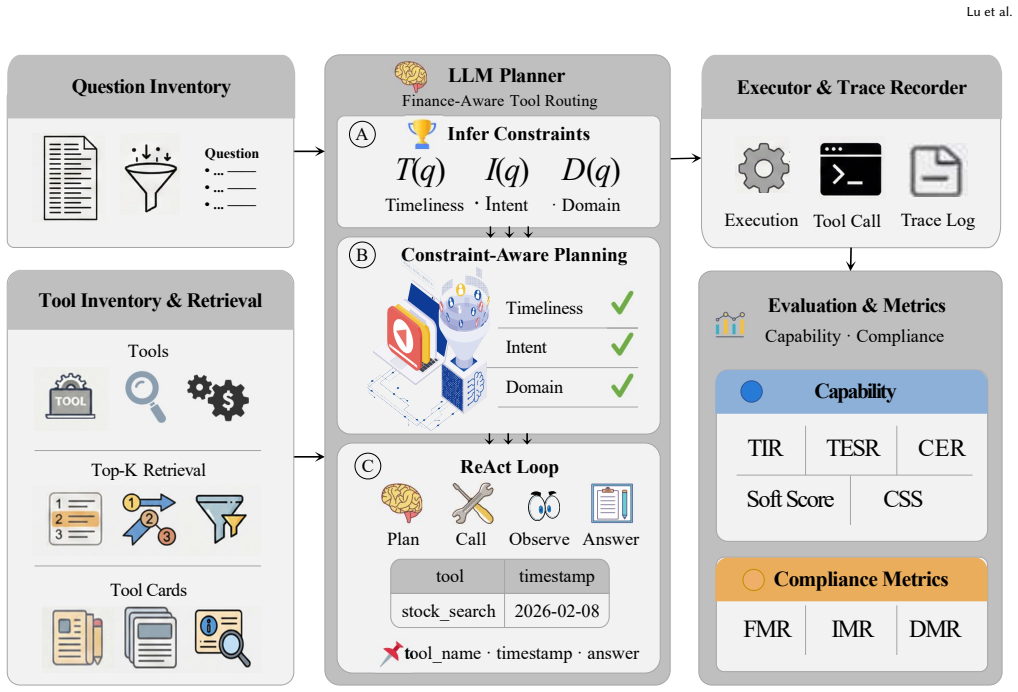
On its own terms, the paper's central discovery is that finance-specific acceptability can be defined call-by-call and measured from execution traces. Each of the 760 tools carries three finance attributes—timeliness, intent type, and regulatory domain—and the evaluation records every tool call as an auditable trace entry. An LLM judge then marks each call as matched or mismatched to the question on each attribute; if any call in a trace violates a dimension, the question is counted as mismatched, yielding TMR, IMR, and DMR. The reported runs show no planner that is both eager and reliable: one backend invokes tools often but fails execution, another is conservative and precise, and the FATR
What carries the argument
The load-bearing machinery is the tool-trace plus finance-attribute schema. Every tool is annotated with three attributes—timeliness (realtime/daily/as_filed/periodic/static), intent type (informational/advisory/transactional), and a set-valued regulatory domain—and every evaluation run logs a structured trace recording step, tool name, parameters, output, and error. From a trace, judge functions assess per-call alignment in each dimension, and the paper aggregates them into question-level mismatch rates TMR, IMR, and DMR. FATR operationalizes the same schema at planning time by retrieving a small candidate set, formatting tool cards with the finance tags, inferring the question's constraint
Load-bearing premise
Everything the paper's compliance numbers say depends on the automated judge's per-call verdicts about timeliness, intent, and regulatory domain matching what a financial compliance expert would decide; the paper reports only spot-check human QA and no direct agreement measurement.
What would settle it
Have a panel of financial-compliance experts independently label a random sample of 50–100 tool traces as compliant or violating timeliness, intent restraint, and regulatory-domain alignment, and compare their verdicts with the judge outputs behind Eq. (1); if agreement is at chance on any dimension, the reported TMR/IMR/DMR rates measure the judge rather than the agents. In parallel, rerun the main protocol across multiple seeds to check whether model rankings change more than run-to-run variance.
If this is right
- Two agents with identical tool-execution success can now be separated by their compliance: TMR/IMR/DMR expose whether the trace used stale data, escalated beyond intent, or crossed market domains.
- Because the benchmark is executable end-to-end on free-tier tools, the same 295 queries can serve as a shared regression suite for financial agents across model versions and providers.
- Attribute injection changes planner behavior: FATR with finance tags lowers tool invocation slightly but raises conditional execution success and cuts mismatch rates, indicating that making constraints salient improves tool choice rather than executor stability.
- The capability/compliance split converts diagnosis from a single pass/fail into a distinction between 'cannot call tools' and 'called the wrong kind of tool'.
- The category-level breakdown shows that aggregate scores hide strong heterogeneity, so deployment decisions may need per-category compliance budgets rather than one global number.
Where Pith is reading between the lines
- If the compliance layer survives a human-agreement check, the benchmark's attribute schema is a template for other regulated domains—healthcare, legal, or public administration—where stale, out-of-scope, or unrequested actions carry similar risks.
- Because the 760 tools are live free-tier APIs, the benchmark could detect tool drift: re-running the same queries months apart would quantify how much of an agent's failures come from endpoints changing, a dimension the paper leaves to future work.
- The reported trade-off between coverage and precision suggests a deployment calibration: a planner's invocation threshold should be tuned against the relative cost of a wrong-but-tool-backed answer versus a missed answer—an axis the paper does not quantify.
- Given the paper's own acknowledgement that LLM judges can be unstable, a natural next step is to publish a human-agreement study on the judge labels and seed variance for the main results table.
Editorial analysis
A structured set of objections, weighed in public.
Referee Report
Summary. FinToolBench introduces a runnable benchmark for financial tool-use agents, coupling 760 executable free-tier tools (RapidAPI and AkShare) with 295 tool-required questions derived from FinanceBench and OpenFinData. Each tool is annotated with three finance attributes—timeliness, intent type, and regulatory domain—via a Qwen3-8B three-vote majority protocol. The evaluation separates capability metrics (TIR, TESR, CER, Soft Score, CSS) from compliance mismatch rates (TMR, IMR, DMR), with compliance scored by a GPT-5.1 judge checking each tool call's attributes against the question. The paper also proposes FATR, a finance-aware retrieval and ReAct-planning baseline that injects finance attributes into tool cards and adds execution stabilization. Experiments compare four LLM planners and an attribute-injection ablation, reporting trade-offs between coverage, execution reliability, and compliance, with case studies showing that attribute injection changes tooling behavior but does not guarantee final-answer correctness.
Significance. The benchmark construction is concrete and audit-friendly: the staged pipeline, rule-based executability filters (Appendix A), normalized manifest, and detailed trace schema (Table 2) are valuable assets. The case studies in Appendix I are a real strength, honestly showing that FATR can produce cleaner traces while still failing on numeric fidelity or task framing. If the compliance layer were externally validated, FinToolBench would fill a genuine gap as a standard, trace-level testbed for financial tool-use agents. However, the paper's central contribution—measuring timeliness, intent, and regulatory-domain compliance—currently rests on unvalidated LLM-generated labels and a single-run LLM judge, and all agent results are reported without seed variance. The significance is therefore conditional: the infrastructure is promising, but the metric validity and statistical reliability need to be established before the benchmark can support comparative conclusions.
major comments (3)
- [§3.2.4, §B.2, Eq. (1), §5.4] The compliance metrics TMR/IMR/DMR are computed by GPT-5.1 judging each tool call against tool attributes that were produced by Qwen3-8B majority vote from tool names and descriptions. No human agreement statistics, calibration, or error analysis are reported for either the attribute labels or the judge decisions. The human spot-check in §3.2.4 mentions a 'statistically significant sample' but provides no sample size, measured agreement, or protocol details. Given that §2.3 itself cites LLM-judge instability, relying on a single un-repeated GPT-5.1 decision per call (§5.4) is a serious risk. Without external validation against domain experts, the advertised TMR/IMR/DMR numbers may reflect agreement with the pipeline's own labels rather than finance acceptability. This is load-bearing for the benchmark's central claim and needs to be addressed with a human-agreement study, label-validity
- [§4.2, §6.2, Eq. (1)] FATR's compliance benefit is in part circular: FATR injects finance tags into tool cards, and the compliance judge checks exactly those tags when computing mismatch rates. A planner that follows the prompt rule 'informational > advisory; avoid transactional' can trivially lower IMR without necessarily improving true compliance. To establish that the TMR/IMR/DMR reductions in Figure 5 are not an artifact of shared label injection, the authors should run ablations with corrupted or permuted tags, blind the judge to the injected tool-card text, or compare against human-validated labels. Without such tests, the claim that attribute injection 'improves compliance alignment' is not identifiable from the reported experiments.
- [Table 3, §5.1, §5.4] All results in Table 3 are single-run, with no seed variance, confidence intervals, or error bars. Given that LLM planners are stochastic and that §2.3 argues LLM judges are unstable, the observed model differences (e.g., TIR 0.4407 vs. 0.2267, IMR 0.5000 vs. 0.7231) may be within run-to-run noise. The comparison between model backends and the FATR ablation needs at least 3–5 independent runs per condition with standard errors, and the compliance judge should either be repeated or accompanied by an agreement measure. This is necessary to support the paper's comparative conclusions.
minor comments (4)
- [§3.4, Eq. (1), D.2] The notation for the compliance judge is inconsistent: Eq. (1) writes J_T(q, A(t_k), τ_k), while D.2 defines J_T(q, t_k, x_k, o_k, T(t_k)). Please unify the notation and state explicitly what context the judge receives (question, tool name, arguments, output, and attribute tag).
- [Figure 7] The heatmap column header reads 'FMR' but the metric is called TMR in the text. Please correct the label.
- [§3.2.4] The phrase 'statistically significant sample' should either be backed with the sample size and the statistical test used, or softened to 'a spot-check sample' to avoid overstating the nature of the human audit.
- [§5.4] The decision to use a single judge decision per tool call for compliance is stated without justification, despite three repeats being used for Soft Score. Please explain and, if possible, report repeat agreement on a small sample.
Circularity Check
No significant circularity: compliance metrics are an operational definition, and FATR's use of the same attribute tags is a deliberate treatment, not a reduction of the result to its inputs.
full rationale
FinToolBench is an empirical benchmark paper rather than a derivation chain, and no central claim reduces to its own inputs by construction. The compliance metrics in Eq. (1) are operationally defined: TMR/IMR/DMR state that a question is mismatched when an LLM judge, looking at tool metadata A(t), finds a call inconsistent with the question's timeliness, intent, or domain requirement. FATR injects those same attribute tags into tool cards and instructs the planner to prefer tags that match the inferred requirements. This is the intended intervention, not circularity: the judge evaluates the resulting tool trace, and FATR improves compliance by making the labels salient to the planner. The labels themselves are produced by Qwen3-8B majority vote (§B.2) and judge decisions are not accompanied by human-agreement statistics, which is a real validity concern for the benchmark's external meaning, but it is not a circular step under the required standard of exhibiting an equation or fitted parameter that is equivalent to its input. The paper's self-citations (e.g., [13], [17], [25], [27]) appear only as related-work context and are not load-bearing for the benchmark's construction or evaluation claims. Appendix I further shows that attribute injection does not mechanically guarantee correctness, indicating the evaluation is not trivially gaming its own judge. Therefore, no significant circularity is present; the unvalidated label/judge pipeline should be assessed as a measurement-validity limitation, not as circular reasoning.
Axiom & Free-Parameter Ledger
free parameters (4)
- Top-K retrieval candidate set =
20
- Interaction horizon max_steps =
5
- Execution budget per call =
60s timeout, 2 retries
- Vote/threshold constants =
3 samples majority (≥2 votes) in construction; 3 judge repeats for Soft Score; 1 judge decision per compliance call
axioms (5)
- domain assumption GPT-5.1 judge output approximates human/regulatory truth for both correctness and compliance without calibration
- domain assumption Qwen3-8B majority-vote finance attribute annotations are correct
- domain assumption Qwen3-8B tool-required filtering and tool-question alignment are valid
- domain assumption Free-tier APIs remain executable and stable after construction
- domain assumption FinanceBench/OpenFinData gold answers are correct scoring targets
invented entities (1)
-
None
no independent evidence
read the original abstract
The integration of Large Language Models (LLMs) into the financial domain is driving a paradigm shift from passive information retrieval to dynamic, agentic interaction. While general-purpose tool learning has witnessed a surge in benchmarks, the financial sector, characterized by high stakes, strict compliance, and rapid data volatility, remains critically underserved. Existing financial evaluations predominantly focus on static textual analysis or document-based QA, ignoring the complex reality of tool execution. Conversely, general tool benchmarks lack the domain-specific rigor required for finance, often relying on toy environments or a negligible number of financial APIs. To bridge this gap, we introduce FinToolBench, the first real-world, runnable benchmark dedicated to evaluating financial tool learning agents. Unlike prior works limited to a handful of mock tools, FinToolBench establishes a realistic ecosystem coupling 760 executable financial tools with 295 rigorous, tool-required queries. We propose a novel evaluation framework that goes beyond binary execution success, assessing agents on finance-critical dimensions: timeliness, intent type, and regulatory domain alignment. Furthermore, we present FATR, a finance-aware tool retrieval and reasoning baseline that enhances stability and compliance. By providing the first testbed for auditable, agentic financial execution, FinToolBench sets a new standard for trustworthy AI in finance. The tool manifest, execution environment, and evaluation code will be open-sourced to facilitate future research.
Figures




Forward citations
Cited by 2 Pith papers
-
FinTrace: Holistic Trajectory-Level Evaluation of LLM Tool Calling for Long-Horizon Financial Tasks
FinTrace supplies trajectory-level metrics for LLM financial tool calling, exposing gaps in information use and output quality, while its preference dataset enables DPO training that boosts intermediate metrics.
-
The Alpha Illusion: Reported Alpha from LLM Trading Agents Should Not Be Treated as Deployment Evidence
Reported alpha from end-to-end LLM trading agents does not constitute deployment evidence until it passes structural tests for temporal integrity, frictions, robustness, calibration, execution, and disaggregation.
Reference graph
Works this paper leans on
-
[1]
2025.𝜏 2-bench: Evaluating conversational agents in a dual-control environment
Victor Barres, Honghua Dong, Soham Ray, Xujie Si, and Karthik R Narasimhan. 2025.𝜏 2-bench: Evaluating conversational agents in a dual-control environment. arXiv preprint arXiv:2506.07982(2025)
Pith/arXiv arXiv 2025
-
[2]
Antoine Bigeard, Langston Nashold, Rayan Krishnan, and Shirley Wu. 2025. Finance agent benchmark: Benchmarking LLMs on real-world financial research tasks.arXiv preprint arXiv:2508.00828(2025)
Pith/arXiv arXiv 2025
-
[3]
Jianlv Chen, Shitao Xiao, Peitian Zhang, Kun Luo, Defu Lian, and Zheng Liu. 2024. BGE M3-Embedding: Multi-lingual, multi-functionality, multi-granularity text embeddings through self-knowledge distillation.arXiv preprint arXiv:2402.03216 (2024)
Pith/arXiv arXiv 2024
-
[4]
Zhiyu Chen, Wenhu Chen, Charese Smiley, Sameena Shah, Iana Borova, Dylan Langdon, Reema Moussa, Matt Beane, Ting-Hao Huang, Bryan R Routledge, and William Yang Wang. 2021. FinQA: A dataset of numerical reasoning over financial data. InProceedings of the 2021 Conference on Empirical Methods in Natural Language Processing, Marie-Francine Moens, Xuanjing Hua...
2021
-
[5]
Alexandre Drouin, Maxime Gasse, Massimo Caccia, Issam H Laradji, Manuel Del Verme, Tom Marty, Léo Boisvert, Megh Thakkar, Quentin Cappart, David Vazquez, et al. 2024. WorkArena: How capable are web agents at solving common knowledge work tasks?arXiv preprint arXiv:2403.07718(2024)
Pith/arXiv arXiv 2024
-
[6]
Jennifer D’Souza, Hamed Babaei Giglou, and Quentin Münch. 2025. YESciEval: Robust LLM-as-a-judge for scientific question answering. InProceedings of the 63rd Annual Meeting of the Association for Computational Linguistics (Volume 1: Long Papers). Association for Computational Linguistics, 13749–13783
2025
-
[7]
Jiayu Guo, Yu Guo, Martha Li, and Songtao Tan. 2025. FLAME: Financial large-language model assessment and metrics evaluation.arXiv preprint arXiv:2501.06211(2025)
Pith/arXiv arXiv 2025
-
[8]
Xin Guo, Haotian Xia, Zhaowei Liu, Hanyang Cao, Zhi Yang, Zhiqiang Liu, Sizhe Wang, Jinyi Niu, Chuqi Wang, Yanhui Wang, Xiaolong Liang, Xiaoming Huang, Bing Zhu, Zhongyu Wei, Yun Chen, Weining Shen, and Liwen Zhang
-
[9]
Zhicheng Guo, Sijie Cheng, Hao Wang, Shihao Liang, Yujia Qin, Peng Li, Zhiyuan Liu, Maosong Sun, and Yang Liu. 2024. StableToolBench: Towards stable large- scale benchmarking on tool learning of large language models.arXiv preprint arXiv:2403.07714(2024)
Pith/arXiv arXiv 2024
-
[10]
Rajarshi Haldar and Julia Hockenmaier. 2025. Rating Roulette: Self-inconsistency in LLM-as-a-judge frameworks. InFindings of the Association for Computational Linguistics: EMNLP 2025. Association for Computational Linguistics, 24986– 25004
2025
-
[11]
Helia Hashemi, Jason Eisner, Corby Rosset, Benjamin Van Durme, and Chris Kedzie. 2024. LLM-Rubric: A multidimensional, calibrated approach to automated evaluation of natural language texts. InProceedings of the 62nd Annual Meeting of the Association for Computational Linguistics (Volume 1: Long Papers). Association for Computational Linguistics, 13806–13834
2024
-
[12]
Pranab Islam, Anand Kannappan, Douwe Kiela, Rebecca Qian, Nino Scherrer, and Bertie Vidgen. 2023. FinanceBench: A new benchmark for financial question answering.arXiv preprint arXiv:2311.11944(2023)
Pith/arXiv arXiv 2023
-
[13]
Yankai Jiang, Wenjie Lou, Lilong Wang, Zhenyu Tang, Shiyang Feng, Jiaxuan Lu, Haoran Sun, Yaning Pan, Shuang Gu, Haoyang Su, Feng Liu, Wangxu Wei, Pan Tan, Dongzhan Zhou, Fenghua Ling, Cheng Tan, Bo Zhang, Xiaosong Wang, Lei Bai, and Bowen Zhou. 2025. SCP: Accelerating discovery with a global web of autonomous scientific agents.arXiv preprint arXiv:2512.2...
arXiv 2025
-
[14]
Minghao Li, Yingxiu Zhao, Bowen Yu, Feifan Song, Hangyu Li, Haiyang Yu, Zhoujun Li, Fei Huang, and Yongbin Li. 2023. API-Bank: A comprehensive benchmark for tool-augmented LLMs.arXiv preprint arXiv:2304.08244(2023)
Pith/arXiv arXiv 2023
-
[15]
Xiao Liu, Hao Yu, Hanchen Zhang, Yifan Xu, Xuanyu Lei, Hanyu Lai, Yu Gu, Hangliang Ding, Kaiwen Men, Kejuan Yang, et al . 2024. AgentBench: Evalu- ating LLMs as agents. InInternational Conference on Learning Representations. arXiv:2308.03688
Pith/arXiv arXiv 2024
-
[16]
Yang Liu, Dan Iter, Yichong Xu, Shuohang Wang, Ruochen Xu, and Chenguang Zhu. 2023. G-Eval: NLG evaluation using GPT-4 with better human alignment. arXiv preprint arXiv:2303.16634(2023)
Pith/arXiv arXiv 2023
-
[17]
Jiaxuan Lu, Ziyu Kong, Yemin Wang, Rong Fu, Haiyuan Wan, Cheng Yang, Wenjie Lou, Haoran Sun, Lilong Wang, Yankai Jiang, Xiaosong Wang, Xiao Sun, and Dongzhan Zhou. 2026. Beyond Static Tools: Test-Time Tool Evolution for Scientific Reasoning.arXiv preprint arXiv:2601.07641(2026)
arXiv 2026
-
[18]
Grégoire Mialon, Clémentine Fourrier, Thomas Wolf, Yann LeCun, and Thomas Scialom. 2023. GAIA: a benchmark for general AI assistants.arXiv preprint arXiv:2311.12983(2023)
Pith/arXiv arXiv 2023
-
[19]
OpenFinData. 2024. OpenFinData: An Open Financial Evaluation Dataset. GitHub repository. Release v0.1.0; Accessed: 2026-02-07
2024
-
[20]
Shishir G Patil, Huanzhi Mao, Fanjia Yan, Charlie Cheng-Jie Ji, Vishnu Suresh, Ion Stoica, and Joseph E Gonzalez. 2025. The Berkeley Function Calling Leaderboard (BFCL): From Tool Use to Agentic Evaluation of Large Language Models. In Proceedings of the 42nd International Conference on Machine Learning (Proceedings of Machine Learning Research, Vol. 267)....
2025
-
[21]
Shishir G Patil, Tianjun Zhang, Xin Wang, and Joseph E Gonzalez. 2024. Go- rilla: Large language model connected with massive APIs.Advances in Neural Information Processing Systems37 (2024), 126544–126565
2024
-
[22]
Yujia Qin, Shihao Liang, Yining Ye, Kunlun Zhu, Lan Yan, Yaxi Lu, Yankai Lin, Xin Cong, Xiangru Tang, Bill Qian, et al . 2024. ToolLLM: Facilitating large language models to master 16,000+ real-world APIs. InInternational Conference on Learning Representations. arXiv:2307.16789
Pith/arXiv arXiv 2024
-
[23]
Timo Schick, Jane Dwivedi-Yu, Roberto Dessì, Roberta Raileanu, Maria Lomeli, Eric Hambro, Luke Zettlemoyer, Nicola Cancedda, and Thomas Scialom. 2023. Toolformer: Language models can teach themselves to use tools.Advances in Neural Information Processing Systems36 (2023), 68539–68551
2023
-
[24]
Ada Defne Tur, Nicholas Meade, Xing Han Lù, Alejandra Zambrano, Arkil Pa- tel, Esin Durmus, Spandana Gella, Karolina Stańczak, and Siva Reddy. 2025. SafeArena: Evaluating the safety of autonomous web agents.arXiv preprint arXiv:2503.04957(2025)
Pith/arXiv arXiv 2025
-
[25]
Haiyuan Wan, Chen Yang, Junchi Yu, Meiqi Tu, Jiaxuan Lu, Di Yu, Jianbao Cao, Ben Gao, Jiaqing Xie, Aoran Wang, Wenlong Zhang, Philip Torr, and Dongzhan Zhou. 2025. DeepResearch Arena: The first exam of LLMs’ research abilities via seminar-grounded tasks.arXiv preprint arXiv:2509.01396(2025)
arXiv 2025
-
[26]
Hongfei Xia, Hongru Wang, Zeming Liu, Qian Yu, Yuhang Guo, and Haifeng Wang. 2025. SafeToolBench: Pioneering a prospective benchmark to evaluating tool utilization safety in LLMs.arXiv preprint arXiv:2509.07315(2025)
Pith/arXiv arXiv 2025
-
[27]
Cheng Yang, Jiaxuan Lu, Haiyuan Wan, Junchi Yu, and Feiwei Qin. 2025. From What to Why: A multi-agent system for evidence-based chemical reaction con- dition reasoning.arXiv preprint arXiv:2509.23768(2025)
arXiv 2025
-
[28]
Shunyu Yao, Noah Shinn, Pedram Razavi, and Karthik R Narasimhan. 2024.𝜏- bench: A benchmark for tool-agent-user interaction in real-world domains.arXiv preprint arXiv:2406.12045(2024)
Pith/arXiv arXiv 2024
-
[29]
Shunyu Yao, Jeffrey Zhao, Dian Yu, Nan Du, Izhak Shafran, Karthik R Narasimhan, and Yuan Cao. 2023. ReAct: Synergizing reasoning and acting in language models. InInternational Conference on Learning Representations. arXiv:2210.03629
Pith/arXiv arXiv 2023
-
[30]
Qiyuan Zhang, Yufei Wang, Yuxin Jiang, Liangyou Li, Chuhan Wu, Yasheng Wang, Xin Jiang, Lifeng Shang, Ruiming Tang, Fuyuan Lyu, and Chen Ma. 2025. Crowd Comparative Reasoning: Unlocking comprehensive evaluations for LLM- as-a-judge.arXiv preprint arXiv:2502.12501(2025)
Pith/arXiv arXiv 2025
-
[31]
Lianmin Zheng, Wei-Lin Chiang, Ying Sheng, Siyuan Zhuang, Zhanghao Wu, Yonghao Zhuang, Zi Lin, Zhuohan Li, Dacheng Li, Eric Xing, et al. 2023. Judg- ing LLM-as-a-Judge with MT-Bench and Chatbot Arena.Advances in Neural Information Processing Systems36 (2023), 46595–46623. arXiv:2306.05685
Pith/arXiv arXiv 2023
-
[32]
Shuyan Zhou, Frank F Xu, Hao Zhu, Xuhui Zhou, Robert Lo, Abishek Sridhar, Xianyi Cheng, Tianyue Ou, Yonatan Bisk, Daniel Fried, et al. 2024. WebArena: A realistic web environment for building autonomous agents. InInternational Conference on Learning Representations. arXiv:2307.13854
Pith/arXiv arXiv 2024
-
[33]
Fengbin Zhu, Wenqiang Lei, Youcheng Huang, Chao Wang, Shuo Zhang, Jiancheng Lv, Fuli Feng, and Tat-Seng Chua. 2021. TAT-QA: A question an- swering benchmark on a hybrid of tabular and textual content in finance.arXiv preprint arXiv:2105.07624(2021). Lu et al. A Tool Curation Criteria This section spells out the criteria used to build the FinToolBench tool...
Pith/arXiv arXiv 2021
-
[35]
Function name: {func_name}
-
[36]
<RAPIDAPI_KEY>
Function parameters: - All input parameters: {param_str} - Additional fixed parameter: rapidapi_key: str = "<RAPIDAPI_KEY>"
-
[37]
Performance is not measured through operating margin
The function must: - Use requests to send the HTTP request - Use X-RapidAPI-Key and X-RapidAPI-Host in headers - Return response.json() if possible, otherwise return response.text - Do not explain anything. Output pure Python code only - Parameter names must exactly match the keys in the parameter dictionary (case sensitive) Description: {desc} Parameter ...
2022
-
[2025]
FinEval: A Chinese financial domain knowledge evaluation benchmark for large language models. InProceedings of the 2025 Conference of the Nations of the Americas Chapter of the Association for Computational Linguistics: Human Language Technologies (Volume 1: Long Papers), Luis Chiruzzo, Alan Ritter, and Lu Wang (Eds.). Association for Computational Lingui...
2025
discussion (0)
Sign in with ORCID, Apple, or X to comment. Anyone can read and Pith papers without signing in.