Recognition: 2 theorem links
· Lean TheoremCoupled-Layer Construction of Quantum Product Codes
Pith reviewed 2026-05-15 14:21 UTC · model grok-4.3
The pith
Quantum product codes arise by stacking one code and condensing excitations set by the other's checks.
A machine-rendered reading of the paper's core claim, the machinery that carries it, and where it could break.
Core claim
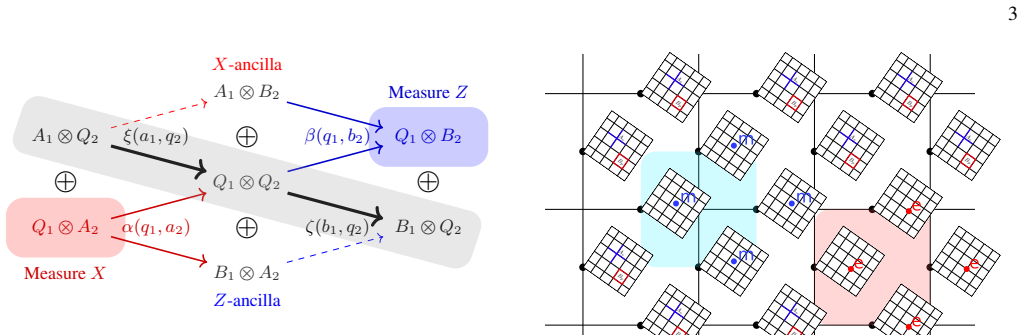
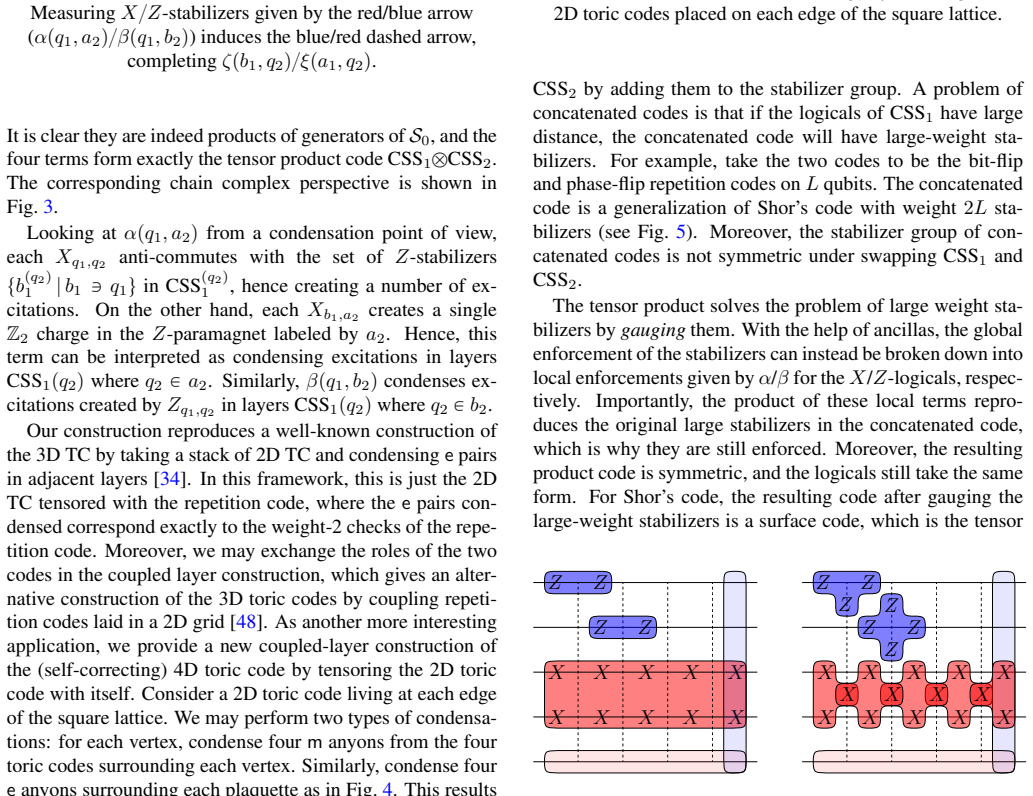
Tensor and balanced product codes admit a coupled-layer construction obtained by stacking one constituent code and condensing excitations in the pattern given by the checks of the other code. This construction also connects to concatenated codes, where the tensor product is recovered by gauging large-weight logicals to make the code qLDPC. The method works for both classical and quantum CSS codes and extends known anyon condensation techniques to non-topological codes.
What carries the argument
Coupled-layer construction via condensation of excitations patterned by the checks of the second code.
If this is right
- The tensor product code is recovered by gauging large-weight logical operators in concatenated codes.
- The construction unifies with anyon condensation mechanisms for higher-dimensional topological phases.
- The framework applies equally to classical or quantum CSS input codes.
- The same layered approach extends to non-topological codes.
Where Pith is reading between the lines
- Different choices of condensation patterns might generate new families of qLDPC codes beyond standard products.
- Techniques from anyon condensation in topological order could be imported to design stabilizers for error-correcting codes.
- Numerical checks on small examples would confirm that distance and encoding rate are preserved under the condensation step.
Load-bearing premise
The condensation pattern defined by the checks of the second code produces a valid stabilizer code without introducing new logical operators or violating the CSS structure.
What would settle it
Explicitly compute the stabilizers and logical operators after condensation on small input codes and verify whether the resulting code distance, rate, and generators exactly match the known tensor or balanced product code.
Figures






read the original abstract
Product codes are a class of quantum error correcting codes built from two or more constituent codes. They have recently gained prominence for a breakthrough yielding quantum low-density parity-check (qLDPC) codes with favorable scaling of both code distance and encoding rate. However, despite its powerful algebraic formulation, the physical mechanism for assembling a general product code from its constituents remains unclear. In this letter, we show that the tensor and balanced product codes admit an intuitive coupled-layer construction by taking a stack of one code and condensing a set of excitations in the pattern given by the checks of the other code. We also make a connection to concatenated codes by showing that the tensor product code can be obtained by gauging large-weight logicals in concatenated codes, making them qLDPC. Our framework accommodates both classical or quantum CSS input codes, unifies known physical mechanisms for constructing higher dimensional topological phases via anyon condensation, and naturally extends to non-topological codes.
Editorial analysis
A structured set of objections, weighed in public.
Referee Report
Summary. The paper claims that tensor and balanced product quantum codes admit a coupled-layer physical construction obtained by stacking one CSS code and condensing excitations whose pattern is dictated by the checks of the second code; it further asserts that the tensor product can be recovered by gauging large-weight logical operators in a concatenated code, thereby producing a qLDPC code, and that the framework unifies anyon condensation in topological phases while applying to both classical and quantum CSS inputs.
Significance. If the central identification between the condensation procedure and the algebraic product construction holds with preserved distance and rate, the work supplies a concrete physical mechanism for a class of qLDPC codes that have recently achieved favorable scaling. The explicit link to gauging in concatenated codes and the extension beyond topological codes are potentially useful for code design and for connecting algebraic and Hamiltonian-based constructions.
major comments (2)
- [coupled-layer construction (presumably §2–3)] The central claim that condensation of check-defined excitations exactly reproduces the tensor-product stabilizer group (including logical operators and CSS bipartition) is load-bearing. An explicit algebraic verification is required showing that the selected excitations commute with all original stabilizers and that no extraneous logical operators appear; this should be stated for general CSS inputs, not only topological examples.
- [distance and rate analysis] The distance and rate preservation under condensation must be demonstrated. The manuscript should contain a calculation (or reference to one) that the minimum weight of nontrivial logical operators in the condensed code matches the product-code distance formula, at least for a small non-trivial example such as two repetition codes or two surface codes.
minor comments (2)
- [introduction and framework] The notation distinguishing 'excitations' in the algebraic (non-topological) case from anyonic excitations should be clarified; a short table comparing the two settings would help readers.
- [gauging connection] Figure captions and the description of the gauging step should explicitly state which logical operators are being gauged and why the resulting code remains CSS.
Simulated Author's Rebuttal
We thank the referee for the constructive feedback and positive evaluation of our work. We address the major comments below and will revise the manuscript accordingly to strengthen the presentation.
read point-by-point responses
-
Referee: [coupled-layer construction (presumably §2–3)] The central claim that condensation of check-defined excitations exactly reproduces the tensor-product stabilizer group (including logical operators and CSS bipartition) is load-bearing. An explicit algebraic verification is required showing that the selected excitations commute with all original stabilizers and that no extraneous logical operators appear; this should be stated for general CSS inputs, not only topological examples.
Authors: We agree that providing an explicit algebraic verification for general CSS inputs is essential for rigor. In the revised manuscript, we will include a new appendix that derives the commutation relations between the condensed excitations and the original stabilizers for arbitrary CSS codes. We will also prove that the resulting stabilizer group coincides exactly with that of the tensor product code, with no additional logical operators introduced. This will cover both the stabilizer generators and the logical operators, as well as the CSS bipartition. revision: yes
-
Referee: [distance and rate analysis] The distance and rate preservation under condensation must be demonstrated. The manuscript should contain a calculation (or reference to one) that the minimum weight of nontrivial logical operators in the condensed code matches the product-code distance formula, at least for a small non-trivial example such as two repetition codes or two surface codes.
Authors: We will add an explicit calculation in the revised version demonstrating distance preservation. Specifically, we will work through the example of two repetition codes, computing the logical operators after condensation and verifying that their minimum weights match the product code distance formula. We will also include a brief discussion for two surface codes to illustrate the general case. This addition will confirm that the condensation procedure preserves both distance and rate as required. revision: yes
Circularity Check
Coupled-layer construction is presented as a direct physical mechanism without reducing to self-definition or fitted inputs
full rationale
The paper advances a coupled-layer construction in which a stack of one code is condensed according to the checks of the second code, claiming this reproduces the tensor and balanced product codes. This is framed as an intuitive physical mechanism that also connects to gauging in concatenated codes. No equations or derivations in the provided text reduce the claimed equivalence to a tautology by construction, nor do they rely on self-citations for load-bearing uniqueness theorems or ansatzes. The argument remains self-contained against the algebraic product-code definition and does not invoke fitted parameters renamed as predictions. A minor self-citation risk exists in any unification claim, but it is not load-bearing for the central construction.
Axiom & Free-Parameter Ledger
axioms (1)
- domain assumption Condensation of excitations according to a set of checks yields a valid stabilizer code
Lean theorems connected to this paper
-
IndisputableMonolith/Cost/FunctionalEquation.leanwashburn_uniqueness_aczel unclear?
unclearRelation between the paper passage and the cited Recognition theorem.
the tensor and balanced product codes admit an intuitive coupled-layer construction by taking a stack of one code and condensing a set of excitations in the pattern given by the checks of the other code
-
IndisputableMonolith/Foundation/AlexanderDuality.leanalexander_duality_circle_linking unclear?
unclearRelation between the paper passage and the cited Recognition theorem.
unifies known physical mechanisms for constructing higher dimensional topological phases via anyon condensation
What do these tags mean?
- matches
- The paper's claim is directly supported by a theorem in the formal canon.
- supports
- The theorem supports part of the paper's argument, but the paper may add assumptions or extra steps.
- extends
- The paper goes beyond the formal theorem; the theorem is a base layer rather than the whole result.
- uses
- The paper appears to rely on the theorem as machinery.
- contradicts
- The paper's claim conflicts with a theorem or certificate in the canon.
- unclear
- Pith found a possible connection, but the passage is too broad, indirect, or ambiguous to say the theorem truly supports the claim.
Forward citations
Cited by 1 Pith paper
-
Topological subsystem bivariate bicycle codes with four-qubit check operators
Subsystem bivariate bicycle codes achieve high-rate BB logical qubits with local four-qubit gauge checks, yielding examples such as [[108,12,6]] that outperform surface-code alternatives.
Reference graph
Works this paper leans on
-
[1]
foliated 1-form symmetry. In comparison to the construction of 3D TC by condensing pairs of anyons in adjacent layers of a stack of 2D TCs, stacking on a 2D layout allows bothmandeanyons to form strings, which commute with each other. Notably, the 2D TC does not have local metachecks since the stabilizers of 2D TC only has global redundancies. This makes ...
-
[2]
P. W. Shor, Scheme for reducing decoherence in quantum com- puter memory, Phys. Rev. A52, R2493 (1995)
work page 1995
-
[3]
S. H. Simon,Topological Quantum(Oxford University Press, 2023)
work page 2023
-
[4]
K. J. Satzinger, Y .-J. Liu, A. Smith, C. Knapp, M. Newman, C. Jones, Z. Chen, C. Quintana, X. Mi, A. Dunsworth, C. Gid- ney, I. Aleiner, F. Arute, K. Arya, J. Atalaya, R. Babbush, J. C. Bardin, R. Barends, J. Basso, A. Bengtsson, A. Bilmes, M. Broughton, B. B. Buckley, D. A. Buell, B. Burkett, N. Bush- nell, B. Chiaro, R. Collins, W. Courtney, S. Demura,...
work page 2021
-
[5]
S. Krinner, N. Lacroix, A. Remm, A. Di Paolo, E. Genois, C. Leroux, C. Hellings, S. Lazar, F. Swiadek, J. Herrmann, et al., Realizing repeated quantum error correction in a distance-three surface code, Nature605, 669 (2022)
work page 2022
-
[6]
B. Het ´enyi and J. R. Wootton, Creating entangled logical qubits in the heavy-hex lattice with topological codes, PRX Quantum 5, 040334 (2024)
work page 2024
-
[7]
M. Iqbal, N. Tantivasadakarn, T. M. Gatterman, J. A. Ger- ber, K. Gilmore, D. Gresh, A. Hankin, N. Hewitt, C. V . Horst, M. Matheny, T. Mengle, B. Neyenhuis, A. Vishwanath, M. Foss-Feig, R. Verresen, and H. Dreyer, Topological order from measurements and feed-forward on a trapped ion quan- tum computer, Communications Physics7, 205 (2024)
work page 2024
-
[8]
M. Iqbal, N. Tantivasadakarn, R. Verresen, S. L. Campbell, J. M. Dreiling, C. Figgatt, J. P. Gaebler, J. Johansen, M. Mills, S. A. Moses, J. M. Pino, A. Ransford, M. Rowe, P. Siegfried, R. P. Stutz, M. Foss-Feig, A. Vishwanath, and H. Dreyer, Non- abelian topological order and anyons on a trapped-ion proces- sor, Nature626, 505 (2024)
work page 2024
-
[9]
D. Bluvstein, S. J. Evered, A. A. Geim, S. H. Li, H. Zhou, T. Manovitz, S. Ebadi, M. Cain, M. Kalinowski, D. Hangleiter, et al., Logical quantum processor based on reconfigurable atom arrays, Nature626, 58 (2024)
work page 2024
-
[10]
M. Iqbal, A. Lyons, C. F. B. Lo, N. Tantivasadakarn, J. Dreiling, C. Foltz, T. M. Gatterman, D. Gresh, N. Hewitt, C. A. Holliman, J. Johansen, B. Neyenhuis, Y . Matsuoka, M. Mills, S. A. Moses, P. Siegfried, A. Vishwanath, R. Verresen, and H. Dreyer, Qutrit toric code and parafermions in trapped ions, Nature Communi- cations16, 6301 (2025)
work page 2025
-
[11]
P. Sales Rodriguez, J. M. Robinson, P. N. Jepsen, Z. He, C. Duckering, C. Zhao, K.-H. Wu, J. Campo, K. Bagnall, M. Kwon,et al., Experimental demonstration of logical magic state distillation, Nature645, 620 (2025)
work page 2025
- [12]
-
[13]
G. Q. AI and Collaborators, Quantum error correction below the surface code threshold, Nature636, 527 (2024)
work page 2024
-
[14]
B. L. Brock, S. Singh, A. Eickbusch, V . V . Sivak, A. Z. Ding, L. Frunzio, S. M. Girvin, and M. H. Devoret, Quantum er- ror correction of qudits beyond break-even, Nature641, 612 (2025)
work page 2025
-
[15]
S. Bravyi and B. Terhal, A no-go theorem for a two-dimensional self-correcting quantum memory based on stabilizer codes, New Journal of Physics11, 043029 (2009)
work page 2009
- [16]
-
[17]
S. T. Flammia, J. Haah, M. J. Kastoryano, and I. H. Kim, Limits on the storage of quantum information in a volume of space, Quantum1, 4 (2017)
work page 2017
-
[18]
Ungauging quantum error-correcting codes
A. Kubica and B. Yoshida, Ungauging quantum error- correcting codes, arXiv preprint arXiv:1805.01836 (2018)
work page internal anchor Pith review Pith/arXiv arXiv 2018
-
[19]
T. Rakovszky and V . Khemani, The physics of (good) ldpc codes i. gauging and dualities, arXiv preprint arXiv:2310.16032 (2023)
-
[20]
T. Rakovszky and V . Khemani, The physics of (good) ldpc codes ii. product constructions, arXiv preprint arXiv:2402.16831 (2024)
-
[21]
W. De Roeck, V . Khemani, Y . Li, N. O’Dea, and T. Rakovszky, Ldpc stabilizer codes as gapped quantum phases: stability un- der graph-local perturbations, arXiv preprint arXiv:2411.02384 (2024)
- [22]
- [23]
- [24]
-
[25]
H. Yu and T.-C. Wei, Universal energy-space localization and stable quantum phases against time-dependent perturbations, arXiv preprint arXiv:2510.14160 (2025)
-
[26]
Quantum LDPC codes with positive rate and minimum distance proportional to n^{1/2}
J.-P. Tillich and G. Z´emor, Quantum LDPC Codes With Positive Rate and Minimum Distance Proportional to the Square Root of the Blocklength, IEEE Trans. Info. Theor.60, 1193 (2014), arXiv:0903.0566 [cs.IT]
work page internal anchor Pith review Pith/arXiv arXiv 2014
-
[27]
S. Bravyi and M. B. Hastings, Homological product codes, in Proceedings of the forty-sixth annual ACM symposium on The- ory of computing(2014) pp. 273–282
work page 2014
-
[28]
M. B. Hastings, J. Haah, and R. O’Donnell, Fiber bundle codes: breaking the n 1/2 polylog (n) barrier for quantum ldpc codes, inProceedings of the 53rd Annual ACM SIGACT Symposium on Theory of Computing(2021) pp. 1276–1288
work page 2021
-
[29]
P. Panteleev and G. Kalachev, Quantum ldpc codes with almost linear minimum distance, IEEE Transactions on Information Theory68, 213 (2021)
work page 2021
-
[30]
N. P. Breuckmann and J. N. Eberhardt, Balanced product quan- tum codes, IEEE Transactions on Information Theory67, 6653 (2021)
work page 2021
-
[31]
P. Panteleev and G. Kalachev, Asymptotically good quantum and locally testable classical LDPC codes, inProceedings of the 54th Annual ACM SIGACT Symposium on Theory of Comput- ing, STOC 2022 (Association for Computing Machinery, New York, NY , USA, 2022) p. 375–388
work page 2022
-
[32]
C. L. Kane, R. Mukhopadhyay, and T. C. Lubensky, Fractional 30 quantum hall effect in an array of quantum wires, Phys. Rev. Lett.88, 036401 (2002)
work page 2002
-
[33]
J. C. Y . Teo and C. L. Kane, From luttinger liquid to non-abelian quantum hall states, Phys. Rev. B89, 085101 (2014)
work page 2014
-
[34]
C. Wang and T. Senthil, Boson topological insulators: A win- dow into highly entangled quantum phases, Phys. Rev. B87, 235122 (2013)
work page 2013
-
[35]
C.-M. Jian and X.-L. Qi, Layer construction of 3d topologi- cal states and string braiding statistics, Phys. Rev. X4, 041043 (2014)
work page 2014
-
[38]
A. Prem, S.-J. Huang, H. Song, and M. Hermele, Cage-net frac- ton models, Phys. Rev. X9, 021010 (2019)
work page 2019
- [39]
-
[40]
G. B. Hal ´asz, T. H. Hsieh, and L. Balents, Fracton topological phases from strongly coupled spin chains, Phys. Rev. Lett.119, 257202 (2017)
work page 2017
-
[41]
D. J. Williamson and M. Cheng, Designer non-abelian fractons from topological layers, Phys. Rev. B107, 035103 (2023)
work page 2023
- [42]
-
[43]
D. J. Williamson and T. Devakul, Type-ii fractons from coupled spin chains and layers, Phys. Rev. B103, 155140 (2021)
work page 2021
-
[44]
J. Sullivan, T. Iadecola, and D. J. Williamson, Planar p-string condensation: Chiral fracton phases from fractional quantum hall layers and beyond, Phys. Rev. B103, 205301 (2021)
work page 2021
-
[45]
Wen, Systematic construction of gapped nonliquid states, Phys
X.-G. Wen, Systematic construction of gapped nonliquid states, Phys. Rev. Res.2, 033300 (2020)
work page 2020
-
[46]
J. Wang, Nonliquid cellular states: Gluing gauge-higher- symmetry-breaking versus gauge-higher-symmetry-extension interfacial defects, Phys. Rev. Res.4, 023258 (2022)
work page 2022
-
[47]
Z. Song, A. Dua, W. Shirley, and D. J. Williamson, Topological defect network representations of fracton stabilizer codes, PRX Quantum4, 010304 (2023)
work page 2023
- [48]
-
[49]
See Supplemental Materials ()
-
[50]
N. Tantivasadakarn, R. Thorngren, A. Vishwanath, and R. Ver- resen, Long-range entanglement from measuring symmetry- protected topological phases, Phys. Rev. X14, 021040 (2024)
work page 2024
-
[51]
D. J. Williamson and T. J. Yoder, Low-overhead fault-tolerant quantum computation by gauging logical operators, Nature Physics22, 598 (2026)
work page 2026
-
[52]
E. Knill and R. Laflamme, Concatenated quantum codes, arXiv preprint quant-ph/9608012 (1996)
work page internal anchor Pith review Pith/arXiv arXiv 1996
-
[53]
K. T. Tian, E. Samperton, and Z. Wang, Haah codes on general three-manifolds, Annals of Physics412, 168014 (2020)
work page 2020
-
[54]
The general case and further examples can be found in the sup- plemental materials ()
-
[55]
Haah, Local stabilizer codes in three dimensions without string logical operators, Phys
J. Haah, Local stabilizer codes in three dimensions without string logical operators, Phys. Rev. A83, 042330 (2011)
work page 2011
-
[56]
Y . Tan, B. Roberts, N. Tantivasadakarn, B. Yoshida, and N. Y . Yao, Fracton models from product codes, Phys. Rev. Res.7, L032062 (2025)
work page 2025
- [57]
-
[58]
A. Leverrier, S. Apers, and C. Vuillot, Quantum XYZ Product Codes, Quantum6, 766 (2022), arXiv:2011.09746 [quant-ph]
-
[59]
S. Yoshida, S. Tamiya, and H. Yamasaki, Concatenate codes, save qubits, npj Quantum Inf.11, 88 (2025), arXiv:2402.09606 [quant-ph]
- [60]
-
[61]
N. Tantivasadakarn, W. Ji, and S. Vijay, Hybrid fracton phases: Parent orders for liquid and nonliquid quantum phases, Phys. Rev. B103, 245136 (2021)
work page 2021
-
[62]
N. Tantivasadakarn, W. Ji, and S. Vijay, Non-abelian hybrid fracton orders, Phys. Rev. B104, 115117 (2021)
work page 2021
-
[63]
Y . Fuji and A. Furusaki, From coupled wires to coupled layers: Model with three-dimensional fractional excitations, Phys. Rev. B99, 241107 (2019)
work page 2019
-
[64]
Y . Fuji and A. Furusaki, Bridging three-dimensional coupled- wire models and cellular topological states: Solvable models for topological and fracton orders, Phys. Rev. Res.5, 043108 (2023)
work page 2023
-
[65]
M. Christos, C. F. B. Lo, V . Khemani, and R. Sahay, Non- abelian quantum low-density parity check codes and non- clifford operations from gauging logical gates via measure- ments, arXiv preprint arXiv:2602.12228 (2026)
- [66]
-
[67]
H. Ma, E. Lake, X. Chen, and M. Hermele, Fracton topological order via coupled layers, Phys. Rev. B95, 245126 (2017)
work page 2017
-
[68]
Isotropic Layer Construction and Phase Diagram for Fracton Topological Phases
S. Vijay, Isotropic Layer Construction and Phase Dia- gram for Fracton Topological Phases, arXiv e-prints 10.48550/arXiv.1701.00762 (2017), arXiv:1701.00762 [cond- mat.str-el]
work page internal anchor Pith review Pith/arXiv arXiv doi:10.48550/arxiv.1701.00762 2017
-
[69]
P. Gorantla, A. Prem, N. Tantivasadakarn, and D. J. Williamson, String membrane nets from higher-form gauging: An alter- nate route top-string condensation, Phys. Rev. B112, 125124 (2025)
work page 2025
-
[70]
P. Gorantla, A. Prem, N. Tantivasadakarn, and D. J. Williamson, Gauging nexus between topological and fracton phases, Phys. Rev. B113, 085110 (2026)
work page 2026
-
[71]
R. Raussendorf, S. Bravyi, and J. Harrington, Long-range quan- tum entanglement in noisy cluster states, Phys. Rev. A71, 062313 (2005)
work page 2005
-
[72]
A. Bolt, G. Duclos-Cianci, D. Poulin, and T. M. Stace, Foliated quantum error-correcting codes, Phys. Rev. Lett.117, 070501 (2016)
work page 2016
-
[73]
T. Hillmann, G. Dauphinais, I. Tzitrin, and M. Vasmer, Single- shot and measurement-based quantum error correction via fault complexes, Phys. Rev. A112, L040401 (2025)
work page 2025
-
[74]
B. J. Brown and S. Roberts, Universal fault-tolerant measurement-based quantum computation, Phys. Rev. Res.2, 033305 (2020)
work page 2020
-
[75]
R. Tanner, A recursive approach to low complexity codes, IEEE Transactions on Information Theory27, 533 (1981)
work page 1981
-
[76]
M. E. J. Newman and C. Moore, Glassy dynamics and aging in an exactly solvable spin model, Phys. Rev. E60, 5068 (1999)
work page 1999
-
[77]
W. Zeng and L. P. Pryadko, Minimal distances for certain quan- tum product codes and tensor products of chain complexes, Phys. Rev. A102, 062402 (2020)
work page 2020
- [78]
-
[79]
Bacon, Operator quantum error-correcting subsystems for self-correcting quantum memories, Phys
D. Bacon, Operator quantum error-correcting subsystems for self-correcting quantum memories, Phys. Rev. A73, 012340 (2006)
work page 2006
-
[80]
Poulin, Stabilizer formalism for operator quantum error cor- rection, Phys
D. Poulin, Stabilizer formalism for operator quantum error cor- rection, Phys. Rev. Lett.95, 230504 (2005)
work page 2005
-
[81]
D. Bacon and A. Casaccino, Quantum error correcting subsys- tem codes from two classical linear codes, arXiv preprint quant- ph/0610088 (2006)
- [82]
discussion (0)
Sign in with ORCID, Apple, or X to comment. Anyone can read and Pith papers without signing in.