Recognition: 3 theorem links
· Lean TheoremTopological subsystem bivariate bicycle codes with four-qubit check operators
Pith reviewed 2026-05-08 18:19 UTC · model grok-4.3
The pith
Subsystem bivariate bicycle codes realize high-rate BB logical structures using only local four-qubit gauge measurements.
A machine-rendered reading of the paper's core claim, the machinery that carries it, and where it could break.
Core claim
We construct translation-invariant CSS subsystem codes that inherit the logical structure of bivariate bicycle codes while restricting all gauge measurements to weight four. Nonlocal stabilizers are excluded by a determinantal-ideal criterion applied to the gauge-operator commutation matrix; when the criterion holds, a finite-depth Clifford circuit decouples the gauge qubits and recovers the protected BB subsystem. The resulting SBB codes are topological if and only if the corresponding BB code is topological. Finite search yields low-overhead instances including [[27,6,3]], [[75,10,5]], and [[108,12,6]], the last of which encodes six times more logical qubits than a subsystem surface code (
What carries the argument
The subsystem bivariate bicycle (SBB) construction, which realizes BB-code logical operators and stabilizers via local weight-4 gauge operators whose outcomes are multiplied to infer stabilizer syndromes.
If this is right
- Syndrome extraction for SBB codes uses only weight-4 measurements whose outcomes are post-processed to obtain the full stabilizer syndrome.
- SBB codes remain topological precisely when the parent BB code is topological, so no nontrivial local logical operators exist.
- The [[108,12,6]] code stores six times as many logical qubits as a subsystem surface code of the same length and distance.
- Gauge freedom converts the high-rate but high-weight BB family into a family compatible with local syndrome extraction.
Where Pith is reading between the lines
- The same gauge-based reduction might be applied to other translation-invariant high-rate CSS families to lower their measurement weights.
- Hardware implementations would need to verify that the decoupling Clifford circuit can be realized with the available gate set without increasing error rates.
- The rate advantage over surface codes suggests that SBB codes could reduce the physical-qubit overhead needed for a given logical memory capacity.
- Generalizing the determinantal-ideal test to non-translation-invariant subsystem codes could enlarge the search space for low-overhead quantum memories.
Load-bearing premise
The determinantal-ideal criterion on the gauge commutation matrix correctly excludes every nonlocal stabilizer, and a finite-depth Clifford circuit can always decouple the gauge qubits without leaving residual errors.
What would settle it
An explicit SBB code that passes the determinantal-ideal test yet contains a nonlocal stabilizer operator, or a numerical distance calculation showing that one of the reported codes (such as [[108,12,6]]) has distance strictly less than claimed.
Figures



read the original abstract
High-rate bivariate bicycle (BB) codes are promising low-overhead quantum memories, but their stabilizer checks typically have weight $6$ or higher, making syndrome extraction challenging. We introduce subsystem bivariate bicycle (SBB) codes, a translation-invariant CSS subsystem construction that realizes BB-code logical structure using local weight-$4$ gauge measurements. Their stabilizer syndromes are inferred by multiplying the corresponding gauge outcomes. We further show that nonlocal stabilizers in translation-invariant CSS subsystem codes can be detected using a determinantal-ideal criterion based on the gauge-operator commutation matrix. When this criterion excludes nonlocal stabilizers, a finite-depth Clifford circuit decouples gauge qubits and identifies the protected subsystem with a corresponding BB stabilizer code. An SBB code is topological, meaning that it has no nontrivial local logical operators, if and only if the corresponding BB code is topological. A finite search yields low-overhead examples including $[[27,6,3]]$, $[[75,10,5]]$, and $[[108,12,6]]$; the latter encodes six times more logical qubits than a subsystem surface code at the same block length and distance. These results show how gauge degrees of freedom can make high-rate BB logical structure compatible with local weight-$4$ syndrome extraction.
Editorial analysis
A structured set of objections, weighed in public.
Referee Report
Summary. The manuscript introduces subsystem bivariate bicycle (SBB) codes, a translation-invariant CSS subsystem construction that realizes the logical structure of bivariate bicycle (BB) stabilizer codes via local weight-4 gauge operators whose syndromes are inferred by multiplication. It presents a determinantal-ideal criterion on the gauge-operator commutation matrix to exclude nonlocal stabilizers, after which a finite-depth Clifford circuit decouples gauge qubits to recover the protected BB subsystem. The paper proves that an SBB code is topological if and only if the corresponding BB code is topological, and reports explicit low-overhead examples including the [[27,6,3]], [[75,10,5]], and [[108,12,6]] codes, with the last encoding six times as many logical qubits as a subsystem surface code at identical block length and distance.
Significance. If the determinantal-ideal criterion is shown to be both necessary and sufficient for the claimed logical structure and if the reported distances are independently verified, the construction would offer a concrete route to high-rate quantum memories whose stabilizer extraction uses only weight-4 local measurements, substantially lowering the overhead relative to surface-code-based alternatives while preserving the favorable scaling of BB codes.
major comments (2)
- [the section introducing the determinantal-ideal criterion] The section introducing the determinantal-ideal criterion: the manuscript asserts that this algebraic test on the gauge-operator commutation matrix excludes all nonlocal stabilizers and guarantees that a finite-depth Clifford circuit recovers the BB subsystem without residual errors, yet provides no explicit derivation or verification for the bivariate polynomials appearing in the search; this step is load-bearing for every reported parameter set.
- [the section presenting the concrete examples] The section presenting the concrete examples: the distance claims for [[27,6,3]], [[75,10,5]], and especially [[108,12,6]] (which supports the sixfold rate advantage) rest on unshown computational checks or syndrome simulations; without these, the effective k and d after decoupling cannot be confirmed.
minor comments (1)
- [abstract] The abstract states that 'stabilizer syndromes are inferred by multiplying the corresponding gauge outcomes' but does not specify the exact linear combinations or circuit depth required; a brief clarifying sentence would improve readability.
Simulated Author's Rebuttal
We thank the referee for their thorough review and insightful comments, which will help improve the clarity and rigor of our manuscript. We address the major comments below and plan to incorporate revisions to provide the requested derivations and verifications.
read point-by-point responses
-
Referee: [the section introducing the determinantal-ideal criterion] The section introducing the determinantal-ideal criterion: the manuscript asserts that this algebraic test on the gauge-operator commutation matrix excludes all nonlocal stabilizers and guarantees that a finite-depth Clifford circuit recovers the BB subsystem without residual errors, yet provides no explicit derivation or verification for the bivariate polynomials appearing in the search; this step is load-bearing for every reported parameter set.
Authors: We concur that the derivation of the determinantal-ideal criterion merits a more explicit presentation. In the revised manuscript, we will augment the relevant section with a complete step-by-step algebraic derivation showing how the criterion applied to the commutation matrix of the gauge operators excludes nonlocal stabilizers for the bivariate polynomial case. Additionally, we will verify this explicitly for the polynomials used in generating the reported codes, confirming the conditions for the finite-depth Clifford circuit to recover the BB subsystem without residual errors. revision: yes
-
Referee: [the section presenting the concrete examples] The section presenting the concrete examples: the distance claims for [[27,6,3]], [[75,10,5]], and especially [[108,12,6]] (which supports the sixfold rate advantage) rest on unshown computational checks or syndrome simulations; without these, the effective k and d after decoupling cannot be confirmed.
Authors: We recognize the importance of detailing the computational verification for the code distances. The revised version will include a dedicated subsection or appendix outlining the syndrome simulation procedure and the specific checks performed to establish the distances of 3, 5, and 6 for the [[27,6,3]], [[75,10,5]], and [[108,12,6]] codes, respectively, post-decoupling. This will substantiate the effective logical qubit counts and distances. revision: yes
Circularity Check
Minor reliance on prior BB-code literature and standard subsystem CSS framework; central claims rest on algebraic criterion derived within the paper and finite search, not self-referential definitions or fitted predictions.
full rationale
The derivation introduces SBB codes via a translation-invariant CSS subsystem construction with weight-4 gauges, defines stabilizer inference by gauge multiplication, and proves a determinantal-ideal test on the gauge commutation matrix to exclude nonlocal stabilizers. When the test passes, a finite-depth Clifford circuit is asserted to decouple to the BB logical structure. The topological equivalence is stated as an if-and-only-if with the corresponding BB code, following directly from the construction. All reported codes ([[27,6,3]], [[75,10,5]], [[108,12,6]]) arise from explicit finite search over bivariate polynomials rather than any parameter fit or prediction. No load-bearing step reduces by construction to a self-citation chain or tautological renaming; the algebraic criterion is presented as newly shown in this work. This yields only minor (score-2) circularity risk from background citations to BB codes.
Axiom & Free-Parameter Ledger
axioms (2)
- domain assumption CSS subsystem codes admit gauge operators whose products recover stabilizer syndromes
- domain assumption Translation-invariant CSS subsystem codes have well-defined nonlocal stabilizers detectable via the gauge commutation matrix
Lean theorems connected to this paper
-
Foundation/AlphaDerivationExplicit.lean, ConstantsalphaProvenanceCert (RS-style parameter-free derivations involve φ-ladders and J-cost; the paper's parameters are from a brute-force CSS search, not a forcing chain) unclear?
unclearRelation between the paper passage and the cited Recognition theorem.
A finite search yields low-overhead examples including [[27,6,3]], [[75,10,5]], and [[108,12,6]]
-
Foundation/ArithmeticFromLogic.lean(RS arithmetic is recovered from the J-cost orbit of a generator γ ≠ 1 in ℝ_+; the paper's Laurent ring over F_2 is unrelated to that recovery) unclear?
unclearRelation between the paper passage and the cited Recognition theorem.
R = Z_2[x^±1, y^±1] ... I_r(M) = R ... Quillen–Suslin–Swan theorem for Laurent polynomial rings
What do these tags mean?
- matches
- The paper's claim is directly supported by a theorem in the formal canon.
- supports
- The theorem supports part of the paper's argument, but the paper may add assumptions or extra steps.
- extends
- The paper goes beyond the formal theorem; the theorem is a base layer rather than the whole result.
- uses
- The paper appears to rely on the theorem as machinery.
- contradicts
- The paper's claim conflicts with a theorem or certificate in the canon.
- unclear
- Pith found a possible connection, but the passage is too broad, indirect, or ambiguous to say the theorem truly supports the claim.
Reference graph
Works this paper leans on
-
[1]
There exist invertible matricesP, Q∈GL 2(R) such that P M Q= Å1 0 0 0 ã .(12)
-
[2]
In that case, invertible row and column operations bringMto the canonical rank-rform; see Appendix C 2
The entries ofMgenerate the unit ideal, i.e., I1(M) =R.(13) For a generalp×qmatrixMof generic rankr, the analogous condition isI r(M) =R, whereI r(M) is the ideal generated by allr×rminors ofM. In that case, invertible row and column operations bringMto the canonical rank-rform; see Appendix C 2. Thus far, we have worked on the infinite plane and identifi...
-
[3]
Equivalently, no additional nonlocal stabilizers appear
IfI 1(M) =R, then, for every choice of positive integersnandm, imposing the periodic boundary conditionsx n =y m = 1does not create kernel vectors beyond those generated by the infinite-plane local kernels. Equivalently, no additional nonlocal stabilizers appear
-
[4]
Any nonzero Pauli operator obtained from such an extra kernel vector is an additional nonlocal stabilizer
IfI 1(M)is a proper ideal ofR, then there exist positive integersnandmsuch that the finite-torus kernel ofM (n,m) is strictly larger than the reduc- tion of the infinite-plane local kernel. Any nonzero Pauli operator obtained from such an extra kernel vector is an additional nonlocal stabilizer. For a generalp×qmatrixMof generic rankr, the no-nonlocal-sta...
-
[5]
Scheme for reducing decoherence in quantum computer memory,
Peter W. Shor, “Scheme for reducing decoherence in quantum computer memory,” Phys. Rev. A52, R2493– R2496 (1995)
1995
-
[6]
Error correcting codes in quantum the- ory,
A. M. Steane, “Error correcting codes in quantum the- ory,” Phys. Rev. Lett.77, 793–797 (1996)
1996
-
[7]
Theory of quantum error-correcting codes,
Emanuel Knill and Raymond Laflamme, “Theory of quantum error-correcting codes,” Phys. Rev. A55, 900– 911 (1997)
1997
-
[8]
Stabilizer Codes and Quantum Error Correction
Daniel Gottesman, “Stabilizer codes and quantum er- ror correction,” (1997), arXiv:quant-ph/9705052 [quant- ph]
work page internal anchor Pith review arXiv 1997
-
[9]
Fault-tolerant quantum computation by anyons,
A.Yu. Kitaev, “Fault-tolerant quantum computation by anyons,” Annals of Physics303, 2–30 (2003)
2003
-
[10]
Quantum codes on a lattice with boundary,
S. B. Bravyi and A. Yu. Kitaev, “Quantum codes on a lattice with boundary,” (1998), arXiv:quant- ph/9811052 [quant-ph]
-
[11]
Topological quantum memory,
Eric Dennis, Alexei Kitaev, Andrew Landahl, and John Preskill, “Topological quantum memory,” Journal of Mathematical Physics43, 4452–4505 (2002)
2002
-
[12]
Quantum error correction for quan- tum memories,
Barbara M. Terhal, “Quantum error correction for quan- tum memories,” Reviews of Modern Physics87, 307–346 (2015)
2015
-
[13]
Probing topological spin liquids on a programmable quantum simulator,
G. Semeghini, H. Levine, A. Keesling, S. Ebadi, T. T. Wang, D. Bluvstein, R. Verresen, H. Pichler, M. Kali- nowski, R. Samajdar, A. Omran, S. Sachdev, A. Vish- wanath, M. Greiner, V. Vuleti´ c, and M. D. Lukin, “Probing topological spin liquids on a programmable quantum simulator,” Science374, 1242–1247 (2021)
2021
-
[14]
Prediction of toric code topological order from rydberg blockade,
Ruben Verresen, Mikhail D. Lukin, and Ashvin Vish- wanath, “Prediction of toric code topological order from rydberg blockade,” Phys. Rev. X11, 031005 (2021)
2021
-
[15]
A quantum processor based on coherent transport of entangled atom arrays,
Dolev Bluvstein, Harry Levine, Giulia Semeghini, Tout T. Wang, Sepehr Ebadi, Marcin Kalinowski, Alexander Keesling, Nishad Maskara, Hannes Pichler, Markus Greiner, Vladan Vuleti´ c, and Mikhail D. Lukin, “A quantum processor based on coherent transport of entangled atom arrays,” Nature604, 451–456 (2022)
2022
-
[16]
Suppressing quantum errors by scaling a surface code logical qubit,
Google Quantum AI and Collaborators, “Suppressing quantum errors by scaling a surface code logical qubit,” Nature614, 676–681 (2023)
2023
-
[17]
Non-abelian braiding of graph vertices in a superconducting proces- sor,
Google Quantum AI and Collaborators, “Non-abelian braiding of graph vertices in a superconducting proces- sor,” Nature618, 264–269 (2023)
2023
-
[18]
Quantum er- ror correction below the surface code threshold,
Google Quantum AI and Collaborators, “Quantum er- ror correction below the surface code threshold,” Nature 638, 920–926 (2025)
2025
-
[19]
Topological order from mea- surements and feed-forward on a trapped ion quantum computer,
Mohsin Iqbal, Nathanan Tantivasadakarn, Thomas M. Gatterman, Justin A. Gerber, Kevin Gilmore, Dan Gresh, Aaron Hankin, Nathan Hewitt, Chandler V. Horst, Mitchell Matheny, Tanner Mengle, Brian Neyen- huis, Ashvin Vishwanath, Michael Foss-Feig, Ruben Ver- resen, and Henrik Dreyer, “Topological order from mea- surements and feed-forward on a trapped ion quan...
2024
-
[20]
Non-abelian topological order and anyons on a trapped- ion processor,
Mohsin Iqbal, Nathanan Tantivasadakarn, Ruben Verre- sen, Sara L. Campbell, Joan M. Dreiling, Caroline Fig- gatt, John P. Gaebler, Jacob Johansen, Michael Mills, Steven A. Moses, Juan M. Pino, Anthony Ransford, Mary Rowe, Peter Siegfried, Russell P. Stutz, Michael Foss-Feig, Ashvin Vishwanath, and Henrik Dreyer, “Non-abelian topological order and anyons o...
2024
-
[21]
Enhancing detection of topolog- ical order by local error correction,
Iris Cong, Nishad Maskara, Minh C. Tran, Hannes Pich- ler, Giulia Semeghini, Susanne F. Yelin, Soonwon Choi, and Mikhail D. Lukin, “Enhancing detection of topolog- ical order by local error correction,” Nature Communi- cations15, 1527 (2024)
2024
-
[22]
Surface codes: Towards practical large-scale quantum computation,
Austin G. Fowler, Matteo Mariantoni, John M. Marti- nis, and Andrew N. Cleland, “Surface codes: Towards practical large-scale quantum computation,” Phys. Rev. A86, 032324 (2012)
2012
-
[23]
A Game of Surface Codes: Large-Scale Quantum Computing with Lattice Surgery,
Daniel Litinski, “A Game of Surface Codes: Large-Scale Quantum Computing with Lattice Surgery,” Quantum 3, 128 (2019)
2019
-
[24]
Quantum kronecker sum-product low-density parity-check codes with finite rate,
Alexey A. Kovalev and Leonid P. Pryadko, “Quantum kronecker sum-product low-density parity-check codes with finite rate,” Phys. Rev. A88, 012311 (2013)
2013
-
[25]
Distance bounds for generalized bicycle codes,
Renyu Wang and Leonid P. Pryadko, “Distance bounds for generalized bicycle codes,” Symmetry14(2022), 10.3390/sym14071348
-
[26]
High-threshold and low-overhead fault-tolerant quan- tum memory,
Sergey Bravyi, Andrew W. Cross, Jay M. Gambetta, Dmitri Maslov, Patrick Rall, and Theodore J. Yoder, “High-threshold and low-overhead fault-tolerant quan- tum memory,” Nature627, 778–782 (2024)
2024
-
[27]
Ming Wang and Frank Mueller, “Coprime bivariate bicycle codes and their properties,” arXiv preprint arXiv:2408.10001 (2024)
-
[28]
Rate adjustable bivari- ate bicycle codes for quantum error correction,
Ming Wang and Frank Mueller, “Rate adjustable bivari- ate bicycle codes for quantum error correction,” in2024 IEEE International Conference on Quantum Computing and Engineering (QCE), Vol. 02 (2024) pp. 412–413
2024
-
[29]
Low-Overhead Entangling Gates From Generalised Dehn Twists,
Ryan Tiew and Nikolas P. Breuckmann, “Low-Overhead Entangling Gates From Generalised Dehn Twists,” IEEE Trans. Info. Theor.71, 5452–5468 (2025)
2025
-
[30]
Ambiguity clustering: an accurate and efficient decoder for QLDPC codes,
Stasiu Wolanski and Ben Barber, “Ambiguity clustering: an accurate and efficient decoder for qldpc codes,” arXiv preprint arXiv:2406.14527 (2024)
-
[31]
Toward Low-latency Iterative Decoding of QLDPC Codes Under Circuit-Level Noise,
Anqi Gong, Sebastian Cammerer, and Joseph M Renes, “Toward low-latency iterative decoding of qldpc codes under circuit-level noise,” arXiv preprint arXiv:2403.18901 (2024)
-
[32]
Machine learning message-passing for the scalable decoding of QLDPC codes,
Arshpreet Singh Maan and Alexandru Paler, “Machine learning message-passing for the scalable decoding of QLDPC codes,” npj Quantum Inf.11, 78 (2025)
2025
-
[33]
Cowtan, SSIP: automated surgery with quantum LDPC codes, arXiv preprint arXiv:2407.09423 (2024)
Alexander Cowtan, “Ssip: automated surgery with quantum ldpc codes,” arXiv preprint arXiv:2407.09423 (2024)
-
[34]
Lowering connectivity requirements for bivariate bicycle codes us- ing morphing circuits,
Mackenzie H. Shaw and Barbara M. Terhal, “Lowering connectivity requirements for bivariate bicycle codes us- ing morphing circuits,” Phys. Rev. Lett.134, 090602 (2025)
2025
- [35]
-
[36]
Multivariate bicycle codes,
Lukas Voss, Sim Jian Xian, Tobias Haug, and Kishor 7 Bharti, “Multivariate bicycle codes,” Phys. Rev. A111, L060401 (2025)
2025
-
[37]
Toward a 2d local imple- mentation of quantum low-density parity-check codes,
Noah Berthusen, Dhruv Devulapalli, Eddie Schoute, An- drew M. Childs, Michael J. Gullans, Alexey V. Gor- shkov, and Daniel Gottesman, “Toward a 2d local imple- mentation of quantum low-density parity-check codes,” PRX Quantum6, 010306 (2025)
2025
-
[38]
Logical op- erators and fold-transversal gates of bivariate bicycle codes,
Jens Niklas Eberhardt and Vincent Steffan, “Logical op- erators and fold-transversal gates of bivariate bicycle codes,” IEEE Transactions on Information Theory71, 1140–1152 (2025)
2025
-
[39]
Single-shot and two-shot decod- ing with generalized bicycle codes,
Hsiang-Ku Lin, Xingrui Liu, Pak Kau Lim, and Leonid P Pryadko, “Single-shot and two-shot decod- ing with generalized bicycle codes,” arXiv preprint arXiv:2502.19406 (2025)
-
[40]
Gen- eralized toric codes on twisted tori for quantum error correction,
Zijian Liang, Ke Liu, Hao Song, and Yu-An Chen, “Gen- eralized toric codes on twisted tori for quantum error correction,” PRX Quantum6, 020357 (2025)
2025
-
[41]
Zijian Liang and Yu-An Chen, “Self-dual bivariate bi- cycle codes with transversal clifford gates,” (2025), arXiv:2510.05211 [quant-ph]
-
[42]
GeneralizedZ p toric codes as qudit low-density parity-check codes,
Zijian Liang and Yu-An Chen, “GeneralizedZ p toric codes as qudit low-density parity-check codes,” (2026), arXiv:2602.20158 [quant-ph]
-
[43]
Unified and generalized approach to quantum error cor- rection,
David Kribs, Raymond Laflamme, and David Poulin, “Unified and generalized approach to quantum error cor- rection,” Phys. Rev. Lett.94, 180501 (2005)
2005
-
[44]
Operator quantum error correction,
David W. Kribs, Raymond Laflamme, David Poulin, and Maia Lesosky, “Operator quantum error correction,” Quant. Inf. Comput.6, 382–399 (2006), arXiv:quant- ph/0504189
-
[45]
Stabilizer formalism for operator quan- tum error correction,
David Poulin, “Stabilizer formalism for operator quan- tum error correction,” Phys. Rev. Lett.95, 230504 (2005)
2005
-
[46]
Operator quantum error-correcting sub- systems for self-correcting quantum memories,
Dave Bacon, “Operator quantum error-correcting sub- systems for self-correcting quantum memories,” Phys. Rev. A73, 012340 (2006)
2006
-
[47]
Topological subsystem codes,
H. Bombin, “Topological subsystem codes,” Phys. Rev. A81, 032301 (2010)
2010
-
[48]
Universal topological phase of two-dimensional stabi- lizer codes,
H Bombin, Guillaume Duclos-Cianci, and David Poulin, “Universal topological phase of two-dimensional stabi- lizer codes,” New Journal of Physics14, 073048 (2012)
2012
-
[49]
Coupled-Layer Construction of Quantum Product Codes
Shuyu Zhang, Tzu-Chieh Wei, and Nathanan Tan- tivasadakarn, “Coupled-layer construction of quantum product codes,” (2026), arXiv:2603.08711 [quant-ph]
work page internal anchor Pith review Pith/arXiv arXiv 2026
-
[50]
arXiv preprint arXiv:1207.1443 , year=
Sergey Bravyi, Guillaume Duclos-Cianci, David Poulin, and Martin Suchara, “Subsystem surface codes with three-qubit check operators,” Quantum Information & Computation13, 963–985 (2013), arXiv:1207.1443 [quant-ph]
-
[51]
Subsystem codes with high thresholds by gauge fixing and reduced qubit overhead,
Oscar Higgott and Nikolas P. Breuckmann, “Subsystem codes with high thresholds by gauge fixing and reduced qubit overhead,” Phys. Rev. X11, 031039 (2021)
2021
-
[52]
Subsystem codes with spatially local generators,
Sergey Bravyi, “Subsystem codes with spatially local generators,” Phys. Rev. A83, 012320 (2011)
2011
-
[53]
Tradeoffs for reliable quantum information storage in 2d systems,
Sergey Bravyi, David Poulin, and Barbara Terhal, “Tradeoffs for reliable quantum information storage in 2d systems,” Phys. Rev. Lett.104, 050503 (2010)
2010
-
[54]
Structure of 2d topological stabilizer codes,
H´ ector Bomb´ ın, “Structure of 2d topological stabilizer codes,” Communications in Mathematical Physics327, 387–432 (2014)
2014
-
[55]
Pauli topological subsystem codes from Abelian anyon theories,
Tyler D. Ellison, Yu-An Chen, Arpit Dua, Wilbur Shirley, Nathanan Tantivasadakarn, and Dominic J. Williamson, “Pauli topological subsystem codes from Abelian anyon theories,” Quantum7, 1137 (2023)
2023
-
[56]
Commuting pauli hamiltonians as maps between free modules,
Jeongwan Haah, “Commuting pauli hamiltonians as maps between free modules,” Communications in Math- ematical Physics324, 351–399 (2013)
2013
-
[57]
Algebraic methods for quantum codes on lattices,
Jeongwan Haah, “Algebraic methods for quantum codes on lattices,” Revista colombiana de matematicas50, 299–349 (2016)
2016
-
[58]
Extracting topological orders of generalized pauli stabilizer codes in two dimensions,
Zijian Liang, Yijia Xu, Joseph T. Iosue, and Yu-An Chen, “Extracting topological orders of generalized pauli stabilizer codes in two dimensions,” PRX Quantum5, 030328 (2024)
2024
-
[59]
Andrew J. Landahl, Jonas T. Anderson, and Patrick R. Rice, “Fault-tolerant quantum computing with color codes,” (2011), arXiv:1108.5738 [quant-ph]. 8 Appendix A: Subsystem code preliminaries In this section, we review basic concepts about stabilizer and subsystem codes [4, 41, 42, 46, 51]. Throughout this appendix, all Pauli operators are considered up to...
-
[60]
Stabilizer codes A stabilizer code is specified by an Abelian subgroupS ⊂ P n of then-qubit Pauli group, with−I /∈ S. The code space is the joint +1 eigenspace of all stabilizers: C(S) ={|ψ⟩:S|ψ⟩=|ψ⟩for allS∈ S}.(A6) IfShassindependent generators, then dimC(S) = 2 n−s.(A7) Thus a stabilizer code encodes k=n−s(A8) logical qubits. The logical Pauli operator...
-
[61]
The stabilizer code space factors as C(S) ∼= HL ⊗ HG,(A12) 9 whereH L stores the protected logical qubits andH G stores gauge qubits
Subsystem codes Subsystem codes generalize stabilizer codes by allowing part of the code space to be used as an unprotected gauge subsystem. The stabilizer code space factors as C(S) ∼= HL ⊗ HG,(A12) 9 whereH L stores the protected logical qubits andH G stores gauge qubits. Errors or measurements that affect only HG do not change the protected logical inf...
-
[62]
Their gauge group is generated byX-type and Z-type Pauli operators separately
CSS subsystem codes The SBB codes considered in this work are CSS subsystem codes. Their gauge group is generated byX-type and Z-type Pauli operators separately. Let H g X ∈Z mX ×n 2 , H g Z ∈Z mZ ×n 2 (A25) be the binary matrices whose rows specify theX- andZ-type gauge generators. The corresponding gauge group is G=⟨X(u) :u∈row(H g X)⟩ · ⟨Z(v) :v∈row(H ...
-
[63]
We first prove (1)⇒(2)
Proof of Lemma 2 Proof.First note that the Laurent monomialsx ayb are precisely the units ofR. We first prove (1)⇒(2). Suppose there existP, Q∈GL 2(R) such thatP M Q= ( 1 0 0 0 ). Since a monomial is a unit inR, the entries ofP M Qgenerate the whole ring: I1(P M Q) =R.(C1) On the other hand, multiplication by invertible matrices only performs invertible r...
-
[64]
For a more general subsystem code withp X-type andq Z-type gauge-generator families, the commutation matrix is rectangular
Generalization of Lemma 2 The main text uses Lemma 2 for the 2×2 commutation matrix that appears when there are twoX-type and two Z-type gauge-generator families. For a more general subsystem code withp X-type andq Z-type gauge-generator families, the commutation matrix is rectangular. The entry-ideal condition is then replaced by a determinantal-ideal co...
-
[65]
There exist invertible matrices P∈GL p(R), Q∈GL q(R),(C26) such that P M Q= ÅIr 0 0 0 ã .(C27)
-
[66]
Determinantal ideals are invariant under invertible row and column operations
The maximal nonzero determinantal ideal is the unit ideal: Ir(M) =R.(C28) Proof.We first prove (1)⇒(2). Determinantal ideals are invariant under invertible row and column operations. Indeed, by the Cauchy–Binet formula, multiplying by an invertible matrix replaces eachj×jminor by anR-linear combination ofj×jminors, and applying the inverse operation gives...
-
[67]
The corresponding statement for left kernels follows by applying the same argument toM T
Proof of Theorem 3 Proof.Write M= Åa b c d ã .(C54) We demonstrate the argument for right kernels. The corresponding statement for left kernels follows by applying the same argument toM T. For any torus quotient A=R n,m =R/(x n −1, y m −1),(C55) write KA := kerA(M (n,m) :A 2 →A 2) (C56) for the finite-torus kernel. Also write KR := kerR(M:R 2 →R 2) (C57) ...
-
[68]
For a general translation-invariant CSS subsystem code withp X-type andq Z-type gauge-generator families, the commutation matrix is instead ap×qmatrix overR
Generalization of Theorem 3 Theorem 3 treats the 2×2 commutation matrix arising from twoX-type and twoZ-type gauge-generator families. For a general translation-invariant CSS subsystem code withp X-type andq Z-type gauge-generator families, the commutation matrix is instead ap×qmatrix overR. In this setting, the entry idealI 1(M) is replaced by the determ...
-
[69]
IfI r(M) =R,then for everyn, m, Kn,m =ρ n,m(KR).(C135) Thus imposing periodic boundary conditions creates no additional right-kernel vectors, and hence no additional nonlocalZ-type stabilizers from this sector
-
[70]
The analogous statements forX-type stabilizers hold for left kernels, or equivalently by applying the theorem toM T
IfI r(M)⊊R,then there exist positive integersn, msuch that ρn,m(KR)⊊K n,m.(C136) Any nonzero Pauli operator obtained from a vector in Kn,m \ρ n,m(KR) (C137) is an additional nonlocalZ-type stabilizer. The analogous statements forX-type stabilizers hold for left kernels, or equivalently by applying the theorem toM T. Proof.We first prove the caseI r(M) =R....
-
[71]
We denote byUthe symplectic matrix representing the Clifford circuitU; thus conjugation byUacts on Pauli vectors by left multiplication byU
Proof of Theorem 4 Proof.We work in the polynomial Pauli module R6 =R 3 X ⊕R 3 Z.(C186) Let ¯·denote the involutionx7→x −1,y7→y −1, extended coefficientwise toR, and write v† := ¯vT (C187) for vectors or matrices overR. We denote byUthe symplectic matrix representing the Clifford circuitU; thus conjugation byUacts on Pauli vectors by left multiplication b...
-
[72]
The gauge generators shown in Fig
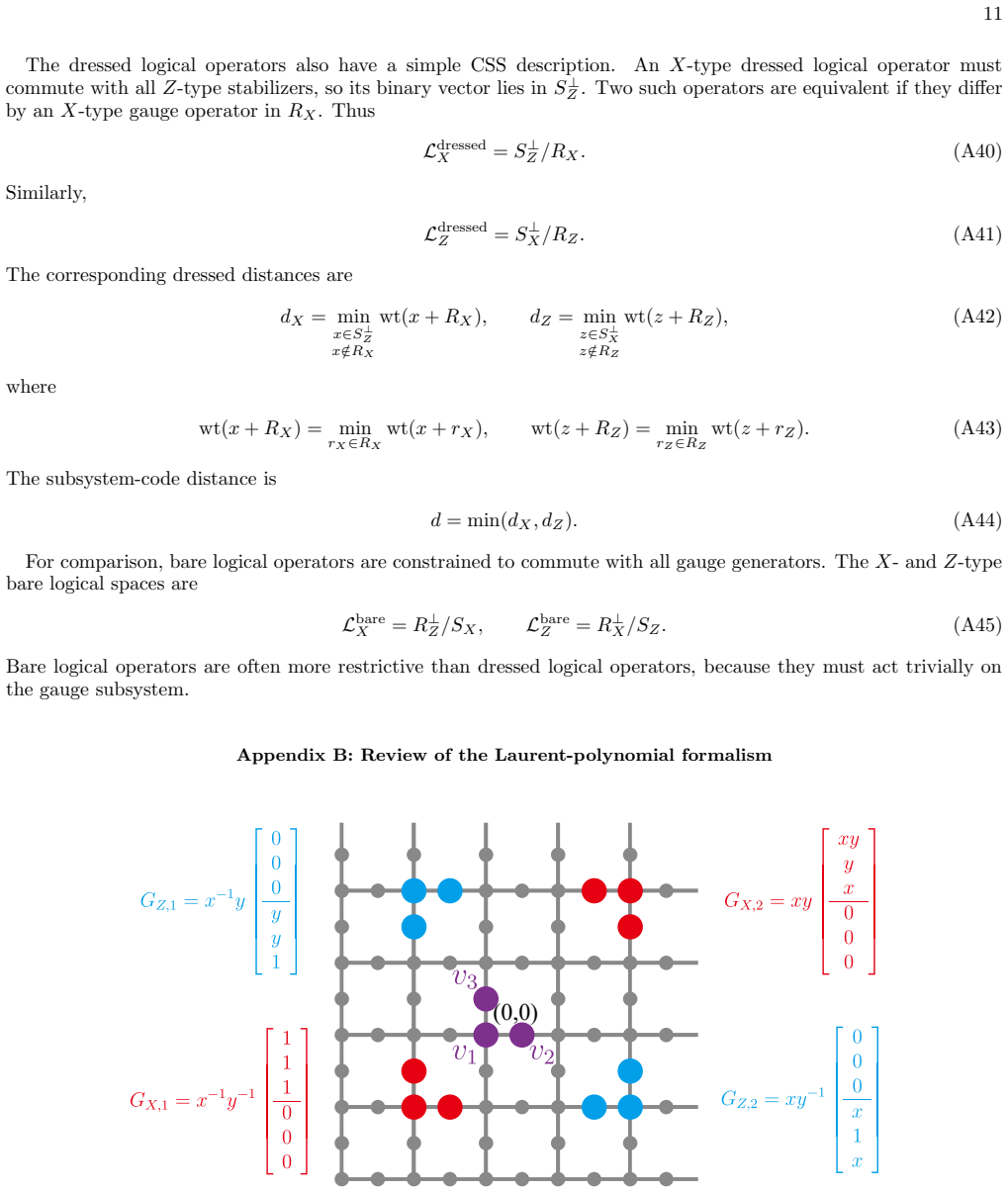
Verification of the[[75,10,5]]guiding example We begin with the [[75,10,5]] code discussed in the main text. The gauge generators shown in Fig. 1 are GX,1 = x2 y2 x+x 2y 0 0 0 , G X,2 = 1 +y 2 x+y 0 0 0 0 , GZ,1 = 0 0 0 y2 y+xy 2 x2 , G Z,2 = 0 0 0 1 +x 2 0 x+y . (E1) Their co...
-
[73]
Further examples from the finite search Table II lists representative weight-4 SBB codes found in the finite search. For each row, the second and third columns give the twoX-type gauge generators, GX,1 =G X(f1, g1, h1), G X,2 =G X(f2, g2, h2).(E11) The correspondingZ-type gauge generators are obtained by the combined reflection symmetry used in Appendix D...
-
[74]
[[27,6,3]]: Mc = Å x2y−2 x−1y−1 +y −2 +xy −1 xy−1 +xy+x 2 x−2 +x −2y2 +x −1y−1 +y 2 +xy ã .(E17)
-
[75]
[[60,10,4]]: Mc = Å x2y−2 xy−1 +xy x−1y−1 +xy −1 x−2 +x −2y2 + 1 +y 2 ã .(E18)
-
[76]
[[75,10,5]]: Mc = Å x−2y2 x−1y−1 +x −1y x−1y+xy y −2 + 1 +x 2y−2 +x 2 ã .(E19)
-
[77]
[[90,12,5]]: Mc = Å x2y−2 x−1y−1 +x 2 y−2 +xy x −3y−1 +x −2y2 + 1 +xy 3 ã .(E20)
-
[78]
[[108,12,6]]: Mc = Å x2y−2 x−1y−1 +x 2 y−2 +xy x −3y−1 +x −2y2 + 1 +xy 3 ã .(E21)
-
[79]
The distances listed in Table II are the dressed distances of the corresponding subsystem codes
[[126,14,6]]: Mc = Å x2y−2 x−1 +x y−1 +y x −3y+x −3y3 +x −1y+x −1y3 ã .(E22) For all matrices above, one verifies that detM c = 0.(E23) Moreover, since each matrix has a monomial entry, the entry ideal satisfies I1(Mc) =R.(E24) Therefore, the no-nonlocal-stabilizer criterion applies. The distances listed in Table II are the dressed distances of the corres...
discussion (0)
Sign in with ORCID, Apple, or X to comment. Anyone can read and Pith papers without signing in.