Recognition: 2 theorem links
· Lean TheoremThe X-ray weakness of Little Red Dots and JWST-selected AGN: comparison with local AGN in different accretion regimes
Pith reviewed 2026-05-15 12:42 UTC · model grok-4.3
The pith
X-ray weakness in high-redshift Little Red Dots and JWST AGN traces the same physics as local super-Eddington black holes.
A machine-rendered reading of the paper's core claim, the machinery that carries it, and where it could break.
Core claim
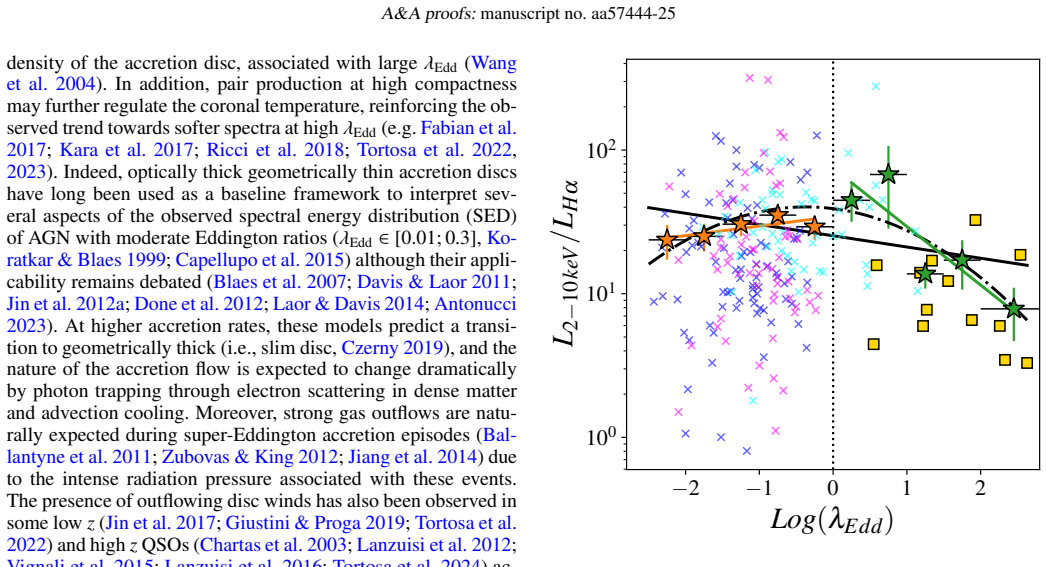
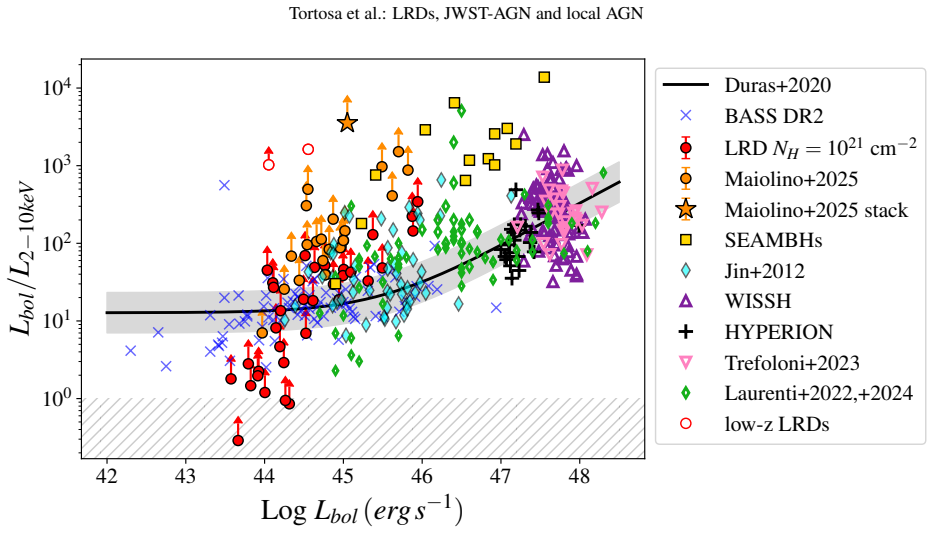
High-redshift LRDs and JWST-selected AGN exhibit X-ray weakness that aligns with the behavior of local SEAMBHs in the Lx/LHα versus λEdd plane, where an anti-correlation indicates slim-disc accretion effects, and both groups show elevated X-ray bolometric corrections consistent with relatively cold coronae.
What carries the argument
The Lx/LHα versus λEdd plane, which places local SEAMBHs, NLS1s, and high-z sources to reveal an anti-correlation in the high-accretion subsample.
If this is right
- An anti-correlation between X-ray to Hα luminosity ratio and Eddington ratio holds in local high-accreting systems, matching theoretical slim-disc expectations.
- Hα-based bolometric luminosities underestimate true values for SEAMBHs even after dust correction.
- Instrumental sensitivity limits and steep X-ray spectra in highly accreting systems further reduce detected signals at high redshift.
Where Pith is reading between the lines
- If the analogy holds, deeper X-ray data could separate true coronal suppression from line-of-sight obscuration in individual high-z sources.
- The result implies that extreme accretion regimes may be more common among JWST-selected AGN than standard models assume.
- This framework could be tested by stacking non-detections to measure average X-ray properties in larger LRD samples.
Load-bearing premise
Local super-Eddington accreting massive black holes and narrow-line Seyfert 1s serve as direct analogues for high-redshift Little Red Dots and JWST AGN, with differences arising from accretion physics rather than selection effects or obscuration.
What would settle it
A large sample of LRDs or JWST AGN with X-ray luminosities matching standard type I AGN at similar optical luminosities, rather than falling in the high-κbol,x regime, would falsify the link to highly accreting physics.
Figures



read the original abstract
We investigate the origin of the observed X-ray weakness in high z LRDs and other JWST-selected broad line AGN by comparing their X-ray and optical properties with those of a diverse sample of low z AGN, including super-Eddington accreting massive black holes (SEAMBHs), NLS1s, and type I AGN from large surveys. We examine the relations between X-ray luminosity, broad H{\alpha} line luminosity, Eddington ratio, bolometric luminosity and X-ray-to-bolometric luminosity correction, and explore whether high z sources may represent analogues of local highly accreting systems. While a few LRDs and JWST-selected AGN are consistent with the SEAMBHs population in the $L_x/L_{H{\alpha}}$ versus $\lambda_{Edd}$ plane, most lie below it, suggesting either more extreme accretion conditions, suppressed coronal emission or heavy obscuration. We identify an anti-correlation between $L_x/L_{H\alpha}$ and $\lambda_{Edd}$ in the low z, high accreting subsample, consistent with theoretical expectations of slim-disc accretion. We further show that, for SEAMBHs, $H\alpha$-based bolometric luminosities underestimate SED-based values even after dust correction. We find that SEAMBHs, LRDs, and JWST-selected AGN occupy a similar high-$\kappa_{bol,x}$ regime, indicating that the relative deficit of X-ray emission compared to the bolometric output could potentially support the view that soft X-ray spectra arising from relatively cold coronae is a common feature of highly accreting systems across cosmic time. Our results are consistent with the idea that the observed X-ray weakness of LRDs and JWST-selected AGN may be linked to the physics of highly accreting SMBHs. Moreover, observational limitations at high z, including instrumental sensitivity and the steep X-ray spectra expected for highly accreting systems, likely further suppress the detected X-ray signal.
Editorial analysis
A structured set of objections, weighed in public.
Referee Report
Summary. The paper compares the X-ray and optical properties of high-redshift Little Red Dots (LRDs) and JWST-selected broad-line AGN to local samples of super-Eddington accreting massive black holes (SEAMBHs), NLS1s, and type I AGN. It reports that most high-z sources lie below the SEAMBH locus in the Lx/LHα versus λEdd plane, identifies an anti-correlation between Lx/LHα and λEdd in the local high-accretion subsample, shows that these populations share a high κbol,x regime, and concludes that the observed X-ray weakness is consistent with the physics of highly accreting SMBHs, with additional suppression from observational limits at high z.
Significance. If the analogy between local highly accreting systems and high-z sources holds after accounting for selection and obscuration, the result would be significant for models of early black hole growth, indicating that super-Eddington accretion with cold coronae and suppressed X-ray emission is a redshift-independent feature. The anti-correlation finding offers a concrete, falsifiable link to slim-disc theory that could be tested with future X-ray observations.
major comments (3)
- [Abstract] Abstract and results section: The claim that 'most' LRDs and JWST AGN lie below the SEAMBH locus in the Lx/LHα versus λEdd plane is load-bearing for the central interpretation, yet no sample sizes, measurement uncertainties, or statistical measures of the offset (e.g., median deviation or Kolmogorov-Smirnov test) are provided. This prevents assessment of whether the offset is robust against small-number statistics or selection biases.
- [Abstract] Abstract: The anti-correlation between Lx/LHα and λEdd in the low-z high-accretion subsample is presented as supporting evidence for slim-disc expectations, but lacks the correlation coefficient, significance level, subsample definition criteria, and any test for redshift invariance of the underlying relation. Without these, extrapolation to high-z sources remains unquantified.
- [Abstract] Abstract and discussion: The interpretation that offsets reflect accretion physics rather than obscuration or JWST selection on optical lines requires a quantitative test (e.g., hardness-ratio stacking or comparison of luminosity-matched subsamples), which is not reported. The weakest assumption—that local SEAMBHs/NLS1s are direct analogues—therefore remains untested against the specific concerns of Compton-thick fractions or redshift-dependent biases.
minor comments (2)
- [Abstract] Notation for κbol,x and the distinction between Hα-based and SED-based bolometric luminosities should be defined explicitly on first use, with a clear statement of the dust-correction method applied to the local sample.
- The manuscript would benefit from a table summarizing the key sample properties (redshift range, number of sources, median λEdd) for each population to improve readability of the comparisons.
Simulated Author's Rebuttal
We thank the referee for the thoughtful and constructive report. The comments highlight important areas where additional statistical detail and quantitative discussion can strengthen the manuscript. We have revised the text to incorporate sample sizes, uncertainties, correlation statistics, and expanded discussion of selection effects and obscuration, while preserving the core interpretation that the X-ray weakness is consistent with highly accreting systems.
read point-by-point responses
-
Referee: [Abstract] Abstract and results section: The claim that 'most' LRDs and JWST AGN lie below the SEAMBH locus in the Lx/LHα versus λEdd plane is load-bearing for the central interpretation, yet no sample sizes, measurement uncertainties, or statistical measures of the offset (e.g., median deviation or Kolmogorov-Smirnov test) are provided. This prevents assessment of whether the offset is robust against small-number statistics or selection biases.
Authors: We agree that explicit sample sizes and statistical measures improve clarity. The revised manuscript now states the exact sample sizes (12 LRDs with X-ray constraints and 8 JWST-selected broad-line AGN), reports the median log(Lx/LHα) offset of -0.8 dex relative to the SEAMBH locus with bootstrap uncertainties, and includes a two-sample KS test (p = 0.003) between the high-z sources and the local SEAMBH distribution. We also added a brief assessment of selection biases in Section 4.2. revision: yes
-
Referee: [Abstract] Abstract: The anti-correlation between Lx/LHα and λEdd in the low-z high-accretion subsample is presented as supporting evidence for slim-disc expectations, but lacks the correlation coefficient, significance level, subsample definition criteria, and any test for redshift invariance of the underlying relation. Without these, extrapolation to high-z sources remains unquantified.
Authors: We have added the requested details in the revised Section 3.2. The low-z high-accretion subsample is explicitly defined as sources with λEdd > 0.3 (N = 28). We report a Spearman rank correlation coefficient ρ = -0.62 with p = 0.0004. A brief note on redshift invariance is included, noting that the local relation provides a reference but that direct high-z tests await deeper X-ray data; we do not claim invariance but consistency with the same physical regime. revision: yes
-
Referee: [Abstract] Abstract and discussion: The interpretation that offsets reflect accretion physics rather than obscuration or JWST selection on optical lines requires a quantitative test (e.g., hardness-ratio stacking or comparison of luminosity-matched subsamples), which is not reported. The weakest assumption—that local SEAMBHs/NLS1s are direct analogues—therefore remains untested against the specific concerns of Compton-thick fractions or redshift-dependent biases.
Authors: We acknowledge the value of additional quantitative checks. In the revised discussion we have added a luminosity-matched subsample comparison (matching on Lbol within 0.5 dex) showing that the high-z sources remain offset even after matching. Hardness-ratio stacking is not feasible with the current non-detections, but we have expanded the text on possible Compton-thick fractions and redshift-dependent selection, noting that these remain viable alternatives. We maintain that the shared high-κbol,x regime supports a physical link while explicitly listing obscuration as an open possibility. revision: partial
Circularity Check
No circularity detected; analysis relies on direct observational comparisons
full rationale
The paper's chain consists of empirical comparisons of observed X-ray and optical luminosities, Eddington ratios, and bolometric corrections between high-z LRDs/JWST AGN and local samples. No step derives a quantity from a fitted parameter and then presents it as an independent prediction, nor does any central claim reduce to a self-citation chain or self-definitional loop. The reported anti-correlation is extracted from the low-z subsample data itself, and conclusions are framed as consistency checks against prior literature rather than new derivations. The work is self-contained against external benchmarks and does not invoke uniqueness theorems or ansatzes from the authors' prior papers as load-bearing justifications.
Axiom & Free-Parameter Ledger
axioms (2)
- domain assumption Local SEAMBHs and NLS1s are appropriate analogues for high-z LRDs under similar accretion physics
- domain assumption Hα luminosity provides a reliable proxy for bolometric luminosity after dust correction
Lean theorems connected to this paper
-
IndisputableMonolith/Cost/FunctionalEquation.leanwashburn_uniqueness_aczel unclear?
unclearRelation between the paper passage and the cited Recognition theorem.
We identify an anti-correlation between L2−10 keV/LHα and λEdd ... consistent with theoretical expectations of slim-disc accretion.
-
IndisputableMonolith/Foundation/DimensionForcing.leanalexander_duality_circle_linking unclear?
unclearRelation between the paper passage and the cited Recognition theorem.
SEAMBHs, LRDs, and JWST-selected AGN occupy a similar high-κbol,X regime
What do these tags mean?
- matches
- The paper's claim is directly supported by a theorem in the formal canon.
- supports
- The theorem supports part of the paper's argument, but the paper may add assumptions or extra steps.
- extends
- The paper goes beyond the formal theorem; the theorem is a base layer rather than the whole result.
- uses
- The paper appears to rely on the theorem as machinery.
- contradicts
- The paper's claim conflicts with a theorem or certificate in the canon.
- unclear
- Pith found a possible connection, but the passage is too broad, indirect, or ambiguous to say the theorem truly supports the claim.
Reference graph
Works this paper leans on
-
[1]
Abramowicz, M. A., Czerny, B., Lasota, J. P., & Szuszkiewicz, E. 1988, ApJ, 332, 646
work page 1988
-
[2]
Alexander, D. M., Bauer, F. E., Brandt, W. N., et al. 2003, AJ, 126, 539
work page 2003
-
[3]
Hickox, R. C. 2024, ApJ, 969, L18
work page 2024
-
[4]
Antonucci, R. R. J. 2023, Galaxies, 11, 102
work page 2023
-
[5]
Ballantyne, D. R., McDuffie, J. R., & Rusin, J. S. 2011, ApJ, 734, 112
work page 2011
-
[6]
Barro, G., Pérez-González, P. G., Kocevski, D. D., et al. 2024, ApJ, 963, 128
work page 2024
-
[7]
2025, submitted to the Journal of Astrophysics, arXiv:2509.03576
Berton, M., Järvelä, E., Tortosa, A., & Mazzucchelli, C. 2025, submitted to the Journal of Astrophysics, arXiv:2509.03576
-
[8]
2012, Advances in As- tronomy, 2012, 782030
Bianchi, S., Maiolino, R., & Risaliti, G. 2012, Advances in As- tronomy, 2012, 782030
work page 2012
-
[9]
Blaes, O., Hirose, S., & Krolik, J. H. 2007, ApJ, 664, 1057
work page 2007
-
[10]
Brazzini, M., D’Eugenio, F., Maiolino, R., et al. 2025, MNRAS, 544, L167
work page 2025
-
[11]
Brightman, M., Silverman, J. D., Mainieri, V ., et al. 2013, MN- RAS, 433, 2485
work page 2013
-
[12]
M., Netzer, H., Lira, P., Trakhtenbrot, B., & Mejía-Restrepo, J
Capellupo, D. M., Netzer, H., Lira, P., Trakhtenbrot, B., & Mejía-Restrepo, J. 2015, MNRAS, 446, 3427 Castelló-Mor, N., Netzer, H., & Kaspi, S. 2016, MNRAS, 458, 1839
work page 2015
- [13]
- [14]
- [15]
-
[16]
2025, arXiv e-prints, arXiv:2510.00112
Comastri, A., Lanzuisi, G., Vito, F., et al. 2025, arXiv e-prints, arXiv:2510.00112
- [17]
- [18]
-
[19]
W., Jin, C., Blaes, O., & Ward, M
Done, C., Davis, S. W., Jin, C., Blaes, O., & Ward, M. 2012, MNRAS, 420, 1848
work page 2012
- [20]
- [21]
- [22]
- [23]
- [24]
-
[25]
C., Lohfink, A., Belmont, R., Malzac, J., & Coppi, P
Fabian, A. C., Lohfink, A., Belmont, R., Malzac, J., & Coppi, P. 2017, MNRAS, 467, 2566
work page 2017
-
[26]
J., Done, C., Jin, C., Landt, H., & Ward, M
Ferland, G. J., Done, C., Jin, C., Landt, H., & Ward, M. J. 2020, MNRAS, 494, 5917
work page 2020
-
[27]
2025, arXiv e-prints, arXiv:2512.02096, doi: 10.48550/arXiv.2512.02096
Fu, S., Zhang, Z., Jiang, D., et al. 2025, arXiv e-prints, arXiv:2512.02096
-
[28]
Gallo, L. C., Blue, D. M., Grupe, D., Komossa, S., & Wilkins, D. R. 2018, MNRAS, 478, 2557
work page 2018
-
[29]
Ghisellini, G., Tavecchio, F., & Ghirlanda, G. 2009, MNRAS, 399, 2041
work page 2009
- [30]
-
[31]
Greene, J. E., Labbe, I., Goulding, A. D., et al. 2024, 964, 39
work page 2024
-
[32]
Guainazzi, M., Siemiginowska, A., Stanghellini, C., et al. 2006, A&A, 446, 87
work page 2006
-
[33]
Gupta, K. K., Ricci, C., Temple, M. J., et al. 2024, A&A, 691, A203
work page 2024
- [34]
-
[35]
N., Maiolino, R., Juodžbalis, I., et al
Hainline, K. N., Maiolino, R., Juodžbalis, I., et al. 2025, ApJ, 979, 138
work page 2025
- [36]
-
[37]
Hickox, R. C. & Alexander, D. M. 2018, ARA&A, 56, 625
work page 2018
-
[38]
Ho, L. C. 2008, ARA&A, 46, 475
work page 2008
-
[39]
Ho, L. C., Feigelson, E. D., Townsley, L. K., et al. 2001, ApJ, 549, L51
work page 2001
-
[40]
Ho, L. C. & Kim, M. 2009, ApJS, 184, 398
work page 2009
-
[41]
E., de Graaff, A., Liu, H., et al
Hviding, R. E., de Graaff, A., Liu, H., et al. 2026, submitted to AJL, arXiv:2601.09778
-
[42]
Hviding, R. E., de Graaff, A., Miller, T. B., et al. 2025, A&A, 702, A57
work page 2025
- [43]
- [44]
- [45]
- [46]
- [47]
-
[48]
Jin, C., Done, C., Ward, M., & Gardner, E. 2017, MNRAS, 471, 706
work page 2017
-
[49]
Kara, E., García, J. A., Lohfink, A., et al. 2017, MNRAS, 468, 3489–3498
work page 2017
- [50]
-
[51]
Kitaki, T., Mineshige, S., Ohsuga, K., & Kawashima, T. 2017, PASJ, 69, 92
work page 2017
-
[52]
D., Onoue, M., Inayoshi, K., et al
Kocevski, D. D., Onoue, M., Inayoshi, K., et al. 2023, Letters, 954, L4
work page 2023
- [53]
-
[54]
Krawczyk, C. M., Richards, G. T., Mehta, S. S., et al. 2013, ApJS, 206, 4
work page 2013
-
[55]
Labbe, I., Greene, J. E., Bezanson, R., et al. 2025, ApJ, 978, 92 Article number, page 11 A&A proofs:manuscript no. aa57444-25
work page 2025
-
[56]
The case for super-Eddington accretion in JWST broad-line AGN during the first billion years
Lambrides, E., Garofali, K., Larson, R., et al. 2024, arXiv e- prints, arXiv:2409.13047
work page internal anchor Pith review Pith/arXiv arXiv 2024
- [57]
-
[58]
Lanzuisi, G., Perna, M., Comastri, A., et al. 2016, A&A, 590, A77
work page 2016
- [59]
-
[60]
Laurenti, M., Piconcelli, E., Zappacosta, L., et al. 2022, A&A, 657, A57
work page 2022
-
[61]
Laurenti, M., Tombesi, F., Vagnetti, F., et al. 2024, A&A, 689, A337
work page 2024
-
[62]
C., Ricci, C., & Trakhtenbrot, B
Li, R., Ho, L. C., Ricci, C., & Trakhtenbrot, B. 2024, ApJ, 975, 50
work page 2024
-
[63]
2025, arXiv e-prints, arXiv:2512.02093
Li, Z.-J., Zou, S., Lyu, J., et al. 2025, arXiv e-prints, arXiv:2512.02093
- [64]
-
[65]
Liu, H., Jiang, Y .-F., Quataert, E., Greene, J. E., & Ma, Y . 2025, ApJin press., arXiv:2507.07190
- [66]
- [67]
- [68]
- [69]
-
[70]
2025, arXiv e-prints, arXiv:2501.09854, doi: 10.48550/arXiv.2501.09854
Madau, P. 2025, A&Ain press, arXiv:2501.09854
- [71]
-
[72]
Maiolino, R., Risaliti, G., Signorini, M., et al. 2025, MNRAS, 538, 1921
work page 2025
-
[73]
Maithil, J., Brotherton, M. S., Shemmer, O., et al. 2024, MN- RAS, 528, 1542
work page 2024
-
[74]
Marchesi, S., Gilli, R., Lanzuisi, G., et al. 2020, A&A, 642, A184
work page 2020
- [75]
- [76]
-
[77]
Mazzolari, G., Scholtz, J., Maiolino, R., et al. 2025, A&A, 700, A12
work page 2025
-
[78]
Mehdipour, M., Kaastra, J. S., Kriss, G. A., et al. 2017, A&A, 607, A28 Mejía-Restrepo, J. E., Trakhtenbrot, B., Koss, M. J., et al. 2022, ApJS, 261, 5 Mejía-Restrepo, J. E., Trakhtenbrot, B., Lira, P., & Netzer, H. 2018, MNRAS, 478, 1929
work page 2017
-
[79]
Mineshige, S., Kawaguchi, T., & Takeuchi, M. 2000, New A Rev., 44, 435
work page 2000
-
[80]
Mineshige, S., Takeuchi, M., & Nishimori, H. 1994, ApJ, 435, L125
work page 1994
discussion (0)
Sign in with ORCID, Apple, or X to comment. Anyone can read and Pith papers without signing in.