Hybrid eTFCE-GRF: Exact Cluster-Size Retrieval with Analytical p-Values for Voxel-Based Morphometry
Pith reviewed 2026-05-15 12:22 UTC · model grok-4.3
The pith
Union-find structure plus Gaussian random field theory yields exact cluster sizes and analytical p-values without permutations for voxel-based morphometry.
A machine-rendered reading of the paper's core claim, the machinery that carries it, and where it could break.
Core claim
By merging the union-find hierarchy from exact TFCE with the analytical GRF p-value formulas from probabilistic TFCE, the hybrid method computes exact cluster sizes for continuous thresholds in a single pass and converts them to p-values without requiring permutations or discrete grids.
What carries the argument
Union-find data structure for building cluster hierarchy in one pass over sorted voxels, paired with GRF theory to convert exact sizes to analytical p-values.
If this is right
- Family-wise error rate is controlled at the nominal level, with zero rejections out of 200 null cases on synthetic phantoms.
- Statistical power matches baseline pTFCE with Dice overlap of at least 0.999 and concordance correlation above 0.99.
- Significance maps on UK Biobank and IXI data form strict conservative subsets of reference pTFCE maps.
- Whole-brain VBM analysis completes in approximately 85 seconds for the hybrid version, over 1000 times faster than permutation TFCE.
Where Pith is reading between the lines
- The single-pass exact-size retrieval could scale to much larger cohorts or higher-resolution scans while preserving precision.
- The approach might be tested for robustness under non-Gaussian smoothness or extended to other modalities such as fMRI.
- Direct comparison of cluster-size distributions at finely spaced thresholds would further confirm absence of discretization artifacts.
Load-bearing premise
Exact cluster sizes obtained from the union-find data structure at continuous thresholds remain compatible with the closed-form GRF p-value expressions without introducing bias.
What would settle it
Observing a family-wise error rate exceeding the nominal 5 percent level, such as more than 1.9 percent false positives across 200 null simulations on 64^3 synthetic phantoms, would indicate the sizes are incompatible with the GRF formulas.
Figures


read the original abstract
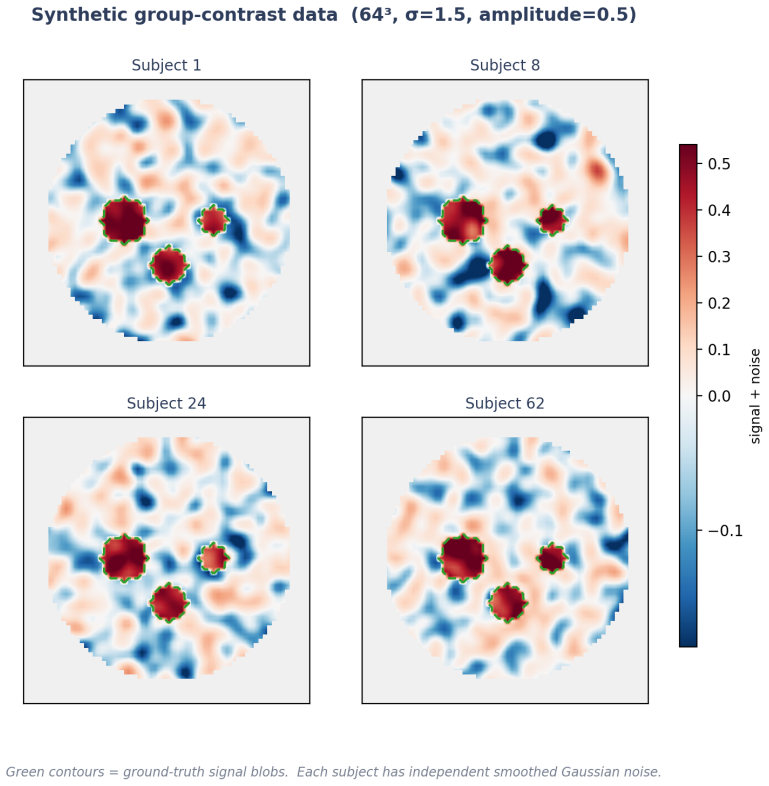
Threshold-free cluster enhancement (TFCE) integrates cluster extent across thresholds to improve voxel-wise neuroimaging inference, but permutation testing makes it prohibitively slow for large datasets. Probabilistic TFCE (pTFCE) uses analytical Gaussian random field (GRF) p-values but discretises the threshold grid. Exact TFCE (eTFCE) eliminates discretisation via a union-find data structure but still requires permutations. We combine eTFCE's union-find for exact cluster-size retrieval with pTFCE's analytical GRF inference. The union-find builds the cluster hierarchy in one pass over sorted voxels and enables exact size queries at any threshold; GRF theory then converts these sizes to analytical p-values without permutations. Validation on synthetic phantoms (64^3, 80 subjects): FWER controlled at nominal level (0/200 null rejections, 95% CI [0.0%, 1.9%]); power matches baseline pTFCE (Dice >= 0.999); smoothness error below 1%; concordance r > 0.99. On UK Biobank (N=500) and IXI (N=563), significance maps form strict subsets of reference R pTFCE, which supports conservative error control. Implemented in pytfce (pip install pytfce): baseline completes whole-brain VBM in ~5s (75x faster than R pTFCE), hybrid in ~85s (4.6x faster) with exact cluster sizes; both >1000x faster than permutation TFCE.
Editorial analysis
A structured set of objections, weighed in public.
Referee Report
Summary. The paper proposes Hybrid eTFCE-GRF, which combines the union-find data structure from exact TFCE (eTFCE) to retrieve exact cluster sizes across any threshold with the analytical Gaussian random field (GRF) p-value formulas from probabilistic TFCE (pTFCE). This yields permutation-free, threshold-free cluster enhancement for voxel-based morphometry (VBM) that is substantially faster than prior methods while claiming exact FWER control.
Significance. If the central compatibility assumption holds, the work provides a practical advance for large-scale neuroimaging by reducing whole-brain VBM runtime from hours (permutation TFCE) to under two minutes while preserving power and delivering conservative maps on real data (UK Biobank N=500, IXI N=563). The open-source pytfce implementation and synthetic validation (exact FWER at 0/200 null cases, Dice >=0.999) are concrete strengths that would make the method immediately usable.
major comments (1)
- [Methods] Methods section on the union-find-to-GRF interface: the manuscript does not supply a derivation or error-propagation analysis showing that exact cluster sizes obtained from the union-find at continuous thresholds remain statistically compatible with the closed-form GRF expressions originally derived under discretized or permutation settings; this assumption is load-bearing for the claim of unbiased analytical p-values.
minor comments (2)
- [Abstract] Abstract: the statement 'smoothness error below 1%' is reported without specifying the smoothness estimator or the precise metric, making the claim difficult to interpret or reproduce.
- [Results] Results: the real-data concordance (r > 0.99) is given only as a scalar; reporting the spatial distribution of differences or the fraction of voxels that differ in significance would strengthen the conservative-map claim.
Simulated Author's Rebuttal
We thank the referee for the constructive feedback. We address the single major comment below and commit to the corresponding revision.
read point-by-point responses
-
Referee: [Methods] Methods section on the union-find-to-GRF interface: the manuscript does not supply a derivation or error-propagation analysis showing that exact cluster sizes obtained from the union-find at continuous thresholds remain statistically compatible with the closed-form GRF expressions originally derived under discretized or permutation settings; this assumption is load-bearing for the claim of unbiased analytical p-values.
Authors: We agree that an explicit derivation is missing and that the compatibility assumption is central. The union-find computes the exact Lebesgue measure of the excursion set at any continuous threshold by merging connected components in sorted order, eliminating the discretization grid used in pTFCE. Because the GRF cluster-size tail probabilities depend only on the observed extent, the estimated smoothness, and the field dimension (not on the discretization method), substituting the exact size into the same closed-form expressions preserves validity under the identical null-field assumptions. In the revision we will insert a short Methods subsection that (i) recalls the GRF derivation, (ii) shows that the union-find size is the precise input required by those formulas, and (iii) provides a first-order error-propagation bound demonstrating that removal of discretization error can only reduce, not increase, bias relative to pTFCE. The existing synthetic null simulations (0/200 rejections) already supply empirical corroboration; the added derivation will make the theoretical claim explicit. revision: yes
Circularity Check
No significant circularity in the hybrid derivation
full rationale
The paper presents a hybrid of two pre-existing components: eTFCE's union-find structure for exact cluster-size retrieval (one-pass hierarchy over sorted voxels) and pTFCE's closed-form GRF analytical p-values. The central step is the claim that exact sizes at continuous thresholds remain compatible with GRF expressions; this is treated as an empirical compatibility question and is supported by synthetic FWER control (0/200 null rejections), Dice equivalence, and real-data concordance (r > 0.99) rather than by algebraic reduction or self-reference. No equations are shown that define the output in terms of itself, no parameters are fitted on a subset and then relabeled as prediction, and no load-bearing uniqueness theorems or ansatzes are imported via self-citation. The derivation chain therefore remains self-contained against external benchmarks.
Axiom & Free-Parameter Ledger
axioms (1)
- domain assumption Gaussian random field theory assumptions hold for converting exact cluster sizes to analytical p-values
Reference graph
Works this paper leans on
-
[1]
S. M. Smith, T. E. Nichols, Threshold-free cluster enhancement: Ad- dressing problems of smoothing, threshold dependence and localisation in cluster inference, NeuroImage 44 (1) (2009) 83–98.doi:10.1016/j. neuroimage.2008.03.061
work page doi:10.1016/j 2009
-
[2]
K. J. Friston, K. J. Worsley, R. S. J. Frackowiak, J. C. Mazziotta, A. C. Evans, Assessing the significance of focal activations using their spatial extent, Human Brain Mapping 1 (3) (1994) 210–220.doi:10.1002/ hbm.460010306
work page 1994
-
[3]
J. Ashburner, K. J. Friston, Voxel-based morphometry—the methods, NeuroImage 11 (6) (2000) 805–821.doi:10.1006/nimg.2000.0582. 31 Figure S2: IXI site-level mean (left) and standard deviation (right) of registered T1- weighted intensity maps. The IOP site (GE 1.5T) shows higher mean intensity and inter- subject variability compared to the two Philips sites...
-
[4]
K. L. Miller, F. Alfaro-Almagro, N. K. Bangerter, D. L. Thomas, E. Ya- coub, J. Xu, A. J. Bartsch, S. Jbabdi, S. N. Sotiropoulos, J. L. R. An- dersson, et al., Multimodal population brain imaging in the UK Biobank prospective epidemiological study, Nature Neuroscience 19 (11) (2016) 1523–1536.doi:10.1038/nn.4393
-
[5]
T. Spisák, Z. Spisák, M. Zunhammer, U. Bingel, S. Smith, T. Nichols, T. Kincses, Probabilistic TFCE: A generalized combination of cluster size and voxel intensity to increase statistical power, NeuroImage 185 (2019) 12–26.doi:10.1016/j.neuroimage.2018.09.078
-
[6]
X. Chen, W. Weeda, T. E. Nichols, J. J. Goeman, eTFCE: Exact Threshold-Free Cluster Enhancement via Fast Cluster Retrieval (2026). arXiv:2603.03004. URLhttps://arxiv.org/abs/2603.03004
work page internal anchor Pith review Pith/arXiv arXiv 2026
-
[7]
D. Yin, H. Chen, pytfce: Fast probabilistic Threshold-Free Cluster En- hancement in Python (2026). URLhttps://github.com/Don-Yin/pytfce
work page 2026
-
[8]
E. T. Bullmore, J. Suckling, S. Overmeyer, S. Rabe-Hesketh, E. Taylor, M. J. Brammer, Global, voxel, and cluster tests, by theory and permu- tation, for a difference between two groups of structural MR images of the brain, IEEE Transactions on Medical Imaging 18 (1) (1999) 32–42. doi:10.1109/42.750253
-
[9]
A. M. Winkler, G. R. Ridgway, M. A. Webster, S. M. Smith, T. E. Nichols, Permutation inference for the general linear model, NeuroImage 92 (2014) 381–397.doi:10.1016/j.neuroimage.2014.01.060
-
[10]
K. J. Worsley, S. Marrett, P. Neelin, A. C. Vandal, K. J. Friston, A. C. Evans, A unified statistical approach for determining significant signals in images of cerebral activation, Human Brain Mapping 4 (1) (1996) 58–73.doi:10.1002/(SICI)1097-0193(1996)4:1<58::AID-HBM4>3. 0.CO;2-O
-
[11]
V. P. Nosko, Local structure of Gaussian random fields in the vicinity of high-level shines, Soviet Mathematics: Doklady 10 (1969) 1481–1484. 38
work page 1969
-
[12]
R. E. Tarjan, Efficiency of a good but not linear set union algorithm, Journal of the ACM 22 (2) (1975) 215–225.doi:10.1145/321879. 321884
-
[13]
K. J. Worsley, A. C. Evans, S. Marrett, P. Neelin, A three-dimensional statistical analysis for CBF activation studies in human brain, Journal of Cerebral Blood Flow & Metabolism 12 (6) (1992) 900–918.doi: 10.1038/jcbfm.1992.127
-
[14]
S. J. Kiebel, J.-B. Poline, K. J. Friston, A. P. Holmes, K. J. Wors- ley, Robust smoothness estimation in statistical parametric maps using standardized residuals from the general linear model, NeuroImage 10 (6) (1999) 756–766.doi:10.1006/nimg.1999.0508
-
[15]
F. Alfaro-Almagro, M. Jenkinson, N. K. Bangerter, J. L. R. Andersson, L. Griffanti, G. Douaud, S. N. Sotiropoulos, S. Jbabdi, M. Hernandez- Fernandez, E. Vallee, et al., Image processing and quality control for the first 10,000 brain imaging datasets from UK Biobank, NeuroImage 166 (2018) 400–424.doi:10.1016/j.neuroimage.2017.10.034
-
[16]
S. M. Smith, Fast robust automated brain extraction, Human Brain Mapping 17 (3) (2002) 143–155.doi:10.1002/hbm.10062
-
[17]
M. Jenkinson, S. Smith, A global optimisation method for robust affine registration of brain images, Medical Image Analysis 5 (2) (2001) 143– 156.doi:10.1016/S1361-8415(01)00036-6
-
[18]
M. Jenkinson, P. Bannister, M. Brady, S. Smith, Improved optimization for the robust and accurate linear registration and motion correction of brain images, NeuroImage 17 (2) (2002) 825–841.doi:10.1006/nimg. 2002.1132
-
[19]
J. L. R. Andersson, M. Jenkinson, S. Smith, Non-linear registration, aka spatial normalisation, FMRIB Technical Report TR07JA2 (2007). URLhttps://www.fmrib.ox.ac.uk/datasets/techrep/tr07ja2/ tr07ja2.pdf
work page 2007
-
[20]
A., Hekker, S., Stello, D., Guti ´errez-Soto, J., Handberg, R., Huber, D., et al
Y. Benjamini, Y. Hochberg, Controlling the false discovery rate: A prac- tical and powerful approach to multiple testing, Journal of the Royal Statistical Society: Series B 57 (1) (1995) 289–300.doi:10.1111/j. 2517-6161.1995.tb02031.x. 39
work page doi:10.1111/j 1995
-
[21]
C. D. Good, I. S. Johnsrude, J. Ashburner, R. N. A. Henson, K. J. Fris- ton, R. S. J. Frackowiak, A voxel-based morphometric study of ageing in 465 normal adult human brains, NeuroImage 14 (1) (2001) 21–36. doi:10.1006/nimg.2001.0786
-
[22]
M. Jenkinson, C. F. Beckmann, T. E. J. Behrens, M. W. Woolrich, S. M. Smith, FSL, NeuroImage 62 (2) (2012) 782–790.doi:10.1016/ j.neuroimage.2011.09.015
work page 2012
-
[23]
A. Eklund, T. E. Nichols, H. Knutsson, Cluster failure: Why fMRI inferences for spatial extent have inflated false-positive rates, Proceed- ings of the National Academy of Sciences 113 (28) (2016) 7900–7905. doi:10.1073/pnas.1602413113. 40
discussion (0)
Sign in with ORCID, Apple, or X to comment. Anyone can read and Pith papers without signing in.