Recognition: 2 theorem links
· Lean TheoremAnalysis of spatially resolved stellar populations and emission line properties in nearby galaxies with J-PLUS data. II-Results for the M51 group and first comparison with the M101 group
Pith reviewed 2026-05-15 09:38 UTC · model grok-4.3
The pith
The M51 group shows more advanced dynamical evolution than the M101 group, with flatter age and metallicity gradients plus signs of quenching.
A machine-rendered reading of the paper's core claim, the machinery that carries it, and where it could break.
Core claim
The M51 group displays signatures of more advanced dynamical evolution than the M101 group. This appears in flattened age and nebular metallicity gradients, enhanced dust content, and environmental quenching in some members. The interacting pair M51a/b shows M51a with star-forming spiral arms while M51b is a retired early-type galaxy. M63 has asymmetries consistent with outside-in quenching from a past interaction. All galaxies follow the resolved star-forming main sequence except M51b. In contrast, the less evolved M101 group preserves inside-out formation signatures. The comparison remains limited by small-number statistics but suggests group mass and interactions influence evolution even,
What carries the argument
AlStar spectral fitting code applied to J-PLUS multi-band datacubes to produce spatially resolved maps of stellar population properties and emission-line quantities.
If this is right
- Age and nebular metallicity gradients flatten in groups that have undergone more interactions.
- Environmental quenching can proceed from the outside in, as seen in M63 asymmetries.
- Retired galaxies emerge within interacting pairs while their companions remain star-forming.
- Relations between physical properties and stellar mass surface density become flatter in more evolved groups.
- Most group members align with the resolved star-forming main sequence except retired early-type objects.
Where Pith is reading between the lines
- Extending the same photometric fitting method to additional groups would test whether group mass correlates with the degree of gradient flattening.
- The approach could scale to wider surveys to build statistical samples of environmental effects on resolved galaxy properties.
- Dynamical history may leave lasting imprints on dust content and star-formation patterns that models of group evolution should reproduce.
Load-bearing premise
The observed differences between the M51 and M101 groups are driven primarily by dynamical evolution and interactions rather than selection biases or unaccounted systematics in the AlStar fitting.
What would settle it
A larger sample of galaxy groups with comparable masses showing no systematic difference in age or metallicity gradients between interacting and non-interacting systems would challenge the claim that M51 is more dynamically evolved.
Figures




read the original abstract
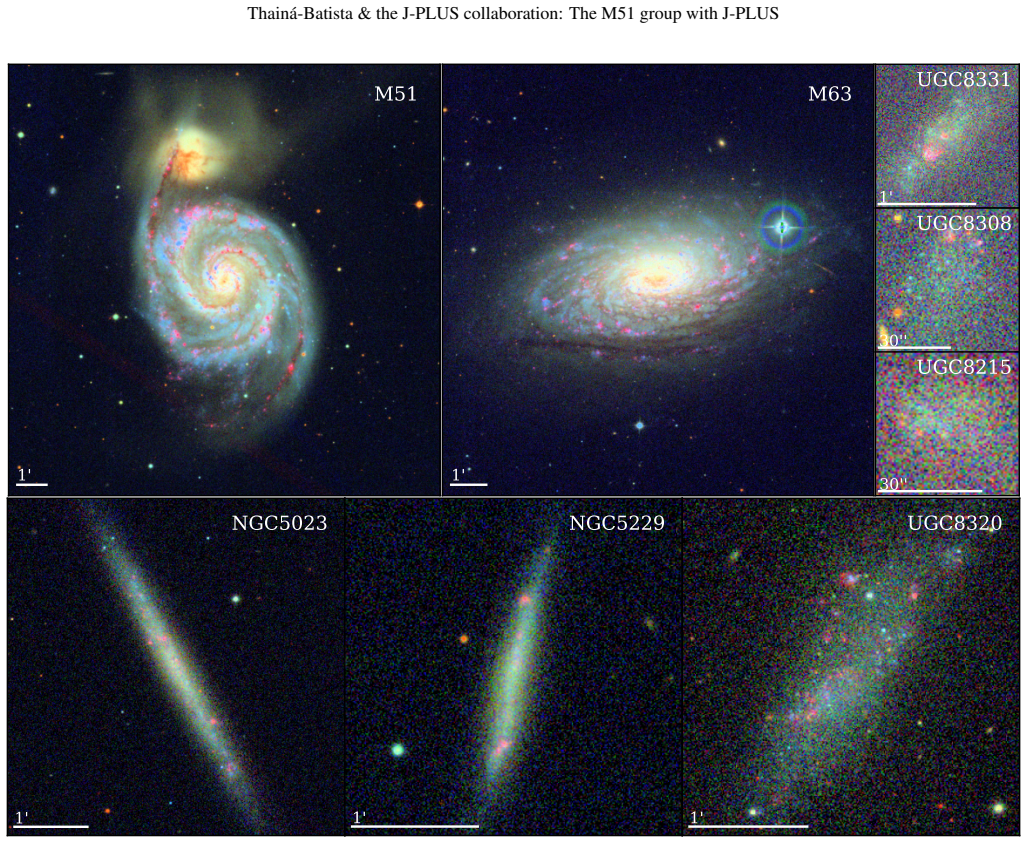
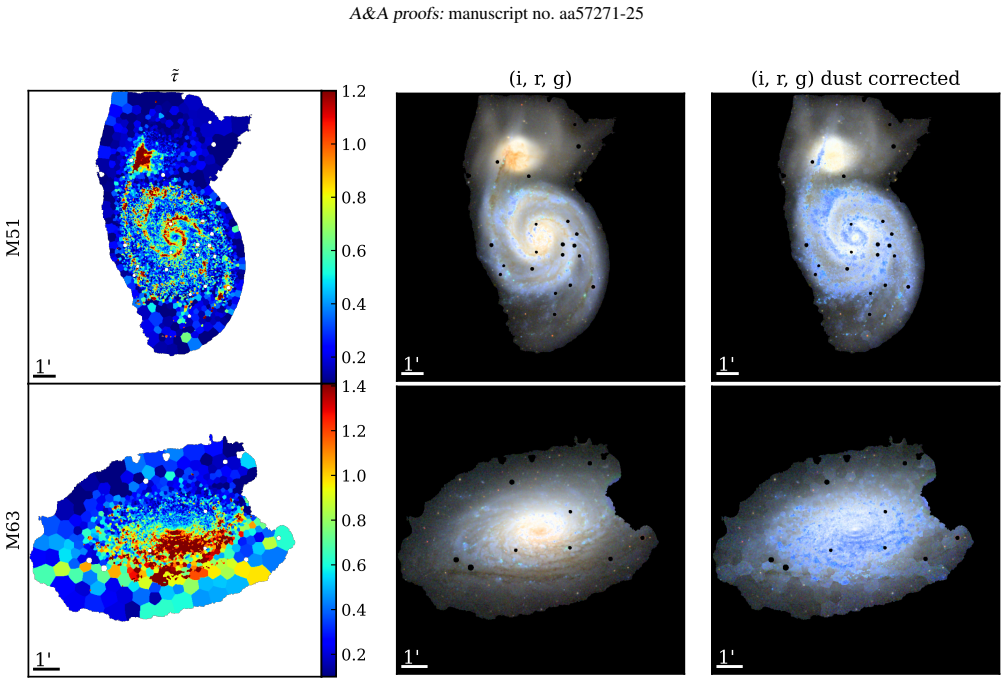
We characterize the spatially resolved stellar population and emission-line properties of galaxies in the M51 group using the same methodology previously applied to the M101 group, aiming to understand how environmental processes shape galaxy properties across different groups. Properties are derived by applying the \textsc{AlStar} spectral fitting code to multi-band datacubes from the Javalambre Photometric Local Universe Survey (J-PLUS). We present spatially resolved maps of the main stellar population and emission-line properties for the M51 group galaxies. The interacting pair M51a/b displays clearly distinct properties: M51a shows prominent star-forming spiral arms, while its companion is essentially an early-type retired galaxy. M63 exhibits asymmetries in stellar age, dust attenuation, and H$_\alpha$ equivalent width, consistent with outside-in quenching likely related to a past interaction. Relations between physical properties and stellar mass surface density ($\Sigma_\star$) were investigated. The age-$\Sigma_\star$ and nebular metallicity-$\Sigma_\star$ relations are flatter than those in the M101 group. In addition, all galaxies align with the resolved star-forming main sequence, except M51b, which shows the properties of a retired galaxy. Overall, the M51 group displays signatures of more advanced dynamical evolution than the M101 group. This is evidenced by flattened age and nebular metallicity gradients, enhanced dust content, and signs of environmental quenching in some members. In contrast, the less dynamically evolved M101 group largely preserves its inside-out formation signatures. While these results suggest that group mass and interactions influence galaxy evolution even in low-mass environments, the comparison of two systems remains limited by small-number statistics. This study highlights the potential of J-PLUS data for IFS-like analyses of nearby galaxies.
Editorial analysis
A structured set of objections, weighed in public.
Referee Report
Summary. The manuscript applies the AlStar spectral fitting code to J-PLUS multi-band datacubes to derive spatially resolved stellar population and emission-line properties for galaxies in the M51 group (M51a/b and M63), following the identical methodology used previously for the M101 group. It reports flatter age-Σ⋆ and nebular metallicity-Σ⋆ relations, enhanced dust content, asymmetries consistent with outside-in quenching, and alignment with the resolved star-forming main sequence (except for retired galaxy M51b), concluding that the M51 group shows signatures of more advanced dynamical evolution than the less evolved M101 group due to interactions and group environment.
Significance. If the inter-group differences can be placed on a statistically quantified footing, the results would provide concrete observational evidence that even low-mass group environments and interactions can drive measurable changes in radial gradients and quenching, extending the M101 baseline and demonstrating J-PLUS's utility for photometric IFS-like analyses of nearby galaxies. The explicit acknowledgment of small-number statistics is a positive step toward cautious interpretation.
major comments (3)
- [Abstract] Abstract: the claim that age-Σ⋆ and nebular metallicity-Σ⋆ relations are 'flatter' than in the M101 group is presented without reported uncertainties on the fitted slopes, without a statistical test of the difference between groups, and without an error budget on the AlStar-derived quantities; this directly undermines the central evolutionary comparison given the small sample.
- [Abstract] Abstract and results: only three galaxies (M51a, M51b, M63) are analyzed in the M51 group; no quantitative assessment is given of how representative these objects are or how small-number variance could produce the reported flattening, enhanced dust, and quenching signatures relative to M101 analogs.
- [Abstract] Abstract: the interpretation that observed differences arise primarily from dynamical evolution and interactions (rather than selection biases, galaxy-specific histories, or systematics in AlStar fits to J-PLUS photometry) lacks supporting tests such as mock recovery of radial trends or explicit checks against known biases in the fitting code.
minor comments (2)
- [Abstract] Abstract: the statement that 'all galaxies align with the resolved star-forming main sequence' would benefit from an explicit reference or definition of the sequence used for comparison.
- [Results] Throughout: ensure that spatially resolved maps include quantitative color bars with units and that any radial profiles are accompanied by the number of radial bins and the adopted binning scheme.
Simulated Author's Rebuttal
We thank the referee for their constructive comments, which have prompted us to strengthen the statistical foundation and supporting analyses in our manuscript. We address each major comment point by point below, incorporating revisions where they improve the rigor of our claims while maintaining an honest assessment of the study's limitations.
read point-by-point responses
-
Referee: [Abstract] Abstract: the claim that age-Σ⋆ and nebular metallicity-Σ⋆ relations are 'flatter' than in the M101 group is presented without reported uncertainties on the fitted slopes, without a statistical test of the difference between groups, and without an error budget on the AlStar-derived quantities; this directly undermines the central evolutionary comparison given the small sample.
Authors: We agree that the original presentation lacked sufficient quantitative support for the slope comparison. In the revised manuscript, we now report the fitted slopes with their uncertainties for both the M51 and M101 groups. We have added a statistical test (two-sample t-test accounting for slope uncertainties) to evaluate the significance of the differences. We have also expanded the methods and results sections to include a comprehensive error budget for the AlStar-derived quantities, incorporating photometric uncertainties, model degeneracies, and systematic effects. These changes provide a more robust basis for the claim of flatter relations while preserving the cautious interpretation already present in the text. revision: yes
-
Referee: [Abstract] Abstract and results: only three galaxies (M51a, M51b, M63) are analyzed in the M51 group; no quantitative assessment is given of how representative these objects are or how small-number variance could produce the reported flattening, enhanced dust, and quenching signatures relative to M101 analogs.
Authors: The manuscript already explicitly acknowledges the limitation imposed by small-number statistics. In the revision, we have added a dedicated paragraph discussing the representativeness of M51a, M51b, and M63 by comparing their global properties and environments to other known members of the M51 group from the literature. We have also performed a bootstrap resampling analysis on the derived relations to illustrate the potential impact of small-sample variance on the observed flattening and dust enhancements. These additions quantify the uncertainty arising from the limited sample while reinforcing that the qualitative differences (e.g., asymmetries and retired status of M51b) remain robust. revision: partial
-
Referee: [Abstract] Abstract: the interpretation that observed differences arise primarily from dynamical evolution and interactions (rather than selection biases, galaxy-specific histories, or systematics in AlStar fits to J-PLUS photometry) lacks supporting tests such as mock recovery of radial trends or explicit checks against known biases in the fitting code.
Authors: We have addressed this by adding mock recovery tests in the revised methods section. Simulated J-PLUS multi-band datacubes with known input radial gradients in age, metallicity, and dust were generated and fitted with AlStar to confirm reliable recovery of the trends within the reported uncertainties. We have also included explicit checks for known photometric fitting biases (e.g., age-dust-metallicity degeneracies) by comparing AlStar results against alternative model libraries and against literature values for M51 from spectroscopic studies. These tests support that systematics do not dominate the observed inter-group differences, though we continue to frame the interpretation as suggestive rather than definitive given the sample size. revision: yes
- A complete statistical quantification of inter-group differences that fully accounts for small-number variance and selection effects would require observations of additional groups, which lies beyond the scope of the present study.
Circularity Check
Minor self-citation of methodology; empirical results independent of prior inputs
specific steps
-
self citation load bearing
[Abstract]
"We characterize the spatially resolved stellar population and emission-line properties of galaxies in the M51 group using the same methodology previously applied to the M101 group"
The comparison framework is justified by reference to overlapping-author prior work, but the M51 results are generated independently from fresh photometry and do not reduce the evolutionary interpretation to the M101 inputs.
full rationale
The paper applies the AlStar fitting code to new J-PLUS datacubes for M51 galaxies to produce maps of age, metallicity, dust, and emission-line properties, then performs direct observational comparisons of gradients and relations against the M101 results. No derivation, prediction, or ansatz reduces to its own fitted inputs by construction. The sole self-reference is to the shared methodology from prior work on M101; this citation is not load-bearing for the central claim of more advanced dynamical evolution in M51, which rests on the new data contrasts. Small-sample caveats are explicitly noted in the abstract.
Axiom & Free-Parameter Ledger
axioms (1)
- domain assumption Stellar population synthesis models in AlStar accurately recover ages, metallicities, and dust attenuation from broadband photometry without major degeneracies
Lean theorems connected to this paper
-
IndisputableMonolith/Foundation/RealityFromDistinction.leanreality_from_one_distinction unclear?
unclearRelation between the paper passage and the cited Recognition theorem.
We characterize the spatially resolved stellar population and emission-line properties of galaxies in the M51 group using the same methodology previously applied to the M101 group... flattened age and nebular metallicity gradients, enhanced dust content, and signs of environmental quenching
-
IndisputableMonolith/Cost/FunctionalEquation.leanwashburn_uniqueness_aczel unclear?
unclearRelation between the paper passage and the cited Recognition theorem.
Properties are derived by applying the AlStar spectral fitting code to multi-band datacubes from the Javalambre Photometric Local Universe Survey (J-PLUS)
What do these tags mean?
- matches
- The paper's claim is directly supported by a theorem in the formal canon.
- supports
- The theorem supports part of the paper's argument, but the paper may add assumptions or extra steps.
- extends
- The paper goes beyond the formal theorem; the theorem is a base layer rather than the whole result.
- uses
- The paper appears to rely on the theorem as machinery.
- contradicts
- The paper's claim conflicts with a theorem or certificate in the canon.
- unclear
- Pith found a possible connection, but the passage is too broad, indirect, or ambiguous to say the theorem truly supports the claim.
Forward citations
Cited by 1 Pith paper
-
SAGUI: SED-based Segmentation of Multi-band Galaxy Images -- Application to JADES in GOODS-South
SAGUI introduces a two-stage segmentation framework for multi-band galaxy images that combines starlet decomposition, spectral similarity analysis, and copula statistics to identify structures and recover low-surface-...
Reference graph
Works this paper leans on
-
[1]
Alonso, S., Mesa, V ., Padilla, N., & Lambas, D. G. 2012, A&A, 539, A46
work page 2012
-
[2]
V ., Cid Fernandes, R., Stasi´nska, G., et al
Asari, N. V ., Cid Fernandes, R., Stasi´nska, G., et al. 2007, MNRAS, 381, 263
work page 2007
- [3]
-
[4]
Barrera-Ballesteros, J. K., Heckman, T. M., Zhu, G. B., et al. 2016, MNRAS, 463, 2513
work page 2016
-
[5]
Battaglia, G., Fraternali, F., Oosterloo, T., & Sancisi, R. 2006, A&A, 447, 49
work page 2006
-
[6]
Bluck, A. F. L., Maiolino, R., Piotrowska, J. M., et al. 2020, MNRAS, 499, 230
work page 2020
-
[7]
Boselli, A. & Gavazzi, G. 2006, PASP, 118, 517 Article number, page 13 A&A proofs:manuscript no. aa57271-25
work page 2006
-
[8]
2024, astropy/photutils: 1.12.0
Bradley, L., Sip˝ocz, B., Robitaille, T., et al. 2024, astropy/photutils: 1.12.0
work page 2024
-
[9]
Bresolin, F., Garnett, D. R., & Kennicutt, Jr., R. C. 2004, ApJ, 615, 228
work page 2004
- [10]
- [11]
-
[12]
Calzetti, D., Kinney, A. L., & Storchi-Bergmann, T. 1994, ApJ, 429, 582
work page 1994
- [13]
-
[14]
Castellanos, M., Díaz, A. I., & Terlevich, E. 2002, MNRAS, 329, 315
work page 2002
-
[15]
J., Moles, M., Cristóbal-Hornillos, D., et al
Cenarro, A. J., Moles, M., Cristóbal-Hornillos, D., et al. 2019, A&A, 622, A176
work page 2019
-
[16]
J., Moles, M., Marín-Franch, A., et al
Cenarro, A. J., Moles, M., Marín-Franch, A., et al. 2014, in Proc. SPIE, V ol. 9149, Observatory Operations: Strategies, Processes, and Systems V , 91491I
work page 2014
- [17]
-
[18]
S., Martínez-Delgado, D., Gabany, R
Chonis, T. S., Martínez-Delgado, D., Gabany, R. J., et al. 2011, AJ, 142, 166 Cid Fernandes, R., Stasi ´nska, G., Mateus, A., & Vale Asari, N. 2011, MNRAS, 413, 1687–1699 Cristóbal-Hornillos, D., Gruel, N., Varela, J., et al. 2012, in SPIE CS, V ol. 8451
work page 2011
-
[19]
M., van de Sande, J., Vaughan, S
Croom, S. M., van de Sande, J., Vaughan, S. P., et al. 2024, MNRAS, 529, 3446
work page 2024
-
[20]
Croxall, K. V ., Pogge, R. W., Berg, D. A., Skillman, E. D., & Moustakas, J. 2015, ApJ, 808, 42
work page 2015
-
[21]
Dobbs, C. L., Theis, C., Pringle, J. E., & Bate, M. R. 2010, MNRAS, 403, 625
work page 2010
- [22]
-
[23]
Elmegreen, D. M. & Elmegreen, B. G. 1987, ApJ, 314, 3
work page 1987
-
[24]
Enia, A., Rodighiero, G., Morselli, L., et al. 2020, MNRAS, 493, 4107
work page 2020
-
[25]
Gallazzi, A., Charlot, S., Brinchmann, J., White, S. D. M., & Tremonti, C. A. 2005, MNRAS, 362, 41 García-Benito, R., González Delgado, R. M., Pérez, E., et al. 2017, A&A, 608, A27 González Delgado, R. M., Cid Fernandes, R., García-Benito, R., et al. 2014a, ApJ, 791, L16 González Delgado, R. M., Cid Fernandes, R., Pérez, E., et al. 2016, A&A, 590, A44 Gon...
work page 2005
-
[26]
Gullieuszik, M., Poggianti, B. M., Moretti, A., et al. 2020, The Astrophysical Journal, 846, 27
work page 2020
-
[27]
Gunn, J. E. & Gott, J. R. 1972, The Astrophysical Journal, 176, 1
work page 1972
-
[28]
1990, Bulletin d’Information du Centre de Donnees Stellaires, 38, 7 Jaffé, Y
Helou, G. 1990, Bulletin d’Information du Centre de Donnees Stellaires, 38, 7 Jaffé, Y . L., Poggianti, B. M., Moretti, A., et al. 2018, MNRAS, 476, 4753
work page 1990
-
[29]
Kauffmann, G., White, S. D. M., & Heckman, T. M. e. a. 2004, MNRAS, 353, 713
work page 2004
-
[30]
Kennicutt, Robert C., J., Bresolin, F., & Garnett, D. R. 2003, ApJ, 591, 801
work page 2003
-
[31]
Lacerda, E. A. D., Cid Fernandes, R., Couto, G. S., et al. 2018, MNRAS, 474, 3727
work page 2018
-
[32]
Lee, J. H., Hwang, N., & Lee, M. G. 2011, ApJ, 735, 75 Logroño-García, R., Vilella-Rojo, G., López-Sanjuan, C., et al. 2019, A&A, 622, A180
work page 2011
-
[33]
Lopes, A. R., Smith Castelli, A. V ., Krabbe, A. C., et al. 2025, A&A, 699, A331 López-Sanjuan, C., Vázquez Ramió, H., Xiao, K., et al. 2024, A&A, 683, A29
work page 2025
-
[34]
Lotz, J. M., Jonsson, P., Cox, T. J., & Primack, J. R. 2010, MNRAS, 404, 575
work page 2010
-
[35]
2022, A&A, 668, A60 Marín-Franch, A., Taylor, K., Cenarro, J., Cristobal-Hornillos, D., & Moles, M
Lumbreras-Calle, A., López-Sanjuan, C., Sobral, D., et al. 2022, A&A, 668, A60 Marín-Franch, A., Taylor, K., Cenarro, J., Cristobal-Hornillos, D., & Moles, M. 2015, in IAU General Assembly, V ol. 29, 2257381
work page 2022
-
[36]
Marino, R. A., Rosales-Ortega, F. F., Sánchez, S. F., et al. 2013, A&A, 559, A114
work page 2013
-
[37]
McQuinn, K. B. W., Skillman, E. D., Dolphin, A. E., Berg, D., & Kennicutt, R. 2016, ApJ, 826, 21 Mendes de Oliveira, C., Ribeiro, T., Schoenell, W., et al. 2019, MNRAS, 489, 241 Mentuch Cooper, E., Wilson, C. D., Foyle, K., et al. 2012, ApJ, 755, 165
work page 2016
- [38]
-
[39]
Moustakas, J., Kennicutt, Jr., R. C., Tremonti, C. A., et al. 2010, ApJS, 190, 233
work page 2010
-
[40]
J., Tacchella, S., Diemer, B., et al
Nelson, E. J., Tacchella, S., Diemer, B., et al. 2021, MNRAS, 508, 219
work page 2021
-
[41]
Nersesian, A., Viaene, S., De Looze, I., et al. 2020, A&A, 643, A90
work page 2020
-
[42]
2001, ApJ, 561, 203 Pérez-González, P
Nikola, T., Geis, N., Herrmann, F., et al. 2001, ApJ, 561, 203 Pérez-González, P. G., Rieke, G. H., Villar, V ., et al. 2008, ApJ, 675, 234
work page 2001
-
[43]
Plat, A., Charlot, S., Bruzual, G., et al. 2019, MNRAS, 490, 978
work page 2019
-
[44]
Poggianti, B. M., Jaffé, Y . L., Moretti, A., et al. 2017, Nature, 548, 304
work page 2017
-
[45]
T., Akhlaghi, M., López-Sanjuan, C., et al
Rahna, P. T., Akhlaghi, M., López-Sanjuan, C., et al. 2025, A&A, 695, A200
work page 2025
- [46]
-
[47]
Ricci, T. V ., Steiner, J. E., & Menezes, R. B. 2014, MNRAS, 440, 2419 Rodríguez-Martín, J. E., Díaz-García, L. A., González Delgado, R. M., et al. 2025, A&A, 704, A52 San Roman, I., Sánchez-Blázquez, P., Cenarro, A. J., et al. 2019, A&A, 622, A181 Sánchez-Gil, M. C., Jones, D. H., Pérez, E., et al. 2011, MNRAS, 415, 753
work page 2014
-
[48]
Smith, M. V ., van Zee, L., Dale, D. A., Staudaher, S., & Wrock, T. 2022, MN- RAS, 516, 477
work page 2022
-
[49]
2020, A&A, 642, A113 Stasi´nska, G., Vale Asari, N., Cid Fernandes, R., et al
Spitoni, E., Calura, F., Mignoli, M., et al. 2020, A&A, 642, A113 Stasi´nska, G., Vale Asari, N., Cid Fernandes, R., et al. 2008, MNRAS, 391, L29
work page 2020
-
[50]
Staudaher, S. M., Dale, D. A., van Zee, L., Barnes, K. L., & Cook, D. O. 2015, MNRAS, 454, 3613
work page 2015
-
[51]
Swaters, R. A., van Albada, T. S., van der Hulst, J. M., & Sancisi, R. 2002, A&A, 390, 829 Sánchez, S. F. 2020, Annual Review of Astronomy and Astrophysics, 58, 99–155
work page 2002
-
[52]
Tacchella, S., Carollo, C. M., Renzini, A., et al. 2015, Science, 348, 314 Thainá-Batista, J., Cid Fernandes, R., González Delgado, R. M., et al. 2025, A&A, 699, A45 Thainá-Batista, J., Cid Fernandes, R., Herpich, F. R., et al. 2023, MNRAS, 526, 1874
work page 2015
-
[53]
Tikhonov, N. A., Galazutdinova, O. A., & Drozdovsky, I. O. 2006, arXiv e- prints, astro
work page 2006
-
[54]
Tress, R. G., Smith, R. J., Sormani, M. C., et al. 2020, MNRAS, 492, 2973
work page 2020
-
[55]
Vilella-Rojo, G., Viironen, K., López-Sanjuan, C., et al. 2015, A&A, 580, A47
work page 2015
- [56]
- [57]
- [58]
-
[59]
Zabludoff, A. I. & Mulchaey, J. S. 1998, ApJ, 496, 39 Article number, page 14 Thainá-Batista & the J-PLUS collaboration: The M51 group with J-PLUS Appendix A: Complementary material This appendix presents complementary figures that support the results discussed in the main text. Fig. A.1.RGB composites using (J0660,g, sum of five bluer filters) of the pre...
work page 1998
discussion (0)
Sign in with ORCID, Apple, or X to comment. Anyone can read and Pith papers without signing in.