Recognition: unknown
SAGUI: SED-based Segmentation of Multi-band Galaxy Images -- Application to JADES in GOODS-South
Pith reviewed 2026-05-10 03:35 UTC · model grok-4.3
The pith
SAGUI segments multi-band galaxy images by combining starlet decomposition with spectral-similarity grouping and copula recovery of faint features.
A machine-rendered reading of the paper's core claim, the machinery that carries it, and where it could break.
Core claim
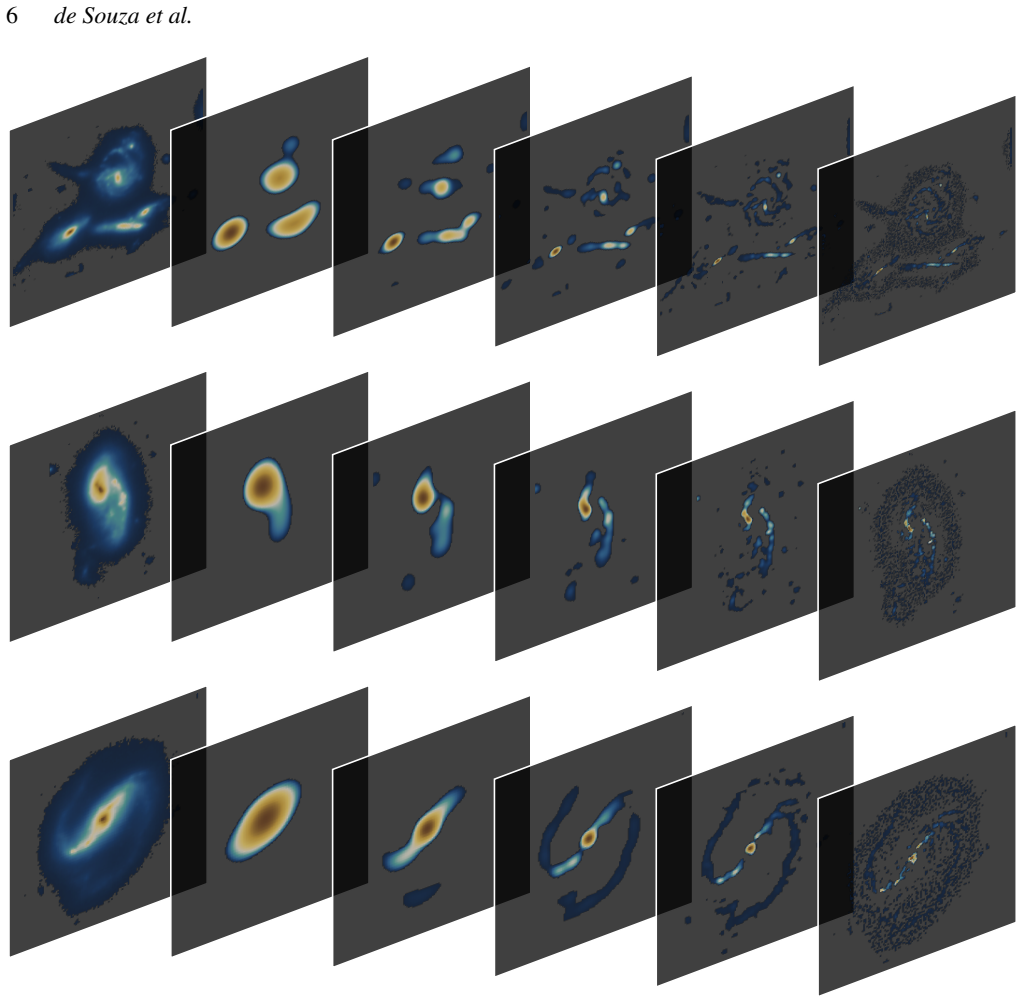
SAGUI extends the spectro-spatial paradigm to imaging data through a two-stage strategy: starlet-based multi-scale decomposition first identifies and masks spatial structures while suppressing noise, after which spectral-similarity analysis partitions the image into coherent pixel groups that preserve spectral consistency. The framework adds a dedicated copula-transform treatment to identify and recover faint diffuse low-surface-brightness components, and the approach is demonstrated on morphologically diverse galaxies from the JADES GOODS-South field.
What carries the argument
The central mechanism is the two-stage segmentation that pairs starlet-based multi-scale decomposition for spatial structure detection and noise suppression with spectral-similarity partitioning for pixel grouping, augmented by a copula transform to recover low-surface-brightness features.
If this is right
- Enables characterization of complex galaxy structures including clumps, bars, interacting systems, and low-surface-brightness features.
- Delivers a coherent pixel-level treatment of spatial and spectral information across multiple bands.
- Supports synergies with integral-field spectroscopy for spatially resolved galaxy studies.
- Facilitates analysis of faint components in deep surveys such as JADES.
Where Pith is reading between the lines
- The segmentation output could be combined with existing photometry pipelines to improve measurements of galaxy stellar populations in large surveys.
- The approach might help isolate diffuse features that influence models of galaxy assembly and evolution.
- Extension to additional wavelength regimes could reveal how spectral consistency holds or breaks across different instruments.
Load-bearing premise
The method assumes that starlet decomposition plus spectral-similarity partitioning will form pixel groups that keep spectral consistency across bands, and that the copula transform will recover true faint low-surface-brightness structures without creating artifacts or false features.
What would settle it
Apply SAGUI to simulated multi-band galaxy images that contain known injected low-surface-brightness components and check whether the output segmentation recovers those exact components without adding spurious structures or missing real ones; systematic mismatches would falsify the claim.
Figures




read the original abstract
We present sagui, a modular framework for the analysis of multi-band imaging data in spatially resolved galaxies, with synergies to integral-field spectroscopy (IFS). Building on the spectro-spatial paradigm introduced by capivara for IFS data, sagui extends this approach to imaging datasets, enabling a coherent, pixel-level treatment of spatial and spectral information across multiple bands. The method follows a two-stage strategy: a starlet-based decomposition is first used to identify and mask spatial structures across multiple scales while suppressing noise, and a spectral-similarity analysis then partitions the image into coherent pixel groups that preserve spectral consistency. In addition to compact and high-contrast structures, the framework incorporates a dedicated statistical treatment, based on a copula transform, to identify and recover faint, diffuse low-surface-brightness components. We demonstrate the method across a diverse range of galaxy morphologies, highlighting its ability to characterize complex spatial structures, including clumps, bars, interacting systems, and low-surface-brightness features. As a case study, we apply it to eleven morphologically diverse galaxies from the James Webb Space Telescope Advanced Deep Extragalactic Survey in the GOODS--South field. sagui is released under an MIT license and is available at https://rafaelsdesouza.github.io/sagui/.
Editorial analysis
A structured set of objections, weighed in public.
Referee Report
Summary. The paper introduces SAGUI, a modular framework extending the CAPIVARA spectro-spatial approach from IFS to multi-band imaging data. It employs a two-stage pipeline—starlet-based multi-scale decomposition to identify spatial structures and suppress noise, followed by spectral-similarity partitioning to group pixels while preserving spectral consistency—plus a copula transform to recover faint diffuse low-surface-brightness components. The method is demonstrated qualitatively on 11 morphologically diverse galaxies from the JADES survey in GOODS-South, with open-source code released under MIT license.
Significance. If the LSB recovery and segmentation claims hold under quantitative scrutiny, SAGUI would provide a useful open tool for coherent pixel-level analysis of complex galaxy structures (clumps, bars, interactions, diffuse features) in JWST multi-band imaging while maintaining spectral fidelity, with potential synergies to IFS studies. The public code release is a clear strength supporting reproducibility.
major comments (2)
- [Abstract and case-study application] Abstract and demonstration on JADES galaxies: the central claim that the copula transform accurately identifies and recovers faint LSB components without introducing artifacts or false structures rests on qualitative examples only; no completeness, purity, flux-recovery fractions, or controlled tests on simulated images with injected LSB signals at known surface-brightness levels and noise realizations are reported, leaving the performance unverified.
- [Methods] Methods description of the two-stage strategy: no quantitative error analysis, baseline comparisons (e.g., against standard segmentation tools), or details on parameter choices for starlet scales and spectral-similarity thresholds are supplied, which is load-bearing for assessing whether the partitioning truly preserves spectral consistency across bands.
minor comments (1)
- [Abstract] The abstract states the code is available at a GitHub link but does not include a direct citation or DOI for the CAPIVARA framework it builds upon.
Simulated Author's Rebuttal
We thank the referee for the careful and constructive review of our manuscript. The comments identify key areas where additional rigor would strengthen the presentation of SAGUI. We address each major comment point by point below, indicating the revisions we will implement.
read point-by-point responses
-
Referee: [Abstract and case-study application] Abstract and demonstration on JADES galaxies: the central claim that the copula transform accurately identifies and recovers faint LSB components without introducing artifacts or false structures rests on qualitative examples only; no completeness, purity, flux-recovery fractions, or controlled tests on simulated images with injected LSB signals at known surface-brightness levels and noise realizations are reported, leaving the performance unverified.
Authors: We agree that the current demonstration is based on qualitative assessment of real JADES data across 11 morphologically diverse galaxies. While this choice emphasizes applicability to complex observational datasets, we acknowledge that quantitative validation would better support the LSB recovery claims. In the revised manuscript we will add a dedicated section presenting controlled tests on simulated images with injected LSB signals, including completeness, purity, and flux-recovery metrics across multiple noise realizations. revision: yes
-
Referee: [Methods] Methods description of the two-stage strategy: no quantitative error analysis, baseline comparisons (e.g., against standard segmentation tools), or details on parameter choices for starlet scales and spectral-similarity thresholds are supplied, which is load-bearing for assessing whether the partitioning truly preserves spectral consistency across bands.
Authors: We accept that the methods section would benefit from greater quantitative support. The original text describes the starlet decomposition and spectral-similarity partitioning but does not include formal error analysis or direct comparisons. We will revise the methods to incorporate quantitative error analysis, baseline comparisons against standard tools such as SExtractor, and explicit details on the selection of starlet scales and spectral-similarity thresholds together with sensitivity tests confirming preservation of spectral consistency. revision: yes
Circularity Check
SAGUI presents independent methodological extensions without derivation circularity
full rationale
The manuscript introduces SAGUI as a new two-stage pipeline (starlet decomposition followed by spectral-similarity partitioning, augmented by a copula transform for LSB recovery) that extends the prior CAPIVARA framework to imaging data. No equations or steps in the provided description reduce the core outputs (pixel groups, recovered LSB components) to quantities fitted from the same JADES dataset by construction. The application to eleven galaxies is a demonstration rather than a self-referential prediction. The self-citation to CAPIVARA is explicit but does not serve as the sole justification for the new imaging-specific components or claims; those rest on the described algorithmic choices and qualitative results. This is a standard case of building on prior work without tautological reduction.
Axiom & Free-Parameter Ledger
Reference graph
Works this paper leans on
-
[1]
Behind the spotlight: a systematic assessment of outshining using NIRCam medium bands in the JADES Origins Field. , keywords =. doi:10.1093/mnras/staf1396 , archivePrefix =. 2504.05244 , primaryClass =
-
[2]
Resolved Stellar Mass Maps of Galaxies in the Hubble Frontier Fields: Evidence for Mass Dependency in Environmental Quenching. , keywords =. doi:10.3847/1538-4357/ac7051 , archivePrefix =. 2205.07913 , primaryClass =
-
[3]
The MOSDEF survey: an improved Voronoi binning technique on spatially resolved stellar populations at z 2. , keywords =. doi:10.1093/mnras/staa2775 , archivePrefix =. 2009.03926 , primaryClass =
-
[4]
Analysis of spatially resolved stellar populations and emission line properties in nearby galaxies with J-PLUS data. II-Results for the M51 group and first comparison with the M101 group. arXiv e-prints , keywords =. doi:10.48550/arXiv.2603.15869 , archivePrefix =. 2603.15869 , primaryClass =
work page internal anchor Pith review Pith/arXiv arXiv doi:10.48550/arxiv.2603.15869
-
[5]
Ground-based and Airborne Instrumentation for Astronomy VI , year = 2016, editor =
Hector: a new massively multiplexed IFU instrument for the Anglo-Australian Telescope. Ground-based and Airborne Instrumentation for Astronomy VI , year = 2016, editor =. doi:10.1117/12.2230740 , archivePrefix =. 1608.03921 , primaryClass =
-
[6]
Journal of Classification , volume =
Murtagh, Fionn and Legendre, Pierre , title =. Journal of Classification , volume =. 2014 , doi =
2014
-
[7]
, title =
Ward, Joe H. , title =. Journal of the American Statistical Association , volume =. 1963 , doi =
1963
-
[8]
J-PLUS: a catalogue of globular cluster candidates around the M 81/M 82/NGC 3077 triplet of galaxies. , keywords =. doi:10.1093/mnras/stac2002 , archivePrefix =. 2202.11472 , primaryClass =
-
[9]
SPICY: The Spitzer/IRAC Candidate YSO Catalog for the Inner Galactic Midplane. , keywords =. doi:10.3847/1538-4365/abe465 , archivePrefix =. 2011.12961 , primaryClass =
-
[10]
The stellar, dust, and gas mass functions
The bivariate luminosity and mass functions of the local HRS galaxy sample. The stellar, dust, and gas mass functions. , keywords =. doi:10.1051/0004-6361/201832873 , archivePrefix =. 1806.02567 , primaryClass =
-
[11]
A new model to predict weak-lensing peak counts. III. Filtering technique comparisons. , keywords =. doi:10.1051/0004-6361/201628565 , archivePrefix =. 1603.06773 , primaryClass =
-
[12]
Copula cosmology: Constructing a likelihood function. , keywords =. doi:10.1103/PhysRevD.83.023501 , archivePrefix =. 1011.4997 , primaryClass =
-
[13]
2018, MNRAS, 476, 1532, doi: 10.1093/mnras/sty186
Spatially unresolved SED fitting can underestimate galaxy masses: a solution to the missing mass problem. , keywords =. doi:10.1093/mnras/sty186 , archivePrefix =. 1801.07368 , primaryClass =
-
[14]
Beware the recent past: a bias in spectral energy distribution modelling due to bursty star formation. , keywords =. doi:10.1093/mnrasl/slae019 , archivePrefix =. 2310.16097 , primaryClass =
-
[15]
Deriving star formation histories from photometry using energy balance spectral energy distribution modelling. , keywords =. doi:10.1093/mnras/stv1727 , archivePrefix =. 1507.07554 , primaryClass =
-
[16]
The LOFAR Two-metre Sky Survey: The nature of the faint source population and SFR-radio luminosity relation using PROSPECTOR. , keywords =. doi:10.1093/mnras/stae1204 , archivePrefix =. 2405.01624 , primaryClass =
-
[17]
The wide-field, multiplexed, spectroscopic facility WEAVE: Survey design, overview, and simulated implementation. , keywords =. doi:10.1093/mnras/stad557 , archivePrefix =. 2212.03981 , primaryClass =
-
[18]
2017, MNRAS, 469, 2806, doi: 10.1093/mnras/stx936 Astropy Collaboration, Price-Whelan, A
Abdurro'uf and Akiyama, Masayuki , title =. Monthly Notices of the Royal Astronomical Society , volume =. 2017 , month =. doi:10.1093/mnras/stx936 , url =
-
[19]
The Wide Field Infrared Survey Telescope: 100 Hubbles for the 2020s
The Wide Field Infrared Survey Telescope: 100 Hubbles for the 2020s. arXiv e-prints , keywords =. doi:10.48550/arXiv.1902.05569 , archivePrefix =. 1902.05569 , primaryClass =
-
[20]
LSST: From Science Drivers to Reference Design and Anticipated Data Products , journal =
Ivezi\'. LSST: From Science Drivers to Reference Design and Anticipated Data Products , journal =. 2019 , doi =
2019
-
[21]
Euclid preparation. VII. Forecast validation for Euclid cosmological probes. , keywords =. doi:10.1051/0004-6361/202038071 , archivePrefix =. 1910.09273 , primaryClass =
-
[22]
Science China Physics, Mechanics, and Astronomy , keywords =
Introduction to the Chinese Space Station Survey Telescope (CSST). Science China Physics, Mechanics, and Astronomy , keywords =. doi:10.1007/s11433-025-2809-0 , archivePrefix =. 2507.04618 , primaryClass =
-
[23]
Fornax3D project: Overall goals, galaxy sample, MUSE data analysis, and initial results. , keywords =. doi:10.1051/0004-6361/201833137 , archivePrefix =. 1804.06795 , primaryClass =
-
[24]
MAUVE-MUSE: A Star-formation-driven Outflow Caught in the Act of Quenching the Stripped Virgo Galaxy NGC 4064. , keywords =. doi:10.3847/2041-8213/ae2c51 , archivePrefix =. 2512.10574 , primaryClass =
-
[25]
The GECKOS survey: Identifying kinematic sub-structures in edge-on galaxies. , keywords =. doi:10.1051/0004-6361/202452891 , archivePrefix =. 2411.03430 , primaryClass =
-
[26]
Properties of the brightest young stellar clumps in extremely lensed galaxies at redshifts 4 to 5. , keywords =. doi:10.1093/mnras/stae565 , archivePrefix =. 2402.14920 , primaryClass =
-
[27]
Spatially resolved PAH _ 3.3 emission and stellar ages in ram pressure stripped clumps at z 0.3. , keywords =. doi:10.1051/0004-6361/202558016 , archivePrefix =. 2511.05113 , primaryClass =
-
[28]
Formation of a low-mass galaxy from star clusters in a 600-million-year-old Universe. , keywords =. doi:10.1038/s41586-024-08293-0 , archivePrefix =. 2402.08696 , primaryClass =
-
[29]
A first GLIMPSE into star clusters popula- tions across cosmic time
A first GLIMPSE into star clusters populations across cosmic time. arXiv e-prints , keywords =. doi:10.48550/arXiv.2601.16281 , archivePrefix =. 2601.16281 , primaryClass =
-
[30]
Astronomy and Computing , year =
Melchior, Peter and Moolekamp, Fred and Jerdee, Maximilian and Armstrong, Robert and Sun, Ai-Lei and Bosch, James and Lupton, Robert , title =. Astronomy and Computing , year =. doi:10.1016/j.ascom.2018.07.001 , url =
-
[31]
Bertin, Emmanuel and Arnouts, Stephane , title =. Astronomy and Astrophysics Supplement Series , year =. doi:10.1051/aas:1996164 , url =
-
[32]
2006 , publisher=
Pattern Recognition and Machine Learning , author=. 2006 , publisher=
2006
-
[33]
Stellar population synthesis at the resolution of 2003. , keywords =. doi:10.1046/j.1365-8711.2003.06897.x , archivePrefix =. astro-ph/0309134 , primaryClass =
-
[34]
Adaptive spatial binning of integral-field spectroscopic data using Voronoi tessellations. , keywords =. doi:10.1046/j.1365-8711.2003.06541.x , archivePrefix =. astro-ph/0302262 , primaryClass =
-
[35]
Aurenhammer, Franz , title =. 1991 , issue_date =. doi:10.1145/116873.116880 , journal =
-
[36]
Nouvelles applications des paramètres continus à la théorie des formes quadratiques
Georges Voronoi , pages =. Nouvelles applications des paramètres continus à la théorie des formes quadratiques. Premier mémoire. Sur quelques propriétés des formes quadratiques positives parfaites. , title =. Journal für die reine und angewandte Mathematik (Crelles Journal) , doi =. 1908 , lastchecked =
1908
-
[37]
A Catalog of Bulge+disk Decompositions and Updated Photometry for 1.12 Million Galaxies in the Sloan Digital Sky Survey. , keywords =. doi:10.1088/0067-0049/196/1/11 , archivePrefix =. 1107.1518 , primaryClass =
-
[38]
Galactic Dynamics: Second Edition
-
[39]
2015, MNRAS, 452, 235, doi: 10.1093/mnras/stv1235
Missing stellar mass in SED fitting: spatially unresolved photometry can underestimate galaxy masses. , keywords =. doi:10.1093/mnras/stv1235 , archivePrefix =. 1506.01653 , primaryClass =
-
[40]
The Intracluster Light of Abell 3667: Unveiling an Optical Bridge in LSST Precursor Data. , keywords =. doi:10.3847/2041-8213/ade8f1 , archivePrefix =. 2505.23551 , primaryClass =
-
[41]
How to Measure Galaxy Star Formation Histories. I. Parametric Models. , keywords =. doi:10.3847/1538-4357/ab04a2 , archivePrefix =. 1811.03635 , primaryClass =
-
[42]
Astronomy and Computing , keywords =
Machine and Deep Learning applied to galaxy morphology - A comparative study. Astronomy and Computing , keywords =. doi:10.1016/j.ascom.2019.100334 , archivePrefix =. 1901.07047 , primaryClass =
-
[43]
Detecting the edges of galaxies with deep learning. , keywords =. doi:10.1051/0004-6361/202347216 , archivePrefix =. 2312.11654 , primaryClass =
-
[44]
Noise-based Detection and Segmentation of Nebulous Objects. , keywords =. doi:10.1088/0067-0049/220/1/1 , archivePrefix =. 1505.01664 , primaryClass =
-
[45]
VLT/VIMOS spectroscopy in the GOODS-south field
The great observatories origins deep survey. VLT/VIMOS spectroscopy in the GOODS-south field. , keywords =. doi:10.1051/0004-6361:200809617 , archivePrefix =. 0802.2930 , primaryClass =
-
[46]
The MUSE Hubble Ultra Deep Field Survey. I. Survey description, data reduction, and source detection. , keywords =. doi:10.1051/0004-6361/201730833 , archivePrefix =. 1710.03002 , primaryClass =
-
[47]
2023, A&A, 670, A4, doi: 10.1051/0004-6361/202244187
The MUSE Hubble Ultra Deep Field surveys: Data release II. , keywords =. doi:10.1051/0004-6361/202244187 , archivePrefix =. 2211.08493 , primaryClass =
-
[48]
CAPIVARA: a spectral-based segmentation method for IFU data cubes. , keywords =. doi:10.1093/mnras/staf688 , archivePrefix =. 2410.21962 , primaryClass =
-
[49]
2006 , publisher =
Starck, Jean-Luc and Murtagh, Fionn , title =. 2006 , publisher =
2006
-
[50]
and Murtagh, Fionn , title =
Starck, Jean-Luc and Fadili, Jalal M. and Murtagh, Fionn , title =. IEEE Transactions on Image Processing , year =
-
[51]
Evolution of spatially resolved star formation main sequence and surface density profiles in massive disc galaxies at 0 z 1: inside-out stellar mass buildup and quenching. , keywords =. doi:10.1093/mnras/sty1771 , archivePrefix =. 1802.03782 , primaryClass =
-
[52]
The KMOS ^ 3D Survey: Data Release and Final Survey Paper. , keywords =. doi:10.3847/1538-4357/ab4db8 , archivePrefix =. 1909.11096 , primaryClass =
-
[53]
The SINS/zC-SINF Survey of z 2 Galaxy Kinematics: SINFONI Adaptive Optics-assisted Data and Kiloparsec-scale Emission-line Properties. , keywords =. doi:10.3847/1538-4365/aadd49 , archivePrefix =. 1802.07276 , primaryClass =
-
[54]
Galactic Stellar and Substellar Initial Mass Function. , keywords =. doi:10.1086/376392 , archivePrefix =. astro-ph/0304382 , primaryClass =
work page internal anchor Pith review Pith/arXiv arXiv doi:10.1086/376392
-
[55]
Overview of the SDSS-IV MaNGA Survey: Mapping Nearby Galaxies at Apache Point Observatory
Overview of the SDSS-IV MaNGA Survey: Mapping nearby Galaxies at Apache Point Observatory. , keywords =. doi:10.1088/0004-637X/798/1/7 , archivePrefix =. 1412.1482 , primaryClass =
-
[56]
The SAMI Galaxy Survey: the third and final data release. , keywords =. doi:10.1093/mnras/stab229 , archivePrefix =. 2101.12224 , primaryClass =
-
[57]
CALIFA, the Calar Alto Legacy Integral Field Area survey. I. Survey presentation. , keywords =. doi:10.1051/0004-6361/201117353 , archivePrefix =. 1111.0962 , primaryClass =
-
[58]
The ATLAS ^ 3D project - I. A volume-limited sample of 260 nearby early-type galaxies: science goals and selection criteria. , keywords =. doi:10.1111/j.1365-2966.2010.18174.x , archivePrefix =. 1012.1551 , primaryClass =
-
[59]
The SAURON project - II. Sample and early results. , eprint =. doi:10.1046/j.1365-8711.2002.05059.x , adsurl =
-
[60]
The Sloan Digital Sky Survey: Technical Summary. , keywords =. doi:10.1086/301513 , archivePrefix =. astro-ph/0006396 , primaryClass =
-
[61]
GAMA: towards a physical understanding of galaxy formation. Astronomy and Geophysics , keywords =. doi:10.1111/j.1468-4004.2009.50512.x , archivePrefix =. 0910.5123 , primaryClass =
-
[62]
Streams, Substructures, and the Early History of the Milky Way. , keywords =. doi:10.1146/annurev-astro-032620-021917 , archivePrefix =. 2002.04340 , primaryClass =
-
[63]
Abdurro’uf and Lin, Yen-Ting and Wu, Po-Feng and Akiyama, Masayuki , title =. 2021 , month =. doi:10.3847/1538-4365/abebe2 , url =
-
[64]
Clump formation in ram-pressure stripped galaxies: Evidence from mass function. , keywords =. doi:10.1051/0004-6361/202452983 , archivePrefix =. 2502.15554 , primaryClass =
-
[65]
Sam-Sam - A Novel Approach to Hyperspectral Image Semantic Segmentation , year=
Medellin, Anthony and Grabowsky, David and Mikulski, Dariusz and Langari, Reza , booktitle=. Sam-Sam - A Novel Approach to Hyperspectral Image Semantic Segmentation , year=
-
[66]
Unsupervised segmentation of hyperspectral remote sensing images with superpixels , volume=
Barbato, Mirko Paolo and Napoletano, Paolo and Piccoli, Flavio and Schettini, Raimondo , year=. Unsupervised segmentation of hyperspectral remote sensing images with superpixels , volume=. doi:10.1016/j.rsase.2022.100823 , journal=
-
[67]
Improvement of hyperspectral imaging signal quality using filtering technique , journal =
Jiasheng Zhou and Te Ma and Satoru Tsuchikawa and Tetsuya Inagaki , keywords =. Improvement of hyperspectral imaging signal quality using filtering technique , journal =. 2025 , issn =. doi:https://doi.org/10.1016/j.chemolab.2025.105386 , url =
-
[68]
Applied Sciences , VOLUME =
Mohammadi, Sina and Allali, Mohamed , TITLE =. Applied Sciences , VOLUME =. 2024 , NUMBER =
2024
-
[69]
D., Sandoval, A., Veeraraghavan, A., & Valdés, P
Kotwal, A., Saragadam, V., Bernstock, J. D., Sandoval, A., Veeraraghavan, A., & Valdés, P. A. , TITLE =. Journal of Biomedical Optics , VOLUME =. 2024 , NUMBER =
2024
-
[70]
J., Willott, C., Alberts, S., et al
Overview of the JWST Advanced Deep Extragalactic Survey (JADES). arXiv e-prints , keywords =. doi:10.48550/arXiv.2306.02465 , archivePrefix =. 2306.02465 , primaryClass =
-
[71]
The JADES Origins Field: A New JWST Deep Field in the JADES Second NIRCam Data Release. arXiv e-prints , keywords =. doi:10.48550/arXiv.2310.12340 , archivePrefix =. 2310.12340 , primaryClass =
-
[72]
JADES NIRSpec initial data release for the Hubble Ultra Deep Field: Redshifts and line fluxes of distant galaxies from the deepest JWST Cycle 1 NIRSpec multi-object spectroscopy. , keywords =. doi:10.1051/0004-6361/202347094 , archivePrefix =. 2306.02467 , primaryClass =
-
[73]
JADES Data Release 3: NIRSpec/Microshutter Assembly Spectroscopy for 4000 Galaxies in the GOODS Fields. , keywords =. doi:10.3847/1538-4365/ada148 , archivePrefix =. 2404.06531 , primaryClass =
-
[74]
The Fraction of Clumpy Galaxies in JADES over $2<z<9$
The Fraction of Clumpy Galaxies in JWST Surveys over 2<z<12. arXiv e-prints , keywords =. doi:10.48550/arXiv.2508.14972 , archivePrefix =. 2508.14972 , primaryClass =
work page internal anchor Pith review Pith/arXiv arXiv doi:10.48550/arxiv.2508.14972
-
[75]
The Great Observatories Origins Deep Survey: Initial Results from Optical and Near-Infrared Imaging. , keywords =. doi:10.1086/379232 , archivePrefix =. astro-ph/0309105 , primaryClass =
-
[76]
D., Leja, J., Conroy, C., & Speagle, J
Stellar Population Inference with Prospector. , keywords =. doi:10.3847/1538-4365/abef67 , archivePrefix =. 2012.01426 , primaryClass =
work page internal anchor Pith review doi:10.3847/1538-4365/abef67 2012
-
[77]
2013, ApJ, 775, L16, doi: 10.1088/2041-8205/775/1/L16
The Dust Attenuation Law in Distant Galaxies: Evidence for Variation with Spectral Type. , keywords =. doi:10.1088/2041-8205/775/1/L16 , archivePrefix =. 1308.1099 , primaryClass =
-
[78]
The Propagation of Uncertainties in Stellar Population Synthesis Modeling. I. The Relevance of Uncertain Aspects of Stellar Evolution and the Initial Mass Function to the Derived Physical Properties of Galaxies. , keywords =. doi:10.1088/0004-637X/699/1/486 , archivePrefix =. 0809.4261 , primaryClass =
work page internal anchor Pith review Pith/arXiv arXiv doi:10.1088/0004-637x/699/1/486
-
[79]
J., Robertson, B., Tacchella, S., et al
JADES Initial Data Release for the Hubble Ultra Deep Field: Revealing the Faint Infrared Sky with Deep JWST NIRCam Imaging. , keywords =. doi:10.3847/1538-4365/acf44d , archivePrefix =. 2306.02466 , primaryClass =
-
[80]
Stellar Populations in 10 Clump-Cluster Galaxies of the Hubble Ultra Deep Field. , keywords =. doi:10.1086/430514 , archivePrefix =. astro-ph/0504032 , primaryClass =
discussion (0)
Sign in with ORCID, Apple, or X to comment. Anyone can read and Pith papers without signing in.