Recognition: 2 theorem links
· Lean TheoremThe Program Hypergraph: Multi-Way Relational Structure for Geometric Algebra, Spatial Compute, and Physics-Aware Compilation
Pith reviewed 2026-05-15 08:39 UTC · model grok-4.3
The pith
The Program Hypergraph generalizes binary semantic graphs to arbitrary-arity hyperedges to natively represent geometric algebra and spatial dataflow constraints.
A machine-rendered reading of the paper's core claim, the machinery that carries it, and where it could break.
Core claim
By promoting binary edges to hyperedges of arbitrary arity in the Program Hypergraph, grade in Clifford algebra becomes a natural dimension axis within the DTS abelian group framework, grade inference derives geometric product sparsity without manual specialization, and the k-simplex structure of mesh topology is a direct instance of the hyperedge formalism, closing the type-theoretic gap in geometric algebra libraries within the Fidelity compilation framework.
What carries the argument
The Program Hypergraph, a generalization of the Program Semantic Graph that uses hyperedges of arbitrary arity to capture multi-way relational structures for geometric and spatial computations.
If this is right
- Grade in Clifford algebra integrates as a dimension axis in the existing DTS abelian group.
- Grade inference automatically derives sparsity for geometric products, removing the primary performance objection to Clifford algebra neural networks.
- The k-simplex structure of mesh topology becomes a direct instance of hyperedges.
- Geometric correctness, memory placement, numerical precision, and hardware partitioning are jointly derivable from the single hypergraph structure.
- Interactive design-time feedback becomes available for these properties in the compilation process.
Where Pith is reading between the lines
- Compilers could use this to optimize geometric computations across different hardware without explicit user tuning for sparsity.
- The approach might generalize to other domains with multi-way constraints, such as relational databases or chemical reaction networks.
- Physics simulations could be compiled directly from geometric descriptions using the mesh hyperedges.
- Future work might test whether the hypergraph preserves performance in large-scale neural network training involving geometric algebra.
Load-bearing premise
That replacing binary edges with hyperedges of arbitrary arity preserves all algebraic identities while enabling the joint derivation of multiple compilation properties without adding performance or correctness costs.
What would settle it
Finding a specific Clifford algebra expression where the hyperedge representation produces a different result from the standard geometric product, or measuring no reduction in computation time from the inferred sparsity in a neural network benchmark.
Figures

read the original abstract
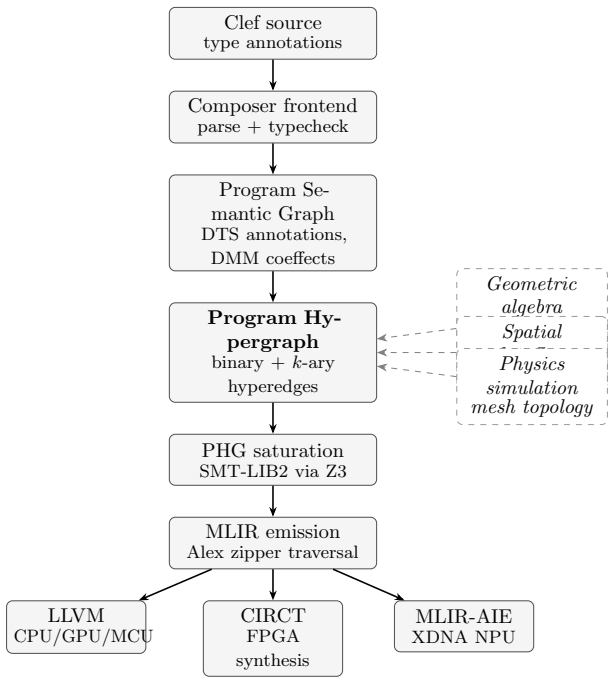
The Program Semantic Graph (PSG) introduced in prior work on Dimensional Type Systems and Deterministic Memory Management encodes compilation-relevant properties as binary edge relations between computation nodes. This representation is adequate for scalar and tensor computations, but becomes structurally insufficient for two classes of problems central to heterogeneous compute: tile co-location and routing constraints in spatial dataflow architectures, which are inherently multi-way; and geometric algebra computation, where graded multi-way products cannot be faithfully represented as sequences of binary operations without loss of algebraic identity. This paper introduces the Program Hypergraph (PHG) as a principled generalization of the PSG that promotes binary edges to hyperedges of arbitrary arity. We demonstrate that grade in Clifford algebra is a natural dimension axis within the existing DTS abelian group framework, that grade inference derives geometric product sparsity eliminating the primary performance objection to Clifford algebra neural networks without manual specialization, and that the k-simplex structure of mesh topology is a direct instance of the hyperedge formalism. We assess the existing geometric algebra library ecosystem, identify the consistent type-theoretic gap that no current system addresses, and show that the PHG closes it within the Fidelity compilation framework. The result is a compilation framework where geometric correctness, memory placement, numerical precision selection, and hardware partitioning are jointly derivable from a single graph structure exposed as interactive design-time feedback.
Editorial analysis
A structured set of objections, weighed in public.
Referee Report
Summary. The paper introduces the Program Hypergraph (PHG) as a generalization of the prior Program Semantic Graph (PSG) within Dimensional Type Systems (DTS). Binary edges are promoted to hyperedges of arbitrary arity while preserving the underlying abelian-group structure. The central claims are that Clifford-algebra grade functions as a natural dimension axis inside this framework, that grade inference directly yields geometric-product sparsity (removing the need for manual specialization in Clifford neural networks), and that k-simplex mesh topology is an instance of the hyperedge formalism. The work evaluates existing geometric-algebra libraries, identifies a type-theoretic gap, and integrates PHG into the Fidelity compilation framework so that geometric correctness, memory placement, numerical precision, and hardware partitioning become jointly derivable from a single graph exposed for interactive design-time feedback.
Significance. If the algebraic constructions hold, the result supplies a unified relational substrate that simultaneously addresses multi-way constraints in spatial dataflow, graded products in geometric algebra, and mesh topology. This removes a structural limitation of binary-edge representations and enables a single derivation path for correctness, placement, and precision decisions inside a compilation framework. The explicit closure of the identified gap in current GA libraries and the provision of interactive feedback constitute a concrete engineering contribution for physics-aware heterogeneous compilation.
major comments (2)
- [Definition of PHG and DTS integration] The manuscript states that hyperedges of arbitrary arity are absorbed into the existing DTS grading without new axioms or alteration of the group operation. An explicit homomorphism construction (or reduction to the binary case) should be supplied in the section defining the PHG to confirm that algebraic identity is preserved for arity > 2.
- [Grade inference and sparsity derivation] Grade inference is claimed to derive geometric-product sparsity directly from the abelian-group homomorphism. A worked example (e.g., a specific multivector product together with the inferred zero pattern) is needed to demonstrate that the sparsity is obtained without manual specialization and that it matches the performance-critical cases for Clifford neural networks.
minor comments (2)
- [Introduction] The abstract and introduction refer to “the existing DTS abelian group framework” without a self-contained recap of the relevant group operation and grading; a short reminder paragraph would improve readability for readers unfamiliar with the prior PSG work.
- [Figures illustrating k-simplex and geometric products] Figure captions for the mesh-topology and geometric-product examples should explicitly label the hyperedge arities and the corresponding DTS grades so that the claimed direct instance relation is visually verifiable.
Simulated Author's Rebuttal
We thank the referee for the positive assessment and constructive comments. We address each major point below and will revise the manuscript accordingly.
read point-by-point responses
-
Referee: [Definition of PHG and DTS integration] The manuscript states that hyperedges of arbitrary arity are absorbed into the existing DTS grading without new axioms or alteration of the group operation. An explicit homomorphism construction (or reduction to the binary case) should be supplied in the section defining the PHG to confirm that algebraic identity is preserved for arity > 2.
Authors: We agree that an explicit construction strengthens the presentation. In the revised manuscript we will insert a dedicated paragraph in the PHG definition section that constructs the homomorphism explicitly: each n-ary hyperedge is reduced to an iterated binary product under the existing abelian group operation on graded dimensions, with a short proof that the grading and all algebraic identities are preserved without new axioms. revision: yes
-
Referee: [Grade inference and sparsity derivation] Grade inference is claimed to derive geometric-product sparsity directly from the abelian-group homomorphism. A worked example (e.g., a specific multivector product together with the inferred zero pattern) is needed to demonstrate that the sparsity is obtained without manual specialization and that it matches the performance-critical cases for Clifford neural networks.
Authors: We will add a worked example in the grade-inference subsection. The example will compute the geometric product of two explicit multivectors in Cl(3,0), derive the zero pattern directly from the abelian-group homomorphism on grades, and show that the resulting sparsity pattern matches the hand-specialized kernels used in current Clifford neural-network implementations, confirming that no manual specialization is required. revision: yes
Circularity Check
No significant circularity detected
full rationale
The paper defines the Program Hypergraph explicitly as a generalization of the prior Program Semantic Graph by promoting binary edges to arbitrary-arity hyperedges whose arity is absorbed into the existing DTS abelian-group structure without new axioms or altered operations. Grade inference follows directly from the group homomorphism, geometric-product sparsity is derived as a consequence, and k-simplex mesh topology is exhibited as the special case of arity k+1. No equation or claim reduces by construction to a fitted parameter, self-defined quantity, or unverified self-citation chain; the algebraic construction is supplied in the manuscript and remains self-contained against external benchmarks.
Axiom & Free-Parameter Ledger
axioms (1)
- domain assumption Grade in Clifford algebra is a natural dimension axis within the existing DTS abelian group framework
invented entities (1)
-
Program Hypergraph (PHG)
no independent evidence
Lean theorems connected to this paper
-
IndisputableMonolith/Foundation/ArithmeticFromLogic.leanLogicNat ≃ Nat (recovery of abelian-group arithmetic from Law of Logic) echoes?
echoesECHOES: this paper passage has the same mathematical shape or conceptual pattern as the Recognition theorem, but is not a direct formal dependency.
Proposition 3.1 (Grade is a DTS Dimension Axis under the Outer Product). Restricted to the outer product, the grade of a Clifford algebra element satisfies the axioms of a DTS dimension: it is an element of a finitely generated abelian group (Z, +), it is preserved under the outer product (addition), and its consistency is decidable in O(1) per operation.
-
IndisputableMonolith/Foundation/AlexanderDuality.leanalexander_duality_circle_linking (D=3 forced by non-trivial circle linking) echoes?
echoesECHOES: this paper passage has the same mathematical shape or conceptual pattern as the Recognition theorem, but is not a direct formal dependency.
In Plane-based Geometric Algebra (PGA, R^{3,0,1}) ... k-simplex is the outer product of k+1 grade-1 elements ... triangle join is a single hyperedge f = ({p1,p2,p3}, triangle, λ∧) where δ(pi)=1 ... δ(triangle)=3.
What do these tags mean?
- matches
- The paper's claim is directly supported by a theorem in the formal canon.
- supports
- The theorem supports part of the paper's argument, but the paper may add assumptions or extra steps.
- extends
- The paper goes beyond the formal theorem; the theorem is a base layer rather than the whole result.
- uses
- The paper appears to rely on the theorem as machinery.
- contradicts
- The paper's claim conflicts with a theorem or certificate in the canon.
- unclear
- Pith found a possible connection, but the passage is too broad, indirect, or ambiguous to say the theorem truly supports the claim.
Forward citations
Cited by 2 Pith papers
-
Dimensional Type Systems and Deterministic Memory Management: Design-Time Semantic Preservation in Native Compilation
A dimensional type system extends Hindley-Milner inference with abelian-group constraints and carries annotations through MLIR lowering to jointly decide numeric representation and deterministic memory allocation at c...
-
Decidable By Construction: Design-Time Verification for Trustworthy AI
A type system over finitely generated abelian groups enables design-time verification of AI model properties and links Hindley-Milner unification to a restriction of Solomonoff's universal prior.
Reference graph
Works this paper leans on
-
[1]
MLIR-AIE: An MLIR-based toolchain for AMD AI engines, 2024
AMD/Xilinx. MLIR-AIE: An MLIR-based toolchain for AMD AI engines, 2024. github. com/Xilinx/mlir-aie
work page 2024
- [2]
- [3]
-
[4]
M. Coll. Inet dialect: Declarative rewrite rules for interaction nets. MLIR Open Design Meeting, April 2025. University of Buenos Aires
work page 2025
-
[5]
S. De Keninck, M. Roelfs, L. Dorst, and D. Eelbode. Clean up your mesh! Part 1: Plane and simplex.arXiv preprint arXiv:2511.08058, 2025
-
[6]
L. Dorst and S. De Keninck. A guided tour to the plane-based geometric algebra PGA, version 2.0, 2022.bivector.net/PGA4CS.html
work page 2022
-
[7]
B. Gavranovi´ c, P. Lessard, A. Dudzik, T. von Glehn, J. G. M. Ara´ ujo, and P. Veliˇ ckovi´ c. Position: Categorical deep learning is an algebraic theory of all architectures.arXiv preprint arXiv:2402.15332, 2024
-
[8]
H. Haynes. The DCont/Inet duality: How computation expressions decompose into fundamental compilation patterns. SpeakEZ Technologies, 2025. speakez.tech/blog/ dcont-inet-duality/
work page 2025
-
[9]
H. Haynes. Quantum optionality and the precision problem. Clef Language Framework blog, 2026.clef-lang.com/blog/quantum-optionality/
work page 2026
-
[10]
H. Haynes. Dimensional type systems and deterministic memory management: Design- time semantic preservation in native compilation. SpeakEZ Technologies, 2026
work page 2026
- [11]
-
[12]
G. Karypis and V. Kumar. Multilevel k-way hypergraph partitioning.VLSI Design, 11(3):285–300, 2000
work page 2000
-
[13]
A. Kennedy. Types for units-of-measure: Theory and practice. InCentral European Functional Programming School, LNCS 6299. Springer, 2009
work page 2009
-
[14]
C. Lattner et al. MLIR: Scaling compiler infrastructure for domain specific computation. InProceedings of CGO, 2021
work page 2021
-
[15]
J. Ong. Klein: A fast geometric algebra library for 3D PGA, 2020. github.com/ jeremyong/Klein
work page 2020
-
[16]
T. Petricek, D. Orchard, and A. Mycroft. Coeffects: A calculus of context-dependent computation. InProceedings of ICFP, 2014
work page 2014
- [17]
-
[18]
Outrageously Large Neural Networks: The Sparsely-Gated Mixture-of-Experts Layer
N. Shazeer, A. Mirhoseini, K. Maziarz, A. Davis, Q. Le, G. Hinton, and J. Dean. Outrageously large neural networks: The sparsely-gated mixture-of-experts layer.arXiv preprint arXiv:1701.06538, 2017
work page internal anchor Pith review Pith/arXiv arXiv 2017
-
[19]
A. Rico et al. AMD XDNA NPU in Ryzen AI processors.IEEE Micro, 44(6):73–83, 2024
work page 2024
- [20]
- [21]
-
[22]
S. Peyton Jones, K. Claessen, R. Jhala, T. Sweeney, L. Augustsson, and O. Shivers. The Verse calculus: A core calculus for functional logic programming.Proceedings of the ACM on Programming Languages, 7(ICFP), 2023
work page 2023
- [23]
-
[24]
M. Zhdanov. Flash Clifford: Hardware-efficient implementation of Clifford algebra neural networks.github.com/maxxxzdn/flash-clifford, 2025
work page 2025
-
[25]
M. Zhdanov, D. Ruhe, M. Weiler, A. Lucic, J. Brandstetter, and P. Forr´ e. Clifford- steerable convolutional neural networks. InProceedings of ICML, 2024
work page 2024
-
[26]
all four on the same tile block
biVector.net geometric algebra library catalog, 2025.bivector.net/lib.html. A. Grade Inference Example Consider an unannotated Clef function computing the area of a triangle from three PGA points. The function takes three grade-1 homogeneous point coordinates in R3,0,1 and returns a scalar area value with dimension m 2. The body performs two successive ou...
work page 2025
discussion (0)
Sign in with ORCID, Apple, or X to comment. Anyone can read and Pith papers without signing in.