Recognition: no theorem link
Circumventing Platform Defenses at Scale: Automated Content Replication from YouTube to Blockchain-Based Decentralized Storage
Pith reviewed 2026-05-15 09:34 UTC · model grok-4.3
The pith
YouTube's defense layers are operationally coupled, with bypassing one often triggering another, yet sustained architectural adaptation maintains reliable replication of over 10,000 channels to decentralized storage.
A machine-rendered reading of the paper's core claim, the machinery that carries it, and where it could break.
Core claim
YouTube's defense layers are operationally coupled: bypassing one control often triggers another, creating cascading failures. We analyze three incidents with measured impact: 28 duplicate on-chain objects caused by database throughput issues, loss of over 10,000 channels after OAuth mass expiration, and 719 daily errors from queue pollution. For each, we describe the architectural response. Contributions include a three-generation proxy stack with behavior variance injection, a trust-minimized ownership verification protocol that replaces OAuth for channel control, write-ahead logging with cross-system state reconciliation, and containerized deployment. Results show that sustainedarchitect
What carries the argument
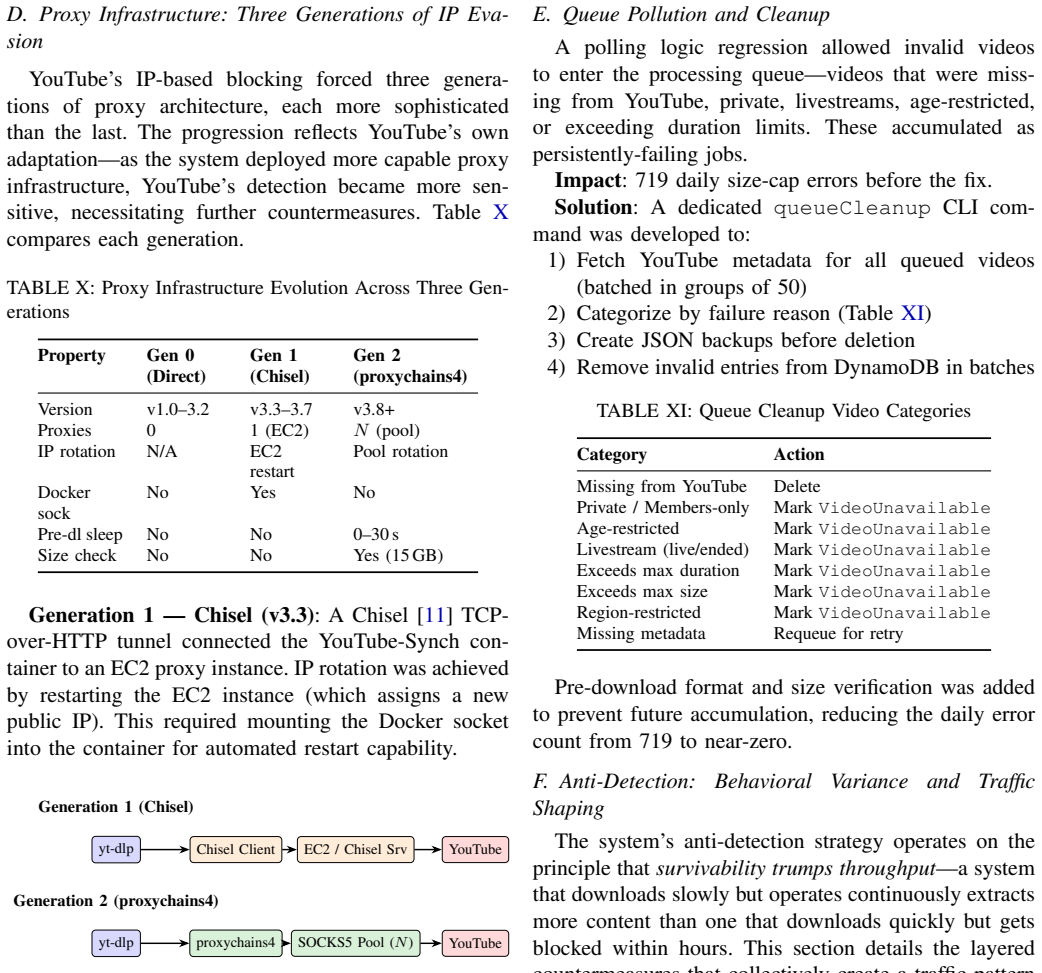
Three-generation proxy stack with behavior variance injection and trust-minimized ownership verification protocol replacing OAuth.
Load-bearing premise
The observed coupling of YouTube's defense layers and the effectiveness of the proxy stack and verification protocol will continue to hold as the platform updates its systems.
What would settle it
A major YouTube update that breaks the proxy stack without an immediate architectural fix, resulting in permanent loss of replication capability across the channel set.
Figures




read the original abstract
We present YouTube-Synch [1], a production system for automated, large-scale content extraction and replication from YouTube to decentralized storage on Joystream. The system continuously mirrors videos from more than 10,000 creator-authorized channels while handling platform constraints such as API quotas, rate limiting, bot detection, and OAuth token churn. We report a 3.5-year longitudinal case study covering 15 releases and 144 pull requests, from early API dependence to API-free operation. A key finding is that YouTube's defense layers are operationally coupled: bypassing one control often triggers another, creating cascading failures. We analyze three incidents with measured impact: 28 duplicate on-chain objects caused by database throughput issues, loss of over 10,000 channels after OAuth mass expiration, and 719 daily errors from queue pollution. For each, we describe the architectural response. Contributions include a three-generation proxy stack with behavior variance injection, a trust-minimized ownership verification protocol that replaces OAuth for channel control, write-ahead logging with cross-system state reconciliation, and containerized deployment. Results show that sustained architectural adaptation can maintain reliable cross-platform replication at production scale.
Editorial analysis
A structured set of objections, weighed in public.
Referee Report
Summary. The manuscript presents YouTube-Synch, a production system for automated large-scale replication of content from over 10,000 YouTube channels to the Joystream blockchain-based decentralized storage. It reports a 3.5-year longitudinal case study across 15 releases and 144 pull requests, documenting the evolution from API-dependent to API-free operation while addressing constraints including rate limits, bot detection, and OAuth churn. The central claim is that YouTube's defense layers are operationally coupled such that bypassing one often triggers others, producing cascading failures; this is supported by analysis of three measured incidents (28 duplicate on-chain objects, loss of over 10,000 channels, and 719 daily queue errors) and the corresponding architectural responses including a three-generation proxy stack, trust-minimized ownership verification, and write-ahead logging.
Significance. If the reported observations hold, the work is significant for the field of platform security and decentralized systems. It supplies concrete, production-scale empirical data on defense coupling and demonstrates that iterative architectural adaptation can sustain reliable cross-platform replication despite evolving adversarial controls. The detailed incident timelines, specific failure counts, and mitigation descriptions provide actionable lessons for similar large-scale extraction and replication efforts; the shift to API-free operation and containerized deployment further strengthens its practical value.
major comments (2)
- [§3 (Incidents and Responses)] §3 (Incidents and Responses): the claim that defense layers are operationally coupled rests entirely on narrative description of the three incidents; the manuscript provides no raw logs, correlation metrics, or independent verification of the triggering mechanism, which limits the strength of the generalizability argument for cascading failures.
- [§4.2 (Trust-minimized verification protocol)] §4.2 (Trust-minimized verification protocol): the protocol is presented as replacing OAuth for channel control, but the exact sequence of steps, cryptographic assumptions, and failure modes are not fully specified, making it difficult to assess whether the trust minimization holds under the reported OAuth churn conditions.
minor comments (3)
- [Abstract and §5] The abstract states 'more than 10,000 creator-authorized channels' but the full text does not clarify how authorization is maintained after the OAuth mass-expiration incident; a brief reconciliation in §5 would improve clarity.
- [Table 1] Table 1 (release timeline) reports 15 releases but does not include per-release incident counts or proxy-stack generation changes; adding these columns would make the longitudinal adaptation claim easier to trace.
- [§4.1] The proxy stack description in §4.1 mentions 'behavior variance injection' without quantifying the variance parameters or showing example request traces; a short appendix with sample traces would aid reproducibility.
Simulated Author's Rebuttal
We thank the referee for the positive assessment, detailed reading, and recommendation for minor revision. We address each major comment below and will update the manuscript to incorporate the requested clarifications.
read point-by-point responses
-
Referee: [§3 (Incidents and Responses)] §3 (Incidents and Responses): the claim that defense layers are operationally coupled rests entirely on narrative description of the three incidents; the manuscript provides no raw logs, correlation metrics, or independent verification of the triggering mechanism, which limits the strength of the generalizability argument for cascading failures.
Authors: We acknowledge that the evidence for operational coupling is presented through narrative timelines and measured impacts rather than raw logs or statistical correlation metrics. Raw logs cannot be released because the system operates on live, creator-authorized channels and contains sensitive operational data. To strengthen the section, we will add a structured table in the revision that explicitly maps the sequence of defense activations across the three incidents, together with the internal monitoring signals we used to infer coupling. This will make the supporting evidence more transparent while respecting confidentiality constraints. revision: partial
-
Referee: [§4.2 (Trust-minimized verification protocol)] §4.2 (Trust-minimized verification protocol): the protocol is presented as replacing OAuth for channel control, but the exact sequence of steps, cryptographic assumptions, and failure modes are not fully specified, making it difficult to assess whether the trust minimization holds under the reported OAuth churn conditions.
Authors: We agree that the protocol description requires greater precision. In the revised manuscript we will expand §4.2 to include (1) the complete step-by-step protocol flow, (2) the cryptographic assumptions (Ed25519 signatures over channel metadata and Merkle commitments for ownership proofs), and (3) an explicit enumeration of failure modes under OAuth token expiration and mass churn. A protocol diagram will also be added to clarify trust boundaries. revision: yes
Circularity Check
No significant circularity
full rationale
The manuscript is a longitudinal engineering case study of a deployed replication system, reporting concrete incidents (duplicates, OAuth churn, queue errors) and mitigations (proxy stack, verification protocol, write-ahead logging) over 3.5 years and 15 releases. No equations, derivations, fitted parameters, or predictions appear; all central claims rest on direct empirical observations of failure modes and architectural responses. The single self-reference to the system name [1] is not load-bearing for any derivation and does not reduce any result to prior fitted values or self-citation chains. The work is therefore self-contained against external benchmarks with no circular steps.
Axiom & Free-Parameter Ledger
axioms (1)
- domain assumption YouTube's defense layers are operationally coupled such that bypassing one triggers others
Reference graph
Works this paper leans on
-
[1]
YouTube, “YouTube for Press,” https://blog.youtube/press/, ac- cessed 2025
work page 2025
-
[2]
Joystream: A user governed video platform,
Joystream, “Joystream: A user governed video platform,” https: //www.joystream.org/, 2020
work page 2020
-
[3]
LBRY: A free, open, and community-run digital marketplace,
LBRY Inc., “LBRY: A free, open, and community-run digital marketplace,” https://lbry.com/, 2016
work page 2016
-
[4]
PeerTube: Free software to take back control of your videos,
Framasoft, “PeerTube: Free software to take back control of your videos,” https://joinpeertube.org/, 2018
work page 2018
-
[5]
DTube: Decentralized Video Platform,
DTube, “DTube: Decentralized Video Platform,” https://d.tube/, 2017
work page 2017
-
[6]
youtube-dl: Command-line program to download videos,
youtube-dl contributors, “youtube-dl: Command-line program to download videos,” https://github.com/ytdl-org/youtube-dl, 2008
work page 2008
-
[7]
yt-dlp: A youtube-dl fork with additional features,
yt-dlp contributors, “yt-dlp: A youtube-dl fork with additional features,” https://github.com/yt-dlp/yt-dlp, 2021
work page 2021
-
[8]
BullMQ: Premium Message Queue for Node.js,
Taskforce.sh Inc., “BullMQ: Premium Message Queue for Node.js,” https://bullmq.io/, 2020
work page 2020
-
[9]
NestJS: A progressive Node.js framework,
K. Mysliwiec, “NestJS: A progressive Node.js framework,” https://nestjs.com/, 2017
work page 2017
-
[10]
BLAKE3: One function, fast everywhere,
J. O’Connor, J.-P. Aumasson, S. Neves, and Z. Wilcox-O’Hearn, “BLAKE3: One function, fast everywhere,” 2020
work page 2020
-
[11]
Chisel: A fast TCP/UDP tunnel over HTTP,
J. Parrott, “Chisel: A fast TCP/UDP tunnel over HTTP,” https: //github.com/jpillora/chisel, 2015
work page 2015
-
[12]
Cloud Native Computing Foundation, “OpenTelemetry,” https: //opentelemetry.io/, 2019
work page 2019
-
[13]
Winston: A logger for just about everything,
C. Robbins et al., “Winston: A logger for just about everything,” https://github.com/winstonjs/winston, 2010
work page 2010
-
[14]
DECO: Liberating web data using decentralized oracles,
F. Zhang, D. Maram, H. Malvai, S. Goldfeder, and A. Juels, “DECO: Liberating web data using decentralized oracles,” in Proc. ACM CCS, 2020, pp. 1919–1938
work page 2020
-
[15]
TLS-N: Non-repudiation over TLS enabling ubiquitous content signing,
H. Ritzdorf, K. Wüst, A. Gervais, G. Felley, and S. ˇCapkun, “TLS-N: Non-repudiation over TLS enabling ubiquitous content signing,”IACR ePrint, 2017/578, 2017
work page 2017
-
[16]
Ethereum: A secure decentralised generalised trans- action ledger,
G. Wood, “Ethereum: A secure decentralised generalised trans- action ledger,”Ethereum project yellow paper, vol. 151, pp. 1– 32, 2014
work page 2014
-
[17]
IPFS - Content Addressed, Versioned, P2P File System
J. Benet, “IPFS—Content addressed, versioned, P2P file sys- tem,”arXiv preprint arXiv:1407.3561, 2014
work page internal anchor Pith review Pith/arXiv arXiv 2014
-
[18]
Filecoin: A decentralized storage network,
Protocol Labs, “Filecoin: A decentralized storage network,” https://filecoin.io/filecoin.pdf, 2017
work page 2017
-
[19]
Substrate: The blockchain framework for a multichain future,
Parity Technologies, “Substrate: The blockchain framework for a multichain future,” https://substrate.io/, 2018
work page 2018
-
[20]
Deplatforming: Following extreme internet celebri- ties to Telegram and alternative social media,
R. Rogers, “Deplatforming: Following extreme internet celebri- ties to Telegram and alternative social media,”European Jour- nal of Communication, vol. 35, no. 3, pp. 213–229, 2020
work page 2020
discussion (0)
Sign in with ORCID, Apple, or X to comment. Anyone can read and Pith papers without signing in.