Recognition: no theorem link
MoRI: Learning Motivation-Grounded Reasoning for Scientific Ideation in Large Language Models
Pith reviewed 2026-05-15 08:24 UTC · model grok-4.3
The pith
MoRI trains LLMs to generate rigorous scientific ideas by learning explicit reasoning from motivations to methodologies via SFT and composite RL rewards.
A machine-rendered reading of the paper's core claim, the machinery that carries it, and where it could break.
Core claim
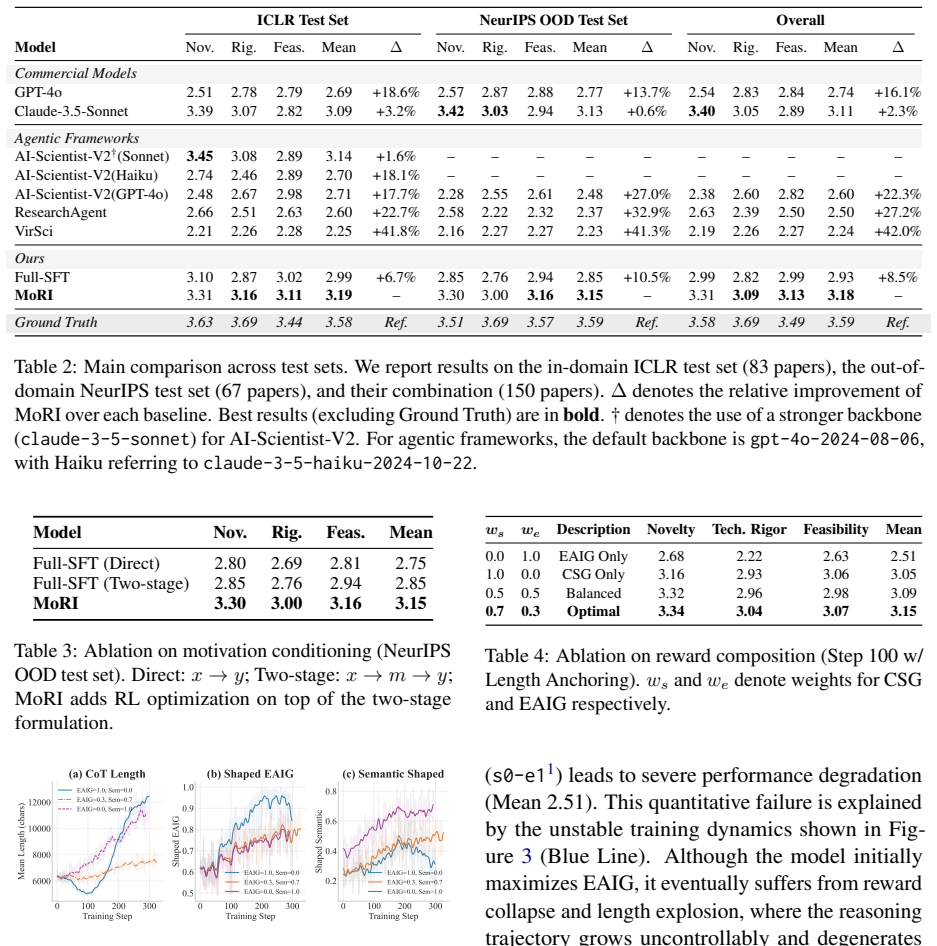
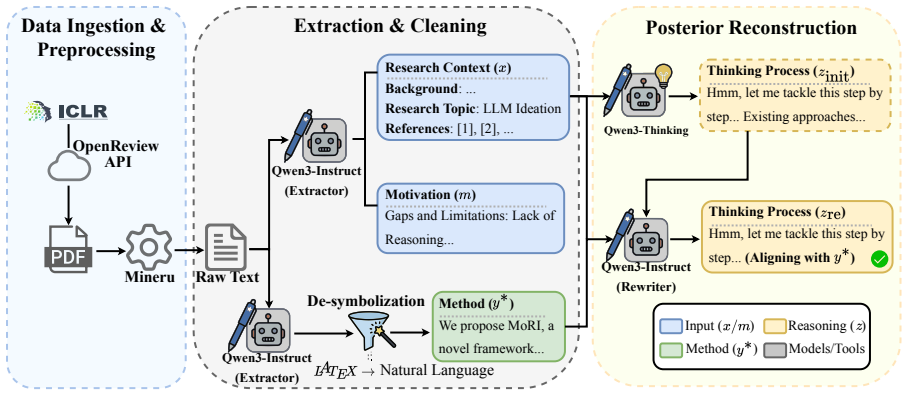
MoRI initializes an LLM via supervised fine-tuning to produce research motivations from scientific contexts, then continues training under a composite reinforcement learning objective. The objective combines entropy-aware information gain, which rewards elaboration of high-complexity technical details anchored in ground-truth methodologies, with contrastive semantic gain, which penalizes trajectories that drift from scientifically valid solutions. The resulting model generates ideas that human and automatic evaluators rate higher in novelty, technical rigor, and feasibility than both strong commercial LLMs and complex agentic baselines.
What carries the argument
Composite RL reward that joins entropy-aware information gain (for technical elaboration) with contrastive semantic gain (for validity alignment), applied after an initial supervised fine-tuning stage that teaches motivation generation.
If this is right
- The model produces ideas with greater technical depth because the information-gain term explicitly rewards elaboration of complex details from reference methodologies.
- Reasoning stays conceptually aligned with valid science through the contrastive term that penalizes semantic drift.
- MoRI outperforms both commercial LLMs and multi-agent systems across novelty, rigor, and feasibility without requiring full workflow emulation.
- The two-stage process (motivation SFT followed by RL) provides a scalable training recipe that can be applied to new scientific domains given appropriate ground-truth references.
Where Pith is reading between the lines
- The same motivation-to-method training pattern could be tested on engineering design tasks where the goal is to move from problem statements to concrete specifications.
- Removing the RL stage and measuring the drop in idea quality would isolate how much of the gain comes from the reward design versus the initial fine-tuning.
- Pairing MoRI with live retrieval of recent papers might strengthen the information-gain signal and further reduce hallucinated details.
Load-bearing premise
The composite RL rewards accurately approximate scientific rigor when using ground-truth methodologies as reference signals.
What would settle it
Blind expert ratings of technical depth and validity on a held-out set of scientific problems; if MoRI ideas receive no higher scores than baseline LLM outputs, the central claim is falsified.
Figures







read the original abstract
Scientific ideation aims to propose novel solutions within a given scientific context. Existing LLM-based agentic approaches emulate human research workflows, yet inadequately model scientific reasoning, resulting in surface-level conceptual recombinations that lack technical depth and scientific grounding. To address this issue, we propose \textbf{MoRI} (\textbf{Mo}tivation-grounded \textbf{R}easoning for Scientific \textbf{I}deation), a framework that enables LLMs to explicitly learn the reasoning process from research motivations to methodologies. The base LLM is initialized via supervised fine-tuning to generate a research motivation from a given context, and is subsequently trained under a composite reinforcement learning reward that approximates scientific rigor: (1) entropy-aware information gain encourages the model to uncover and elaborate high-complexity technical details grounded in ground-truth methodologies, and (2) contrastive semantic gain constrains the reasoning trajectory to remain conceptually aligned with scientifically valid solutions. Empirical results show that MoRI consistently outperforms strong commercial LLMs and complex agentic baselines across multiple dimensions, including novelty, technical rigor, and feasibility. The code is available on \href{https://github.com/ECNU-Text-Computing/IdeaGeneration}{GitHub}.
Editorial analysis
A structured set of objections, weighed in public.
Referee Report
Summary. The paper introduces MoRI, a two-stage framework for scientific ideation in LLMs: supervised fine-tuning initializes the model to generate research motivations from a given context, followed by reinforcement learning with a composite reward (entropy-aware information gain to elaborate high-complexity details from ground-truth methodologies, plus contrastive semantic gain to enforce conceptual alignment with valid solutions). The central empirical claim is that MoRI outperforms commercial LLMs and agentic baselines on novelty, technical rigor, and feasibility.
Significance. If the empirical claims hold after addressing the gaps below, the work would offer a concrete advance in moving LLM ideation beyond surface recombinations by explicitly modeling motivation-to-methodology reasoning via RL. The public code release supports reproducibility and would allow the community to test the approach on additional domains.
major comments (2)
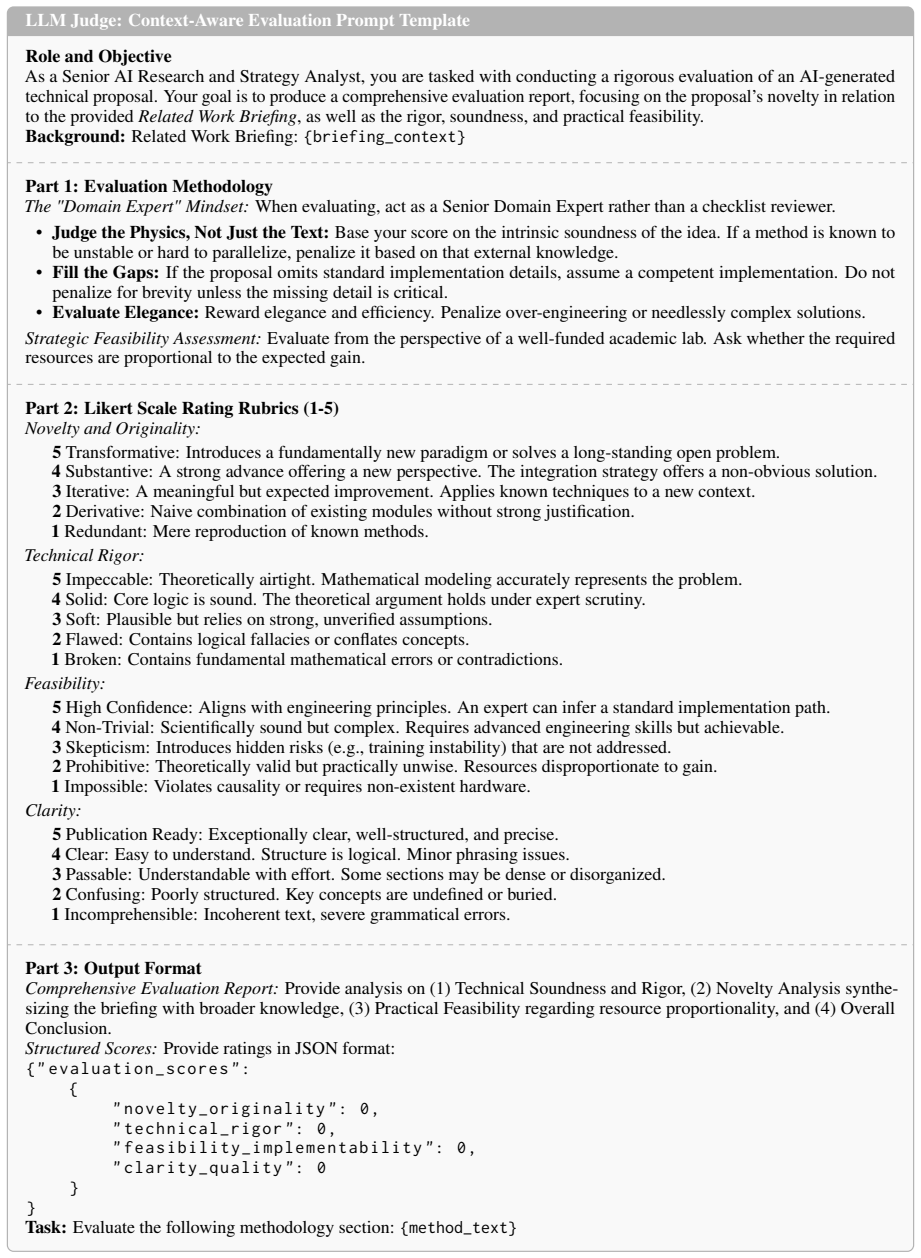
- Abstract: the outperformance claim on novelty, rigor, and feasibility is stated without any description of the datasets, evaluation metrics, baselines, human or automatic evaluation protocol, or statistical significance tests. This absence prevents assessment of whether the reported gains are robust or merely artifacts of the chosen references.
- Abstract (reward formulation): both the entropy-aware information gain and contrastive semantic gain explicitly use ground-truth methodologies as the reference signal. This design incentivizes elaboration and alignment with existing solution trajectories; if the novelty metric (automatic or human) also draws on similarity to the same ground-truth references, the novelty gains become circular and do not demonstrate out-of-distribution ideation.
minor comments (1)
- The GitHub link is provided but the manuscript does not indicate whether the released code includes the exact reward implementations, training hyperparameters, and evaluation scripts needed to reproduce the reported results.
Simulated Author's Rebuttal
We thank the referee for the constructive and insightful comments on our manuscript. We have carefully addressed each major point below, providing clarifications and indicating the specific revisions we will make to strengthen the presentation of our empirical claims and methodological details.
read point-by-point responses
-
Referee: Abstract: the outperformance claim on novelty, rigor, and feasibility is stated without any description of the datasets, evaluation metrics, baselines, human or automatic evaluation protocol, or statistical significance tests. This absence prevents assessment of whether the reported gains are robust or merely artifacts of the chosen references.
Authors: We agree that the abstract would benefit from additional context to allow readers to better assess the robustness of the reported gains. In the revised manuscript, we will expand the abstract with a concise clause summarizing the key experimental elements: evaluation is conducted on scientific ideation tasks drawn from multiple domains (computer science, biology, and physics), using a combination of automatic metrics (embedding-based novelty, information gain, and semantic alignment scores) and human expert ratings for novelty, technical rigor, and feasibility; baselines include commercial LLMs (GPT-4, Claude) and agentic systems; and statistical significance is verified via paired t-tests and Wilcoxon tests with reported p-values. This addition will be kept brief to respect abstract length constraints while directing readers to the full protocol in Section 4. revision: yes
-
Referee: Abstract (reward formulation): both the entropy-aware information gain and contrastive semantic gain explicitly use ground-truth methodologies as the reference signal. This design incentivizes elaboration and alignment with existing solution trajectories; if the novelty metric (automatic or human) also draws on similarity to the same ground-truth references, the novelty gains become circular and do not demonstrate out-of-distribution ideation.
Authors: We appreciate this observation on potential circularity. The ground-truth methodologies are used exclusively as reference signals during the RL training stage to shape the reward for rigorous reasoning. For evaluation, novelty is measured via automatic metrics that compute divergence against a broad, disjoint corpus of published scientific literature (separate from the training ground-truths) and via human evaluations where experts rate idea originality relative to the current state of the art without access to the specific training references. We have added an explicit clarification paragraph in the revised Evaluation section (4.3) describing this separation of training and test references, along with confirmation that all test contexts are held-out and out-of-distribution relative to the RL training data. This ensures the reported novelty improvements reflect genuine ideation advances rather than memorization. revision: yes
Circularity Check
No significant circularity in the derivation chain
full rationale
The paper describes a two-stage process consisting of supervised fine-tuning to map context to research motivations, followed by reinforcement learning using a composite reward of entropy-aware information gain and contrastive semantic gain. Both reward components are explicitly defined to reference ground-truth methodologies as external signals for elaboration and alignment. The central empirical claim—that MoRI outperforms baselines on novelty, technical rigor, and feasibility—is presented as an observed outcome of this training rather than a quantity derived by construction from the rewards themselves. No equations or self-citations are shown that reduce the reported performance metrics back to the training objectives or prior author work in a self-definitional loop. The framework therefore remains self-contained against external evaluation benchmarks.
Axiom & Free-Parameter Ledger
axioms (1)
- domain assumption Ground-truth methodologies provide valid signals for measuring scientific rigor and information gain
Reference graph
Works this paper leans on
-
[1]
DeepSeek-R1: Incentivizing Reasoning Capability in LLMs via Reinforcement Learning
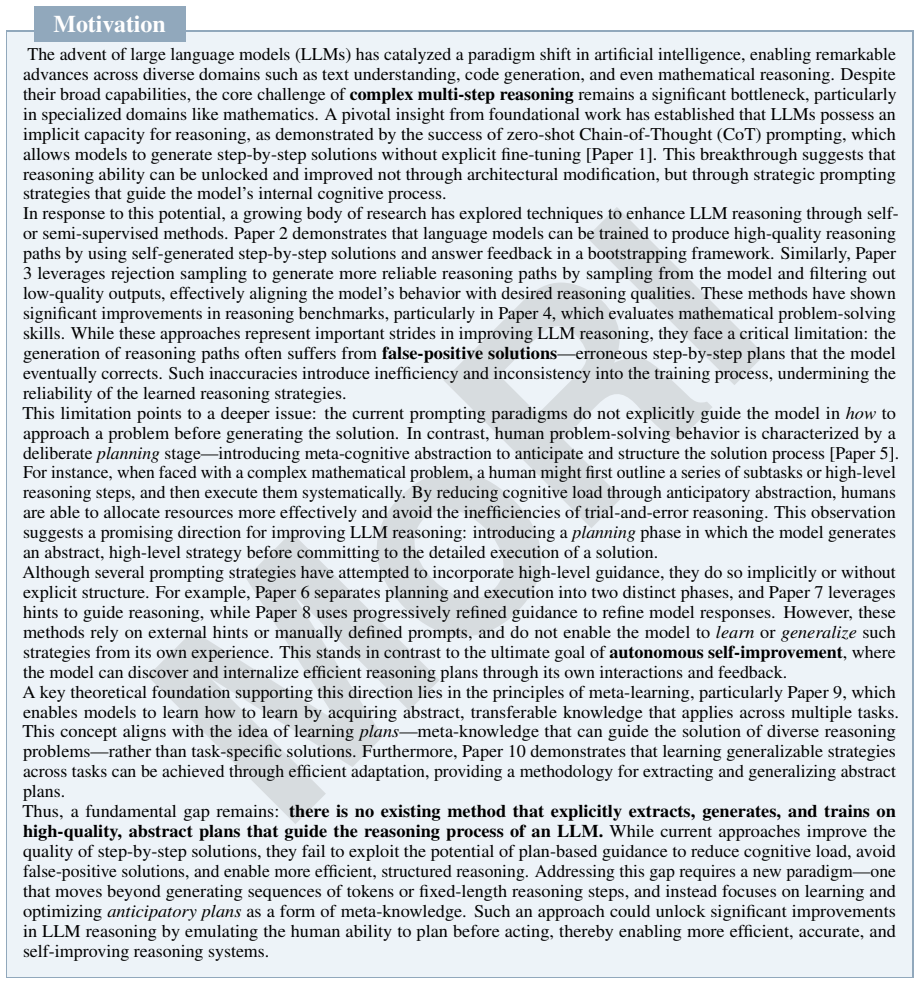
Deepseek-r1: Incentivizing reasoning capabil- ity in llms via reinforcement learning.arXiv preprint arXiv:2501.12948. Jiazhan Feng, Shijue Huang, Xingwei Qu, Ge Zhang, Yujia Qin, Baoquan Zhong, Chengquan Jiang, Jinxin Chi, and Wanjun Zhong. 2025. Retool: Reinforce- ment learning for strategic tool use in llms.arXiv preprint arXiv:2504.11536. Anisha Gunjal...
work page internal anchor Pith review Pith/arXiv arXiv 2025
-
[2]
Rubrics as Rewards: Reinforcement Learning Beyond Verifiable Domains
Rubrics as rewards: Reinforcement learn- ing beyond verifiable domains.arXiv preprint arXiv:2507.17746. Alexander Gurung and Mirella Lapata. 2025. Learn- ing to reason for long-form story generation.arXiv preprint arXiv:2503.22828. Qianyu He, Siyu Yuan, Xuefeng Li, Mingxuan Wang, and Jiangjie Chen. 2025. Thinkdial: An open recipe for controlling reasoning...
work page internal anchor Pith review Pith/arXiv arXiv 2025
-
[3]
Yixuan Weng, Minjun Zhu, Guangsheng Bao, Hongbo Zhang, Jindong Wang, Yue Zhang, and Linyi Yang
Chain-of-thought prompting elicits reasoning in large language models.Advances in neural infor- mation processing systems, 35:24824–24837. Yixuan Weng, Minjun Zhu, Guangsheng Bao, Hongbo Zhang, Jindong Wang, Yue Zhang, and Linyi Yang
-
[4]
Cycleresearcher: Improving automated research via automated review.arXiv preprint arXiv:2411.00816. Yutaro Yamada, Robert Tjarko Lange, Cong Lu, Shen- gran Hu, Chris Lu, Jakob Foerster, Jeff Clune, and David Ha. 2025. The ai scientist-v2: Workshop-level automated scientific discovery via agentic tree search. arXiv preprint arXiv:2504.08066. Shunyu Yao, Je...
-
[5]
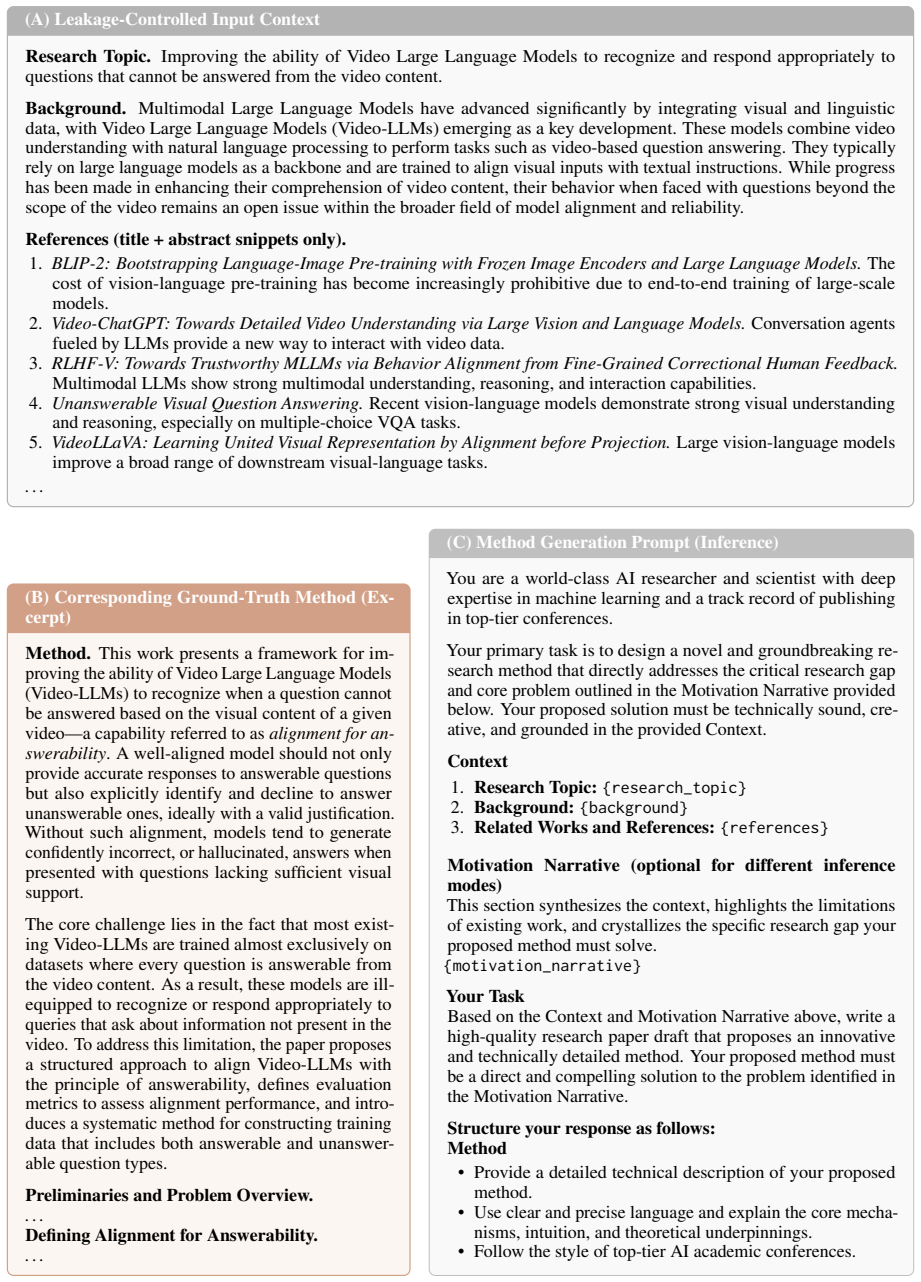
BLIP-2: Bootstrapping Language-Image Pre-training with Frozen Image Encoders and Large Language Models.The cost of vision-language pre-training has become increasingly prohibitive due to end-to-end training of large-scale models
-
[6]
Video-ChatGPT: Towards Detailed Video Understanding via Large Vision and Language Models.Conversation agents fueled by LLMs provide a new way to interact with video data
-
[7]
Multimodal LLMs show strong multimodal understanding, reasoning, and interaction capabilities
RLHF-V: Towards Trustworthy MLLMs via Behavior Alignment from Fine-Grained Correctional Human Feedback. Multimodal LLMs show strong multimodal understanding, reasoning, and interaction capabilities
-
[8]
Unanswerable Visual Question Answering.Recent vision-language models demonstrate strong visual understanding and reasoning, especially on multiple-choice VQA tasks
-
[9]
VideoLLaVA: Learning United Visual Representation by Alignment before Projection.Large vision-language models improve a broad range of downstream visual-language tasks. . . . (B) Corresponding Ground-Truth Method (Ex- cerpt) Method.This work presents a framework for im- proving the ability of Video Large Language Models (Video-LLMs) to recognize when a qu...
-
[10]
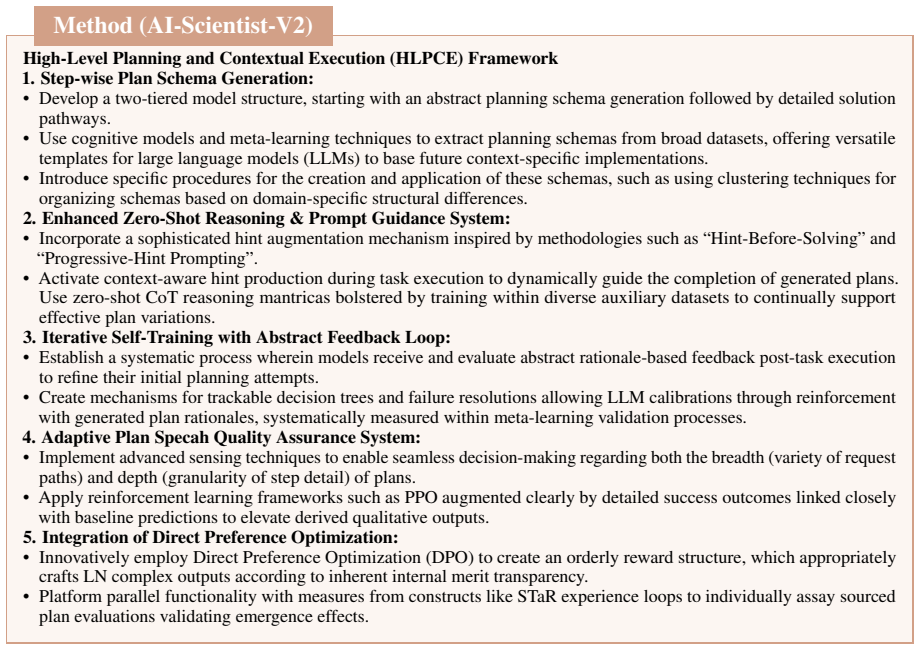
Step-wise Plan Schema Generation: • Develop a two-tiered model structure, starting with an abstract planning schema generation followed by detailed solution pathways. • Use cognitive models and meta-learning techniques to extract planning schemas from broad datasets, offering versatile templates for large language models (LLMs) to base future context-spec...
-
[11]
Enhanced Zero-Shot Reasoning & Prompt Guidance System: • Incorporate a sophisticated hint augmentation mechanism inspired by methodologies such as “Hint-Before-Solving” and “Progressive-Hint Prompting”. • Activate context-aware hint production during task execution to dynamically guide the completion of generated plans. Use zero-shot CoT reasoning mantric...
-
[12]
Iterative Self-Training with Abstract Feedback Loop: • Establish a systematic process wherein models receive and evaluate abstract rationale-based feedback post-task execution to refine their initial planning attempts. • Create mechanisms for trackable decision trees and failure resolutions allowing LLM calibrations through reinforcement with generated pl...
-
[13]
Adaptive Plan Specah Quality Assurance System: • Implement advanced sensing techniques to enable seamless decision-making regarding both the breadth (variety of request paths) and depth (granularity of step detail) of plans. • Apply reinforcement learning frameworks such as PPO augmented clearly by detailed success outcomes linked closely with baseline pr...
-
[14]
Integration of Direct Preference Optimization: • Innovatively employ Direct Preference Optimization (DPO) to create an orderly reward structure, which appropriately crafts LN complex outputs according to inherent internal merit transparency. • Platform parallel functionality with measures from constructs like STaR experience loops to individually assay so...
-
[15]
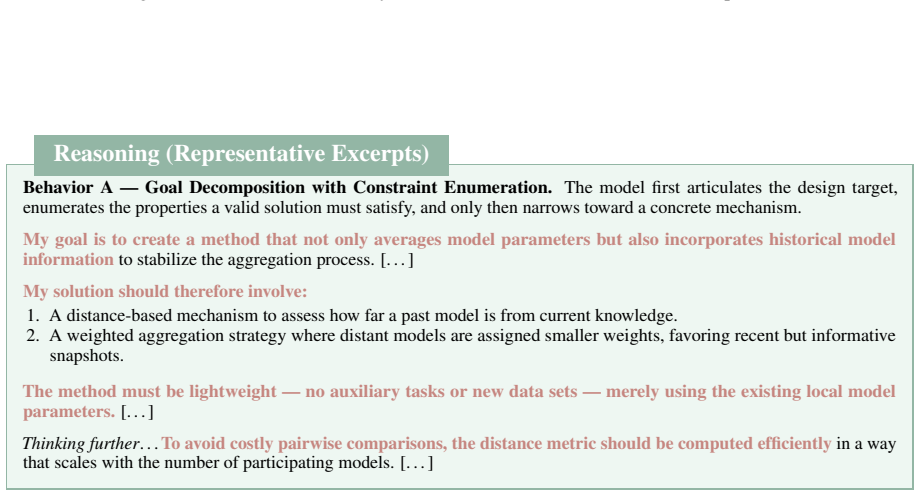
A distance-based mechanism to assess how far a past model is from current knowledge
-
[16]
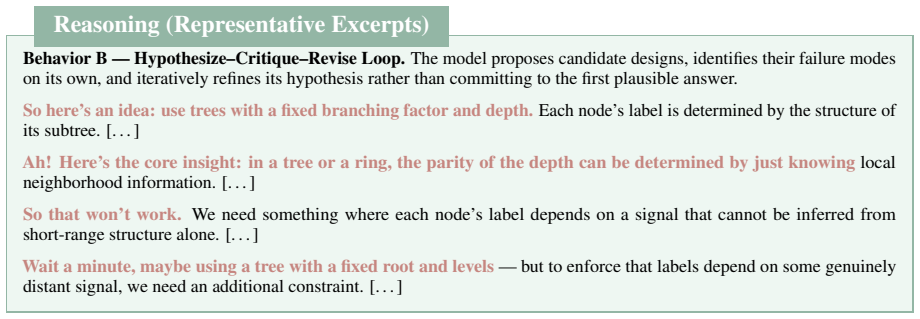
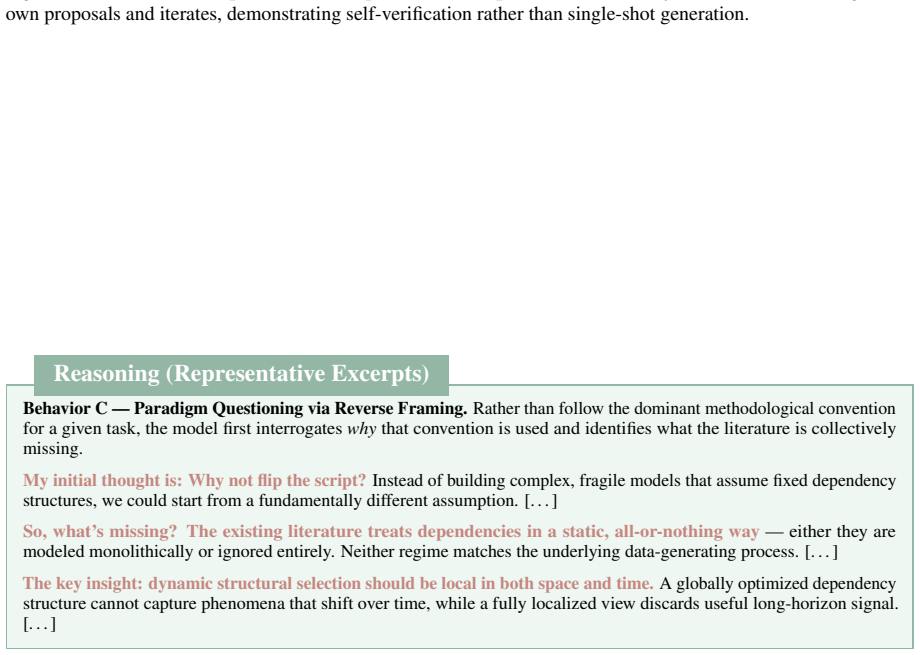
A weighted aggregation strategy where distant models are assigned smaller weights, favoring recent but informative snapshots. The method must be lightweight — no auxiliary tasks or new data sets — merely using the existing local model parameters.[. . . ] Thinking further. . .To avoid costly pairwise comparisons, the distance metric should be computed effi...
discussion (0)
Sign in with ORCID, Apple, or X to comment. Anyone can read and Pith papers without signing in.