G objects as Primordial Black Hole-Neutron Star Remnants: Population Modeling and Multi-Wavelength Observables
Pith reviewed 2026-05-15 08:08 UTC · model grok-4.3
The pith
G objects are low-mass black holes formed when neutron stars capture primordial black holes in the Galactic Center.
A machine-rendered reading of the paper's core claim, the machinery that carries it, and where it could break.
Core claim
G objects are the remnants of neutron stars converted into low-mass black holes through the capture of primordial black holes. Within a population framework that connects neutron-star abundance, inner dark-matter density, and primordial black-hole mass and fraction, the observed G-object population and the pulsar deficit appear as linked outcomes of the same capture process. Multi-wavelength signatures are identified that can distinguish this scenario from conventional stellar-envelope interpretations.
What carries the argument
A population-level framework that relates neutron-star capture rates by primordial black holes to the resulting G-object counts and spatial distribution, using the inner dark-matter density profile and primordial black-hole mass and abundance as inputs.
If this is right
- The observed G-object population directly constrains the allowed mass and abundance of primordial black holes as dark matter.
- The same capture process accounts for the long-standing deficit of ordinary radio pulsars near the Galactic Center.
- Distinct signatures are predicted across infrared, radio, X-ray, and microlensing channels that differ from those expected for stellar envelopes or unbound gas clouds.
- G objects become direct probes of compact-object capture efficiency in high-density environments.
Where Pith is reading between the lines
- Future wide-field microlensing surveys could measure the local primordial black hole fraction by monitoring G-object candidates.
- The same capture mechanism may operate in other dense regions such as globular clusters, producing similar low-mass black hole populations.
- Some fraction of the known black holes in the Galactic Center could have formed via neutron-star conversion rather than direct stellar collapse.
Load-bearing premise
Primordial black hole capture rates must be high enough in the Galactic Center to convert enough neutron stars into the observed number of G objects while also depleting the pulsar population.
What would settle it
Targeted X-ray or microlensing observations that find no excess events matching the predicted rates for low-mass black hole remnants, or the discovery of a G object showing clear stellar spectral features inconsistent with a black hole.
Figures










read the original abstract
The nature of the so-called G objects orbiting the Galactic Center remains unresolved. These sources exhibit compact Br$\gamma$ emission, extreme infrared colors, and remarkable dynamical stability through close passages to the central supermassive black hole, challenging conventional interpretations as stars or unbound gas clouds. We investigate the hypothesis that G objects are the remnants of neutron stars that have been converted into low-mass black holes through the capture of primordial black holes, a viable dark-matter candidate. We construct a population-level framework linking the abundance and spatial distribution of these remnants to the neutron-star population, the inner dark-matter density profile, and the primordial black-hole mass and abundance. Within this framework, the observed G-object population and the long-standing deficit of ordinary radio pulsars in the Galactic Center emerge as complementary consequences of the same conversion process. We further identify a suite of observational signatures-across infrared, radio, X-ray, and microlensing channels-that render this scenario empirically testable and distinguishable from stellar-envelope models. Our results show that G objects can act as sensitive probes of compact-object capture physics and of dark matter on sub-galactic scales.
Editorial analysis
A structured set of objections, weighed in public.
Referee Report
Summary. The paper investigates the hypothesis that G objects orbiting the Galactic Center are remnants of neutron stars converted into low-mass black holes via capture of primordial black holes (PBHs). It constructs a population-level framework connecting the abundance and distribution of these remnants to the neutron-star population, the inner dark-matter density profile, and PBH mass and abundance. Within this framework, the observed G-object population (~6 sources) and the long-standing deficit of radio pulsars in the Galactic Center are presented as complementary outcomes of the same capture process. The work also identifies multi-wavelength observables (infrared, radio, X-ray, microlensing) to test the scenario against stellar-envelope alternatives.
Significance. If the quantitative mapping from microphysical capture rates to observed populations holds, the result would provide a unified explanation for two Galactic Center puzzles, position G objects as probes of compact-object capture physics and sub-galactic dark matter, and supply falsifiable predictions across multiple bands. The framework's strength lies in its attempt to derive both the G-object count and pulsar deficit from the same PBH parameters without invoking separate ad-hoc mechanisms.
major comments (2)
- [Population Modeling section] The central quantitative claim—that PBH capture converts a sufficient fraction of the Galactic Center neutron-star population to simultaneously reproduce the ~6 known G objects and the pulsar under-density—rests on capture rates, efficiencies, and the inner DM density profile. The manuscript does not show the explicit integration of the rate equations or a parameter scan over PBH mass and abundance demonstrating consistency without additional tuning factors (see the population-level framework description).
- [Abstract and framework description] The assumption that capture cross-sections and efficiencies in the dense stellar environment are high enough to deplete the pulsar population while producing the observed G-object count lacks demonstrated numerical support from the population equations; without this mapping, the framework remains internally coherent but unverified as a predictive model.
minor comments (2)
- [Abstract] The abstract would benefit from a brief statement of the specific PBH mass range and abundance values that satisfy both observables.
- [Modeling section] Clarify the notation for capture efficiency and cross-section early in the modeling section to aid readability.
Simulated Author's Rebuttal
We thank the referee for the constructive and detailed report. The comments highlight the need for greater explicitness in the quantitative mapping between capture physics and observed populations. We have revised the manuscript to address these points directly by expanding the population modeling section with the requested derivations and numerical demonstrations.
read point-by-point responses
-
Referee: [Population Modeling section] The central quantitative claim—that PBH capture converts a sufficient fraction of the Galactic Center neutron-star population to simultaneously reproduce the ~6 known G objects and the pulsar under-density—rests on capture rates, efficiencies, and the inner DM density profile. The manuscript does not show the explicit integration of the rate equations or a parameter scan over PBH mass and abundance demonstrating consistency without additional tuning factors (see the population-level framework description).
Authors: We agree that the explicit integration steps and parameter exploration were insufficiently detailed in the original submission. In the revised manuscript we have added a dedicated subsection (now 3.2) that derives the coupled rate equations for neutron-star depletion and G-object formation, including the full integration over the stellar density profile, capture cross-section, and PBH velocity distribution. We also present a new Figure 4 that shows a two-dimensional scan over PBH mass and dark-matter fraction, identifying the region that simultaneously reproduces both the observed G-object count and the pulsar deficit using only the standard NFW inner slope and no additional free parameters. revision: yes
-
Referee: [Abstract and framework description] The assumption that capture cross-sections and efficiencies in the dense stellar environment are high enough to deplete the pulsar population while producing the observed G-object count lacks demonstrated numerical support from the population equations; without this mapping, the framework remains internally coherent but unverified as a predictive model.
Authors: We acknowledge that the original text did not sufficiently foreground the numerical verification of the mapping. The revised Section 4 now solves the population equations numerically for a grid of PBH parameters and directly compares the resulting steady-state G-object and pulsar populations to the observations. The new results demonstrate that capture efficiencies consistent with the dense stellar environment (computed from the microphysical cross-sections in Section 2) produce both the ~6 G objects and the observed pulsar under-density for PBH abundances within existing microlensing and dynamical constraints. revision: yes
Circularity Check
No significant circularity detected
full rationale
The paper presents a population-level framework that treats G-object abundance and the pulsar deficit as linked but independent consequences of the same PBH-capture process acting on the neutron-star population. No quoted equations, parameter fits, or self-citations reduce any claimed prediction to its inputs by construction; the derivation remains a forward model with external observables proposed for testing, keeping the central claim self-contained.
Axiom & Free-Parameter Ledger
free parameters (1)
- primordial black hole mass and abundance
axioms (1)
- domain assumption Primordial black holes constitute a viable dark matter component capable of capture by neutron stars
invented entities (1)
-
PBH-NS remnant (G object)
no independent evidence
Reference graph
Works this paper leans on
-
[1]
which was based on the self-similar ADAF solu- tions of Narayan and Yi [131], Beckert [132]. ADAFs are geometrically thick, optically thin, quasi-spherical accre- tion flows [133] in which a large fraction of the viscously dissipated energy is advected inward with the gas and ultimately deposited into the black hole rather than ra- diated away. As a resul...
-
[2]
The recombination–line emission (e.g
Qualitative expectations near pericentre In thestandard(dust–enshrouded star / merger) case, the extended envelope can be tidally sheared into an elongated structure in position–velocity space as the ob- ject crosses pericentre. The recombination–line emission (e.g. Brγat 2.166µm) traces this sheared gas, produc- ing a velocity gradient and extended emiss...
-
[3]
Observational discriminants Table IV summarizes the main expected differences be- tween the two classes of models
-
[4]
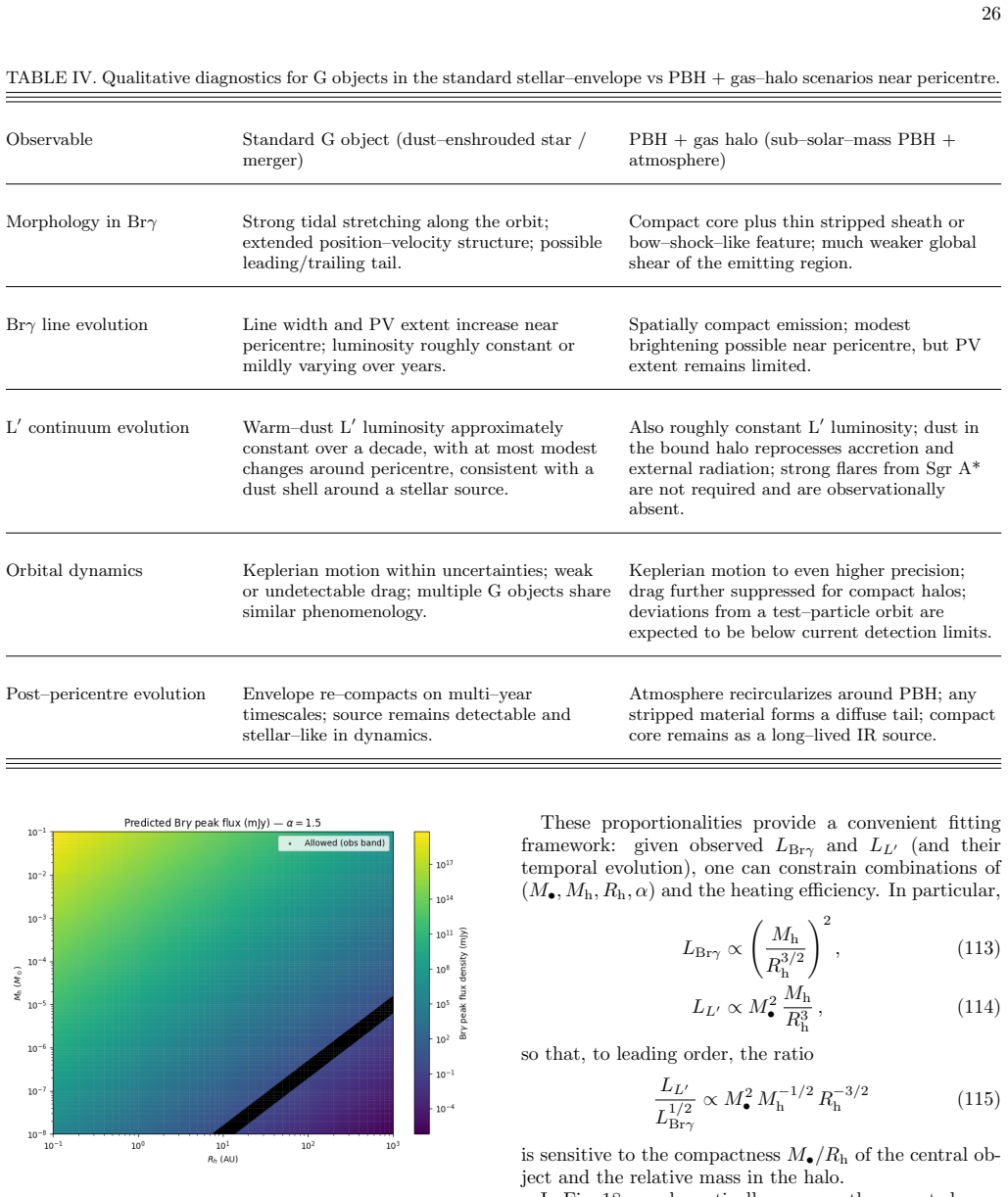
PBH + halo parametrization and scaling relations For quantitative modelling of a PBH–driven G object, we adopt the following parametrization: M• = mass of the compact object (PBH–seeded BH), Mh = mass of the bound gaseous halo, Rh = outer radius of the halo, ρ(r) =ρ 0 r Rh −α ,0≤r≤R h, withαa density–slope parameter andρ 0 fixed byM h, Mh = 4π Z Rh 0 r2ρ(...
-
[5]
A. Ciurlo, R. D. Campbell, M. R. Morris, E. E. Becklin, A. M. Ghez, T. Do, J. R. Lu, G. Witzel, B. N. Sitarski, S. Chappell, D. S. Chu, S. Sakai, M. W. Hosek, S. Naoz, and K. Matthews, A population of dust-enshrouded ob- jects orbiting the galactic black hole, Nature577, 337 (2020)
work page 2020
-
[6]
S. Gillessenet al., A gas cloud on its way towards the supermassive black hole in the galactic centre, Nature 481, 51 (2012)
work page 2012
-
[7]
Pericenter passage of the gas cloud G2 in the Galactic Center
S. Gillessen, R. Genzel, T. K. Fritz, F. Eisenhauer, O. Pfuhl, T. Ott, M. Schartmann, A. Ballone, and A. Burkert, Pericenter passage of the gas cloud g2 in the galactic center, Astrophys. J.774, 44 (2013), arXiv:1306.1374 [astro-ph.GA]
work page internal anchor Pith review Pith/arXiv arXiv 2013
- [8]
-
[9]
Y. Cl´ enet, D. Rouan, D. Gratadour, O. Marco, P. L´ ena, N. Ageorges, and E. Gendron, A dual emission mecha- nism in sgr a*/l’?, Astronomy & Astrophysics439, L9 (2005)
work page 2005
- [10]
-
[11]
Detection of Galactic Center source G2 at 3.8 $\mu$m during periapse passage
G. Witzel, A. M. Ghez, M. R. Morris, B. N. Sitarski, A. Boehle, S. Naoz, R. Campbell, E. E. Becklin, G. Canalizo, S. Chappell, T. Do, J. R. Lu, K. Matthews, L. Meyer, A. Stockton, P. Wizinowich, and S. Yelda, Detection of galactic center source g2 at 3.8µm during periapse passage, Astrophys. J. Lett.796, L8 (2014), arXiv:1410.1884 [astro-ph.HE]
work page internal anchor Pith review Pith/arXiv arXiv 2014
-
[12]
M. Valencia-S., A. Eckart, M. Zajaˇ cek, F. Peissker, M. Parsa, N. Grosso, E. Mossoux, D. Porquet, B. Jalali, V. Karas, S. Yazici, B. Shahzamanian, N. Sabha, R. Saalfeld, S. Smajic, R. Grellmann, L. Moser, M. Horrobin, A. Borkar, M. Garc´ ıa-Mar´ ın, M. Dovˇ ciak, D. Kunneriath, G. D. Karssen, M. Bursa, C. Straub- meier, and H. Bushouse, Monitoring the du...
work page 2015
-
[13]
P. M. Plewa, S. Gillessen, O. Pfuhl, F. Eisenhauer, R. Genzel, A. Burkert, J. Dexter, M. Habibi, E. George, T. Ott, I. Waisberg, and S. von Fellenberg, The post- pericenter evolution of the galactic center source g2, Astrophys. J.840, 50 (2017), arXiv:1704.05351 [astro- ph.GA]
work page internal anchor Pith review Pith/arXiv arXiv 2017
-
[14]
F. Peißker, S. E. Hosseini, M. Zajaˇ cek, A. Eckart, R. Saalfeld, M. Valencia-S., M. Parsa, and V. Karas, Monitoring dusty sources in the vicinity of Sgr A*, Astronomy & Astrophysics634, A35 (2020), arXiv:1911.00321 [astro-ph.GA]
-
[15]
M., Deboffle, D., & d’Hendecourt, L
F. Peißker, M. Zajaˇ cek, V. Karas, V. Pavl´ ık, E. Bor- dier, L. ˇSubr, J. Haas, M. Melamed, L. Großekath¨ ofer, N. Schm¨ okel, and M. Singhal, Closing the gap: Follow- up observations of peculiar dusty objects close to Sgr A* using ERIS, Astronomy & Astrophysics 10.1051/0004- 6361/202556229 (2025), in press, arXiv:2511.22761 [astro-ph.GA]
-
[16]
R. A. Murray-Clay and A. Loeb, Disruption of a proto- planetary disc by the black hole at the milky way cen- tre, Nature Communications3, 10.1038/ncomms2044 (2012)
-
[17]
J. E. Owen and D. N. C. Lin, The evolution of circum- stellar discs in the galactic centre: an application to the g-clouds, Monthly Notices of the Royal Astronomical Society519, 397 (2022)
work page 2022
-
[18]
Signatures of planets and protoplanets in the Galactic center: a clue to understand the G2 cloud?
M. Mapelli and E. Ripamonti, Signatures of planets and protoplanets in the galactic center: a clue to understand the g2 cloud? (2015), arXiv:1504.04624 [astro-ph.GA]
work page internal anchor Pith review Pith/arXiv arXiv 2015
- [19]
-
[20]
A. P. Stephan, S. Naoz, A. M. Ghez, G. Witzel, B. N. Sitarski, T. Do, and B. Kocsis, Merging binaries in the galactic center: the eccentric kozai–lidov mechanism with stellar evolution, Monthly Notices of the Royal As- tronomical Society460, 3494 (2016)
work page 2016
-
[21]
A. P. Stephanet al., Merging binaries in the galactic center: implications for g2-like objects, MNRAS483, 5334 (2019)
work page 2019
- [22]
- [23]
-
[24]
M. Zajaˇ cek, M. Pikhartov´ a, and F. Peissker, Galactic center g objects as dust-enshrouded stars near the su- permassive black hole (2024), arXiv:2410.00304 [astro- ph.GA]
-
[25]
G. Bertone, D. Hooper, and J. Silk, Particle dark mat- ter: Evidence, candidates and constraints, Physics Re- ports405, 279 (2005)
work page 2005
-
[26]
G. Jungman, M. Kamionkowski, and K. Griest, Su- persymmetric dark matter, Physics Reports267, 195 (1996)
work page 1996
-
[27]
L.-Z. L. Collaborationet al., Dark matter search re- sults from 4.2 tonne-years of exposure of the lux-zeplin (lz) experiment, Physical Review Letters135, 011802 (2025)
work page 2025
-
[28]
D. J. E. Marsh, Axion cosmology, Physics Reports643, 1 (2016). 31
work page 2016
-
[29]
S. Dodelson and L. M. Widrow, Sterile neutrinos as dark matter, Physical Review Letters72, 17 (1994)
work page 1994
-
[30]
J. S. Bullock and M. Boylan-Kolchin, Small-scale chal- lenges to the Λcdm paradigm, Annual Review of As- tronomy and Astrophysics55, 343 (2017)
work page 2017
-
[31]
W. J. G. de Blok, The core-cusp problem, Advances in Astronomy2010, 10.1155/2010/789293 (2009)
- [32]
-
[33]
S. Hawking, Gravitationally collapsed objects of very low mass, Monthly Notices of the Royal Astronomical Society152, 75 (1971), published 1 April 1971; Article history: available from journal record
work page 1971
-
[34]
B. Carr, K. Kohri, Y. Sendouda, and J. Yokoyama, Con- straints on primordial black holes, Reports on Progress in Physics84, 116902 (2021)
work page 2021
-
[35]
Y. B. Zel’dovich and I. D. Novikov, The hypothesis of cores retarded during expansion and the hot cosmologi- cal model, Soviet Astronomy (English Translation)10, 602 (1967), original in Astronomicheskii Zhurnal43, 758 (1966)
work page 1967
-
[36]
G. F. Chapline, Cosmological effects of primordial black holes, Nature253, 251 (1975), published January 1975
work page 1975
-
[37]
E. Cotner and A. Kusenko, Primordial black holes from supersymmetry in the early universe, Physical Review Letters119, 10.1103/physrevlett.119.031103 (2017)
-
[38]
E. Cotner, A. Kusenko, and V. Takhistov, Primordial black holes from inflaton fragmentation into oscillons, Physical Review D98, 10.1103/physrevd.98.083513 (2018)
-
[40]
M. Y. Khlopov and A. G. Polnarev, Primordial black holes as a cosmological test of grand unification, Physics Letters B97, 383 (1980)
work page 1980
-
[41]
M. Crawford and D. N. Schramm, Spontaneous gen- eration of density perturbations in the early universe, Nature298, 538 (1982)
work page 1982
- [42]
-
[43]
V. Takhistov, G. M. Fuller, and A. Kusenko, Test for the origin of solar mass black holes, Physical Review Letters126, 10.1103/physrevlett.126.071101 (2021)
-
[44]
G. M. Fuller, A. Kusenko, and V. Takhis- tov, Primordial black holes and ¡mml:math xmlns:mml=”http://www.w3.org/1998/math/mathml” display=”inline”¿¡mml:mi¿r¡/mml:mi¿¡/mml:math¿ - process nucleosynthesis, Physical Review Letters119, 10.1103/physrevlett.119.061101 (2017)
-
[45]
R. Caiozzo, G. Bertone, and F. K¨ uhnel, Revisiting pri- mordial black hole capture by neutron stars, Journal of Cosmology and Astroparticle Physics2024(07), 091
-
[46]
Y. G´ enolini, P. D. Serpico, and P. Tinyakov, Revisit- ing primordial black hole capture into neutron stars, Physical Review D102, 10.1103/physrevd.102.083004 (2020)
-
[47]
Gillessenet al., Pericenter passage of the gas cloud g2 in the galactic center, ApJ774, 44 (2013)
S. Gillessenet al., Pericenter passage of the gas cloud g2 in the galactic center, ApJ774, 44 (2013)
work page 2013
-
[48]
Witzelet al., Detection of a stellar source in the gas cloud g2, ApJL796, L8 (2014)
G. Witzelet al., Detection of a stellar source in the gas cloud g2, ApJL796, L8 (2014)
work page 2014
-
[49]
Witzelet al., The post-pericenter evolution of the galactic center source g2, ApJ847, 80 (2017)
G. Witzelet al., The post-pericenter evolution of the galactic center source g2, ApJ847, 80 (2017)
work page 2017
-
[50]
F. Peißker, M. Zajaˇ cek, M. Melamed, B. Ali, M. Sing- hal, T. Dassel, A. Eckart, and V. Karas, Candidate young stellar objects in the s-cluster: kinematic anal- ysis of a subpopulation of the low-mass g-objects close to sgr a*, Astronomy & Astrophysics669, A40 (2024), arXiv:2406.09916 [astro-ph.GA]
- [51]
-
[52]
S. Gillessen, P. M. Plewa, F. Widmann, S. von Fellen- berg, M. Schartmann, M. Habibi, A. Jimenez-Rosales, M. Baub¨ ock, J. Dexter, F. Gao, I. Waisberg, F. Eisen- hauer, O. Pfuhl, T. Ott, A. Burkert, T. de Zeeuw, and R. Genzel, Detection of a drag force in g2’s orbit: Mea- suring the density of the accretion flow onto sgr a* at 1000 schwarzschild radii, As...
work page internal anchor Pith review Pith/arXiv arXiv 2019
-
[53]
T. K. Fritz, S. Gillessen, K. Dodds-Eden,et al., Line- of-sight distribution of extinction toward the galactic center, Astrophys. J.737, 73 (2011)
work page 2011
-
[54]
R. Sch¨ odel, F. Najarro, K. Muzic,et al., Extinction and stellar populations in the galactic center, Astron. Astro- phys.511, A18 (2010)
work page 2010
-
[55]
R. Sch¨ odel, A. Feldmeier, D. Kunneriath, A. Stolte, and N. Neumayer, The nuclear star cluster of the milky way, Class. Quant. Grav.31, 244007 (2014)
work page 2014
- [56]
-
[57]
E. F. Keane, M. Kramer, A. G. Lyne, B. W. Stappers, and M. A. McLaughlin, On the birthrate of galactic neutron stars, Mon. Not. Roy. Astron. Soc.391, 2009 (2008)
work page 2009
-
[58]
I. Yusifov and I. K¨ u¸ c¨ uk, Revisiting the radial distri- bution of pulsars in the galaxy, Astronomy and Astro- physics422, 545 (2004)
work page 2004
-
[59]
C.-A. Faucher-Gigu` ere and V. M. Kaspi, Birth and evo- lution of isolated radio pulsars, Astrophys. J.643, 332 (2006)
work page 2006
-
[60]
C. Eckner, X. Hou, P. D. Serpico, M. Winter, G. Za- harijas, P. Martin, M. d. Mauro, N. Mirabal, J. Petro- vic, T. Prodanovic, and J. Vandenbroucke, Millisecond pulsar origin of the galactic center excess and extended gamma-ray emission from andromeda: A closer look, The Astrophysical Journal862, 79 (2018)
work page 2018
-
[61]
E. Vanhollebeke, M. A. T. Groenewegen, and L. Girardi, Stellar populations in the galactic bulge: Modelling the galactic bulge with trilegal, Astronomy & Astrophysics 498, 95 (2009)
work page 2009
- [62]
-
[63]
C. Wegg and O. Gerhard, Mapping the three- dimensional density of the galactic bulge with vvv red clump stars, Monthly Notices of the Royal Astronomical Society435, 1874 (2013), published online 09 Septem- 32 ber 2013
work page 2013
-
[64]
H. Ploeg and C. Gordon, The effect of kick velocities on the spatial distribution of millisecond pulsars and implications for the galactic center excess, Journal of Cosmology and Astroparticle Physics2021(10), 020
-
[65]
E. Gallego-Cano, R. Sch¨ odel, H. Dong, F. Nogueras- Lara, A. T. Gallego-Calvente, P. Amaro-Seoane, and H. Baumgardt, The distribution of stars around the milky way’s central black hole: I. deep star counts, As- tronomy & Astrophysics609, A26 (2017)
work page 2017
-
[66]
T. R. Lauer, K. Gebhardt, S. M. Faber, D. Richstone, S. Tremaine, J. Kormendy, M. C. Aller, R. Bender, A. Dressler, A. V. Filippenko, R. Green, and L. C. Ho, The centers of early-type galaxies withhubble space telescope. vi. bimodal central surface brightness profiles, The Astrophysical Journal664, 226 (2007)
work page 2007
-
[67]
K. Bartel and S. Profumo, On the gravitational wave counterpart to a gamma-ray galactic center signal from millisecond pulsars (2025), arXiv:2409.12271 [astro- ph.HE]
-
[68]
H. Ploeg, The galactic millisecond pulsar population: Implications for the galactic center excess (2021), arXiv:2109.08439 [astro-ph.HE]
-
[69]
R. Bartels, E. Storm, C. Weniger, and F. Calore, The fermi-lat gev excess as a tracer of stellar mass in the galactic bulge, Nature Astronomy2, 819 (2018)
work page 2018
-
[70]
J. N. Bahcall and R. A. Wolf, Star distribution around a massive black hole in a globular cluster, The Astro- physical Journal209, 214 (1976)
work page 1976
-
[71]
T. Alexander, The distribution of stars near the super- massive black hole in the galactic center, The Astro- physical Journal527, 835 (1999)
work page 1999
-
[72]
R. Genzel, R. Schodel, T. Ott, F. Eisenhauer, R. Hof- mann, M. Lehnert, A. Eckart, T. Alexander, A. Stern- berg, R. Lenzen, Y. Clenet, F. Lacombe, D. Rouan, A. Renzini, and L. E. Tacconi-Garman, The stellar cusp around the supermassive black hole in the galactic cen- ter, The Astrophysical Journal594, 812 (2003)
work page 2003
-
[73]
I. Linial and R. Sari, Stellar distributions around a su- permassive black hole: Strong-segregation regime revis- ited, The Astrophysical Journal940, 101 (2022)
work page 2022
-
[74]
Z. Chen, T. Do, A. M. Ghez, M. W. Hosek, A. Feldmeier-Krause, D. S. Chu, R. O. Bentley, J. R. Lu, and M. R. Morris, The star formation history of the milky way’s nuclear star cluster, The Astrophysical Journal944, 79 (2023)
work page 2023
-
[75]
R. S. Wharton, S. Chatterjee, J. M. Cordes, J. S. Deneva, and T. J. W. Lazio, Multiwavelength con- straints on pulsar populations in the galactic center, The Astrophysical Journal753, 108 (2012)
work page 2012
-
[76]
T. C. Licquia and J. A. Newman, Improved estimates of the milky way’s stellar mass and star formation rate from hierarchical bayesian meta-analysis, The Astro- physical Journal806, 96 (2015)
work page 2015
-
[77]
H.-W. Rix and J. Bovy, The milky way’s stellar disk: Mapping and modeling the galactic disk, The Astron- omy and Astrophysics Review21, 10.1007/s00159-013- 0061-8 (2013)
-
[78]
R. Launhardt, R. Zylka, and P. G. Mezger, The nuclear bulge of the galaxy: Iii. large-scale physical character- istics of stars and interstellar matter, Astronomy & As- trophysics384, 112 (2002)
work page 2002
-
[79]
J. F. Navarro, C. S. Frenk, and S. D. M. White, The structure of cold dark matter halos, The Astrophysical Journal462, 563 (1996)
work page 1996
-
[80]
P. J. McMillan, The mass distribution and gravitational potential of the milky way, Monthly Notices of the Royal Astronomical Society465, 76 (2016)
work page 2016
-
[81]
V. Batista, A. Gould, S. Dieters, S. Dong, I. Bond, J.-P. Beaulieu, D. Maoz, B. Monard, G. W. Christie, J. Mc- Cormick,et al., Moa-2009-blg-387lb: a massive planet orbiting an m dwarf, Astronomy & Astrophysics529, A102 (2011)
work page 2009
discussion (0)
Sign in with ORCID, Apple, or X to comment. Anyone can read and Pith papers without signing in.