Recognition: no theorem link
Spectral Alignment in Forward-Backward Representations via Temporal Abstraction
Pith reviewed 2026-05-15 08:28 UTC · model grok-4.3
The pith
Temporal abstraction aligns high-rank dynamics with low-rank forward-backward representations by suppressing high-frequency spectral components.
A machine-rendered reading of the paper's core claim, the machinery that carries it, and where it could break.
Core claim
By characterizing the spectral properties of the transition operator, temporal abstraction acts analogously to a low-pass filter that suppresses high-frequency spectral components. This suppression reduces the effective rank of the induced successor representation while preserving a formal bound on the resulting value function error.
What carries the argument
The spectral properties of the transition operator, where temporal abstraction suppresses high-frequency components to reduce the effective rank of the successor representation.
If this is right
- The effective rank of the successor representation decreases under temporal abstraction.
- Value function error remains within the formal bound.
- Forward-backward learning stabilizes particularly at high discount factors.
- Long-horizon representations become feasible in continuous control.
Where Pith is reading between the lines
- The filtering idea may extend to other low-rank representation methods in reinforcement learning.
- Abstraction levels could be tuned directly from the eigenvalue spectrum of the dynamics.
- This offers one explanation for why hierarchical structures improve long-horizon planning.
- Similar spectral shaping might reduce variance in other bootstrapped value estimates.
Load-bearing premise
Temporal abstraction can be implemented to suppress high-frequency spectral components without introducing errors beyond the stated value function bound.
What would settle it
Compute the eigenvalues of the transition operator in a controlled continuous MDP before and after temporal abstraction to check whether high-frequency modes are suppressed and the effective rank of the successor representation decreases as predicted.
Figures
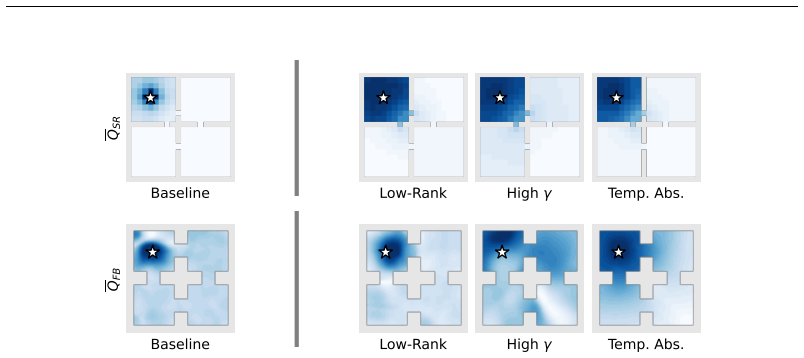


read the original abstract
Forward-backward (FB) representations provide a powerful framework for learning the successor representation (SR) in continuous spaces by enforcing a low-rank factorization. However, a fundamental spectral mismatch often exists between the high-rank transition dynamics of continuous environments and the low-rank bottleneck of the FB architecture, making accurate low-rank representation learning difficult. In this work, we analyze temporal abstraction as a mechanism to mitigate this mismatch. By characterizing the spectral properties of the transition operator, we show that temporal abstraction acts analogously to a low-pass filter that suppresses high-frequency spectral components. This suppression reduces the effective rank of the induced SR while preserving a formal bound on the resulting value function error. Empirically, we show that this alignment is a key factor for stable FB learning, particularly at high discount factors where bootstrapping becomes error-prone. Our results identify temporal abstraction as a principled mechanism for shaping the spectral structure of the underlying MDP and enabling effective long-horizon representations in continuous control.
Editorial analysis
A structured set of objections, weighed in public.
Referee Report
Summary. The paper claims that temporal abstraction mitigates the spectral mismatch between high-rank continuous transition dynamics and the low-rank bottleneck in forward-backward (FB) representations. By analyzing the spectral properties of the transition operator, it shows that temporal abstraction functions analogously to a low-pass filter, suppressing high-frequency components to reduce the effective rank of the induced successor representation (SR) while preserving a formal bound on value-function error. This alignment is argued to enable stable FB learning, especially at high discount factors, and is supported by empirical results in continuous control.
Significance. If the formal bound and spectral characterization hold under practical implementations, the work supplies a principled mechanism for shaping MDP spectral structure to improve low-rank successor-feature learning. This could guide the design of abstraction operators in long-horizon RL and strengthen the theoretical basis for FB methods in continuous spaces, where bootstrapping instability is acute.
major comments (2)
- [§4 (Spectral Analysis) and Theorem 1] §4 (Spectral Analysis) and Theorem 1: The derivation treats temporal abstraction as an ideal low-pass filter that exactly commutes with the eigen-decomposition of the transition operator, yielding a clean rank reduction and an error bound that depends only on the retained spectral components. In continuous MDPs the abstraction is realized by learned or fixed-horizon options, which induce an approximate projection; the residual operator can re-introduce high-frequency modes and is not folded into the stated bound, leaving the stability claim at high discount factors dependent on an unverified exactness assumption.
- [§5 (Empirical Evaluation), Table 2 and Figure 3] §5 (Empirical Evaluation), Table 2 and Figure 3: The reported stability gains at γ=0.99 are shown for FB with abstraction, yet no ablation isolates the contribution of spectral-rank reduction from confounding factors such as option-learning variance or horizon-induced bias. Without these controls it is unclear whether the observed improvement is attributable to the claimed low-pass mechanism or to other regularization effects.
minor comments (2)
- [§3] Notation for the effective rank of the SR is introduced without an explicit definition or reference to the precise matrix whose singular values are counted; a short clarifying sentence would remove ambiguity.
- [Abstract] The abstract states that the bound is 'preserved' but does not indicate whether the bound is identical to the non-abstracted case or merely of the same order; a parenthetical remark would improve precision.
Simulated Author's Rebuttal
We thank the referee for the detailed and constructive feedback on our spectral analysis and empirical results. We address each major comment below, clarifying the scope of our theoretical claims and outlining revisions to strengthen the manuscript.
read point-by-point responses
-
Referee: [§4 (Spectral Analysis) and Theorem 1] §4 (Spectral Analysis) and Theorem 1: The derivation treats temporal abstraction as an ideal low-pass filter that exactly commutes with the eigen-decomposition of the transition operator, yielding a clean rank reduction and an error bound that depends only on the retained spectral components. In continuous MDPs the abstraction is realized by learned or fixed-horizon options, which induce an approximate projection; the residual operator can re-introduce high-frequency modes and is not folded into the stated bound, leaving the stability claim at high discount factors dependent on an unverified exactness assumption.
Authors: We agree that Theorem 1 is stated for the ideal case of an exact low-pass filter that commutes with the transition operator's eigen-decomposition. The manuscript presents this as the core mechanism by which temporal abstraction reduces effective rank while bounding value error. Practical realizations via options yield an approximate projection, and we note in the text that residual high-frequency modes may persist. The stability claims at high discount factors are primarily supported by the empirical results rather than relying solely on the exact bound. To address the concern, we will add a discussion paragraph on the approximation error induced by learned options and include a corollary bounding the additional error term from non-commuting residuals. This is a partial revision. revision: partial
-
Referee: [§5 (Empirical Evaluation), Table 2 and Figure 3] §5 (Empirical Evaluation), Table 2 and Figure 3: The reported stability gains at γ=0.99 are shown for FB with abstraction, yet no ablation isolates the contribution of spectral-rank reduction from confounding factors such as option-learning variance or horizon-induced bias. Without these controls it is unclear whether the observed improvement is attributable to the claimed low-pass mechanism or to other regularization effects.
Authors: We acknowledge that the current experiments do not include explicit ablations that fully isolate spectral-rank reduction from factors such as option-learning variance or horizon-induced bias. The reported gains at γ=0.99 are consistent with the low-pass filtering effect, but additional controls would strengthen attribution to the claimed mechanism. We will revise the empirical section to include new ablation studies: one varying option horizon lengths while holding learning variance fixed, and another comparing fixed-horizon options against learned options with matched variance. These will be added to Table 2 and Figure 3 with corresponding analysis. revision: yes
Circularity Check
No circularity detected; derivation appears self-contained from available text
full rationale
The provided abstract and context contain no equations, derivations, or self-citations that reduce any claim to its inputs by construction. The spectral low-pass characterization and formal bound on value error are presented as results of analyzing the transition operator, with no visible reduction to fitted parameters or prior self-citations that would force the outcome. Per rules, absence of quotable load-bearing steps that collapse to inputs means score 0; the paper's central claim has independent mathematical content as described.
Axiom & Free-Parameter Ledger
Reference graph
Works this paper leans on
-
[1]
Curran Associates Inc. ISBN 9781510860964. André Biedenkapp, Raghu Rajan, Frank Hutter, and Marius Lindauer. Temporl: Learning when to act. InProceedings of the 38th International Conference on Machine Learning (ICML 2021), volume 139, pp. 914–924,
work page 2021
-
[3]
URLhttps://arxiv. org/abs/2101.07123. Peter Dayan. Improving generalization for temporal difference learning: The successor representa- tion.Neural Comput., 5(4):613–624, July
-
[4]
ISSN 0899-7667. DOI: 10.1162/neco.1993.5.4
-
[5]
Bastien Dubail, Stefan Stojanovic, and Alexandre Proutière
URLhttps://doi.org/10.1162/neco.1993.5.4.613. Bastien Dubail, Stefan Stojanovic, and Alexandre Proutière. Shift before you learn: Enabling low- rank representations in reinforcement learning.arXiv preprint arXiv:2509.05193,
-
[6]
URLhttps://api.semanticscholar.org/CorpusID: 10163399. Tejas D. Kulkarni, Ardavan Saeedi, Simanta Gautam, and Samuel J. Gershman. Deep suc- cessor reinforcement learning.ArXiv, abs/1606.02396,
work page internal anchor Pith review Pith/arXiv arXiv
-
[7]
Eigenoption Discovery through the Deep Successor Representation
Marlos C. Machado, Marc G. Bellemare, and Michael Bowling. A laplacian framework for option discovery in reinforcement learning. InProceedings of the 34th International Conference on Machine Learning - Volume 70, ICML’17, pp. 2295–2304. JMLR.org, 2017a. 12 Marlos C. Machado, Clemens Rosenbaum, Xiaoxiao Guo, Miao Liu, Gerald Tesauro, and Mur- ray Campbell....
work page internal anchor Pith review Pith/arXiv arXiv
-
[8]
Association for Computing Machinery. ISBN 1595931805. DOI: 10.1145/ 1102351.1102421. URLhttps://doi.org/10.1145/1102351.1102421. Sean P Meyn and Richard L Tweedie.Markov chains and stochastic stability. Springer Science & Business Media,
-
[9]
ISSN 00280836. URL http://dx.doi.org/10.1038/nature14236. Seohong Park, Kevin Frans, Benjamin Eysenbach, and Sergey Levine. Ogbench: Benchmarking offline goal-conditioned rl. InInternational Conference on Learning Representations (ICLR),
-
[10]
Dikshant Shehmar, Matthew Schlegel, Matthew E. Taylor, and Marlos C. Machado. Laplacian representations for decision-time planning.CoRR, abs/2602.05031,
-
[11]
Harshit S. Sikchi, Andrea Tirinzoni, Ahmed Touati, Yingchen Xu, Anssi Kanervisto, Scott Niekum, Amy Zhang, Alessandro Lazaric, and Matteo Pirotta. Fast adaptation with behavioral founda- tion models.ArXiv, abs/2504.07896,
-
[12]
DOI: https://doi.org/10.1016/S0004-3702(99)00052-1
ISSN 0004-3702. DOI: https://doi.org/10.1016/S0004-3702(99)00052-1. URLhttps://www. sciencedirect.com/science/article/pii/S0004370299000521. Andrea Tirinzoni, Ahmed Touati, Jesse Farebrother, Mateusz Guzek, Anssi Kanervisto, Yingchen Xu, Alessandro Lazaric, and Matteo Pirotta. Zero-shot whole-body humanoid control via behavioral foundation models.ArXiv, a...
-
[13]
Curran Associates Inc. ISBN 9781713845393. Ahmed Touati, Jérémy Rapin, and Yann Ollivier. Does zero-shot reinforcement learning ex- ist?ArXiv, abs/2209.14935,
-
[14]
URLhttps://doi.org/10.1109/ IROS.2017.8206049
DOI: 10.1109/IROS.2017.8206049. URLhttps://doi.org/10.1109/ IROS.2017.8206049. 14 Supplementary Materials The following content was not necessarily subject to peer review. B Proofs In the following, we provide the proofs of this work. Note, that in Touati & Ollivier (2021), the reward embeddingz R :=B ⊤rνis weighted by a data distributionν. For this work,...
discussion (0)
Sign in with ORCID, Apple, or X to comment. Anyone can read and Pith papers without signing in.