Recognition: unknown
MAGICIAN: Efficient Long-Term Planning with Imagined Gaussians for Active Mapping
Pith reviewed 2026-05-15 00:05 UTC · model grok-4.3
The pith
Imagined Gaussians from a pre-trained occupancy network let agents plan long-horizon trajectories that maximize total surface coverage in active mapping.
A machine-rendered reading of the paper's core claim, the machinery that carries it, and where it could break.
Core claim
The paper claims that a scene representation formed by Imagined Gaussians, obtained by lifting a pre-trained occupancy network into 3D Gaussian Splatting, permits rapid volumetric rendering of coverage gain for arbitrary novel viewpoints; this quantity can be maximized over long horizons by a tree-search algorithm whose trajectories are refined in closed loop with the evolving Gaussian model, yielding higher accumulated surface coverage than greedy next-best-view selection.
What carries the argument
Imagined Gaussians, a temporary 3D Gaussian Splatting representation derived from a pre-trained occupancy network that encodes structural priors and supports fast volumetric rendering of surface coverage gain for any candidate viewpoint.
If this is right
- Long-horizon tree search replaces single-step greedy selection, directly increasing total surface coverage accumulated along the trajectory.
- Fast volumetric rendering inside the Gaussian model allows many candidate future views to be evaluated without expensive ray casting or mesh extraction.
- Closed-loop updates keep the Imagined Gaussians aligned with incoming sensor data, enabling the planner to react to newly discovered structure.
- The same representation works across indoor and outdoor scenes and across different discrete or continuous action spaces.
Where Pith is reading between the lines
- The approach could be combined with learned motion priors to prune the search tree further and reduce planning time in large environments.
- If the occupancy network generalizes across robot platforms, the same Gaussian model might support active mapping on aerial, ground, or underwater agents without retraining.
- Coverage-gain estimates derived from Gaussians could serve as a drop-in reward signal for reinforcement-learning policies trained in simulation.
Load-bearing premise
The pre-trained occupancy network supplies structural priors strong enough that the derived Imagined Gaussians accurately forecast coverage gains for novel viewpoints in environments never seen during training.
What would settle it
Deploy both MAGICIAN and a standard greedy next-best-view planner on the same unseen real-world scene for a fixed budget of actions and measure final surface coverage; if the long-horizon planner does not produce strictly higher coverage, the claimed advantage of the imagined-Gaussian planning loop is falsified.
Figures


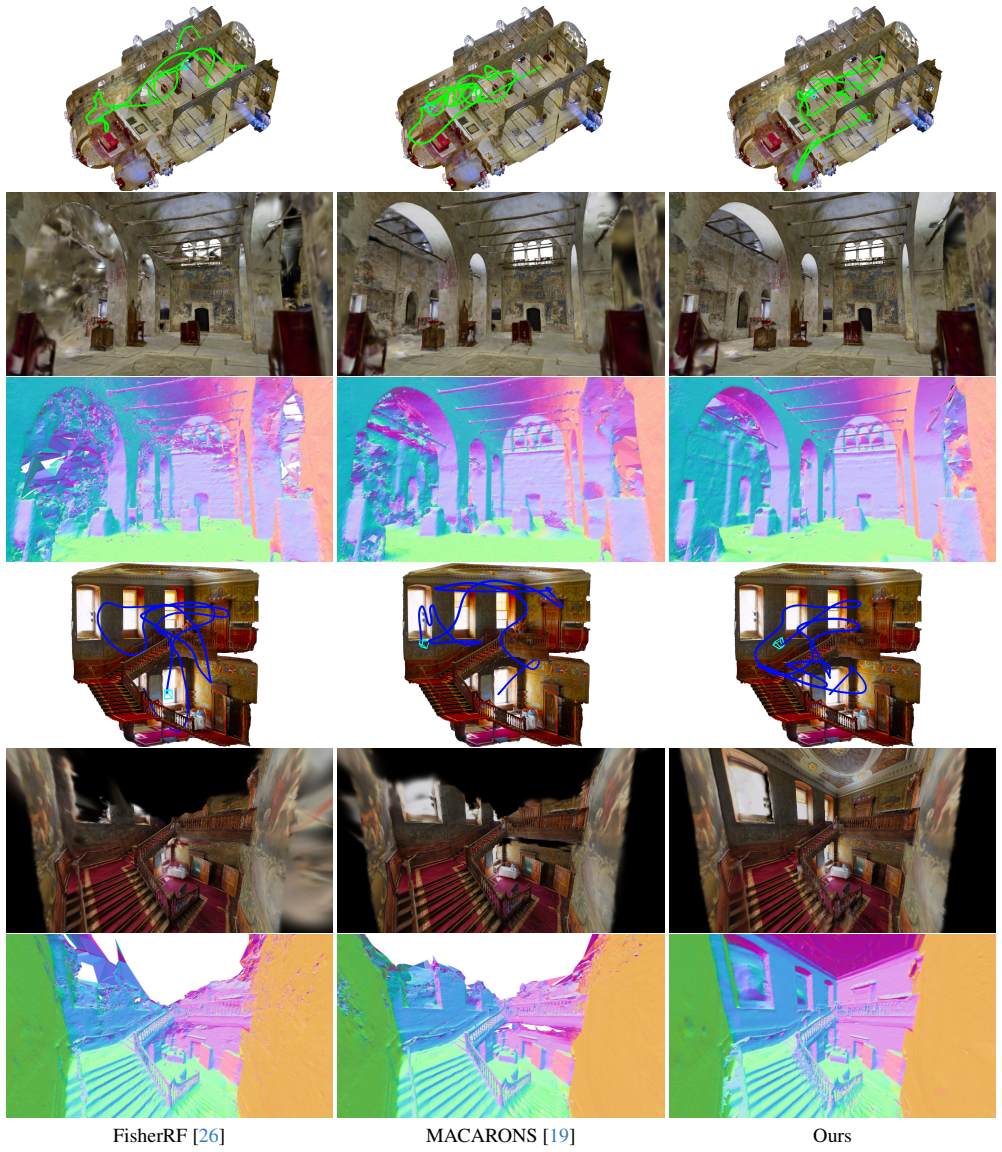
read the original abstract
Active mapping aims to determine how an agent should move to efficiently reconstruct unknown environments. Most existing approaches rely on greedy next-best-view prediction, resulting in inefficient exploration and incomplete reconstruction. To address this, we introduce MAGICIAN, a novel long-term planning framework that maximizes accumulated surface coverage gain through Imagined Gaussians, a scene representation based on 3D Gaussian Splatting, derived from a pre-trained occupancy network with strong structural priors. This representation enables efficient coverage gain computation for any novel viewpoint via fast volumetric rendering, allowing its integration into a tree-search algorithm for long-horizon planning. We update Imagined Gaussians and refine the trajectory in a closed loop. Our method achieves state-of-the-art performance across indoor and outdoor benchmarks with varying action spaces, highlighting the advantage of long-term planning in active mapping.
Editorial analysis
A structured set of objections, weighed in public.
Referee Report
Summary. The paper introduces MAGICIAN, a long-term planning framework for active mapping that derives Imagined Gaussians from a pre-trained occupancy network to enable fast volumetric rendering of coverage gains for novel viewpoints, which are then maximized via tree-search planning in a closed-loop update scheme, claiming state-of-the-art performance on indoor and outdoor benchmarks with varying action spaces.
Significance. If the Imagined Gaussians yield accurate coverage predictions that transfer to unseen scenes, the approach would meaningfully advance active mapping by replacing greedy next-best-view selection with efficient long-horizon planning, potentially improving reconstruction completeness in robotics applications.
major comments (2)
- [§3.2] §3.2 (Imagined Gaussians derivation): The coverage-gain computation via fast rendering assumes that the pre-trained occupancy network supplies sufficiently accurate structural priors for novel viewpoints and environments, yet no quantitative prediction-error metrics or cross-scene transfer experiments are reported; this assumption is load-bearing for the tree-search planner's claimed advantage.
- [Experiments] Experiments section, Table 1 (SOTA comparison): The reported performance gains over greedy baselines are presented without ablations isolating the contribution of long-horizon planning versus the representation itself, nor any validation that the planner optimizes against faithful rather than erroneous coverage estimates.
minor comments (2)
- [Abstract] The abstract and §2 could more explicitly define the closed-loop update procedure and the precise formulation of accumulated coverage gain.
- [§3] Notation for the Gaussian parameters and rendering integral is introduced without a consolidated table, which would aid readability.
Simulated Author's Rebuttal
We thank the referee for the constructive feedback and the recommendation for major revision. The comments highlight important aspects of validation that will strengthen the manuscript. We address each point below and will incorporate the suggested additions in the revised version.
read point-by-point responses
-
Referee: [§3.2] §3.2 (Imagined Gaussians derivation): The coverage-gain computation via fast rendering assumes that the pre-trained occupancy network supplies sufficiently accurate structural priors for novel viewpoints and environments, yet no quantitative prediction-error metrics or cross-scene transfer experiments are reported; this assumption is load-bearing for the tree-search planner's claimed advantage.
Authors: We agree that direct validation of the occupancy network's structural priors is essential to support the coverage-gain computation and the planner's advantage. While the SOTA results on diverse indoor and outdoor benchmarks provide indirect evidence of effective generalization, the original manuscript did not report quantitative prediction-error metrics or dedicated cross-scene transfer experiments. In the revised version, we will add these: occupancy prediction errors (e.g., IoU and MSE on novel viewpoints) and cross-scene transfer results to explicitly demonstrate the accuracy and transferability of the priors. This will directly address the load-bearing assumption. revision: yes
-
Referee: [Experiments] Experiments section, Table 1 (SOTA comparison): The reported performance gains over greedy baselines are presented without ablations isolating the contribution of long-horizon planning versus the representation itself, nor any validation that the planner optimizes against faithful rather than erroneous coverage estimates.
Authors: We appreciate the call for clearer isolation of contributions. The original experiments emphasized end-to-end SOTA comparisons but did not include targeted ablations separating the long-horizon planner from the Imagined Gaussians representation, nor direct validation against ground-truth coverage. In the revision, we will add ablations that (1) compare tree-search long-horizon planning against greedy selection with the same representation and (2) evaluate planner performance using our coverage estimates versus oracle ground-truth estimates. These will confirm the source of the gains and the faithfulness of the estimates. revision: yes
Circularity Check
No circularity: derivation relies on external pre-trained priors and standard rendering/planning without self-referential reduction
full rationale
The abstract and description present Imagined Gaussians as derived from an external pre-trained occupancy network, with coverage gains computed via volumetric rendering and integrated into tree-search planning. No equations, predictions, or claims reduce by construction to fitted inputs, self-citations, or ansatzes from the same authors. The SOTA performance is benchmark-driven rather than tautological, and the method chain remains self-contained against external priors without load-bearing internal loops.
Axiom & Free-Parameter Ledger
axioms (1)
- domain assumption Pre-trained occupancy networks encode strong structural priors that transfer to unseen environments for coverage prediction.
invented entities (1)
-
Imagined Gaussians
no independent evidence
Reference graph
Works this paper leans on
-
[1]
Information-Theoretic Exploration with Bayesian Optimiza- tion
Shi Bai, Jinkun Wang, Fanfei Chen, and Brendan Englot. Information-Theoretic Exploration with Bayesian Optimiza- tion. InInternational Conference on Intelligent Robots and Systems, pages 1816–1822, 2016. 2
work page 2016
- [2]
-
[3]
Ana Batinovic, Tamara Petrovic, Antun Ivanovic, Frano Pet- ric, and Stjepan Bogdan. A Multi-Resolution Frontier-Based Planner for Autonomous 3D Exploration.IEEE Robotics and Automation Letters, 6(3):4528–4535, 2021. 2
work page 2021
-
[4]
Receding Horizon” Next- Best-View” Planner for 3D Exploration
Andreas Bircher, Mina Kamel, Kostas Alexis, Helen Oleynikova, and Roland Siegwart. Receding Horizon” Next- Best-View” Planner for 3D Exploration. InInternational Conference on Robotics and Automation, pages 1462–1468,
-
[5]
Frederic Bourgault, Alexei A. Makarenko, Stefan B. Williams, Ben Grocholsky, and Hugh F. Durrant-Whyte. In- formation Based Adaptive Robotic Exploration. InInterna- tional Conference on Intelligent Robots and Systems, pages 540–545, 2002. 2
work page 2002
-
[6]
Hi- erarchical coverage path planning in complex 3d environ- ments
Chao Cao, Ji Zhang, Matt Travers, and Howie Choset. Hi- erarchical coverage path planning in complex 3d environ- ments. In2020 IEEE International Conference on Robotics and Automation (ICRA), pages 3206–3212. IEEE, 2020. 2
work page 2020
-
[7]
Chao Cao, Hongbiao Zhu, Howie Choset, and Ji Zhang. TARE: A Hierarchical Framework for Efficiently Exploring Complex 3D Environments.Robotics: Science and Systems, 5:2, 2021. 2
work page 2021
-
[8]
Matterport3D: Learning from RGB- D Data in Indoor Environments
Angel Chang, Angela Dai, Thomas Funkhouser, Maciej Hal- ber, Matthias Niessner, Manolis Savva, Shuran Song, Andy Zeng, and Yinda Zhang. Matterport3D: Learning from RGB- D Data in Indoor Environments. InarXiv Preprint, 2017. 2, 5
work page 2017
-
[9]
Angel X. Chang, Thomas Funkhouser, Leonidas Guibas, Pat Hanrahan, Qixing Huang, Zimo Li, Silvio Savarese, Mano- lis Savva, Shuran Song, Hao Su, et al. ShapeNet: An Information-Rich 3D Model Repository. InarXiv Preprint,
-
[10]
ActiveGamer: Active Gaussian Mapping through Efficient Rendering
Liyan Chen, Huangying Zhan, Kevin Chen, Xiangyu Xu, Qingan Yan, Changjiang Cai, and Yi Xu. ActiveGamer: Active Gaussian Mapping through Efficient Rendering. In Proceedings of the Computer Vision and Pattern Recognition Conference, pages 16486–16497, 2025. 2, 3, 6, 8
work page 2025
-
[11]
Liyan Chen, Huangying Zhan, Hairong Yin, Yi Xu, and Philippos Mordohai. Understanding while explor- ing: Semantics-driven active mapping.arXiv preprint arXiv:2506.00225, 2025. 8
-
[12]
GLEAM: Learning Generalizable Exploration Policy for Active Mapping in Complex 3D In- door Scenes
Xiao Chen, Tai Wang, Quanyi Li, Tao Huang, Jiangmiao Pang, and Tianfan Xue. GLEAM: Learning Generalizable Exploration Policy for Active Mapping in Complex 3D In- door Scenes. InarXiv Preprint, 2025. 2, 3
work page 2025
-
[13]
Fast Frontier-Based Information-Driven Autonomous Exploration with an Mav
Anna Dai, Sotiris Papatheodorou, Nils Funk, Dimos Tzoumanikas, and Stefan Leutenegger. Fast Frontier-Based Information-Driven Autonomous Exploration with an Mav. InInternational Conference on Robotics and Automation, pages 9570–9576, 2020. 2
work page 2020
-
[14]
Andrew J. Davison, Ian D. Reid, Nicholas D. Molton, and Olivier Stasse. MonoSLAM: Real-Time Single Camera SLAM.IEEE Transactions on Pattern Analysis and Machine Intelligence, 29(6):1052–1067, 2007. 2
work page 2007
-
[15]
NARUTO: Neural Active Reconstruction from Uncer- tain Target Observations
Ziyue Feng, Huangying Zhan, Zheng Chen, Qingan Yan, Xiangyu Xu, Changjiang Cai, Bing Li, Qilun Zhu, and Yi Xu. NARUTO: Neural Active Reconstruction from Uncer- tain Target Observations. InConference on Computer Vision and Pattern Recognition, pages 21572–21583, 2024. 2, 3, 6, 8
work page 2024
-
[16]
Uncertainty-Driven Planner for Exploration and Navigation
Georgios Georgakis, Bernadette Bucher, Anton Arapin, Karl Schmeckpeper, Nikolai Matni, and Kostas Daniilidis. Uncertainty-Driven Planner for Exploration and Navigation. InInternational Conference on Robotics and Automation, pages 11295–11302, 2022. 6, 8
work page 2022
-
[17]
Antoine Gu ´edon and Vincent Lepetit. Sugar: Surface- Aligned Gaussian Splatting for Efficient 3D Mesh Recon- struction and High-Quality Mesh Rendering. InConference on Computer Vision and Pattern Recognition, pages 5354– 5363, 2024. 3
work page 2024
-
[18]
SCONE: Surface Coverage Optimization In Unknown Envi- ronments by V olumetric Integration
Antoine Gu ´edon, Pascal Monasse, and Vincent Lepetit. SCONE: Surface Coverage Optimization In Unknown Envi- ronments by V olumetric Integration. InAdvances in Neural Information Processing Systems, page NIPS, 2022. 2, 3, 4, 5, 6, 7, 1
work page 2022
-
[19]
MACARONS: Mapping And Coverage Antici- pation with RGB Online Self-Supervision
Antoine Gu ´edon, Tom Monnier, Pascal Monasse, and Vin- cent Lepetit. MACARONS: Mapping And Coverage Antici- pation with RGB Online Self-Supervision. InConference on Computer Vision and Pattern Recognition, pages 940–951,
-
[20]
MILo: Mesh-In-the-Loop Gaussian Splatting for Detailed and Ef- ficient Surface Reconstruction
Antoine Gu ´edon, Diego Gomez, Nissim Maruani, Bingchen Gong, George Drettakis, and Maks Ovsjanikov. MILo: Mesh-In-the-Loop Gaussian Splatting for Detailed and Ef- ficient Surface Reconstruction. InarXiv Preprint, pages arXiv–2506, 2025. 6, 7
work page 2025
-
[21]
Guillaume Hardouin, Julien Moras, Fabio Morbidi, Julien Marzat, and El Mustapha Mouaddib. Next-Best-View Plan- ning for Surface Reconstruction of Large-Scale 3D Environ- ments with Multiple UA Vs. InInternational Conference on Intelligent Robots and Systems, pages 1567–1574, 2020. 2
work page 2020
-
[22]
A formal basis for the heuristic determination of minimum cost paths
Peter E Hart, Nils J Nilsson, and Bertram Raphael. A formal basis for the heuristic determination of minimum cost paths. IEEE transactions on Systems Science and Cybernetics, 4 (2):100–107, 1968. 2
work page 1968
-
[23]
Efficient Visual Exploration and Coverage with a Micro Aerial Vehicle in Unknown Environments
Lionel Heng, Alkis Gotovos, Andreas Krause, and Marc Pollefeys. Efficient Visual Exploration and Coverage with a Micro Aerial Vehicle in Unknown Environments. InIn- ternational Conference on Robotics and Automation, pages 1071–1078, 2015. 2
work page 2015
-
[24]
2D Gaussian Splatting for Geometrically Ac- curate Radiance Fields
Binbin Huang, Zehao Yu, Anpei Chen, Andreas Geiger, and Shenghua Gao. 2D Gaussian Splatting for Geometrically Ac- curate Radiance Fields. InACM SIGGRAPH, pages 1–11,
-
[25]
An Information Gain Formulation for Active V olumetric 3D Reconstruction
Stefan Isler, Reza Sabzevari, Jeffrey Delmerico, and Davide Scaramuzza. An Information Gain Formulation for Active V olumetric 3D Reconstruction. InInternational Conference on Robotics and Automation, pages 3477–3484, 2016. 2
work page 2016
-
[26]
FisherRF: Ac- tive View Selection and Mapping with Radiance Fields Us- ing Fisher Information
Wen Jiang, Boshu Lei, and Kostas Daniilidis. FisherRF: Ac- tive View Selection and Mapping with Radiance Fields Us- ing Fisher Information. InEuropean Conference on Com- puter Vision, pages 422–440, 2024. 2, 3, 6, 7, 4, 5
work page 2024
-
[27]
Liren Jin, Xingguang Zhong, Yue Pan, Jens Behley, Cyrill Stachniss, and Marija Popovi ´c. Activegs: Active Scene Re- construction Using Gaussian Splatting.IEEE Robotics and Automation Letters, 2025. 2, 3
work page 2025
-
[28]
Bernhard Kerbl, Georgios Kopanas, Thomas Leimk ¨uhler, and George Drettakis. 3D Gaussian Splatting for Real-Time Radiance Field Rendering.ACM Transactions on Graphics, 42(4):1–14, 2023. 3
work page 2023
-
[29]
Next-Best-Scan Planning for Autonomous 3D Modeling
Simon Kriegel, Christian Rink, Tim Bodenm¨uller, Alexander Narr, Michael Suppa, and Gerd Hirzinger. Next-Best-Scan Planning for Autonomous 3D Modeling. InInternational Conference on Intelligent Robots and Systems, pages 2850– 2856, 2012. 2
work page 2012
-
[30]
Rapidly-exploring random trees: A new tool for path planning.Research Report 9811, 1998
Steven LaValle. Rapidly-exploring random trees: A new tool for path planning.Research Report 9811, 1998. 2
work page 1998
-
[31]
Soomin Lee, Le Chen, Jiahao Wang, Alexander Liniger, Suryansh Kumar, and Fisher Yu. Uncertainty Guided Pol- icy for Active Robotic 3D Reconstruction Using Neural Ra- diance Fields.IEEE Robotics and Automation Letters, 7(4): 12070–12077, 2022. 2
work page 2022
-
[32]
NextBestPath: Efficient 3D Map- ping of Unseen Environments
Shiyao Li, Antoine Guedon, Cl ´ementin Boittiaux, Shizhe Chen, and Vincent Lepetit. NextBestPath: Efficient 3D Map- ping of Unseen Environments. InInternational Conference on Learning Representations, 2025. 2, 3, 6, 8
work page 2025
-
[33]
Yuetao Li, Zijia Kuang, Ting Li, Qun Hao, Zike Yan, Guyue Zhou, and Shaohui Zhang. Activesplat: High-fidelity scene reconstruction through active gaussian splatting.IEEE Robotics and Automation Letters, 2025. 2, 3
work page 2025
-
[34]
Miguel Mendoza, Juan Irving Vasquez-Gomez, Hind Taud, Luis Enrique Sucar, and Carolina Reta. Supervised Learning of the Next-Best-View for 3D Object Reconstruction.Pat- tern Recognition Letters, 2020. 2, 3
work page 2020
-
[35]
NeRF: Representing Scenes As Neural Radiance Fields for View Synthesis
Ben Mildenhall, Pratul P Srinivasan, Matthew Tancik, Jonathan T Barron, Ravi Ramamoorthi, and Ren Ng. NeRF: Representing Scenes As Neural Radiance Fields for View Synthesis. InEuropean Conference on Computer Vision, pages 405–421. Springer, 2020. 3, 4
work page 2020
-
[36]
Raul Mur-Artal and Juan D Tardos. ORB-SLAM: A versatile and accurate monocular SLAM system.IEEE Transactions on Robotics, 31(5):1147–1163, 2015. 2
work page 2015
-
[37]
Activen- erf: Learning Where to See with Uncertainty Estimation
Xuran Pan, Zihang Lai, Shiji Song, and Gao Huang. Activen- erf: Learning Where to See with Uncertainty Estimation. In European Conference on Computer Vision, pages 230–246,
-
[38]
Ramakrishnan, Ziad Al-Halah, and Kristen Grauman
Santhosh K. Ramakrishnan, Ziad Al-Halah, and Kristen Grauman. Occupancy Anticipation for Efficient Exploration and Navigation. InEuropean Conference on Computer Vi- sion, pages 400–418, 2020. 6, 8
work page 2020
-
[39]
Accelerating 3D Deep Learning with PyTorch3D
Nikhila Ravi, Jeremy Reizenstein, David Novotny, Tay- lor Gordon, Wan-Yen Lo, Justin Johnson, and Georgia Gkioxari. Accelerating 3d deep learning with pytorch3d. arXiv preprint arXiv:2007.08501, 2020. 2
work page internal anchor Pith review arXiv 2007
-
[40]
Submodular Trajectory Optimization for Aerial 3D Scan- ning
Mike Roberts, Debadeepta Dey, Anh Truong, Sudipta Sinha, Shital Shah, Ashish Kapoor, Pat Hanrahan, and Neel Joshi. Submodular Trajectory Optimization for Aerial 3D Scan- ning. InInternational Conference on Computer Vision, pages 5324–5333, 2017. 2
work page 2017
-
[41]
Cyrill Stachniss, Giorgio Grisetti, and Wolfram Bur- gard. Information Gain-Based Exploration Using Rao- Blackwellized Particle Filters.Robotics: Science and sys- tems, 2(1):65–72, 2005. 2
work page 2005
-
[42]
Vggt: Vi- sual geometry grounded transformer
Jianyuan Wang, Minghao Chen, Nikita Karaev, Andrea Vedaldi, Christian Rupprecht, and David Novotny. Vggt: Vi- sual geometry grounded transformer. InProceedings of the Computer Vision and Pattern Recognition Conference, pages 5294–5306, 2025. 8
work page 2025
-
[43]
Dust3r: Geometric 3d vi- sion made easy
Shuzhe Wang, Vincent Leroy, Yohann Cabon, Boris Chidlovskii, and Jerome Revaud. Dust3r: Geometric 3d vi- sion made easy. InProceedings of the IEEE/CVF Conference on Computer Vision and Pattern Recognition, pages 20697– 20709, 2024. 8
work page 2024
-
[44]
A Frontier-Based Approach for Au- tonomous Exploration
Brian Yamauchi. A Frontier-Based Approach for Au- tonomous Exploration. InProceedings 1997 IEEE In- ternational Symposium on Computational Intelligence in Robotics and Automation CIRA’97. ’Towards New Computa- tional Principles for Robotics and Automation’, pages 146– 151, 1997. 2, 8
work page 1997
-
[45]
Zike Yan, Haoxiang Yang, and Hongbin Zha. Active Neural Mapping. InInternational Conference on Computer Vision, pages 10981–10992, 2023. 2, 3, 6, 8
work page 2023
-
[46]
PC-NBV: A Point Cloud Based Deep Network for Efficient Next Best View Planning
Rui Zeng, Wang Zhao, and Yong-Jin Liu. PC-NBV: A Point Cloud Based Deep Network for Efficient Next Best View Planning. InInternational Conference on Intelligent Robots and Systems, 2020. 2, 3
work page 2020
-
[47]
RaDe-GS: Rasterizing Depth in Gaussian Splatting.arXiv Preprint, 2024
Baowen Zhang, Chuan Fang, Rakesh Shrestha, Yixun Liang, Xiaoxiao Long, and Ping Tan. RaDe-GS: Rasterizing Depth in Gaussian Splatting.arXiv Preprint, 2024. 6
work page 2024
-
[48]
Boyu Zhou, Yichen Zhang, Xinyi Chen, and Shaojie Shen. Fuel: Fast uav exploration using incremental frontier struc- ture and hierarchical planning.IEEE Robotics and Automa- tion Letters, 6(2):779–786, 2021. 3 Appendix In Sec. A, we present the details of the occupancy module, and the complete formulation of the coverage gain com- putation along with the a...
discussion (0)
Sign in with ORCID, Apple, or X to comment. Anyone can read and Pith papers without signing in.