Recognition: no theorem link
HI Gas and Star Formation in Major Galaxy Pairs from the FAST All-Sky HI Survey (FASHI)
Pith reviewed 2026-05-15 01:17 UTC · model grok-4.3
The pith
Galaxy pairs with small separations exhibit 8.8 percent lower HI gas fractions than mass-matched isolated galaxies.
A machine-rendered reading of the paper's core claim, the machinery that carries it, and where it could break.
Core claim
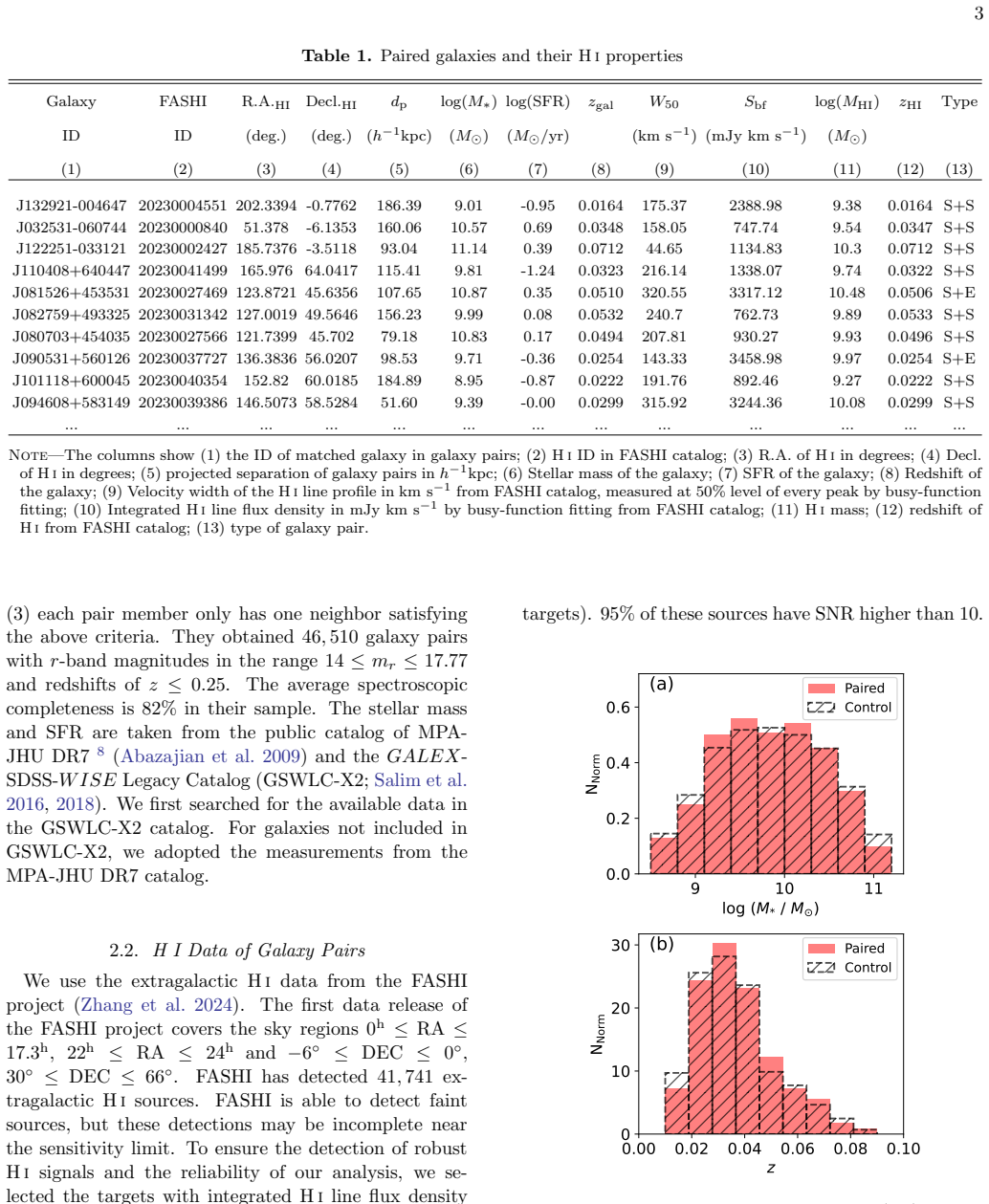
Cross-matching the FASHI extragalactic HI catalog with an established sample of isolated major pairs yields the largest such dataset with 364 S+S and 76 S+E systems. Paired galaxies, especially at projected separations below 50 h^{-1} kpc, display HI gas fractions 8.8 percent lower than controls. Star formation rates rise in S+S pairs and their HI star formation efficiency is roughly 15 percent higher, whereas S+E pairs show little change in efficiency. This pattern implies that the merging process drives rapid HI consumption and enhanced star formation, with red spirals in pairs appearing more quiescent.
What carries the argument
HI gas fraction (M_HI over stellar mass), star formation rate, and HI star formation efficiency (SFR over M_HI) measured for individual galaxies in pairs and compared to a stellar-mass and redshift matched control sample.
Load-bearing premise
Matching control galaxies only by stellar mass and redshift is enough to isolate the effects of interactions from other galaxy properties such as environment or morphology.
What would settle it
A larger sample of close pairs that still shows no HI gas deficiency after further matching on local density or morphology would indicate that interactions alone do not drive the observed depletion.
Figures


read the original abstract
Atomic hydrogen (HI) plays a fundamental role in fueling star formation in galaxies. However, the behavior of HI gas in interacting systems, particularly galaxy pairs, remains elusive. In this work, we investigate the HI content of major mergers by cross-matching the extragalactic HI catalog from the FAST All-Sky HI Survey (FASHI) with a previously established sample of isolated galaxy pairs. With the superior sensitivity of FAST, we have constructed the largest sample of major mergers with HI detections, consisting of $440$ galaxy pairs: $364$ spiral-spiral (S+S) and $76$ spiral-elliptical (S+E) systems. We examine the HI gas fraction ($f_{\mathrm{HI}}$), star formation rate (SFR) and HI star formation efficiency ($\mathrm{SFE_{HI}}=\mathrm{SFR}/M_{\rm HI}$) for individual galaxies in pairs. The control sample is matched in both stellar mass and redshift. We find that paired galaxies, particularly those in pairs with small projected separations ($d_{\mathrm{p}}<50\ h^{-1}\mathrm{kpc}$), exhibit systematically lower (by $8.8\%$) HI gas fractions compared to the control galaxies. The SFR is enhanced for galaxies in S+S pairs. $\mathrm{SFE_{HI}}$ is $\sim15\%$ higher for galaxies in S+S pairs than in the control galaxies, while spiral galaxies in S+E pairs show no significant difference in $\mathrm{SFE_{HI}}$ compared to the control sample. These findings suggest that the merging process triggers efficient HI gas depletion and enhances star formation, especially in close S+S pairs. Notably, our sample includes $26$ red spirals in paired systems. These galaxies exhibit HI deficiency and suppressed star formation activity compared to the isolated galaxies, indicating that interactions may affect quiescent spirals differently, potentially due to mechanisms similar to ellipticals.
Editorial analysis
A structured set of objections, weighed in public.
Referee Report
Summary. The paper cross-matches the FASHI HI catalog with a sample of isolated major galaxy pairs to assemble 440 systems (364 S+S, 76 S+E) and compares their HI gas fractions (f_HI), star-formation rates, and HI star-formation efficiencies (SFE_HI = SFR/M_HI) against a control sample matched only in stellar mass and redshift. It reports an 8.8% lower f_HI for galaxies in close pairs (d_p < 50 h^{-1} kpc), elevated SFR in S+S pairs, and ~15% higher SFE_HI in S+S systems relative to controls, while noting HI deficiency and suppressed SFR in a subsample of 26 red spirals.
Significance. If the control matching adequately isolates interaction effects, the large FASHI-enabled sample supplies one of the most statistically substantial observational constraints to date on how major mergers deplete the atomic-gas reservoir and modulate star-formation efficiency, with separate results for S+S versus S+E systems and for red spirals adding useful granularity.
major comments (3)
- [Methods (control-sample construction)] The control-sample construction (described in the methods section) matches only on stellar mass and redshift. Because local density, group membership, and morphological type are known to modulate f_HI independently of interactions, the reported 8.8% deficit and 15% SFE_HI excess cannot be unambiguously attributed to the merging process without additional matching or explicit environmental controls.
- [Results (quantitative differences)] The quantitative claims of an 8.8% f_HI reduction and ~15% SFE_HI increase are presented without error bars, bootstrap uncertainties, or Kolmogorov-Smirnov/p-value statistics that incorporate the matching procedure and selection function. This omission makes it impossible to judge whether the offsets exceed the combined statistical and systematic uncertainties.
- [Results (subsample analysis)] The S+E subsample (76 pairs) and the red-spiral subsample (26 galaxies) are small; statements that S+E systems show “no significant difference” in SFE_HI and that red spirals are HI-deficient therefore rest on low-number statistics that require explicit robustness tests (e.g., jackknife or Monte-Carlo resampling) before they can support the broader interpretation.
minor comments (2)
- [Sample selection] Define the precise criteria used to classify pairs as “isolated” and to assign morphological types (S vs. E) at first mention; the current description leaves open the possibility of projection or classification biases.
- [Figures and notation] Ensure that all symbols (f_HI, SFE_HI, d_p, etc.) are defined on first use and that figure captions explicitly state the binning and error treatment applied to the histograms and median trends.
Simulated Author's Rebuttal
We thank the referee for the constructive comments. We provide point-by-point responses below and indicate the planned revisions.
read point-by-point responses
-
Referee: [Methods (control-sample construction)] The control-sample construction (described in the methods section) matches only on stellar mass and redshift. Because local density, group membership, and morphological type are known to modulate f_HI independently of interactions, the reported 8.8% deficit and 15% SFE_HI excess cannot be unambiguously attributed to the merging process without additional matching or explicit environmental controls.
Authors: We note that our pair sample was selected to be isolated, which helps to reduce the influence of group membership and local density. However, we agree that residual environmental effects could play a role. In the revised version, we will add a discussion section addressing potential environmental biases and explore the possibility of additional matching on available density estimates for a subset of the sample. revision: partial
-
Referee: [Results (quantitative differences)] The quantitative claims of an 8.8% f_HI reduction and ~15% SFE_HI increase are presented without error bars, bootstrap uncertainties, or Kolmogorov-Smirnov/p-value statistics that incorporate the matching procedure and selection function. This omission makes it impossible to judge whether the offsets exceed the combined statistical and systematic uncertainties.
Authors: We apologize for the oversight in not including uncertainties. We will recalculate the differences with bootstrap resampling to provide error bars and perform statistical tests such as the Kolmogorov-Smirnov test to quantify the significance of the observed offsets, taking into account the matching procedure. revision: yes
-
Referee: [Results (subsample analysis)] The S+E subsample (76 pairs) and the red-spiral subsample (26 galaxies) are small; statements that S+E systems show “no significant difference” in SFE_HI and that red spirals are HI-deficient therefore rest on low-number statistics that require explicit robustness tests (e.g., jackknife or Monte-Carlo resampling) before they can support the broader interpretation.
Authors: We acknowledge the small sizes of these subsamples. In the revision, we will include jackknife and Monte-Carlo resampling tests to assess the robustness of our findings for the S+E and red-spiral subsamples, and qualify our statements accordingly. revision: yes
Circularity Check
No circularity: purely observational comparison against external control sample
full rationale
The paper reports direct empirical measurements of HI gas fractions, SFR, and SFE_HI in a sample of 440 galaxy pairs drawn from FASHI cross-matched with an isolated pairs catalog, compared to a control sample matched only in stellar mass and redshift. No equations, derivations, or fitted parameters are defined in terms of the target results; the 8.8% deficit and 15% SFE enhancement are stated as observed offsets, not predictions that reduce to the matching procedure by construction. No self-citation chains, ansatzes, or renamings of known results are invoked as load-bearing steps. The analysis is self-contained against external data.
Axiom & Free-Parameter Ledger
axioms (1)
- domain assumption Stellar-mass and redshift matching of the control sample isolates interaction-driven effects from other galaxy properties
Reference graph
Works this paper leans on
-
[1]
Abazajian, K. N., Adelman-McCarthy, J. K., Ag¨ ueros, M. A., et al. 2009, ApJS, 182, 543, doi: 10.1088/0067-0049/182/2/543
-
[2]
Abolfathi, B., Aguado, D. S., Aguilar, G., et al. 2018, ApJS, 235, 42, doi: 10.3847/1538-4365/aa9e8a 13 Astropy Collaboration, Robitaille, T. P., Tollerud, E. J., et al. 2013, A&A, 558, A33, doi: 10.1051/0004-6361/201322068
-
[3]
2001, MNRAS, 322, 231, doi: 10.1046/j.1365-8711.2001.04022.x
Barnes, D. G., Staveley-Smith, L., de Blok, W. J. G., et al. 2001, MNRAS, 322, 486, doi: 10.1046/j.1365-8711.2001.04102.x
-
[4]
Barnes, J. E., & Hernquist, L. 1996, ApJ, 471, 115, doi: 10.1086/177957
-
[5]
Bessell, M. S. 1990, PASP, 102, 1181, doi: 10.1086/132749
-
[6]
Blanton, M. R., Schlegel, D. J., Strauss, M. A., et al. 2005, AJ, 129, 2562, doi: 10.1086/429803
-
[7]
Bok, J., Blyth, S. L., Gilbank, D. G., & Elson, E. C. 2019, MNRAS, 484, 582, doi: 10.1093/mnras/sty3448
-
[8]
Bok, J., Cluver, M. E., Jarrett, T. H., et al. 2022, MNRAS, 513, 2581, doi: 10.1093/mnras/stac1036
-
[9]
Bok, J., Skelton, R. E., Cluver, M. E., et al. 2020, MNRAS, 499, 3193, doi: 10.1093/mnras/staa3034
-
[10]
2015, ApJ, 813, 46, doi: 10.1088/0004-637X/813/1/46
Borthakur, S., Heckman, T., Tumlinson, J., et al. 2015, ApJ, 813, 46, doi: 10.1088/0004-637X/813/1/46
-
[11]
Brown, W., Patton, D. R., Ellison, S. L., & Faria, L. 2023, MNRAS, 522, 5107, doi: 10.1093/mnras/stad1314
-
[12]
2004, A&A, 422, 941, doi: 10.1051/0004-6361:20040283
Casasola, V., Bettoni, D., & Galletta, G. 2004, A&A, 422, 941, doi: 10.1051/0004-6361:20040283
-
[13]
2018, MNRAS, 476, 875, doi: 10.1093/mnras/sty089
Catinella, B., Saintonge, A., Janowiecki, S., et al. 2018, MNRAS, 476, 875, doi: 10.1093/mnras/sty089
-
[14]
Ram Pressure Stripping of Disc Galaxies: The Role of the Inclination Angle , shorttitle =
Cox, T. J., Jonsson, P., Primack, J. R., & Somerville, R. S. 2006, MNRAS, 373, 1013, doi: 10.1111/j.1365-2966.2006.11107.x
-
[15]
2024, MNRAS, 528, 2391, doi: 10.1093/mnras/stae156
Cui, J., Gu, Q., & Shi, Y. 2024, MNRAS, 528, 2391, doi: 10.1093/mnras/stae156
-
[16]
2012, Research in Astronomy and Astrophysics, 12, 1197, doi: 10.1088/1674-4527/12/9/003
Cui, X.-Q., Zhao, Y.-H., Chu, Y.-Q., et al. 2012, Research in Astronomy and Astrophysics, 12, 1197, doi: 10.1088/1674-4527/12/9/003 D´ enes, H., Kilborn, V. A., & Koribalski, B. S. 2014, MNRAS, 444, 667, doi: 10.1093/mnras/stu1337
-
[17]
2018, MNRAS, 480, 947, doi: 10.1093/mnras/sty1872
Dutta, R., Srianand, R., & Gupta, N. 2018, MNRAS, 480, 947, doi: 10.1093/mnras/sty1872
-
[18]
Elbaz, D., Dickinson, M., Hwang, H. S., et al. 2011, A&A, 533, A119, doi: 10.1051/0004-6361/201117239
-
[19]
L., Catinella, B., & Cortese, L
Ellison, S. L., Catinella, B., & Cortese, L. 2018, MNRAS, 478, 3447, doi: 10.1093/mnras/sty1247
-
[20]
Ellison, S. L., Fertig, D., Rosenberg, J. L., et al. 2015, MNRAS, 448, 221, doi: 10.1093/mnras/stu2744
-
[21]
Feng, S., Shen, S.-Y., Yuan, F.-T., Riffel, R. A., & Pan, K. 2020, ApJL, 892, L20, doi: 10.3847/2041-8213/ab7dba
-
[22]
2024, ApJ, 965, 60, doi: 10.3847/1538-4357/ad343e —
Feng, S., Shen, S.-Y., Yuan, F.-T., et al. 2024, ApJ, 965, 60, doi: 10.3847/1538-4357/ad343e —. 2019, ApJ, 880, 114, doi: 10.3847/1538-4357/ab24da
-
[23]
Ferreira, L., Ellison, S. L., Patton, D. R., et al. 2025, MNRAS, 538, L31, doi: 10.1093/mnrasl/slaf004
-
[24]
Fukugita, M., Ichikawa, T., Gunn, J. E., et al. 1996, AJ, 111, 1748, doi: 10.1086/117915
-
[25]
Georgakakis, A., Forbes, D. A., & Norris, R. P. 2000, MNRAS, 318, 124, doi: 10.1046/j.1365-8711.2000.03709.x
-
[26]
Giovanelli, R., Haynes, M. P., Kent, B. R., et al. 2005, AJ, 130, 2598, doi: 10.1086/497431
-
[27]
2020, ApJ, 897, 162, doi: 10.3847/1538-4357/ab9b75
Guo, R., Hao, C.-N., Xia, X., et al. 2020, ApJ, 897, 162, doi: 10.3847/1538-4357/ab9b75
-
[28]
Guo, R., Hao, C.-N., Xia, X. Y., Mao, S., & Shi, Y. 2016, ApJ, 826, 30, doi: 10.3847/0004-637X/826/1/30
-
[29]
Haynes, M. P., Giovanelli, R., Martin, A. M., et al. 2011, AJ, 142, 170, doi: 10.1088/0004-6256/142/5/170
-
[30]
Haynes, M. P., Giovanelli, R., Kent, B. R., et al. 2018, ApJ, 861, 49, doi: 10.3847/1538-4357/aac956
-
[31]
Hibbard, J. E., & van Gorkom, J. H. 1996, AJ, 111, 655, doi: 10.1086/117815
-
[32]
Hibbard, J. E., & Yun, M. S. 1999, AJ, 118, 162, doi: 10.1086/300928
-
[33]
2025, ApJ, 980, 157, doi: 10.3847/1538-4357/ad9579
Huang, Q., Wang, J., Lin, X., et al. 2025, ApJ, 980, 157, doi: 10.3847/1538-4357/ad9579
-
[34]
2017, MNRAS, 466, 4795, doi: 10.1093/mnras/stx046
Janowiecki, S., Catinella, B., Cortese, L., et al. 2017, MNRAS, 466, 4795, doi: 10.1093/mnras/stx046
- [35]
-
[36]
Physics, Mechanics, and Astronomy, 62, 959502, doi: 10.1007/s11433-018-9376-1
-
[37]
2020, Research in Astronomy and Astrophysics, 20, 064, doi: 10.1088/1674-4527/20/5/64
Jiang, P., Tang, N.-Y., Hou, L.-G., et al. 2020, Research in Astronomy and Astrophysics, 20, 064, doi: 10.1088/1674-4527/20/5/64
-
[38]
Koribalski, B., & Dickey, J. M. 2004, MNRAS, 348, 1255, doi: 10.1111/j.1365-2966.2004.07444.x
-
[39]
S., Staveley-Smith, L., Westmeier, T., et al
Koribalski, B. S., Staveley-Smith, L., Westmeier, T., et al. 2020, Ap&SS, 365, 118, doi: 10.1007/s10509-020-03831-4
-
[40]
1993, MNRAS, 262, 627, doi: 10.1093/mnras/262.3.627
Lacey, C., & Cole, S. 1993, MNRAS, 262, 627, doi: 10.1093/mnras/262.3.627
-
[41]
Lehner, N., & Howk, J. C. 2011, Science, 334, 955, doi: 10.1126/science.1209069
-
[42]
Li, X., Li, C., Mo, H. J., et al. 2024, ApJ, 963, 86, doi: 10.3847/1538-4357/ad1ce3
-
[43]
2025, ApJ, 982, 151, doi: 10.3847/1538-4357/adb718
Lin, X., Wang, J., Staveley-Smith, L., et al. 2025, ApJ, 982, 151, doi: 10.3847/1538-4357/adb718
-
[44]
The Merger Rates and Mass Assembly Histories of Dark Matter Haloes in the Two
Lintott, C., Schawinski, K., Bamford, S., et al. 2011, MNRAS, 410, 166, doi: 10.1111/j.1365-2966.2010.17432.x
-
[45]
Lintott, C. J., Schawinski, K., Slosar, A., et al. 2008, MNRAS, 389, 1179, doi: 10.1111/j.1365-2966.2008.13689.x
-
[46]
Lisenfeld, U., Xu, C. K., Gao, Y., et al. 2019, A&A, 627, A107, doi: 10.1051/0004-6361/201935536
-
[47]
Liske, J., Baldry, I. K., Driver, S. P., et al. 2015, MNRAS, 452, 2087, doi: 10.1093/mnras/stv1436 14
-
[48]
L., Zhao, Y.-H., Zhao, G., et al
Luo, A. L., Zhao, Y.-H., Zhao, G., et al. 2015, Research in Astronomy and Astrophysics, 15, 1095, doi: 10.1088/1674-4527/15/8/002 Mancera Pi˜ na, P. E., Posti, L., Fraternali, F., Adams, E. A. K., & Oosterloo, T. 2021a, A&A, 647, A76, doi: 10.1051/0004-6361/202039340 Mancera Pi˜ na, P. E., Posti, L., Pezzulli, G., et al. 2021b, A&A, 651, L15, doi: 10.1051...
-
[49]
2004, MNRAS, 351, 1379, doi: 10.1111/j.1365-2966.2004.07876.x
Meyer, M. J., Zwaan, M. A., Webster, R. L., et al. 2004, MNRAS, 350, 1195, doi: 10.1111/j.1365-2966.2004.07710.x
-
[50]
Mihos, J. C., & Hernquist, L. 1996, ApJ, 464, 641, doi: 10.1086/177353
work page internal anchor Pith review doi:10.1086/177353 1996
-
[51]
Mo, H., van den Bosch, F. C., & White, S. 2010, Galaxy Formation and Evolution
work page 2010
-
[52]
2019, ApJ, 882, 14, doi: 10.3847/1538-4357/ab3401
Moon, J.-S., An, S.-H., & Yoon, S.-J. 2019, ApJ, 882, 14, doi: 10.3847/1538-4357/ab3401
-
[53]
Moreno, J., Torrey, P., Ellison, S. L., et al. 2019, MNRAS, 485, 1320, doi: 10.1093/mnras/stz417 —. 2021, MNRAS, 503, 3113, doi: 10.1093/mnras/staa2952
-
[54]
2018, ApJ, 868, 132, doi: 10.3847/1538-4357/aaeb92
Pan, H.-A., Lin, L., Hsieh, B.-C., et al. 2018, ApJ, 868, 132, doi: 10.3847/1538-4357/aaeb92
-
[55]
Scudder, J. M. 2013, MNRAS, 433, L59, doi: 10.1093/mnrasl/slt058
-
[56]
2019, MNRAS, 483, 3213, doi: 10.1093/mnras/sty3210
Popesso, P., Concas, A., Morselli, L., et al. 2019, MNRAS, 483, 3213, doi: 10.1093/mnras/sty3210
-
[57]
Salim, S., Boquien, M., & Lee, J. C. 2018, ApJ, 859, 11, doi: 10.3847/1538-4357/aabf3c
-
[58]
Salim, S., Lee, J. C., Janowiecki, S., et al. 2016, ApJS, 227, 2, doi: 10.3847/0067-0049/227/1/2
-
[59]
2008, A&A Rv, 15, 189, doi: 10.1007/s00159-008-0010-0
Sancisi, R., Fraternali, F., Oosterloo, T., & van der Hulst, T. 2008, A&A Rv, 15, 189, doi: 10.1007/s00159-008-0010-0
-
[60]
Schawinski, K., Urry, C. M., Simmons, B. D., et al. 2014, MNRAS, 440, 889, doi: 10.1093/mnras/stu327
-
[61]
Scudder, J. M., Ellison, S. L., Momjian, E., et al. 2015, MNRAS, 449, 3719, doi: 10.1093/mnras/stv588
-
[62]
Mendel, J. T. 2012, MNRAS, 426, 549, doi: 10.1111/j.1365-2966.2012.21749.x
-
[63]
Shen, S., Mo, H. J., White, S. D. M., et al. 2003, MNRAS, 343, 978, doi: 10.1046/j.1365-8711.2003.06740.x
-
[64]
McConnachie, A. W. 2011, ApJS, 196, 11, doi: 10.1088/0067-0049/196/1/11
-
[65]
2022, MNRAS, 509, 2720, doi: 10.1093/mnras/stab3171
Sparre, M., Whittingham, J., Damle, M., et al. 2022, MNRAS, 509, 2720, doi: 10.1093/mnras/stab3171
-
[66]
Taylor, M. B. 2005, in Astronomical Society of the Pacific Conference Series, Vol. 347, Astronomical Data Analysis Software and Systems XIV, ed. P. Shopbell, M. Britton, & R. Ebert, 29
work page 2005
-
[67]
J., Kewley, L., & Hernquist, L
Torrey, P., Cox, T. J., Kewley, L., & Hernquist, L. 2012, ApJ, 746, 108, doi: 10.1088/0004-637X/746/1/108
-
[68]
Violino, G., Ellison, S. L., Sargent, M., et al. 2018, MNRAS, 476, 2591, doi: 10.1093/mnras/sty345
-
[69]
Virtanen, P., Gommers, R., Oliphant, T. E., et al. 2020, Nature Methods, 17, 261, doi: 10.1038/s41592-019-0686-2
-
[70]
2020, ApJ, 890, 63, doi: 10.3847/1538-4357/ab68dd
Wang, J., Catinella, B., Saintonge, A., et al. 2020, ApJ, 890, 63, doi: 10.3847/1538-4357/ab68dd
-
[71]
2022, MNRAS, 516, 2337, doi: 10.1093/mnras/stac2292
Wang, L., Zheng, Z., Hao, C.-N., et al. 2022, MNRAS, 516, 2337, doi: 10.1093/mnras/stac2292
-
[72]
2025, MNRAS, doi: 10.1093/mnras/staf273
Wang, S., Wang, J., Lee-Waddell, K., et al. 2025, MNRAS, doi: 10.1093/mnras/staf273
-
[73]
Wang, W.-H., Lo, K. Y., Gao, Y., & Gruendl, R. A. 2001, AJ, 122, 140, doi: 10.1086/321112
-
[74]
Ram Pressure Stripping of Disc Galaxies: The Role of the Inclination Angle , shorttitle =
Wong, O. I., Ryan-Weber, E. V., Garcia-Appadoo, D. A., et al. 2006, MNRAS, 371, 1855, doi: 10.1111/j.1365-2966.2006.10846.x
-
[75]
2024, ApJ, 971, 165, doi: 10.3847/1538-4357/ad5836
Xu, X., Wang, J., Li, Z., & Chen, Y. 2024, ApJ, 971, 165, doi: 10.3847/1538-4357/ad5836
-
[76]
2022, ApJ, 934, 114, doi: 10.3847/1538-4357/ac78e6
Yu, Q., Fang, T., Feng, S., et al. 2022, ApJ, 934, 114, doi: 10.3847/1538-4357/ac78e6
-
[77]
Yu, Q., Fang, T., Xu, C. K., et al. 2024, ApJS, 273, 2, doi: 10.3847/1538-4365/ad4547
- [78]
-
[79]
Physics, Mechanics, and Astronomy, 67, 219511, doi: 10.1007/s11433-023-2219-7
-
[80]
Research in Astronomy and Astrophysics , year = 2012, month = jul, volume =
Zhao, G., Zhao, Y.-H., Chu, Y.-Q., Jing, Y.-P., & Deng, L.-C. 2012, Research in Astronomy and Astrophysics, 12, 723, doi: 10.1088/1674-4527/12/7/002
discussion (0)
Sign in with ORCID, Apple, or X to comment. Anyone can read and Pith papers without signing in.