Recognition: 2 theorem links
· Lean Theorem3D NLTE Sodium abundances in late-type stars. Abundance corrections and synthetic spectra
Pith reviewed 2026-05-15 00:59 UTC · model grok-4.3
The pith
Three-dimensional non-LTE calculations yield sodium abundance corrections that are negative relative to 1D LTE but more positive than 1D NLTE for late-type stars.
A machine-rendered reading of the paper's core claim, the machinery that carries it, and where it could break.
Core claim
The central discovery is that 3D NLTE abundance corrections for Na I lines relative to 1D LTE tend to be negative and more positive than the corresponding 1D NLTE corrections. This arises because overionisation is more efficient in the steeper temperature gradients of the 3D models. The corrections are typically less severe than -0.1 dex for weak lines but can reach -0.7 dex for saturated lines in low-gravity giants, while for the D resonance lines they become slightly positive around +0.05 dex at the lowest metallicities.
What carries the argument
The 3D NLTE radiative transfer calculations performed by the Balder code on Stagger-grid radiation-hydrodynamic model atmospheres for nine Na I lines.
If this is right
- Derived sodium abundances in metal-poor giants will be lower when using 3D NLTE instead of 1D LTE.
- Publicly available grids enable correction of large survey data for better Galactic chemical evolution studies.
- Exoplanet transmission spectroscopy of Na I D lines will benefit from more accurate stellar reference abundances.
- Saturated lines require the largest adjustments, particularly in supergiants and giants with log g below 2.
Where Pith is reading between the lines
- Previous sodium abundance measurements in halo stars based on 1D LTE may have been systematically too high.
- The approach of 3D NLTE post-processing could be applied to other trace elements like lithium or potassium with similar formation physics.
- Interpolation via neural networks may allow seamless integration into automated stellar parameter pipelines for upcoming surveys.
Load-bearing premise
The 3D radiation-hydrodynamic models from the Stagger grid accurately represent the temperature and velocity fields that affect sodium line formation, and the Balder code solves the non-LTE problem without significant unaccounted errors.
What would settle it
Comparison of sodium abundances inferred from 3D NLTE models against those from independent methods, such as sodium lines in the Sun or in stars with known abundances from other indicators, showing discrepancies larger than 0.1 dex would falsify the corrections.
Figures


read the original abstract
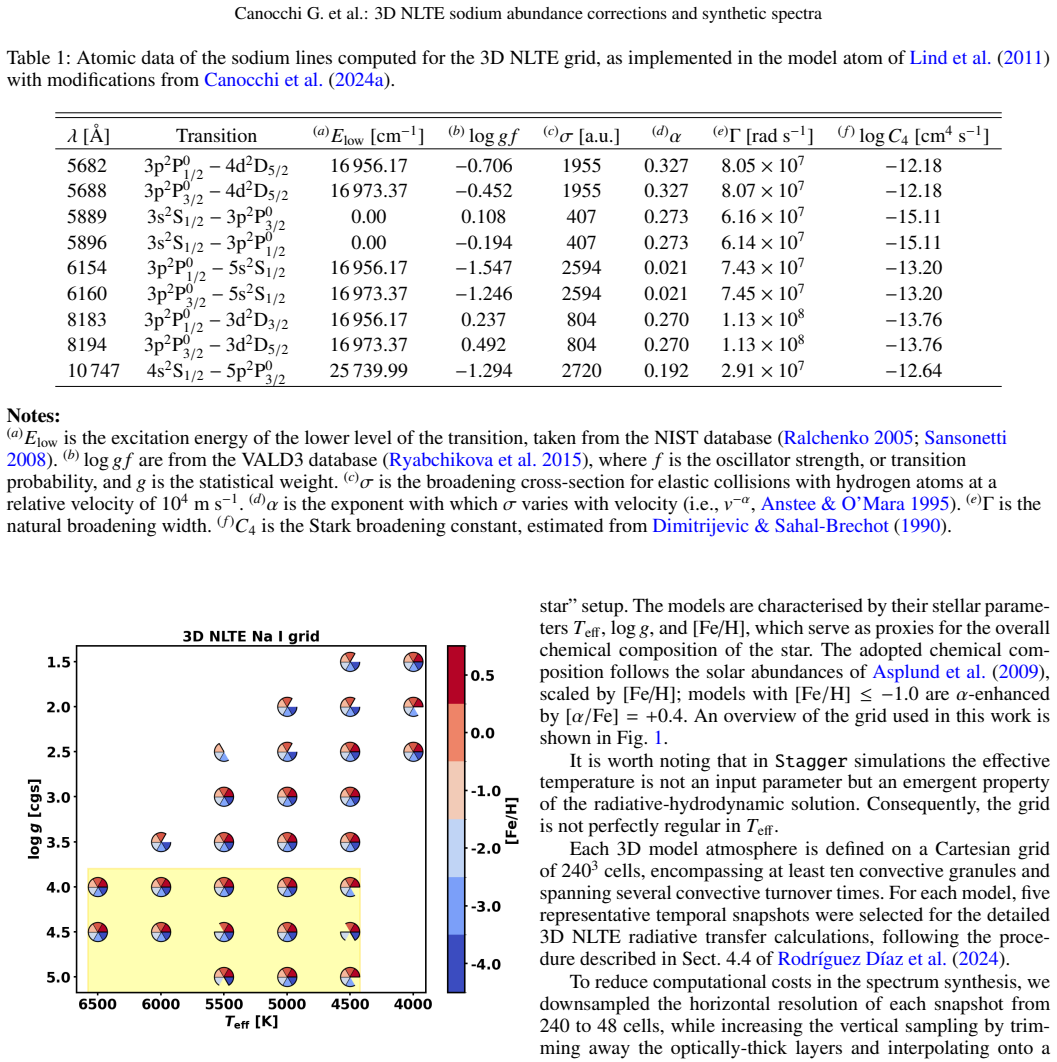
Neutral sodium is an important tracer of the Galactic chemical evolution, a powerful diagnostic of different stellar populations, and the subject of detailed studies of exoplanet atmospheres via transmission spectroscopy. This work aims to study and quantify the errors in stellar analyses of Na I lines caused by the use of one-dimensional (1D) hydrostatic model atmospheres and the assumption of local thermodynamic equilibrium (LTE). We studied the line formation of nine Na I lines in FGK dwarfs and giants via, for the first time, 3D non-LTE (NLTE) radiative transfer post-processing with the code Balder on 3D radiation hydrodynamic stellar atmospheres from the Stagger grid spanning Teff= 4000 to 6500 K, log g = 1.5 to 5.0, and [Fe/H]=-4 to +0.5. We find that the 3D NLTE abundance corrections relative to 1D LTE tend to be negative, and more positive than the corresponding 1D NLTE corrections. This reflects more efficient overionisation in the steeper temperature gradient of the 3D models. The corrections are typically less severe than -0.1 dex for weak lines, but become much larger for saturated lines in low-gravity giants (log g < 2.0), even reaching -0.7 dex. However, for the D resonance lines, the 3D NLTE corrections relative to 1D LTE become slightly positive at the lowest metallicities in our grid, typically around +0.05 dex at [Fe/H]=-4. We make our 3D NLTE grid, together with interpolation routines based on radial basis functions and fully connected feedforward neural networks, publicly available. This will enable more accurate determination of sodium abundances in present and forthcoming stellar spectroscopic surveys, particularly for metal-poor stars, as well as a better characterisation of the Na I D lines in exoplanet atmospheres.
Editorial analysis
A structured set of objections, weighed in public.
Referee Report
Summary. The manuscript presents the first 3D NLTE radiative-transfer calculations for nine Na I lines in FGK dwarfs and giants, performed with the Balder code on Stagger-grid 3D radiation-hydrodynamic models (Teff 4000–6500 K, log g 1.5–5.0, [Fe/H] −4 to +0.5). It reports that 3D NLTE abundance corrections relative to 1D LTE are generally negative but systematically more positive than the corresponding 1D NLTE corrections, with values typically < −0.1 dex for weak lines and reaching −0.7 dex for saturated lines in low-gravity giants; the D resonance lines show slightly positive corrections (~+0.05 dex) at the lowest metallicities. A public grid of corrections together with radial-basis-function and neural-network interpolation routines is released.
Significance. If the computed corrections hold, the work supplies a practical and publicly accessible improvement to sodium abundance determinations that are central to Galactic chemical-evolution studies, stellar-population diagnostics, and exoplanet transmission spectroscopy. The release of the full grid and ready-to-use interpolation tools is a clear strength that directly enhances reproducibility and usability across ongoing and future spectroscopic surveys.
major comments (1)
- [Abstract and results/discussion] The central interpretive claim (abstract and results section) that the 3D NLTE corrections are more positive than 1D NLTE corrections because of “more efficient overionisation in the steeper temperature gradient of the 3D models” is not accompanied by any explicit comparison of horizontally averaged T(τ) profiles, departure coefficients, or ionization balances between the 3D and 1D structures at the optical depths where the nine Na I lines form. Without such a demonstration the proposed mechanism remains an assertion rather than a demonstrated result; a figure or table showing these quantities at line-formation depths should be added.
Simulated Author's Rebuttal
We thank the referee for the constructive review and the recommendation of minor revision. We address the single major comment below and will incorporate the requested demonstration in the revised version of the manuscript.
read point-by-point responses
-
Referee: [Abstract and results/discussion] The central interpretive claim (abstract and results section) that the 3D NLTE corrections are more positive than 1D NLTE corrections because of “more efficient overionisation in the steeper temperature gradient of the 3D models” is not accompanied by any explicit comparison of horizontally averaged T(τ) profiles, departure coefficients, or ionization balances between the 3D and 1D structures at the optical depths where the nine Na I lines form. Without such a demonstration the proposed mechanism remains an assertion rather than a demonstrated result; a figure or table showing these quantities at line-formation depths should be added.
Authors: We agree that an explicit comparison of the 3D and 1D temperature structures and Na I departure coefficients at line-formation depths would strengthen the physical interpretation. In the revised manuscript we will add a new figure (or expanded panel) that shows, for representative models spanning the grid (e.g., a metal-poor giant and a solar-metallicity dwarf), the horizontally averaged T(τ) profiles from the Stagger 3D models versus the corresponding 1D hydrostatic models, together with the departure coefficients b_i for the relevant Na I levels at the optical depths where the nine lines form. This will directly illustrate the steeper temperature gradient and its impact on over-ionisation. revision: yes
Circularity Check
No significant circularity; direct computation on independent models
full rationale
The paper computes 3D NLTE abundance corrections via direct radiative transfer post-processing of Stagger-grid 3D radiation-hydrodynamic atmospheres using the Balder code. No parameters are fitted to the target Na I line data, no self-definitional loops appear in the equations, and no load-bearing claims reduce to self-citations or prior ansatzes by the same authors. The reported corrections and the overionisation interpretation follow from the numerical solution on the supplied 3D structures; the derivation chain is therefore self-contained against external benchmarks.
Axiom & Free-Parameter Ledger
axioms (2)
- domain assumption Stagger-grid 3D radiation-hydrodynamic models accurately represent the temperature and velocity fields in late-type stellar atmospheres
- domain assumption The Balder code correctly computes NLTE line formation for Na I transitions
Lean theorems connected to this paper
-
IndisputableMonolith/Foundation/RealityFromDistinction.leanreality_from_one_distinction unclear?
unclearRelation between the paper passage and the cited Recognition theorem.
We studied the line formation of nine Na I lines in FGK dwarfs and giants via, for the first time, 3D non-LTE (NLTE) radiative transfer post-processing with the code Balder on 3D radiation hydrodynamic stellar atmospheres from the Stagger grid
-
IndisputableMonolith/Cost/FunctionalEquation.leanwashburn_uniqueness_aczel unclear?
unclearRelation between the paper passage and the cited Recognition theorem.
The corrections are typically less severe than -0.1 dex for weak lines, but become much larger for saturated lines in low-gravity giants (log g < 2.0), even reaching -0.7 dex.
What do these tags mean?
- matches
- The paper's claim is directly supported by a theorem in the formal canon.
- supports
- The theorem supports part of the paper's argument, but the paper may add assumptions or extra steps.
- extends
- The paper goes beyond the formal theorem; the theorem is a base layer rather than the whole result.
- uses
- The paper appears to rely on the theorem as machinery.
- contradicts
- The paper's claim conflicts with a theorem or certificate in the canon.
- unclear
- Pith found a possible connection, but the passage is too broad, indirect, or ambiguous to say the theorem truly supports the claim.
Reference graph
Works this paper leans on
-
[1]
Amarsi, A. M. 2015, MNRAS, 452, 1612
work page 2015
-
[2]
M., Liljegren, S., & Nissen, P
Amarsi, A. M., Liljegren, S., & Nissen, P. E. 2022, A&A, 668, A68
work page 2022
-
[3]
M., Lind, K., Osorio, Y ., et al
Amarsi, A. M., Lind, K., Osorio, Y ., et al. 2020, A&A, 642, A62
work page 2020
- [4]
-
[5]
M., Nordlander, T., Barklem, P
Amarsi, A. M., Nordlander, T., Barklem, P. S., et al. 2018, A&A, 615, A139
work page 2018
-
[6]
Andrievsky, S. M., Spite, M., Korotin, S. A., et al. 2007, A&A, 464, 1081
work page 2007
-
[7]
Anstee, S. D. & O’Mara, B. J. 1995, MNRAS, 276, 859
work page 1995
- [8]
-
[9]
Asplund, M., Grevesse, N., Sauval, A. J., & Scott, P. 2009, ARA&A, 47, 481
work page 2009
-
[10]
Athay, R. G. & Canfield, R. C. 1969, ApJ, 156, 695
work page 1969
-
[11]
Barklem, P. S., Belyaev, A. K., Dickinson, A. S., & Gadéa, F. X. 2010, A&A, 519, A20
work page 2010
- [12]
-
[13]
Belyaev, A. K., Barklem, P. S., Dickinson, A. S., & Gadéa, F. X. 2010, Phys. Rev. A, 81, 032706
work page 2010
- [14]
-
[15]
Bensby, T., Feltzing, S., & Oey, M. S. 2014, A&A, 562, A71 Bertran de Lis, S., Allende Prieto, C., Ludwig, H. G., & Koesterke, L. 2022, A&A, 661, A76 Böhm-Vitense, E. 1958, ZAp, 46, 108
work page 2014
-
[16]
Botnen, A. & Carlsson, M. 1999, in Astrophysics and Space Science Library, V ol. 240, Numerical Astrophysics, ed. S. M. Miyama, K. Tomisaka, & T. Hanawa, 379
work page 1999
- [17]
- [18]
- [19]
-
[20]
Cameron, A. G. W. 1959, ApJ, 130, 429
work page 1959
-
[21]
Carlos, M., Amarsi, A. M., Nissen, P. E., & Canocchi, G. 2025, A&A, 700, A127
work page 2025
-
[22]
1992, in Astronomical Society of the Pacific Conference Series, V ol
Carlsson, M. 1992, in Astronomical Society of the Pacific Conference Series, V ol. 26, Cool Stars, Stellar Systems, and the Sun, ed. M. S. Giampapa & J. A. Bookbinder, 499
work page 1992
-
[23]
Carretta, E., Bragaglia, A., Gratton, R., & Lucatello, S. 2009, A&A, 505, 139
work page 2009
-
[24]
2011, in Journal of Physics Conference
Collet, R., Magic, Z., & Asplund, M. 2011, in Journal of Physics Conference
work page 2011
-
[25]
Cunto, W. & Mendoza, C. 1992, Rev. Mexicana Astron. Astrofis., 23, 107 de Mink, S. E., Pols, O. R., Langer, N., & Izzard, R. G. 2009, A&A, 507, L1 De Silva, G. M., Freeman, K. C., Bland-Hawthorn, J., et al. 2015, MNRAS, 449, 2604
work page 1992
-
[26]
Decressin, T., Meynet, G., Charbonnel, C., Prantzos, N., & Ekström, S. 2007, A&A, 464, 1029
work page 2007
-
[27]
Denisenkov, P. A. & Denisenkova, S. N. 1990, Soviet Astronomy Letters, 16, 275
work page 1990
-
[28]
Dimitrijevic, M. S. & Sahal-Brechot, S. 1990, J. Quant. Spectr. Rad. Transf., 44, 421
work page 1990
- [29]
-
[30]
Dravins, D., Ludwig, H.-G., & Freytag, B. 2021, A&A, 649, A16 El Eid, M. F. & Champagne, A. E. 1995, ApJ, 451, 298
work page 2021
-
[31]
Galsgaard, K. & Nordlund, A. 1995, A 3D MHD Code for Parallel Computers
work page 1995
-
[32]
Gao, X., Han, X.-Y ., V oky, L., Feautrier, N., & Li, J.-M. 2010, Phys. Rev. A, 81, 022703
work page 2010
- [33]
-
[34]
G., Bonifacio, P., Bragaglia, A., et al
Gratton, R. G., Bonifacio, P., Bragaglia, A., et al. 2001, A&A, 369, 87
work page 2001
-
[35]
G., Carretta, E., & Bragaglia, A
Gratton, R. G., Carretta, E., & Bragaglia, A. 2012, A&A Rev., 20, 50
work page 2012
-
[36]
G., Carretta, E., Eriksson, K., & Gustafsson, B
Gratton, R. G., Carretta, E., Eriksson, K., & Gustafsson, B. 1999, A&A, 350, 955
work page 1999
-
[37]
G., Lucatello, S., Carretta, E., et al
Gratton, R. G., Lucatello, S., Carretta, E., et al. 2011, A&A, 534, A123
work page 2011
-
[38]
Grevesse, N., Asplund, M., & Sauval, A. J. 2007, Space Sci. Rev., 130, 105
work page 2007
-
[39]
Gustafsson, B., Edvardsson, B., Eriksson, K., et al. 2008, A&A, 486, 951
work page 2008
-
[40]
Heiter, U., Jofré, P., Gustafsson, B., et al. 2015, A&A, 582, A49
work page 2015
-
[41]
Hinton, G. E. 1990, Artificial Intelligence, 46, 47
work page 1990
-
[42]
2008, Atomic Data and Nuclear Data Tables, 94, 981
Igenbergs, K., Schweinzer, J., Bray, I., Bridi, D., & Aumayr, F. 2008, Atomic Data and Nuclear Data Tables, 94, 981
work page 2008
-
[43]
2013, An Introduction to Sta- tistical Learning: with Applications in R, corrected edition edn
James, G., Witten, D., Hastie, T., & Tibshirani, R. 2013, An Introduction to Sta- tistical Learning: with Applications in R, corrected edition edn. (New York: Springer)
work page 2013
-
[44]
Johnson, H. R. 1964, Annales d’Astrophysique, 27, 695
work page 1964
-
[45]
Karakas, A. I. 2010, MNRAS, 403, 1413
work page 2010
-
[46]
Karovicova, I., White, T. R., Nordlander, T., et al. 2020, A&A, 640, A25
work page 2020
- [47]
- [48]
-
[49]
Lagae, C., Amarsi, A. M., Rodríguez Díaz, L. F., et al. 2023, A&A, 672, A90
work page 2023
-
[50]
Leenaarts, J. & Carlsson, M. 2009, in Astronomical Society of the Pacific Conference Series, V ol. 415, The Second Hinode Science Meeting: Be- yond Discovery-Toward Understanding, ed. B. Lites, M. Cheung, T. Magara, J. Mariska, & K. Reeves, 87
work page 2009
- [51]
-
[52]
Lind, K., Asplund, M., Barklem, P. S., & Belyaev, A. K. 2011, A&A, 528, A103
work page 2011
-
[53]
Lind, K., Melendez, J., Asplund, M., Collet, R., & Magic, Z. 2013, A&A, 554, A96
work page 2013
-
[54]
Lind, K., Nordlander, T., Wehrhahn, A., et al. 2022, A&A, 665, A33
work page 2022
-
[55]
Loaiza-Tacuri, V ., Cunha, K., Souto, D., et al. 2023, MNRAS, 526, 2378
work page 2023
- [56]
-
[57]
Marino, A. F., Villanova, S., Milone, A. P., et al. 2011, ApJ, 730, L16
work page 2011
-
[58]
Mashonkina, L., Pakhomov, Y ., Sitnova, T., et al. 2023, MNRAS, 524, 3526
work page 2023
-
[59]
Mashonkina, L. I., Shimanski ˘i, V . V ., & Sakhibullin, N. A. 2000, Astronomy Reports, 44, 790
work page 2000
-
[60]
Matsuno, T., Amarsi, A. M., Carlos, M., & Nissen, P. E. 2024, A&A, 688, A72
work page 2024
- [61]
- [62]
-
[63]
Milone, A. P. & Marino, A. F. 2022, Universe, 8, 359
work page 2022
- [64]
-
[65]
Nissen, P. E., Amarsi, A. M., Skúladóttir, Á., & Schuster, W. J. 2024, A&A, 682, A116
work page 2024
-
[66]
Nordlander, T., Amarsi, A. M., Lind, K., et al. 2017, A&A, 597, A6
work page 2017
-
[67]
Owusu, E. K., Buder, S., Ruiter, A. J., Seitenzahl, I. R., & Rodriguez-Segovia, N. 2024, PASA, 41, e092
work page 2024
-
[68]
2011, Journal of Machine Learning Research, 12, 2825
Pedregosa, F., Varoquaux, G., Gramfort, A., et al. 2011, Journal of Machine Learning Research, 12, 2825
work page 2011
-
[69]
2021, A&A, 645, A96 Prša, A., Harmanec, P., Torres, G., et al
Pepe, F., Cristiani, S., Rebolo, R., et al. 2021, A&A, 645, A96 Prša, A., Harmanec, P., Torres, G., et al. 2016, AJ, 152, 41
work page 2021
-
[70]
L., D’Antona, F., & Ventura, P
Pumo, M. L., D’Antona, F., & Ventura, P. 2008, ApJ, 672, L25
work page 2008
-
[71]
2005, Memorie della Societa Astronomica Italiana Supplementi, 8, 96
Ralchenko, Y . 2005, Memorie della Societa Astronomica Italiana Supplementi, 8, 96
work page 2005
-
[72]
2014, Experimental Astronomy, 38, 249 Rodríguez Díaz, L
Rauer, H., Catala, C., Aerts, C., et al. 2014, Experimental Astronomy, 38, 249 Rodríguez Díaz, L. F., Lagae, C., Amarsi, A. M., et al. 2024, A&A, 688, A212
work page 2014
-
[73]
Ruiter, A. J., Belczynski, K., Sim, S. A., et al. 2011, MNRAS, 417, 408
work page 2011
-
[74]
Rutten, R. J. 2003, Radiative Transfer in Stellar Atmospheres
work page 2003
- [75]
-
[76]
Salpeter, E. E. 1952, ApJ, 115, 326
work page 1952
-
[77]
Sansonetti, J. E. 2008, Journal of Physical and Chemical Reference Data, 37, 1659
work page 2008
-
[78]
Scharmer, G. B., Bjelksjo, K., Korhonen, T. K., Lindberg, B., & Petterson, B. 2003, in Society of Photo-Optical Instrumentation Engineers (SPIE) Confer- ence Series, V ol. 4853, Innovative Telescopes and Instrumentation for Solar Astrophysics, ed. S. L. Keil & S. V . Avakyan, 341–350
work page 2003
- [79]
-
[80]
F., Nordlund, Å., Collet, R., & Trampedach, R
Stein, R. F., Nordlund, Å., Collet, R., & Trampedach, R. 2024, ApJ, 970, 24
work page 2024
discussion (0)
Sign in with ORCID, Apple, or X to comment. Anyone can read and Pith papers without signing in.