Impurity quadrupole moments as local probes of flux sectors in the Kitaev spin liquid
Pith reviewed 2026-05-15 00:39 UTC · model grok-4.3
The pith
The quadrupole moment of magnetic impurities jumps discontinuously at flux sector transitions in the Kitaev spin liquid.
A machine-rendered reading of the paper's core claim, the machinery that carries it, and where it could break.
Core claim
In the isotropic Kitaev spin liquid the quadrupole moment of an impurity spin-3/2, obtained from the SO(6) Majorana representation and treated in self-consistent mean-field theory, exhibits discontinuous jumps precisely at the magnetic-field values that separate different ground-state flux sectors. These jumps identify the flux sector. Quadrupole correlations between distant impurities decay exponentially under an applied field, with the decay length sensitive to the sector. The stability of impurity-bound pi fluxes is examined across parameter ranges and is found consistent with Lieb's conjecture.
What carries the argument
The impurity quadrupole moment computed from the SO(6) Majorana representation of spin-3/2 operators inside a self-consistent mean-field approximation for the impurity-Kitaev couplings.
If this is right
- Discontinuous jumps in the impurity quadrupole moment identify the ground-state flux sector at the transition points.
- Quadrupole correlations between impurities decay exponentially under magnetic field, with the decay rate depending on the flux sector.
- Pi fluxes bound to impurities remain stable for a range of model parameters and internal flux configurations.
- The results are consistent with Lieb's conjecture on the preferred flux configurations.
Where Pith is reading between the lines
- Experimental detection of the jumps in doped Kitaev materials would provide a local probe of flux sectors under varying magnetic fields.
- The same quadrupole response could be examined in other quantum spin liquids that host emergent fluxes.
- Placing multiple impurities might allow spatial mapping of flux configurations in finite systems.
Load-bearing premise
The self-consistent mean-field treatment of the impurity terms together with the SO(6) Majorana representation must faithfully capture the quadrupole response across the flux transitions.
What would settle it
A direct measurement or exact calculation that finds continuous variation of the impurity quadrupole moment through the magnetic-field values where flux-sector transitions are expected would show that the jumps do not identify the sectors.
Figures




read the original abstract
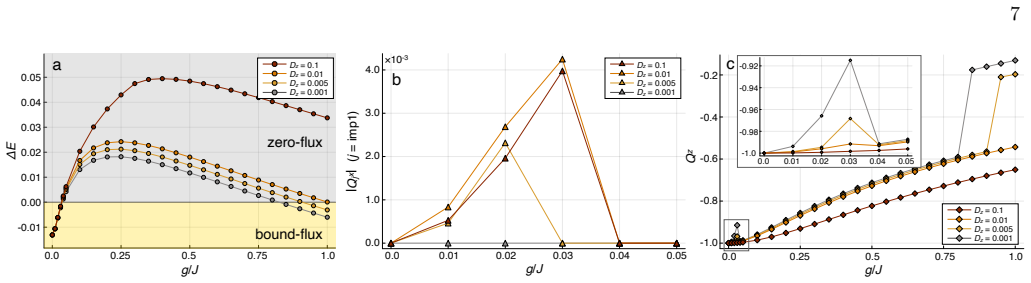
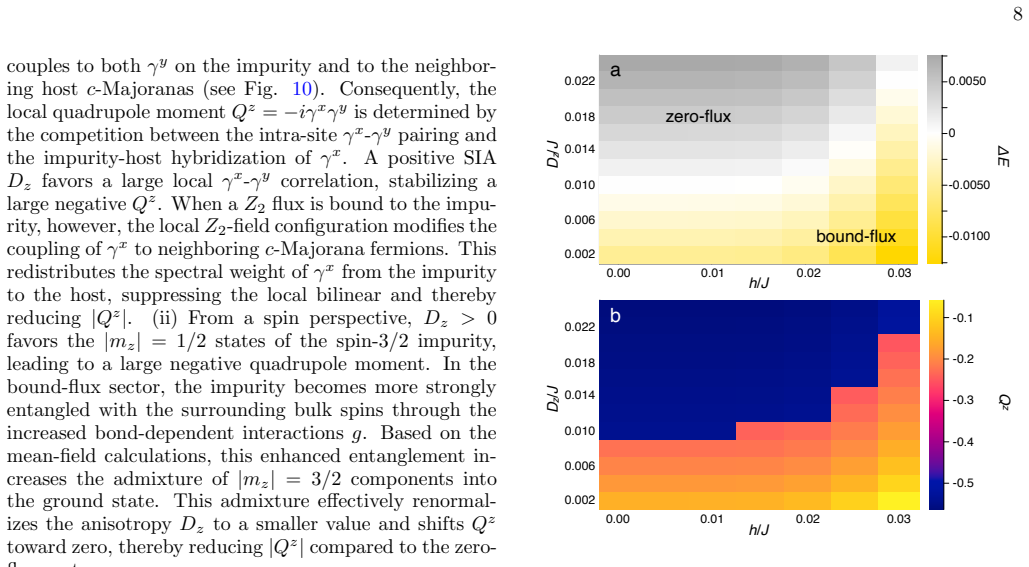
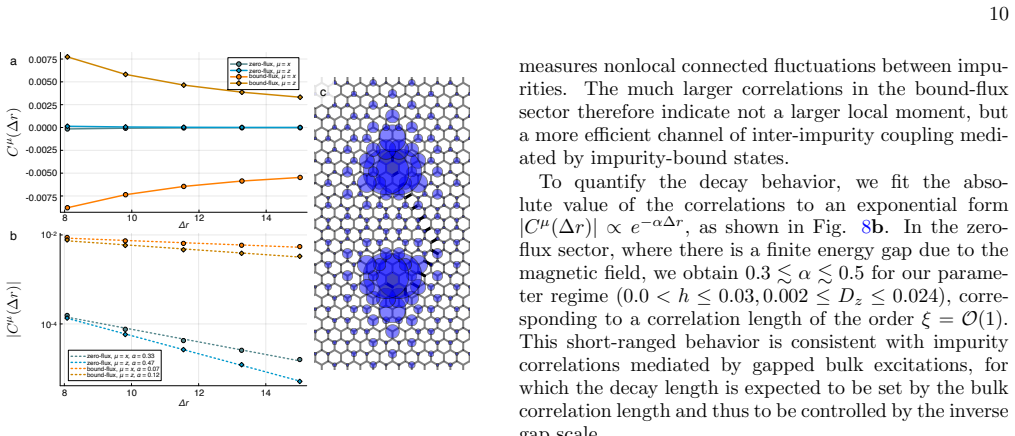
Emergent fluxes play a central role in the low-energy properties of quantum spin liquids (QSLs), where they encode the underlying gauge structure and fractionalization of spins. Here, we show that the quadrupole moment of magnetic impurities provides a direct probe of these flux configurations in QSLs. Employing the SO(6) Majorana representation for spin-3/2 impurity operators in the isotropic Kitaev spin liquid together with a self-consistent mean-field approximation for impurity-related terms, we show that the ground-state flux sector can be identified by discontinuous jumps of the impurity quadrupole moment at the flux sector transition points. We also demonstrate that the quadrupole correlations between impurities under a magnetic field exhibit exponential decay, with decay rates that depend sensitively on the flux sector. Furthermore, we discuss the stability of pi fluxes bound to impurities with respect to model parameters and internal flux configurations, and relate our findings to Lieb's conjecture on flux configurations. These results establish the quadrupole moments of magnetic impurities as a sensitive tool to study fractionalized excitations and flux physics in Kitaev magnets.
Editorial analysis
A structured set of objections, weighed in public.
Referee Report
Summary. The paper claims that the quadrupole moment of spin-3/2 magnetic impurities serves as a local probe of flux sectors in the isotropic Kitaev spin liquid. Using the SO(6) Majorana representation for the impurity operators together with a self-consistent mean-field approximation for all impurity-related bilinear and quartic terms, the authors report that the ground-state flux sector is identified by discontinuous jumps in the impurity quadrupole moment precisely at the flux-sector transition points. They further show that quadrupole correlations between impurities decay exponentially under a magnetic field, with decay lengths that depend on the flux sector, and discuss the stability of impurity-bound pi fluxes in relation to Lieb's conjecture.
Significance. If the reported discontinuities survive beyond mean-field, the work would supply a concrete, experimentally accessible local observable for distinguishing flux sectors in Kitaev quantum spin liquids, complementing global probes such as specific heat or neutron scattering. The explicit connection drawn to Lieb's conjecture on minimal-flux configurations adds theoretical interest. The absence of any benchmark against exact diagonalization or DMRG, however, leaves the quantitative reliability of the jumps untested.
major comments (3)
- [Methods (SO(6) Majorana representation and self-consistent mean-field decoupling)] The central claim of discontinuous jumps in the quadrupole moment at flux-sector transitions rests entirely on the self-consistent mean-field decoupling of impurity bilinears and quartics. Because the quadrupole operator is itself bilinear in the impurity Majoranas, any mean-field error in the ground-state flux parity directly maps into the reported discontinuity. No comparison to exact methods on finite clusters is presented to quantify how much the transition points or jump sizes are shifted or rounded by the approximation.
- [Results (quadrupole-moment versus flux-sector plots)] The manuscript supplies no numerical values, error bars, or convergence checks for the self-consistent mean-field parameters. Without these, it is impossible to assess whether the observed jumps remain sharp once the mean-field ansatz is relaxed or when gauge fluctuations are restored.
- [Discussion (Lieb's conjecture and pi-flux stability)] The discussion of pi-flux stability and its relation to Lieb's conjecture is presented only within the mean-field spectrum. A direct test of whether the mean-field ground-state flux configuration coincides with the exact minimal-flux sector for the same parameters would be required to substantiate the claimed connection.
minor comments (2)
- The abstract states that results are 'qualitative'; the main text should include at least one table or figure with explicit numerical values of the quadrupole moment on either side of a transition point.
- [Methods] Notation for the impurity quadrupole operator and its decomposition into Majorana bilinears should be collected in a single equation early in the methods section for easy reference.
Simulated Author's Rebuttal
We thank the referee for the careful reading and constructive comments on our manuscript. The points raised highlight important aspects of the mean-field approximation and its limitations. We address each major comment below and have revised the manuscript accordingly to improve transparency and add relevant discussions.
read point-by-point responses
-
Referee: [Methods (SO(6) Majorana representation and self-consistent mean-field decoupling)] The central claim of discontinuous jumps in the quadrupole moment at flux-sector transitions rests entirely on the self-consistent mean-field decoupling of impurity bilinears and quartics. Because the quadrupole operator is itself bilinear in the impurity Majoranas, any mean-field error in the ground-state flux parity directly maps into the reported discontinuity. No comparison to exact methods on finite clusters is presented to quantify how much the transition points or jump sizes are shifted or rounded by the approximation.
Authors: We acknowledge that the mean-field decoupling is central to our results and that direct benchmarks against exact diagonalization or DMRG would be valuable for quantifying any shifts in transition points. However, embedding a spin-3/2 impurity in the Kitaev lattice and treating the full flux dynamics exactly on clusters large enough to resolve distinct flux sectors is computationally prohibitive with current methods. In the revised manuscript we have added a dedicated paragraph discussing the limitations of the approximation, citing prior validations of similar mean-field treatments in the pure Kitaev model where flux gaps and correlation functions agree qualitatively with exact results. We maintain that the reported discontinuities are robust signatures within the controlled mean-field framework employed. revision: partial
-
Referee: [Results (quadrupole-moment versus flux-sector plots)] The manuscript supplies no numerical values, error bars, or convergence checks for the self-consistent mean-field parameters. Without these, it is impossible to assess whether the observed jumps remain sharp once the mean-field ansatz is relaxed or when gauge fluctuations are restored.
Authors: We have revised the manuscript to include explicit tables listing the converged values of all self-consistent mean-field parameters (bilinear and quartic channels) for each flux sector considered. We also report the convergence tolerance (typically 10^{-8} on the order parameters), the number of iterations required, and the final residual norm. Because the procedure is deterministic, statistical error bars do not apply; the provided convergence data allow readers to judge the stability of the solutions and the sharpness of the jumps. revision: yes
-
Referee: [Discussion (Lieb's conjecture and pi-flux stability)] The discussion of pi-flux stability and its relation to Lieb's conjecture is presented only within the mean-field spectrum. A direct test of whether the mean-field ground-state flux configuration coincides with the exact minimal-flux sector for the same parameters would be required to substantiate the claimed connection.
Authors: We agree that an exact confirmation would be desirable. Lieb's conjecture itself is most often examined variationally or within mean-field treatments of flux energetics. Our self-consistent solution selects the minimal-flux configuration consistent with the conjecture for the parameter range studied. In the revision we have clarified that the agreement is obtained within the mean-field spectrum and added an explicit statement that quantitative verification against exact methods remains an open direction for future work. revision: partial
Circularity Check
No circularity: quadrupole moment computed from independent Majorana representation and mean-field solution
full rationale
The paper derives the impurity quadrupole moment from the SO(6) Majorana representation of spin-3/2 operators inserted into the Kitaev Hamiltonian, then applies a self-consistent mean-field decoupling to obtain the spectrum. The reported discontinuous jumps at flux-sector transitions emerge as an output of this calculation rather than being imposed by definition or by fitting parameters to the target flux parity. No self-citation chain, ansatz smuggling, or renaming of known results is used to justify the central claim; the flux sectors remain exactly labeled by the plaquette operators W_p while the quadrupole is a derived bilinear observable. The derivation is therefore self-contained against the standard Kitaev model and does not reduce to its own inputs.
Axiom & Free-Parameter Ledger
free parameters (1)
- self-consistent mean-field parameters
axioms (1)
- domain assumption SO(6) Majorana representation for spin-3/2 impurity operators
Lean theorems connected to this paper
-
IndisputableMonolith/Cost/FunctionalEquation.leanwashburn_uniqueness_aczel (J-cost uniqueness) unclear?
unclearRelation between the paper passage and the cited Recognition theorem.
Employing the SO(6) Majorana representation for spin-3/2 impurity operators together with a self-consistent mean-field approximation for impurity-related terms, we show that the ground-state flux sector can be identified by discontinuous jumps of the impurity quadrupole moment at the flux sector transition points.
-
IndisputableMonolith/Foundation/AlexanderDuality.leanalexander_duality_circle_linking (D=3 forcing) unclear?
unclearRelation between the paper passage and the cited Recognition theorem.
the quadrupole correlations between impurities under a magnetic field exhibit exponential decay, with decay rates that depend sensitively on the flux sector... relate our findings to Lieb’s conjecture on flux configurations
What do these tags mean?
- matches
- The paper's claim is directly supported by a theorem in the formal canon.
- supports
- The theorem supports part of the paper's argument, but the paper may add assumptions or extra steps.
- extends
- The paper goes beyond the formal theorem; the theorem is a base layer rather than the whole result.
- uses
- The paper appears to rely on the theorem as machinery.
- contradicts
- The paper's claim conflicts with a theorem or certificate in the canon.
- unclear
- Pith found a possible connection, but the passage is too broad, indirect, or ambiguous to say the theorem truly supports the claim.
Reference graph
Works this paper leans on
-
[1]
Since the flux operators commute both with the total Hamiltonian and mutually, [ˆWp, ˆHtotal] = [ ˆWp, ˆWp′] = 0, their eigenvalues are conserved quantities taking values ±1. For spin-1/2 operators, the identity ˆRαj j =−2iS αj j al- lows us to rewrite the flux operator ˆWp in the more fa- miliar form: ˆWp = 26 ˆSx j1 ˆSy j2 ˆSz j3 ˆSx j4 ˆSy j5 ˆSz j6 .(...
- [2]
- [3]
-
[4]
L. Savary and L. Balents, Reports on Progress in Physics 80, 016502 (2016)
work page 2016
-
[5]
C. Broholm, R. J. Cava, S. A. Kivel- son, D. G. Nocera, M. R. Norman, and T. Senthil, Science367, eaay0668 (2020), https://www.science.org/doi/pdf/10.1126/science.aay0668
- [6]
-
[7]
X. G. Wen, Phys. Rev. B44, 2664 (1991). 14
work page 1991
-
[8]
A. J. Willans, J. T. Chalker, and R. Moessner, Phys. Rev. Lett.104, 237203 (2010)
work page 2010
-
[9]
A. J. Willans, J. T. Chalker, and R. Moessner, Phys. Rev. B84, 115146 (2011)
work page 2011
-
[10]
S. G., V. Sreenath, A. Lakshminarayan, and R. Narayanan, Phys. Rev. B85, 054204 (2012)
work page 2012
- [11]
-
[12]
W.-H. Kao, J. Knolle, G. B. Hal´ asz, R. Moessner, and N. B. Perkins, Phys. Rev. X11, 011034 (2021)
work page 2021
- [13]
- [14]
- [15]
-
[16]
M. O. Takahashi, M. G. Yamada, M. Udagawa, T. Mizushima, and S. Fujimoto, Phys. Rev. Lett.131, 236701 (2023)
work page 2023
-
[17]
W.-H. Kao, G. B. Hal´ asz, and N. B. Perkins, Phys. Rev. B109, 125150 (2024)
work page 2024
-
[18]
W.-H. Kao, N. B. Perkins, and G. B. Hal´ asz, Phys. Rev. Lett.132, 136503 (2024)
work page 2024
- [19]
-
[20]
B. Xiao, G. Alvarez, and G. B. Hal´ asz, Phys. Rev. Lett. 135, 096603 (2025)
work page 2025
- [21]
- [22]
-
[23]
G. Cassella, P. d’Ornellas, T. Hodson, W. M. H. Natori, and J. Knolle, Nature Communications14, 6663 (2023)
work page 2023
-
[24]
A. G. Grushin and C. Repellin, Phys. Rev. Lett.130, 186702 (2023)
work page 2023
-
[25]
K. Dhochak, R. Shankar, and V. Tripathi, Phys. Rev. Lett.105, 117201 (2010)
work page 2010
-
[26]
S. D. Das, K. Dhochak, and V. Tripathi, Phys. Rev. B 94, 024411 (2016)
work page 2016
- [27]
- [28]
-
[29]
M. O. Takahashi, W.-H. Kao, S. Fujimoto, and N. B. Perkins, npj Quantum Materials10, 14 (2025)
work page 2025
- [30]
- [31]
-
[32]
A. Seth, F. Borhani, and I. Kimchi, arXiv preprint (2025), 2511.19409
work page internal anchor Pith review Pith/arXiv arXiv 2025
-
[33]
A. Seth, F. Borhani, and I. Kimchi, arXiv preprint (2025), 2512.13490
work page internal anchor Pith review Pith/arXiv arXiv 2025
-
[34]
G. Baskaran, S. Mandal, and R. Shankar, Phys. Rev. Lett.98, 247201 (2007)
work page 2007
- [35]
-
[36]
M. Punk, D. Chowdhury, and S. Sachdev, Nature Physics 10, 289 (2014)
work page 2014
- [37]
- [38]
-
[39]
J. Yoshitake, J. Nasu, and Y. Motome, Phys. Rev. Lett. 117, 157203 (2016)
work page 2016
- [40]
- [41]
- [42]
- [43]
-
[44]
K. Wang, S. Feng, P. Zhu, R. Chi, H.-J. Liao, N. Trivedi, and T. Xiang, Phys. Rev. B111, L100402 (2025)
work page 2025
-
[45]
V. Por´ ee, H. Yan, F. Desrochers, S. Petit, E. Lhotel, M. Appel, J. Ollivier, Y. B. Kim, A. H. Nevidomskyy, and R. Sibille, Nature Physics21, 83 (2025)
work page 2025
-
[46]
A. Kolezhuk, S. Sachdev, R. R. Biswas, and P. Chen, Phys. Rev. B74, 165114 (2006)
work page 2006
- [47]
- [48]
- [49]
-
[50]
E. H. Lieb, Helv. Phys. Acta65(1992)
work page 1992
-
[51]
E. H. Lieb and M. Loss, Duke Math. J.71, 337 (1993), arXiv:cond-mat/9209031
work page internal anchor Pith review Pith/arXiv arXiv 1993
-
[52]
E. H. Lieb, Phys. Rev. Lett.73, 2158 (1994)
work page 1994
-
[53]
P. P. Stavropoulos, X. Liu, and H.-Y. Kee, Phys. Rev. Res.3, 013216 (2021)
work page 2021
-
[54]
H.-K. Jin, W. M. H. Natori, F. Pollmann, and J. Knolle, Nature Communications13, 3813 (2022)
work page 2022
-
[55]
W. M. H. Natori, H.-K. Jin, and J. Knolle, Phys. Rev. B 108, 075111 (2023)
work page 2023
-
[56]
W. M. H. Natori, E. C. Andrade, E. Miranda, and R. G. Pereira, Phys. Rev. Lett.117, 017204 (2016)
work page 2016
- [57]
-
[58]
F. L. Pedrocchi, S. Chesi, and D. Loss, Phys. Rev. B84, 165414 (2011)
work page 2011
-
[59]
Nasu, Progress of Theoretical and Experimental Physics2024, 08C104 (2023)
J. Nasu, Progress of Theoretical and Experimental Physics2024, 08C104 (2023)
work page 2023
-
[60]
C. S. de Farias, V. S. de Carvalho, E. Miranda, and R. G. Pereira, Phys. Rev. B102, 075110 (2020)
work page 2020
-
[61]
K. W. Plumb, J. P. Clancy, L. J. Sandilands, V. V. Shankar, Y. F. Hu, K. S. Burch, H.-Y. Kee, and Y.-J. Kim, Phys. Rev. B90, 041112 (2014)
work page 2014
-
[62]
S.-H. Baek, S.-H. Do, K.-Y. Choi, Y. S. Kwon, A. U. B. Wolter, S. Nishimoto, J. van den Brink, and B. B¨ uchner, Phys. Rev. Lett.119, 037201 (2017)
work page 2017
-
[63]
G. Bastien, M. Roslova, M. H. Haghighi, K. Mehlawat, J. Hunger, A. Isaeva, T. Doert, M. Vojta, B. B¨ uchner, and A. U. B. Wolter, Phys. Rev. B99, 214410 (2019)
work page 2019
-
[64]
S. Lee, Y. S. Choi, S.-H. Do, W. Lee, C. H. Lee, M. Lee, M. Vojta, C. N. Wang, H. Luetkens, Z. Guguchia, and K.-Y. Choi, Nature Communications14, 7405 (2023)
work page 2023
-
[65]
R. B. Laughlin, Science242, 525 (1988), https://www.science.org/doi/pdf/10.1126/science.242.4878.525
-
[66]
Y. Hasegawa, P. Lederer, T. M. Rice, and P. B. Wieg- mann, Phys. Rev. Lett.63, 907 (1989)
work page 1989
-
[67]
Y. Iqbal, W.-J. Hu, R. Thomale, D. Poilblanc, and F. Becca, Phys. Rev. B93, 144411 (2016)
work page 2016
-
[68]
J. Willsher and J. Knolle, Dynamics and stability of u(1) spin liquids beyond mean-field theory: Triangular-lattice j1-j2 heisenberg model (2025), arXiv:2503.13831 [cond- mat.str-el]
-
[69]
A. Smerald, H. T. Ueda, and N. Shannon, Phys. Rev. B 91, 174402 (2015). 15
work page 2015
- [70]
-
[71]
Probing Hidden Orders with Resonant Inelastic X-Ray Scattering
L. Savary and T. Senthil, Probing hidden orders with res- onant inelastic x-ray scattering (2015), arXiv:1506.04752 [cond-mat.str-el]
work page internal anchor Pith review Pith/arXiv arXiv 2015
-
[72]
M. Sato, T. Momoi, and A. Furusaki, Phys. Rev. B79, 060406 (2009)
work page 2009
-
[73]
M. Sato, T. Hikihara, and T. Momoi, Phys. Rev. B83, 064405 (2011)
work page 2011
- [74]
- [75]
discussion (0)
Sign in with ORCID, Apple, or X to comment. Anyone can read and Pith papers without signing in.