Generation of chirality and orbital magnetization by Stone-Wales-type lattice defects in the Kitaev spin liquid
Pith reviewed 2026-05-16 22:10 UTC · model grok-4.3
The pith
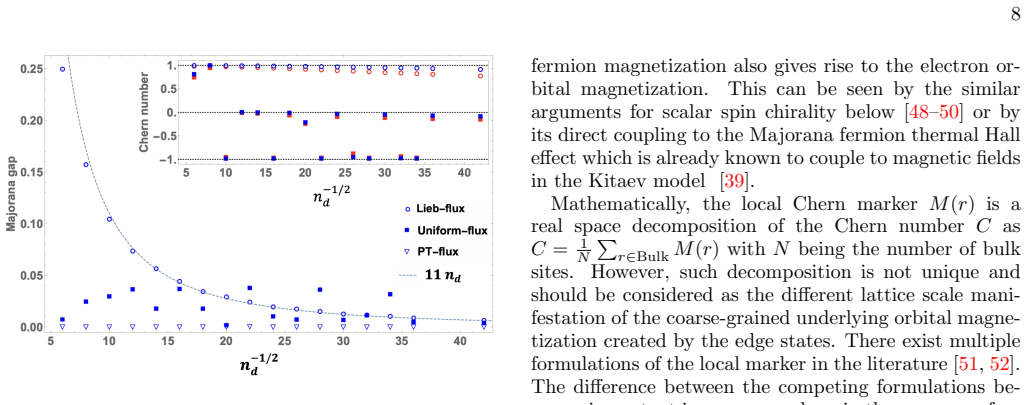
Stone-Wales defects in the Kitaev spin liquid generate chirality that opens a topological gap of 11 times defect density and drives a finite-temperature transition to the chiral spin liquid.
A machine-rendered reading of the paper's core claim, the machinery that carries it, and where it could break.
Core claim
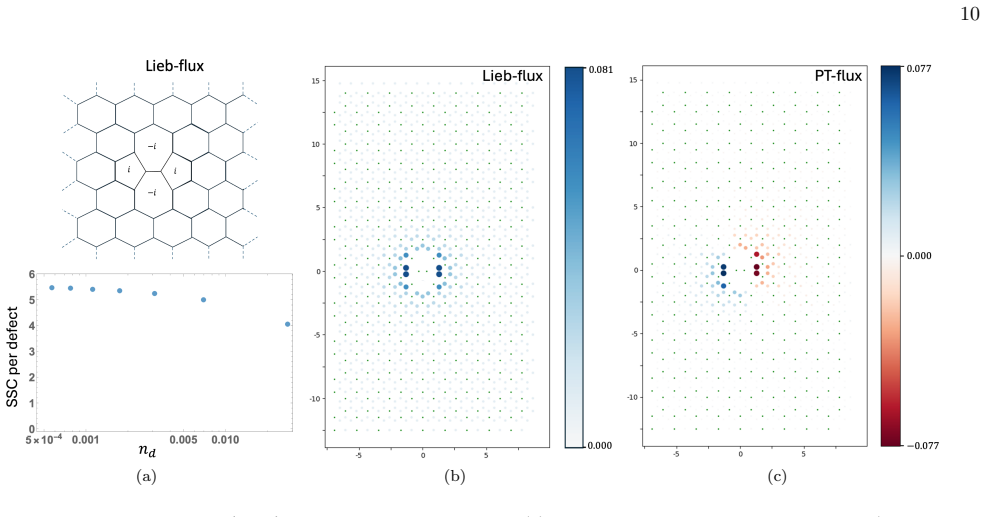
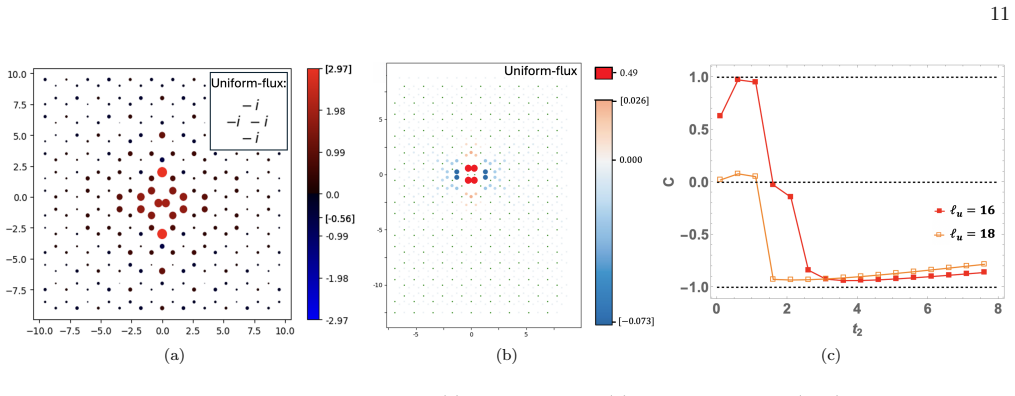
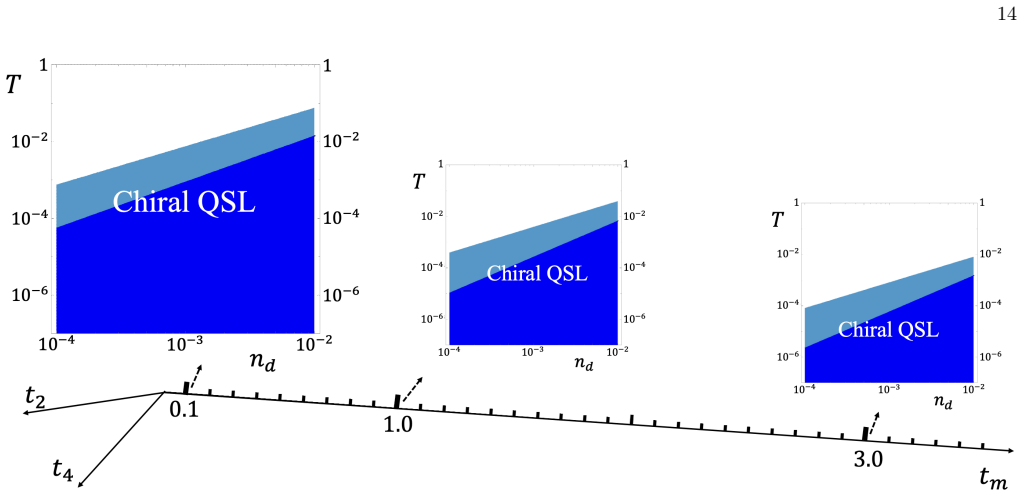
Stone-Wales-type defects consisting of local 90-degree bond rotations in the Kitaev honeycomb spin liquid preserve exact solvability while introducing plus or minus pi over 2 fluxes on odd plaquettes; an isolated defect hosts a time-reversal pair of ground states with large net chirality that generates orbital magnetization, and at finite density these chiral defects open a topological gap of 11 n_d protecting Chern number plus or minus 1 while producing long-range ferromagnetic Ising interactions with exponent gamma between 2 and 3 that drive a finite-temperature transition into the chiral spin liquid with T_c proportional to n_d.
What carries the argument
The Stone-Wales defect, defined as a 90-degree bond rotation that preserves Kitaev bond labels for edge-sharing octahedra and thereby creates solvable odd-sided plaquettes carrying plus or minus pi over 2 fluxes, which hosts chiral ground-state configurations whose interactions are analyzed via T-matrix methods.
If this is right
- Defect chiralities open a topological gap of 11 n_d that protects a Chern number of plus or minus 1.
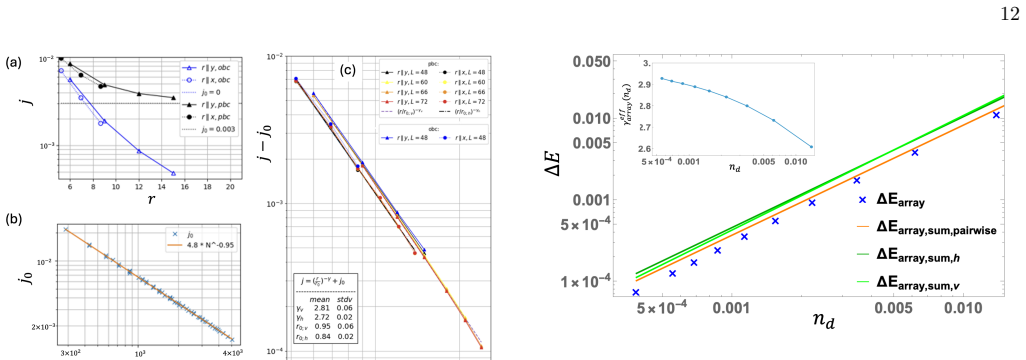
- Emergent ferromagnetic long-range Ising interactions with exponent gamma between 2 and 3 drive a finite-temperature transition into the chiral spin liquid.
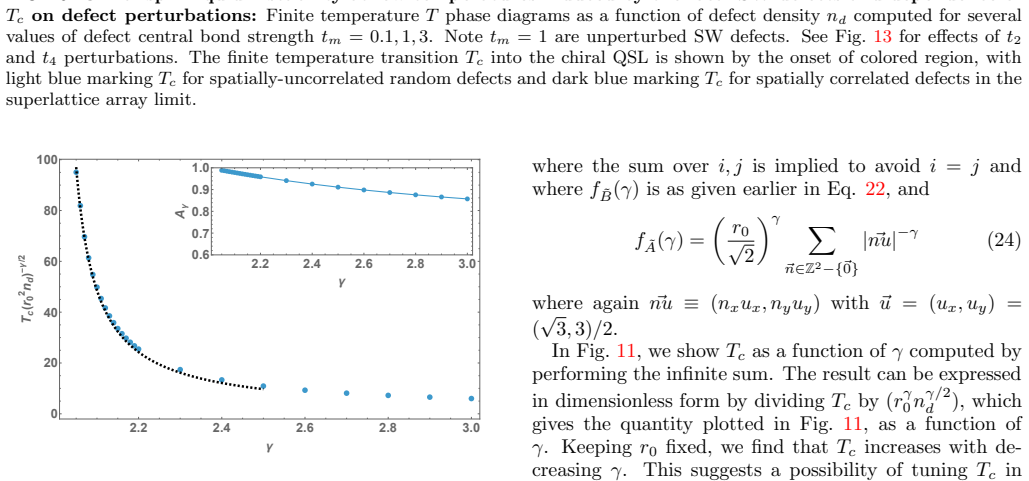
- The transition temperature T_c scales proportionally with defect density n_d and diverges as gamma approaches 2 from above.
- Additional solvable impurity potentials can reduce gamma below 2.3 and correspondingly raise T_c.
- The mechanism applies directly to 2D Dirac cone systems containing a finite density of fluctuating Ising magnetic impurities.
Where Pith is reading between the lines
- Varying defect density in candidate Kitaev materials would provide a direct experimental knob for tuning the chiral transition temperature.
- The orbital magnetization generated by the chiral defects offers a potential signature detectable through local magnetic probes or torque magnetometry.
- The same defect-chirality mechanism could be tested in other exactly solvable spin models or in graphene-like Dirac systems with magnetic impurities.
- Finite-density numerics at higher defect concentrations might reveal whether screening or clustering effects eventually cut off the power-law interactions.
Load-bearing premise
The T-matrix analysis and numerics at finite defect density correctly capture the effective long-range interactions between defect chiralities without significant higher-order corrections or screening effects that would alter the interaction exponent gamma or the gap coefficient 11.
What would settle it
A measurement showing that the spin-liquid energy gap scales linearly with defect density n_d at low densities, or that the transition temperature into the chiral phase is proportional to n_d and diverges as the interaction exponent approaches 2.
Figures





read the original abstract
In this work we extend our study of the effect of certain crystallographic defects on the spin-1/2 Kitaev honeycomb spin liquid (arXiv:2511.19409), focusing on its gapless phase and contrasting with the gapped phase. We identify a Stone-Wales (SW) local defect consisting of a 90$^\circ$ bond rotation that preserves Kitaev bond labels for edge-sharing octahedra and thereby enables exact solvability. These SW-type defects involve odd-sided plaquettes with $\pm \pi/2$ fluxes, but can be created locally. An isolated defect hosts a time-reversal pair of ground-state flux configurations with large net chirality. Certain excitations are also chiral. The chirality manifests in Majorana local Chern marker and in scalar spin chirality, producing electronic orbital magnetization. T-matrix analysis and numerics at finite defect density $n_d$ show that defect chiralities generate a topological gap of $11 n_d$ protecting a Chern number $C=\pm 1$. Emergent ferromagnetic long range Ising interactions $r^{-\gamma}$ with $2<\gamma < 3$ between defect chiralities lead to a finite temperature $T_c$ phase transition into the chiral spin liquid. The $T_c$ is proportional to $n_d$ and diverges when $\gamma\rightarrow 2$. We also consider additional solvable impurity potentials and find that $\gamma$ can be reduced to below $2.3$ and correspondingly enhance $T_c$. Our results offer applications to 2D Dirac cone systems with a finite density of fluctuating Ising magnetic impurities and to identifying spin liquids with lattice defects.
Editorial analysis
A structured set of objections, weighed in public.
Referee Report
Summary. The paper extends prior work on defects in the Kitaev honeycomb spin liquid to its gapless phase. It identifies Stone-Wales defects (90° bond rotations preserving Kitaev labels) that remain exactly solvable, host time-reversal pairs of chiral ground-state flux configurations with net chirality, and produce orbital magnetization via the Majorana local Chern marker and scalar spin chirality. At finite defect density n_d, T-matrix analysis combined with numerics is used to show that these chiralities open a topological gap of 11 n_d protecting Chern number C=±1; emergent ferromagnetic Ising interactions decaying as r^{-γ} with 2<γ<3 then drive a finite-T_c transition into the chiral spin liquid, with T_c proportional to n_d (and diverging as γ→2). Additional solvable impurity potentials are shown to reduce γ below 2.3 and enhance T_c.
Significance. If the central claims hold, the work supplies an exactly solvable route to defect-induced chirality and orbital magnetization in a gapless Kitaev spin liquid, together with concrete scaling predictions (gap linear in n_d, T_c∝n_d) that could be tested in 2D Dirac systems with magnetic impurities. The exact solvability for isolated defects and the parameter-free character of the isolated-defect chirality are genuine strengths; the finite-density T-matrix plus numerics, if fully documented, would constitute a reproducible prediction for the effective interactions.
major comments (3)
- [T-matrix analysis] T-matrix analysis section: the coefficient 11 in the reported topological gap Δ=11 n_d is stated as an output of the T-matrix calculation, yet no explicit T-matrix equations, matrix elements, or intermediate steps are shown; without these it is impossible to verify that the prefactor is independent of the chosen defect configurations or finite-size cutoffs.
- [Finite-density numerics] Finite-density numerics section: the interaction exponent range 2<γ<3 is extracted from numerics, but the manuscript provides neither error bars, finite-size extrapolation of the fitted γ, nor explicit checks for higher-order multi-defect scattering or screening of the Majorana wavefunctions that could renormalize either γ or the gap prefactor 11.
- [Temperature-transition discussion] Temperature-transition discussion: the claim that T_c∝n_d survives at finite density assumes the emergent Ising couplings remain ferromagnetic with γ strictly inside (2,3) after T-matrix resummation; the text does not address possible density-dependent corrections that would push γ outside this window or alter the linear gap scaling.
minor comments (2)
- [Abstract] The abstract states that 'certain excitations are also chiral' without identifying the excitations or directing the reader to the relevant figure or section.
- [Introduction] The contrast between the gapless-phase results and the gapped-phase findings of the companion preprint (arXiv:2511.19409) is mentioned only briefly; a short dedicated paragraph would improve readability.
Simulated Author's Rebuttal
We thank the referee for the careful reading of our manuscript and the constructive comments. We address each of the major comments below and indicate the revisions we will make to strengthen the presentation.
read point-by-point responses
-
Referee: [T-matrix analysis] T-matrix analysis section: the coefficient 11 in the reported topological gap Δ=11 n_d is stated as an output of the T-matrix calculation, yet no explicit T-matrix equations, matrix elements, or intermediate steps are shown; without these it is impossible to verify that the prefactor is independent of the chosen defect configurations or finite-size cutoffs.
Authors: We agree that the T-matrix section would benefit from greater transparency. In the revised manuscript, we will include the explicit form of the T-matrix equations used, the matrix elements for the scattering off the Stone-Wales defects, and the intermediate steps in the calculation of the gap. The prefactor 11 is obtained from the low-energy effective theory projecting onto the Dirac fermions and is robust against variations in defect configurations within the dilute limit, as confirmed by our numerical validations. revision: yes
-
Referee: [Finite-density numerics] Finite-density numerics section: the interaction exponent range 2<γ<3 is extracted from numerics, but the manuscript provides neither error bars, finite-size extrapolation of the fitted γ, nor explicit checks for higher-order multi-defect scattering or screening of the Majorana wavefunctions that could renormalize either γ or the gap prefactor 11.
Authors: We acknowledge these omissions. We will add error bars to the extracted γ values from the numerical fits, include finite-size scaling analysis to extrapolate γ, and provide additional checks comparing results at different densities to assess multi-defect scattering effects. Regarding screening of Majorana wavefunctions, our approach incorporates the T-matrix resummation which accounts for multiple scatterings; we will clarify this point and discuss any potential renormalization effects. revision: yes
-
Referee: [Temperature-transition discussion] Temperature-transition discussion: the claim that T_c∝n_d survives at finite density assumes the emergent Ising couplings remain ferromagnetic with γ strictly inside (2,3) after T-matrix resummation; the text does not address possible density-dependent corrections that would push γ outside this window or alter the linear gap scaling.
Authors: The T-matrix analysis is performed at finite but low densities, and our results indicate that the ferromagnetic character and the exponent range are preserved. To address this concern, we will expand the discussion to include an analysis of density-dependent corrections, showing that within the regime studied, γ remains between 2 and 3 and the gap scaling stays linear. We will also note the conditions under which these assumptions hold. revision: yes
Circularity Check
No significant circularity detected
full rationale
The paper's quantitative claims—the topological gap coefficient of 11 n_d and the interaction exponent range 2<γ<3—are explicitly attributed to T-matrix analysis plus numerics performed at finite defect density. These constitute independent computational outputs on the defect model rather than quantities defined in terms of themselves or obtained by fitting a parameter and relabeling it a prediction. The self-citation to arXiv:2511.19409 supplies background on the defect construction but does not carry the load of the new gap or exponent results; no equation or step in the provided abstract reduces the reported outputs to the inputs by construction. The derivation chain therefore remains self-contained against external benchmarks.
Axiom & Free-Parameter Ledger
free parameters (2)
- gap coefficient 11
- interaction exponent γ
axioms (2)
- domain assumption The Stone-Wales defect preserves Kitaev bond labels and remains exactly solvable
- domain assumption T-matrix analysis accurately captures the effective interactions between dilute chiral defects
Forward citations
Cited by 1 Pith paper
-
Impurity quadrupole moments as local probes of flux sectors in the Kitaev spin liquid
Impurity quadrupole moments exhibit discontinuous jumps at flux sector transitions in the Kitaev spin liquid, serving as a local probe of flux configurations.
Reference graph
Works this paper leans on
-
[1]
and antialigned (µ z 1 =−µ z
-
[2]
Such a comparison is shown in Fig
flux configura- tions. Such a comparison is shown in Fig. 8(a) for a small 48×48 system withN= 2304 sites. We consider defects separated by a vector⃗ rwhich is||x(horizontal separation ‘h’) or||y(vertical separation ‘v’), which show a distinct difference. In all cases we find that the aligned configu- ration has lower energy, consistent with a ferromagnet...
-
[3]
and antialigned (µz 1 =−µ z
-
[4]
chirality configurations of two SW defects in a 48×48 site system with open (OBC) (blue) or periodic (PBC) (black) boundary conditions. The energy difference is plotted after dividing by 2, asj≡∆E/2, to suggest an interpretation in terms of effective Ising spin interaction of Eq. 1. This numerically computed energy dif- ferencej(r) vanishes with increasin...
-
[5]
Imaginary hopping Inversion (P): ˜crA → −˜c−r,B ,˜c rB →˜c−r,A (B1) ˜ckA → −˜c−k,B ,˜c kB →˜c−k,A (B2) σx,z → −σ x,z , σ y →σ y (B3) τ x →τ x , τ y,z → −τ y,z (B4) Time-reversal (T): ˜crA →˜cr,A ,˜c rB → −˜cr,B (B5) ˜ckA →˜c−k,A ,˜c kB → −˜c−k,B (B6) σx → −σ x , σ y,z →σ y,z (B7) τ x,y →τ x,y , τ z → −τ z (B8)
-
[6]
Real hopping Inversion (P): ¯crA →¯c−r,B ,¯c rB →¯c−r,A (B9) ¯ckA →¯c−k,B ,¯c kB →¯c−k,A (B10) σx →σ x , σ y,z → −σ y,z (B11) τ x →τ x , τ y,z → −τ y,z (B12) Time-reversal (T): ¯crA →¯cr,A ,¯c rB →¯cr,B (B13) ¯ckA →¯c−k,A ,¯c kB →¯c−k,B (B14) σx,z →σ x,z , σ y → −σ y (B15) τ x,y →τ x,y , τ z → −τ z (B16) Appendix C: Details of T-matrix computations In thi...
-
[7]
(C5) c1 =−9 √ 3π(t2 1 +t 2 2 −2t 1), d 1 = 18πt1 −(9 √ 3 + 6π)(t2 1 +t 2
-
[8]
(C6) PT-flux: ¯V SW PT = ¯c† R,A,¯c† R,B t1σ0 +it 2µz P T σz ¯cR+d+,A ¯cR−d+,B + h.c. (C7) P[ ¯V SW PT ] = 1 Nc ¯ψ† q − √ 3µz PTt2τ z −2t 1(Re , Im)e iπ/3 ·(σ x, σyτ z)−t 1(Re , Im)e −i(K−K ′)·R ·(τ x, τ y)σx ¯ψq (C8) P[ ¯T SW PT ] = 1 Nc ¯ψ† qf2 a2t2µz PTτ zσz +b 2σx +c 2σyτ z +d 2 (Re,Im)e −i(K−K ′)·R ·(τ x, τ y)σ x ¯ψq (C9) f2 = 1 (3 √ 3−4π)(t 2 2 −t 2
-
[9]
+ 18π−12πt 1 , a 2 = 18 √ 3π , b 2 =−18πt 1 + (3π−9 √ 3)(t2 2 −t 2
-
[10]
(C10) c2 =−9 √ 3π(t2 2 −t 2 1 + 2t1), d 2 =−18πt 1 −(9 √ 3 + 6π)(t2 2 −t 2
-
[11]
(C11) 19 Uniform-flux: ¯V Uniform PT = ¯c† R,A,¯c† R,B t1σ0 +it 2µz P T σz ¯cR+d+,A ¯cR−d+,B + 2t1¯c† R,B¯cR+d−,A + h.c. (C12) P[ ¯V SW Uniform] = 1 Nc ¯ψ† q − √ 3µz Ut2τ z −2t 1(Re , Im)e iπ/3 ·(σ x, σyτ z)−t ′ 1(Re , Im)e −iπ/3 ·(σ x, σyτ z) −t1(Re , Im)e i(K−K ′)·R ·(τ x, τ y)σx −t ′ 1(Re , Im) e−i(K−K ′)·Reiπ/3 ·(τ x, τ y)σx ¯ψq (C13) P[ ¯T SW Uniform...
- [12]
-
[13]
Kitaev, Anyons in an exactly solved model and be- yond, Annals of Physics321, 2 (2006)
A. Kitaev, Anyons in an exactly solved model and be- yond, Annals of Physics321, 2 (2006)
work page 2006
-
[14]
G. Jackeli and G. Khaliullin, Mott insulators in the strong spin-orbit coupling limit: From heisenberg to a quantum compass and kitaev models, Physical Review Letters102, 017205 (2009)
work page 2009
-
[15]
M. Hermanns, I. Kimchi, and J. Knolle, Physics of the Kitaev Model: Fractionalization, Dynamic Correlations, and Material Connections, Annual Review of Condensed Matter Physics9, 17 (2018)
work page 2018
- [16]
-
[17]
S. Trebst and C. Hickey, Kitaev materials, Physics Re- ports Kitaev Materials,950, 1 (2022)
work page 2022
-
[18]
L. Savary and L. Balents, Quantum spin liquids: A re- view, Reports on Progress in Physics80, 016502 (2016)
work page 2016
-
[19]
A. J. Willans, J. T. Chalker, and R. Moessner, Disorder in a quantum spin liquid: Flux binding and local moment formation, Physical Review Letters104, 237203 (2010)
work page 2010
-
[20]
A. J. Willans, J. T. Chalker, and R. Moessner, Site dilu- tion in the Kitaev honeycomb model, Physical Review B 84, 115146 (2011). 21
work page 2011
-
[21]
G. J. Sreejith, S. Bhattacharjee, and R. Moessner, Va- cancies in Kitaev quantum spin liquids on the three- dimensional hyperhoneycomb lattice, Physical Review B 93, 064433 (2016)
work page 2016
-
[22]
J. Nasu and Y. Motome, Thermodynamic and transport properties in disordered Kitaev models, Physical Review B102, 054437 (2020)
work page 2020
- [23]
-
[24]
K. Dhochak, R. Shankar, and V. Tripathi, Magnetic Im- purities in the Honeycomb Kitaev Model, Physical Re- view Letters105, 117201 (2010)
work page 2010
- [25]
-
[26]
W.-H. Kao, J. Knolle, G. B. Hal´ asz, R. Moessner, and N. B. Perkins, Vacancy-induced low-energy density of states in the kitaev spin liquid, Physical Review X11, 011034 (2021)
work page 2021
-
[27]
A. Singhania, J. Van Den Brink, and S. Nishimoto, Dis- order effects in the Kitaev-Heisenberg model, Physical Review Research5, 023009 (2023)
work page 2023
-
[28]
F. Zschocke and M. Vojta, Physical states and finite-size effects in Kitaev’s honeycomb model: Bond disorder, spin excitations, and NMR line shape, Physical Review B92, 014403 (2015)
work page 2015
- [29]
-
[30]
G. Cassella, P. D’Ornellas, T. Hodson, W. M. H. Na- tori, and J. Knolle, An exact chiral amorphous spin liq- uid, Nature Commun.14, 6663 (2023), arXiv:2208.08246 [cond-mat.str-el]
-
[31]
A. G. Grushin and C. Repellin, Amorphous and poly- crystalline routes toward a chiral spin liquid, Physical Review Letters130, 186702 (2023)
work page 2023
-
[32]
O. Petrova, P. Mellado, and O. Tchernyshyov, Unpaired Majorana modes on dislocations and string defects in Ki- taev’s honeycomb model, Physical Review B90, 134404 (2014)
work page 2014
- [33]
-
[34]
G. B. Hal´ asz, J. T. Chalker, and R. Moessner, Doping a topological quantum spin liquid: Slow holes in the Kitaev honeycomb model, Physical Review B90, 035145 (2014)
work page 2014
-
[35]
G. B. Hal´ asz and J. T. Chalker, Coherent hole propaga- tion in an exactly solvable gapless spin liquid, Physical Review B94, 235105 (2016)
work page 2016
-
[36]
V. Lahtinen, A. W. W. Ludwig, and S. Trebst, Perturbed vortex lattices and the stability of nucleated topological phases, Physical Review B89, 085121 (2014)
work page 2014
-
[37]
M. Udagawa, Vison-Majorana complex zero-energy res- onance in the Kitaev spin liquid, Physical Review B98, 220404 (2018)
work page 2018
- [38]
- [39]
-
[40]
J. Nasu and Y. Motome, Spin dynamics in the Kitaev model with disorder: Quantum Monte Carlo study of dynamical spin structure factor, magnetic susceptibil- ity, and NMR relaxation rate, Physical Review B104, 035116 (2021)
work page 2021
-
[41]
L. R. D. Freitas and R. G. Pereira, Gapless excitations in non-Abelian Kitaev spin liquids with line defects, Physi- cal Review B105, L041104 (2022)
work page 2022
-
[42]
V. Dantas and E. C. Andrade, Disorder, Low-Energy Ex- citations, and Topology in the Kitaev Spin Liquid, Phys- ical Review Letters129, 037204 (2022)
work page 2022
-
[43]
X.-Y. Song, Y.-Z. You, and L. Balents, Low-energy spin dynamics of the honeycomb spin liquid beyond the kitaev limit, Physical Review Letters117, 037209 (2016)
work page 2016
-
[44]
I. Yatsuta and D. F. Mross, Vacancies in generic Kitaev spin liquids, arXiv:2312.00147 (2023), arXiv:2312.00147 [cond-mat]
- [45]
-
[46]
A. Seth, F. Borhani, and I. Kimchi, Chiral spin liquid instability of the Kitaev honeycomb model with crystal- lographic defects (2025), arXiv:2511.19409 [cond-mat]
work page internal anchor Pith review Pith/arXiv arXiv 2025
-
[47]
A. J. Stone and D. J. Wales, Theoretical studies of icosa- hedral C60 and some related species, Chemical Physics Letters128, 501 (1986)
work page 1986
-
[48]
M. Vozmediano, M. Katsnelson, and F. Guinea, Gauge fields in graphene, Physics Reports496, 109 (2010)
work page 2010
-
[49]
P. Kot, J. Parnell, S. Habibian, C. Straßer, P. M. Os- trovsky, and C. R. Ast, Band dispersion of graphene with structural defects, Physical Review B101, 235116 (2020)
work page 2020
-
[50]
F. Borhani, A. Seth, and I. Kimchi, Real-space chirality from crystalline topological defects in the Kitaev spin liquid, npj Quantum Materials10, 1 (2025)
work page 2025
- [51]
-
[52]
P. d’Ornellas and J. Knolle, Kitaev-Heisenberg model on the star lattice: From chiral Majorana fermions to chiral triplons, Physical Review B109, 094421 (2024)
work page 2024
-
[53]
V. Peri, S. Ok, S. S. Tsirkin, T. Neupert, G. Baskaran, M. Greiter, R. Moessner, and R. Thomale, Non-Abelian chiral spin liquid on a simple non-Archimedean lattice, Physical Review B101, 041114 (2020)
work page 2020
-
[54]
M. G. Yamada, H. Fujita, and M. Oshikawa, Designing Kitaev Spin Liquids in Metal-Organic Frameworks, Phys- ical Review Letters119, 057202 (2017)
work page 2017
-
[55]
J. Ma, D. Alf` e, A. Michaelides, and E. Wang, Stone- Wales defects in graphene and other planar sp 2-bonded materials, Physical Review B80, 033407 (2009)
work page 2009
-
[56]
E. H. Lieb, Flux Phase of the Half-Filled Band, Physical Review Letters73, 2158 (1994)
work page 1994
-
[57]
A. Panigrahi, P. Coleman, and A. Tsvelik, Analytic cal- culation of the vison gap in the Kitaev spin liquid, Phys- ical Review B108, 045151 (2023)
work page 2023
- [58]
-
[59]
R. Shindou and N. Nagaosa, Orbital Ferromagnetism and Anomalous Hall Effect in Antiferromagnets on the Dis- torted fcc Lattice, Physical Review Letters87, 116801 (2001)
work page 2001
-
[60]
O. I. Motrunich, Orbital magnetic field effects in spin liquid with spinon Fermi sea: Possible application to k- (ET)2Cu2(CN)3, Physical Review B73, 155115 (2006)
work page 2006
-
[61]
L. N. Bulaevskii, C. D. Batista, M. V. Mostovoy, and D. I. Khomskii, Electronic orbital currents and polarization in Mott insulators, Physical Review B78, 024402 (2008)
work page 2008
-
[62]
R. Bianco and R. Resta, Mapping topological order in coordinate space, Physical Review B84, 241106 (2011)
work page 2011
-
[63]
P. d’Ornellas, R. Barnett, and D. K. K. Lee, Quantized bulk conductivity as a local Chern marker, Physical Re- view B106, 155124 (2022)
work page 2022
-
[64]
Kogan, RKKY Interaction in Gapped or Doped Graphene, Graphene2, 8 (2013)
E. Kogan, RKKY Interaction in Gapped or Doped Graphene, Graphene2, 8 (2013)
work page 2013
-
[65]
J. Nasu, M. Udagawa, and Y. Motome, Thermal frac- tionalization of quantum spins in a Kitaev model: Temperature-linear specific heat and coherent transport of Majorana fermions, Physical Review B92, 115122 (2015)
work page 2015
-
[66]
I. Rousochatzakis, S. Kourtis, J. Knolle, R. Moessner, and N. B. Perkins, Quantum spin liquid at finite tem- perature: Proximate dynamics and persistent typicality, Physical Review B100, 045117 (2019)
work page 2019
discussion (0)
Sign in with ORCID, Apple, or X to comment. Anyone can read and Pith papers without signing in.