REVIEW 3 major objections 5 minor 59 references
Knowdit: Agentic Smart Contract Vulnerability Detection with Auditing Knowledge Summarization
T0 review · 3 major / 5 minor · reviewed 2026-07-13 · grok-4.5
Pith's one-line read Shared DeFi economic mechanisms, stored as a knowledge graph, let an agentic loop catch every high-severity smart-contract bug in a hard post-cutoff test set.
desk verdict Competent systems paper with a real bipartite DeFi-semantics KG and solid post-cutoff numbers, but abstract/body count mismatches and missing artifacts make the headline claims hard to trust at face value. read the letter →
The pith
A machine-rendered reading of the paper's core claim, the machinery that carries it, and where it could break.
The reading
What carries the argument
Auditing knowledge graph: a bipartite graph whose DeFi-space nodes (business types, projects, fine-grained economic mechanisms) are linked by many-to-many “may introduce” edges to Vulnerability-space nodes (patterns, findings, attack types); the graph supplies the semantic–vulnerability pairs that drive the agentic auditing loop.
What would settle it
Run the same agentic pipeline on a fresh set of post-cutoff contests after ablating the knowledge graph (or after replacing its causal links with random ones) and check whether high-severity recall collapses below the near-100 % figure reported with the intact graph.
Extended reading notes
Core claim
Recurring DeFi vulnerabilities share transferable DeFi semantics that can be extracted from historical audit reports into a knowledge graph and then used by an iterative multi-agent loop of specification generation, harness synthesis, fuzzing, and reflection to detect both known and previously unknown high-severity bugs with high precision.
Load-bearing premise
The abstract DeFi semantics and causal links distilled from past audits transfer cleanly enough that language models can turn them into correct, executable Foundry oracles for new projects without fatal hallucination or missing project-specific invariants.
Editorial extensions
If this is right
- New contests can be audited end-to-end by first retrieving the matching DeFi semantics rather than inventing oracles from scratch.
- Each confirmed finding can be written back into the graph, so later projects automatically inherit the newly learned pattern.
- Liquidity-draining attack classes that previously required expert insight become systematically searchable once their DeFi semantic is recorded.
- Cost of catching a high-severity bug falls from contest-scale bounties to a few tens of dollars of model tokens per project.
Reading between the lines
- The same semantic-graph idea could be ported to other domains where business logic, not language bugs, produces the costly failures (for example, payment-protocol or oracle-integration audits).
- If the graph is kept continuously updated from public reports, the system becomes a living memory that reduces the chance of the same first-depositor-style bug reappearing years later.
- Human-in-the-loop repair of a single failed harness may be enough to keep precision high while still amortizing most of the specification work across projects.
Editorial analysis
A structured set of objections, weighed in public.
Referee Report
Summary. Knowdit constructs a bipartite auditing knowledge graph (DeFi Space of business types/projects/semantics linked to Vulnerability Space of patterns/findings/attack types) from 270 historical Code4rena reports via LLM extraction, classification, and deduplication, then applies a multi-agent loop (Knowledge Mapper, Specification Generator producing Initial/Pre-Vuln/Post-Vuln states, Harness Synthesizer for Foundry, Fuzz Executor, Finding Reflector) with shared Working Memory to audit new Solidity projects. On AuditEval (body: 12 post-cutoff projects, 14 high + 61 medium ground-truths) it reports detecting all 14 high and 47/61 medium with 2 FPs, outperforming PropertyGPT, PromFuzz, LLMAudit, and GPTScan; ablation without the graph drops coverage from 88% to 20%; on six real-world projects it claims 12 high + 10 medium developer-confirmed findings. The central claim is that abstract DeFi-semantics knowledge plus agentic fuzzing yields higher-precision, higher-recall automated auditing than prior LLM or invariant baselines.
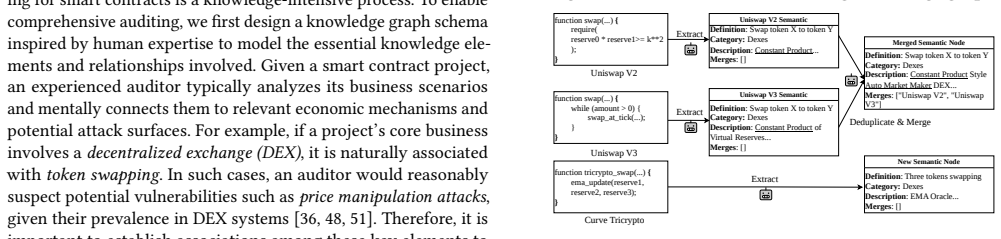
Significance. If the reported numbers hold, the work is a solid systems contribution to DeFi security: it operationalizes the recurring-semantics observation into a reusable graph (475 semantics, 579 patterns, 2,096 links), couples it to executable Foundry harnesses rather than pure static reasoning, and shows both held-out Code4rena gains and developer-confirmed real-world finds that protect liquidity. Strengths include the temporal split after model cutoffs, the explicit ablation (Knowdit-NKG), side-by-side baseline comparison under a shared $100/project budget, and concrete PoC-style harnesses. These make the paper more than another prompting study and potentially useful to auditors if artifacts are released.
major comments (3)
- Abstract vs. body numerical inconsistency is load-bearing for the superiority and impact claims. The abstract states 11 projects / 84 GTs / all 21 high / 90% medium / 0 FP / eight full covers / seven real-world projects / 9 high + 36 medium; Tables 1–2 and §§4.1–4.4 state 12 projects / 75 GTs (14 high + 61 medium) / all 14 high / 47/61 (77%) medium / 2 FP / four full covers / six real-world projects / 12 high + 10 medium. These are not rounding differences; they change headline recall, FP rate, and real-world impact. The manuscript must reconcile or correct every occurrence before the central claim can be trusted.
- Reproducibility of the strongest claim is insufficient. No code, knowledge graph dump, generated harnesses, raw traces, or evaluation scripts are released or promised. Given free parameters (token budget, model choice GPT-5.1/GPT-5-mini, regeneration limits) and the false-negative analysis in §4.2.2 (hallucinated harnesses; project-specific invariants not captured by abstract semantics), independent verification of Tables 2–3 and the real-world counts is impossible from the text alone. At minimum the evaluation harnesses, graph schema instance, and per-finding traces for AuditEval should be made available.
- §4.2.1 / Table 2 baseline comparison understates practical limitations of the invariant tools. PromFuzz and PropertyGPT are reported near-zero on multi-contract projects, yet the text itself notes they were not designed for end-to-end multi-contract setup without manual intervention. The claim of “significantly outperforming all baselines” is therefore partly an apples-to-oranges comparison of fully agentic end-to-end automation versus tools that expect different oracles or single-contract scopes. A fairer protocol (or an explicit “manual-setup” upper bound for those tools) is needed to support the superiority wording.
minor comments (5)
- CCS Concepts and Keywords still contain the ACM placeholder text (“Do Not Use This Code…”); replace with actual terms.
- Figure 2 caption and §3.3.1 use “Working Memory” while the abstract mentions a “shared repository index”; align terminology.
- §3.2.1 lists 13 business types and 7 attack types without a citation or table of definitions; a short appendix table would aid reproducibility of the classification prompts.
- Real-world project X is anonymized (§4.4) while impact claims cite Coingecko/DefiLlama; either de-anonymize after acceptance or quantify impact without named TVL figures that cannot be checked.
- Typos and residual template text: “Conference acronym ’XX”, “Trovato et al.” headers, and the 2018 copyright block should be cleaned for camera-ready.
Circularity Check
Empirical systems paper; knowledge graph built from pre-cutoff audits and evaluated on post-cutoff contests with ablation; minor self-citation of authors' prior fuzzing practice does not force detection rates.
-
self citation load bearing
[§3.3.4 Harness Synthesizer]
"we derive Foundry handlers following the practice from Verite [21] as a thin wrapper of a few external calls to implement the given abstract DeFi semantics."
Verite is prior work by overlapping authors; the citation supplies the concrete harness style used inside the agentic loop. It is minor and non-load-bearing: the detection rates and ablation gains are measured independently of this engineering choice and do not reduce to the citation by construction.
full rationale
Knowdit is an empirical agentic-systems paper whose central claims are measured detection counts (high/medium recall, false positives, real-world finds) on a temporally held-out Code4rena set (AuditEval) plus developer-confirmed findings. The knowledge graph is constructed from 270 earlier contests via LLM extraction/deduplication/linking and is shown by ablation (Knowdit-NKG) to improve coverage from 20% to 88% and to reduce false positives; the evaluation numbers are therefore not tautological with the graph construction. There are no equations, fitted parameters renamed as predictions, uniqueness theorems, or ansatzes smuggled via self-citation that reduce the reported results by construction. The only self-citations (e.g., Verite for Foundry-handler style, Belobog) supply ordinary engineering practice for harness synthesis and are not load-bearing for the superiority claims. Abstract/body numerical mismatches exist but constitute inconsistency, not circularity. Hence circularity is negligible.
Assumptions & free parameters
free parameters (3)
- per-project token budget =
$100 (saturation ~$80)
- LLM model choice and defaults =
GPT-5.1 / GPT-5-mini, default temperature
- harness repair / regeneration attempt limit
assumptions (4)
- domain assumption Recurring smart-contract vulnerabilities across distinct business models share transferable fine-grained economic mechanisms (DeFi semantics).
- domain assumption An LLM can abstract, classify, and deduplicate DeFi semantics and vulnerability patterns from heterogeneous audit reports with sufficient fidelity for later retrieval.
- domain assumption Code4rena high/medium severity labels after QA filtering constitute a reliable ground-truth oracle for end-to-end evaluation.
- domain assumption Foundry fuzzing with LLM-synthesized handlers and require-oracles is an adequate execution substrate for confirming business-logic violations.
invented entities (3)
-
DeFi semantics (fine-grained economic-mechanism nodes)
-
Bipartite auditing knowledge graph (DeFi Space ↔ Vulnerability Space)
-
Three-state auditing specification (Initial / Pre-Vuln / Post-Vuln)
Cite this review
Pith. "Pith review of Knowdit: Agentic Smart Contract Vulnerability Detection with Auditing Knowledge Summarization." pith.science (2026). https://pith.science/paper/VSLF3IZR
@misc{pith2026260326270,
  author       = {Pith},
  title        = {Pith review of: Knowdit: Agentic Smart Contract Vulnerability Detection with Auditing Knowledge Summarization},
  year         = {2026},
  howpublished = {\url{https://pith.science/paper/VSLF3IZR}},
  note         = {Machine review of arXiv:2603.26270}
}
read the original abstract
Smart contracts govern billions of dollars in decentralized finance (DeFi), yet automated vulnerability detection remains challenging because many vulnerabilities are tightly coupled with project-specific business logic. We observe that recurring vulnerabilities across diverse DeFi business models often share the same underlying economic mechanisms, which we term DeFi semantics, and that capturing these shared abstractions can enable more systematic auditing. Building on this insight, we propose Knowdit, a knowledge-driven, agentic workflow for smart contract vulnerability detection. Knowdit first constructs an auditing knowledge graph from historical human audit reports, linking fine-grained DeFi semantics with recurring vulnerability patterns. Given a new project, a multi-agent pipeline leverages this knowledge through an iterative loop of specification generation, Proof-of-Concept (PoC) synthesis, PoC execution, and finding reflection, driven by a shared repository index. We evaluate Knowdit on 11 recent Code4rena projects with 84 ground-truth vulnerabilities. Knowdit detects all 21 high-severity and 90% of medium-severity vulnerabilities without false positives, fully covering eight projects, significantly outperforming all baselines. Applied to seven real-world projects, Knowdit further discovers 9 high- and 36 medium-severity previously unknown vulnerabilities, securing millions in liquidity and proving its outstanding performance.
Figures


Figures from the paper (6 more)


Reference graph
Works this paper leans on
-
[1]
ERC-4626: Tokenized Vaults
2021. ERC-4626: Tokenized Vaults. https://eips.ethereum.org/EIPS/eip-4626
2021
-
[2]
Implement or recommend mitigations for ERC4626 inflation attacks
2022. Implement or recommend mitigations for ERC4626 inflation attacks. https: //github.com/OpenZeppelin/openzeppelin-contracts/issues/3706
2022
-
[3]
2025. Foundry. https://github.com/foundry-rs/foundry
2025
-
[4]
Code4rena
2026. Code4rena. http://code4rena.com/
2026
-
[5]
Coingecko
2026. Coingecko. https://www.coingecko.com/. Accessed on March, 2026
2026
-
[6]
DefiLlama
2026. DefiLlama. https://defillama.com/. Accessed on March, 2026
2026
-
[7]
Hayden Adams, Noah Zinsmeister, and Dan Robinson. 2020. Uniswap v2 Core. https://uniswap.org/whitepaper.pdf
2020
-
[8]
Hayden Adams, Noah Zinsmeister, Moody Salem, River Keefer, and Dan Robinson
Show all 59 references
-
[9]
https://app.uniswap.org/whitepaper-v3.pdf
Uniswap v3 core. https://app.uniswap.org/whitepaper-v3.pdf
-
[10]
Priyanka Bose, Dipanjan Das, Yanju Chen, Yu Feng, Christopher Kruegel, and Giovanni Vigna. 2022. Sailfish: Vetting smart contract state-inconsistency bugs in seconds. In2022 IEEE Symposium on Security and Privacy (SP). IEEE, 161–178
2022
-
[11]
Chuyang Chen, Brendan Dolan-Gavitt, and Zhiqiang Lin. 2025. ELFuzz: Efficient Input Generation via LLM-driven Synthesis Over Fuzzer Space. arXiv:2506.10323 [cs.CR] https://arxiv.org/abs/2506.10323
2025 arXiv
-
[12]
Longfei Chen, Ruibin Yan, Taiyu Wong, Yiyang Chen, and Chao Zhang. 2025. SmartPoC: Generating Executable and Validated PoCs for Smart Contract Bug Reports.arXiv preprint arXiv:2511.12993(2025)
2025
-
[13]
Jaeseung Choi, Doyeon Kim, Soomin Kim, Gustavo Grieco, Alex Groce, and Sang Kil Cha. 2021. Smartian: Enhancing smart contract fuzzing with static and dynamic data-flow analyses. In2021 36th IEEE/ACM International Conference on Automated Software Engineering (ASE). IEEE, 227–23...
2021 doi
-
[14]
Xueying Du, Geng Zheng, Kaixin Wang, Yi Zou, Yujia Wang, Wentai Deng, Jiayi Feng, Mingwei Liu, Bihuan Chen, Xin Peng, Tao Ma, and Yiling Lou. 2025. Vul- RAG: Enhancing LLM-based Vulnerability Detection via Knowledge-level RAG. arXiv:2406.11147 [cs.SE] https://arxiv.org/abs/2406.11147
2025 arXiv
-
[15]
Darren Edge, Ha Trinh, Newman Cheng, Joshua Bradley, Alex Chao, Apurva Mody, Steven Truitt, Dasha Metropolitansky, Robert Osazuwa Ness, and Jonathan Larson. 2025. From Local to Global: A Graph RAG Approach to Query-Focused Summarization. arXiv:2404.16130 [cs.CL] https://arxiv....
2025 arXiv
-
[16]
Michael Egorov and Curve Finance. 2021. Automatic market-making with dy- namic peg. https://classic.curve.finance/files/crypto-pools-paper.pdf
2021
-
[17]
Jiaqi Gao, Zijian Zhang, Yuqiang Sun, Ye Liu, Chengwei Liu, Han Liu, Yi Li, and Yang Liu. 2026. LogicScan: An LLM-driven Framework for Detecting Business Logic Vulnerabilities in Smart Contracts. arXiv:2602.03271 [cs.CR] https://arxiv. org/abs/2602.03271
2026
-
[18]
Arthur Gervais and Liyi Zhou. 2026. AI Agent Smart Contract Exploit Generation. arXiv:2507.05558 [cs.CR] https://arxiv.org/abs/2507.05558
2026
-
[19]
David Jin, Qian Fu, and Yuekang Li. 2025. Good News for Script Kid- dies? Evaluating Large Language Models for Automated Exploit Generation. arXiv:2505.01065 [cs.CR] https://arxiv.org/abs/2505.01065
2025 arXiv
-
[20]
Takeshi Kojima, Shixiang Shane Gu, Machel Reid, Yutaka Matsuo, and Yusuke Iwasawa. 2022. Large language models are zero-shot reasoners.Advances in neural information processing systems35 (2022), 22199–22213
2022
-
[21]
Ziqiao Kong, Wanxu Xia, Zhengwei Li, Yi Lu, Pan Li, Liqun Yang, Yang Liu, Xiapu Luo, and Shaohua Li. 2026. Belobog: Move Language Fuzzing Framework For Real-World Smart Contracts. arXiv:2512.02918 [cs.CR] https://arxiv.org/abs/ 2512.02918
2026
-
[22]
Ziqiao Kong, Cen Zhang, Maoyi Xie, Ming Hu, Yue Xue, Ye Liu, Haijun Wang, and Yang Liu. 2025. Smart Contract Fuzzing Towards Profitable Vulnerabilities. Proceedings of the ACM on Software Engineering2, FSE (2025), 153–175
2025
-
[23]
Dharshan Kumaran, Demis Hassabis, and James L McClelland. 2016. What learning systems do intelligent agents need? Complementary learning systems theory updated.Trends in cognitive sciences20, 7 (2016), 512–534
2016
-
[24]
Patrick Lewis, Ethan Perez, Aleksandra Piktus, Fabio Petroni, Vladimir Karpukhin, Naman Goyal, Heinrich Küttler, Mike Lewis, Wen tau Yih, Tim Rocktäschel, Sebastian Riedel, and Douwe Kiela. 2021. Retrieval-Augmented Generation for Knowledge-Intensive NLP Tasks. arXiv:2005.1140...
2021 arXiv
-
[25]
Kaixuan Li, Yue Xue, Sen Chen, Han Liu, Kairan Sun, Ming Hu, Haijun Wang, Yang Liu, and Yixiang Chen. 2024. Static application security testing (sast) tools for smart contracts: How far are we?Proceedings of the ACM on Software Engineering1, FSE (2024), 1447–1470
2024
-
[26]
Xiaoqi Li, Hailu Kuang, Wenkai Li, Zongwei Li, and Shipeng Ye. 2025. CKG-LLM: LLM-Assisted Detection of Smart Contract Access Control Vulnerabilities Based on Knowledge Graphs. arXiv:2512.06846 [cs.CR] https://arxiv.org/abs/2512.06846
2025 arXiv
-
[27]
Bo Lin, Shangwen Wang, Yihao Qin, Liqian Chen, and Xiaoguang Mao. 2025. Give LLMs a Security Course: Securing Retrieval-Augmented Code Generation via Knowledge Injection. arXiv:2504.16429 [cs.CR] https://arxiv.org/abs/2504.16429
2025 arXiv
-
[28]
Xingshuang Lin, Qinge Xie, Binbin Zhao, Yuan Tian, Saman Zonouz, Na Ruan, Jiliang Li, Raheem Beyah, and Shouling Ji. 2025. PROMFUZZ: Leveraging LLM- Driven and Bug-Oriented Composite Analysis for Detecting Functional Bugs in Smart Contracts.arXiv preprint arXiv:2503.23718(2025)
2025
-
[29]
Ye Liu, Yue Xue, Daoyuan Wu, Yuqiang Sun, Yi Li, Miaolei Shi, and Yang Liu
-
[30]
Propertygpt: Llm-driven formal verification of smart contracts through retrieval-augmented property generation.arXiv preprint arXiv:2405.02580(2024)
2024 arXiv
-
[31]
Loi Luu, Duc-Hiep Chu, Hrishi Olickel, Prateek Saxena, and Aquinas Hobor
-
[32]
InProceedings of the 2016 ACM SIGSAC Conference on Computer and Communications Security(Vienna, Austria)(CCS ’16)
Making Smart Contracts Smarter. InProceedings of the 2016 ACM SIGSAC Conference on Computer and Communications Security(Vienna, Austria)(CCS ’16). Association for Computing Machinery, New York, NY, USA, 254–269. doi:10. 1145/2976749.2978309
2016
-
[33]
Wei Ma, Daoyuan Wu, Yuqiang Sun, Tianwen Wang, Shangqing Liu, Jian Zhang, Yue Xue, and Yang Liu. 2025. Combining fine-tuning and llm-based agents for intuitive smart contract auditing with justifications. In2025 IEEE/ACM 47th International Conference on Software Engineering (I...
2025
-
[34]
2025.Code Cloning in Solidity Smart Contracts: Prevalence, Evolution, and Impact on Development
Ran Mo, Haopeng Song, Wei Ding, and Chaochao Wu. 2025.Code Cloning in Solidity Smart Contracts: Prevalence, Evolution, and Impact on Development. IEEE Press, 3060–3071. https://doi.org/10.1109/ICSE55347.2025.00123
2025 doi
-
[35]
Nguyen, Long H
Tai D. Nguyen, Long H. Pham, Jun Sun, Yun Lin, and Quang Tran Minh
-
[36]
arXiv:2004.08563 [cs.SE] https://arxiv.org/abs/2004.08563
sFuzz: An Efficient Adaptive Fuzzer for Solidity Smart Contracts. arXiv:2004.08563 [cs.SE] https://arxiv.org/abs/2004.08563
2004 arXiv
-
[37]
Chenyang Peng, Haijun Wang, Yin Wu, Hao Wu, Ming Fan, Yitao Zhao, and Ting Liu. 2025. ETrace: Event-Driven Vulnerability Detection in Smart Contracts via LLM-Based Trace Analysis. InProceedings of the 16th International Conference on Internetware (Internetware 2025). ACM, 533–...
2025 doi
-
[38]
Chaofan Shou, Shangyin Tan, and Koushik Sen. 2023. Ityfuzz: Snapshot-based fuzzer for smart contract. InProceedings of the 32nd ACM SIGSOFT International Symposium on Software Testing and Analysis. 322–333. doi:10.1145/3597926. 3598059
2023 doi
-
[39]
Kairan Sun, Zhengzi Xu, Chengwei Liu, Kaixuan Li, and Yang Liu. 2023. Demys- tifying the composition and code reuse in solidity smart contracts. InProceedings of the 31st ACM Joint European Software Engineering Conference and Symposium on the Foundations of Software Engineerin...
2023
-
[40]
Yuqiang Sun, Daoyuan Wu, Yue Xue, Han Liu, Haijun Wang, Zhengzi Xu, Xiaofei Xie, and Yang Liu. 2024. Gptscan: Detecting logic vulnerabilities in smart contracts by combining gpt with program analysis. InProceedings of the IEEE/ACM 46th Conference acronym ’XX, June 03–05, 2018,...
2024
-
[41]
Christof Ferreira Torres, Antonio Ken Iannillo, Arthur Gervais, and Radu State
-
[42]
arXiv:2005.12156 [cs.CR] https://arxiv.org/abs/2005.12156
ConFuzzius: A Data Dependency-Aware Hybrid Fuzzer for Smart Contracts. arXiv:2005.12156 [cs.CR] https://arxiv.org/abs/2005.12156
2005 arXiv
-
[43]
Justin Wang, Andreas Bigger, Xiaohai Xu, Justin W Lin, Andy Applebaum, Tejal Patwardhan, Alpin Yukseloglu, and Olivia Watkins. 2026. EVMbench: Evaluating AI Agents on Smart Contract Security. (2026)
2026
-
[44]
Sally Junsong Wang, Kexin Pei, and Junfeng Yang. 2024. Smartinv: Multimodal learning for smart contract invariant inference. In2024 IEEE Symposium on Security and Privacy (SP). IEEE, 2217–2235
2024
-
[45]
Jason Wei, Xuezhi Wang, Dale Schuurmans, Maarten Bosma, Fei Xia, Ed Chi, Quoc V Le, Denny Zhou, et al. 2022. Chain-of-thought prompting elicits reasoning in large language models.Advances in neural information processing systems35 (2022), 24824–24837
2022
-
[46]
Zhiyuan Wei, Jing Sun, Yuqiang Sun, Ye Liu, Daoyuan Wu, Zijian Zhang, Xianhao Zhang, Meng Li, Yang Liu, Chunmiao Li, et al. 2025. Advanced smart contract vulnerability detection via llm-powered multi-agent systems.IEEE Transactions on Software Engineering(2025)
2025
-
[47]
Dr Gavin Wood. 2025. ETHEREUM: A SECURE DECENTRALISED GENER- ALISED TRANSACTION LEDGER SHANGHAI VERSION. https://ethereum. github.io/yellowpaper/paper.pdf. (2025)
2025
-
[48]
Di Wu, Wasi Uddin Ahmad, Dejiao Zhang, Murali Krishna Ramanathan, and Xiaofei Ma. 2024. Repoformer: Selective Retrieval for Repository-Level Code Completion. arXiv:2403.10059 [cs.SE] https://arxiv.org/abs/2403.10059
2024 arXiv
-
[49]
Siwei Wu, Zhou Yu, Dabao Wang, Yajin Zhou, Lei Wu, Haoyu Wang, and Xingliang Yuan. 2023. Defiranger: Detecting defi price manipulation attacks. IEEE Transactions on Dependable and Secure Computing21, 4 (2023), 4147–4161
2023
-
[50]
Chunqiu Steven Xia, Matteo Paltenghi, Jia Le Tian, Michael Pradel, and Lingming Zhang. 2024. Fuzz4All: Universal Fuzzing with Large Language Models. In Proceedings of the IEEE/ACM 46th International Conference on Software Engineering (ICSE ’24). ACM, 1–13. doi:10.1145/3597503.3639121
2024 doi
-
[51]
Shihao Xia, Shuai Shao, Mengting He, Tingting Yu, Linhai Song, and Yiy- ing Zhang. 2024. AuditGPT: Auditing Smart Contracts with ChatGPT. arXiv:2404.04306 [cs.CR] https://arxiv.org/abs/2404.04306
2024 arXiv
-
[52]
Zeke Xiao, Qin Wang, Yuekang Li, and Shiping Chen. 2025. Prompt to pwn: Automated exploit generation for smart contracts.arXiv preprint arXiv:2508.01371 (2025)
2025 arXiv
-
[53]
Maoyi Xie, Ming Hu, Ziqiao Kong, Cen Zhang, Yebo Feng, Haijun Wang, Yue Xue, Hao Zhang, Ye Liu, and Yang Liu. 2024. Defort: Automatic detection and analysis of price manipulation attacks in defi applications. InProceedings of the 33rd ACM SIGSOFT International Symposium on Sof...
2024
-
[54]
Hanxiang Xu, Yanjie Zhao, and Haoyu Wang. 2025. Directed Greybox Fuzzing via Large Language Model. arXiv:2505.03425 [cs.CR] https://arxiv.org/abs/2505. 03425
2025 arXiv
-
[55]
Fengji Zhang, Bei Chen, Yue Zhang, Jacky Keung, Jin Liu, Daoguang Zan, Yi Mao, Jian-Guang Lou, and Weizhu Chen. 2023. RepoCoder: Repository-Level Code Completion Through Iterative Retrieval and Generation. arXiv:2303.12570 [cs.CL] https://arxiv.org/abs/2303.12570
2023 arXiv
-
[56]
Zhuo Zhang, Brian Zhang, Wen Xu, and Zhiqiang Lin. 2023. Demystifying ex- ploitable bugs in smart contracts. In2023 IEEE/ACM 45th International Conference on Software Engineering (ICSE). IEEE, 615–627. doi:10.1109/ICSE48619.2023.00061
2023 doi
-
[57]
Mengyao Zhao, Kaixuan Li, Lyuye Zhang, Wenjing Dang, Chenggong Ding, Sen Chen, and Zheli Liu. 2025. A Systematic Study on Generating Web Vulnerability Proof-of-Concepts Using Large Language Models. arXiv:2510.10148 [cs.SE] https://arxiv.org/abs/2510.10148
2025
-
[58]
Liyi Zhou, Xihan Xiong, Jens Ernstberger, Stefanos Chaliasos, Zhipeng Wang, Ye Wang, Kaihua Qin, Roger Wattenhofer, Dawn Song, and Arthur Gervais. 2023. Sok: Decentralized finance (defi) attacks. In2023 IEEE Symposium on Security and Privacy (SP). IEEE, 2444–2461. doi:10.1145/...
2023 doi
-
[59]
Hao Zhu, Jia Li, Cuiyun Gao, Jiaru Qian, Yihong Dong, Huanyu Liu, Lecheng Wang, Ziliang Wang, Xiaolong Hu, and Ge Li. 2025. Specification-Guided Vul- nerability Detection with Large Language Models. arXiv:2511.04014 [cs.SE] https://arxiv.org/abs/2511.04014 Received 20 February...
2025
Reviewed July 13, 2026 · model on record in the stance chip above.
Discussion (0). Sign in to comment.