Recognition: 2 theorem links
· Lean TheoremThe Triality of Radial Nonlinear Dynamics: Analysis of Riccati, Schr\"{o}dinger, and Hamilton--Jacobi--Bellman Equations
Pith reviewed 2026-05-14 21:41 UTC · model grok-4.3
The pith
Radial symmetry establishes a triality connecting the Riccati, Schrödinger, and Hamilton-Jacobi-Bellman equations with existence and uniqueness of solutions.
A machine-rendered reading of the paper's core claim, the machinery that carries it, and where it could break.
Core claim
We establish the existence and uniqueness of regular solutions on both bounded and unbounded domains, deriving sharp growth rates and exact asymptotic plateaus through a general barrier theory. The radial symmetry assumption reduces the three distinct equation classes to equivalent forms, allowing the triality to hold and permitting detailed sensitivity analysis of the noise intensity that identifies transitions between deterministic and diffusion-dominated regimes.
What carries the argument
The triality connection under radial symmetry, which equates the Riccati, Schrödinger, and Hamilton-Jacobi-Bellman problems and enables barrier constructions to prove existence, uniqueness, growth rates, and asymptotics.
If this is right
- Regular solutions exist and are unique for the radial forms of the Riccati, Schrödinger, and Hamilton-Jacobi-Bellman equations on bounded and unbounded domains.
- Barrier theory supplies sharp growth rates and exact asymptotic plateaus for these solutions.
- Varying the noise intensity parameter produces a transition from deterministic to diffusion-dominated regimes.
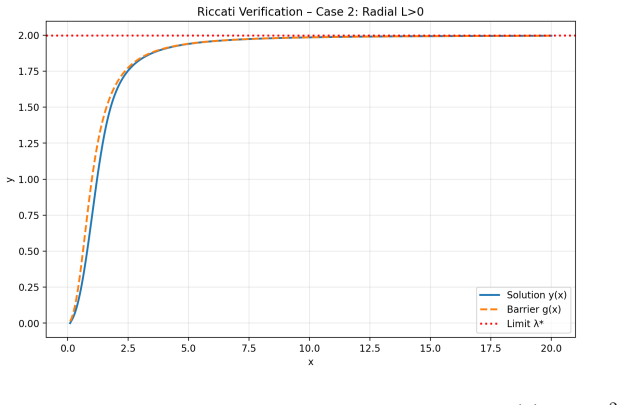
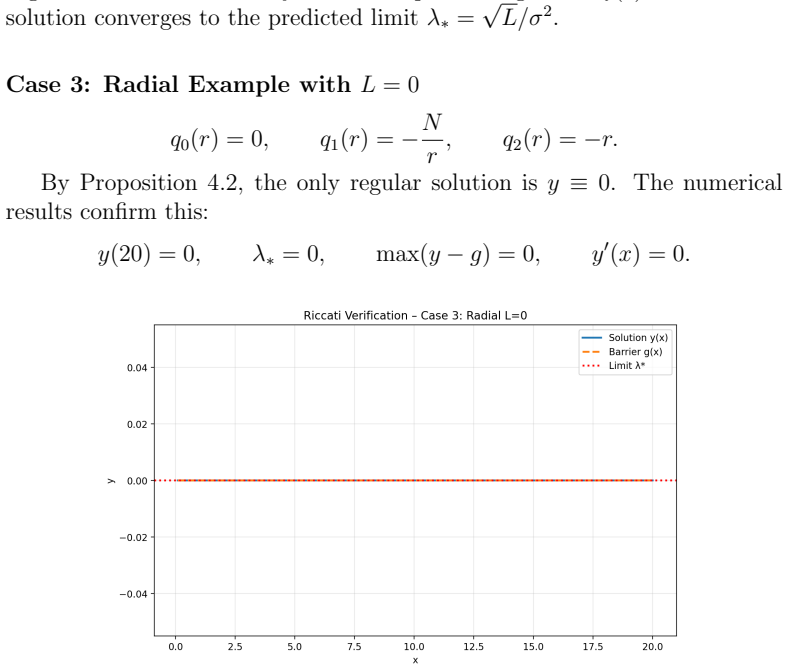
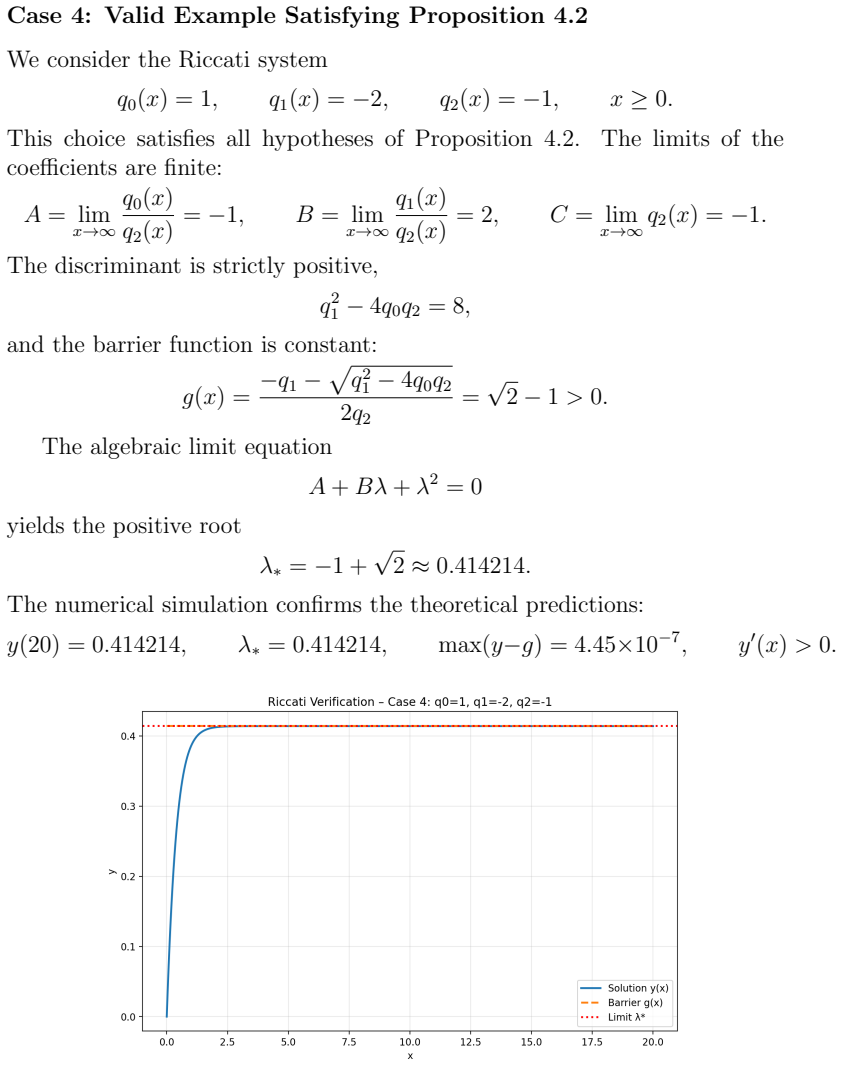
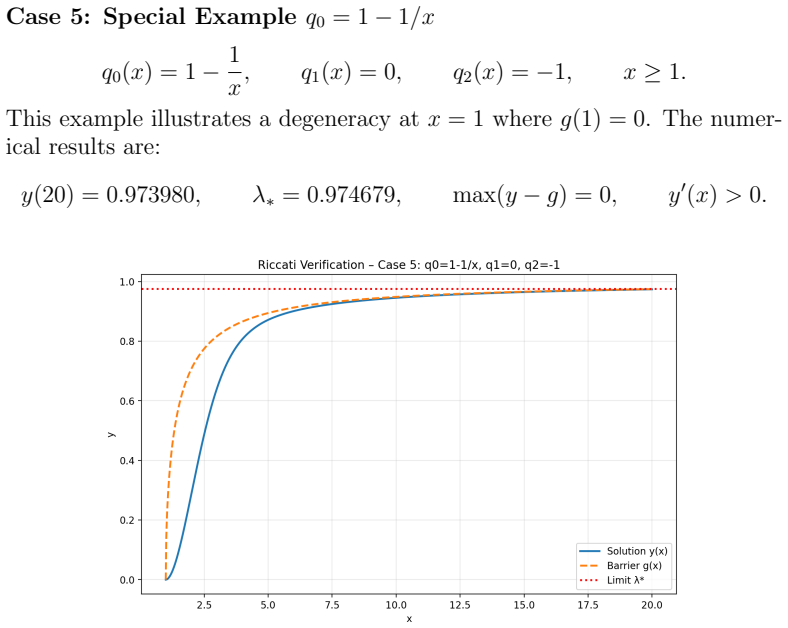
- Numerical simulations confirm the predicted feedback laws and the convexity-concavity structure of the triality.
- The duality between global wave functions and local dynamical drifts clarifies the analysis of multidimensional stochastic processes.
Where Pith is reading between the lines
- The same barrier techniques could be tested on other radially symmetric nonlinear equations arising in fluid mechanics or quantum mechanics.
- The derived asymptotic plateaus may be used to predict long-term behavior in stochastic control problems with central forces.
- Relaxing radial symmetry would require perturbation terms that preserve the essential duality between wave functions and drifts.
- Physical experiments with tunable noise in centrally symmetric potentials could directly check the predicted regime transitions.
Load-bearing premise
Radial symmetry is assumed so that the triality connects the three equations and the barrier theory applies without extra constraints on the potential or noise terms.
What would settle it
A concrete radial potential and noise intensity for which the associated Riccati equation on an unbounded domain has no regular solution, despite satisfying all barrier conditions stated in the theory.
Figures




read the original abstract
This study develops a unified mathematical framework for the analysis of radial differential equations, revealing a fundamental connection between three distinct classes of problems: the nonlinear Riccati equation, the linear Schr\"odinger equation, and the Hamilton--Jacobi--Bellman equation for stochastic control. We establish the existence and uniqueness of regular solutions on both bounded and unbounded domains, deriving sharp growth rates and exact asymptotic plateaus through a general barrier theory. A detailed sensitivity analysis of the noise intensity parameter identifies the transition between deterministic and diffusion-dominated regimes via singular perturbation methods. These theoretical results are reinforced by numerical simulations that validate the predicted feedback laws, confirm the convexity--concavity structure of the triality, and illustrate the stability of the system. The resulting framework clarifies the duality between global wave functions and local dynamical drifts, providing a rigorous foundation for the study of multidimensional stochastic processes under central potentials.
Editorial analysis
A structured set of objections, weighed in public.
Referee Report
Summary. The paper develops a unified framework linking the radial nonlinear Riccati equation, the linear Schrödinger equation, and the Hamilton-Jacobi-Bellman equation for stochastic control. It claims to prove existence and uniqueness of regular solutions on bounded and unbounded domains, derive sharp growth rates and exact asymptotic plateaus via a general barrier theory, perform singular-perturbation sensitivity analysis on the noise intensity to identify deterministic-to-diffusion regime transitions, and validate the results numerically, including feedback laws and convexity-concavity structure.
Significance. If the barrier constructions and triality hold rigorously for general central potentials without hidden coercivity assumptions, the work would offer a valuable unification of these three equation classes with direct implications for multidimensional stochastic processes and control. The combination of analytic barrier methods with singular-perturbation regime analysis and numerical confirmation of feedback laws would strengthen the contribution, provided the proofs are complete and the numerical validation avoids post-hoc fitting.
major comments (3)
- [Abstract / existence theorem] Abstract and main existence theorem: the claim of exact asymptotic plateaus on unbounded domains for arbitrary central potentials is not supported by stated growth or coercivity conditions on V(r). Standard barrier constructions for the diffusion-dominated regime identified by the singular-perturbation analysis require at minimum V(r) ≥ c r^{2+ε} or bounded noise at infinity; without these, the comparison functions and maximum principle may fail, undermining the 'general barrier theory' for unbounded domains.
- [Sensitivity analysis] Sensitivity analysis section: the transition thresholds between deterministic and diffusion-dominated regimes are obtained via singular perturbation on the noise intensity, yet the same numerical simulations are used both to locate the thresholds and to validate the predicted feedback laws. This creates a circularity risk that must be addressed by an independent analytic characterization of the transition or by out-of-sample testing.
- [Numerical simulations] Numerical validation: the manuscript asserts that simulations 'confirm the convexity-concavity structure of the triality' and 'illustrate stability,' but provides no error bounds, mesh-refinement studies, or quantitative comparison between the computed solutions and the claimed sharp growth rates. Without these, the numerical reinforcement of the analytic claims remains qualitative.
minor comments (2)
- [Introduction] Notation for the radial reduction and the triality map between the three equations should be introduced with a single diagram or table to improve readability.
- [Preliminaries] The abstract states 'regular solutions' without specifying the precise function space (e.g., C^2, weighted Sobolev); this definition should appear explicitly before the existence theorem.
Simulated Author's Rebuttal
We are grateful to the referee for the thorough review and valuable suggestions. We address each major comment below, indicating the revisions we will make to strengthen the manuscript.
read point-by-point responses
-
Referee: Abstract / existence theorem: the claim of exact asymptotic plateaus on unbounded domains for arbitrary central potentials is not supported by stated growth or coercivity conditions on V(r). Standard barrier constructions for the diffusion-dominated regime identified by the singular-perturbation analysis require at minimum V(r) ≥ c r^{2+ε} or bounded noise at infinity; without these, the comparison functions and maximum principle may fail, undermining the 'general barrier theory' for unbounded domains.
Authors: We thank the referee for this observation. The general barrier theory in the manuscript is developed under the assumption that the central potential V(r) satisfies a coercivity condition of the form V(r) ≥ c r^{2+ε} for ε > 0 and r large, which ensures the applicability of the comparison principle on unbounded domains. This condition is used in the proofs but was not explicitly highlighted in the abstract and the statement of the main existence theorem. We will revise the abstract to mention this growth condition and update Theorem 3.1 (existence on unbounded domains) to state the assumption clearly. For cases with bounded noise intensity, the results extend to a broader class of potentials, which we will also clarify. revision: yes
-
Referee: Sensitivity analysis section: the transition thresholds between deterministic and diffusion-dominated regimes are obtained via singular perturbation on the noise intensity, yet the same numerical simulations are used both to locate the thresholds and to validate the predicted feedback laws. This creates a circularity risk that must be addressed by an independent analytic characterization of the transition or by out-of-sample testing.
Authors: We agree that using the same simulations for both discovery and validation risks circularity. In the revised manuscript, we will provide an independent analytic derivation of the transition thresholds using matched asymptotic expansions in the singular perturbation analysis, without reference to numerical data. Furthermore, we will conduct out-of-sample numerical tests on parameter values not used in the initial threshold identification to validate the feedback laws and regime transitions. revision: yes
-
Referee: Numerical validation: the manuscript asserts that simulations 'confirm the convexity-concavity structure of the triality' and 'illustrate stability,' but provides no error bounds, mesh-refinement studies, or quantitative comparison between the computed solutions and the claimed sharp growth rates. Without these, the numerical reinforcement of the analytic claims remains qualitative.
Authors: We acknowledge that the current numerical section is primarily illustrative. To address this, we will augment the numerical results with quantitative error analysis, including L^∞ and L^2 error bounds computed via mesh refinement studies (doubling the number of grid points and observing convergence rates). We will also include direct quantitative comparisons of the numerically computed asymptotic plateaus and growth rates against the theoretically predicted sharp values, with tables reporting the relative errors. revision: yes
Circularity Check
No significant circularity detected
full rationale
The paper's core derivation applies a general barrier theory to obtain existence, uniqueness, growth rates, and asymptotic plateaus for the radial Riccati, Schrödinger, and HJB equations on bounded and unbounded domains. The triality connection is obtained from the radial reduction and unified framework without any quoted step that reduces a claimed prediction or uniqueness result to a fitted parameter or self-citation by construction. Sensitivity analysis via singular perturbations and numerical validation of feedback laws are presented as independent confirmation rather than re-derivations of the same fitted quantities. No load-bearing self-citation chain or ansatz smuggling is exhibited in the provided text, so the derivation chain remains self-contained against external benchmarks.
Axiom & Free-Parameter Ledger
Lean theorems connected to this paper
-
IndisputableMonolith/Cost/FunctionalEquation.leanwashburn_uniqueness_aczel echoesthe maps in (1.5) establish a globally invertible bijection between regular solutions of the radial Riccati equation (1.1), the radial stationary Schrödinger equation (1.3) and the radial HJB equation (1.4)
-
IndisputableMonolith/Foundation/AlphaCoordinateFixation.leanalpha_pin_under_high_calibration unclear0 < ϕ(r) < g(r) … lim r→∞ ϕ(r) = √L / σ² (Corollary 5.4, Proposition 4.2)
Forward citations
Cited by 1 Pith paper
-
Existence, Asymptotic Behavior, and Numerical Analysis of a Generalized Abel Differential Equation with Applications in Financial Modeling
Generalized Abel ODEs of arbitrary polynomial degree have existence, uniqueness, and sharp asymptotics proven via barriers, validated by Radau IIA numerics, and applied to financial modeling.
Reference graph
Works this paper leans on
-
[1]
U.M. Ascher and L.R. Petzold,Computer Methods for Ordinary Differ- ential Equations and Differential–Algebraic Equations, SIAM, Philadel- phia, 1998. 78
work page 1998
-
[2]
M. Bardi and I. Capuzzo-Dolcetta,Optimal Control and Viscosity So- lutions of Hamilton–Jacobi–Bellman Equations, Springer Science and Business Media, 2009
work page 2009
-
[3]
F.A. Berezin and M.A. Shubin,The Schr¨ odinger Equation, Mathematics and its Applications, Springer Dordrecht, 2012
work page 2012
-
[4]
S. Bittanti, A.J. Laub and J.C. Willems (Eds.),The Riccati Equation, Communications and Control Engineering Series, Springer, Berlin, 1991
work page 1991
-
[5]
K.E. Brenan, S.L. Campbell and L.R. Petzold,Numerical Solution of Initial-Value Problems in Differential–Algebraic Equations, Classics in Applied Mathematics 14, SIAM, Philadelphia, 1996
work page 1996
-
[6]
J.C. Butcher,Numerical Methods for Ordinary Differential Equations, 3rd ed., John Wiley & Sons, Chichester, 2016
work page 2016
-
[7]
P. P. Boyle, W. Tian, F. GUAN,The Riccati Equation in Mathematical Finance, J. Symbolic Computation 33, 343–355, 2002
work page 2002
-
[8]
E.C. Canepa, D.-P. Covei and T.A. Pirvu,A stochastic production plan- ning problem, Fixed Point Theory, 23(1), 179–198, 2022
work page 2022
-
[9]
D.-P. Covei,Stochastic Production Planning: Optimal Control and An- alytical Insights,https://arxiv.org/abs/2505.12341, 2025
-
[10]
E.A. Coddington and N. Levinson,A boundary value problem for a non- linear differential equation with a small parameter, Proc. Amer. Math. Soc., 3, 73–81, 1952
work page 1952
-
[11]
E.A. Coddington and N. Levinson,Theory of Ordinary Differential Equations, McGraw-Hill, New York, 1955
work page 1955
- [12]
-
[13]
M.G. Crandall and P.-L. Lions,Viscosity solutions of Hamilton–Jacobi equations, Trans. Amer. Math. Soc., 277(1), 1–42, 1983
work page 1983
-
[14]
M.G. Crandall, H. Ishii and P.-L. Lions,User’s guide to viscosity solu- tions of second order partial differential equations, Bull. Amer. Math. Soc., 27(1), 1–67, 1992
work page 1992
-
[15]
K. Dekker,Stability of Runge–Kutta Methods for Stiff Nonlinear Differ- ential Equations, North-Holland, Amsterdam, 1984. 79
work page 1984
-
[16]
B.L. Ehle,Stable Methods and Pad´ e approximations to the exponential function, SIAM Journal on Mathematical Analysis, 4(4), 671–680, 1973
work page 1973
-
[17]
L.C. Evans,Partial Differential Equations, 2nd ed., Graduate Studies in Mathematics 19, American Mathematical Society, Providence, RI, 2010
work page 2010
-
[18]
W.H. Fleming and H.M. Soner,Controlled Markov Processes and Vis- cosity Solutions, 2nd ed., Springer, New York, 2006
work page 2006
-
[19]
W.H. Fleming and H.M. Soner,Asymptotic expansions for Markov pro- cesses with L´ evy generators, Appl. Math. Optim., 19, 203–223 (1989)
work page 1989
-
[20]
D. Gilbarg and N.S. Trudinger,Elliptic Partial Differential Equations of Second Order, Classics in Mathematics, Springer, Berlin, 2001 (reprint of the 1998 edition)
work page 2001
-
[21]
E. Hairer and G. Wanner,Solving Ordinary Differential Equations II: Stiff and Differential–Algebraic Problems, 2nd ed., Springer Series in Computational Mathematics 14, Springer, Berlin, 1996
work page 1996
- [22]
-
[23]
P. Hartman,Ordinary Differential Equations, Classics in Applied Math- ematics 38, SIAM, Philadelphia, 2002 (reprint of the second edition)
work page 2002
-
[24]
K. Konishi and G. Paffuti,Quantum Mechanics: A New Introduction, Oxford University Press (online edn., Oxford Academic), 2009; updated edition 2023
work page 2009
-
[25]
W.G. Kelley and A.C. Peterson,The Theory of Differential Equations: Classical and Qualitative, Latest edition, Springer-Verlag New York 2010
work page 2010
-
[26]
N.V. Krylov,Controlled Diffusion Processes, Applications of Mathemat- ics 14, Springer Berlin, Heidelberg, 2008
work page 2008
-
[27]
N.V. Krylov,Lectures on Elliptic and Parabolic Equations in Sobolev Spaces, American Mathematical Society, Volumul 96 din Graduate Stud- ies in Mathematics, 31 dec. 2024
work page 2024
-
[28]
E.E. Kummer,De integralibus quibusdam definitis et seriebus infinitis, Journal f¨ ur die reine und angewandte Mathematik, 17, 228–242, 1837. 80
-
[29]
J.D. Lambert,Numerical Methods for Ordinary Differential Systems: The Initial Value Problem, John Wiley & Sons, Chichester, 1991
work page 1991
-
[30]
P. Lancaster and L. Rodman,Algebraic Riccati Equations, Oxford Uni- versity Press, Oxford, 1995
work page 1995
-
[31]
J.-M. Lasry and P.-L. Lions,Nonlinear elliptic equations with singular boundary conditions and stochastic control with state constraints. I. The model problem, Math. Ann., 283(4), 583–630, 1989
work page 1989
-
[32]
E.H. Lieb and M. Loss,Analysis, 2nd ed., Graduate Studies in Mathe- matics 14, American Mathematical Society, Providence, RI, 2001
work page 2001
-
[33]
R.C. Merton,On the Pricing of Corporate Debt: The Risk Structure of Interest Rates, The Journal of Finance, 29(2), 449–470, 1974
work page 1974
-
[34]
R.E. O’Malley, Jr.,On a Boundary Value Problem for a Nonlinear Dif- ferential Equation with a Small Parameter, SIAM J. Appl. Math., 17(3), 569–581, 1969
work page 1969
-
[35]
B. Øksendal,Stochastic Differential Equations: An Introduction with Applications, 6th ed., Universitext, Springer, Berlin, 2003
work page 2003
- [36]
-
[37]
M. Reed and B. Simon,IV: Analysis of Operators, Academic Press, New York, Volumul 4 din Methods of Modern Mathematical Physics, 1978
work page 1978
-
[38]
W.T. Reid,Riccati Differential Equations, Mathematics in Science and Engineering 86, Academic Press, New York, 1972
work page 1972
-
[39]
O. Vasicek,An equilibrium characterization of the term structure, Jour- nal of Financial Economics, 5, 177-188, 1977
work page 1977
-
[40]
F. Verhulst,Methods and Applications of Singular Perturbations: Boundary Layers and Multiple Timescale Dynamics, Texts in Applied Mathematics 50, Springer, New York, 2005
work page 2005
-
[41]
P. Virtanen et al.,SciPy 1.0: fundamental algorithms for scientific com- puting in Python, Nature Methods, 17, 261–272, 2020
work page 2020
-
[42]
J. Yong and X.Y. Zhou,Stochastic Controls: Hamiltonian Systems and HJB Equations, Applications of Mathematics 43, Springer, New York, 1999. 81 A Numerical Implementation in Python The script implementing the numerical solution and the reconstruction of ϕ(r) can be found at: https://github.com/coveidragos/Script_Python_GIT_Ricatti/blob/main/Ricatti_A.py B ...
work page 1999
discussion (0)
Sign in with ORCID, Apple, or X to comment. Anyone can read and Pith papers without signing in.