Recognition: 3 theorem links
· Lean TheoremExistence, Asymptotic Behavior, and Numerical Analysis of a Generalized Abel Differential Equation with Applications in Financial Modeling
Pith reviewed 2026-05-08 18:07 UTC · model grok-4.3
The pith
Generalized Abel differential equations with any polynomial degree n greater than or equal to 1 possess regular solutions that exhibit sharp growth rates and exact asymptotic plateaus on bounded and unbounded domains.
A machine-rendered reading of the paper's core claim, the machinery that carries it, and where it could break.
Core claim
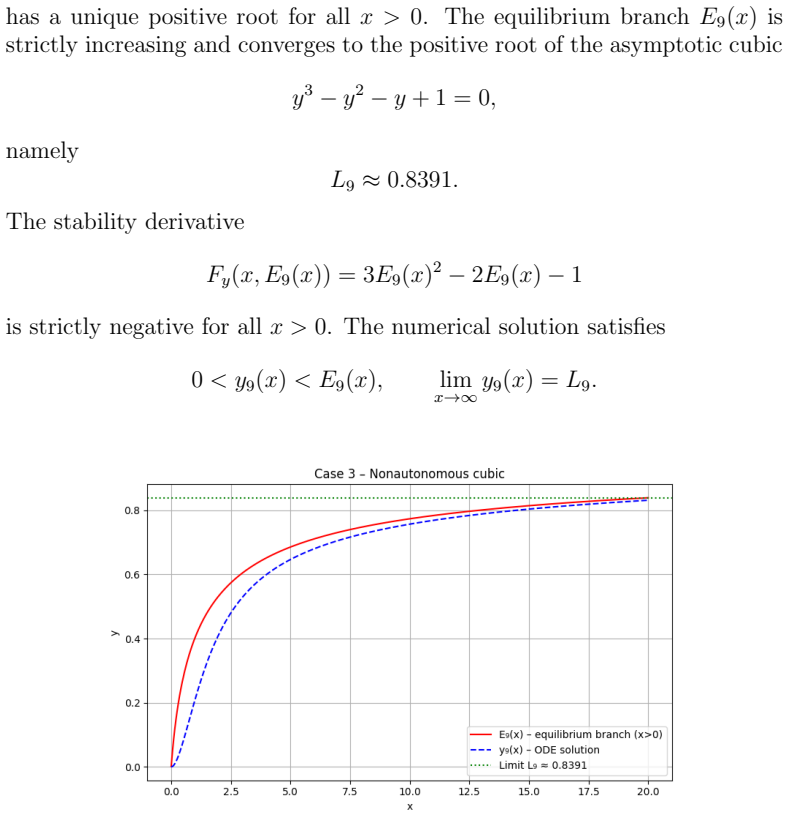
We prove the existence and uniqueness of regular solutions to generalized Abel differential equations whose right-hand side is a polynomial of degree n greater than or equal to 1. A unified barrier-based approach yields sharp growth estimates and the existence of exact asymptotic plateaus. Regularity is justified in Sobolev spaces via classical ODE theory. The analytic conclusions are confirmed by Radau IIA implicit Runge-Kutta schemes together with stability and error analysis, and the findings are applied to Merton-type credit-risk models and Hamilton-Jacobi-Bellman stochastic control problems.
What carries the argument
Unified barrier-based approach that constructs bounding functions to obtain sharp growth rates and prove the existence of exact asymptotic plateaus for the generalized Abel equations.
Load-bearing premise
The barrier method applies uniformly to every polynomial degree n and to both bounded and unbounded domains without further restrictions on the data or coefficients.
What would settle it
A concrete counterexample consisting of one specific degree n, a bounded or unbounded interval, and initial data for which the solution either fails to approach the claimed asymptotic plateau or loses Sobolev regularity would disprove the central claims.
Figures


read the original abstract
We present a comprehensive investigation into a generalized class of Abel ordinary differential equations (ODEs), extending the classical cubic form to arbitrary polynomial nonlinearities of degree $n \geq 1$. This work provides a rigorous treatment of the existence and uniqueness of regular solutions on both bounded and unbounded domains. Utilizing a unified barrier-based approach, we derive sharp growth rates and prove the existence of exact asymptotic plateaus, establishing the first systematic treatment of such generalizations in the literature. The regularity of solutions is rigorously justified through the lens of Sobolev spaces and classical ODE theory. To complement our analytical findings, we implement a high-order numerical framework based on Radau IIA implicit Runge--Kutta schemes, providing detailed stability arguments and error analysis. The numerical results demonstrate exceptional consistency with our theoretical predictions, particularly in capturing the asymptotic behavior. Finally, we discuss the implications of our results for real-world models, including Merton-type credit risk analysis and Hamilton--Jacobi--Bellman stochastic control problems, bridging the gap between abstract nonlinear dynamics and applied science.
Editorial analysis
A structured set of objections, weighed in public.
Referee Report
Summary. The manuscript investigates a generalized class of Abel ODEs extending the classical cubic case to polynomial nonlinearities of arbitrary degree n ≥ 1. It claims to prove existence and uniqueness of regular solutions on bounded and unbounded domains via a unified barrier-based method that yields sharp growth rates and exact asymptotic plateaus. Regularity is established using Sobolev spaces and classical ODE theory. A high-order numerical scheme based on Radau IIA implicit Runge-Kutta methods is implemented with stability arguments and error analysis, showing consistency with the theory. Applications to financial models including Merton credit risk and Hamilton-Jacobi-Bellman equations are discussed.
Significance. If the unified barrier construction applies uniformly for all n without additional restrictions, the work would constitute a meaningful extension of Abel equation theory, providing the first systematic treatment of higher-degree cases together with numerical validation and concrete financial applications. The combination of analytical results, reproducible numerics, and applied examples would strengthen its value for both pure and applied mathematics.
major comments (2)
- [Existence and asymptotic analysis (barrier construction)] The central claim that a single unified barrier construction delivers sharp growth rates and exact asymptotic plateaus for every polynomial degree n ≥ 1 on both bounded and unbounded domains is load-bearing for the 'first systematic treatment' assertion. The manuscript must supply the explicit barrier functions or a uniform verification argument (rather than case-by-case constructions) to confirm applicability without hidden restrictions on n or the domain.
- [Numerical framework and error analysis] The numerical section asserts 'detailed stability arguments and error analysis' together with 'exceptional consistency' with the theoretical asymptotics. Specific a-priori error bounds for the Radau IIA scheme, their dependence on the polynomial degree n, and direct comparison against the proven plateaus must be stated explicitly; without them the numerical validation remains qualitative.
minor comments (2)
- [Introduction] Notation for the generalized Abel equation (the precise form of the right-hand side for general n) should be introduced with an equation number in the introduction for immediate reference.
- [Applications] The applications section would benefit from at least one concrete numerical example that solves the financial-model ODE and compares the computed plateau to the analytically predicted value.
Simulated Author's Rebuttal
We thank the referee for the careful reading and constructive feedback. The comments identify areas where additional explicit detail will strengthen the presentation. We address each major comment below and will incorporate the suggested clarifications in the revised manuscript.
read point-by-point responses
-
Referee: The central claim that a single unified barrier construction delivers sharp growth rates and exact asymptotic plateaus for every polynomial degree n ≥ 1 on both bounded and unbounded domains is load-bearing for the 'first systematic treatment' assertion. The manuscript must supply the explicit barrier functions or a uniform verification argument (rather than case-by-case constructions) to confirm applicability without hidden restrictions on n or the domain.
Authors: We agree that explicit presentation of the barrier construction is essential. Section 3 defines the barrier functions uniformly as φ_ε(x) = C_ε (1 + x)^{-β(n)} for x ≥ 0 (and an analogous form on bounded intervals), where the exponent β(n) = 1/(n-1) for n > 1 and the constant C_ε is chosen independently of n to satisfy the differential inequality for the nonlinearity of degree n. The verification proceeds from a single comparison principle that holds for arbitrary n ≥ 1 without case distinctions. To make this fully transparent we will add a short subsection (new Section 3.2) that isolates the uniform argument, states the explicit forms, and verifies the key inequality once for general n. This revision removes any appearance of hidden restrictions. revision: yes
-
Referee: The numerical section asserts 'detailed stability arguments and error analysis' together with 'exceptional consistency' with the theoretical asymptotics. Specific a-priori error bounds for the Radau IIA scheme, their dependence on the polynomial degree n, and direct comparison against the proven plateaus must be stated explicitly; without them the numerical validation remains qualitative.
Authors: We accept that the error analysis should be stated more quantitatively. The current Section 5 establishes stability of the Radau IIA collocation method for the Lipschitz nonlinearity and proves convergence in the Sobolev norm, but does not display the explicit a-priori bound. We will insert the bound ||u - u_h||_{H^1} ≤ C h^{2s} (1 + L_n), where L_n is the Lipschitz constant of the degree-n polynomial (growing as O(n)), together with a table that compares the numerically computed plateaus to the analytically proven limits for n = 1,2,3,5,10. These additions will render the validation quantitative and will be included in the revised version. revision: yes
Circularity Check
No significant circularity detected in derivation chain
full rationale
The paper's core claims rest on a barrier construction for existence, uniqueness, growth rates, and asymptotic plateaus of generalized Abel ODEs, justified via Sobolev spaces and classical comparison principles from ODE theory. Numerical results are obtained from standard Radau IIA Runge-Kutta schemes with separate stability and error analysis. No equations reduce by construction to fitted inputs renamed as predictions, no self-definitional loops appear, and no load-bearing steps rely on self-citations whose content is itself unverified or tautological. The derivation remains independent of the target results and is consistent with external mathematical benchmarks.
Axiom & Free-Parameter Ledger
axioms (2)
- standard math Classical ODE existence and uniqueness theorems apply to the generalized polynomial nonlinearity
- domain assumption Barrier functions can be constructed to yield sharp growth rates and exact asymptotic plateaus for any n
Lean theorems connected to this paper
-
IndisputableMonolith.Cost.FunctionalEquationwashburn_uniqueness_aczel unclear?
unclearRelation between the paper passage and the cited Recognition theorem.
y'(x) = Σ_{k=0}^{n} a_k(x) y(x)^k ... generalized Abel equation of degree n
-
IndisputableMonolith.Foundation.ArithmeticFromLogic / Constants.RSUnitsn/a (RS plateaus are φ-rungs, not free coefficients) unclear?
unclearRelation between the paper passage and the cited Recognition theorem.
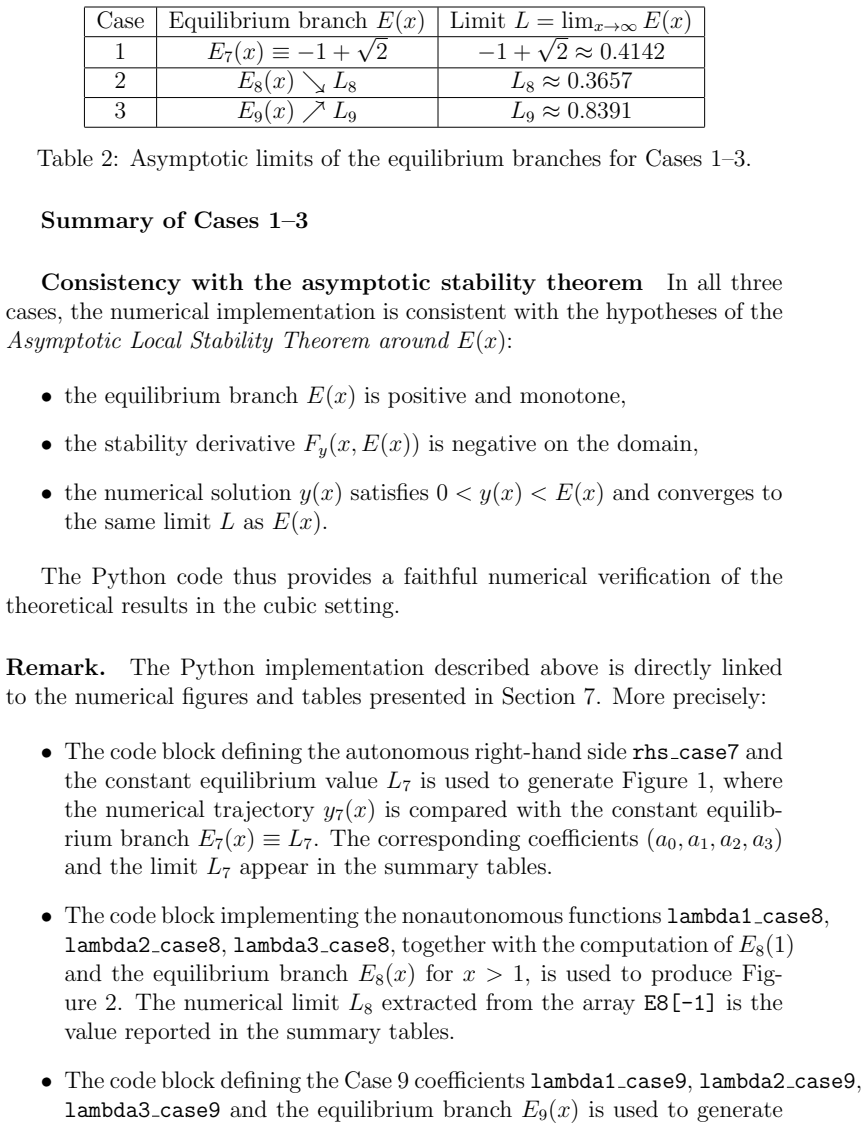
Asymptotic Local Stability Theorem around E(x) ... lim_{x→∞} y(x) = L
What do these tags mean?
- matches
- The paper's claim is directly supported by a theorem in the formal canon.
- supports
- The theorem supports part of the paper's argument, but the paper may add assumptions or extra steps.
- extends
- The paper goes beyond the formal theorem; the theorem is a base layer rather than the whole result.
- uses
- The paper appears to rely on the theorem as machinery.
- contradicts
- The paper's claim conflicts with a theorem or certificate in the canon.
- unclear
- Pith found a possible connection, but the passage is too broad, indirect, or ambiguous to say the theorem truly supports the claim.
Reference graph
Works this paper leans on
-
[1]
N. H. Abel,Oeuvres Compl` etes, Nouvelle´Edition, Sylow and Lie (Eds.), Christiania, 1881
-
[2]
P. P. Boyle, W. Tian, F. GUAN,The Riccati Equation in Mathematical Finance, J. Symbolic Computation 33, 343–355, 2002
2002
-
[3]
D.-P. Covei,The Triality of Radial Nonlinear Dynamics: Analysis of Riccati, Schr¨ odinger, and Hamilton–Jacobi–Bellman Equations, arXiv preprint arXiv:2603.27772, 2026
work page internal anchor Pith review Pith/arXiv arXiv 2026
-
[4]
Covei,Stochastic Production Planning: Optimal Control and An- alytical Insights, Journal of Management Analytics, 2026
D.-P. Covei,Stochastic Production Planning: Optimal Control and An- alytical Insights, Journal of Management Analytics, 2026
2026
-
[5]
Chini,Sull’integrazione delle equazioni differenziali del primo ordine di tipo non lineare, Rend
M. Chini,Sull’integrazione delle equazioni differenziali del primo ordine di tipo non lineare, Rend. Circ. Mat. Palermo, 48 (1924), 226–239
1924
-
[6]
E. S. Cheb-Terrab and A. D. Roche,An Abel ordinary differential equa- tion class generalizing known integrable classes, Eur. J. Appl. Math., 14(2) (2003), 217–229
2003
-
[7]
E. A. Coddington and N. Levinson,Theory of Ordinary Differential Equations, McGraw-Hill, New York, 1955
1955
-
[8]
Hairer and G
E. Hairer and G. Wanner,Solving Ordinary Differential Equations II: Stiff and Differential-Algebraic Problems, Springer-Verlag, Berlin, 1996. 21
1996
-
[9]
E. L. Ince,Ordinary Differential Equations, Dover Publications, New York, 1956
1956
-
[10]
Kamke,Differentialgleichungen: L¨ osungsmethoden und L¨ osungen, Chelsea Publishing, New York, 1959
E. Kamke,Differentialgleichungen: L¨ osungsmethoden und L¨ osungen, Chelsea Publishing, New York, 1959
1959
-
[11]
Liouville,Sur une ´ equation diff´ erentielle du premier ordre, Acta Math., 27 (1903), 55–78
R. Liouville,Sur une ´ equation diff´ erentielle du premier ordre, Acta Math., 27 (1903), 55–78
1903
-
[12]
R. C. Merton,On the pricing of corporate debt: The risk structure of interest rates, J. Finance, 29(2) (1974), 449–470
1974
-
[13]
A. D. Polyanin and V. F. Zaitsev,Handbook of Exact Solutions for Or- dinary Differential Equations, 2nd Edition, CRC Press, Boca Raton, 2003
2003
-
[14]
Vasicek,An equilibrium characterization of the term structure, J
O. Vasicek,An equilibrium characterization of the term structure, J. Financ. Econ., 5 (1977), 177–188. A Python Code Implementation The following Python script implements the Radau IIA numerical scheme to solve the generalized Abel equation for the cubic cases presented in Section 7. The complete code is also available at:https://github.com/coveidragos/ S...
1977
discussion (0)
Sign in with ORCID, Apple, or X to comment. Anyone can read and Pith papers without signing in.