DiffAttn: Diffusion-Based Drivers' Visual Attention Prediction with LLM-Enhanced Semantic Reasoning
Pith reviewed 2026-05-14 21:51 UTC · model grok-4.3
The pith
A diffusion-based model with transformer encoding and language model reasoning predicts drivers' visual attention more accurately than prior methods.
A machine-rendered reading of the paper's core claim, the machinery that carries it, and where it could break.
Core claim
The paper claims that formulating drivers' visual attention prediction as a conditional diffusion-denoising process, using a Swin Transformer encoder to extract scene features, a Feature Fusion Pyramid for cross-layer multi-scale fusion, and an LLM layer to enhance semantic reasoning about safety-critical elements, enables more accurate modeling of attention patterns than existing approaches.
What carries the argument
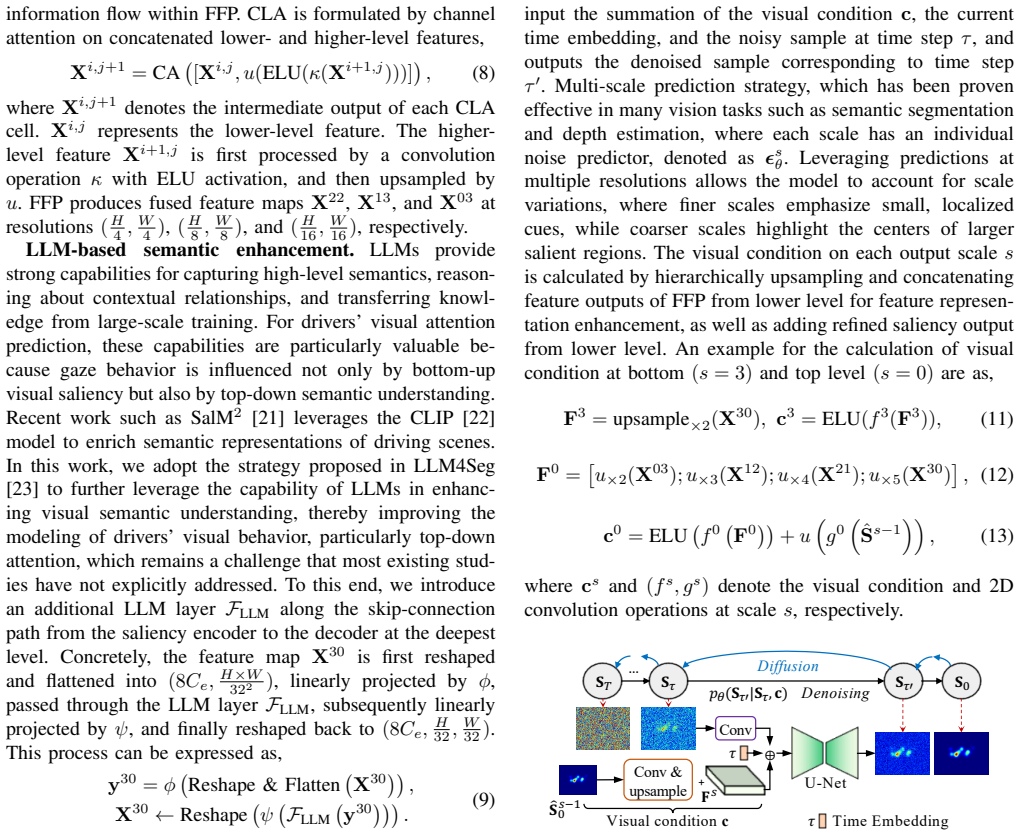
The conditional diffusion-denoising process that progressively removes noise from attention maps while conditioned on encoded scene features and LLM-derived semantic cues.
If this is right
- More precise capture of both fine-grained local details and broader global context in driving scenes.
- Greater sensitivity to safety-critical cues through integrated semantic reasoning from language models.
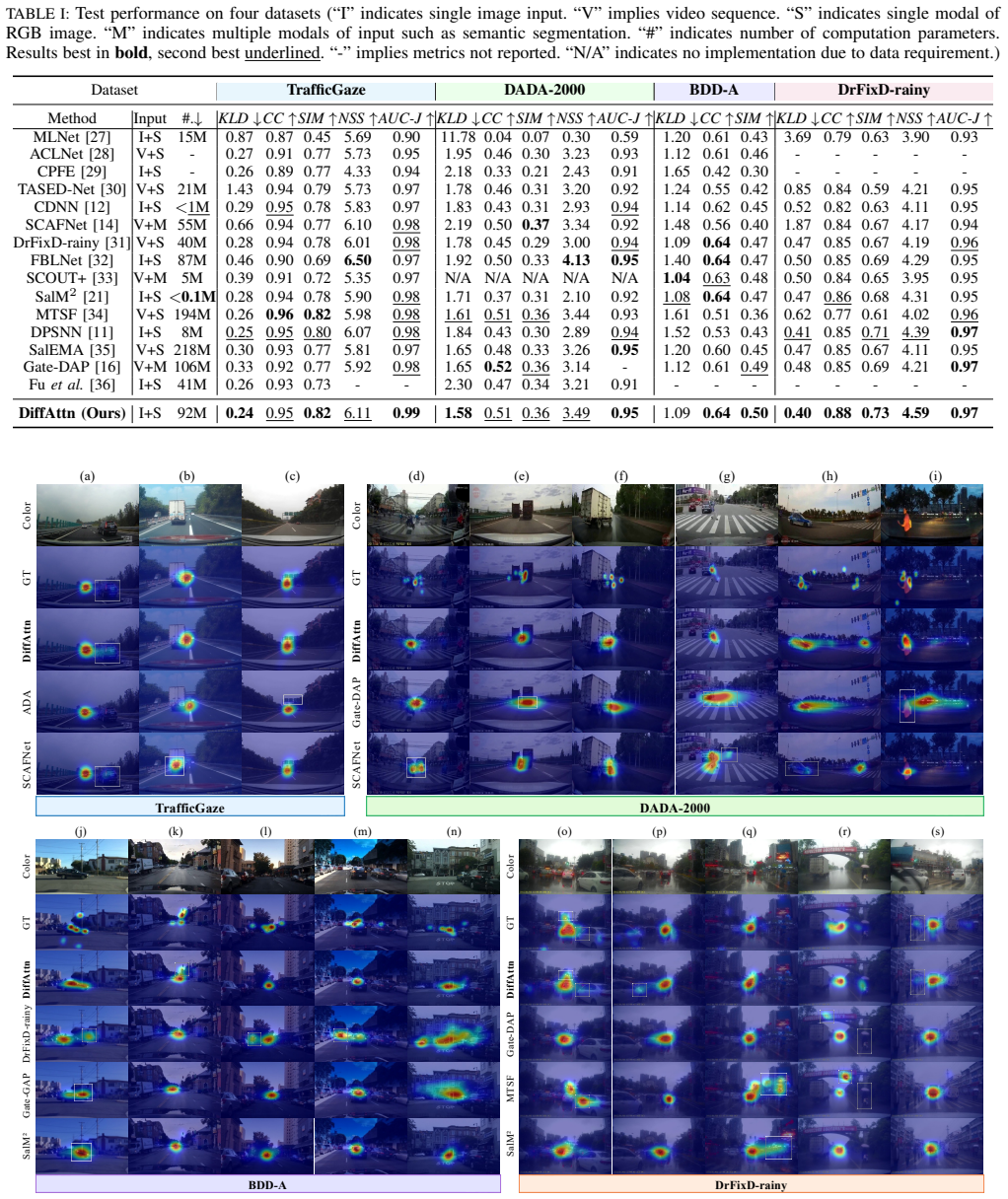
- State-of-the-art performance across four public benchmarks for visual attention prediction.
- Support for interpretable, driver-centric scene understanding in vehicle systems.
- Potential improvements to in-cabin human-machine interaction and risk perception modules.
Where Pith is reading between the lines
- The method could enable earlier hazard anticipation in autonomous driving by aligning more closely with human attention patterns.
- It might extend to predicting attention lapses in driver monitoring systems for fatigue detection.
- Further tests in varied conditions like night driving or heavy traffic could show whether the gains hold beyond the evaluated datasets.
Load-bearing premise
That combining diffusion denoising with transformer-based multi-scale features and language model semantics will reliably outperform baselines across datasets without needing post-hoc tuning or dataset-specific adjustments.
What would settle it
A test on a new held-out driving dataset where DiffAttn's attention prediction scores, such as AUC or correlation coefficients, are compared directly against the top baseline methods to check for consistent gains.
Figures



read the original abstract
Drivers' visual attention provides critical cues for anticipating latent hazards and directly shapes decision-making and control maneuvers, where its absence can compromise traffic safety. To emulate drivers' perception patterns and advance visual attention prediction for intelligent vehicles, we propose DiffAttn, a diffusion-based framework that formulates this task as a conditional diffusion-denoising process, enabling more accurate modeling of drivers' attention. To capture both local and global scene features, we adopt Swin Transformer as encoder and design a decoder that combines a Feature Fusion Pyramid for cross-layer interaction with dense, multi-scale conditional diffusion to jointly enhance denoising learning and model fine-grained local and global scene contexts. Additionally, a large language model (LLM) layer is incorporated to enhance top-down semantic reasoning and improve sensitivity to safety-critical cues. Extensive experiments on four public datasets demonstrate that DiffAttn achieves state-of-the-art (SoTA) performance, surpassing most video-based, top-down-feature-driven, and LLM-enhanced baselines. Our framework further supports interpretable driver-centric scene understanding and has the potential to improve in-cabin human-machine interaction, risk perception, and drivers' state measurement in intelligent vehicles.
Editorial analysis
A structured set of objections, weighed in public.
Referee Report
Summary. The paper proposes DiffAttn, a diffusion-based framework for predicting drivers' visual attention that formulates the task as a conditional diffusion-denoising process. It employs a Swin Transformer encoder, a decoder combining Feature Fusion Pyramid for cross-layer multi-scale interaction with dense conditional diffusion, and an LLM layer for top-down semantic reasoning on safety-critical cues. Extensive experiments on four public datasets are claimed to demonstrate state-of-the-art performance, surpassing most video-based, top-down-feature-driven, and LLM-enhanced baselines, with potential applications in interpretable driver-centric scene understanding for intelligent vehicles.
Significance. If the empirical claims hold with rigorous validation, the work could advance attention modeling in autonomous driving by integrating diffusion processes with transformer architectures and LLM semantics, offering improved capture of local/global features and hazard cues. The approach aligns with growing interest in generative models for vision tasks and could support better risk perception and HMI systems, though its impact depends on demonstrating clear gains over strong baselines.
major comments (3)
- [§4] §4 (Experiments): The central SoTA claim is presented without quantitative tables, specific metric values (e.g., AUC, NSS, CC), error bars, or results from multiple random seeds. This prevents verification of whether gains are statistically significant or protocol-dependent, directly undermining the assertion that the full architecture reliably outperforms baselines.
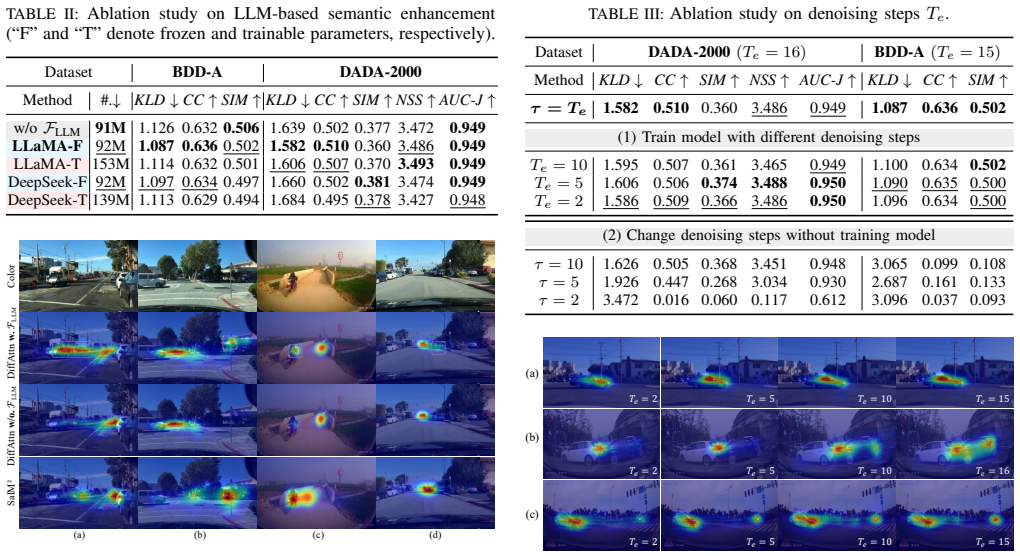
- [§3.2–3.3] §3.2–3.3 (Method, Ablations): No ablation study isolates the contribution of the conditional diffusion-denoising process from the Swin encoder, Feature Fusion Pyramid, or LLM layer. Without this, it is impossible to confirm that the diffusion formulation is load-bearing for the reported improvements rather than the backbone components.
- [§4.2] §4.2 (Baselines): The claim of surpassing 'most' baselines requires explicit enumeration of all compared methods, their implementations, and per-dataset margins. Selective reporting leaves open the possibility that gains are marginal or driven by dataset-specific tuning rather than the proposed framework.
minor comments (2)
- [Abstract] Abstract: The phrase 'surpassing most' baselines should be replaced with precise statements of which methods are outperformed and by what margins once tables are added.
- [§3.3] §3.3 (LLM Integration): The prompt design and integration details for the LLM semantic layer should be expanded with examples to improve reproducibility.
Simulated Author's Rebuttal
We thank the referee for the constructive and detailed comments, which highlight important aspects for strengthening the empirical validation of DiffAttn. We agree that the initial submission would benefit from expanded quantitative reporting, explicit ablations, and fuller baseline documentation. We will revise the manuscript to address these points directly while preserving the core contributions of the diffusion-based formulation, Swin encoder, Feature Fusion Pyramid, and LLM semantic reasoning.
read point-by-point responses
-
Referee: §4 (Experiments): The central SoTA claim is presented without quantitative tables, specific metric values (e.g., AUC, NSS, CC), error bars, or results from multiple random seeds. This prevents verification of whether gains are statistically significant or protocol-dependent, directly undermining the assertion that the full architecture reliably outperforms baselines.
Authors: We acknowledge the need for more rigorous empirical presentation. In the revised manuscript, we will insert comprehensive tables in §4 reporting AUC, NSS, CC, and additional metrics across all four datasets, accompanied by standard deviations from multiple random seeds and p-values from statistical significance tests (e.g., paired t-tests) against baselines. This will allow direct verification of the reported gains. revision: yes
-
Referee: §3.2–3.3 (Method, Ablations): No ablation study isolates the contribution of the conditional diffusion-denoising process from the Swin encoder, Feature Fusion Pyramid, or LLM layer. Without this, it is impossible to confirm that the diffusion formulation is load-bearing for the reported improvements rather than the backbone components.
Authors: We will add a dedicated ablation subsection in §3.3 that isolates the conditional diffusion-denoising component. Specifically, we will compare the full DiffAttn model against controlled variants that replace the diffusion-denoising process with a deterministic decoder (while retaining the identical Swin encoder, Feature Fusion Pyramid, and LLM layer) and report the resulting performance drops on the same datasets and metrics. revision: yes
-
Referee: §4.2 (Baselines): The claim of surpassing 'most' baselines requires explicit enumeration of all compared methods, their implementations, and per-dataset margins. Selective reporting leaves open the possibility that gains are marginal or driven by dataset-specific tuning rather than the proposed framework.
Authors: In the revised §4.2, we will provide an exhaustive enumeration table listing every baseline (video-based, top-down-feature-driven, and LLM-enhanced), its original reference, implementation source (official code or re-implementation details), and per-dataset performance margins (absolute and relative) against DiffAttn. This will clarify the scope and consistency of the improvements. revision: yes
Circularity Check
No circularity: empirical architecture proposal validated on public datasets without self-referential derivations
full rationale
The paper proposes DiffAttn as a conditional diffusion-denoising framework using Swin Transformer encoder, Feature Fusion Pyramid decoder, and LLM semantic layer. No equations, derivations, or closed-form predictions are presented in the provided text that reduce any claimed performance or attention modeling to a fitted parameter or input by construction. The SoTA claim rests on experimental results across four public datasets rather than any mathematical chain that loops back to its own definitions or self-citations. No load-bearing self-citation, ansatz smuggling, or renaming of known results is evident. The framework is self-contained as an empirical ML architecture with independent experimental support.
Axiom & Free-Parameter Ledger
Lean theorems connected to this paper
-
IndisputableMonolith/Foundation/Cost/FunctionalEquation.leanwashburn_uniqueness_aczel unclear?
unclearRelation between the paper passage and the cited Recognition theorem.
formulates this task as a conditional diffusion-denoising process... Swin Transformer as encoder... Feature Fusion Pyramid... LLM layer... LLaMA 3.2-1B
What do these tags mean?
- matches
- The paper's claim is directly supported by a theorem in the formal canon.
- supports
- The theorem supports part of the paper's argument, but the paper may add assumptions or extra steps.
- extends
- The paper goes beyond the formal theorem; the theorem is a base layer rather than the whole result.
- uses
- The paper appears to rely on the theorem as machinery.
- contradicts
- The paper's claim conflicts with a theorem or certificate in the canon.
- unclear
- Pith found a possible connection, but the passage is too broad, indirect, or ambiguous to say the theorem truly supports the claim.
Reference graph
Works this paper leans on
-
[1]
Understanding driver preferences for secondary tasks in highly autonomous vehicles,
Q. Li, Z. Wang, W. Wang, and Q. Yuan, “Understanding driver preferences for secondary tasks in highly autonomous vehicles,” in International Conference on Man-Machine-Environment System Engi- neering. Springer, 2022, pp. 126–133
work page 2022
-
[2]
Deep learning based take-over performance prediction and its application on intelligent vehicles,
W. Liu, Q. Li, W. Wang, Z. Wang, C. Zeng, and B. Cheng, “Deep learning based take-over performance prediction and its application on intelligent vehicles,”IEEE Transactions on Intelligent Vehicles, 2024
work page 2024
-
[3]
W. Liu, Q. Li, Z. Wang, W. Wang, C. Zeng, and B. Cheng, “A literature review on additional semantic information conveyed from driving automation systems to drivers through advanced in-vehicle hmi just before, during, and right after takeover request,”International Journal of Human–Computer Interaction, vol. 39, no. 10, pp. 1995– 2015, 2023
work page 1995
-
[4]
J. Qiu, C. Jiang, and H. Wang, “Etformer: An efficient transformer based on multimodal hybrid fusion and representation learning for rgb-dt salient object detection,”IEEE Signal Processing Letters, 2024
work page 2024
-
[5]
Evsmap: An efficient volumetric-semantic mapping approach for embedded systems,
J. Qiu, C. Jiang, P. Zhang, and H. Wang, “Evsmap: An efficient volumetric-semantic mapping approach for embedded systems,” in 2024 IEEE/RSJ International Conference on Intelligent Robots and Systems (IROS). IEEE, 2024, pp. 9839–9846
work page 2024
-
[6]
S. Baee, E. Pakdamanian, I. Kim, L. Feng, V . Ordonez, and L. Barnes, “Medirl: Predicting the visual attention of drivers via maximum entropy deep inverse reinforcement learning,” inProceedings of the IEEE/CVF international conference on computer vision, 2021, pp. 13 178–13 188
work page 2021
-
[7]
Deeptake: Prediction of driver takeover behavior using multimodal data,
E. Pakdamanian, S. Sheng, S. Baee, S. Heo, S. Kraus, and L. Feng, “Deeptake: Prediction of driver takeover behavior using multimodal data,” inProceedings of the 2021 CHI Conference on Human Factors in Computing Systems, 2021, pp. 1–14
work page 2021
-
[8]
Q. Li, Y . Su, W. Wang, Z. Wang, J. He, G. Li, C. Zeng, and B. Cheng, “Latent hazard notification for highly automated driving: Expected safety benefits and driver behavioral adaptation,”IEEE Transactions on Intelligent Transportation Systems, 2023
work page 2023
-
[9]
A saliency-based search mechanism for overt and covert shifts of visual attention,
L. Itti and C. Koch, “A saliency-based search mechanism for overt and covert shifts of visual attention,”Vision research, vol. 40, no. 10-12, pp. 1489–1506, 2000
work page 2000
-
[10]
Attention for vision-based assistive and automated driving: a review of algorithms and datasets,
I. Kotseruba and J. K. Tsotsos, “Attention for vision-based assistive and automated driving: a review of algorithms and datasets,”IEEE transactions on intelligent transportation systems, 2022
work page 2022
-
[11]
A driving position-sensitive neural network for driver fixation prediction,
S. Ji, T. Deng, F. Yan, and P. Du, “A driving position-sensitive neural network for driver fixation prediction,” in2022 41st Chinese Control Conference (CCC). IEEE, 2022, pp. 6660–6665
work page 2022
-
[12]
T. Deng, H. Yan, L. Qin, T. Ngo, and B. Manjunath, “How do drivers allocate their potential attention? driving fixation prediction via convolutional neural networks,”IEEE Transactions on Intelligent Transportation Systems, vol. 21, no. 5, pp. 2146–2154, 2019
work page 2019
-
[14]
Dada: Driver attention prediction in driving accident scenarios,
J. Fang, D. Yan, J. Qiao, J. Xue, and H. Yu, “Dada: Driver attention prediction in driving accident scenarios,”IEEE transactions on intel- ligent transportation systems, vol. 23, no. 6, pp. 4959–4971, 2021
work page 2021
-
[15]
An Image is Worth 16x16 Words: Transformers for Image Recognition at Scale
A. Dosovitskiy, L. Beyer, A. Kolesnikov, D. Weissenborn, X. Zhai, T. Unterthiner, M. Dehghani, M. Minderer, G. Heigold, S. Gellyet al., “An image is worth 16x16 words: Transformers for image recognition at scale,”arXiv preprint arXiv:2010.11929, 2020
work page internal anchor Pith review Pith/arXiv arXiv 2010
-
[16]
Gated driver attention pre- dictor,
T. Zhao, X. Bai, J. Fang, and J. Xue, “Gated driver attention pre- dictor,” in2023 IEEE 26th International Conference on Intelligent Transportation Systems (ITSC). IEEE, 2023, pp. 270–276
work page 2023
-
[17]
A review of interac- tions between peripheral and foveal vision,
E. E. Stewart, M. Valsecchi, and A. C. Sch ¨utz, “A review of interac- tions between peripheral and foveal vision,”Journal of vision, vol. 20, no. 12, pp. 2–2, 2020
work page 2020
-
[18]
Denoising diffusion probabilistic models,
J. Ho, A. Jain, and P. Abbeel, “Denoising diffusion probabilistic models,”Advances in neural information processing systems, vol. 33, pp. 6840–6851, 2020
work page 2020
-
[19]
Improved techniques for training score- based generative models,
Y . Song and S. Ermon, “Improved techniques for training score- based generative models,”Advances in neural information processing systems, vol. 33, pp. 12 438–12 448, 2020
work page 2020
-
[20]
Swin transformer: Hierarchical vision transformer using shifted windows,
Z. Liu, Y . Lin, Y . Cao, H. Hu, Y . Wei, Z. Zhang, S. Lin, and B. Guo, “Swin transformer: Hierarchical vision transformer using shifted windows,” inProceedings of the IEEE/CVF international conference on computer vision, 2021, pp. 10 012–10 022
work page 2021
-
[21]
C. Zhao, W. Mu, X. Zhou, W. Liu, F. Yan, and T. Deng, “Salm 2: An extremely lightweight saliency mamba model for real-time cognitive awareness of driver attention,” inProceedings of the AAAI Conference on Artificial Intelligence, vol. 39, no. 2, 2025, pp. 1647–1655
work page 2025
-
[22]
Learning transferable visual models from natural language supervision,
A. Radford, J. W. Kim, C. Hallacy, A. Ramesh, G. Goh, S. Agarwal, G. Sastry, A. Askell, P. Mishkin, J. Clarket al., “Learning transferable visual models from natural language supervision,” inInternational conference on machine learning. PmLR, 2021, pp. 8748–8763
work page 2021
-
[23]
Pre-trained llm is a semantic-aware and generalizable segmentation booster,
F. Tang, W. Ma, Z. He, X. Tao, Z. Jiang, and S. K. Zhou, “Pre-trained llm is a semantic-aware and generalizable segmentation booster,”arXiv preprint arXiv:2506.18034, 2025
-
[24]
Predicting driver attention in critical situations,
Y . Xia, D. Zhang, J. Kim, K. Nakayama, K. Zipser, and D. Whitney, “Predicting driver attention in critical situations,” inComputer Vision– ACCV 2018: 14th Asian Conference on Computer Vision, Perth, Australia, December 2–6, 2018, Revised Selected Papers, Part V 14. Springer, 2019, pp. 658–674
work page 2018
-
[25]
H. Tian, T. Deng, and H. Yan, “Driving as well as on a sunny day? predicting driver’s fixation in rainy weather conditions via a dual- branch visual model,”IEEE/CAA Journal of Automatica Sinica, vol. 9, no. 7, pp. 1335–1338, 2022
work page 2022
-
[26]
A. Dubey, A. Jauhri, A. Pandey, A. Kadian, A. Al-Dahle, A. Letman, A. Mathur, A. Schelten, A. Yang, A. Fanet al., “The llama 3 herd of models,”arXiv e-prints, pp. arXiv–2407, 2024
work page 2024
-
[27]
A deep multi- level network for saliency prediction,
M. Cornia, L. Baraldi, G. Serra, and R. Cucchiara, “A deep multi- level network for saliency prediction,” in2016 23rd International Conference on Pattern Recognition (ICPR). IEEE, 2016, pp. 3488– 3493
work page 2016
-
[28]
Revisiting video saliency: A large-scale benchmark and a new model,
W. Wang, J. Shen, F. Guo, M.-M. Cheng, and A. Borji, “Revisiting video saliency: A large-scale benchmark and a new model,” in Proceedings of the IEEE Conference on computer vision and pattern recognition, 2018, pp. 4894–4903
work page 2018
-
[29]
Pyramid feature attention network for saliency detection,
T. Zhao and X. Wu, “Pyramid feature attention network for saliency detection,” inProceedings of the IEEE/CVF conference on computer vision and pattern recognition, 2019, pp. 3085–3094
work page 2019
-
[30]
Tased-net: Temporally-aggregating spatial encoder-decoder network for video saliency detection,
K. Min and J. J. Corso, “Tased-net: Temporally-aggregating spatial encoder-decoder network for video saliency detection,” inProceedings of the IEEE/CVF International Conference on Computer Vision, 2019, pp. 2394–2403
work page 2019
-
[31]
T. Deng, L. Jiang, Y . Shi, J. Wu, Z. Wu, S. Yan, X. Zhang, and H. Yan, “Driving visual saliency prediction of dynamic night scenes via a spatio-temporal dual-encoder network,”IEEE Transactions on Intelligent Transportation Systems, vol. 25, no. 3, pp. 2413–2423, 2023
work page 2023
-
[32]
Fblnet: Feedback loop network for driver attention prediction,
Y . Chen, Z. Nan, and T. Xiang, “Fblnet: Feedback loop network for driver attention prediction,” inProceedings of the IEEE/CVF International Conference on Computer Vision, 2023, pp. 13 371– 13 380
work page 2023
-
[33]
Scout+: Towards practical task-driven drivers’ gaze prediction,
I. Kotseruba and J. K. Tsotsos, “Scout+: Towards practical task-driven drivers’ gaze prediction,” in2024 IEEE Intelligent Vehicles Symposium (IV). IEEE, 2024, pp. 1927–1932
work page 2024
-
[34]
Mtsf: Multi-scale temporal–spatial fusion network for driver attention prediction,
L. Jin, B. Ji, B. Guo, H. Wang, Z. Han, and X. Liu, “Mtsf: Multi-scale temporal–spatial fusion network for driver attention prediction,”IEEE Transactions on Intelligent Transportation Systems, 2024
work page 2024
-
[35]
Simple vs complex temporal recurrences for video saliency prediction
P. Linardos, E. Mohedano, J. J. Nieto, N. E. O’Connor, X. Giro-i Nieto, and K. McGuinness, “Simple vs complex temporal recurrences for video saliency prediction,”arXiv preprint arXiv:1907.01869, 2019
work page internal anchor Pith review Pith/arXiv arXiv 1907
-
[36]
R. Fu, T. Huang, M. Li, Q. Sun, and Y . Chen, “A multimodal deep neural network for prediction of the driver’s focus of attention based on anthropomorphic attention mechanism and prior knowledge,”Expert Systems with Applications, vol. 214, p. 119157, 2023
work page 2023
-
[37]
DeepSeek-R1: Incentivizing Reasoning Capability in LLMs via Reinforcement Learning
D. Guo, D. Yang, H. Zhang, J. Song, R. Zhang, R. Xu, Q. Zhu, S. Ma, P. Wang, X. Biet al., “Deepseek-r1: Incentivizing reasoning capability in llms via reinforcement learning,”arXiv preprint arXiv:2501.12948, 2025
work page internal anchor Pith review Pith/arXiv arXiv 2025
discussion (0)
Sign in with ORCID, Apple, or X to comment. Anyone can read and Pith papers without signing in.