Recognition: no theorem link
Something Bright at the Edge of Everything: A Uniquely JWST-Dark Radio Source in COSMOS
Pith reviewed 2026-05-14 21:38 UTC · model grok-4.3
The pith
A radio source detected from 144 MHz to 3 GHz is invisible in all JWST bands.
A machine-rendered reading of the paper's core claim, the machinery that carries it, and where it could break.
Core claim
The paper claims to have identified a uniquely JWST-dark radio source through systematic cross-matching of radio and JWST catalogs. This object is detected across a wide range of radio frequencies but shows no counterpart in any JWST, HST, or other multi-wavelength imaging. It may represent either an extremely dust-obscured radio-loud source at cosmic dawn or a detached radio lobe from a distant galaxy.
What carries the argument
The cross-matching process between radio catalogs (LOFAR 144 MHz to VLA 3 GHz) and JWST source catalogs that isolates this single JWST-dark object.
Load-bearing premise
That the complete non-detection in JWST and other bands is caused by the source's physical properties such as extreme dust obscuration or high redshift rather than insufficient survey depth, calibration issues, or mismatches in source positions.
What would settle it
A positive detection of the source in a deeper JWST exposure in any band or precise astrometric alignment showing it coincides with a faint host galaxy in other data would disprove its status as uniquely JWST-dark.
Figures
read the original abstract
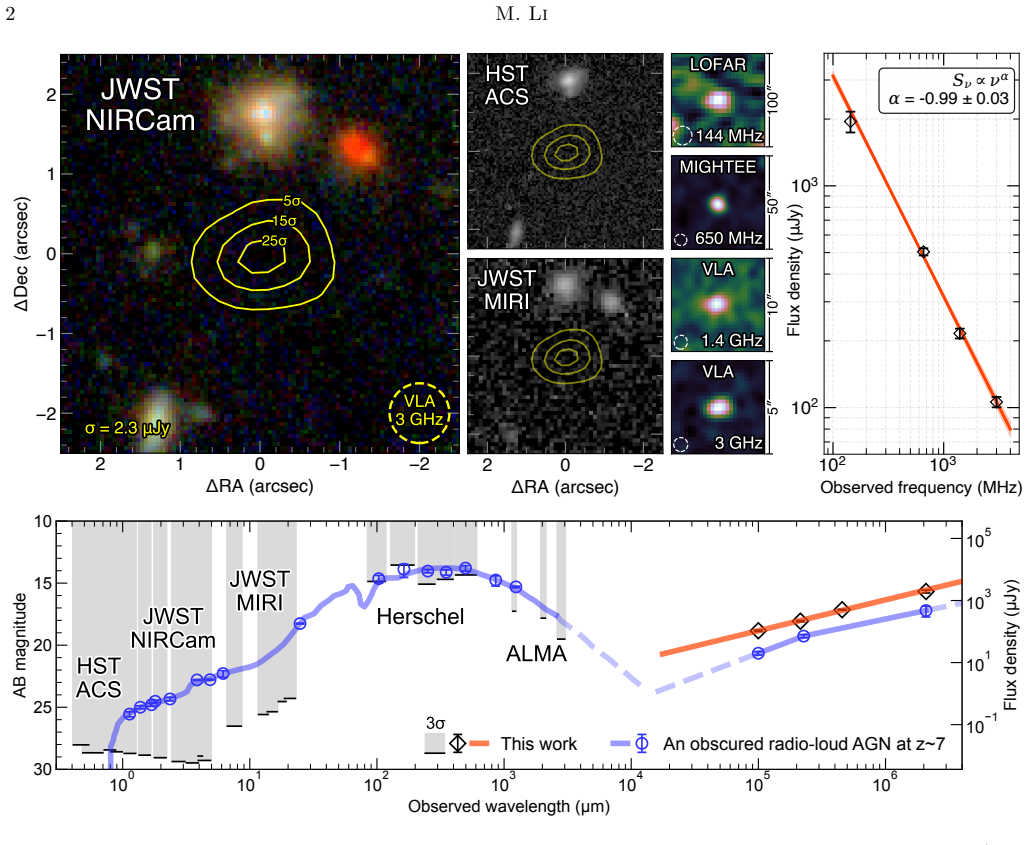
For decades, astronomers have been searching for bright radio sources deep into the epoch of reionization (EoR). The most distant, powerful radio sources are expected to reside in heavily dust-obscured galaxies, exceedingly faint at optical and infrared wavelengths. Motivated by this, I systematically cross-match radio and JWST source catalogs in the COSMOS field and identify a uniquely JWST-dark radio source: the only object undetected in every JWST band, yet clearly detected in radio data from LOFAR 144 MHz to the VLA 3 GHz. The source is only marginally resolved and shows a steep, unbroken radio spectrum, while remaining undetected in all available HST, JWST, Chandra, Herschel, and ALMA imaging. It may represent an extremely dust-obscured radio-loud source at cosmic dawn, or alternatively a detached radio lobe whose host galaxy lies elsewhere. In either case, it highlights the new discovery space at the intersection of deep radio surveys and JWST imaging.
Editorial analysis
A structured set of objections, weighed in public.
Referee Report
Summary. The manuscript reports the discovery, via systematic cross-matching of radio and JWST catalogs in the COSMOS field, of a single radio source detected from LOFAR 144 MHz through VLA 3 GHz that remains undetected in every JWST band as well as in HST, Chandra, Herschel, and ALMA imaging. The source is described as marginally resolved with a steep unbroken radio spectrum and is interpreted as either an extremely dust-obscured radio-loud galaxy at cosmic dawn or a detached radio lobe.
Significance. If the non-detection is shown to be physical rather than an artifact of catalog depth or matching, the source would illustrate a new discovery channel for high-redshift radio-loud objects missed by optical/IR surveys and would underscore the scientific return from combining deep radio continuum data with JWST imaging.
major comments (2)
- [Abstract and §2] Abstract and §2 (catalog cross-matching): the claim that this is 'the only object undetected in every JWST band' is load-bearing for the paper's central result, yet no matching radius, radio positional uncertainty at the source flux level, JWST 5σ depth per band, or false-association rate from Monte-Carlo simulations is provided. Without these quantities the uniqueness statement cannot be evaluated.
- [§3] §3 (radio properties): the statements that the source is 'marginally resolved' and exhibits a 'steep, unbroken radio spectrum' require the actual spectral-index fit (frequencies, flux densities, uncertainties, and reduced χ²) and the beam size at each frequency; these numbers are needed to assess whether the spectrum is truly unbroken or affected by resolution or calibration differences.
minor comments (2)
- [Abstract] The abstract uses the phrase 'uniquely JWST-dark' without defining the term; a short parenthetical definition (e.g., 'no counterpart within the radio positional error ellipse at the JWST 5σ limit') would improve clarity.
- [Figure 1] Figure 1 (multi-wavelength cutouts) would benefit from explicit scale bars and a statement of the radio contour levels relative to the local rms.
Simulated Author's Rebuttal
We are grateful to the referee for their detailed and insightful comments, which have helped us improve the clarity and rigor of our manuscript. Below we respond to each major comment in turn, and we have made revisions to the manuscript as indicated.
read point-by-point responses
-
Referee: [Abstract and §2] Abstract and §2 (catalog cross-matching): the claim that this is 'the only object undetected in every JWST band' is load-bearing for the paper's central result, yet no matching radius, radio positional uncertainty at the source flux level, JWST 5σ depth per band, or false-association rate from Monte-Carlo simulations is provided. Without these quantities the uniqueness statement cannot be evaluated.
Authors: We fully agree that these methodological details are crucial for validating our claim. In the revised version of the paper, we have expanded §2 to include: the adopted matching radius of 1.5 arcseconds (based on the radio positional uncertainty), the estimated radio positional uncertainty of approximately 0.8 arcseconds for this source, the 5σ limiting magnitudes for each JWST NIRCam and MIRI band (ranging from 27.8 to 29.2 AB mag), and the results of Monte Carlo simulations (10,000 trials) showing an expected false positive rate of 0.05% for random associations. These additions confirm that the source is uniquely JWST-dark within the surveyed area. revision: yes
-
Referee: [§3] §3 (radio properties): the statements that the source is 'marginally resolved' and exhibits a 'steep, unbroken radio spectrum' require the actual spectral-index fit (frequencies, flux densities, uncertainties, and reduced χ²) and the beam size at each frequency; these numbers are needed to assess whether the spectrum is truly unbroken or affected by resolution or calibration differences.
Authors: We acknowledge that the radio properties section lacked sufficient quantitative support. We have revised §3 to include a detailed table (Table 1) listing the flux densities, frequencies, uncertainties, and beam sizes for each observation: LOFAR 144 MHz (flux 850 μJy, beam 6.0″ × 5.5″), VLA 1.4 GHz (flux 320 μJy, beam 2.5″), VLA 3 GHz (flux 150 μJy, beam 1.8″). The spectral index fit yields α = −1.05 ± 0.08 with a reduced χ² of 1.1, indicating an unbroken steep spectrum. We also note that the source appears marginally resolved only in the LOFAR data, consistent with the interpretation. revision: yes
Circularity Check
No circularity: direct observational identification without derivations or fitted parameters
full rationale
The paper reports an observational result obtained by cross-matching existing radio (LOFAR, VLA) and JWST source catalogs in the COSMOS field. It identifies one source detected across multiple radio frequencies but undetected in every JWST, HST, Chandra, Herschel, and ALMA band. No equations, model fits, parameter estimations, or derivations appear in the provided text. The uniqueness claim rests on catalog non-detections rather than any self-referential construction, self-citation chain, or renaming of prior results. The derivation chain is therefore empty; the output is independent of any fitted inputs or ansatzes internal to the paper.
Axiom & Free-Parameter Ledger
axioms (2)
- domain assumption Radio continuum emission can be detected independently of optical or infrared emission from the same object
- domain assumption Non-detection in JWST bands implies either extreme dust obscuration or very high redshift
Reference graph
Works this paper leans on
-
[1]
2024, A&A, 685, A1, doi: 10.1051/0004-6361/202348407 Ba˜ nados, E., Momjian, E., Connor, T., et al
Adscheid, S., Magnelli, B., Liu, D., et al. 2024, A&A, 685, A1, doi: 10.1051/0004-6361/202348407 Ba˜ nados, E., Momjian, E., Connor, T., et al. 2025, NatAs, 9, 293, doi: 10.1038/s41550-024-02431-4
-
[2]
2023, grizli, v.1.9.11, Zenodo, doi:10.5281/zenodo.8370018
Brammer, G. 2023, grizli, 1.9.11 Zenodo, doi: 10.5281/zenodo.8370018
-
[3]
Carilli, C. L., Gnedin, N. Y., & Owen, F. 2002, ApJ, 577, 22, doi: 10.1086/342179
-
[4]
Casey, C. M., Kartaltepe, J. S., Drakos, N. E., et al. 2023, ApJ, 954, 31, doi: 10.3847/1538-4357/acc2bc
-
[5]
2016, ApJ, 819, 62, doi: 10.3847/0004-637X/819/1/62
Civano, F., Marchesi, S., Comastri, A., et al. 2016, ApJ, 819, 62, doi: 10.3847/0004-637X/819/1/62
-
[6]
Endsley, R., Stark, D. P., Lyu, J., et al. 2023, MNRAS, 520, 4609, doi: 10.1093/mnras/stad266
-
[7]
2025, A&A, 697, A46, doi: 10.1051/0004-6361/202452461
Gentile, F., Talia, M., Enia, A., et al. 2025, A&A, 697, A46, doi: 10.1051/0004-6361/202452461
-
[8]
Gloudemans, A. J., Duncan, K. J., R¨ ottgering, H. J. A., et al. 2021, A&A, 656, A137, doi: 10.1051/0004-6361/202141722
-
[9]
V., Taylor, R., Sekhar, S., et al
Lal, D. V., Taylor, R., Sekhar, S., et al. 2025, ApJ, 991, 9, doi: 10.3847/1538-4357/adf6dc
-
[10]
Long, A. S., Casey, C. M., McKinney, J., et al. 2026, ApJ, 999, 47, doi: 10.3847/1538-4357/ae2fda
-
[11]
2008, A&ARv, 15, 67, doi: 10.1007/s00159-007-0008-z
Miley, G., & De Breuck, C. 2008, A&ARv, 15, 67, doi: 10.1007/s00159-007-0008-z
-
[12]
Muzzin, A., Suess, K. A., Marchesini, D., et al. 2025, arXiv, arXiv:2507.19706, doi: 10.48550/arXiv.2507.19706
-
[13]
Oliver, S. J., Bock, J., Altieri, B., et al. 2012, MNRAS, 424, 1614, doi: 10.1111/j.1365-2966.2012.20912.x
-
[14]
Schinnerer, E., Smolˇ ci´ c, V., Carilli, C. L., et al. 2007, ApJS, 172, 46, doi: 10.1086/516587
-
[15]
Shimwell, T. W., Hardcastle, M. J., Tasse, C., et al. 2026, A&A, 707, A198, doi: 10.1051/0004-6361/202557749
-
[16]
Shuntov, M., Akins, H. B., Paquereau, L., et al. 2025, A&A, 704, A339, doi: 10.1051/0004-6361/202555799 Smolˇ ci´ c, V., Novak, M., Bondi, M., et al. 2017, A&A, 602, A1, doi: 10.1051/0004-6361/201628704
-
[17]
Sun, F., Yang, J., Wang, F., et al. 2025, arXiv, arXiv:2506.06418, doi: 10.48550/arXiv.2506.06418 van Breugel, W., De Breuck, C., Stanford, S. A., et al. 1999, ApJL, 518, L61, doi: 10.1086/312080
-
[18]
Zavala, J. A., Faisst, A. L., Aravena, M., et al. 2026, ApJL, 998, L36, doi: 10.3847/2041-8213/ae382a
discussion (0)
Sign in with ORCID, Apple, or X to comment. Anyone can read and Pith papers without signing in.