Recognition: no theorem link
Non-stabilizerness and U(1) symmetry in chaotic many-body quantum systems
Pith reviewed 2026-05-14 21:21 UTC · model grok-4.3
The pith
A conserved U(1) charge substantially suppresses non-stabilizerness in Haar random quantum states.
A machine-rendered reading of the paper's core claim, the machinery that carries it, and where it could break.
Core claim
We present exact, closed-form results for the non-stabilizerness of random pure states subject to a U(1) symmetry constraint. Using stabilizer entropy as our non-stabilizerness monotone, we derive the average and the variance for U(1)-constrained Haar random states. We show that the presence of a conserved charge leads to a substantial suppression of non-stabilizerness (magic) compared to the unconstrained case, and identify a qualitative difference between entanglement and magic response. In the thermodynamic limit, stabilizer entropy exhibits a different leading-order scaling close to a vanishing relative charge density, implying that magic is more robust to charge density fluctuations.
What carries the argument
The U(1)-constrained Haar ensemble, which restricts random pure states to a fixed total charge sector and yields closed-form expressions for the moments of stabilizer entropy.
Load-bearing premise
The quantum states are distributed exactly according to the Haar measure restricted to one U(1) symmetry sector.
What would settle it
A direct numerical computation of the average stabilizer entropy in the midspectrum of the complex SYK model that deviates from the derived closed-form expression at large system size.
Figures







read the original abstract
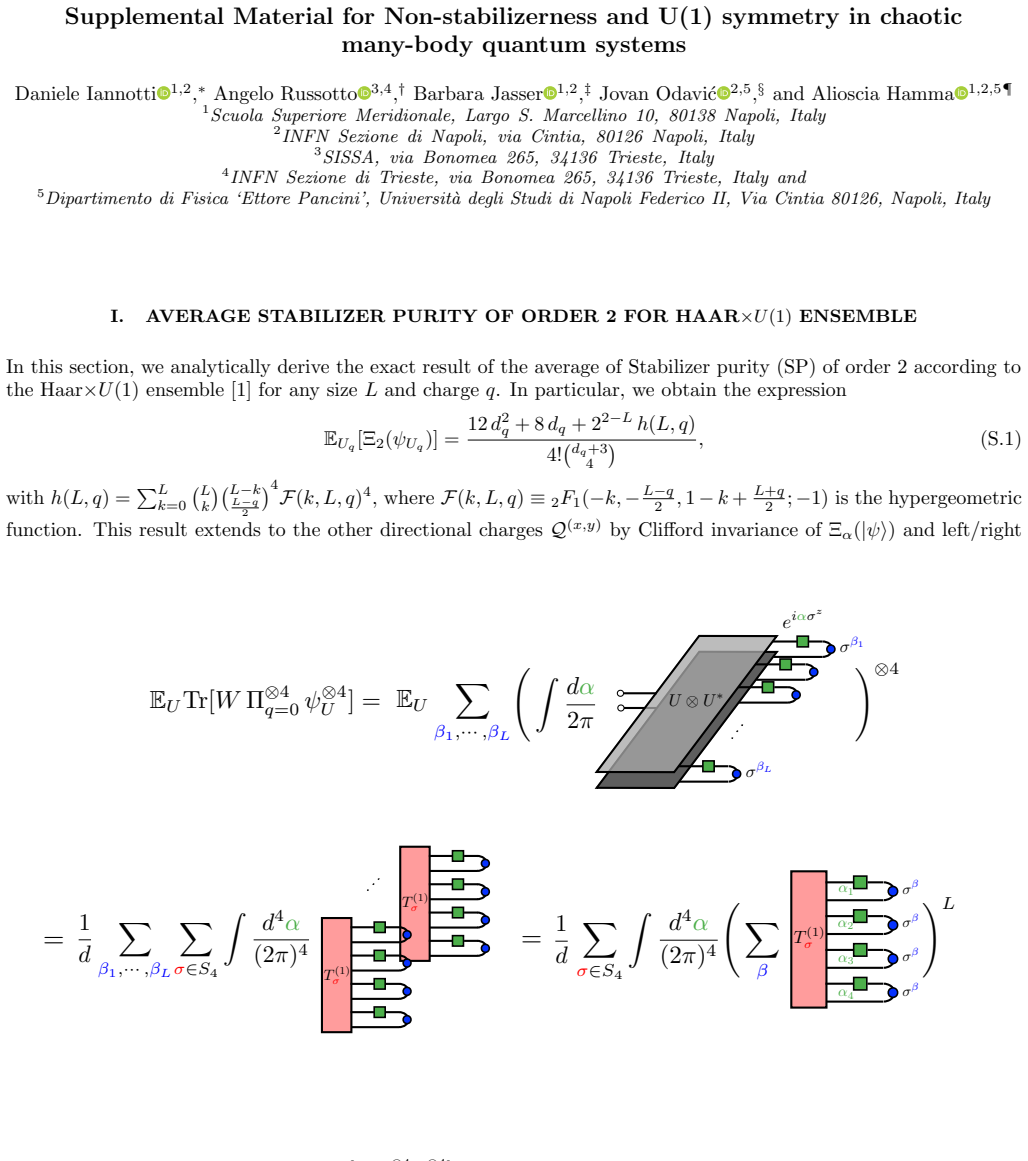
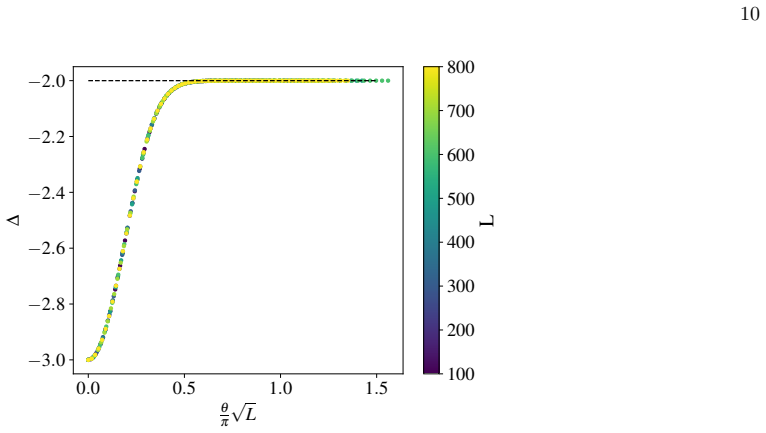
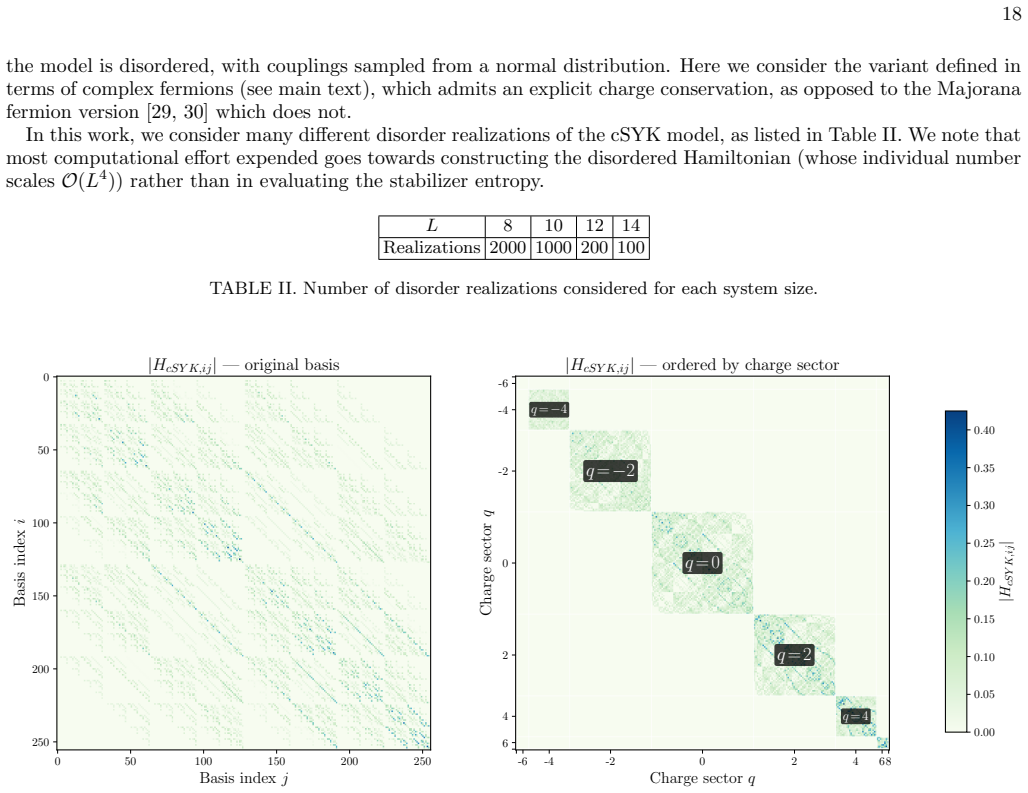
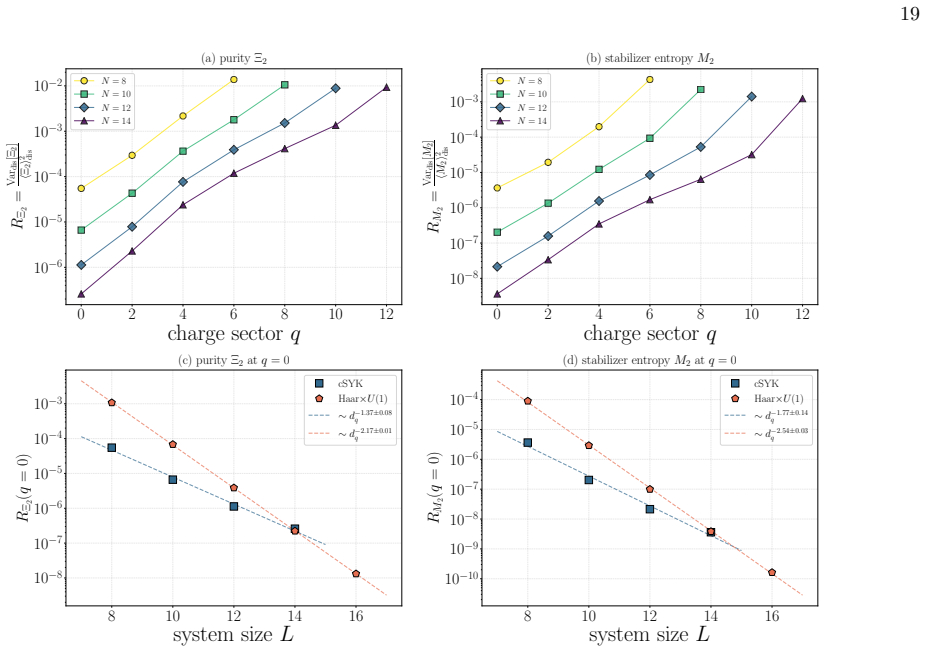
We present exact, closed-form results for the non-stabilizerness of random pure states subject to a U(1) symmetry constraint. Using stabilizer entropy as our non-stabilizerness monotone, we derive the average and the variance for U(1)-constrained Haar random states. We show that the presence of a conserved charge leads to a substantial suppression of non-stabilizerness (magic) compared to the unconstrained case, and identify a qualitative difference between entanglement and magic response. In the thermodynamic limit, stabilizer entropy exhibits a different leading-order scaling close to a vanishing relative charge density, implying that magic is more robust to charge density fluctuations than entanglement entropy. We test our analytical predictions against midspectrum eigenstates of two chaotic many-body systems with conserved U(1) charge: the complex-fermion Sachdev-Ye-Kitaev (cSYK) model and a Heisenberg XXZ chain with next-to-nearest-neighbour couplings and conserved magnetization. We find an excellent agreement for the non-local cSYK model and systematic deviations for the local XXZ chain, highlighting the role of interaction locality.
Editorial analysis
A structured set of objections, weighed in public.
Referee Report
Summary. The paper derives exact closed-form expressions for the average and variance of stabilizer entropy (a non-stabilizerness monotone) over the U(1)-constrained Haar ensemble on fixed-charge subspaces. It shows that conserved charge substantially suppresses magic relative to the unconstrained case, with a distinct leading-order thermodynamic scaling near vanishing relative charge density that differs from entanglement entropy. Numerical comparisons are presented for midspectrum eigenstates of the non-local cSYK model (excellent agreement) and a local XXZ chain (systematic deviations attributed to interaction locality).
Significance. If the closed-form results hold, the work supplies a precise, parameter-free characterization of symmetry-induced suppression of magic in chaotic many-body systems. The exact derivation for the constrained Haar measure, the identification of qualitatively different scaling for magic versus entanglement, and the clean match to non-local chaotic models constitute a substantive advance in understanding non-stabilizerness under conservation laws.
minor comments (2)
- [§3] §3 (or equivalent derivation section): the explicit integration steps over the constrained manifold should be expanded with one intermediate identity to make the passage from the Haar measure to the final variance formula fully self-contained for readers.
- [Figure 2] Figure 2 caption: the error bars on the XXZ data points are not described; adding a brief statement on their origin (e.g., disorder averaging or finite-size effects) would improve clarity.
Simulated Author's Rebuttal
We thank the referee for their positive and accurate summary of our manuscript, as well as their recommendation to accept. We are pleased that the exact results on U(1)-constrained non-stabilizerness, the distinct scaling behavior relative to entanglement, and the numerical comparisons were viewed as a substantive advance.
Circularity Check
No significant circularity; derivation is self-contained
full rationale
The paper presents exact closed-form derivations of the average and variance of stabilizer entropy for U(1)-constrained Haar random states, obtained by direct integration over the symmetry sector using standard properties of the restricted Haar measure. No load-bearing steps reduce to self-definitions, fitted inputs renamed as predictions, or self-citation chains; the central results for suppression of magic and distinct scaling near zero charge density follow independently from the ensemble definition without circular reduction. Numerical comparisons to cSYK and XXZ models serve as external validation rather than internal justification.
Axiom & Free-Parameter Ledger
axioms (1)
- standard math Haar measure on the U(1)-constrained subspace of the Hilbert space
Forward citations
Cited by 4 Pith papers
-
Nonstabilizerness Mpemba Effects
In U(1)-symmetric random circuits, initial states with lower stabilizer Rényi entropy generate nonstabilizerness faster than those with higher entropy, with the effect also depending on spatial charge structure and ex...
-
Non-Local Magic Resources for Fermionic Gaussian States
Closed-form formula computes non-local magic for fermionic Gaussian states from two-point correlations in polynomial time.
-
Coherence dynamics in quantum many-body systems with conservation laws
Conservation laws in quantum circuits and Hamiltonians replace logarithmic coherence saturation with slow hydrodynamic relaxation globally and produce algebraic peak-time growth locally, unlike ergodic cases.
-
Quantum Complexity and New Directions in Nuclear Physics and High-Energy Physics Phenomenology
A review of how quantum information science is expected to provide new tools and insights for nuclear and high-energy physics phenomenology and quantum simulations.
Reference graph
Works this paper leans on
-
[1]
P. Calabrese, J. Dubail, and S. Murciano, Symmetry- resolved entanglement entropy in wess-zumino-witten models, Journal of High Energy Physics2021, 10.1007/jhep10(2021)067 (2021)
-
[2]
E. Bianchi, P. Dona, and R. Kumar, Non-Abelian symmetry-resolved entanglement entropy, SciPost Phys. 17, 127 (2024)
work page 2024
- [3]
- [4]
-
[5]
S. Majidy, A. Lasek, D. A. Huse, and N. Yunger Halpern, Non-abelian symmetry can increase entanglement entropy, Physical Review B107, 10.1103/physrevb.107.045102 (2023)
- [6]
-
[7]
S. Bravyi and A. Kitaev, Universal quantum computa- tion with ideal clifford gates and noisy ancillas, Phys. Rev. A71, 022316 (2005)
work page 2005
-
[8]
S. Piemontese, T. Roscilde, and A. Hamma, Entangle- ment complexity of the rokhsar-kivelson-sign wavefunc- tions, Physical Review B107, 134202 (2023)
work page 2023
-
[9]
S. Zhou, Z. Yang, A. Hamma, and C. Chamon, Single t gate in a clifford circuit drives transition to universal en- tanglement spectrum statistics, SciPost Physics9, 087 7 (2020)
work page 2020
- [10]
-
[11]
S. True and A. Hamma, Transitions in entanglement complexity in random circuits, Quantum6, 818 (2022)
work page 2022
-
[12]
M. Hinsche, M. Ioannou, A. Nietner, J. Haferkamp, Y. Quek, D. Hangleiter, J.-P. Seifert, J. Eisert, and R. Sweke, Onetgate makes distribution learning hard, Physical Review Letters130, 240602 (2023)
work page 2023
- [13]
-
[14]
S. F. E. Oliviero, L. Leone, and A. Hamma, Magic-state resource theory for the ground state of the transverse- field ising model, Physical Review A106, 042426 (2022)
work page 2022
-
[15]
G. Lami and M. Collura, Nonstabilizerness via perfect pauli sampling of matrix product states, Physical Re- view Letters131, 180401 (2023)
work page 2023
-
[16]
D. Rattacaso, L. Leone, S. F. E. Oliviero, and A. Hamma, Stabilizer entropy dynamics after a quan- tum quench, Physical Review A108, 042407 (2023)
work page 2023
- [17]
-
[18]
M. Viscardi, M. Dalmonte, A. Hamma, and E. Tir- rito, Interplay of entanglement structures and stabilizer entropy in spin models, SciPost Physics Core9, 012 (2026)
work page 2026
-
[19]
X. Turkeshi, E. Tirrito, and P. Sierant, Magic spreading in random quantum circuits, Nature Communications 16, 10.1038/s41467-025-57704-x (2025)
-
[20]
E. Tirrito, X. Turkeshi, and P. Sierant, Anticoncen- tration and nonstabilizerness spreading under ergodic quantum dynamics, Phys. Rev. Lett.135, 220401 (2025)
work page 2025
- [21]
-
[22]
S. Bera and M. Schirò, Non-stabilizerness of sachdev- ye-kitaev model, SciPost Physics19, 159 (2025)
work page 2025
-
[23]
A. Russomanno, G. Passarelli, D. Rossini, and P. Lucig- nano, Nonstabilizerness in the unitary and monitored quantum dynamics of xxz-staggered and sachdev-ye- kitaev models, Physical Review B112, 10.1103/njgn- fksh (2025)
- [24]
-
[25]
L. Leone and L. Bittel, Stabilizer entropies are mono- tones for magic-state resource theory, Physical Review A110, L040403 (2024)
work page 2024
-
[26]
Operational interpretation of the Stabilizer Entropy
L. Bittel and L. Leone, Operational interpretation of the stabilizer entropy (2025), arXiv:2507.22883 [quant-ph]
work page internal anchor Pith review Pith/arXiv arXiv 2025
-
[27]
M. Beverland, E. Campbell, M. Howard, and V. Kliuch- nikov, Lower bounds on the non-clifford resources for quantum computations, Quantum Science and Technol- ogy5, 035009 (2020)
work page 2020
- [28]
-
[29]
M. Howard and E. Campbell, Application of a resource theory for magic states to fault-tolerant quantum com- puting, Physical Review Letters118, 090501 (2017)
work page 2017
-
[30]
D. Iannotti, L. Campos Venuti, and A. Hamma, Van hove singularities in stabilizer entropy densities, Journal of Physics A: Mathematical and Theoretical59, 075301 (2026)
work page 2026
-
[32]
R. Jha, Introduction to Sachdev-Ye-Kitaev Model: A Strongly Correlated System Perspective (2025), arXiv:2507.07195 [hep-th]
-
[33]
C. M. Langlett and J. F. Rodriguez-Nieva, Entangle- ment patterns of quantum chaotic hamiltonians with a scalaru(1)charge,PhysicalReviewLetters134,230402 (2025)
work page 2025
-
[34]
P.H.C.Lau, T.Noumi, Y.Takii,andK.Tamaoka,Page curve and symmetries, Journal of High Energy Physics 2022, 10.1007/jhep10(2022)015 (2022)
- [35]
-
[36]
E. Vallini, L. Foini, and S. Pappalardi, Refinements of the eigenstate thermalization hypothesis under lo- cal rotational invariance via free probability (2025), arXiv:2511.23217 [cond-mat.stat-mech]
-
[37]
A. W. Harrow, The church of the symmetric subspace (2013), arXiv:1308.6595 [quant-ph]
work page internal anchor Pith review Pith/arXiv arXiv 2013
-
[38]
Wigner,Group theory: and its application to the quantum mechanics of atomic spectra, Vol
E. Wigner,Group theory: and its application to the quantum mechanics of atomic spectra, Vol. 5 (Elsevier, 2012)
work page 2012
-
[40]
J. C. Xavier, F. C. Alcaraz, and G. Sierra, Equiparti- tion of the entanglement entropy, Physical Review B98, 10.1103/physrevb.98.041106 (2018)
-
[41]
R.Bonsignori, P.Ruggiero,andP.Calabrese,Symmetry resolvedentanglementinfreefermionicsystems,Journal of Physics A: Mathematical and Theoretical52, 475302 (2019)
work page 2019
-
[43]
E. T. Campbell and D. E. Browne, Bound states for magic state distillation in fault-tolerant quantum com- putation, Physical Review Letters104, 030503 (2010)
work page 2010
-
[44]
B. Eastin and E. Knill, Restrictions on transversal en- coded quantum gate sets, Physical Review Letters102, 110502 (2009)
work page 2009
-
[45]
The Heisenberg Representation of Quantum Computers
D. Gottesman, The Heisenberg representation of quan- tum computers (1998), arXiv:quant-ph/9807006
work page internal anchor Pith review Pith/arXiv arXiv 1998
-
[46]
S. Aaronson and D. Gottesman, Improved simulation of stabilizer circuits, Physical Review A70, 052328 (2004)
work page 2004
-
[47]
S. F. E. Oliviero, L. Leone, A. Hamma, and S. Lloyd, Measuringmagiconaquantumprocessor,npjQuantum Information8, 1–8 (2022)
work page 2022
- [48]
-
[49]
T. Haug and L. Piroli, Quantifying nonstabilizerness of matrix product states, Physical Review B107, 035148 (2023). 8
work page 2023
-
[50]
T. Haug and L. Piroli, Stabilizer entropies and nonsta- bilizerness monotones, Quantum7, 1092 (2023)
work page 2023
-
[51]
P. S. Tarabunga, E. Tirrito, M. C. Bañuls, and M. Dal- monte, Nonstabilizerness via matrix product states in the pauli basis, Physical Review Letters133, 010601 (2024)
work page 2024
-
[52]
X. Huang, H.-Z. Li, and J.-X. Zhong, A fast and exact approach for stabilizer rényi entropy via the xor-fwht algorithm (2026), arXiv:2512.24685 [quant-ph]
-
[53]
Exponentially Accelerated Sampling of Pauli Strings for Nonstabilizerness
Z. Xiao and S. Ryu, Exponentially accelerated sam- pling of pauli strings for nonstabilizerness (2026), arXiv:2601.00761 [quant-ph]
work page internal anchor Pith review Pith/arXiv arXiv 2026
-
[54]
P. Sierant, J. Vallès-Muns, and A. Garcia-Saez, Com- puting quantum magic of state vectors (2026)
work page 2026
-
[56]
Supplemental material, see attached supplemental doc- ument
-
[58]
D. Szombathy, A. Valli, C. P. Moca, L. Farkas, and G. Zaránd, Asymptotically independent fluctuations of stabilizer rényi entropy and entanglement in ran- dom unitary circuits, Physical Review Research7, 10.1103/jplh-zl35 (2025)
-
[59]
D. Iannotti, G. Esposito, L. C. Venuti, and A. Hamma, Entanglement and stabilizer entropies of random bipar- tite pure quantum states, Quantum9, 1797 (2025)
work page 2025
-
[60]
C. Liu, X. Chen, and L. Balents, Quantum entangle- ment of the sachdev-ye-kitaev models, Physical Review B97, 245126 (2018)
work page 2018
-
[61]
S. Sachdev and J. Ye, Gapless spin-fluid ground state in a random quantum Heisenberg magnet, Physical review letters70, 3339 (1993)
work page 1993
-
[62]
kitp.ucsb.edu/online/entangled15/kitaev/, http://online.kitp.ucsb.edu/online/entangled15/ kitaev2/
KITP, Proceedings of the kitp (2015)http://online. kitp.ucsb.edu/online/entangled15/kitaev/, http://online.kitp.ucsb.edu/online/entangled15/ kitaev2/
work page 2015
-
[64]
P. Lucignano, G. Passarelli, D. Rossini, and A. Russo- manno, (2024), private communication
work page 2024
-
[65]
S. Cao and X.-H. Ge, Symmetry restoration in a fast scrambling system (2025), arXiv:2509.26176
- [67]
-
[68]
Pirandolaet al., Advances in quantum cryptography, Advances in Optics and Photonics12, 1012 (2020)
S. Pirandolaet al., Advances in quantum cryptography, Advances in Optics and Photonics12, 1012 (2020)
work page 2020
-
[69]
F. Aruteet al., Quantum supremacy using a pro- grammable superconducting processor, Nature574, 505 (2019), arXiv:1910.11333 [quant-ph]
-
[70]
C. Neillet al., A blueprint for demonstrating quantum supremacy with superconducting qubits, Science360, 195–199 (2018)
work page 2018
- [71]
-
[72]
T. Rakovszky, F. Pollmann, and C. von Keyserlingk, Diffusive hydrodynamics of out-of-time-ordered corre- lators with charge conservation, Physical Review X8, 10.1103/physrevx.8.031058 (2018)
-
[73]
V. Khemani, A. Vishwanath, and D. A. Huse, Oper- ator spreading and the emergence of dissipative hy- drodynamics under unitary evolution with conservation laws, Physical Review X8, 10.1103/physrevx.8.031057 (2018)
-
[74]
A. J. Friedman, A. Chan, A. De Luca, and J. Chalker, Spectral statistics and many-body quantum chaos with conserved charge, Physical Review Letters123, 10.1103/physrevlett.123.210603 (2019)
-
[75]
C. Jonay, J. F. Rodriguez-Nieva, and V. Khemani, Slow thermalization and subdiffusion inu(1)conserv- ing floquet random circuits, Physical Review B109, 10.1103/physrevb.109.024311 (2024)
-
[77]
Non-Clifford Cost of Random Unitaries
L. Leone, S. F. E. Oliviero, A. Hamma, J. Eisert, and L. Bittel, The non-clifford cost of random unitaries (2025), arXiv:2505.10110 [quant-ph]
work page internal anchor Pith review Pith/arXiv arXiv 2025
-
[78]
T. Haug, L. Aolita, and M. S. Kim, Probing quan- tum complexity via universal saturation of stabilizer en- tropies, Quantum9, 1801 (2025)
work page 2025
- [79]
-
[80]
P. Sonya Tarabunga, M. Frau, T. Haug, E. Tirrito, and L. Piroli, A nonstabilizerness monotone from stabilizer- ness asymmetry, Quantum Science and Technology10, 045026 (2025)
work page 2025
-
[81]
A.Altland, D.Bagrets,andA.Kamenev,Quantumcrit- icality of granular sachdev-ye-kitaev matter, Physical Review Letters123, 106601 (2019)
work page 2019
- [82]
- [83]
-
[85]
Z.-W. Liu and A. Winter, Many-body quantum magic,PRXQuantum3,10.1103/prxquantum.3.020333 (2022)
-
[86]
P. R. N. Falcão, P. S. Tarabunga, M. Frau, E. Tirrito, J. Zakrzewski, and M. Dalmonte, Nonstabilizerness in u(1) lattice gauge theory, Phys. Rev. B111, L081102 (2025)
work page 2025
-
[87]
M. Hoshino, M. Oshikawa, and Y. Ashida, Stabi- lizer rényi entropy and conformal field theory (2025), arXiv:2503.13599 [quant-ph]
-
[88]
M. Hoshino and Y. Ashida, Stabilizer rényi entropy en- codes fusion rules of topological defects and boundaries (2025), arXiv:2507.10656 [quant-ph]. 9
-
[89]
N. Dowling, P. Kos, and X. Turkeshi, Magic resources of the Heisenberg picture, Phys. Rev. Lett.135, 050401 (2025)
work page 2025
discussion (0)
Sign in with ORCID, Apple, or X to comment. Anyone can read and Pith papers without signing in.