Recognition: 2 theorem links
· Lean TheoremMetriplector: From Field Theory to Neural Architecture
Pith reviewed 2026-05-13 23:53 UTC · model grok-4.3
The pith
Metriplector configures inputs as physical fields and lets metriplectic evolution perform the neural computation, with readout from the stress-energy tensor.
A machine-rendered reading of the paper's core claim, the machinery that carries it, and where it could break.
Core claim
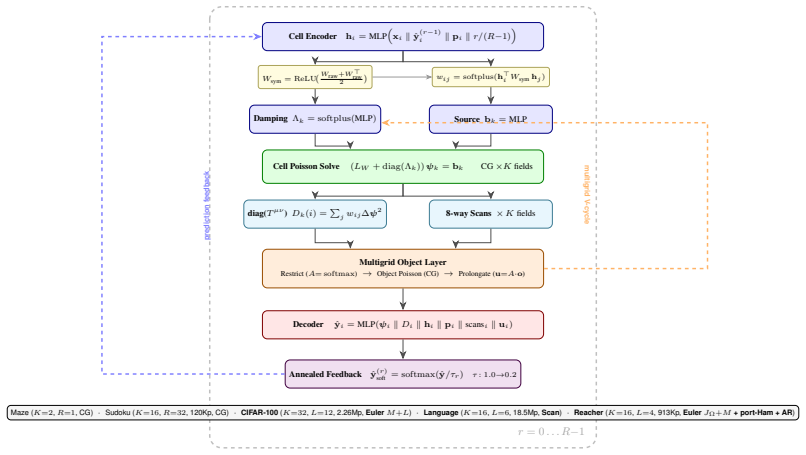
The metriplectic formulation admits a natural spectrum of instantiations as neural architectures: the dissipative branch yields a screened Poisson equation solved exactly via conjugate gradient, while activating the full structure including the antisymmetric Poisson bracket supplies field dynamics that perform image recognition, language modeling, robotic control, Sudoku solving, and maze pathfinding, with the stress-energy tensor providing the readout.
What carries the argument
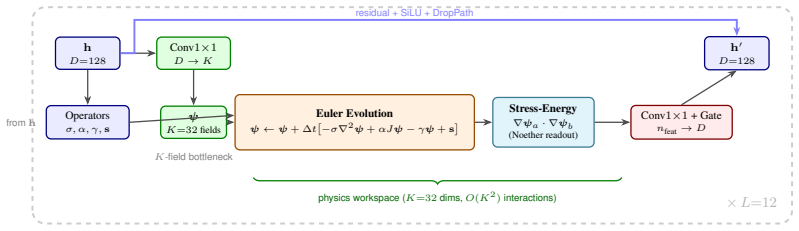
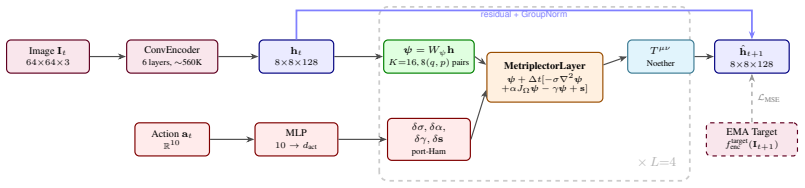
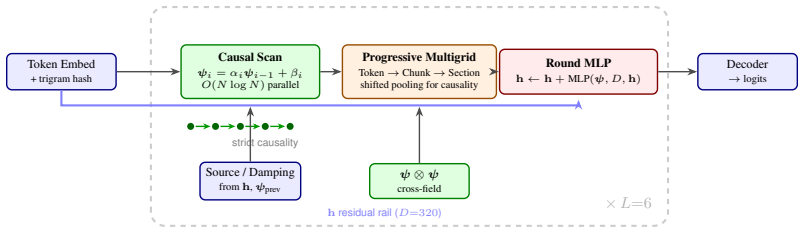
Coupled metriplectic dynamics of multiple fields driven by sources and operators, with the stress-energy tensor derived from Noether's theorem serving as the readout mechanism.
If this is right
- The dissipative branch alone produces exact solutions to screened Poisson equations via conjugate gradient.
- The full metriplectic structure supplies field dynamics capable of image recognition, language modeling, and robotic control.
- Task-specific architectures built from the same primitive achieve 81.03 percent on CIFAR-100, 88 percent CEM success on Reacher, 97.2 percent exact Sudoku solve rate, 1.182 bits per byte on language modeling, and perfect F1 on maze pathfinding.
- The same primitive supports generalization from 15 by 15 training grids to unseen 39 by 39 grids in pathfinding.
Where Pith is reading between the lines
- The spectrum suggests neural computation can be viewed as a tunable physical evolution rather than a stack of unrelated layers.
- Applying the same field setup to new domains such as physics simulation or scientific computing could test whether the physics grounding transfers without redesign.
- Parameter counts under one million for control tasks raise the question of whether metriplectic scaling laws differ from those of standard attention-based models.
Load-bearing premise
That arbitrary task inputs can be configured as fields, sources, and operators such that the resulting metriplectic evolution produces useful computation whose stress-energy readout matches task labels without task-specific fitting that undermines the physics interpretation.
What would settle it
An experiment showing that the stress-energy tensor readout requires extensive task-specific parameter adjustments to match labels, or that performance collapses when field configurations are forced to obey strict physical consistency constraints.
Figures





read the original abstract
We present Metriplector, a neural architecture primitive in which the input configures an abstract physical system -- fields, sources, and operators -- and the dynamics of that system is the computation. Multiple fields evolve via coupled metriplectic dynamics, and the stress-energy tensor T^{\mu\nu}, derived from Noether's theorem, provides the readout. The metriplectic formulation admits a natural spectrum of instantiations: the dissipative branch alone yields a screened Poisson equation solved exactly via conjugate gradient; activating the full structure -- including the antisymmetric Poisson bracket -- gives field dynamics for image recognition, language modeling, and robotic control. We evaluate Metriplector across five domains, each using a task-specific architecture built from this shared primitive with progressively richer physics: 81.03% on CIFAR-100 with 2.26M parameters; 88% CEM success on Reacher robotic control with under 1M parameters; 97.2% exact Sudoku solve rate with zero structural injection; 1.182 bits/byte on language modeling with 3.6x fewer training tokens than a GPT baseline; and F1=1.0 on maze pathfinding, generalizing from 15x15 training grids to unseen 39x39 grids.
Editorial analysis
A structured set of objections, weighed in public.
Referee Report
Summary. The manuscript introduces Metriplector, a neural architecture primitive in which task inputs configure fields, sources, and operators whose coupled metriplectic dynamics (Poisson bracket plus dissipation) perform the computation, with readout given by the stress-energy tensor T^{μν} derived from Noether's theorem. The approach is instantiated across a spectrum from pure dissipative dynamics (screened Poisson equation solved by conjugate gradient) to full structure, and evaluated on five domains using task-specific architectures: 81.03% accuracy on CIFAR-100 (2.26M parameters), 88% CEM success on Reacher (<1M parameters), 97.2% exact Sudoku solve rate with zero structural injection, 1.182 bits/byte on language modeling (3.6× fewer tokens than GPT baseline), and F1=1.0 on maze pathfinding with generalization from 15×15 to 39×39 grids.
Significance. If the central claim holds—that arbitrary inputs can be configured as fields/sources/operators such that metriplectic evolution produces task solutions whose stress-energy readout matches labels without task-specific fitting that undermines the physics interpretation—the work could provide a novel unified primitive bridging field theory and neural computation. The reported parameter efficiency, exact Sudoku performance, and out-of-distribution maze generalization would be notable strengths if supported by explicit derivations and ablations.
major comments (2)
- [Abstract] Abstract: the claim of 97.2% exact Sudoku solve rate with 'zero structural injection' is load-bearing for the assertion of a general physics primitive. Without an explicit description of how the grid is mapped to initial fields, sources, and operators, it remains unclear whether row/column constraints are pre-encoded in the configuration step rather than emerging from the dynamics alone.
- [Abstract] Abstract and Experiments sections: performance numbers (e.g., 81.03% on CIFAR-100, 1.182 bits/byte on LM) are reported without error bars, training details, ablation studies, or derivations showing how the metriplectic equations yield the observed outputs. This prevents verification that the results follow from the stated dynamics rather than from the task-specific configuration choices.
minor comments (2)
- The notation for the stress-energy tensor T^{μν} and its derivation via Noether's theorem should include the explicit metric signature and coordinate conventions used in the field equations.
- The manuscript would benefit from a dedicated section clarifying the precise mapping procedure from task inputs to fields/sources/operators for each domain, to allow readers to assess generality.
Simulated Author's Rebuttal
We thank the referee for their careful reading and constructive comments, which help clarify the presentation of the input-to-field mapping and strengthen the experimental reporting. We address each major comment below and will revise the manuscript accordingly.
read point-by-point responses
-
Referee: [Abstract] Abstract: the claim of 97.2% exact Sudoku solve rate with 'zero structural injection' is load-bearing for the assertion of a general physics primitive. Without an explicit description of how the grid is mapped to initial fields, sources, and operators, it remains unclear whether row/column constraints are pre-encoded in the configuration step rather than emerging from the dynamics alone.
Authors: We agree that an explicit description of the Sudoku input configuration is required to substantiate the 'zero structural injection' claim. In the revised manuscript we will insert a new subsection (Experiments, Sudoku) that provides the precise mapping: the 9x9 grid is encoded as a scalar field φ(x) whose initial value at each cell is set by a delta-source term proportional to the given number (or zero for empty cells); the metriplectic operators are instantiated solely from the abstract Poisson structure and dissipation kernel without any row- or column-specific terms; the Sudoku constraints arise endogenously from the conservation properties enforced by the stress-energy tensor readout. The exact initialization equations and operator definitions will be supplied so that readers can verify the absence of pre-encoded constraints. revision: yes
-
Referee: [Abstract] Abstract and Experiments sections: performance numbers (e.g., 81.03% on CIFAR-100, 1.182 bits/byte on LM) are reported without error bars, training details, ablation studies, or derivations showing how the metriplectic equations yield the observed outputs. This prevents verification that the results follow from the stated dynamics rather than from the task-specific configuration choices.
Authors: We concur that the current reporting lacks the statistical and methodological detail needed for independent verification. The revised manuscript will expand the Experiments section with: (i) mean and standard deviation over five independent random seeds for every reported metric; (ii) complete hyperparameter tables and optimization schedules for each of the five tasks; (iii) ablation tables that isolate the contribution of the antisymmetric Poisson bracket versus the dissipative branch alone; and (iv) explicit derivations (for Sudoku and maze) that step through the metriplectic evolution equations and show how the stress-energy tensor components map to the task labels. These additions will demonstrate that the reported performance is a direct consequence of the coupled dynamics. revision: yes
Circularity Check
No significant circularity in the derivation chain.
full rationale
The paper defines Metriplector as a primitive where task inputs configure fields/sources/operators and metriplectic dynamics (Poisson bracket plus dissipation) perform the computation, with readout via the stress-energy tensor obtained from Noether's theorem. The abstract and description present this as a spectrum of instantiations from screened Poisson to full dynamics, evaluated on multiple domains with task-specific architectures built from the shared primitive. No quoted equations or steps reduce the claimed dynamics or readout to a fitted parameter renamed as prediction, a self-citation chain, or an ansatz smuggled via prior work by the same authors. The configuration step is described as generic and physics-motivated rather than shown to embed the solution by construction. The derivation therefore remains self-contained against external physical principles without the specific reductions required for a positive circularity finding.
Axiom & Free-Parameter Ledger
axioms (2)
- domain assumption Metriplectic dynamics govern the evolution of the configured fields and operators
- domain assumption The stress-energy tensor derived from Noether's theorem provides a sufficient readout for downstream tasks
Lean theorems connected to this paper
-
IndisputableMonolith/Cost/FunctionalEquation.leanwashburn_uniqueness_aczel (J-cost uniqueness) unclearThe GENERIC (General Equation for Non-Equilibrium Reversible-Irreversible Coupling) framework unifies all of classical physics: ż = L(z)·∇E(z) + M(z)·∇S(z)
-
IndisputableMonolith/Foundation/RealityFromDistinction.leanreality_from_one_distinction unclearT^{ij}_{ab} = ∂_i ψ_a · ∂_j ψ_b … stress-energy tensor … Noether’s theorem
Reference graph
Works this paper leans on
-
[1]
Relational inductive biases, deep learning, and graph networks
Battaglia, P. W., Hamrick, J. B., Bapst, V ., et al. Relational inductive biases, deep learning, and graph networks.arXiv preprint arXiv:1806.01261,
work page internal anchor Pith review Pith/arXiv arXiv
-
[2]
Geometric Deep Learning: Grids, Groups, Graphs, Geodesics, and Gauges
Bronstein, M. M., Bruna, J., Cohen, T., and Veliˇckovi´c, P. Geometric deep learning: Grids, groups, graphs, geodesics, and gauges.arXiv preprint arXiv:2104.13478,
work page internal anchor Pith review Pith/arXiv arXiv
-
[3]
CliffordNet: All you need is geometric algebra.arXiv preprint arXiv:2601.06793,
Ji, Z. CliffordNet: All you need is geometric algebra.arXiv preprint arXiv:2601.06793,
-
[4]
The FineWeb Datasets: Decanting the Web for the Finest Text Data at Scale
Penedo, G., Kydlíˇcek, H., Lozhkov, A., Mitchell, M., Colin, C., Mou, G., Ponferrada, E. G., Wolf, T., and Thrush, T. The FineWeb datasets: Decanting the web for the finest text data at scale.arXiv preprint arXiv:2406.17557,
work page internal anchor Pith review Pith/arXiv arXiv
-
[5]
Tensor field networks: Rotation- and translation-equivariant neural networks for 3D point clouds
Thomas, N., Smidt, T., Kearnes, S., Yang, L., Li, L., Kober, K., and Riley, P. Tensor field net- works: Rotation- and translation-equivariant neural networks for 3D point clouds.arXiv preprint arXiv:1802.08219,
-
[6]
LLaMA: Open and Efficient Foundation Language Models
Touvron, H., Lavril, T., Izacard, G., et al. LLaMA: Open and efficient foundation language models. arXiv preprint arXiv:2302.13971,
work page internal anchor Pith review Pith/arXiv arXiv
-
[7]
Neural logic machines for Sudoku solving.arXiv preprint arXiv:2108.06455,
Zhang, J., Li, Z., and Chen, F. Neural logic machines for Sudoku solving.arXiv preprint arXiv:2108.06455,
-
[8]
Maes, L., Le Lidec, Q., Scieur, D., LeCun, Y ., and Balestriero, R. LeWorldModel: Stable end-to-end joint-embedding predictive architecture from pixels.arXiv preprint arXiv:2603.19312,
-
[9]
Ha, D. and Schmidhuber, J. World models.arXiv preprint arXiv:1803.10122,
work page internal anchor Pith review Pith/arXiv arXiv
-
[10]
Mastering Diverse Domains through World Models
Hafner, D., Pasukonis, J., Ba, J., and Lillicrap, T. Mastering diverse domains through world models. arXiv preprint arXiv:2301.04104,
work page internal anchor Pith review Pith/arXiv arXiv
-
[11]
Zhou, Y ., Zhang, Y ., Zhai, Y ., and LeCun, Y . DINO-WM: World models on pre-trained visual features enable zero-shot planning.arXiv preprint arXiv:2411.04983,
- [12]
-
[13]
Sosanya, A. and Greydanus, S. Dissipative Hamiltonian neural networks: Learning dissipative and conservative dynamics separately.arXiv preprint arXiv:2201.10085,
-
[14]
Graph neural networks informed locally by thermodynamics.arXiv preprint arXiv:2405.13093,
Hernández, Q., Badías, A., Chinesta, F., and Cueto, E. Graph neural networks informed locally by thermodynamics.arXiv preprint arXiv:2405.13093,
-
[15]
34 Hernández, Q., Win, M., O’Connor, T. C., Arratia, P. E., and Trask, N. Data-driven particle dy- namics: Structure-preserving coarse-graining for emergent behavior in non-equilibrium systems. arXiv preprint arXiv:2508.12569,
-
[16]
Baheri, A. and Lindemann, L. Metriplectic conditional flow matching for dissipative dynamics. arXiv preprint arXiv:2509.19526,
-
[17]
Meta-learning Structure-Preserving Dynamics
Jing, C., Mudiyanselage, U. B., Cho, W., Jo, M., Gruber, A., and Lee, K. Meta-learning structure- preserving dynamics.arXiv preprint arXiv:2508.11205,
work page internal anchor Pith review Pith/arXiv arXiv
-
[18]
The same CG solver is reused for both forward and adjoint solves, requiringO(N)total memory
A Implicit Differentiation Givenψ ∗ =A −1bwhereA=L W + Λand downstream lossL: ∂L ∂b =A −1 ∂L ∂ψ ∗ =v,(24) ∂L ∂wij =−v i(ψ∗ i −ψ ∗ j )−v j(ψ∗ j −ψ ∗ i ),(25) wherev=A −1(∂L/∂ψ ∗)is the adjoint variable. The same CG solver is reused for both forward and adjoint solves, requiringO(N)total memory. B Dirichlet Energy Derivation Setting∇ ψEDir = 0from Eq. (9): ...
work page 1999
discussion (0)
Sign in with ORCID, Apple, or X to comment. Anyone can read and Pith papers without signing in.