Recognition: unknown
Traces of Helium Detected in Type Ic Supernova 2014L
Pith reviewed 2026-05-08 02:18 UTC · model gemini-3-flash-preview
The pith
Supernova 2014L contains hidden helium, challenging the standard classification of stripped-envelope explosions.
A machine-rendered reading of the paper's core claim, the machinery that carries it, and where it could break.
Core claim
The authors identify approximately 0.018 to 0.020 solar masses of helium in the outer layers of SN 2014L using a Bayesian inference framework. This result stems from analyzing both optical and near-infrared spectra, where helium lines are less prone to blending with other elements. The statistical analysis strongly rejects a model with zero helium, finding that the observed spectral features require a specific helium mass and a density profile consistent with radiation-dominated explosions.
What carries the argument
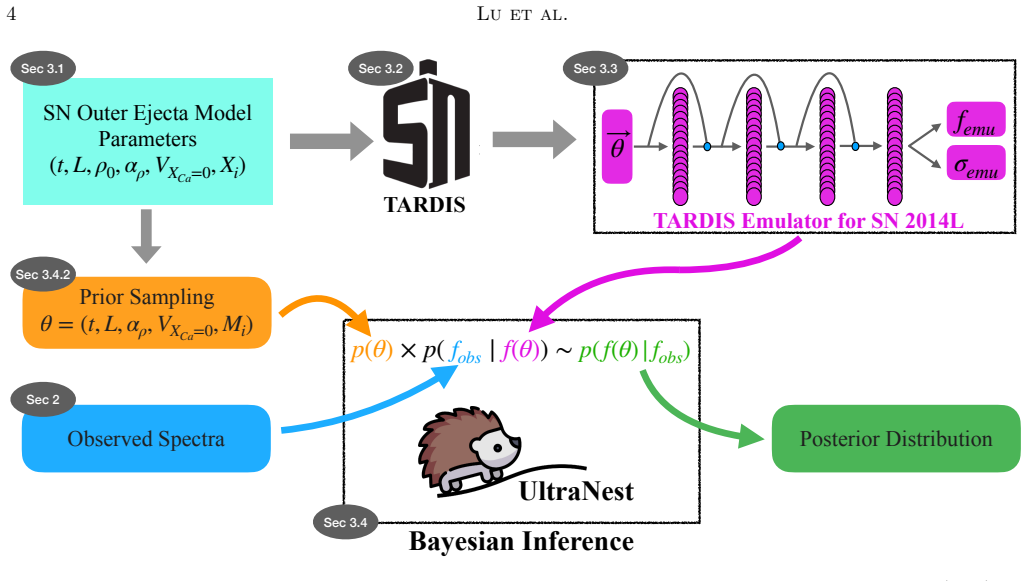
A deep-learning emulator for the TARDIS radiative transfer code. This emulator acts as a fast surrogate, allowing the researchers to perform thousands of spectral simulations in seconds rather than hours, making it possible to use Bayesian statistics to find the best-fit physical parameters for the supernova ejecta.
If this is right
- The classification boundary between Type Ib and Type Ic supernovae may need to be redefined based on quantitative mass limits rather than visual inspection of spectral lines.
- Progenitor models for Type Ic supernovae must account for the retention of small amounts of helium, favoring specific binary evolution or mass-loss scenarios.
- Near-infrared spectroscopy becomes a primary tool for determining the true chemical composition of stripped supernovae.
- Deep-learning emulators can be applied to other complex astrophysical simulations to enable rigorous statistical inference that was previously computationally impossible.
Where Pith is reading between the lines
- If small amounts of helium are common in Type Ic events, the continuum of envelope stripping in massive stars is more gradual and less complete than currently categorized.
- The discrepancy between optical and near-infrared detections suggests that current supernova surveys may be systematically underestimating the helium content of the universe's most common explosions.
Load-bearing premise
The analysis assumes that the distribution of radioactive nickel and the density of the explosion follow simple mathematical power laws rather than complex, clumped structures.
What would settle it
High-resolution near-infrared observations of a similar Type Ic supernova that show a complete absence of the 1.083-micron and 2.058-micron helium lines, even when modeled with high-sensitivity Bayesian techniques.
Figures


read the original abstract
The absence of helium features in optical spectra is one of the classification criteria for Type Ic supernovae (SNe Ic). However, it is highly debated whether helium is truly absent in ejecta or spectroscopically undetectable in the optical region. The near-infrared (NIR) region contains cleaner He lines that are less blended with other common ions in SNe Ic ejecta. We perform full spectral modeling on the near-peak-light optical and NIR spectra of the SN Ic 2014L to quantitatively constrain helium and other outer-ejecta properties, using the radiative transfer code TARDIS. We employ a deep-learning emulator for SNe Ic spectra that serves as a fast surrogate for TARDIS simulations. We then integrate the emulator within the Bayesian inference framework to infer the ejecta properties. The emulator achieves a mean fractional error of 1% between the emulated and TARDIS fluxes across all wavelengths and all samples in the test dataset. We constrain 0.018 to 0.020 M_sun (16% to 84% posterior percentile) of He above the photosphere near peak light in SN 2014L, inferred from the observed spectra covering 3500A to 24000A. A Bayesian statistical test shows that the observed spectra are inconsistent with no helium. Furthermore, the posterior favors a power-law density exponent of -7.04 to -6.88 (16% to 84% credible interval), consistent with theoretical calculations of radiation-dominated explosions. This work demonstrates that Bayesian radiative-transfer inference over a wide wavelength range provides a powerful path toward systematic constraints on He in SNe Ic.
Editorial analysis
A structured set of objections, weighed in public.
Referee Report
Summary. This paper investigates the helium content in the Type Ic supernova SN 2014L using a Bayesian inference framework coupled with a deep-learning emulator for the radiative transfer code TARDIS. By fitting both optical and near-infrared (NIR) spectra (3500–24000 Å) near peak light, the authors claim a detection of 0.018 to 0.020 M_sun of helium above the photosphere. The study highlights the utility of the NIR region, specifically the 1.083 and 2.058 µm He I lines, in overcoming the line blending and excitation issues prevalent in optical-only classification. The authors conclude that SN 2014L, despite its Ic classification, retained a small but detectable mass of helium, and that its density profile follows a power law consistent with radiation-dominated explosions.
Significance. The work is significant for its methodological advancement, specifically the implementation of a fast deep-learning emulator (1% mean fractional error) that enables rigorous MCMC sampling of a 1D radiative transfer model. This addresses a major computational bottleneck in the field. The finding contributes to the ongoing debate regarding "hidden helium" in stripped-envelope supernovae and provides a quantitative template for distinguishing between progenitor models (e.g., binary vs. single star) based on residual helium mass. If the quantitative constraints are robust, it offers a path toward a more physical classification of SNe Ic.
major comments (3)
- [Section 2.1, "Model Parameterization"] The assumption of uniform chemical mixing for radioactive 56Ni is a major simplification. In non-LTE treatments of He I lines, line strength is extremely sensitive to the spatial proximity of 56Ni for non-thermal excitation. Fixing this to a uniform 1D profile likely artificially suppresses the uncertainty in the helium mass. If Ni were centrally concentrated, as is often predicted in explosion models, a much larger He mass would be needed to produce the same observed line depth. The authors should evaluate how different Ni mixing profiles (e.g., boxcar or exponential) affect the posterior of M_He to ensure the reported 0.001 M_sun precision is not an artifact of the fixed mixing prescription.
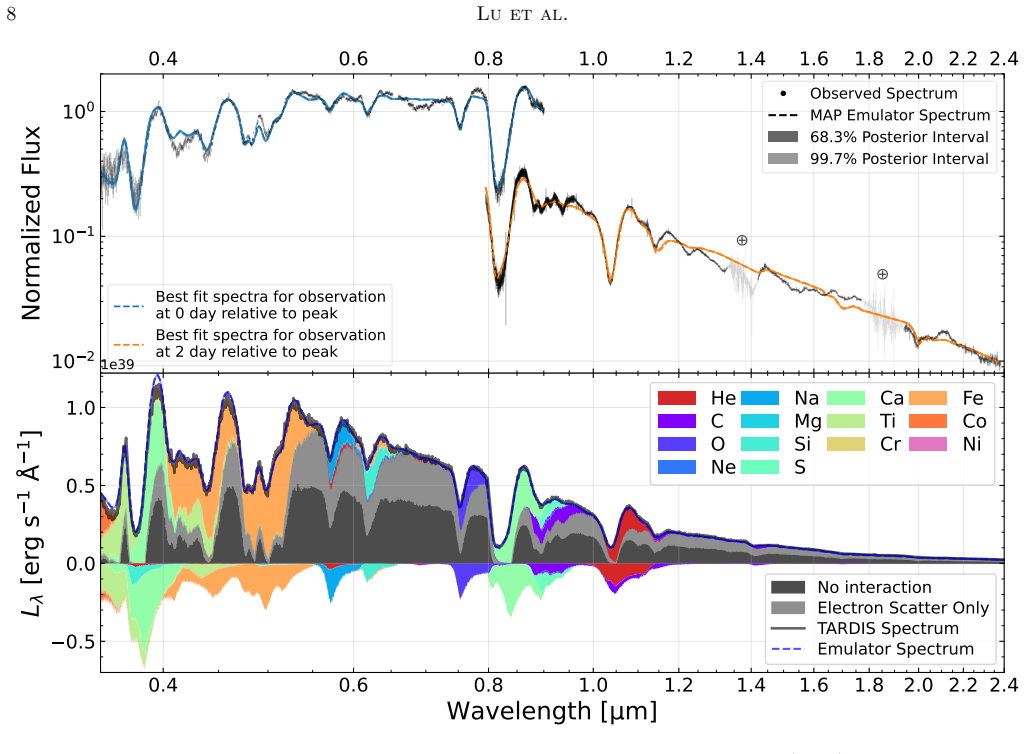
- [Section 4.1, Figure 3] The He I 1.0830 µm feature is frequently blended with Mg II 1.0927 µm and occasionally C I in SNe Ic. While the authors state the NIR is 'cleaner,' the model's ability to uniquely attribute this feature to helium is a load-bearing claim. The manuscript needs to include an ion-by-ion decomposition (contribution plot) for the best-fit model in the 1.0–1.2 µm range to demonstrate that the feature depth is dominated by He I rather than Mg II, given the typical abundances found in Ic ejecta.
- [Section 4.2, Bayesian Inference Result] The reported precision (±0.001 M_sun) appears to represent the width of the posterior given a rigid model topology rather than the physical uncertainty. In §2.1, the density exponent is constrained to ~ -7, but this depends on the assumed outer velocity boundary and the 1D approximation. The authors should explicitly discuss the systematic error budget associated with the power-law assumption and the 1D geometry, as these factors likely exceed the reported statistical precision by an order of magnitude.
minor comments (2)
- [Figure 1] The wavelength range is described as 3500A to 24000A, but the x-axes in the NIR panels use microns. While standard, using consistent units across the text and all figure panels would improve clarity.
- [Section 2.2] Please specify the version of TARDIS and the specific atomic data set used (e.g., Kurucz, CHIANTI). The non-LTE treatment of He is highly sensitive to the available levels and transition rates in the atomic data file.
Simulated Author's Rebuttal
We thank the referee for their constructive and insightful feedback. We appreciate the recognition of our methodological advancement using deep-learning emulators for radiative transfer. We agree that a robust detection of helium in SNe Ic requires careful handling of systematic uncertainties, particularly regarding the spatial distribution of nickel and the potential for line blending in the NIR. We have addressed each of the referee's comments by performing additional sensitivity tests, adding detailed spectral decompositions, and expanding our discussion on the systematic error budget in the revised manuscript.
read point-by-point responses
-
Referee: [Section 2.1, "Model Parameterization"] The assumption of uniform chemical mixing for radioactive 56Ni is a major simplification. In non-LTE treatments of He I lines, line strength is extremely sensitive to the spatial proximity of 56Ni for non-thermal excitation. Fixing this to a uniform 1D profile likely artificially suppresses the uncertainty in the helium mass. If Ni were centrally concentrated, a much larger He mass would be needed to produce the same observed line depth. The authors should evaluate how different Ni mixing profiles affect the posterior of M_He.
Authors: We agree that the non-thermal excitation of He I is highly sensitive to the spatial distribution of 56Ni. Our assumption of uniform mixing was chosen to keep the emulator parameter space tractable. To address this, we have performed a sensitivity analysis using individual TARDIS simulations (not emulated) where we varied the Ni mixing profile while keeping other parameters fixed at the MAP values. We compared the uniform distribution to a centrally concentrated exponential profile. As expected, a more central Ni concentration requires a higher He mass (by ~30%) to maintain the same line depth. We have added this sensitivity study to Appendix A and updated the manuscript text to acknowledge that our reported mass depends on the mixing prescription, effectively increasing our physical uncertainty range. revision: yes
-
Referee: [Section 4.1, Figure 3] The He I 1.0830 µm feature is frequently blended with Mg II 1.0927 µm and occasionally C I in SNe Ic. The manuscript needs to include an ion-by-ion decomposition (contribution plot) for the best-fit model in the 1.0–1.2 µm range to demonstrate that the feature depth is dominated by He I rather than Mg II, given the typical abundances found in Ic ejecta.
Authors: This is a valid concern. While the NIR is relatively cleaner than the optical, Mg II and C I can indeed contribute to the 1.1 µm feature. To clarify the identification, we have added a new panel to Figure 3 (now Figure 3b) showing the ion-by-ion decomposition of the synthetic spectrum. This plot demonstrates that while Mg II 1.0927 µm contributes to the red wing of the absorption, the primary depth and the distinct P-Cygni profile are dominated by the He I 1.0830 µm transition in our best-fit model. This confirms that the statistical preference for He in our Bayesian framework is driven by a physically dominant line rather than a misidentified Mg II feature. revision: yes
-
Referee: [Section 4.2, Bayesian Inference Result] The reported precision (±0.001 M_sun) appears to represent the width of the posterior given a rigid model topology rather than the physical uncertainty. The authors should explicitly discuss the systematic error budget associated with the power-law assumption and the 1D geometry, as these factors likely exceed the reported statistical precision by an order of magnitude.
Authors: The referee is correct that the 0.001 M_sun credible interval represents the statistical precision within our 1D model framework and does not account for total physical uncertainty. We have added a dedicated 'Systematic Uncertainties' subsection in Section 4.2. In this section, we discuss the impact of the 1D spherical symmetry assumption, the choice of a power-law density profile versus a numerical hydrodynamical profile, and the sensitivity to the outer boundary velocity. We now explicitly state that the physical uncertainty on the helium mass is likely on the order of 0.005-0.010 M_sun when considering these systematic modeling choices, which is indeed larger than our reported statistical precision. revision: yes
Circularity Check
The study performs a standard Bayesian inference to constrain physical parameters, using an emulator as a computational tool.
full rationale
The paper's derivation of Helium mass and the density profile exponent is an empirical fit of a physics-based model (TARDIS) to external observed spectral data of SN 2014L. The core logic is a parameter estimation task where Helium abundance, density, and other physical variables are free parameters in a Bayesian framework. While the authors utilize a deep-learning emulator for TARDIS that they developed in a previous paper (Lu et al. 2024b), this is a methodological acceleration (a surrogate model) and not a source of logical circularity; the emulator is trained on a synthetic grid of radiative transfer simulations, not on the observational data it is used to analyze. The assumptions made, such as a 1D uniform mixing profile, are clearly stated simplifications of the physical model rather than results derived from the output. The consistency between the inferred density exponent (-7) and existing theoretical models for radiation-dominated explosions is presented as an independent validation of the fit's physical plausibility, not a circular proof where the theory was used to force the fit. The detection of Helium is derived from the data's requirement for specific absorption features in the NIR that are absent in helium-free models.
Axiom & Free-Parameter Ledger
free parameters (2)
- Helium Mass (M_He) =
0.018 - 0.020 M_sun
- Power-law density exponent =
-7.04 to -6.88
axioms (1)
- domain assumption TARDIS radiative transfer physics
Reference graph
Works this paper leans on
-
[1]
, " * write output.state after.block = add.period write newline
ENTRY address archivePrefix author booktitle chapter doi edition editor eprint howpublished institution journal key month number organization pages publisher school series title misctitle type volume year version url label extra.label sort.label short.list INTEGERS output.state before.all mid.sentence after.sentence after.block FUNCTION init.state.consts ...
-
[2]
write newline
" write newline "" before.all 'output.state := FUNCTION format.url url empty "" new.block "" url * "" * if FUNCTION format.eprint eprint empty "" archivePrefix empty "" archivePrefix "arXiv" = new.block " " eprint * " " * new.block " " eprint * " " * if if if FUNCTION format.doi doi empty "" " " doi * " " * if FUNCTION format.pid doi empty eprint empty ur...
-
[3]
o .)@ h7E/E) 5@ϗe
thebibliography [1] 20pt to REFERENCES 6pt =0pt \@twocolumntrue 12pt -12pt 10pt plus 3pt =0pt =0pt =1pt plus 1pt =0pt =0pt -12pt =13pt plus 1pt =20pt =13pt plus 1pt \@M =10000 =-1.0em =0pt =0pt 0pt =0pt =1.0em @enumiv\@empty 10000 10000 `\.\@m \@noitemerr \@latex@warning Empty `thebibliography' environment \@ifnextchar \@reference \@latexerr Missing key o...
2017
-
[4]
Ashall, C., & Mazzali, P. A. 2020, title Extracting high-level information from gamma-ray burst supernova spectra, Monthly Notices of the Royal Astronomical Society, 492, 5956, 10.1093/mnras/staa212
-
[5]
Nested sampling for physical sci- entists,
Ashton, G., Bernstein, N., Buchner, J., et al. 2022, title Nested sampling for physical scientists, Nature Reviews Methods Primers, 2, 39, 10.1038/s43586-022-00121-x
-
[6]
Astropy Collaboration , Robitaille , T. P., Tollerud , E. J., et al. 2013, title Astropy: A community Python package for astronomy , , 558, A33, 10.1051/0004-6361/201322068
-
[7]
Astropy Collaboration , Price-Whelan , A. M., Sip o cz , B. M., et al. 2018, title The Astropy Project: Building an Open-science Project and Status of the v2.0 Core Package , , 156, 123, 10.3847/1538-3881/aabc4f
-
[8]
Astropy Collaboration , Price-Whelan , A. M., Lim , P. L., et al. 2022, title The Astropy Project: Sustaining and Growing a Community-oriented Open-source Project and the Latest Major Release (v5.0) of the Core Package , , 935, 167, 10.3847/1538-4357/ac7c74
-
[9]
Baron, E., Branch, D., Hauschildt, P. H., Filippenko, A. V., & Kirshner, R. P. 1999, title Spectral Models of the Type IC Supernova SN 1994I in M51 , The Astrophysical Journal, 527, 739, 10.1086/308107
-
[10]
Baron, E., Hauschildt, P. H., Branch, D., Kirshner, R. P., & Filippenko, A. V. 1996, title Preliminary spectral analysis of SN 1994I , Monthly Notices of the Royal Astronomical Society, 279, 799, 10.1093/mnras/279.3.799
-
[11]
A., Hachinger, S., & Kerzendorf, W
Boyle, A., Sim, S. A., Hachinger, S., & Kerzendorf, W. 2017, title Helium in double-detonation models of type Ia supernovae, Astronomy and Astrophysics, 599, A46, 10.1051/0004-6361/201629712
-
[12]
2021, The Journal of Open Source Software, 6, 3001, doi: 10.21105/joss.03001
Buchner, J. 2021, title UltraNest - a robust, general purpose Bayesian inference engine, Journal of Open Source Software, 6, 3001, 10.21105/joss.03001
-
[13]
Chevalier, R. A. 1976, title The hydrodynamics of type II supernovae., The Astrophysical Journal, 207, 872, 10.1086/154557
-
[14]
Chevalier, R. A. 1981, title Exploding white dwarf models for type I SN ., The Astrophysical Journal, 246, 267, 10.1086/158920
-
[15]
Clocchiatti, A., Wheeler, J. C., Brotherton, M. S., et al. 1996, title SN 1994I : Disentangling He i Lines in Type IC Supernovae , The Astrophysical Journal, 462, 462, 10.1086/177165
-
[16]
Colgate, S. A., & McKee, C. 1969, title Early Supernova Luminosity , The Astrophysical Journal, 157, 623, 10.1086/150102
-
[17]
Crowther, P. A. 2007, title Physical Properties of Wolf - Rayet Stars , Annual Review of Astronomy and Astrophysics, 45, 177, 10.1146/annurev.astro.45.051806.110615
-
[18]
Dessart, L., & Hillier, D. J. 2015, title One-dimensional non- LTE time-dependent radiative transfer of an He -detonation model and the connection to faint and fast-decaying supernovae, Monthly Notices of the Royal Astronomical Society, 447, 1370, 10.1093/mnras/stu2520
-
[19]
2012, MNRAS, 423, 600, doi: 10.1111/j.1365-2966.2012.20901.x
Dessart, L., Hillier, D. J., Li, C., & Woosley, S. 2012, title On the nature of supernovae Ib and Ic , Monthly Notices of the Royal Astronomical Society, 424, 2139, 10.1111/j.1365-2966.2012.21374.x
-
[20]
2012, MNRAS, 420, 1825, doi: 10.1111/j.1365-2966.2011.19805.x
Dessart, L., Hillier, D. J., Livne, E., et al. 2011, title Core-collapse explosions of Wolf - Rayet stars and the connection to Type IIb / Ib / Ic supernovae, Monthly Notices of the Royal Astronomical Society, 414, 2985, 10.1111/j.1365-2966.2011.18598.x
-
[21]
Dessart, L., Hillier, D. J., Woosley, S., et al. 2015, title Radiative-transfer models for supernovae IIb / Ib / Ic from binary-star progenitors, Monthly Notices of the Royal Astronomical Society, 453, 2189, 10.1093/mnras/stv1747
-
[22]
Dessart, L., Yoon, S.-C., Aguilera-Dena, D. R., & Langer, N. 2020, title Supernovae Ib and Ic from the explosion of helium stars, Astronomy and Astrophysics, 642, A106, 10.1051/0004-6361/202038763
-
[23]
2000, title Incorporating second-order functional knowledge for better option pricing, Advances in neural information processing systems, 13
Dugas, C., Bengio, Y., B \'e lisle, F., Nadeau, C., & Garcia, R. 2000, title Incorporating second-order functional knowledge for better option pricing, Advances in neural information processing systems, 13
2000
-
[24]
Ekstr \"o m , S. 2021, title Massive star modelling and nucleosynthesis , Frontiers in Astronomy and Space Sciences, 8, 53, 10.3389/fspas.2021.617765
-
[25]
The death of massive stars - II. Observational constraints on the progenitors of Type Ibc supernovae
Eldridge, J. J., Fraser, M., Smartt, S. J., Maund, J. R., & Crockett, R. M. 2013, title The death of massive stars - II . Observational constraints on the progenitors of Type Ibc supernovae, Monthly Notices of the Royal Astronomical Society, 436, 774, 10.1093/mnras/stt1612
-
[26]
2023, title Interacting supernovae from wide massive binary systems, 10.48550/arXiv.2308.01819
Ercolino, A., Jin, H., Langer, N., & Dessart, L. 2023, title Interacting supernovae from wide massive binary systems, 10.48550/arXiv.2308.01819
-
[27]
Falcon, W., & team, T. P. L. 2024, title PyTorch Lightning , Zenodo, 10.5281/zenodo.13254264
-
[28]
2019, Nature Astronomy, 3, 434, doi: 10.1038/s41550-019-0710-6
Fang, Q., Maeda, K., Kuncarayakti, H., Sun, F., & Gal-Yam, A. 2019, title A hybrid envelope-stripping mechanism for massive stars from supernova nebular spectroscopy, Nature Astronomy, 3, 434, 10.1038/s41550-019-0710-6
-
[29]
Farmer, R., Laplace, E., Ma, J.-z., de Mink, S. E., & Justham, S. 2023, title Nucleosynthesis of Binary -stripped Stars , The Astrophysical Journal, 948, 111, 10.3847/1538-4357/acc315
-
[30]
Filippenko, A. V. 1997, title Optical Spectra of Supernovae , araa, 35, 309, 10.1146/annurev.astro.35.1.309
-
[31]
Filippenko, A. V., Barth, A. J., Matheson, T., et al. 1995, title The Type IC Supernova 1994I in M51 : Detection of Helium and Spectral Evolution , The Astrophysical Journal, 450, L11, 10.1086/309659
-
[32]
Frey, L. H., Fryer, C. L., & Young, P. A. 2013, title Can Stellar Mixing Explain the Lack of Type Ib Supernovae in Long -duration Gamma - Ray Bursts ? The Astrophysical Journal, 773, L7, 10.1088/2041-8205/773/1/L7
-
[33]
Fullard, A. G., O'Brien, J. T., Kerzendorf, W. E., et al. 2022, title New Mass Estimates for Massive Binary Systems : A Probabilistic Approach Using Polarimetric Radiative Transfer , The Astrophysical Journal, 930, 89, 10.3847/1538-4357/ac589e
-
[34]
Handbook of Supernovae , year = 2017, editor =
Gal-Yam, A. 2017, in Handbook of Supernovae , 195, 10.1007/978-3-319-21846-5_35
-
[35]
2012, title Grids of stellar models with rotation
Georgy, C., Ekström, S., Meynet, G., et al. 2012, title Grids of stellar models with rotation. II . WR populations and supernovae/ GRB progenitors at Z = 0.014, Astronomy and Astrophysics, 542, A29, 10.1051/0004-6361/201118340
-
[36]
H., Ekström, S., Georgy, C., et al
Groh, J. H., Ekström, S., Georgy, C., et al. 2019, title Grids of stellar models with rotation. IV . Models from 1.7 to 120 M ⊙ at a metallicity Z = 0.0004, Astronomy and Astrophysics, 627, A24, 10.1051/0004-6361/201833720
-
[37]
2011, PhD Thesis , TU München
Hachinger, S. 2011, PhD Thesis , TU München
2011
-
[38]
2012, MNRAS, 423, 600, doi: 10.1111/j.1365-2966.2012.20901.x
Hachinger, S., Mazzali, P. A., Taubenberger, S., et al. 2012, title How much H and He is 'hidden' in SNe Ib /c? - I . Low -mass objects, Monthly Notices of the Royal Astronomical Society, 422, 70, 10.1111/j.1365-2966.2012.20464.x
-
[39]
Hachinger, S., Röpke, F. K., Mazzali, P. A., et al. 2017, title Type Ia supernovae with and without blueshifted narrow Na I D lines - how different is their structure? mnras, 471, 491, 10.1093/mnras/stx1578
-
[40]
Harkness, R. P., Wheeler, J. C., Margon, B., et al. 1987, title The Early Spectral Phase of Type Ib Supernovae : Evidence for Helium , The Astrophysical Journal, 317, 355, 10.1086/165283
-
[41]
Deep residual learning for image recognition
He, K., Zhang, X., Ren, S., & Sun, J. 2016, in 2016 IEEE Conference on Computer Vision and Pattern Recognition ( CVPR ), 770--778, 10.1109/CVPR.2016.90
-
[42]
Heger, A., Fryer, C. L., Woosley, S. E., Langer, N., & Hartmann, D. H. 2003, title How Massive Single Stars End Their Life , The Astrophysical Journal, 591, 288, 10.1086/375341
-
[43]
Hsiao , E. Y., Philips , M. M., Marion , G. H., et al. 2019, title Carnegie Supernova Project-II: The Near-infrared Spectroscopy Program , , 131, 014002, 10.1088/1538-3873/aae961
-
[44]
Huang, G., Liu, Z., van der Maaten, L., & Weinberger, K. Q. 2017, 4700--4708. https://openaccess.thecvf.com/content_cvpr_2017/html/Huang_Densely_Connected_Convolutional_CVPR_2017_paper.html
2017
-
[45]
J., Valenti, S., Kotak, R., et al
Hunter, D. J., Valenti, S., Kotak, R., et al. 2009, title Extensive optical and near-infrared observations of the nearby, narrow-lined type Ic SN 2007gr: days 5 to 415, Astronomy and Astrophysics, 508, 371, 10.1051/0004-6361/200912896
-
[46]
Hunter, J. D. 2007, title Matplotlib: A 2D Graphics Environment, Computing in Science and Engineering, 9, 90, 10.1109/MCSE.2007.55
-
[47]
Höflich, P., Gerardy, C. L., Fesen, R. A., & Sakai, S. 2002, title Infrared Spectra of the Subluminous Type Ia Supernova SN 1999by, The Astrophysical Journal, 568, 791, 10.1086/339063
-
[48]
Iwamoto, K., Nomoto, K., Höflich, P., et al. 1994, title Theoretical Light Curves for the Type IC Supernova SN 1994I , The Astrophysical Journal, 437, L115, 10.1086/187696
-
[49]
Karthik Yadavalli, S., Villar, V. A., Polin, A., et al. 2025, title Radiative Transfer Modeling of Stripped - Envelope Supernovae . I : A Grid for Ejecta Parameter Inference , arXiv, 10.48550/arXiv.2507.10648
-
[50]
2022, title Probabilistic Dalek -- Emulator framework with probabilistic prediction for supernova tomography, , Tech
Kerzendorf, W., Chen, N., O'Brien, J., Buchner, J., & van der Smagt, P. 2022, title Probabilistic Dalek -- Emulator framework with probabilistic prediction for supernova tomography, , Tech. rep. https://ui.adsabs.harvard.edu/abs/2022arXiv220909453K
2022
-
[51]
2025, title tardis-sn/tardis: TARDIS v2025.03.23, Zenodo, 10.5281/zenodo.15069852
Kerzendorf, W., Sim, S., Vogl, C., et al. 2025, title tardis-sn/tardis: TARDIS v2025.03.23, Zenodo, 10.5281/zenodo.15069852
-
[52]
Kerzendorf, W. E., & Sim, S. A. 2014, title A spectral synthesis code for rapid modelling of supernovae, Monthly Notices of the Royal Astronomical Society, 440, 387, 10.1093/mnras/stu055
-
[53]
E., Vogl, C., Buchner, J., et al
Kerzendorf, W. E., Vogl, C., Buchner, J., et al. 2021, title Dalek: A Deep Learning Emulator for TARDIS , The Astrophysical Journal, 910, L23, 10.3847/2041-8213/abeb1b
-
[54]
Adam: A Method for Stochastic Optimization
Kingma, D. P., & Ba, J. 2017, title Adam: A Method for Stochastic Optimization , arXiv, 10.48550/arXiv.1412.6980
work page internal anchor Pith review doi:10.48550/arxiv.1412.6980 2017
-
[55]
1992, ApJ, 390, 602, doi: 10.1086/171311
Kozma, C., & Fransson, C. 1992, title Gamma- Ray Deposition and Nonthermal Excitation in Supernovae , The Astrophysical Journal, 390, 602, 10.1086/171311
-
[56]
Kumar, H., Berger, E., Blanchard, P. K., et al. 2025 a , title A Detection of Helium in the Bright Superluminous Supernova SN 2024rmj, The Astrophysical Journal, 992, 122, 10.3847/1538-4357/adff7e
-
[57]
Kumar, H., Berger, E., Blanchard, P. K., et al. 2025 b , title A Near -infrared Search for Helium in the Superluminous Supernova SN 2024ahr, The Astrophysical Journal, 987, 127, 10.3847/1538-4357/addc67
-
[58]
Kumar , S., Baer-Way , R., Ravi , A. P., et al. 2026, title A multiwavelength view of the nearby Calcium-Strong Transient SN 2025coe in the X-Ray, Near-Infrared, and Radio Wavebands , arXiv e-prints, arXiv:2601.19018, 10.48550/arXiv.2601.19018
-
[59]
2021, A&A, 656, A58, doi: 10.1051/0004-6361/202140506
Laplace, E., Justham, S., Renzo, M., et al. 2021, title Different to the core: The pre-supernova structures of massive single and binary-stripped stars, Astronomy and Astrophysics, 656, A58, 10.1051/0004-6361/202140506
-
[60]
Liu, Y.-Q., Modjaz, M., Bianco, F. B., & Graur, O. 2016, title Analyzing the Largest Spectroscopic Data Set of Stripped Supernovae to Improve Their Identifications and Constrain Their Progenitors , The Astrophysical Journal, 827, 90, 10.3847/0004-637X/827/2/90
-
[61]
Lu, J., Barker, B. L., Goldberg, J., et al. 2025, title Physics-driven Explosions of Stripped High -mass Stars : Synthetic Light Curves and Spectra of Stripped -envelope Supernovae with Broad Light Curves , The Astrophysical Journal, 979, 148, 10.3847/1538-4357/ada26d
-
[62]
Lucy, L. B. 1991, title Nonthermal Excitation of Helium in Type Ib Supernovae , The Astrophysical Journal, 383, 308, 10.1086/170787
-
[63]
Ma, J.-Z., Farmer, R., de Mink, S. E., & Laplace, E. 2025, title Carbon from massive binary-stripped stars over cosmic time: effect of metallicity, arXiv, 10.48550/arXiv.2505.02918
-
[64]
Mazzali, P. A., Sauer, D. N., Pian, E., et al. 2017, title Modelling the Type Ic SN 2004aw: a moderately energetic explosion of a massive C + O star without a GRB , Monthly Notices of the Royal Astronomical Society, 469, 2498, 10.1093/mnras/stx992
-
[65]
Data Structures for Statistical Computing in Python
M c K inney W es. 2010, in P roceedings of the 9th P ython in S cience C onference, ed. S t\'efan van der W alt & J arrod M illman, 56 -- 61, 10.25080/Majora-92bf1922-00a
-
[66]
Millard, J., Branch, D., Baron, E., et al. 1999, title Direct Analysis of Spectra of the Type IC Supernova SN 1994I , The Astrophysical Journal, 527, 746, 10.1086/308108
-
[67]
Modjaz, M., Gutiérrez, C. P., & Arcavi, I. 2019, title New regimes in the observation of core-collapse supernovae, Nature Astronomy, 3, 717, 10.1038/s41550-019-0856-2
-
[68]
Modjaz, M., Liu, Y. Q., Bianco, F. B., & Graur, O. 2016, title The Spectral SN - GRB Connection : Systematic Spectral Comparisons between Type Ic Supernovae and Broad -lined Type Ic Supernovae with and without Gamma - Ray Bursts , The Astrophysical Journal, 832, 108, 10.3847/0004-637X/832/2/108
-
[69]
Modjaz, M., Li, W., Butler, N., et al. 2009, title From Shock Breakout to Peak and Beyond : Extensive Panchromatic Observations of the Type Ib Supernova 2008D Associated with Swift X -ray Transient 080109, The Astrophysical Journal, 702, 226, 10.1088/0004-637X/702/1/226
-
[70]
O'Brien, J. T., Kerzendorf, W. E., Fullard, A., et al. 2021, title Probabilistic Reconstruction of Type Ia Supernova SN 2002bo, The Astrophysical Journal, 916, L14, 10.3847/2041-8213/ac1173
-
[71]
O'Brien, J. T., Kerzendorf, W. E., Fullard, A., et al. 2023, title 1991T - Like Type Ia Supernovae as an Extension of the Normal Population , 10.48550/arXiv.2306.08137
-
[72]
O'Brien, J. T., Kerzendorf, W. E., Fullard, A., et al. 2024, title 1991T - Like Type Ia Supernovae as an Extension of the Normal Population , The Astrophysical Journal, 964, 137, 10.3847/1538-4357/ad2358
-
[73]
pandas development team, pandas-dev/pandas: Pandas (Feb
pandas development team, T. 2020, title pandas-dev/pandas: Pandas, , latest Zenodo, 10.5281/zenodo.3509134
-
[74]
PyTorch: An Imperative Style, High-Performance Deep Learning Library
Paszke, A., Gross, S., Massa, F., et al. 2019, title PyTorch : An Imperative Style , High - Performance Deep Learning Library , arXiv, 10.48550/arXiv.1912.01703
-
[75]
2001, The Astrophysical Journal, 555, 900, doi: 10.1086/321526
Patat, F., Cappellaro, E., Danziger, J., et al. 2001, title The Metamorphosis of SN 1998bw, The Astrophysical Journal, 555, 900, 10.1086/321526
-
[76]
2011, title Scikit-learn: Machine Learning in P ython, Journal of Machine Learning Research, 12, 2825
Pedregosa, F., Varoquaux, G., Gramfort, A., et al. 2011, title Scikit-learn: Machine Learning in P ython, Journal of Machine Learning Research, 12, 2825
2011
-
[77]
Phillips , M. M., Contreras , C., Hsiao , E. Y., et al. 2019, title Carnegie Supernova Project-II: Extending the Near-infrared Hubble Diagram for Type Ia Supernovae to z 0.1 , , 131, 014001, 10.1088/1538-3873/aae8bd
-
[78]
Piro, A. L., & Morozova, V. S. 2014, title Transparent Helium in Stripped Envelope Supernovae , The Astrophysical Journal, 792, L11, 10.1088/2041-8205/792/1/L11
-
[79]
Podsiadlowski, P., Joss, P. C., & Hsu, J. J. L. 1992, title Presupernova Evolution in Massive Interacting Binaries , The Astrophysical Journal, 391, 246, 10.1086/171341
-
[80]
Sana, H., de Mink, S. E., de Koter, A., et al. 2012, title Binary Interaction Dominates the Evolution of Massive Stars , Science, 337, 444, 10.1126/science.1223344
discussion (0)
Sign in with ORCID, Apple, or X to comment. Anyone can read and Pith papers without signing in.