Recognition: 2 theorem links
· Lean TheoremMVNN: A Measure-Valued Neural Network for Learning McKean-Vlasov Dynamics from Particle Data
Pith reviewed 2026-05-13 22:43 UTC · model grok-4.3
The pith
A measure-valued neural network infers interaction drifts in McKean-Vlasov systems directly from observed particle trajectories.
A machine-rendered reading of the paper's core claim, the machinery that carries it, and where it could break.
Core claim
We introduce a measure-valued neural network that infers measure-dependent interaction (drift) terms directly from particle-trajectory observations. The architecture learns cylindrical features via an embedding network that maps distributions to vectors. We establish well-posedness of the resulting dynamics, prove propagation-of-chaos for the interacting-particle system, and obtain universal approximation together with quantitative rates under a low-dimensional measure-dependence assumption.
What carries the argument
The measure-valued neural network (MVNN), which operates on probability measures by learning cylindrical features through a distribution-to-vector embedding network.
If this is right
- The learned dynamics remain well-posed for any initial measure.
- Finite-particle simulations converge to the mean-field limit as the number of particles grows.
- The network recovers both deterministic and stochastic versions of the Motsch-Tadmor, Cucker-Smale, and attraction-repulsion models from data.
- Prediction accuracy persists on out-of-distribution initial configurations and parameter regimes.
Where Pith is reading between the lines
- The same embedding idea could be applied to learn nonlocal kernels in other nonlocal PDEs such as aggregation-diffusion equations.
- Quantitative rates under the low-dimensional assumption suggest that the method may scale to moderately high-dimensional state spaces provided the measure dependence stays low-dimensional.
- If the embedding network is replaced by a learned graph neural network, the architecture might capture heterogeneous interaction rules without explicit low-dimensional reduction.
Load-bearing premise
The interaction drift depends on the measure through a low-dimensional feature map.
What would settle it
A concrete particle trajectory dataset whose learned drift fails to reproduce the observed collective motion once the embedding dimension is fixed below the true intrinsic dimension of the measure dependence.
Figures


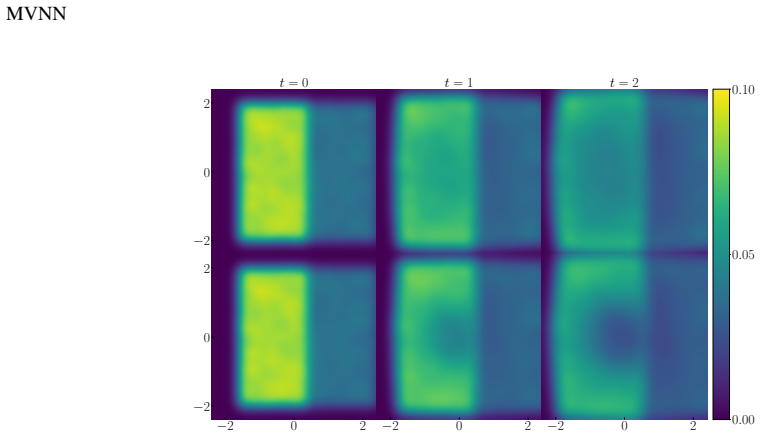


read the original abstract
Collective behaviors that emerge from interactions are fundamental to numerous biological systems. To learn such interacting forces from observations, we introduce a measure-valued neural network that infers measure-dependent interaction (drift) terms directly from particle-trajectory observations. The proposed architecture generalizes standard neural networks to operate on probability measures by learning cylindrical features, using an embedding network that produces scalable distribution-to-vector representations. On the theory side, we establish well-posedness of the resulting dynamics and prove propagation-of-chaos for the associated interacting-particle system. We further show universal approximation and quantitative approximation rates under a low-dimensional measure-dependence assumption. Numerical experiments on first and second order systems, including deterministic and stochastic Motsch-Tadmor dynamics, two-dimensional attraction-repulsion aggregation, Cucker-Smale dynamics, and a hierarchical multi-group system, demonstrate accurate prediction and strong out-of-distribution generalization.
Editorial analysis
A structured set of objections, weighed in public.
Referee Report
Summary. The paper introduces a measure-valued neural network (MVNN) that learns measure-dependent drift terms in McKean-Vlasov equations directly from particle trajectory data. The architecture employs cylindrical features and an embedding network to map probability measures to vectors. Theoretical results include well-posedness of the learned dynamics, propagation of chaos for the associated particle system, and universal approximation with quantitative rates under an explicit low-dimensional measure-dependence assumption on the interaction kernel. Numerical experiments on first- and second-order systems (Motsch-Tadmor, Cucker-Smale, attraction-repulsion aggregation, and hierarchical multi-group models) demonstrate accurate prediction and out-of-distribution generalization.
Significance. If the approximation guarantees and numerical performance hold, the work would supply a theoretically grounded data-driven method for inferring interaction kernels in mean-field limits, with potential applications to collective behavior modeling in biology and physics. The combination of architecture design, well-posedness/propagation-of-chaos results, and reported numerical success on multiple systems constitutes a substantive contribution to learning McKean-Vlasov dynamics.
major comments (1)
- [Abstract and theory section] Abstract and theory section: the universal approximation and quantitative approximation rates are proved only under an explicit low-dimensional measure-dependence assumption on the interaction kernel. The numerical examples (Motsch-Tadmor, Cucker-Smale, aggregation) are all constructed to satisfy this assumption by design; no controlled experiment is reported in which the assumption is violated to quantify performance degradation or to test necessity of the structural restriction.
minor comments (1)
- Notation for the embedding network and cylindrical features should be introduced with explicit dimension tracking to clarify how the map from measures to vectors scales with particle number.
Simulated Author's Rebuttal
We thank the referee for the careful and constructive review of our manuscript. We respond to the major comment below.
read point-by-point responses
-
Referee: [Abstract and theory section] Abstract and theory section: the universal approximation and quantitative approximation rates are proved only under an explicit low-dimensional measure-dependence assumption on the interaction kernel. The numerical examples (Motsch-Tadmor, Cucker-Smale, aggregation) are all constructed to satisfy this assumption by design; no controlled experiment is reported in which the assumption is violated to quantify performance degradation or to test necessity of the structural restriction.
Authors: We thank the referee for highlighting this point. It is correct that the universal approximation result with quantitative rates requires the explicit low-dimensional measure-dependence assumption on the interaction kernel, as stated in the abstract and theory sections. The numerical examples are constructed to satisfy the assumption by design so that the learned dynamics can be validated directly against the theoretical setting. The MVNN architecture itself is general and does not require the assumption for implementation or training; the restriction is used only to derive the quantitative rates. We agree that testing performance when the assumption is violated would be informative. In the revised manuscript we will add a clarifying paragraph in the theory section and a remark in the numerical experiments section that explicitly notes the role of the assumption and discusses its implications for approximation quality outside this regime. revision: partial
Circularity Check
No significant circularity; central claims rest on independent architecture and explicit assumptions
full rationale
The derivation introduces a cylindrical-feature embedding network for measures and establishes well-posedness, propagation-of-chaos, and universal approximation under an explicitly stated low-dimensional measure-dependence assumption on the interaction kernel. This assumption is an external structural restriction on the target dynamics, not a quantity fitted or defined by the network itself. No equation reduces a prediction to a fitted parameter by construction, no uniqueness theorem is imported solely via self-citation, and no ansatz is smuggled through prior work. Numerical examples validate the method but do not define the theoretical guarantees. The chain is self-contained against external benchmarks.
Axiom & Free-Parameter Ledger
axioms (1)
- domain assumption low-dimensional measure-dependence assumption
Lean theorems connected to this paper
-
IndisputableMonolith/Cost/FunctionalEquation.leanwashburn_uniqueness_aczel unclearWe approximate the drift by a composition of two neural networks: (1) an embedding network and (2) an interaction network. We define the MVNN drift as b_θ(x, μ) := φ_int(x, ⟨φ_emb(·;θ_emb), μ⟩; θ_int). ... cylindrical functional framework [69,70]
-
IndisputableMonolith/Foundation/AbsoluteFloorClosure.leanabsolute_floor_iff_bare_distinguishability unclearAssumption 1 (Finite-Dimensional Measure Dependency). ... there exists a fixed, finite set of r feature functions F = {f_i : R^d → R} that fully characterizes the dependencies ... V(μ) = G(⟨f_1, μ⟩, …, ⟨f_r, μ⟩)
Forward citations
Cited by 2 Pith papers
-
One Operator for Many Densities: Amortized Approximation of Conditioning by Neural Operators
A single neural operator can approximate the map from arbitrary joint densities to their conditionals, backed by new continuity results and illustrated on Gaussian mixtures.
-
One Operator for Many Densities: Amortized Approximation of Conditioning by Neural Operators
A single neural operator can approximate the map from joint densities to conditional densities to arbitrary accuracy, with a proof based on continuity of the conditioning operator and a demonstration on Gaussian mixtures.
Reference graph
Works this paper leans on
-
[1]
José A Carrillo, Young-Pil Choi, and Sergio P Perez. A review on attractive–repulsive hydrodynamics for consensus in collective behavior.Active Particles, Volume 1: Advances in Theory, Models, and Applications, pages 259–298, 2017
work page 2017
-
[2]
Giacomo Albi, Nicola Bellomo, Luisa Fermo, S-Y Ha, Jeongho Kim, Lorenzo Pareschi, David Poyato, and Juan Soler. Vehicular traffic, crowds, and swarms: From kinetic theory and multiscale methods to applications and research perspectives.Mathematical Models and Methods in Applied Sciences, 29(10):1901–2005, 2019. 22 MVNN −2 0 2 t = 0 t = 1 t = 2 −2 0 2 −2 0...
work page 1901
-
[3]
Theodore Kolokolnikov, Hui Sun, David Uminsky, and Andrea L Bertozzi. Stability of ring patterns arising from two-dimensional particle interactions.Physical Review E—Statistical, Nonlinear, and Soft Matter Physics, 84(1):015203, 2011
work page 2011
-
[4]
Collective motion.Physics reports, 517(3-4):71–140, 2012
Tamás Vicsek and Anna Zafeiris. Collective motion.Physics reports, 517(3-4):71–140, 2012
work page 2012
-
[5]
Cambridge University Press, 2008
Yoav Shoham and Kevin Leyton-Brown.Multiagent systems: Algorithmic, game-theoretic, and logical foundations. Cambridge University Press, 2008
work page 2008
-
[6]
Fei Lu, Ming Zhong, Sui Tang, and Mauro Maggioni. Nonparametric inference of interaction laws in systems of agents from trajectory data.Proceedings of the National Academy of Sciences, 116(29):14424–14433, 2019
work page 2019
-
[7]
Yuxuan Liu, Scott G McCalla, and Hayden Schaeffer. Random feature models for learning interacting dynamical systems.Proceedings of the Royal Society A, 479(2275):20220835, 2023. 23 MVNN −3 0 3 t = 0 t = 1 t = 2 −3 0 3 −3 0 3 −3 0 3 −3 0 3 0 (a) Upper row: true positions, lower row: learned positions −1 0 1 t = 0 t = 1 t = 2 −1 0 1 −1 0 1 −1 0 1 −1 0 1 0.0...
work page 2023
-
[8]
Quanjun Lang and Fei Lu. Learning interaction kernels in mean-field equations of first-order systems of interacting particles.SIAM Journal on Scientific Computing, 44(1):A260–A285, 2022
work page 2022
-
[9]
Data-driven model construction for anisotropic dynamics of active matter.PRX Life, 1(1):013009, 2023
Mengyang Gu, Xinyi Fang, and Yimin Luo. Data-driven model construction for anisotropic dynamics of active matter.PRX Life, 1(1):013009, 2023
work page 2023
-
[10]
Inference of interaction kernels in mean-field models of opinion dynamics
Weiqi Chu, Qin Li, and Mason A Porter. Inference of interaction kernels in mean-field models of opinion dynamics. SIAM Journal on Applied Mathematics, 84(3):1096–1115, 2024
work page 2024
-
[11]
Learning interaction kernels for agent systems on riemannian manifolds
Mauro Maggioni, Jason J Miller, Hongda Qiu, and Ming Zhong. Learning interaction kernels for agent systems on riemannian manifolds. InInternational Conference on Machine Learning, pages 7290–7300. PMLR, 2021
work page 2021
-
[12]
Bertrand Maury, Aude Roudneff-Chupin, and Filippo Santambrogio. A macroscopic crowd motion model of gradient flow type.Mathematical Models and Methods in Applied Sciences, 20(10):1787–1821, 2010
work page 2010
-
[13]
Michael James Lighthill and Gerald Beresford Whitham. On kinematic waves ii. a theory of traffic flow on long crowded roads.Proceedings of the royal society of london. series a. mathematical and physical sciences, 229(1178):317–345, 1955
work page 1955
-
[14]
Evelyn F Keller and Lee A Segel. Initiation of slime mold aggregation viewed as an instability.Journal of theoretical biology, 26(3):399–415, 1970
work page 1970
-
[15]
Shi Jin, Lei Li, and Jian-Guo Liu. Random batch methods (rbm) for interacting particle systems.Journal of Computational Physics, 400:108877, 2020. 24 MVNN −3 0 3 t = 0 t = 1 t = 2 −3 0 3 −3 0 3 −3 0 3 −3 0 3 0 (a) Upper row: true positions, lower row: learned positions −1 0 1 t = 0 t = 1 t = 2 −1 0 1 −1 0 1 −1 0 1 −1 0 1 0.0 0.4 0.8 1.2 (b) Upper row: tru...
work page 2020
-
[16]
Zecheng Gan, Xuanzhao Gao, Jiuyang Liang, and Zhenli Xu. Random batch ewald method for dielectrically confined coulomb systems.SIAM Journal on Scientific Computing, 47(4):B846–B874, 2025
work page 2025
-
[17]
Leo P Kadanoff. More is the same; phase transitions and mean field theories.Journal of Statistical Physics, 137(5):777–797, 2009
work page 2009
-
[18]
François Golse. The mean-field limit for the dynamics of large particle systems.Journées équations aux dérivées partielles, pages 1–47, 2003
work page 2003
-
[19]
Springer Science & Business Media, 2012
Herbert Spohn.Large scale dynamics of interacting particles. Springer Science & Business Media, 2012
work page 2012
-
[20]
Didier Bresch, Pierre-Emmanuel Jabin, and Zhenfu Wang. Mean field limit and quantitative estimates with singular attractive kernels.Duke Mathematical Journal, 172(13):2591–2641, 2023
work page 2023
-
[21]
Particle, kinetic, and hydrodynamic models of swarming
José A Carrillo, Massimo Fornasier, Giuseppe Toscani, and Francesco Vecil. Particle, kinetic, and hydrodynamic models of swarming. InMathematical modeling of collective behavior in socio-economic and life sciences, pages 297–336. Springer, 2010
work page 2010
-
[22]
José A Carrillo, Massimo Fornasier, Jesús Rosado, and Giuseppe Toscani. Asymptotic flocking dynamics for the kinetic cucker–smale model.SIAM Journal on Mathematical Analysis, 42(1):218–236, 2010
work page 2010
-
[23]
Giacomo Albi, Lorenzo Pareschi, and Mattia Zanella. Boltzmann-type control of opinion consensus through leaders.Philosophical Transactions of the Royal Society A: Mathematical, Physical and Engineering Sciences, 372(2028):20140138, 2014. 25 MVNN
work page 2028
-
[24]
Heterophilious dynamics enhances consensus.SIAM review, 56(4):577–621, 2014
Sebastien Motsch and Eitan Tadmor. Heterophilious dynamics enhances consensus.SIAM review, 56(4):577–621, 2014
work page 2014
-
[25]
José A Carrillo, Young-Pil Choi, Claudia Totzeck, and Oliver Tse. An analytical framework for consensus-based global optimization method.Mathematical Models and Methods in Applied Sciences, 28(06):1037–1066, 2018
work page 2018
-
[26]
José A Carrillo, Shi Jin, Lei Li, and Yuhua Zhu. A consensus-based global optimization method for high dimensional machine learning problems.ESAIM: Control, Optimisation and Calculus of Variations, 27:S5, 2021
work page 2021
-
[27]
Hui Huang and Jinniao Qiu. On the mean-field limit for the consensus-based optimization.Mathematical Methods in the Applied Sciences, 45(12):7814–7831, 2022
work page 2022
-
[28]
Consensus based stochastic optimal control
Liyao Lyu and Jingrun Chen. Consensus based stochastic optimal control. InForty-second International Conference on Machine Learning, 2025
work page 2025
-
[29]
Distilling free-form natural laws from experimental data.science, 324(5923):81– 85, 2009
Michael Schmidt and Hod Lipson. Distilling free-form natural laws from experimental data.science, 324(5923):81– 85, 2009
work page 2009
-
[30]
Neural ordinary differential equations.Advances in neural information processing systems, 31, 2018
Ricky TQ Chen, Yulia Rubanova, Jesse Bettencourt, and David K Duvenaud. Neural ordinary differential equations.Advances in neural information processing systems, 31, 2018
work page 2018
-
[31]
Steven L Brunton, Joshua L Proctor, and J Nathan Kutz. Discovering governing equations from data by sparse identification of nonlinear dynamical systems.Proceedings of the national academy of sciences, 113(15):3932– 3937, 2016
work page 2016
-
[32]
Sparse model selection via integral terms.Physical Review E, 96(2):023302, 2017
Hayden Schaeffer and Scott G McCalla. Sparse model selection via integral terms.Physical Review E, 96(2):023302, 2017
work page 2017
-
[33]
Extracting sparse high-dimensional dynamics from limited data
Hayden Schaeffer, Giang Tran, and Rachel Ward. Extracting sparse high-dimensional dynamics from limited data. SIAM Journal on Applied Mathematics, 78(6):3279–3295, 2018
work page 2018
-
[34]
Pinchen Xie, Roberto Car, and Weinan E. Ab initio generalized langevin equation.Proceedings of the National Academy of Sciences, 121(14):e2308668121, 2024
work page 2024
-
[35]
Liyao Lyu and Huan Lei. Construction of coarse-grained molecular dynamics with many-body non-markovian memory.Physical Review Letters, 131(17):177301, 2023
work page 2023
-
[36]
Pei Ge, Zhongqiang Zhang, and Huan Lei. Data-driven learning of the generalized langevin equation with state-dependent memory.Physical Review Letters, 133(7):077301, 2024
work page 2024
-
[37]
Yuan Chen and Dongbin Xiu. Learning stochastic dynamical system via flow map operator.Journal of Computa- tional Physics, 508:112984, 2024
work page 2024
-
[38]
Yanfang Liu, Yuan Chen, Dongbin Xiu, and Guannan Zhang. A training-free conditional diffusion model for learning stochastic dynamical systems.SIAM Journal on Scientific Computing, 47(5):C1144–C1171, 2025
work page 2025
-
[39]
Kyongmin Yeo, Hyomin Shin, Heechang Kim, and Minseok Choi. Model-free learning of random dynamical system from noisy observations.Journal of Computational Physics, page 114474, 2025
work page 2025
-
[40]
Haoyang Zheng and Guang Lin. Les-sindy: Laplace-enhanced sparse identification of nonlinear dynamical systems.Journal of Computational Physics, page 114443, 2025
work page 2025
-
[41]
Lu Lu, Pengzhan Jin, Guofei Pang, Zhongqiang Zhang, and George Em Karniadakis. Learning nonlinear operators via deeponet based on the universal approximation theorem of operators.Nature machine intelligence, 3(3):218–229, 2021
work page 2021
-
[42]
Fourier neural operator for parametric partial differential equations
Zongyi Li, Nikola Borislavov Kovachki, Kamyar Azizzadenesheli, Kaushik Bhattacharya, Andrew Stuart, Anima Anandkumar, et al. Fourier neural operator for parametric partial differential equations. InInternational Conference on Learning Representations
-
[43]
Hayden Schaeffer, Russel Caflisch, Cory D Hauck, and Stanley Osher. Sparse dynamics for partial differential equations.Proceedings of the National Academy of Sciences, 110(17):6634–6639, 2013
work page 2013
-
[44]
Pde-net: Learning pdes from data
Zichao Long, Yiping Lu, Xianzhong Ma, and Bin Dong. Pde-net: Learning pdes from data. InInternational conference on machine learning, pages 3208–3216. PMLR, 2018
work page 2018
-
[45]
Victor Churchill, Yuan Chen, Zhongshu Xu, and Dongbin Xiu. Dnn modeling of partial differential equations with incomplete data.Journal of Computational Physics, 493:112502, 2023
work page 2023
-
[46]
Yifan Sun, Linan Zhang, and Hayden Schaeffer. Neupde: Neural network based ordinary and partial differential equations for modeling time-dependent data. InMathematical and Scientific Machine Learning, pages 352–372. PMLR, 2020. 26 MVNN
work page 2020
-
[47]
Hayden Schaeffer. Learning partial differential equations via data discovery and sparse optimization.Proceedings of the Royal Society A: Mathematical, Physical and Engineering Sciences, 473(2197), 2017
work page 2017
-
[48]
Hayden Schaeffer, Giang Tran, Rachel Ward, and Linan Zhang. Extracting structured dynamical systems using sparse optimization with very few samples.Multiscale Modeling & Simulation, 18(4):1435–1461, 2020
work page 2020
-
[49]
Weak sindy for partial differential equations.Journal of Computational Physics, 443:110525, 2021
Daniel A Messenger and David M Bortz. Weak sindy for partial differential equations.Journal of Computational Physics, 443:110525, 2021
work page 2021
-
[50]
Junfeng Chen, Kailiang Wu, and Dongbin Xiu. Due: A deep learning framework and library for modeling unknown equations.SIAM Review, 67(4):873–902, 2025
work page 2025
-
[51]
Zongyi Li, Nikola Kovachki, Kamyar Azizzadenesheli, Burigede Liu, Andrew Stuart, Kaushik Bhattacharya, and Anima Anandkumar. Multipole graph neural operator for parametric partial differential equations.Advances in Neural Information Processing Systems, 33:6755–6766, 2020
work page 2020
-
[52]
Pau Batlle, Matthieu Darcy, Bamdad Hosseini, and Houman Owhadi. Kernel methods are competitive for operator learning.Journal of Computational Physics, 496:112549, 2024
work page 2024
-
[53]
Xinyue Yu and Hayden Schaeffer. Regularized random fourier features and finite element reconstruction for operator learning in sobolev space.arXiv preprint arXiv:2512.17884, 2025
-
[54]
Zecheng Zhang, Leung Wing Tat, and Hayden Schaeffer. Belnet: Basis enhanced learning, a mesh-free neural operator.Proceedings of the Royal Society A: Mathematical, Physical and Engineering Sciences, 479(2276), 2023
work page 2023
-
[55]
Jingmin Sun, Yuxuan Liu, Zecheng Zhang, and Hayden Schaeffer. Towards a foundation model for partial differential equations: Multioperator learning and extrapolation.Physical Review E, 111(3):035304, 2025
work page 2025
-
[56]
Min Zhu, Jingmin Sun, Zecheng Zhang, Hayden Schaeffer, and Lu Lu. Pi-mfm: Physics-informed multimodal foundation model for solving partial differential equations.arXiv preprint arXiv:2512.23056, 2025
-
[57]
Adrien Weihs, Jingmin Sun, Zecheng Zhang, and Hayden Schaeffer. A deep learning framework for multi-operator learning: Architectures and approximation theory.arXiv preprint arXiv:2510.25379, 2025
-
[58]
Hamda Hmida, Hsiu-Wen Chang Joly, and Youssef Mesri. Compno: A novel foundation model approach for solving partial differential equations.Applied Sciences, 16(2):972, 2026
work page 2026
-
[59]
Elisa Negrini, Yuxuan Liu, Liu Yang, Stanley J Osher, and Hayden Schaeffer. A multimodal pde foundation model for prediction and scientific text descriptions.arXiv preprint arXiv:2502.06026, 2025
-
[60]
Zhanhong Ye, Xiang Huang, Leheng Chen, Hongsheng Liu, Zidong Wang, and Bin Dong. Pdeformer: Towards a foundation model for one-dimensional partial differential equations.arXiv preprint arXiv:2402.12652, 2024
-
[61]
Yuxuan Liu, Zecheng Zhang, and Hayden Schaeffer. Prose: Predicting multiple operators and symbolic expressions using multimodal transformers.Neural Networks, 180:106707, 2024
work page 2024
-
[62]
Yadi Cao, Yuxuan Liu, Liu Yang, Rose Yu, Hayden Schaeffer, and Stanley Osher. Vicon: Vision in-context operator networks for multi-physics fluid dynamics prediction.arXiv preprint arXiv:2411.16063, 2024
-
[63]
Rudy Morel, Jiequn Han, and Edouard Oyallon. Disco: learning to discover an evolution operator for multi- physics-agnostic prediction.arXiv preprint arXiv:2504.19496, 2025
-
[64]
Liu Yang, Siting Liu, Tingwei Meng, and Stanley J Osher. In-context operator learning with data prompts for differential equation problems.Proceedings of the National Academy of Sciences, 120(39):e2310142120, 2023
work page 2023
-
[65]
Derek Jollie, Jingmin Sun, Zecheng Zhang, and Hayden Schaeffer. Time-series forecasting, knowledge distillation, and refinement within a multimodal pde foundation model.arXiv preprint arXiv:2409.11609, 2024
-
[66]
Yuxuan Liu, Jingmin Sun, Xinjie He, Griffin Pinney, Zecheng Zhang, and Hayden Schaeffer. Prose-fd: A multimodal pde foundation model for learning multiple operators for forecasting fluid dynamics.arXiv preprint arXiv:2409.09811, 2024
-
[67]
Hang Zhou, Yuezhou Ma, Haixu Wu, Haowen Wang, and Mingsheng Long. Unisolver: Pde-conditional trans- formers towards universal neural pde solvers.arXiv preprint arXiv:2405.17527, 2024
-
[68]
Zhanhong Ye, Zining Liu, Bingyang Wu, Hongjie Jiang, Leheng Chen, Minyan Zhang, Xiang Huang, Qinghe Meng Zou, Hongsheng Liu, Bin Dong, et al. Pdeformer-2: A versatile foundation model for two-dimensional partial differential equations.arXiv preprint arXiv:2507.15409, 2025
-
[69]
Xin Guo, Huyên Pham, and Xiaoli Wei. Itô’s formula for flows of measures on semimartingales.Stochastic Processes and their applications, 159:350–390, 2023. 27 MVNN
work page 2023
-
[70]
Protter.Stochastic Differential Equations, pages 249–361
Philip E. Protter.Stochastic Differential Equations, pages 249–361. Springer Berlin Heidelberg, Berlin, Heidelberg, 2005
work page 2005
-
[71]
Topics in propagation of chaos
Alain-Sol Sznitman. Topics in propagation of chaos. InEcole d’été de probabilités de Saint-Flour XIX—1989, pages 165–251. Springer, 2006
work page 1989
-
[72]
Propagation of chaos: a review of models, methods and applications
Louis-Pierre Chaintron and Antoine Diez. Propagation of chaos: a review of models, methods and applications. ii. applications.arXiv preprint arXiv:2106.14812, 2021
-
[73]
Henry P McKean et al. Propagation of chaos for a class of non-linear parabolic equations.Stochastic Differential Equations (Lecture Series in Differential Equations, Session 7, Catholic Univ., 1967), pages 41–57, 1967
work page 1967
-
[74]
Daniel A Messenger and David M Bortz. Learning mean-field equations from particle data using wsindy.Physica D: Nonlinear Phenomena, 439:133406, 2022
work page 2022
-
[75]
Benjamin G Cohen, Burcu Beykal, and George M Bollas. Physics-informed genetic programming for discovery of partial differential equations from scarce and noisy data.Journal of Computational Physics, 514:113261, 2024
work page 2024
-
[76]
Huyên Pham and Xavier Warin. Mean-field neural networks: learning mappings on wasserstein space.Neural Networks, 168:380–393, 2023
work page 2023
-
[77]
Hao Liu, Zecheng Zhang, Wenjing Liao, and Hayden Schaeffer. Neural scaling laws of deep relu and deep operator network: A theoretical study.arXiv preprint arXiv:2410.00357, 2024
-
[78]
Jianghui Wen, Xiangjun Wang, Shuhua Mao, and Xinping Xiao. Maximum likelihood estimation of mckean– vlasov stochastic differential equation and its application.Applied Mathematics and Computation, 274:237–246, 2016
work page 2016
-
[79]
Louis Sharrock, Nikolas Kantas, Panos Parpas, and Grigorios A Pavliotis. Parameter estimation for the mckean- vlasov stochastic differential equation.arXiv preprint arXiv:2106.13751, 2021
-
[80]
Adam: A Method for Stochastic Optimization
Diederik P Kingma. Adam: A method for stochastic optimization.arXiv preprint arXiv:1412.6980, 2014
work page internal anchor Pith review Pith/arXiv arXiv 2014
discussion (0)
Sign in with ORCID, Apple, or X to comment. Anyone can read and Pith papers without signing in.