Recognition: 2 theorem links
· Lean TheoremDeformations of mixed associators in module categories
Pith reviewed 2026-05-13 22:10 UTC · model grok-4.3
The pith
The cohomology of deformations of mixed associators in module categories over monoidal categories is isomorphic to relative Ext groups in the Drinfeld center.
A machine-rendered reading of the paper's core claim, the machinery that carries it, and where it could break.
Core claim
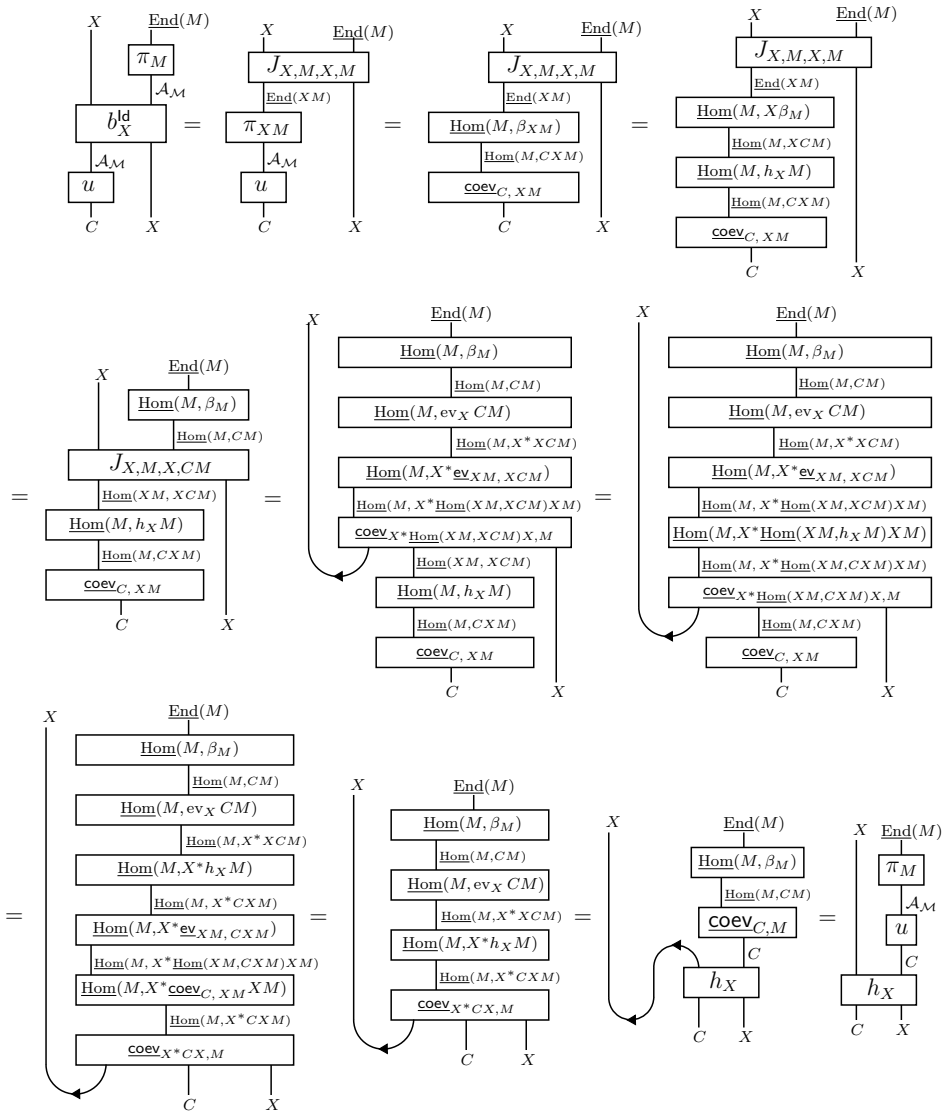
We set up a cochain complex C^•_mix(M) whose cohomology controls deformations of the mixed associator of a module category M over a k-linear monoidal category C. We show that C^•_mix(M) is isomorphic to the Davydov-Yetter complex of the representation functor ρ : C → End(M). Using our previous results on DY cohomology, we prove that if C and M are finite then the cohomology H^•_mix(M) is isomorphic to the relative Ext groups Ext^•_{Z(C),C}(1, A_M) for the usual adjunction between the Drinfeld center Z(C) and C, where A_M is the adjoint algebra of M. This allows us to give a dimension formula for H^n_mix(M) in terms of certain Hom spaces in Z(C), and also to prove that H^{>0}_mix(C) = 0. We也也
What carries the argument
The mixed cochain complex C^•_mix(M) identified with the Davydov-Yetter complex of the representation functor from C to the endofunctors of M, reducing the deformation problem to relative Ext computations.
Load-bearing premise
The isomorphism between the mixed cochain complex and the Davydov-Yetter complex of the representation functor, which is used without full re-derivation here.
What would settle it
Compute both the mixed cohomology directly for a small finite module category and the corresponding relative Ext groups in the Drinfeld center, and check if their dimensions match.
Figures
read the original abstract
We set up a cochain complex $C^\bullet_{\mathrm{mix}}(\mathcal{M})$ whose cohomology controls deformations of the mixed associator of a module category $\mathcal{M}$ over a $\Bbbk$-linear monoidal category $\mathcal{C}$. We show that $C^\bullet_{\mathrm{mix}}(\mathcal{M})$ is isomorphic to the Davydov-Yetter (DY) complex of the representation functor $\rho : \mathcal{C} \to \mathrm{End}(\mathcal{M})$. Using our previous results on DY cohomology (arXiv:2411.19111), we prove that if $\mathcal{C}$ and $\mathcal{M}$ are finite then the cohomology $H^\bullet_{\mathrm{mix}}(\mathcal{M})$ is isomorphic to the relative Ext groups $\mathrm{Ext}^\bullet_{\mathcal{Z}(\mathcal{C}),\mathcal{C}}(\boldsymbol{1},\mathcal{A}_{\mathcal{M}})$ for the usual adjunction between the Drinfeld center $\mathcal{Z}(\mathcal{C})$ and $\mathcal{C}$, where $\mathcal{A}_{\mathcal{M}}$ is the so-called adjoint algebra of $\mathcal{M}$. This allows us to give a dimension formula for $H^n_{\mathrm{mix}}(\mathcal{M})$ in terms of certain Hom spaces in $\mathcal{Z}(\mathcal{C})$, and also to prove that $H^{>0}_{\mathrm{mix}}(\mathcal{C}) = 0$. We also show that the algebra $\mathcal{A}_{\mathcal{M}}$ is the ``full center'' of an algebra in $\mathcal{C}$ realizing $\mathcal{M}$. We furthermore establish a generalized version of Ocneanu rigidity for monoidal functors with coefficients, and provide its application to general (non-exact and non-finite) $\mathcal{C}$-module categories over a fusion category $\mathcal{C}$ such that $\dim(\mathcal{C}) \neq 0$. We spell out these results for module categories defined by finite-dimensional comodule algebras over finite-dimensional Hopf algebras. Examples based on comodule algebras over Sweedler's Hopf algebra are worked out in detail and yield new continuous families of inequivalent non-exact module categories.
Editorial analysis
A structured set of objections, weighed in public.
Referee Report
Summary. The paper defines a cochain complex C^•_mix(M) whose cohomology controls deformations of the mixed associator of a module category M over a k-linear monoidal category C. It shows that C^•_mix(M) is isomorphic to the Davydov-Yetter complex of the representation functor ρ: C → End(M). Using prior results on DY cohomology, it proves that if C and M are finite then H^•_mix(M) ≅ Ext^•_{Z(C),C}(1, A_M) for the adjunction between the Drinfeld center Z(C) and C, where A_M is the adjoint algebra of M. This yields a dimension formula for H^n_mix(M) in terms of Hom spaces in Z(C) and proves H^{>0}_mix(C) = 0. The paper further shows A_M is the full center of an algebra realizing M, establishes a generalized Ocneanu rigidity for monoidal functors with coefficients (applicable to non-exact, non-finite C-module categories over fusion categories C with dim(C) ≠ 0), and works out explicit examples for comodule algebras over finite-dimensional Hopf algebras, including new continuous families over Sweedler's Hopf algebra.
Significance. If the central identifications are verified, the results link mixed-associator deformations directly to relative Ext groups in the Drinfeld center, providing computable dimension formulas and rigidity statements that extend classical results like Ocneanu rigidity. The explicit Hopf algebra examples and the treatment of non-exact module categories add concrete value to the literature on tensor categories and their deformations.
major comments (2)
- The section establishing the isomorphism C^•_mix(M) ≅ DY complex of ρ: the paper asserts this identification (invoked to apply the main theorem of arXiv:2411.19111) but the provided text does not exhibit an explicit chain map or direct comparison of differentials arising from the pentagonator/module-associator data versus the monoidal structure on ρ; any mismatch in signs or higher coherence would invalidate the subsequent Ext isomorphism and all dimension/vanishing formulas derived from it.
- The paragraph deriving the dimension formula for H^n_mix(M) from the Ext groups: this step inherits the identification risk above and is load-bearing for the claim that the cohomology is 'isomorphic to the relative Ext groups'; an independent verification or reference to the precise chain-level isomorphism in the prior work is needed.
minor comments (2)
- Notation: the adjoint algebra A_M is introduced without an early explicit definition or diagram; adding a short definition in the introduction would improve readability.
- The statement of generalized Ocneanu rigidity could include a precise formulation of the 'with coefficients' version and a pointer to where the proof differs from the classical case.
Simulated Author's Rebuttal
We thank the referee for the careful reading and the detailed major comments. We agree that the isomorphism requires a more explicit treatment to be fully rigorous and will revise the manuscript accordingly to strengthen the presentation.
read point-by-point responses
-
Referee: The section establishing the isomorphism C^•_mix(M) ≅ DY complex of ρ: the paper asserts this identification (invoked to apply the main theorem of arXiv:2411.19111) but the provided text does not exhibit an explicit chain map or direct comparison of differentials arising from the pentagonator/module-associator data versus the monoidal structure on ρ; any mismatch in signs or higher coherence would invalidate the subsequent Ext isomorphism and all dimension/vanishing formulas derived from it.
Authors: We agree that an explicit chain map and direct comparison of differentials (including signs and coherence) should be exhibited rather than asserted. In the revised manuscript we will add a dedicated subsection that constructs the chain map explicitly from the definitions of the mixed cochain complex (using the module associator data) to the Davydov-Yetter complex of the representation functor ρ, verifies that it is a chain map by direct computation on generators, and checks compatibility with the higher coherence conditions. This will make the identification fully rigorous and allow safe invocation of the main theorem from arXiv:2411.19111. revision: yes
-
Referee: The paragraph deriving the dimension formula for H^n_mix(M) from the Ext groups: this step inherits the identification risk above and is load-bearing for the claim that the cohomology is 'isomorphic to the relative Ext groups'; an independent verification or reference to the precise chain-level isomorphism in the prior work is needed.
Authors: We will revise the paragraph to include an explicit reference to the precise chain-level isomorphism theorem in arXiv:2411.19111 and add a short independent verification sketch showing how the dimension formula for the relative Ext groups in the Drinfeld center translates directly to the stated formula for dim H^n_mix(M) in terms of Hom spaces in Z(C). This will make the derivation self-contained once the chain map is established. revision: yes
Circularity Check
Central Ext isomorphism obtained via self-cited DY cohomology results from arXiv:2411.19111
specific steps
-
self citation load bearing
[Abstract]
"We show that C^•_mix(M) is isomorphic to the Davydov-Yetter (DY) complex of the representation functor ρ : C → End(M). Using our previous results on DY cohomology (arXiv:2411.19111), we prove that if C and M are finite then the cohomology H^•_mix(M) is isomorphic to the relative Ext groups Ext^•_{Z(C),C}(1, A_M)"
The isomorphism H^•_mix(M) ≅ Ext^•_{Z(C),C}(1, A_M) is obtained directly by substituting the main theorem of the authors' own prior paper arXiv:2411.19111 for the cohomology of the DY complex; the present manuscript provides no independent chain-map verification or re-proof of that substitution, making the central claim rest on the overlapping-author citation.
full rationale
The paper independently defines the mixed cochain complex C^•_mix(M) and claims an isomorphism to the Davydov-Yetter complex of the representation functor ρ. The load-bearing step converting this to the relative Ext isomorphism with the adjoint algebra A_M invokes the authors' prior results on DY cohomology without re-derivation here. This matches the self-citation load-bearing pattern but leaves independent content in the mixed-complex setup and the claimed isomorphism to DY. No self-definitional reductions, fitted predictions, or ansatz smuggling appear in the provided derivation chain. The finite assumptions and dimension formulas inherit the self-citation but do not collapse the entire argument by construction.
Axiom & Free-Parameter Ledger
axioms (2)
- standard math Standard coherence axioms for monoidal categories and module categories (associators, unitors satisfying pentagon and triangle identities).
- domain assumption Finite-dimensionality of C and M to obtain the Ext isomorphism and dimension formula.
invented entities (2)
-
Mixed cochain complex C^•_mix(M)
no independent evidence
-
Adjoint algebra A_M of the module category M
no independent evidence
Reference graph
Works this paper leans on
-
[1]
N. Andruskiewitsch, J. M. Mombelli, On finite-dimensional Hopf algebras , J. Algebra 314 (2007), no. 1, 383--418
work page 2007
- [2]
-
[3]
M. Batanin, A. Davydov, Cosimplicial monoids and deformation theory of tensor categories , J. Noncommut. Geom. 17 (2023), no. 4, 1167--1229
work page 2023
-
[4]
N. Bortolussi, M. Mombelli, The character algebra for module categories over Hopf algebras , Colloq. Math. 165 (2021), no. 2, 171--197
work page 2021
-
[5]
A. Brugui\`eres, S. Lack, A. Virelizier, Hopf monads on monoidal categories , Adv. Math. 227 (2011), no. 2, 745--800
work page 2011
-
[6]
A. Brugui\`eres, A. Virelizier, Hopf monads , Adv. Math. 215 (2007), no. 2, 679--733
work page 2007
-
[7]
K. Coulembier, M. Stroiński, T. Zorman, Simple algebras and exact module categories , arXiv:2501.06629 (2025)
- [8]
-
[9]
Twisting of monoidal structures
A. Davydov, Twisting of monoidal structures , arXiv:q-alg/9703001 (1997)
work page internal anchor Pith review Pith/arXiv arXiv 1997
-
[10]
Davydov, Centre of an algebra , Adv
A. Davydov, Centre of an algebra , Adv. Math. 225 (2010), no. 1, 319--348
work page 2010
-
[11]
C.L. Douglas, C. Schommer-Pries, N. Snyder, The balanced tensor product of module categories , Kyoto J. Math. 59 (2019), no. 1, 167--179
work page 2019
-
[12]
P. Etingof, S. Gelaki, D. Nikshych, V. Ostrik, Tensor categories , Math. Surveys Monogr. 205. American Mathematical Society, Providence, RI, 2015
work page 2015
-
[13]
P. Etingof, V. Ostrik, Finite tensor categories , Mosc. Math. J. 4 (2004), no. 3, 627–654
work page 2004
-
[14]
M. Faitg, A.M. Gainutdinov, C. Schweigert, Davydov--Yetter cohomology and relative homological algebra , Selecta Math. (N.S.) 30 (2024), no. 2, Paper no. 26, 80 pp
work page 2024
- [15]
-
[16]
J. Fjelstad, J. Fuchs, I. Runkel, C. Schweigert, Uniqueness of open / closed rational CFT with given algebra of open states, Adv. Theor. Math. Phys. 12 (2008), no. 6, 1283--1375
work page 2008
-
[17]
J.\ Fuchs, I.\ Runkel, C.\ Schweigert, TFT construction of RCFT correlators I: Partition functions , Nucl.\ Phys.\ B 646 (2002), no. 3, 353–497
work page 2002
- [18]
- [19]
-
[20]
J.\ Fuchs, C.\ Schweigert, A.\ Valentino, Bicategories for boundary conditions and for surface defects in 3-d TFT , Commun. Math. Phys. 321 (2013), no. 2, 543–575
work page 2013
-
[21]
A.M. Gainutdinov, J. Haferkamp, C. Schweigert, Davydov-Yetter cohomology, comonads and Ocneanu rigidity , Adv. Math. 414 (2023), Paper no. 108853, 48 pp
work page 2023
-
[22]
A.M. Gainutdinov, R. Laugwitz, Fully exact and fully dualizable module categories , arXiv:2601.22017
-
[23]
A.M. Gainutdinov, M. Mombelli, The relative Nakayama functor , in preparation
-
[24]
Gerstenhaber, The cohomology structure of an associative ring , Ann
M. Gerstenhaber, The cohomology structure of an associative ring , Ann. of Math. 78 (1963), no. 2, 267--288
work page 1963
-
[25]
M. Gerstenhaber, S. D. Schack, Algebras, bialgebras, quantum groups and algebraic deformations , in: Deformation theory and quantum groups with applications to mathematical physics (Amherst, MA, 1990) , 51--92. Contemp. Math. 134, American Mathematical Society, Providence, RI, 1992
work page 1990
-
[26]
Johnstone, Adjoint lifting theorems for categories of algebras , Bull
P.T. Johnstone, Adjoint lifting theorems for categories of algebras , Bull. London Math. Soc. 7 (1975), no. 3, 294--297
work page 1975
-
[27]
Mac Lane, Homology , Reprint of the 1975 edition
S. Mac Lane, Homology , Reprint of the 1975 edition. Classics Math, Springer-Verlag, Berlin, 1995
work page 1975
-
[28]
Mac Lane, Categories for the working mathematician , second edition
S. Mac Lane, Categories for the working mathematician , second edition. Grad. Texts in Math. 5, Springer-Verlag, New York, 1998
work page 1998
-
[29]
S. Majid, Representations, duals and quantum doubles of monoidal categories , Proceedings of the Winter School ``Geometry and Physics'', Rend. Circ. Mat. Palermo (2), Suppl. No. 26 (1991), 197--206
work page 1991
-
[30]
Mombelli, Module categories over pointed Hopf algebras , Math
M. Mombelli, Module categories over pointed Hopf algebras , Math. Z. 266 (2010), no. 2, 319--344
work page 2010
-
[31]
D. Nakamura, T. Shibata, K. Shimizu, Exact module categories over Rep(u_q( sl _2)) , arxiv:2503.21265, 49pp (2025)
-
[32]
P. Schauenburg, Hopf-Galois and bi-Galois extensions , in: Galois theory, Hopf algebras, and semiabelian categories , 469--515. Fields Inst. Commun. 43, American Mathematical Society, Providence, RI, 2004. https://doi.org/10.1090/fic/043
-
[33]
Shimizu, The monoidal center and the character algebra , J
K. Shimizu, The monoidal center and the character algebra , J. Pure Appl. Algebra 221 (2017), no. 9, 2338--2371
work page 2017
-
[34]
Shimizu, Further results on the structure of (co)ends in finite tensor categories , Appl
K. Shimizu, Further results on the structure of (co)ends in finite tensor categories , Appl. Categ. Structures 28 (2020), no. 2, 237--286
work page 2020
-
[35]
Shimizu, Relative Serre functor for comodule algebras , J
K. Shimizu, Relative Serre functor for comodule algebras , J. Algebra 634 (2023), 237--305
work page 2023
-
[36]
Shimizu, Quasi-Frobenius algebras in finite tensor categories , arXiv:2402.02929
K. Shimizu, Quasi-Frobenius algebras in finite tensor categories , arXiv:2402.02929
-
[37]
Weibel, An Introduction to Homological Algebra , Cambridge Stud
C.A. Weibel, An Introduction to Homological Algebra , Cambridge Stud. Adv. Math. 38, Cambridge University Press, 1994
work page 1994
-
[38]
J.-O. Willprecht, On deformations of module categories over finite tensor categories , PhD thesis, University of Hamburg, 2023. \ at https://ediss.sub.uni-hamburg.de/handle/ediss/10651
work page 2023
-
[39]
D. N. Yetter, Braided deformations of monoidal categories and Vassiliev invariants , in: Higher category theory (Evanston, IL, 1997) , 117--134. Contemp. Math. 230, American Mathematical Society, Providence, RI, 1998
work page 1997
discussion (0)
Sign in with ORCID, Apple, or X to comment. Anyone can read and Pith papers without signing in.