Recognition: no theorem link
First results of AMBRA: Abundant Seeds and Early Mergers as a Pathway to the First Massive Black Holes
Pith reviewed 2026-05-13 21:31 UTC · model grok-4.3
The pith
Abundant early black hole seeds plus mergers explain JWST's massive high-redshift black holes without super-Eddington growth.
A machine-rendered reading of the paper's core claim, the machinery that carries it, and where it could break.
Core claim
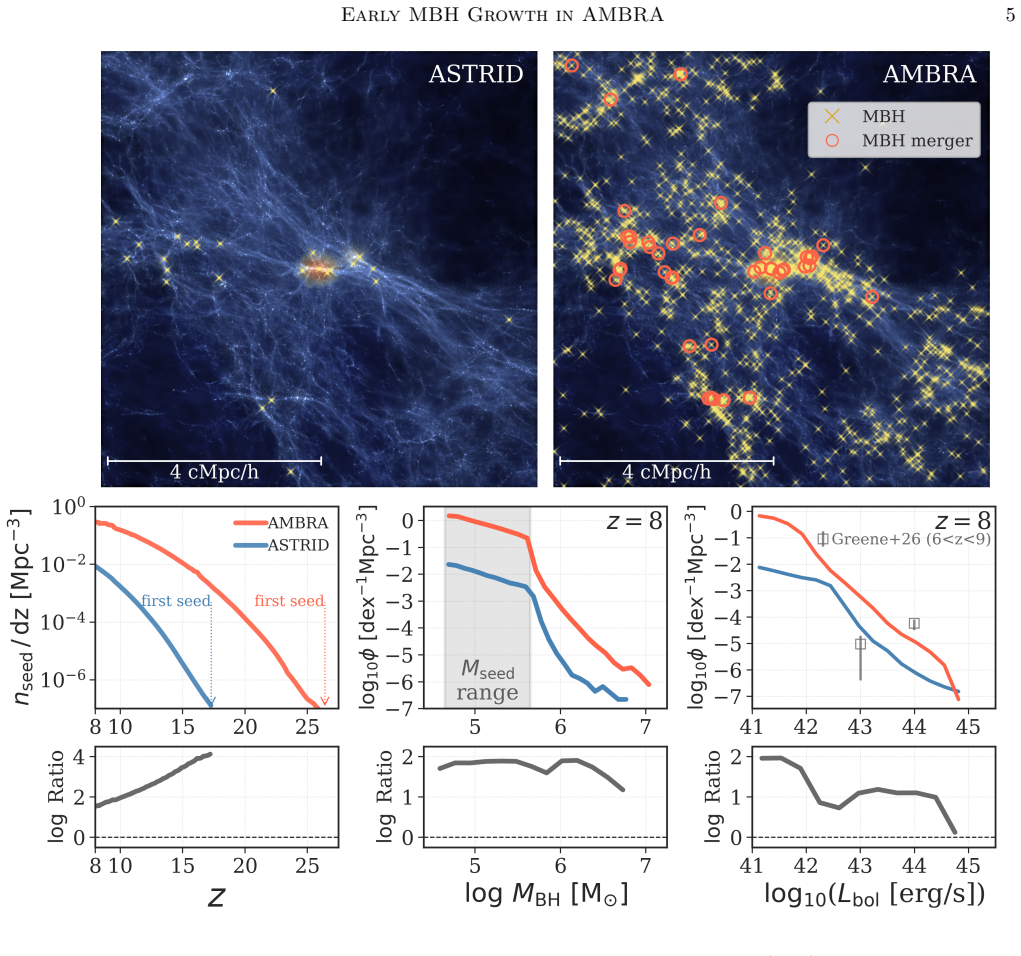
AMBRA shows that a physically motivated heavy-seed prescription permitting 4 times 10 to the 4-5 solar-mass seeds in halos with star-forming, metal-poor gas produces more than an order of magnitude higher black hole number density at z=8 than ASTRID across 10 to the 5-7 solar masses. Black holes matching GN-z11 and CEERS-1019 form in highly compact peaks, acquire about 50 percent of their mass from mergers by z=11, and thereafter grow primarily through gas accretion, reproducing JWST observations without sustained super-Eddington accretion.
What carries the argument
The lenient heavy-seed prescription from BRAHMA that forms 4 times 10 to the 4-5 solar-mass seeds in halos containing star-forming, metal-poor gas, embedded in ASTRID's large cosmological volume.
If this is right
- Black hole number density at z=8 exceeds ASTRID by more than a factor of ten for masses between 10^5 and 10^7 solar masses.
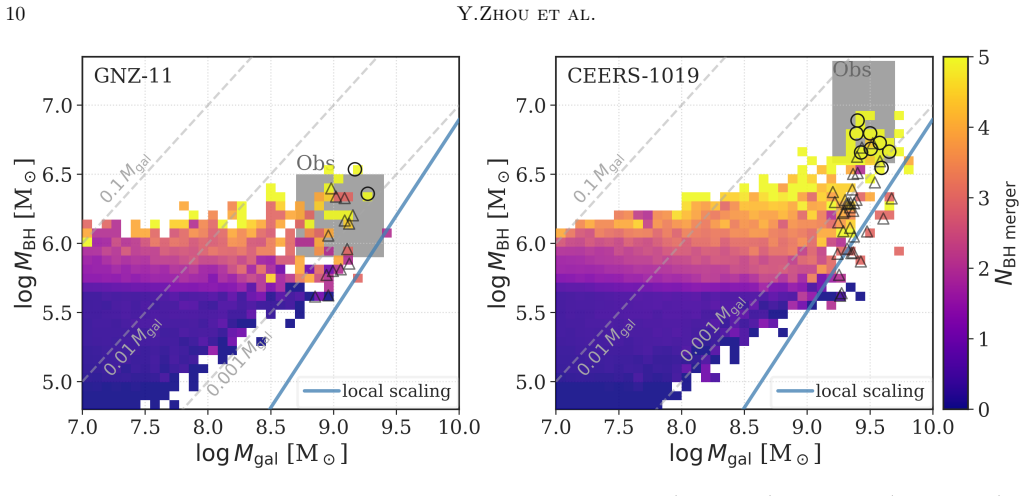
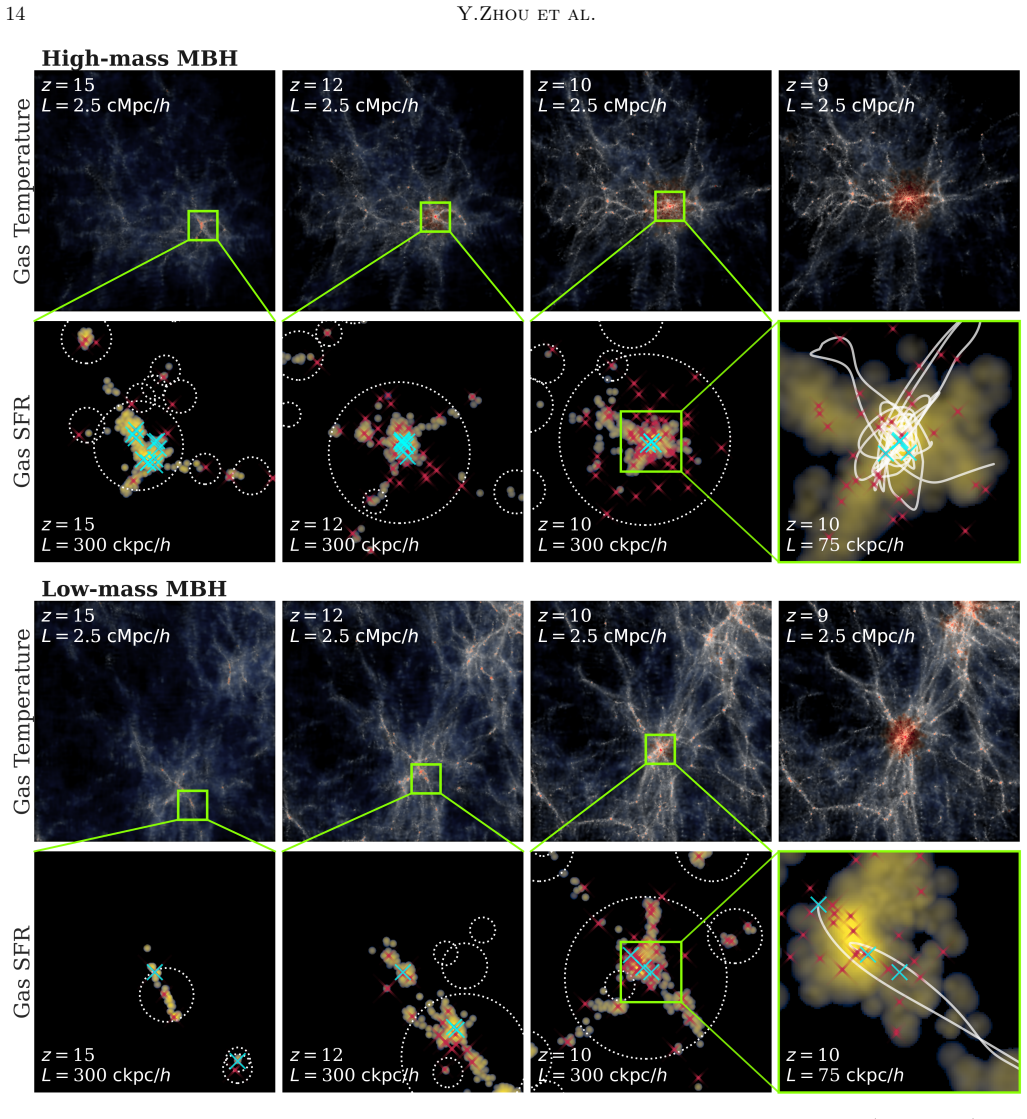
- Black holes matching GN-z11 and CEERS-1019 form in compact density peaks and obtain roughly half their mass from mergers by z=11.
- Gas accretion becomes the dominant growth channel after z=11 once early mergers have assembled the initial mass.
- The model yields approximately four LISA-detectable black hole merger events per year at redshift 8 and above, three orders of magnitude above ASTRID.
Where Pith is reading between the lines
- Heavy-seed formation via stellar collisions or Population III remnants may be common enough in the early universe to dominate the first black hole population.
- Varying the seeding efficiency or halo conditions in future runs could test how sensitive the JWST match is to the exact heavy-seed threshold.
- The elevated high-redshift merger rate provides a direct observational test for LISA that could distinguish this pathway from models relying on super-Eddington accretion alone.
Load-bearing premise
Heavy black hole seeds of 40,000 to 100,000 solar masses form efficiently in halos that contain star-forming, metal-poor gas.
What would settle it
A measured black hole number density at redshift 8 in the 10^5-10^7 solar-mass range that is an order of magnitude lower than AMBRA predicts, or a failure to detect the forecasted LISA merger events at z greater than or equal to 8.
Figures





read the original abstract
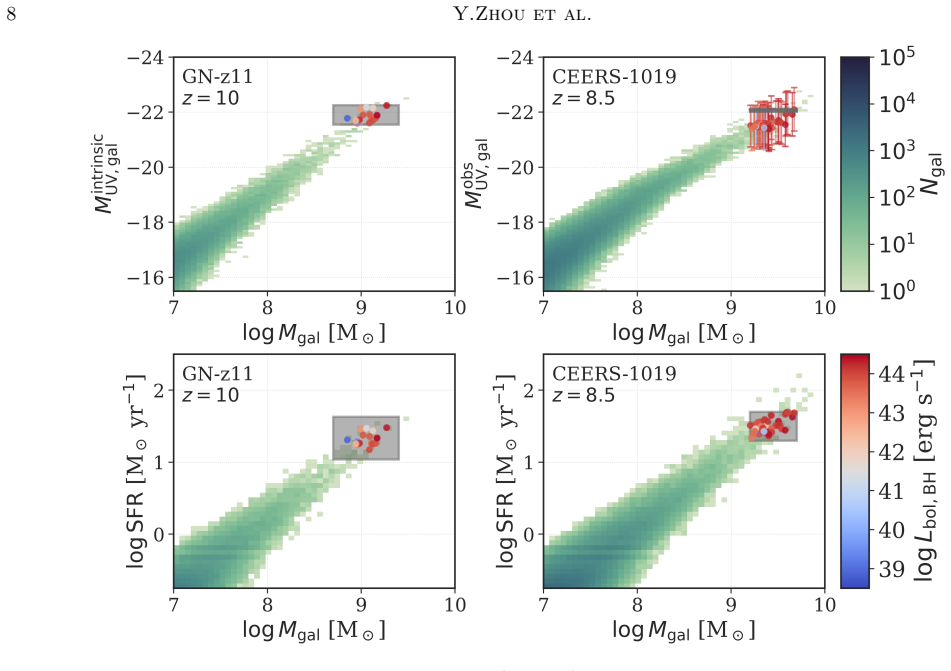
AMBRA combines the large cosmological volume and statistical power of ASTRID with the physically motivated gas-based black hole seeding models from BRAHMA. Motivated by JWST's discoveries of massive black holes (BHs) at $z\gtrsim 9$, AMBRA adopts a lenient heavy-seed prescription from the BRAHMA suite, allowing for the formation of $4\times 10^{4-5}\ M_{\odot}$ seeds in halos with star-forming, metal-poor gas. The seeding model is motivated by scenarios in which heavy seeds form through stellar collisions in star clusters or from the rapid growth of Population III remnants. The improved seeding model enables AMBRA to form BH seeds much earlier and more efficiently compared to ASTRID. This significantly enhances early BH growth, producing a $z=8$ BH number density more than an order of magnitude higher than that in ASTRID over the mass range $10^{5-7}\ M_{\odot}$. BHs reaching masses consistent with GN-z11 and CEERS-1019 typically originate in highly compact density peaks and undergo multiple early mergers. In these systems, $\sim50\%$ of BH masses by $z=11$ is from BH mergers, after which gas accretion becomes the dominant growth channel. Without this early merger-driven assembly, ASTRID cannot reproduce the high-mass BH detected by JWST. Our results indicate that abundant early seed formation combined with frequent mergers can explain several JWST massive BH candidates without requiring sustained super-Eddington accretion. As a testable prediction, AMBRA yields $\approx4$ LISA detectable BH merger events per year at $z\geq8$, which is three orders of magnitude higher than that in ASTRID.
Editorial analysis
A structured set of objections, weighed in public.
Referee Report
Summary. The manuscript presents first results from the AMBRA simulation, which merges the large cosmological volume and statistical power of the ASTRID suite with the gas-based black hole seeding models developed in BRAHMA. Adopting a lenient heavy-seed prescription that places 4×10^{4-5} M_⊙ seeds in halos containing star-forming, metal-poor gas—motivated by stellar collisions in clusters or rapid Pop III remnant growth—AMBRA produces black hole seeds earlier and more abundantly than ASTRID. This yields a z=8 BH number density more than an order of magnitude higher than ASTRID across 10^{5-7} M_⊙. Black holes matching JWST candidates such as GN-z11 and CEERS-1019 form in compact density peaks, with ~50% of their mass assembled via mergers by z=11 before accretion dominates; the work also reports a LISA-detectable merger rate of ~4 events per year at z≥8, three orders of magnitude above ASTRID.
Significance. If the reported trends hold under further scrutiny, the results demonstrate that abundant early heavy seeds combined with merger-driven growth can account for JWST-detected massive black holes at z≳9 without sustained super-Eddington accretion. The study provides a concrete bridge between two established simulation frameworks, quantifies the relative roles of mergers versus accretion in the first ~500 Myr, and supplies a falsifiable prediction for LISA event rates that can be tested with future gravitational-wave observations.
major comments (3)
- [§3] §3 (Seeding implementation): The central >10× enhancement in z=8 BH number density and the ~50% early merger contribution both rest on the specific choice of heavy-seed mass range (4×10^{4-5} M_⊙) and the exact metallicity/star-formation thresholds taken from BRAHMA. No parameter-variation suite is shown; modest tightening of the metal-poor or star-forming gas criterion (well within current uncertainties) would reduce seed abundance and could erase both the density boost and the match to GN-z11/CEERS-1019.
- [§4.3] §4.3 and Figure 7: The statement that BHs matching GN-z11 and CEERS-1019 acquire ~50% of their mass from mergers by z=11 is presented for a small number of compact-peak objects. It is unclear whether this fraction is robust to changes in the merger-tree algorithm, numerical resolution, or the precise definition of “compact peaks”; a resolution study or additional realizations would be required to establish that the merger channel is not an artifact of the chosen sub-grid parameters.
- [§5] §5 (LISA prediction): The reported rate of ≈4 detectable events per year at z≥8 is derived directly from the enhanced high-z BH population. Without explicit convergence tests on the high-redshift merger rate (which is sensitive to both seeding efficiency and dynamical friction prescriptions), the three-order-of-magnitude increase relative to ASTRID cannot yet be regarded as a firm prediction.
minor comments (3)
- [Abstract] The abstract and §2 should explicitly state the precise numerical values of the metallicity and star-formation thresholds used for seeding, rather than referring only to “BRAHMA models.”
- [Figure 3] Figure 3 (BH mass function) would benefit from an additional panel or inset showing the ratio to ASTRID at each mass bin to make the order-of-magnitude claim visually immediate.
- [§3] A short paragraph in §3 comparing the adopted seeding efficiency to other recent heavy-seed implementations (e.g., those in IllustrisTNG or EAGLE variants) would help place the “lenient” choice in context.
Simulated Author's Rebuttal
We thank the referee for the detailed and constructive review. The comments highlight important aspects of the seeding model and the robustness of our results. We address each point below and have made partial revisions to the manuscript by adding discussions on parameter uncertainties and limitations.
read point-by-point responses
-
Referee: [§3] §3 (Seeding implementation): The central >10× enhancement in z=8 BH number density and the ~50% early merger contribution both rest on the specific choice of heavy-seed mass range (4×10^{4-5} M_⊙) and the exact metallicity/star-formation thresholds taken from BRAHMA. No parameter-variation suite is shown; modest tightening of the metal-poor or star-forming gas criterion (well within current uncertainties) would reduce seed abundance and could erase both the density boost and the match to GN-z11/CEERS-1019.
Authors: We agree that our results depend on the adopted seeding parameters. These are taken directly from the BRAHMA models to ensure consistency with prior work on gas-based seeding. A comprehensive parameter study is beyond the scope of this first results paper due to computational costs. In the revised manuscript, we have expanded Section 3 to discuss the sensitivity to metallicity and star-formation thresholds, noting that the lenient criteria are motivated by physical scenarios like stellar collisions. We argue that the qualitative enhancement over ASTRID persists even with moderate adjustments, but we acknowledge this as a key uncertainty. revision: partial
-
Referee: [§4.3] §4.3 and Figure 7: The statement that BHs matching GN-z11 and CEERS-1019 acquire ~50% of their mass from mergers by z=11 is presented for a small number of compact-peak objects. It is unclear whether this fraction is robust to changes in the merger-tree algorithm, numerical resolution, or the precise definition of “compact peaks”; a resolution study or additional realizations would be required to establish that the merger channel is not an artifact of the chosen sub-grid parameters.
Authors: The merger mass fraction is reported for the rare objects that match the JWST candidates, which naturally limits the sample size. We have clarified the definition of compact peaks in the revised Section 4.3 and Figure 7 caption. The merger trees follow the same methodology as ASTRID, and the high merger rate in dense environments is a robust outcome of the increased seed density. However, we concur that additional resolution tests would be valuable. We have added a caveat stating that the 50% figure is specific to these systems and may vary with numerical details, planning further investigation in follow-up studies. revision: partial
-
Referee: [§5] §5 (LISA prediction): The reported rate of ≈4 detectable events per year at z≥8 is derived directly from the enhanced high-z BH population. Without explicit convergence tests on the high-redshift merger rate (which is sensitive to both seeding efficiency and dynamical friction prescriptions), the three-order-of-magnitude increase relative to ASTRID cannot yet be regarded as a firm prediction.
Authors: The LISA event rate is indeed a direct prediction from the simulated high-redshift BH mergers. We use the same dynamical friction model as ASTRID, so the increase stems from the higher BH abundance and earlier mergers. In the revised Section 5, we have included a discussion of potential sensitivities to seeding efficiency and sub-grid physics, framing the rate as a model prediction rather than a definitive forecast. Full convergence tests require new simulation suites, which we note as future work. revision: partial
Circularity Check
No significant circularity in AMBRA simulation results
full rationale
The paper reports direct outputs from cosmological hydrodynamical simulations that adopt a seeding prescription from the BRAHMA suite. The z=8 BH number density (more than 10x higher than ASTRID for 10^5-7 Msun), the ~50% merger mass contribution by z=11 in compact peaks, and the LISA event rate are simulation-derived quantities compared to external ASTRID runs and JWST observations. No load-bearing step reduces any claimed result to a self-definition, a fitted parameter renamed as prediction, or an ansatz smuggled via self-citation. The seeding model is presented as a physically motivated input choice rather than a circular derivation internal to this work.
Axiom & Free-Parameter Ledger
free parameters (2)
- heavy seed mass range =
4e4-5 Msun
- seeding threshold
axioms (1)
- domain assumption Heavy seeds can form via stellar collisions in clusters or rapid growth of Pop III remnants
Reference graph
Works this paper leans on
-
[1]
2026, arXiv e-prints, arXiv:2602.02323, doi: 10.48550/arXiv.2602.02323
´Alvarez-M´ arquez, J., Colina, L., Crespo-Gomez, A., et al. 2026, arXiv e-prints, arXiv:2602.02323, doi: 10.48550/arXiv.2602.02323
-
[2]
2025, MNRAS, 536, 3677, doi: 10.1093/mnras/stae2765
Arita, J., Kashikawa, N., Onoue, M., et al. 2025, MNRAS, 536, 3677, doi: 10.1093/mnras/stae2765
-
[3]
2011, The Astrophysical Journal, 742, 13, doi: 10.1088/0004-637X/742/1/13
Bellovary, J., Volonteri, M., Governato, F., et al. 2011, ApJ, 742, 13, doi: 10.1088/0004-637X/742/1/13
-
[4]
K., Blecha, L., Torrey, P., et al
Bhowmick, A. K., Blecha, L., Torrey, P., et al. 2022a, MNRAS, 510, 177, doi: 10.1093/mnras/stab3439 —. 2024a, MNRAS, 529, 3768, doi: 10.1093/mnras/stae780
-
[5]
Bhowmick, A. K., Blecha, L., Ni, Y., et al. 2022b, MNRAS, 516, 138, doi: 10.1093/mnras/stac2238 —. 2022c, MNRAS, 516, 138, doi: 10.1093/mnras/stac2238
-
[6]
K., Blecha, L., Torrey, P., et al
Bhowmick, A. K., Blecha, L., Torrey, P., et al. 2024b, MNRAS, 531, 4311, doi: 10.1093/mnras/stae1386 —. 2024c, MNRAS, 533, 1907, doi: 10.1093/mnras/stae1819 —. 2025, arXiv e-prints, arXiv:2510.01322, doi: 10.48550/arXiv.2510.01322
-
[7]
2022, MNRAS, 512, 3703, doi: 10.1093/mnras/stac648
Bird, S., Ni, Y., Di Matteo, T., et al. 2022, MNRAS, 512, 3703, doi: 10.1093/mnras/stac648 Bogd´ an,´A., Goulding, A. D., Natarajan, P., et al. 2024, Nature Astronomy, 8, 126, doi: 10.1038/s41550-023-02111-9
- [8]
-
[9]
Bressan, A., Marigo, P., Girardi, L., et al. 2012, MNRAS, 427, 127, doi: 10.1111/j.1365-2966.2012.21948.x
-
[10]
2025, MNRAS, 542, 2597, doi: 10.1093/mnras/staf1362
Cenci, E., & Habouzit, M. 2025, MNRAS, 542, 2597, doi: 10.1093/mnras/staf1362
-
[11]
2003, PASP, 115, 763, doi: 10.1086/376392
Chabrier, G. 2003, PASP, 115, 763, doi: 10.1086/376392
work page internal anchor Pith review doi:10.1086/376392 2003
-
[12]
2022, MNRAS, 510, 531, doi: 10.1093/mnras/stab3411
Chen, N., Ni, Y., Tremmel, M., et al. 2022, MNRAS, 510, 531, doi: 10.1093/mnras/stab3411
-
[13]
2025, MNRAS, 539, 2561, doi: 10.1093/mnras/staf598 Early MBH Growth in AMBRA19
Chon, S., & Omukai, K. 2025, MNRAS, 539, 2561, doi: 10.1093/mnras/staf598 Early MBH Growth in AMBRA19
-
[14]
Conroy, C., & Gunn, J. E. 2010, ApJ, 712, 833, doi: 10.1088/0004-637X/712/2/833
-
[15]
Conroy, C., Gunn, J. E., & White, M. 2009, ApJ, 699, 486, doi: 10.1088/0004-637X/699/1/486
work page internal anchor Pith review doi:10.1088/0004-637x/699/1/486 2009
-
[16]
Davis, M., Efstathiou, G., Frenk, C. S., & White, S. D. M. 1985, ApJ, 292, 371, doi: 10.1086/163168
-
[17]
Dekel, A., Stone, N. C., Chowdhury, D. D., et al. 2025, A&A, 695, A97, doi: 10.1051/0004-6361/202452393 Di Matteo, T., Springel, V., & Hernquist, L. 2005, Nature, 433, 604, doi: 10.1038/nature03335
-
[18]
Doherty, C. L., Gil-Pons, P., Lau, H. H. B., Lattanzio, J. C., & Siess, L. 2014a, MNRAS, 437, 195, doi: 10.1093/mnras/stt1877
-
[19]
Doherty, C. L., Gil-Pons, P., Lau, H. H. B., et al. 2014b, MNRAS, 441, 582, doi: 10.1093/mnras/stu571
-
[20]
Dubois, Y., Peirani, S., Pichon, C., et al. 2016, MNRAS, 463, 3948, doi: 10.1093/mnras/stw2265
-
[21]
2024, ApJ, 974, 275, doi: 10.3847/1538-4357/ad778b
Eilers, A.-C., Mackenzie, R., Pizzati, E., et al. 2024, ApJ, 974, 275, doi: 10.3847/1538-4357/ad778b
-
[22]
Fan, X., Ba˜ nados, E., & Simcoe, R. A. 2023, ARA&A, 61, 373, doi: 10.1146/annurev-astro-052920-102455
-
[23]
2021, ApJL, 914, L26, doi: 10.3847/2041-8213/ac04b0
Feng, W.-X., Yu, H.-B., & Zhong, Y.-M. 2021, ApJL, 914, L26, doi: 10.3847/2041-8213/ac04b0
-
[24]
2018, MP-Gadget/MP-Gadget: A tag for getting a DOI, FirstDOI, Zenodo, doi: 10.5281/zenodo.1451799
Pedersen, C. 2018, MP-Gadget/MP-Gadget: A tag for getting a DOI, FirstDOI, Zenodo, doi: 10.5281/zenodo.1451799
-
[25]
Goulding, A. D., Greene, J. E., Setton, D. J., et al. 2023, ApJL, 955, L24, doi: 10.3847/2041-8213/acf7c5
-
[26]
Greene, J. E., Strader, J., & Ho, L. C. 2020, ARA&A, 58, 257, doi: 10.1146/annurev-astro-032620-021835
-
[27]
Greene, J. E., Setton, D. J., Furtak, L. J., et al. 2026, ApJ, 996, 129, doi: 10.3847/1538-4357/ae1836
-
[28]
Harikane, Y., Inoue, A. K., Ellis, R. S., et al. 2025, ApJ, 980, 138, doi: 10.3847/1538-4357/ad9b2c
-
[29]
Hummer, D. G., & Storey, P. J. 1987, MNRAS, 224, 801, doi: 10.1093/mnras/224.3.801
-
[30]
Inayoshi, K., Haiman, Z., & Ostriker, J. P. 2016, MNRAS, 459, 3738, doi: 10.1093/mnras/stw836
-
[31]
2020, ARA&A, 58, 27, doi: 10.1146/annurev-astro-120419-014455
Inayoshi, K., Visbal, E., & Haiman, Z. 2020, ARA&A, 58, 27, doi: 10.1146/annurev-astro-120419-014455
-
[32]
2026, ApJL, 996, L19, doi: 10.3847/2041-8213/ae247a
Jiang, F., Jia, Z., Zheng, H., et al. 2026, ApJL, 996, L19, doi: 10.3847/2041-8213/ae247a
-
[33]
Johnson, J. L., & Haardt, F. 2016, PASA, 33, e007, doi: 10.1017/pasa.2016.4
-
[34]
Karakas, A. I. 2010, MNRAS, 403, 1413, doi: 10.1111/j.1365-2966.2009.16198.x
-
[35]
Kashino, D., Lilly, S. J., Matthee, J., et al. 2023, ApJ, 950, 66, doi: 10.3847/1538-4357/acc588
-
[36]
Katz, N., Weinberg, D. H., & Hernquist, L. 1996, ApJS, 105, 19, doi: 10.1086/192305
-
[37]
2006, ApJ, 653, 1145, doi: 10.1086/508914 Kov´ acs, O
Ohkubo, T. 2006, ApJ, 653, 1145, doi: 10.1086/508914 Kov´ acs, O. E., Bogd´ an,´A., Natarajan, P., et al. 2024, ApJL, 965, L21, doi: 10.3847/2041-8213/ad391f
-
[38]
2023, PhRvD, 108, 083012, doi: 10.1103/PhysRevD.108.083012
Kritos, K., Berti, E., & Silk, J. 2023, PhRvD, 108, 083012, doi: 10.1103/PhysRevD.108.083012
-
[39]
Krumholz, M. R., & Gnedin, N. Y. 2011, ApJ, 729, 36, doi: 10.1088/0004-637X/729/1/36
-
[40]
Larson, R. L., Finkelstein, S. L., Kocevski, D. D., et al. 2023, ApJL, 953, L29, doi: 10.3847/2041-8213/ace619
-
[41]
Lupi, A., Quadri, G., Volonteri, M., Colpi, M., & Regan, J. A. 2024, A&A, 686, A256, doi: 10.1051/0004-6361/202348788
-
[42]
2024, Nature, 627, 59, doi: 10.1038/s41586-024-07052-5
Maiolino, R., Scholtz, J., Witstok, J., et al. 2024, Nature, 627, 59, doi: 10.1038/s41586-024-07052-5
-
[43]
Massonneau, W., Volonteri, M., Dubois, Y., & Beckmann, R. S. 2023, A&A, 670, A180, doi: 10.1051/0004-6361/202243170
-
[44]
Matthee, J., Naidu, R. P., Brammer, G., et al. 2024, ApJ, 963, 129, doi: 10.3847/1538-4357/ad2345
-
[45]
Mayer, L., Capelo, P. R., Zwick, L., & Di Matteo, T. 2024, ApJ, 961, 76, doi: 10.3847/1538-4357/ad11cf
-
[46]
Mehta, D. H., Regan, J. A., & Prole, L. 2026, Nature Astronomy, doi: 10.1038/s41550-025-02767-5
-
[47]
P., Matthee, J., Katz, H., et al
Naidu, R. P., Matthee, J., Katz, H., et al. 2025, arXiv e-prints, arXiv:2503.16596, doi: 10.48550/arXiv.2503.16596
-
[48]
2021, MNRAS, 501, 1413, doi: 10.1093/mnras/staa3724
Natarajan, P. 2021, MNRAS, 501, 1413, doi: 10.1093/mnras/staa3724
-
[49]
2025, ApJ, 990, 120, doi: 10.3847/1538-4357/adf3a7
Ni, Y., Chen, N., Zhou, Y., et al. 2025, ApJ, 990, 120, doi: 10.3847/1538-4357/adf3a7
-
[50]
2022a, MNRAS, 509, 3043, doi: 10.1093/mnras/stab3162
Ni, Y., Di Matteo, T., & Feng, Y. 2022a, MNRAS, 509, 3043, doi: 10.1093/mnras/stab3162
-
[51]
Ni, Y., Di Matteo, T., Bird, S., et al. 2022b, MNRAS, 513, 670, doi: 10.1093/mnras/stac351
-
[52]
1997, NuPhA, 621, 467, doi: 10.1016/S0375-9474(97)00291-1
Nomoto, K., Iwamoto, K., Nakasato, N., et al. 1997, NuPhA, 621, 467, doi: 10.1016/S0375-9474(97)00291-1
-
[53]
Oesch, P. A., Bouwens, R. J., Illingworth, G. D., et al. 2014, ApJ, 786, 108, doi: 10.1088/0004-637X/786/2/108
-
[54]
A., Brammer, G., van Dokkum, P
Oesch, P. A., Brammer, G., van Dokkum, P. G., et al. 2016, ApJ, 819, 129, doi: 10.3847/0004-637X/819/2/129
-
[55]
2011, MNRAS, 410, 166, doi: 10.1111/j.1365-2966.2010.17432.x
Okamoto, T., Frenk, C. S., Jenkins, A., & Theuns, T. 2010, MNRAS, 406, 208, doi: 10.1111/j.1365-2966.2010.16690.x
-
[56]
2025, ApJ, 994, 40, doi: 10.3847/1538-4357/ae1619
Pacucci, F., Hernquist, L., & Fujii, M. 2025, ApJ, 994, 40, doi: 10.3847/1538-4357/ae1619
-
[57]
2015, MNRAS, 452, 1922, doi: 10.1093/mnras/stv1465 20Y.Zhou et al
Pacucci, F., Volonteri, M., & Ferrara, A. 2015, MNRAS, 452, 1922, doi: 10.1093/mnras/stv1465 20Y.Zhou et al
-
[58]
Petersson, J., Hirschmann, M., Tress, R. G., et al. 2025, A&A, 704, A177, doi: 10.1051/0004-6361/202555130
-
[59]
2016, MNRAS, 458, 3047, doi: 10.1093/mnras/stw505
Pezzulli, E., Valiante, R., & Schneider, R. 2016, MNRAS, 458, 3047, doi: 10.1093/mnras/stw505
-
[60]
2018b, MNRAS, 473, 4077, doi: 10.1093/mnras/stx2656
Pillepich, A., Springel, V., Nelson, D., et al. 2018, MNRAS, 473, 4077, doi: 10.1093/mnras/stx2656 Planck Collaboration, Aghanim, N., Akrami, Y., et al. 2020, A&A, 641, A6, doi: 10.1051/0004-6361/201833910
work page internal anchor Pith review doi:10.1093/mnras/stx2656 2018
-
[61]
Roberts-Borsani, G. W., Bouwens, R. J., Oesch, P. A., et al. 2016, ApJ, 823, 143, doi: 10.3847/0004-637X/823/2/143
-
[62]
Rusakov, V., Watson, D., Nikopoulos, G. P., et al. 2026, Nature, 649, 574, doi: 10.1038/s41586-025-09900-4 S´ anchez-Bl´ azquez, P., Peletier, R. F., Jim´ enez-Vicente, J., et al. 2006, MNRAS, 371, 703, doi: 10.1111/j.1365-2966.2006.10699.x
-
[63]
2009, MNRAS, 397, 265, doi: 10.1111/j.1365-2966.2009.14431.x
Shang, C., Bryan, G. L., & Haiman, Z. 2010, MNRAS, 402, 1249, doi: 10.1111/j.1365-2966.2009.15960.x
-
[64]
F., Faucher-Gigu` ere, C.-A., et al
Shen, X., Hopkins, P. F., Faucher-Gigu` ere, C.-A., et al. 2020, MNRAS, 495, 3252, doi: 10.1093/mnras/staa1381
-
[65]
Springel, V., & Hernquist, L. 2003, MNRAS, 339, 289, doi: 10.1046/j.1365-8711.2003.06206.x
-
[66]
Stern, J., & Laor, A. 2012, MNRAS, 426, 2703, doi: 10.1111/j.1365-2966.2012.21772.x
-
[67]
Sugimura, K., Omukai, K., & Inoue, A. K. 2014, MNRAS, 445, 544, doi: 10.1093/mnras/stu1778
-
[68]
Tacchella, S., Eisenstein, D. J., Hainline, K., et al. 2023, ApJ, 952, 74, doi: 10.3847/1538-4357/acdbc6
-
[69]
Taylor, A. J., Finkelstein, S. L., Kocevski, D. D., et al. 2025a, ApJ, 986, 165, doi: 10.3847/1538-4357/add15b
-
[70]
Taylor, A. J., Kokorev, V., Kocevski, D. D., et al. 2025b, ApJL, 989, L7, doi: 10.3847/2041-8213/ade789
-
[71]
2014, MNRAS, 442, 2751, doi: 10.1093/mnras/stu983
Taylor, P., & Kobayashi, C. 2014, MNRAS, 442, 2751, doi: 10.1093/mnras/stu983
-
[72]
Tremmel, M., Governato, F., Volonteri, M., & Quinn, T. R. 2015, MNRAS, 451, 1868, doi: 10.1093/mnras/stv1060
-
[73]
2017, MNRAS, 470, 1121, doi: 10.1093/mnras/stx1160
Tremmel, M., Karcher, M., Governato, F., et al. 2017, MNRAS, 470, 1121, doi: 10.1093/mnras/stx1160
-
[74]
2013, MNRAS, 436, 3031, doi: 10.1093/mnras/stt1789
Vogelsberger, M., Genel, S., Sijacki, D., et al. 2013, MNRAS, 436, 3031, doi: 10.1093/mnras/stt1789
-
[75]
Vogelsberger, M., Nelson, D., Pillepich, A., et al. 2020, MNRAS, 492, 5167, doi: 10.1093/mnras/staa137
-
[76]
Volonteri, M. 2010, A&A Rv, 18, 279, doi: 10.1007/s00159-010-0029-x
-
[77]
Wang, B. Y., Zhou, Y., Chen, W., et al. 2025, ApJ, 993, 199, doi: 10.3847/1538-4357/ae073e
-
[78]
2021, ApJL, 907, L1, doi: 10.3847/2041-8213/abd8c6
Wang, F., Yang, J., Fan, X., et al. 2021, ApJL, 907, L1, doi: 10.3847/2041-8213/abd8c6
-
[79]
2017, MNRAS, 465, 3291, doi: 10.1093/mnras/stw2944
Weinberger, R., Springel, V., Hernquist, L., et al. 2017, MNRAS, 465, 3291, doi: 10.1093/mnras/stw2944
work page internal anchor Pith review doi:10.1093/mnras/stw2944 2017
-
[80]
Wiersma, R. P. C., Schaye, J., Theuns, T., Dalla Vecchia, C., & Tornatore, L. 2009, MNRAS, 399, 574, doi: 10.1111/j.1365-2966.2009.15331.x
discussion (0)
Sign in with ORCID, Apple, or X to comment. Anyone can read and Pith papers without signing in.