Recognition: 2 theorem links
· Lean TheoremUniRecGen: Unifying Multi-View 3D Reconstruction and Generation
Pith reviewed 2026-05-13 22:07 UTC · model grok-4.3
The pith
UniRecGen unifies reconstruction and generation by sharing a canonical space so sparse views yield complete consistent 3D models.
A machine-rendered reading of the paper's core claim, the machinery that carries it, and where it could break.
Core claim
UniRecGen integrates the reconstruction module and diffusion generator inside a single cooperative system by aligning them in a shared canonical space, applying disentangled cooperative learning to maintain training stability, letting the reconstruction supply canonical geometric anchors while the diffusion component uses latent-augmented conditioning to refine and complete the geometry, thereby producing more complete and consistent 3D models from sparse observations than either paradigm alone.
What carries the argument
The shared canonical space plus disentangled cooperative learning that aligns coordinate systems, representations, and objectives so the reconstruction module can anchor geometry while the diffusion generator refines and completes it.
If this is right
- Sparse multi-view inputs produce finished 3D models with both input fidelity and global structural completeness.
- Reconstruction supplies stable geometric anchors that guide the diffusion process without destabilizing training.
- The same framework outperforms prior separate reconstruction and generation methods on fidelity and robustness metrics.
- Inference becomes a single seamless collaboration rather than two disconnected stages.
Where Pith is reading between the lines
- Real-time capture pipelines in robotics or mobile AR could adopt the approach to turn a few camera frames into usable 3D assets.
- The same shared-space cooperation pattern might transfer to other domains where one module supplies local accuracy and another supplies global priors.
Load-bearing premise
That forcing reconstruction and diffusion models into one canonical space with disentangled learning resolves their conflicts in coordinates, representations, and goals without creating fresh inconsistencies or training instability.
What would settle it
A controlled comparison on standard sparse-view benchmarks showing that UniRecGen outputs are no more complete, no more multi-view consistent, or no higher in fidelity than the best separate reconstruction or diffusion baselines.
Figures




read the original abstract
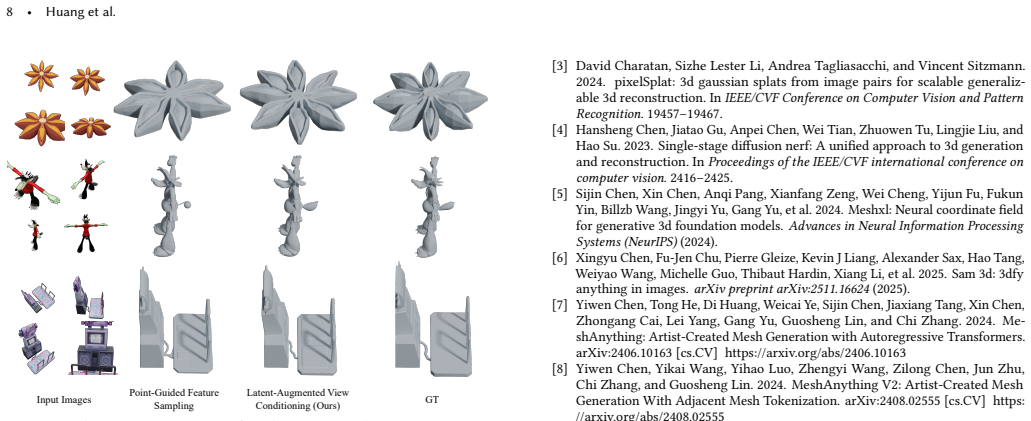
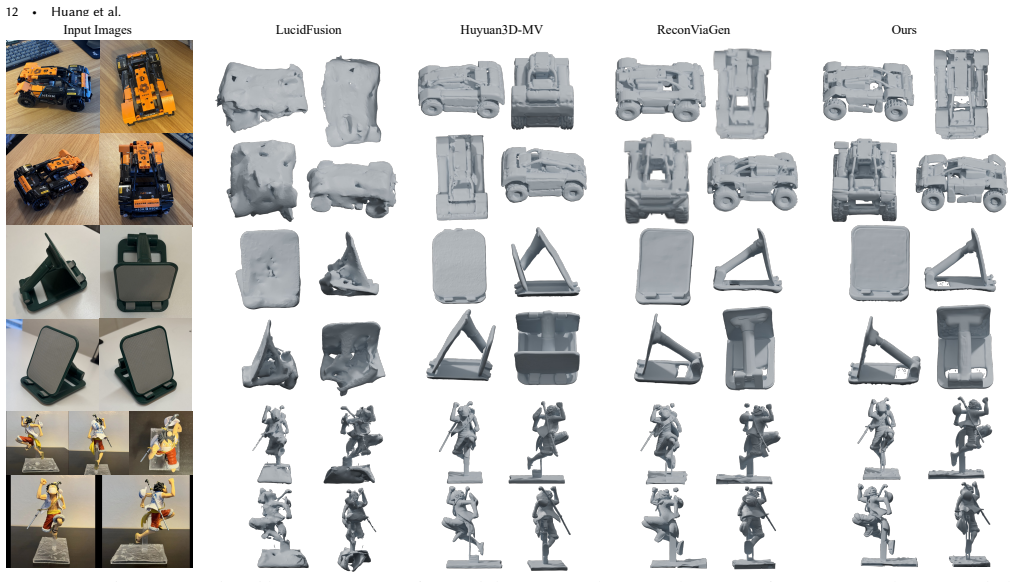
Sparse-view 3D modeling represents a fundamental tension between reconstruction fidelity and generative plausibility. While feed-forward reconstruction excels in efficiency and input alignment, it often lacks the global priors needed for structural completeness. Conversely, diffusion-based generation provides rich geometric details but struggles with multi-view consistency. We present UniRecGen, a unified framework that integrates these two paradigms into a single cooperative system. To overcome inherent conflicts in coordinate spaces, 3D representations, and training objectives, we align both models within a shared canonical space. We employ disentangled cooperative learning, which maintains stable training while enabling seamless collaboration during inference. Specifically, the reconstruction module is adapted to provide canonical geometric anchors, while the diffusion generator leverages latent-augmented conditioning to refine and complete the geometric structure. Experimental results demonstrate that UniRecGen achieves superior fidelity and robustness, outperforming existing methods in creating complete and consistent 3D models from sparse observations. Code is available at https://github.com/zsh523/UniRecGen.
Editorial analysis
A structured set of objections, weighed in public.
Referee Report
Summary. The paper presents UniRecGen, a unified framework integrating feed-forward 3D reconstruction and diffusion-based generation for sparse-view modeling. It aligns both components in a shared canonical space and uses disentangled cooperative learning to resolve conflicts in coordinate systems, representations, and objectives, with the reconstruction module providing geometric anchors and the diffusion module refining structure via latent-augmented conditioning. The central claim is that this yields superior fidelity, robustness, and consistency over existing methods.
Significance. If the empirical claims hold, the work would meaningfully bridge reconstruction efficiency with generative completeness for sparse inputs, offering a practical path to more reliable 3D models without separate pipelines. The availability of code is a positive factor for reproducibility.
major comments (2)
- Abstract: the claim that UniRecGen 'achieves superior fidelity and robustness, outperforming existing methods' is presented without any quantitative metrics, tables, ablation results, or error analysis in the provided text, rendering the central empirical claim unevaluable on its own terms.
- The description of disentangled cooperative learning (Abstract) is load-bearing for the unification argument yet supplies no loss formulations, training schedule details, or stability analysis; without these, it is unclear whether the shared canonical space actually eliminates the stated conflicts rather than introducing new inconsistencies.
minor comments (1)
- Abstract: the GitHub link is given but no statement of what is released (models, training code, evaluation scripts) appears.
Simulated Author's Rebuttal
We thank the referee for the constructive feedback on our manuscript. We address the major comments point by point below, indicating planned revisions where appropriate.
read point-by-point responses
-
Referee: Abstract: the claim that UniRecGen 'achieves superior fidelity and robustness, outperforming existing methods' is presented without any quantitative metrics, tables, ablation results, or error analysis in the provided text, rendering the central empirical claim unevaluable on its own terms.
Authors: We agree that the abstract would benefit from greater specificity to support its claims. While the full manuscript contains the requested quantitative metrics, tables, ablation studies, and error analysis in Section 4, we will revise the abstract to incorporate brief quantitative highlights (e.g., key improvements in fidelity and consistency metrics) so that the central claim is more self-contained and evaluable from the abstract alone. revision: yes
-
Referee: The description of disentangled cooperative learning (Abstract) is load-bearing for the unification argument yet supplies no loss formulations, training schedule details, or stability analysis; without these, it is unclear whether the shared canonical space actually eliminates the stated conflicts rather than introducing new inconsistencies.
Authors: The abstract is a concise summary; the loss formulations for disentangled cooperative learning, the training schedule with alternating optimization, and stability analysis (including convergence behavior) are fully detailed in Section 3 of the manuscript, with experimental validation that the shared canonical space resolves the coordinate, representation, and objective conflicts. We will not alter the abstract but will review Section 3 to ensure the resolution of conflicts is emphasized even more explicitly. revision: no
Circularity Check
No significant circularity detected in derivation chain
full rationale
The paper introduces UniRecGen as a novel unification of reconstruction and diffusion paradigms via a shared canonical space and disentangled cooperative learning. The abstract describes new alignment mechanisms, adaptation of the reconstruction module for geometric anchors, and latent-augmented conditioning for the generator, without any equations or claims that reduce predictions to fitted inputs, self-definitions, or self-citation chains by construction. No load-bearing step renames known results or imports uniqueness theorems from prior author work as external facts. The framework's central claims rest on the proposed integration and experimental outcomes rather than tautological reductions, making the derivation self-contained against external benchmarks.
Axiom & Free-Parameter Ledger
Lean theorems connected to this paper
-
IndisputableMonolith/Foundation/AlexanderDuality.leanalexander_duality_circle_linking unclearwe establish a shared canonical 3D modeling space that serves as a unified structural bridge... branch repurposing strategy... latent-augmented multi-view conditioning
-
IndisputableMonolith/Foundation/BranchSelection.leanbranch_selection unclearmodular design... reconstruction module is trained first to provide a stable geometric anchor... generation model is then trained as a prior-driven refiner
Reference graph
Works this paper leans on
-
[1]
Eric R Chan, Connor Z Lin, Matthew A Chan, Koki Nagano, Boxiao Pan, Shalini De Mello, Orazio Gallo, Leonidas Guibas, Jonathan Tremblay, Sameh Khamis, et al. 2022. Efficient geometry-aware 3D generative adversarial networks. In IEEE/CVF International Conference on Computer Vision
work page 2022
- [2]
-
[3]
David Charatan, Sizhe Lester Li, Andrea Tagliasacchi, and Vincent Sitzmann
-
[4]
InIEEE/CVF Conference on Computer Vision and Pattern Recognition
pixelSplat: 3d gaussian splats from image pairs for scalable generaliz- able 3d reconstruction. InIEEE/CVF Conference on Computer Vision and Pattern Recognition. 19457–19467
-
[5]
Hansheng Chen, Jiatao Gu, Anpei Chen, Wei Tian, Zhuowen Tu, Lingjie Liu, and Hao Su. 2023. Single-stage diffusion nerf: A unified approach to 3d generation and reconstruction. InProceedings of the IEEE/CVF international conference on computer vision. 2416–2425
work page 2023
-
[6]
Sijin Chen, Xin Chen, Anqi Pang, Xianfang Zeng, Wei Cheng, Yijun Fu, Fukun Yin, Billzb Wang, Jingyi Yu, Gang Yu, et al. 2024. Meshxl: Neural coordinate field for generative 3d foundation models.Advances in Neural Information Processing Systems (NeurIPS)(2024)
work page 2024
-
[7]
Xingyu Chen, Fu-Jen Chu, Pierre Gleize, Kevin J Liang, Alexander Sax, Hao Tang, Weiyao Wang, Michelle Guo, Thibaut Hardin, Xiang Li, et al. 2025. Sam 3d: 3dfy anything in images.arXiv preprint arXiv:2511.16624(2025)
work page internal anchor Pith review Pith/arXiv arXiv 2025
-
[8]
Yiwen Chen, Tong He, Di Huang, Weicai Ye, Sijin Chen, Jiaxiang Tang, Xin Chen, Zhongang Cai, Lei Yang, Gang Yu, Guosheng Lin, and Chi Zhang. 2024. Me- shAnything: Artist-Created Mesh Generation with Autoregressive Transformers. arXiv:2406.10163 [cs.CV] https://arxiv.org/abs/2406.10163
- [9]
- [10]
-
[11]
Zilong Chen, Yikai Wang, Feng Wang, Zhengyi Wang, and Huaping Liu
- [12]
-
[13]
Matt Deitke, Ruoshi Liu, Matthew Wallingford, Huong Ngo, Oscar Michel, Aditya Kusupati, Alan Fan, Christian Laforte, Vikram Voleti, Samir Yitzhak Gadre, et al. 2023. Objaverse-xl: A universe of 10m+ 3d objects.Advances in Neural Information Processing Systems36 (2023), 35799–35813
work page 2023
-
[14]
Laura Downs, Anthony Francis, Nate Maggio, Brandon Cavalcanti, Gerard Tagli- abue, Jake Varley, and Brian Ichter. 2022. Google scanned objects: A high-quality dataset of 3D scanned household items. In2022 International Conference on Robotics and Automation (ICRA). IEEE, 2553–2560
work page 2022
- [15]
-
[16]
Yang Fu, Sifei Liu, Amey Kulkarni, Jan Kautz, Alexei A Efros, and Xiaolong Wang. 2023. COLMAP-Free 3D Gaussian Splatting.2024 IEEE/CVF Conference on Computer Vision and Pattern Recognition (CVPR)(2023), 20796–20805
work page 2023
-
[17]
Jun Gao, Tianchang Shen, Zian Wang, Wenzheng Chen, Kangxue Yin, Daiqing Li, Or Litany, Zan Gojcic, and Sanja Fidler. 2022. Get3d: A generative model of high quality 3d textured shapes learned from images.Advances In Neural Information Processing Systems35 (2022), 31841–31854
work page 2022
- [18]
-
[19]
Ian Goodfellow, Jean Pouget-Abadie, Mehdi Mirza, Bing Xu, David Warde-Farley, Sherjil Ozair, Aaron Courville, and Yoshua Bengio. 2014. Generative adversarial nets.Advances in Neural Information Processing Systems27 (2014)
work page 2014
-
[20]
Xiaodong Gu, Zhiwen Fan, Siyu Zhu, Zuozhuo Dai, Feitong Tan, and Ping Tan
-
[21]
InProceedings of the IEEE/CVF Conference on Computer Vision and Pattern Recognition (CVPR)
Cascade Cost Volume for High-Resolution Multi-View Stereo and Stereo Matching. InProceedings of the IEEE/CVF Conference on Computer Vision and Pattern Recognition (CVPR). 2495–2504
-
[22]
Romero, Tsung-Yi Lin, and Ming-Yu Liu
Zekun Hao, David W. Romero, Tsung-Yi Lin, and Ming-Yu Liu. 2024. Meshtron: High-Fidelity, Artist-Like 3D Mesh Generation at Scale. arXiv:2412.09548 [cs.GR] https://arxiv.org/abs/2412.09548
-
[23]
Hao He, Yixun Liang, Luozhou Wang, Yuanhao Cai, Xinli Xu, Hao-Xiang Guo, Xiang Wen, and Ying-Cong Chen. 2024. Lucidfusion: Generating 3d gaussians with arbitrary unposed images. (2024)
work page 2024
-
[24]
Xianglong He, Junyi Chen, Sida Peng, Di Huang, Yangguang Li, Xiaoshui Huang, Chun Yuan, Wanli Ouyang, and Tong He. 2024. GVGEN: Text-to-3D Generation with Volumetric Representation. InEuropean Conference on Computer Vision
work page 2024
- [25]
-
[26]
Jonathan Ho, Ajay Jain, and Pieter Abbeel. 2020. Denoising diffusion probabilistic models.Advances in Neural Information Processing Systems33 (2020), 6840–6851. ACM Trans. Graph., Vol. 1, No. 1, Article . Publication date: April 2026. UniRecGen: Unifying Multi-View 3D Reconstruction and Generation•9
work page 2020
- [27]
-
[28]
Jiaxin Huang, Yuanbo Yang, Bangbang Yang, Lin Ma, Yuewen Ma, and Yiyi Liao
- [29]
-
[30]
Ka-Hei Hui, Ruihui Li, Jingyu Hu, and Chi-Wing Fu. 2022. Neural wavelet- domain diffusion for 3d shape generation. InSIGGRAPH Asia 2022 Conference Papers. 1–9
work page 2022
- [31]
- [32]
- [33]
-
[34]
Bernhard Kerbl, Georgios Kopanas, Thomas Leimkühler, and George Drettakis
-
[35]
3D Gaussian Splatting for Real-Time Radiance Field Rendering.ACM Transactions on Graphics42, 4 (2023), 139–1
work page 2023
-
[36]
Zeqiang Lai, Yunfei Zhao, Haolin Liu, Zibo Zhao, Qingxiang Lin, Huiwen Shi, Xianghui Yang, Mingxin Yang, Shuhui Yang, Yifei Feng, Sheng Zhang, Xin Huang, Di Luo, Fan Yang, Fang Yang, Lifu Wang, Sicong Liu, Yixuan Tang, Yulin Cai, Zebin He, Tian Liu, Yuhong Liu, Jie Jiang, Linus, Jingwei Huang, and Chunchao Guo. 2025. Hunyuan3D 2.5: Towards High-Fidelity 3...
-
[37]
Yushi Lan, Fangzhou Hong, Shuai Yang, Shangchen Zhou, Xuyi Meng, Bo Dai, Xingang Pan, and Chen Change Loy. 2024. LN3Diff: Scalable Latent Neural Fields Diffusion for Speedy 3D Generation. InECCV
work page 2024
-
[38]
Vincent Leroy, Yohann Cabon, and Jérôme Revaud. 2024. Grounding image matching in 3d with MASt3R. InEuropean Conference on Computer Vision. 71– 91
work page 2024
- [39]
- [40]
- [41]
- [42]
-
[43]
Hanwen Liang, Junli Cao, Vidit Goel, Guocheng Qian, Sergei Korolev, Demetri Terzopoulos, Konstantinos N Plataniotis, Sergey Tulyakov, and Jian Ren. 2025. Wonderland: Navigating 3d scenes from a single image. InIEEE/CVF Conference on Computer Vision and Pattern Recognition. 798–810
work page 2025
-
[44]
Chenguo Lin, Panwang Pan, Bangbang Yang, Zeming Li, and Yadong MU. 2025. DiffSplat: Repurposing Image Diffusion Models for Scalable Gaussian Splat Generation. InInternational Conference on Learning Representations
work page 2025
-
[45]
Chen-Hsuan Lin, Wei-Chiu Ma, Antonio Torralba, and Simon Lucey. 2021. BARF: Bundle-Adjusting Neural Radiance Fields. InProceedings of the IEEE/CVF Inter- national Conference on Computer Vision (ICCV). 5741–5751
work page 2021
- [46]
-
[47]
Minghua Liu, Chao Xu, Haian Jin, Linghao Chen, Mukund Varma T, Zexiang Xu, and Hao Su. 2023. One-2-3-45: Any single image to 3d mesh in 45 seconds without per-shape optimization.Advances in Neural Information Processing Systems36 (2023), 22226–22246
work page 2023
-
[48]
Ruoshi Liu, Rundi Wu, Basile Van Hoorick, Pavel Tokmakov, Sergey Zakharov, and Carl Vondrick. 2023. Zero-1-to-3: Zero-shot one image to 3d object. In Proceedings of the IEEE/CVF international conference on computer vision. 9298– 9309
work page 2023
-
[49]
Xiaoxiao Long, Yuan-Chen Guo, Cheng Lin, Yuan Liu, Zhiyang Dou, Lingjie Liu, Yuexin Ma, Song-Hai Zhang, Marc Habermann, Christian Theobalt, et al. 2024. Wonder3d: Single image to 3d using cross-domain diffusion. InProceedings of the IEEE/CVF Conference on Computer Vision and Pattern Recognition. 9970–9980
work page 2024
-
[50]
William E Lorensen and Harvey E Cline. 1987. Marching cubes: A high resolution 3D surface construction algorithm.ACM SIGGRAPH Computer Graphics21, 4 (1987), 163–169
work page 1987
-
[51]
Shitong Luo and Wei Hu. 2021. Diffusion probabilistic models for 3d point cloud generation. InProceedings of the IEEE/CVF conference on computer vision and pattern recognition. 2837–2845
work page 2021
-
[52]
Ben Mildenhall, Pratul P Srinivasan, Matthew Tancik, Jonathan T Barron, Ravi Ramamoorthi, and Ren Ng. 2020. NeRF: Representing Scenes as Neural Radiance Fields for View Synthesis. InEuropean Conference on Computer Vision (ECCV). 405–421
work page 2020
-
[53]
Norman Müller, Yawar Siddiqui, Lorenzo Porzi, Samuel Rota Bulo, Peter Kontschieder, and Matthias Nießner. 2023. Diffrf: Rendering-guided 3d radiance field diffusion. InProceedings of the IEEE/CVF Conference on Computer Vision and Pattern Recognition. 4328–4338
work page 2023
-
[54]
Alex Nichol, Heewoo Jun, Prafulla Dhariwal, Pamela Mishkin, and Mark Chen
-
[55]
Point-E: A System for Generating 3D Point Clouds from Complex Prompts
Point-e: A system for generating 3d point clouds from complex prompts. arXiv preprint arXiv:2212.08751(2022)
work page internal anchor Pith review arXiv 2022
-
[56]
Michael Niemeyer, Jonathan T. Barron, Ben Mildenhall, Mehdi S. M. Sajjadi, An- dreas Geiger, and Noha Radwan. 2022. RegNeRF: Regularizing Neural Radiance Fields for View Synthesis from Sparse Inputs. In2022 IEEE/CVF Conference on Computer Vision and Pattern Recognition (CVPR). IEEE, New Orleans, LA, USA. doi:10.1109/CVPR52688.2022.00540
-
[57]
Maxime Oquab, Timothée Darcet, Théo Moutakanni, Huy Vo, Marc Szafraniec, Vasil Khalidov, Pierre Fernandez, Daniel Haziza, Francisco Massa, Alaaeldin El- Nouby, et al. 2023. Dinov2: Learning robust visual features without supervision. arXiv preprint arXiv:2304.07193(2023)
work page internal anchor Pith review Pith/arXiv arXiv 2023
-
[58]
Jeong Joon Park, Peter Florence, Julian Straub, Richard Newcombe, and Steven Lovegrove. 2019. Deepsdf: Learning continuous signed distance functions for shape representation. InProceedings of the IEEE/CVF conference on computer vision and pattern recognition. 165–174
work page 2019
-
[59]
Ben Poole, Ajay Jain, Jonathan T Barron, and Ben Mildenhall. 2023. Dream- Fusion: Text-to-3D using 2D Diffusion. InInternational Conference on Learning Representations
work page 2023
-
[60]
Robin Rombach, Andreas Blattmann, Dominik Lorenz, Patrick Esser, and Björn Ommer. 2022. High-resolution image synthesis with latent diffusion models. In Proceedings of the IEEE/CVF Conference on Computer Vision and Pattern Recogni- tion. 10684–10695
work page 2022
-
[61]
Johannes L Schönberger and Jan-Michael Frahm. 2016. Structure-from-motion revisited. InIEEE Conference on Computer Vision and Pattern Recognition. 4104– 4113
work page 2016
-
[62]
Schönberger, Enliang Zheng, Marc Pollefeys, and Jan-Michael Frahm
Johannes L. Schönberger, Enliang Zheng, Marc Pollefeys, and Jan-Michael Frahm
-
[63]
InEuropean Conference on Computer Vision (ECCV)
Pixelwise View Selection for Unstructured Multi-View Stereo. InEuropean Conference on Computer Vision (ECCV). 501–518
- [64]
-
[65]
Yichun Shi, Peng Wang, Jianglong Ye, Long Mai, Kejie Li, and Xiao Yang. 2024. MVDream: Multi-view Diffusion for 3D Generation. InInternational Conference on Learning Representations
work page 2024
-
[66]
Yawar Siddiqui, Antonio Alliegro, Alexey Artemov, Tatiana Tommasi, Daniele Sirigatti, Vladislav Rosov, Angela Dai, and Matthias Nießner. 2024. Meshgpt: Generating triangle meshes with decoder-only transformers. InProceedings of the IEEE/CVF Conference on Computer Vision and Pattern Recognition (CVPR)
work page 2024
-
[67]
Jascha Sohl-Dickstein, Eric Weiss, Niru Maheswaranathan, and Surya Ganguli
-
[68]
In International Conference on Machine Learning
Deep unsupervised learning using nonequilibrium thermodynamics. In International Conference on Machine Learning. 2256–2265
-
[69]
Stefan Stojanov, Anh Thai, and James M Rehg. 2021. Using shape to categorize: Low-shot learning with an explicit shape bias. InProceedings of the IEEE/CVF conference on computer vision and pattern recognition. 1798–1808
work page 2021
- [70]
-
[71]
Bin Tan, Nan Xue, Tianfu Wu, and Gui-Song Xia. 2023. NOPE-SAC: Neural One- Plane RANSAC for Sparse-View Planar 3D Reconstruction.IEEE Transactions on Pattern Analysis and Machine Intelligence45 (2023). doi:10.1109/TPAMI.2023. 3314745
-
[72]
Jiaxiang Tang, Zhaoxi Chen, Xiaokang Chen, Tengfei Wang, Gang Zeng, and Ziwei Liu. 2024. Lgm: Large multi-view gaussian model for high-resolution 3d content creation. InEuropean Conference on Computer Vision. 1–18
work page 2024
- [73]
-
[74]
Jiaxiang Tang, Ruijie Lu, Zhaoshuo Li, Zekun Hao, Xuan Li, Fangyin Wei, Shuran Song, Gang Zeng, Ming-Yu Liu, and Tsung-Yi Lin. 2025. Efficient Part-level ACM Trans. Graph., Vol. 1, No. 1, Article . Publication date: April 2026. 10•Huang et al. 3D Object Generation via Dual Volume Packing. arXiv:2506.09980 [cs.CV] https://arxiv.org/abs/2506.09980
-
[75]
Junshu Tang, Tengfei Wang, Bo Zhang, Ting Zhang, Ran Yi, Lizhuang Ma, and Dong Chen. 2023. Make-it-3d: High-fidelity 3d creation from a single image with diffusion prior. InProceedings of the IEEE/CVF international conference on computer vision. 22819–22829
work page 2023
- [76]
-
[77]
Arash Vahdat, Francis Williams, Zan Gojcic, Or Litany, Sanja Fidler, Karsten Kreis, et al. 2022. Lion: Latent point diffusion models for 3d shape generation. Advances in Neural Information Processing Systems35 (2022), 10021–10039
work page 2022
-
[78]
Vikram Voleti, Chun-Han Yao, Mark Boss, Adam Letts, David Pankratz, Dmitry Tochilkin, Christian Laforte, Robin Rombach, and Varun Jampani. 2024. Sv3d: Novel multi-view synthesis and 3d generation from a single image using latent video diffusion. InEuropean Conference on Computer Vision. Springer, 439–457
work page 2024
-
[79]
Fangjinhua Wang, Silvano Galliani, Christoph Vogel, Pablo Speciale, and Marc Pollefeys. 2021. PatchmatchNet: Learned Multi-View Patchmatch Stereo. InPro- ceedings of the IEEE/CVF Conference on Computer Vision and Pattern Recognition (CVPR). 14194–14203
work page 2021
-
[80]
Jianyuan Wang, Minghao Chen, Nikita Karaev, Andrea Vedaldi, Christian Rup- precht, and David Novotny. 2025. VGGT: Visual geometry grounded transformer. InIEEE/CVF Conference on Computer Vision and Pattern Recognition. 5294–5306
work page 2025
discussion (0)
Sign in with ORCID, Apple, or X to comment. Anyone can read and Pith papers without signing in.