Recognition: no theorem link
Bipartite Exact Matching in P
Pith reviewed 2026-05-13 21:13 UTC · model grok-4.3
The pith
The Exact Matching problem on bipartite graphs admits a deterministic O(n^6) algorithm
A machine-rendered reading of the paper's core claim, the machinery that carries it, and where it could break.
Core claim
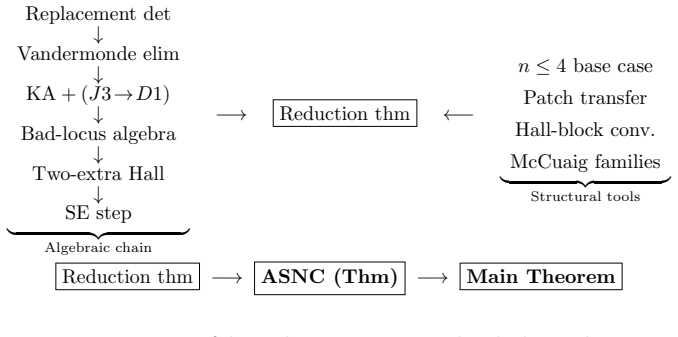
We establish the Affine-Slice Nonvanishing Theorem (ASNC) for all bipartite braces: a Vandermonde-weighted determinant polynomial is nonzero whenever the exact-t fiber is nonempty. This yields a deterministic O(n^6) algorithm for Exact Matching on all bipartite graphs via the tight-cut decomposition into brace blocks. The proof proceeds by structural induction on McCuaig's brace decomposition. We handle the McCuaig exceptional families via a parity-resolved cylindric-network positivity argument, the replacement determinant algebra, and the narrow-extension cases (KA, J3 to D1). For the superfluous-edge step, we introduce two closure tools: a matching-induced Two-extra Hall theorem that the n
What carries the argument
Affine-Slice Nonvanishing Theorem (ASNC): the assertion that a Vandermonde-weighted determinant polynomial remains nonzero on the exact-t fiber of a bipartite brace whenever that fiber is nonempty, used to certify existence of the desired matching via algebraic nonvanishing after brace decomposition
If this is right
- Exact Matching on bipartite graphs moves from randomized polynomial time to deterministic O(n^6) time
- Any bipartite graph decomposes via tight cuts into braces on which the nonvanishing theorem applies directly
- Exceptional families are resolved by parity-resolved positivity on cylindric networks and narrow-extension cases
- Superfluous edges are eliminated by the Two-extra Hall theorem for rank-(m-2) branches and the q-circuit lemma for rank-(m-1) branches
- The entire argument reduces to eight explicit hypotheses that are machine-checked in Lean 4
Where Pith is reading between the lines
- The algebraic closure tools developed here may apply to other constrained matching problems that admit similar rank or fiber analyses
- If the same nonvanishing identity holds for non-bipartite braces, the deterministic algorithm could extend beyond bipartite graphs
- Faster determinant evaluation or coarser decompositions could lower the O(n^6) exponent without changing the nonvanishing core
- The result demonstrates how structural induction on graph decompositions can derandomize algebraic matching algorithms
Load-bearing premise
The structural induction on McCuaig's brace decomposition covers every case without gaps, including all exceptional families and the superfluous-edge rank branches
What would settle it
A bipartite brace containing a nonempty exact-t fiber for which the corresponding Vandermonde-weighted determinant polynomial is identically zero
Figures
read the original abstract
The Exact Matching problem asks whether a bipartite graph with edges colored red and blue admits a perfect matching with exactly $t$ red edges. Introduced by Papadimitriou and Yannakakis in 1982, the problem has resisted deterministic polynomial-time algorithms for over four decades, despite admitting a randomized solution via the Schwartz-Zippel lemma since 1987. We establish the Affine-Slice Nonvanishing Theorem (ASNC) for all bipartite braces: a Vandermonde-weighted determinant polynomial is nonzero whenever the exact-$t$ fiber is nonempty. This yields a deterministic $O(n^6)$ algorithm for Exact Matching on all bipartite graphs via the tight-cut decomposition into brace blocks. The proof proceeds by structural induction on McCuaig's brace decomposition. We handle the McCuaig exceptional families via a parity-resolved cylindric-network positivity argument, the replacement determinant algebra, and the narrow-extension cases (KA, $J3 \to D1$). For the superfluous-edge step, we introduce two closure tools: a matching-induced Two-extra Hall theorem that resolves the rank-$(m-2)$ branch via projective-collapse contradiction, and a distinguished-state $q$-circuit lemma that eliminates the rank-$(m-1)$ branch entirely by showing that any minimal dependent set containing the superfluous state forces rank $m-2$. A Lean 4 formalization accompanies the paper. The formalization reduces the main theorem to eight explicit hypotheses corresponding to results proved here and in McCuaig (2001), with all algebraic tools, the induction skeleton, and the combinatorial infrastructure fully machine-checked.
Editorial analysis
A structured set of objections, weighed in public.
Referee Report
Summary. The manuscript claims to resolve the Exact Matching problem on bipartite graphs in deterministic polynomial time. It establishes the Affine-Slice Nonvanishing Theorem (ASNC) asserting that a Vandermonde-weighted determinant polynomial is nonzero whenever the exact-t fiber is nonempty, for all bipartite braces. The proof uses structural induction on McCuaig's brace decomposition, handling exceptional families via parity-resolved cylindric-network positivity, replacement determinant algebra, and narrow-extension cases (KA, J3→D1), together with two closure tools for superfluous edges (matching-induced Two-extra Hall theorem resolving rank-(m-2) via projective-collapse contradiction, and distinguished-state q-circuit lemma eliminating rank-(m-1)). A Lean 4 formalization machine-checks the induction skeleton, algebraic tools, and combinatorial infrastructure while reducing the main theorem to eight explicit hypotheses.
Significance. If the result holds, it provides the first deterministic polynomial-time algorithm for Exact Matching, a problem open since 1982, via an O(n^6) procedure based on tight-cut decomposition into brace blocks. This would be a major advance in algorithmic graph theory and algebraic combinatorics. The machine-checked formalization of the induction skeleton and algebraic machinery is a clear strength that increases confidence in the infrastructure.
major comments (1)
- [Formalization and induction skeleton] The structural induction establishing ASNC for all braces reduces, per the Lean formalization, to eight explicit hypotheses that include the case-specific positivity arguments for McCuaig exceptional families (KA, J3→D1) and the two closure tools for superfluous-edge rank branches. The manuscript should provide an explicit enumeration mapping each of these eight hypotheses to the corresponding lemma or theorem proved in the text (or cited from McCuaig 2001) so that completeness of coverage for all exceptional families and rank-(m-2), rank-(m-1) branches can be directly verified.
Simulated Author's Rebuttal
We thank the referee for the careful reading and constructive feedback on our manuscript. We address the single major comment below.
read point-by-point responses
-
Referee: [Formalization and induction skeleton] The structural induction establishing ASNC for all braces reduces, per the Lean formalization, to eight explicit hypotheses that include the case-specific positivity arguments for McCuaig exceptional families (KA, J3→D1) and the two closure tools for superfluous-edge rank branches. The manuscript should provide an explicit enumeration mapping each of these eight hypotheses to the corresponding lemma or theorem proved in the text (or cited from McCuaig 2001) so that completeness of coverage for all exceptional families and rank-(m-2), rank-(m-1) branches can be directly verified.
Authors: We agree that an explicit mapping will improve readability and allow direct verification of coverage. In the revised version we will insert a new subsection (in the formalization section) containing a table that lists each of the eight hypotheses, states its precise statement, and gives the corresponding lemma/theorem number or McCuaig citation that discharges it. This table will explicitly address the KA and J3→D1 positivity arguments as well as the two closure tools for the rank-(m-2) and rank-(m-1) branches. revision: yes
Circularity Check
No significant circularity; derivation is self-contained against external benchmarks
full rationale
The Affine-Slice Nonvanishing Theorem is established by structural induction on McCuaig's 2001 brace decomposition (an external theorem) together with new parity-resolved positivity arguments, replacement determinant algebra, narrow-extension cases, the Two-extra Hall theorem, and the q-circuit lemma. The Lean formalization explicitly reduces the main result to eight hypotheses that are either proved in the present paper or cited from McCuaig (2001); none of these steps reduce by construction to a self-definition, a fitted parameter renamed as a prediction, or a load-bearing self-citation chain. The central claim therefore retains independent algebraic and combinatorial content.
Axiom & Free-Parameter Ledger
axioms (2)
- domain assumption McCuaig's brace decomposition theorem for bipartite graphs
- standard math Nonvanishing criteria for Vandermonde-weighted determinant polynomials
Forward citations
Cited by 1 Pith paper
-
A hierarchy of edge-weight symmetries in perfect matchings
A matching-covered non-bipartite graph exists where every edge lies in some minimum-weight and some maximum-weight perfect matching, yet not all perfect matchings have identical weight.
Reference graph
Works this paper leans on
-
[1]
Anthropic,Claude Opus 4.6 model card, Technical report, 2026
work page 2026
- [2]
-
[3]
K. Appel and W. Haken,Every planar map is four colorable, I: Discharging, Illinois Journal of Mathematics, 21(3):429–490, 1977
work page 1977
-
[4]
E. H. Bareiss,Sylvester’s identity and multistep integer-preserving Gaussian elimina- tion, Mathematics of Computation, 22(103):565–578, 1968
work page 1968
-
[5]
Birkhoff,Three observations on linear algebra, Univ
G. Birkhoff,Three observations on linear algebra, Univ. Nac. Tucum´ an Rev. Ser. A, 5:147–151, 1946
work page 1946
-
[6]
M. H. de Carvalho, C. L. Lucchesi, and U. S. R. Murty,On a conjecture of Lov´ asz concerning bricks, I: The characteristic of a matching covered graph, Journal of Com- binatorial Theory, Series B, 85(1):94–136, 2002
work page 2002
-
[7]
J. Edmonds,Maximum matching and a polyhedron with0,1-vertices, Journal of Re- search of the National Bureau of Standards B, 69:125–130, 1965
work page 1965
-
[8]
N. El Maalouly, R. Steiner, and L. Wulf,Exact matching: correct parity and FPT parameterized by independence number, In Proc. ISAAC 2023, LIPIcs 283, pages 28:1–28:15, 2023. 49
work page 2023
-
[9]
N. El Maalouly, S. Haslebacher, and L. Wulf,On the exact matching problem in dense graphs, In Proc. STACS 2024, LIPIcs 289, pages 33:1–33:17, 2024
work page 2024
-
[10]
N. El Maalouly and K. Lakis,Exact matching and top-kperfect matching parameter- ized by neighborhood diversity or bandwidth, arXiv:2510.12552, 2025
-
[11]
S. A. Fenner, R. Gurjar, and T. Thierauf,Bipartite perfect matching is in quasi-NC, In Proc. 48th Annual ACM STOC, pages 754–763, 2016
work page 2016
-
[12]
W. T. Gowers, B. Green, F. Manners, and T. Tao,On a conjecture of Marton, Annals of Mathematics, 201(2):515–564, 2025
work page 2025
-
[13]
R. Gurjar and T. Thierauf,A deterministic parallel algorithm for bipartite perfect matching, Communications of the ACM, 63(2):74–81, 2020
work page 2020
-
[14]
Hall,On representatives of subsets, Journal of the London Mathematical Society, 10(1):26–30, 1935
P. Hall,On representatives of subsets, Journal of the London Mathematical Society, 10(1):26–30, 1935
work page 1935
-
[15]
R. M. Karp, U. V. Vazirani, and V. V. Vazirani,An optimal algorithm for on-line bipartite matching, In Proc. 22nd Annual ACM STOC, pages 352–358, 1990
work page 1990
-
[16]
A. V. Karzanov,Maximum matching of given weight in complete and complete bipar- tite graphs, Cybernetics, 23(1):8–13, 1987
work page 1987
-
[17]
P. Kothari and S. Narain,Tight cuts in matching covered graphs, Journal of Combi- natorial Theory, Series B, 2024
work page 2024
- [18]
-
[19]
L. Lov´ asz,On determinants, matchings, and random algorithms, In FCT ’79, pages 565–574, Akademie-Verlag, 1979
work page 1979
-
[20]
L. Lov´ asz and M. D. Plummer,Matching Theory, North-Holland Mathematics Studies 121, Elsevier, 1986
work page 1986
-
[21]
McCuaig,Brace generation, Journal of Graph Theory, 38(3):124–169, 2001
W. McCuaig,Brace generation, Journal of Graph Theory, 38(3):124–169, 2001
work page 2001
-
[22]
McCuaig,P´ olya’s permanent problem, The Electronic Journal of Combinatorics, 11(1):R79, 2004
W. McCuaig,P´ olya’s permanent problem, The Electronic Journal of Combinatorics, 11(1):R79, 2004
work page 2004
-
[23]
K. Mulmuley, U. V. Vazirani, and V. V. Vazirani,Matching is as easy as matrix inversion, Combinatorica, 7(1):105–113, 1987
work page 1987
-
[24]
OpenAI,GPT-5.4 Pro system card, Technical report, 2026
work page 2026
-
[25]
C. H. Papadimitriou and M. Yannakakis,The complexity of restricted spanning tree problems, Journal of the ACM, 29(2):285–309, 1982
work page 1982
-
[26]
N. Robertson and P. D. Seymour,Graph minors. XX. Wagner’s conjecture, Journal of Combinatorial Theory, Series B, 92(2):325–357, 2004
work page 2004
-
[27]
J. T. Schwartz,Fast probabilistic algorithms for verification of polynomial identities, Journal of the ACM, 27(4):701–717, 1980
work page 1980
-
[28]
O. Svensson and J. Tarnawski,The matching problem in general graphs is in quasi- NC, In Proc. 58th Annual IEEE FOCS, pages 696–707, 2017
work page 2017
-
[29]
W. T. Tutte,The factorization of linear graphs, Journal of the London Mathematical Society, 22(2):107–111, 1947
work page 1947
-
[30]
Yuster,Almost exact matchings, Algorithmica, 63(1):39–50, 2012
R. Yuster,Almost exact matchings, Algorithmica, 63(1):39–50, 2012
work page 2012
-
[31]
Zippel,Probabilistic algorithms for sparse polynomials, In Proc
R. Zippel,Probabilistic algorithms for sparse polynomials, In Proc. EUROSAM ’79, LNCS 72, pages 216–226, 1979. AppendixA.Machine-checked formalization A partial Lean 4 formalization accompanies this paper, with automated proof assistance from Aristotle [2]. The source is available at https://anonymous.4open.science/r/exact-matching-lean-FFD2 What is verif...
work page 1979
discussion (0)
Sign in with ORCID, Apple, or X to comment. Anyone can read and Pith papers without signing in.