Recognition: 2 theorem links
· Lean TheoremJahn-Teller distortion on strained La₃Ni₂O₇ thin films
Pith reviewed 2026-05-13 20:31 UTC · model grok-4.3
The pith
Biaxial compressive strain in La3Ni2O7 thin films enhances the Jahn-Teller splitting as the main microscopic tuning parameter for superconductivity.
A machine-rendered reading of the paper's core claim, the machinery that carries it, and where it could break.
Core claim
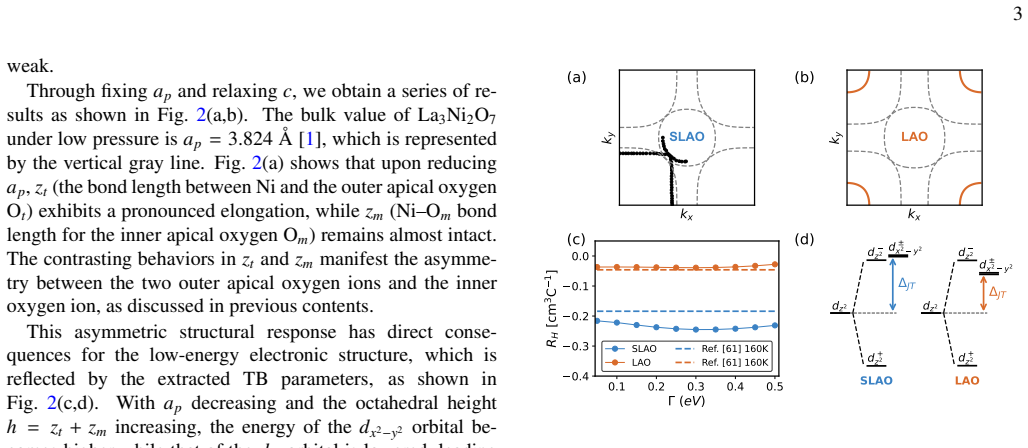
Biaxial compressive strain mainly elongates the outer apical Ni-O bond, strongly enhancing the Jahn-Teller splitting Δ_JT while the interlayer d_z² hopping t_⊥^z changes only weakly. Since superconductivity emerges only below a critical in-plane lattice constant, the strain-enhanced Δ_JT is identified as the relevant microscopic tuning parameter. The calculated Fermi surfaces and Hall responses for LaAlO3 and SrLaAlO4 substrates agree with ARPES and Hall measurements, confirming Jahn-Teller distortion as a central tuning parameter in strained La3Ni2O7.
What carries the argument
The Jahn-Teller splitting Δ_JT, the energy splitting from strain-induced elongation of the outer apical Ni-O bond, which grows strongly under compression while interlayer hopping stays nearly constant.
If this is right
- The strain-enhanced Jahn-Teller splitting controls superconductivity rather than changes in interlayer hopping.
- Fermi surfaces calculated for specific substrates match ARPES data on LaAlO3 and SrLaAlO4.
- Hall responses from the same calculations match experimental measurements.
- Jahn-Teller distortion serves as the central mechanism for optimizing superconductivity in bilayer nickelates.
Where Pith is reading between the lines
- Similar strain tuning of Jahn-Teller splitting could apply to other nickelate families if the critical-lattice-constant assumption generalizes.
- Measuring the outer apical bond length directly under strain would provide a testable link to the calculated splitting.
- If Δ_JT proves dominant, targeted chemical substitutions that mimic the bond elongation could stabilize superconductivity without external strain.
Load-bearing premise
Superconductivity appears only below a critical in-plane lattice constant.
What would settle it
A direct measurement showing superconductivity persisting above the critical in-plane lattice constant without corresponding increase in Δ_JT, or a mismatch between calculated and measured Hall response under varying strain.
Figures



read the original abstract
We present a systematic study of the electronic structure of strained La$_3$Ni$_2$O$_7$ thin films. We show that biaxial compressive strain mainly elongates the outer apical Ni-O bond while leaving the inner apical Ni-O bond nearly unchanged. As a result, the Jahn-Teller splitting $\Delta_{JT}$ is strongly enhanced, whereas the interlayer $d_{z^2}$ hopping $t_\perp^z$ changes only weakly. Since superconductivity is widely believed to emerge only below a critical in-plane lattice constant, our results identify the strain-enhanced $\Delta_{JT}$ as the relevant microscopic tuning parameter. Consistently, the calculated Fermi surfaces and Hall response for LaAlO$_3$ and SrLaAlO$_4$ substrates agree with ARPES and Hall measurements. Our results identify Jahn-Teller distortion as a key tuning parameter in strained La$_3$Ni$_2$O$_7$ and support its central role in optimizing superconductivity in bilayer nickelates.
Editorial analysis
A structured set of objections, weighed in public.
Referee Report
Summary. The manuscript presents a systematic study of the electronic structure of strained La₃Ni₂O₇ thin films. It reports that biaxial compressive strain primarily elongates the outer apical Ni-O bond while leaving the inner apical Ni-O bond nearly unchanged, resulting in strong enhancement of the Jahn-Teller splitting Δ_JT with only weak variation in the interlayer d_{z²} hopping t_⊥^z. The authors identify the strain-enhanced Δ_JT as the relevant microscopic tuning parameter for superconductivity, based on the premise that superconductivity emerges only below a critical in-plane lattice constant. They further state that the calculated Fermi surfaces and Hall response for LaAlO₃ and SrLaAlO₄ substrates agree with ARPES and Hall measurements.
Significance. If the underlying calculations are robust and the identification of Δ_JT holds, the work would provide a concrete microscopic link between strain-induced structural changes and electronic tuning in bilayer nickelates, potentially explaining why superconductivity optimizes under specific compressive strains and offering a parameter that can be targeted in future material design.
major comments (2)
- [Abstract] Abstract: The central claim that strain-enhanced Δ_JT is the relevant tuning parameter rests directly on the statement 'Since superconductivity is widely believed to emerge only below a critical in-plane lattice constant'. No independent test, additional calculation, or explicit comparison to other strain effects (e.g., changes in in-plane hopping or charge transfer) is supplied to establish that Δ_JT dominates over alternative mechanisms.
- [Abstract] Abstract: The abstract asserts that 'the calculated Fermi surfaces and Hall response ... agree with ARPES and Hall measurements' but supplies no information on the computational method, functional, convergence criteria, k-mesh, or the precise procedure used to extract Δ_JT and t_⊥^z from the band structure. These omissions make it impossible to assess whether the reported consistency is robust or parameter-dependent.
minor comments (1)
- The title is slightly imprecise; 'Jahn-Teller distortion in strained La₃Ni₂O₇ thin films' would better reflect the content.
Simulated Author's Rebuttal
We thank the referee for the careful reading of our manuscript and the constructive comments. We address the two major points raised below, indicating where revisions will be made to the manuscript.
read point-by-point responses
-
Referee: [Abstract] Abstract: The central claim that strain-enhanced Δ_JT is the relevant tuning parameter rests directly on the statement 'Since superconductivity is widely believed to emerge only below a critical in-plane lattice constant'. No independent test, additional calculation, or explicit comparison to other strain effects (e.g., changes in in-plane hopping or charge transfer) is supplied to establish that Δ_JT dominates over alternative mechanisms.
Authors: The manuscript's identification of Δ_JT follows directly from the calculated structural response: biaxial compression elongates the outer apical Ni-O bond while the inner apical bond remains nearly fixed, producing a large increase in Δ_JT with only weak variation in t_⊥^z. This differential effect is shown explicitly in the relaxed structures and band dispersions. Because the critical in-plane lattice constant is an established experimental boundary below which superconductivity appears, the parameter that changes most strongly with strain in this regime is the relevant tuning knob. We do not claim to have performed an exhaustive comparison against every conceivable alternative (e.g., charge-transfer shifts), but the calculations already demonstrate that in-plane hopping and interlayer dispersion are far less sensitive than Δ_JT under the strains considered. We will add a short clarifying sentence in the revised abstract and main text to make this structural selectivity explicit. revision: partial
-
Referee: [Abstract] Abstract: The abstract asserts that 'the calculated Fermi surfaces and Hall response ... agree with ARPES and Hall measurements' but supplies no information on the computational method, functional, convergence criteria, k-mesh, or the precise procedure used to extract Δ_JT and t_⊥^z from the band structure. These omissions make it impossible to assess whether the reported consistency is robust or parameter-dependent.
Authors: We agree that the abstract is too concise to contain full technical specifications. All computational details—DFT functional, plane-wave cutoff, k-mesh density, convergence thresholds, and the exact definitions used to extract Δ_JT (energy splitting between d_{x²-y²} and d_{z²} bands) and t_⊥^z (interlayer bandwidth)—are provided in the Methods section and are used consistently for the Fermi-surface and Hall calculations shown in the figures. The agreement with ARPES and Hall data is therefore based on the same converged setup. To address the concern, we will insert a brief parenthetical reference to the Methods section in the revised abstract. revision: yes
Circularity Check
No significant circularity; derivation of strain effects on Δ_JT is independent of the tuning-parameter identification
full rationale
The paper performs structural relaxation under biaxial strain to show elongation of the outer apical Ni-O bond (inner bond unchanged), directly yielding enhanced Δ_JT with weak t_⊥^z variation. This structural-electronic mapping is computed from the input lattice constants and does not presuppose the superconductivity conclusion. The subsequent claim that strain-enhanced Δ_JT is the relevant tuning parameter rests on the external premise 'superconductivity is widely believed to emerge only below a critical in-plane lattice constant,' which is not derived, fitted, or self-cited within the work. Fermi-surface and Hall-response calculations for specific substrates are compared to ARPES/Hall data, providing an independent consistency check on the electronic model rather than a self-referential loop. No self-definitional, fitted-prediction, or self-citation reductions occur in the load-bearing steps.
Axiom & Free-Parameter Ledger
Lean theorems connected to this paper
-
IndisputableMonolith/Cost/FunctionalEquation.leanwashburn_uniqueness_aczel unclear?
unclearRelation between the paper passage and the cited Recognition theorem.
Since superconductivity is widely believed to emerge only below a critical in-plane lattice constant, our results identify the strain-enhanced Δ_JT as the relevant microscopic tuning parameter.
-
IndisputableMonolith/Foundation/AlphaCoordinateFixation.leanJ_uniquely_calibrated_via_higher_derivative unclear?
unclearRelation between the paper passage and the cited Recognition theorem.
the Jahn–Teller splitting Δ_JT is strongly enhanced, whereas the interlayer d_z2 hopping t_⊥^z changes only weakly
What do these tags mean?
- matches
- The paper's claim is directly supported by a theorem in the formal canon.
- supports
- The theorem supports part of the paper's argument, but the paper may add assumptions or extra steps.
- extends
- The paper goes beyond the formal theorem; the theorem is a base layer rather than the whole result.
- uses
- The paper appears to rely on the theorem as machinery.
- contradicts
- The paper's claim conflicts with a theorem or certificate in the canon.
- unclear
- Pith found a possible connection, but the passage is too broad, indirect, or ambiguous to say the theorem truly supports the claim.
Forward citations
Cited by 2 Pith papers
-
Orbital-Selective $d$-wave Superconductivity in the Two-Band $t$-$J$ Model: Possible Applications to La$_3$Ni$_2$O$_7$
Orbital-selective d-wave superconductivity arises exclusively from the itinerant orbital in the two-band t-J model, suppressed by local inter-orbital bound states from the quasi-localized orbital.
-
Superconductivity in bilayer La$_3$Ni$_2$O$_7$: A review focusing on the strong-coupling Hund's rule assisted pairing mechanism
Superconductivity in La3Ni2O7 arises from interlayer Cooper pairs of 3d_x2-y2 electrons driven by effective J_perp from Hund-assisted AFM exchange transfer, while localized 3d_z2 electrons form rung singlets that prod...
Reference graph
Works this paper leans on
-
[1]
The main contrast between the two substrates are the emergence ofγpocket highlighted in LAO
is plotted as black dots in (a). The main contrast between the two substrates are the emergence ofγpocket highlighted in LAO. (c) The Hall coefficient obtained from the two substrates as a function of quasiparticle scattering rateΓ. The dashed line show the Hall coeffi- cient from experimental measurements at 160K [61]. (d) Schematic illustration of the l...
work page 2021
-
[2]
H. Sun, M. Huo, X. Hu, J. Li, Z. Liu, Y . Han, L. Tang, Z. Mao, P. Yang, B. Wang, J. Cheng, D.-X. Yao, G.-M. Zhang, and M. Wang, Nature621, 493 (2023)
work page 2023
-
[3]
E. K. Ko, Y . Yu, Y . Liu, L. Bhatt, J. Li, V . Thampy, C.-T. Kuo, B. Y . Wang, Y . Lee, K. Lee, J.-S. Lee, B. H. Goodge, D. A. Muller, and H. Y . Hwang, Nature638, 935 (2025)
work page 2025
-
[4]
N. Wang, G. Wang, X. Shen, J. Hou, J. Luo, X. Ma, H. Yang, L. Shi, J. Dou, J. Feng, J. Yang, Y . Shi, Z. Ren, H. Ma, P. Yang, Z. Liu, Y . Liu, H. Zhang, X. Dong, Y . Wang, K. Jiang, J. Hu, S. Nagasaki, K. Kitagawa, S. Calder, J. Yan, J. Sun, B. Wang, R. Zhou, Y . Uwatoko, and J. Cheng, Nature634, 579 (2024)
work page 2024
-
[5]
G. Zhou, W. Lv, H. Wang, Z. Nie, Y . Chen, Y . Li, H. Huang, W.-Q. Chen, Y .-J. Sun, Q.-K. Xue, and Z. Chen, Nature640, 641 (2025)
work page 2025
-
[6]
Y . Wang, K. Jiang, J. Ying, T. Wu, J. Cheng, J. Hu, and X. Chen, National Science Review12, nwaf373 (2025)
work page 2025
-
[7]
M. Wang, H.-H. Wen, T. Wu, D.-X. Yao, and T. Xiang, Chinese Physics Letters41, 077402 (2024)
work page 2024
- [8]
-
[9]
G. Wang, N. N. Wang, X. L. Shen, J. Hou, L. Ma, L. F. Shi, Z. A. Ren, Y . D. Gu, H. M. Ma, P. T. Yang, Z. Y . Liu, H. Z. Guo, J. P. Sun, G. M. Zhang, S. Calder, J.-Q. Yan, B. S. Wang, Y . Uwatoko, and J.-G. Cheng, Physical Review X14, 011040 (2024)
work page 2024
-
[10]
J. Li, D. Peng, P. Ma, H. Zhang, Z. Xing, X. Huang, C. Huang, M. Huo, D. Hu, Z. Dong, X. Chen, T. Xie, H. Dong, H. Sun, Q. Zeng, H.-k. Mao, and M. Wang, National Science Review 12, nwaf220 (2025)
work page 2025
-
[11]
M. Shi, D. Peng, K. Fan, Z. Xing, S. Yang, Y . Wang, H. Li, R. Wu, M. Du, B. Ge, Z. Zeng, Q. Zeng, J. Ying, T. Wu, and X. Chen, Nature Physics21, 1780 (2025)
work page 2025
-
[12]
F. Li, Z. Xing, D. Peng, J. Dou, N. Guo, L. Ma, Y . Zhang, L. Wang, J. Luo, J. Yang, J. Zhang, T. Chang, Y .-S. Chen, W. Cai, J. Cheng, Y . Wang, Y . Liu, T. Luo, N. Hirao, T. Mat- suoka, H. Kadobayashi, Z. Zeng, Q. Zheng, R. Zhou, Q. Zeng, X. Tao, and J. Zhang, Nature649, 871 (2026)
work page 2026
-
[13]
M. Shi, D. Peng, Y . Li, S. Yang, Z. Xing, Y . Wang, K. Fan, H. Li, R. Wu, B. Ge, Z. Zeng, Q. Zeng, J. Ying, T. Wu, and X. Chen, Nature Communications16, 9141 (2025)
work page 2025
-
[14]
Z. Dong, M. Huo, J. Li, J. Li, P. Li, H. Sun, L. Gu, Y . Lu, M. Wang, Y . Wang, and Z. Chen, Nature630, 847 (2024)
work page 2024
-
[15]
Z. Dong, G. Wang, N. Wang, W.-H. Dong, L. Gu, Y . Xu, J. Cheng, Z. Chen, and Y . Wang, Nature Materials24, 1927 (2025)
work page 1927
- [16]
- [17]
-
[18]
S. V . Mandyam, E. Wang, Z. Wang, B. Chen, N. C. Jayarama, A. Gupta, E. A. Riesel, V . I. Levitas, C. R. Laumann, and N. Y . Yao, Nature651, 54 (2026)
work page 2026
-
[19]
Y . Zhu, D. Peng, E. Zhang, B. Pan, X. Chen, L. Chen, H. Ren, F. Liu, Y . Hao, N. Li, Z. Xing, F. Lan, J. Han, J. Wang, D. Jia, H. Wo, Y . Gu, Y . Gu, L. Ji, W. Wang, H. Gou, Y . Shen, T. Ying, X. Chen, W. Yang, H. Cao, C. Zheng, Q. Zeng, J.-g. Guo, and J. Zhao, Nature631, 531 (2024)
work page 2024
-
[20]
M. Zhang, C. Pei, D. Peng, X. Du, W. Hu, Y . Cao, Q. Wang, J. Wu, Y . Li, H. Liu, C. Wen, J. Song, Y . Zhao, C. Li, W. Cao, S. Zhu, Q. Zhang, N. Yu, P. Cheng, L. Zhang, Z. Li, J. Zhao, Y . Chen, C. Jin, H. Guo, C. Wu, F. Yang, Q. Zeng, S. Yan, L. Yang, and Y . Qi, Physical Review X15, 021005 (2025)
work page 2025
- [21]
-
[22]
Z. Luo, X. Hu, M. Wang, W. W ´u, and D.-X. Yao, Physical Re- view Letters131, 126001 (2023)
work page 2023
-
[23]
Q.-G. Yang, D. Wang, and Q.-H. Wang, Physical Review B108, L140505 (2023)
work page 2023
-
[24]
Y .-f. Yang, G.-M. Zhang, and F.-C. Zhang, Physical Review B 108, L201108 (2023)
work page 2023
- [25]
-
[26]
F. Lechermann, J. Gondolf, S. B ¨otzel, and I. M. Eremin, Physi- cal Review B108, L201121 (2023)
work page 2023
-
[27]
Z. Liao, L. Chen, G. Duan, Y . Wang, C. Liu, R. Yu, and Q. Si, Physical Review B108, 214522 (2023)
work page 2023
- [28]
- [29]
-
[30]
C. Lu, Z. Pan, F. Yang, and C. Wu, Physical Review Letters 132, 146002 (2024)
work page 2024
-
[31]
H. Sakakibara, N. Kitamine, M. Ochi, and K. Kuroki, Physical Review Letters132, 106002 (2024)
work page 2024
- [32]
- [33]
-
[34]
S. Ryee, N. Witt, and T. O. Wehling, Physical Review Letters 133, 096002 (2024)
work page 2024
-
[35]
Y . Wang, K. Jiang, Z. Wang, F.-C. Zhang, and J. Hu, Physical Review B110, 205122 (2024)
work page 2024
-
[36]
Y . Wang, Y . Zhang, and K. Jiang, Chinese Physics B34, 047105 (2025)
work page 2025
- [37]
-
[38]
K.-Y . Jiang, Y .-H. Cao, Q.-G. Yang, H.-Y . Lu, and Q.-H. Wang, Physical Review Letters134, 076001 (2025)
work page 2025
-
[39]
J. Zhan, Y . Gu, X. Wu, and J. Hu, Physical Review Letters134, 136002 (2025)
work page 2025
-
[40]
Y . Gu, C. Le, Z. Yang, X. Wu, and J. Hu, Physical Review B 111, 174506 (2025)
work page 2025
-
[41]
Z. Wang, H.-J. Zhang, K. Jiang, and F.-C. Zhang, National Sci- ence Review12, nwaf353 (2025)
work page 2025
- [42]
- [43]
- [44]
-
[45]
B. Geisler, J. J. Hamlin, G. R. Stewart, R. G. Hennig, and P. J. Hirschfeld, Physical Review B112, L100506 (2025)
work page 2025
- [46]
- [47]
-
[48]
X. Hu, W. Qiu, C.-Q. Chen, Z. Luo, and D.-X. Yao, Communi- cations Physics8, 506 (2025)
work page 2025
- [49]
- [50]
-
[51]
G. Khaliullin and J. Chaloupka, (2025), 2506.16360 [cond- mat]
- [52]
-
[53]
B. Hao, M. Wang, W. Sun, Y . Yang, Z. Mao, S. Yan, H. Sun, H. Zhang, L. Han, Z. Gu, J. Zhou, D. Ji, and Y . Nie, Nature Materials24, 1756 (2025)
work page 2025
- [54]
-
[55]
Y . Liu, E. K. Ko, Y . Tarn, L. Bhatt, J. Li, V . Thampy, B. H. Goodge, D. A. Muller, S. Raghu, Y . Yu, and H. Y . Hwang, Na- ture Materials24, 1221 (2025)
work page 2025
-
[56]
L. Bhatt, E. Abarca Morales, A. Y . Jiang, E. K. Ko, Y .-F. Zhao, N. Schnitzer, G. A. Pan, D. Ferenc Segedin, Y . Liu, Y . Yu, C. M. Brooks, A. S. Botana, H. Y . Hwang, J. A. Mundy, D. A. Muller, and B. H. Goodge, Nature 10.1038/s41586-026-10446- 2 (2026)
-
[57]
P. Li, G. Zhou, W. Lv, Y . Li, C. Yue, H. Huang, L. Xu, J. Shen, Y . Miao, W. Song, Z. Nie, Y . Chen, H. Wang, W. Chen, Y . Huang, Z.-H. Chen, T. Qian, J. Lin, J. He, Y .-J. Sun, Z. Chen, and Q.-K. Xue, National Science Review , nwaf205 (2025)
work page 2025
- [58]
- [59]
-
[60]
H. Wang, H. Huang, G. Zhou, W. Lv, C. Yue, L. Xu, X. Wu, Z. Nie, Y . Chen, Y .-J. Sun, W. Chen, H. Yuan, Z. Chen, and Q.-K. Xue, (2025), arXiv:2502.18068 [cond-mat]
work page internal anchor Pith review Pith/arXiv arXiv 2025
- [61]
- [62]
- [63]
- [64]
-
[65]
M. Wang, B. Hao, W. Sun, S. Yan, S. Sun, H. Zhang, Z. Gu, and Y . Nie, Physical Review Letters136, 066002 (2026)
work page 2026
- [66]
-
[67]
W. Lyu, Z. Nie, H. Wang, Y . Chen, H. Huang, G. Zhou, Q. Xue, and Z. Chen, Acta Phys. Sin.74, 227403 (2025)
work page 2025
-
[68]
J. Sun, A. Ruzsinszky, and J. P. Perdew, Physical Review Letters 115, 036402 (2015)
work page 2015
-
[69]
A. A. Mostofi, J. R. Yates, Y .-S. Lee, I. Souza, D. Vanderbilt, and N. Marzari, Computer physics communications178, 685 (2008)
work page 2008
-
[70]
N. Marzari, A. A. Mostofi, J. R. Yates, I. Souza, and D. Vander- bilt, Rev. Mod. Phys.84, 1419 (2012)
work page 2012
-
[71]
R. Dronskowski and P. E. Bloechl, The Journal of Physical Chemistry97, 8617 (1993)
work page 1993
-
[72]
V . L. Deringer, A. L. Tchougr ´eeff, and R. Dronskowski, The journal of physical chemistry A115, 5461 (2011)
work page 2011
- [73]
- [74]
-
[75]
P. V oruganti, A. Golubentsev, and S. John, Physical Review B 45, 13945 (1992)
work page 1992
-
[76]
Z. Wang, K. Jiang, F.-C. Zhang, and H.-K. Jin, To appear
- [77]
-
[78]
G. Kresse and D. Joubert, Physical Review B59, 1758 (1999). 7 tx 1 tz 1 tx 2 tz 2 txz 3 -0.4732 -0.0759 0.0779 -0.0154 0.2022 txz 4 tx ⊥ tz ⊥ ϵ x ϵz -0.0263 0.0081 -0.5868 0.9416 0.3072 tx 1 tz 1 tx 2 tz 2 txz 3 -0.4609 -0.0877 0.0743 -0.0158 0.2106 txz 4 tx ⊥ tz ⊥ ϵ x ϵz -0.0294 0.0087 -0.5845 0.8011 0.3631 TABLE A1. The hopping parameters of the TB Hami...
work page 1999
discussion (0)
Sign in with ORCID, Apple, or X to comment. Anyone can read and Pith papers without signing in.