Recognition: no theorem link
Proton Temperature Anisotropy Across Interplanetary Shocks: A Statistical Analysis with WIND observations
Pith reviewed 2026-05-13 20:37 UTC · model grok-4.3
The pith
Interplanetary shocks modify proton temperature anisotropy according to geometry and instability thresholds.
A machine-rendered reading of the paper's core claim, the machinery that carries it, and where it could break.
Core claim
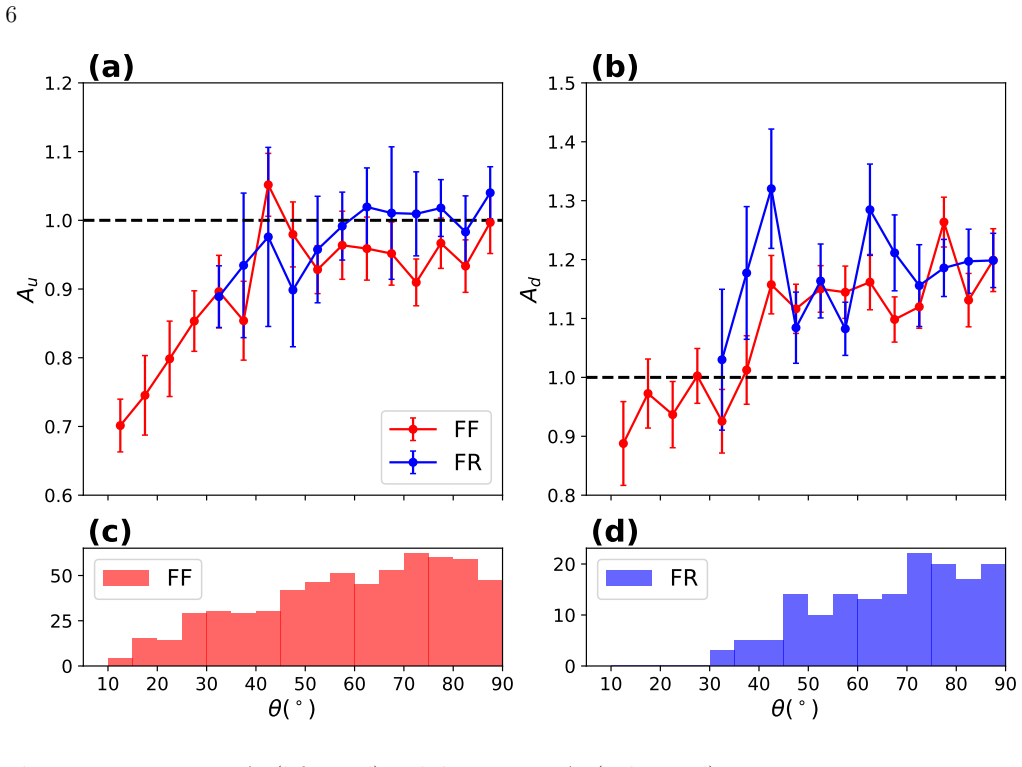
Quasi-perpendicular shocks cause pronounced downstream perpendicular heating (T_perp > T_para) while parallel shocks remain near isotropic due to stronger upstream parallel temperatures; the CGL model overestimates perpendicular heating at quasi-perpendicular shocks and underestimates it at parallel ones; the anisotropy is localized near the shock and relaxes downstream; and it is regulated by proton cyclotron and mirror instabilities for perpendicular shocks and parallel firehose for parallel shocks.
What carries the argument
Statistical mapping of temperature anisotropy ratios against shock normal angle, compression ratio, and distance from the shock front, bounded by linear instability thresholds.
If this is right
- Quasi-perpendicular shocks exhibit stronger deviations from adiabatic compression than quasi-parallel ones.
- The influence of the shock on anisotropy diminishes with distance, returning to typical solar wind values.
- Kinetic instabilities prevent excessive anisotropy development in both shock types.
- Non-adiabatic processes must be included to accurately model heating across shocks.
Where Pith is reading between the lines
- Improved models of solar wind propagation could incorporate these geometry-dependent anisotropy patterns to better predict turbulence and heating.
- These findings suggest that shock geometry influences the efficiency of particle acceleration at interplanetary shocks.
- Future missions with higher resolution plasma measurements could test the relaxation rate of anisotropy downstream.
Load-bearing premise
That shocks can be reliably classified as quasi-perpendicular or quasi-parallel using magnetic field geometry and that the proton temperature measurements accurately reflect the plasma state without significant instrumental bias.
What would settle it
Direct observation of downstream anisotropy exceeding the mirror or firehose instability thresholds without relaxation, or no difference in anisotropy evolution between quasi-perpendicular and quasi-parallel shocks.
Figures


read the original abstract
Interplanetary (IP) shocks efficiently modify the proton temperature anisotropy of the solar wind. Analyzing ~800 IP shocks observed by the Wind spacecraft from 1997-2024, we present a statistical study of upstream and downstream proton temperature anisotropy and its dependence on shock geometry, compression, and distance from the shock. We find that (1) quasi-perpendicular shocks produce a pronounced enhancement of perpendicular temperature downstream (Tperp > Tpara), whereas parallel shocks remain near isotropic downstream due to typically stronger upstream Tpara; (2) comparisons with the Chew-Goldberger-Low (CGL) double-adiabatic model reveal geometry-dependent deviations. CGL overestimates downstream perpendicular heating and underestimates parallel heating at quasi-perpendicular shocks, with the opposite trend at quasi-parallel shocks, highlighting the importance of non-adiabatic processes beyond simple compression; (3) Shock-driven anisotropy is strongly localized near the shock and gradually relaxes toward typical solar wind conditions farther downstream as the shock's influence diminishes; and (4) downstream anisotropy is regulated by kinetic instabilities, with quasi-perpendicular shocks constrained by proton cyclotron and mirror instabilities and quasi-parallel shocks limited by the parallel firehose instability. Together, these results show that the evolution of temperature anisotropy at interplanetary shocks is controlled by shock geometry, localized processes, and instability driven regulation.
Editorial analysis
A structured set of objections, weighed in public.
Referee Report
Summary. The paper presents a statistical analysis of proton temperature anisotropy across ~800 interplanetary shocks observed by the Wind spacecraft (1997-2024). It reports that quasi-perpendicular shocks produce downstream T_perp enhancement while quasi-parallel shocks remain near-isotropic; CGL double-adiabatic predictions show geometry-dependent deviations (overestimating perp heating at quasi-perp shocks); anisotropy is localized near the shock and relaxes downstream; and downstream states are regulated by proton cyclotron/mirror instabilities at quasi-perp shocks versus parallel firehose at quasi-parallel shocks. The central conclusion is that shock geometry, localized processes, and instability regulation control anisotropy evolution.
Significance. If the results hold after addressing methodological details, the large sample provides useful observational constraints on non-adiabatic heating and kinetic regulation at collisionless shocks. The geometry-dependent CGL deviations and localization findings add empirical support for models of solar wind evolution, with potential relevance to space weather forecasting.
major comments (3)
- [§3] §3 (Shock classification and normal determination): The split into quasi-perpendicular (>45°) and quasi-parallel (<45°) shocks relies on θ_Bn from single-spacecraft Wind data. Standard coplanarity or mixed methods carry documented 10-20° uncertainties, especially for weak/oblique events. No sensitivity test or error propagation on θ_Bn is shown; systematic misclassification near the boundary could erase or reverse the reported T_perp enhancement, CGL deviations, and instability assignments in claims (1)-(4).
- [§4.3] §4.3 (Instability regulation): The assignment of downstream anisotropy to specific instabilities (proton cyclotron and mirror for quasi-perp; parallel firehose for quasi-parallel) lacks explicit thresholds, growth-rate comparisons, or quantitative criteria used to identify regulation. Without these, the claim that anisotropy 'is regulated by' these modes is not fully supported by the presented statistics.
- [Methods] Methods and data selection: Details on exact downstream interval selection, proton temperature error propagation, and how the ~800 events were filtered (e.g., shock strength, data gaps) are insufficient. This affects evaluation of the statistical robustness of the geometry-dependent trends and the localization result in claim (3).
minor comments (2)
- [Figure 4] Figure 4: Axis labels for anisotropy ratio and distance from shock should include explicit units and the precise definition of 'downstream distance' used.
- [§4.2] CGL comparison: Clarify whether the CGL predictions use the observed upstream values or assume specific polytropic indices; this affects interpretation of the reported over/under-estimates.
Simulated Author's Rebuttal
We thank the referee for the constructive comments, which have helped strengthen the methodological transparency and robustness of our analysis. We address each major point below and have revised the manuscript accordingly.
read point-by-point responses
-
Referee: [§3] §3 (Shock classification and normal determination): The split into quasi-perpendicular (>45°) and quasi-parallel (<45°) shocks relies on θ_Bn from single-spacecraft Wind data. Standard coplanarity or mixed methods carry documented 10-20° uncertainties, especially for weak/oblique events. No sensitivity test or error propagation on θ_Bn is shown; systematic misclassification near the boundary could erase or reverse the reported T_perp enhancement, CGL deviations, and instability assignments in claims (1)-(4).
Authors: We acknowledge the documented uncertainties in θ_Bn from single-spacecraft data. In the revised manuscript we have added a sensitivity analysis that shifts the 45° boundary by ±10° and recomputes the key statistics for T_perp enhancement, CGL deviations, and instability assignments. The geometry-dependent trends remain statistically significant across the tested range. We have also included representative error bars on θ_Bn in the relevant figures and text to reflect typical 10-20° uncertainties. revision: yes
-
Referee: [§4.3] §4.3 (Instability regulation): The assignment of downstream anisotropy to specific instabilities (proton cyclotron and mirror for quasi-perp; parallel firehose for quasi-parallel) lacks explicit thresholds, growth-rate comparisons, or quantitative criteria used to identify regulation. Without these, the claim that anisotropy 'is regulated by' these modes is not fully supported by the presented statistics.
Authors: We have expanded §4.3 to state the explicit instability thresholds (drawn from linear theory in Gary 1993 and subsequent works) applied to the observed parameters. We now include direct comparisons of measured anisotropy values against these thresholds for both shock geometries and have added a short discussion of estimated growth rates using the downstream plasma conditions to support the regulation interpretation. revision: yes
-
Referee: [Methods] Methods and data selection: Details on exact downstream interval selection, proton temperature error propagation, and how the ~800 events were filtered (e.g., shock strength, data gaps) are insufficient. This affects evaluation of the statistical robustness of the geometry-dependent trends and the localization result in claim (3).
Authors: We have added a dedicated Methods subsection that specifies: (i) the exact downstream interval criteria (typically 2–10 min post-shock, excluding immediate transients), (ii) the error-propagation procedure used for proton temperature anisotropy, and (iii) the full event-selection pipeline, including minimum Mach-number threshold (>1.5) and treatment of data gaps. These additions allow readers to evaluate the robustness of the reported trends and localization result. revision: yes
Circularity Check
No circularity: purely observational statistical analysis
full rationale
The paper conducts a statistical analysis of ~800 observed IP shocks from Wind spacecraft data, directly measuring upstream/downstream proton temperature anisotropy and comparing it to the standard CGL double-adiabatic model. No derivations, parameter fits presented as predictions, self-citations as load-bearing uniqueness theorems, or ansatzes are present. All four main findings (geometry dependence, CGL deviations, localization, instability regulation) follow from data splits and comparisons without reducing to inputs by construction. The analysis is self-contained against external benchmarks.
Axiom & Free-Parameter Ledger
axioms (2)
- domain assumption Proton temperature anisotropy can be reliably measured from Wind spacecraft observations.
- domain assumption The CGL double-adiabatic model serves as a valid baseline for adiabatic compression in collisionless plasma.
Reference graph
Works this paper leans on
-
[1]
Denton, R. E. 1994, J. Geophys. Res., 99, 5877, doi: 10.1029/93JA02827 Bavassano Cattaneo, M. B., Basile, C., Moreno, G., & Richardson, J. D. 1998, J. Geophys. Res., 103, 11961, doi: 10.1029/97JA03683
- [2]
-
[3]
2015, Collisionless Shocks in Space Plasmas, doi: 10.1017/CBO9781139044097
Burgess, D., & Scholer, M. 2015, Collisionless Shocks in Space Plasmas, doi: 10.1017/CBO9781139044097
-
[4]
2005, Space Science Reviews, 118, 205
Burgess, D., Lucek, E., Scholer, M., et al. 2005, Space Science Reviews, 118, 205
work page 2005
-
[5]
Chao, J. K., Zhang, X. X., & Song, P. 1995, Geophys. Res. Lett., 22, 2409, doi: 10.1029/95GL02187 20
-
[6]
1956, Proceedings of the Royal Society of London
Chew, G., Goldberger, M., & Low, F. 1956, Proceedings of the Royal Society of London. Series A. Mathematical and Physical Sciences, 236, 112
work page 1956
-
[7]
Chew, G. F., Goldberger, M. L., & Low, F. E. 1956, Proceedings of the Royal Society of London Series A, 236, 112, doi: 10.1098/rspa.1956.0116
-
[8]
Czaykowska, A., Bauer, T. M., Treumann, R. A., & Baumjohann, W. 1998, Journal of Geophysical Research: Space Physics, 103, 4747
work page 1998
-
[9]
Czaykowska, A., Bauer, T. M., Treumann, R. A., & Baumjohann, W. 2001, Annales Geophysicae, 19, 275, doi: 10.5194/angeo-19-275-2001 D’Amicis, R., De Marco, R., Bruno, R., &
-
[10]
2019, A&A, 632, A92, doi: 10.1051/0004-6361/201936728
Perrone, D. 2019, A&A, 632, A92, doi: 10.1051/0004-6361/201936728
-
[11]
Decker, R. B. 1988, SSRv, 48, 195, doi: 10.1007/BF00226009
-
[12]
2005, Space Science Reviews, 118, 41
Eastwood, J., Lucek, E., Mazelle, C., et al. 2005, Space Science Reviews, 118, 41
work page 2005
-
[13]
Erkaev, N. V., Vogl, D. F., & Biernat, H. K. 2000, Journal of Plasma Physics, 64, 561, doi: 10.1017/S002237780000893X
-
[14]
2024, Journal of Plasma Physics, 90, 905900509 G´ enot, V
Gedalin, M. 2024, Journal of Plasma Physics, 90, 905900509 G´ enot, V. 2009, Astrophysics and Space Sciences Transactions, 5, 31, doi: 10.5194/astra-5-31-2009
-
[15]
Goodrich, C. C., & Scudder, J. D. 1984, J. Geophys. Res., 89, 6654, doi: 10.1029/JA089iA08p06654
-
[16]
Haggerty, C. C., Bret, A., & Caprioli, D. 2022, MNRAS, 509, 2084, doi: 10.1093/mnras/stab3110
-
[17]
Lazarus, A. J. 2006, Geophys. Res. Lett., 33, L09101, doi: 10.1029/2006GL025925
-
[18]
2011, Journal of Geophysical Research (Space Physics), 116, A10105, doi: 10.1029/2011JA016669
Hietala, H., Agueda, N., Andr´ eEov´ a, K., et al. 2011, Journal of Geophysical Research (Space Physics), 116, A10105, doi: 10.1029/2011JA016669
-
[19]
Howes, G. G., Felix, A., Brown, C. R., et al. 2025, Physics of Plasmas, 32
work page 2025
-
[20]
Hudson, P. D. 1970, Planet. Space Sci., 18, 1611, doi: 10.1016/0032-0633(70)90036-X
-
[21]
2012, Journal of Geophysical Research: Space Physics, 117
Hull, A., Muschietti, L., Oka, M., et al. 2012, Journal of Geophysical Research: Space Physics, 117
work page 2012
-
[22]
Kasper, J. C., Lazarus, A. J., & Gary, S. P. 2002, Geophys. Res. Lett., 29, 1839, doi: 10.1029/2002GL015128
-
[23]
Kaufmann, R. L., Horng, J.-T., & Wolfe, A. 1970, J. Geophys. Res., 75, 4666, doi: 10.1029/JA075i025p04666
-
[24]
2015, Journal of Geophysical Research: Space Physics, 120, 4112
Kilpua, E., Lumme, E., Andreeova, K., Isavnin, A., & Koskinen, H. 2015, Journal of Geophysical Research: Space Physics, 120, 4112
work page 2015
-
[25]
Kuznetsov, V. D., & Osin, A. I. 2018, Physics Letters A, 382, 2052, doi: 10.1016/j.physleta.2018.05.029
-
[26]
1995, Space Science Reviews, 71, 207 21
Lepping, R., Ac˜ una, M., Burlaga, L., et al. 1995, Space Science Reviews, 71, 207 21
work page 1995
-
[27]
1995, Space Science Reviews, 71, 125
Lin, R., Anderson, K., Ashford, S., et al. 1995, Space Science Reviews, 71, 125
work page 1995
-
[28]
Schroeder, P. 2021, Wind 3DP 24-sec Ion OmniDirectional Fluxes and Moments, Accessed on 2025-10-14 NASA Space Physics Data Facility; Space Sciences Laboratory, University of California Berkeley, doi: 10.48322/C4MF-9N52
-
[29]
Kasper, J. C. 2007, ApJL, 659, L65, doi: 10.1086/516568
-
[30]
Liu, Y.-H., Drake, J. F., & Swisdak, M. 2011, Physics of Plasmas, 18, 062110, doi: 10.1063/1.3601760
-
[31]
Lyu, L. H., & Kan, J. R. 1986, J. Geophys. Res., 91, 6771, doi: 10.1029/JA091iA06p06771
-
[32]
2013, Journal of Geophysical Research (Space Physics), 118, 823, doi: 10.1002/jgra.50146
Omidi, N., Sibeck, D., Blanco-Cano, X., et al. 2013, Journal of Geophysical Research (Space Physics), 118, 823, doi: 10.1002/jgra.50146
-
[33]
Parks, G. K., Lee, E., Fu, S. Y., et al. 2017, Reviews of Modern Plasma Physics, 1, 1, doi: 10.1007/s41614-017-0003-4
-
[34]
J., Ibscher, D., Lazar, M., & Skoda, T
Schlickeiser, R., Michno, M. J., Ibscher, D., Lazar, M., & Skoda, T. 2011, PhRvL, 107, 201102, doi: 10.1103/PhysRevLett.107.201102
-
[35]
Schwartz, S. J., Goodrich, K. A., Wilson III, L. B., et al. 2022, Journal of Geophysical Research: Space Physics, 127, e2022JA030637
work page 2022
-
[36]
Treumann, R. A. 2009, A&A Rv, 17, 409, doi: 10.1007/s00159-009-0024-2
-
[37]
2022, Frontiers in Astronomy and Space Sciences, 9, 1005672, doi: 10.3389/fspas.2022.1005672
Trotta, D., Vuorinen, L., Hietala, H., et al. 2022, Frontiers in Astronomy and Space Sciences, 9, 1005672, doi: 10.3389/fspas.2022.1005672
-
[38]
2018, A&A, 613, A23, doi: 10.1051/0004-6361/201731852
Vafin, S., Lazar, M., Fichtner, H., Schlickeiser, R., & Drillisch, M. 2018, A&A, 613, A23, doi: 10.1051/0004-6361/201731852
-
[39]
2016, The Astrophysical Journal, 831, 128
Quataert, E. 2016, The Astrophysical Journal, 831, 128
work page 2016
-
[40]
Verscharen, D., Klein, K. G., & Maruca, B. A. 2019, Living Reviews in Solar Physics, 16, 5, doi: 10.1007/s41116-019-0021-0
-
[41]
Wilson, III, L. B. 2010, PhD thesis, University of
work page 2010
-
[42]
2026, ApJL, 1000, L30, doi: 10.3847/2041-8213/ae4de9
Zhao, L., Zhu, X., Jin, Z., et al. 2026, ApJL, 1000, L30, doi: 10.3847/2041-8213/ae4de9
-
[43]
Zhao, L., Zhu, X., Silwal, A., Zank, G. P., & Pitˇ na, A. 2025, Proceedings of the National Academy of Sciences, 122, e2425668122
work page 2025
-
[44]
2019, The Astrophysical Journal, 872, 4
Zhao, L.-L., Zank, G., Chen, Y., et al. 2019, The Astrophysical Journal, 872, 4
work page 2019
-
[45]
Zhao, L.-L., Zank, G. P., Khabarova, O., et al. 2018, The Astrophysical Journal Letters, 864, L34, doi: 10.3847/2041-8213/aaddf6
discussion (0)
Sign in with ORCID, Apple, or X to comment. Anyone can read and Pith papers without signing in.