Recognition: no theorem link
An Explainable Vision-Language Model Framework with Adaptive PID-Tversky Loss for Lumbar Spinal Stenosis Diagnosis
Pith reviewed 2026-05-13 21:39 UTC · model grok-4.3
The pith
A vision-language model uses spatial patch attention and adaptive PID-Tversky loss to diagnose lumbar spinal stenosis from MRI at 90.69 percent accuracy while generating clinical reports.
A machine-rendered reading of the paper's core claim, the machinery that carries it, and where it could break.
Core claim
The central claim is that a Spatial Patch Cross-Attention module for precise text-directed localization of spinal anomalies, paired with an Adaptive PID-Tversky Loss that dynamically adjusts training penalties for under-segmented instances via control-theory principles, enables a vision-language model to overcome global pooling limitations and class imbalance, yielding accurate lumbar spinal stenosis classification, high-quality segmentation, and automated generation of clinical radiology reports from MRI.
What carries the argument
The Spatial Patch Cross-Attention module, which performs text-directed localization of spinal anomalies at patch level, together with the Adaptive PID-Tversky Loss, which integrates PID control to raise penalties on difficult minority instances during training.
If this is right
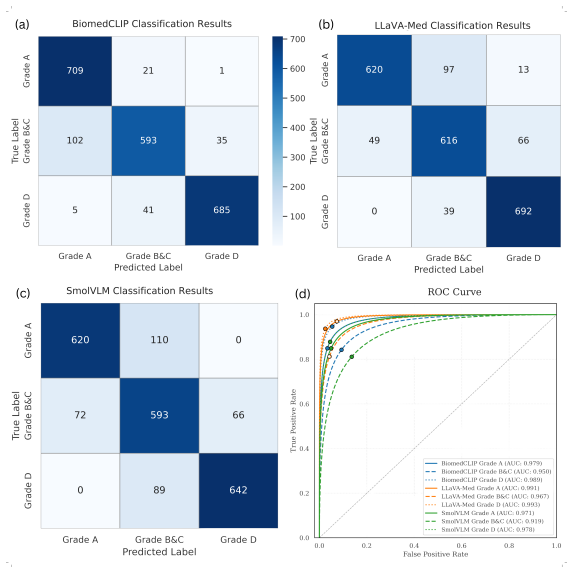
- Diagnostic classification reaches 90.69 percent accuracy on lumbar spinal stenosis from MRI.
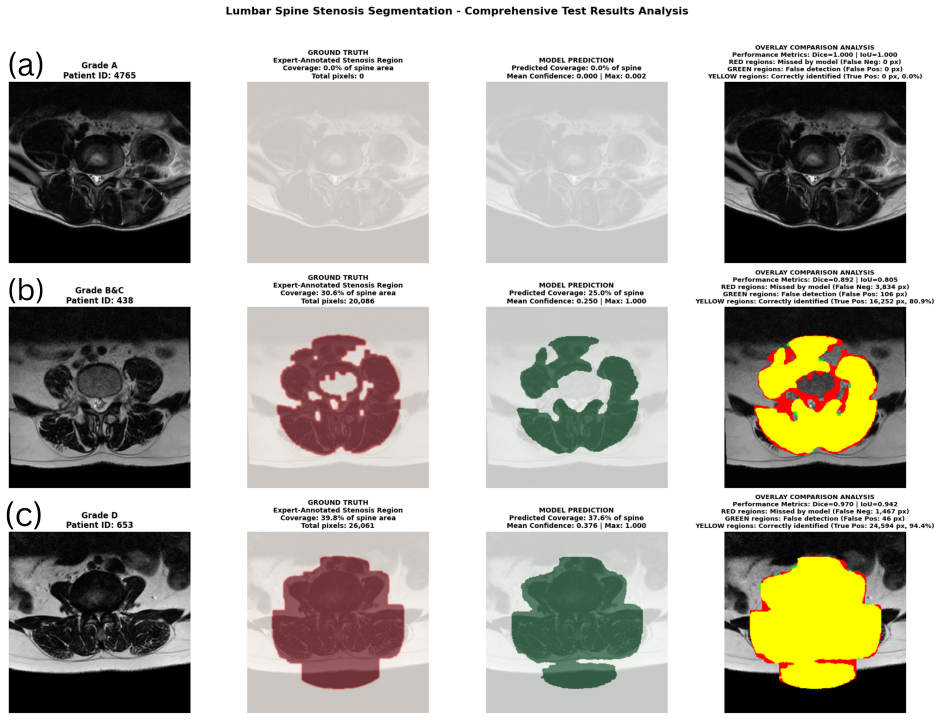
- Segmentation quality reaches a macro-averaged Dice score of 0.9512.
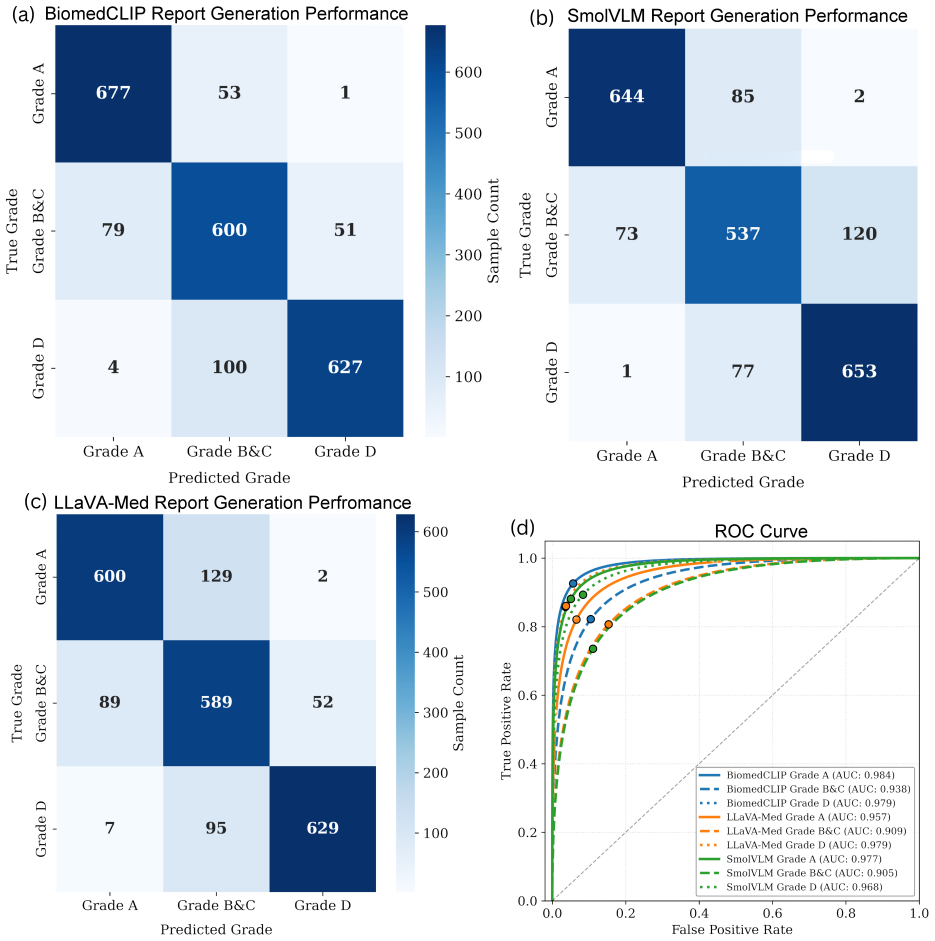
- Automated report generation achieves a CIDEr score of 92.80.
- Complex segmentation outputs are converted into radiologist-style clinical reports for interpretability.
- The framework keeps essential human supervision in the diagnostic loop while improving consistency.
Where Pith is reading between the lines
- The same modules could be applied to other imbalanced medical segmentation tasks such as tumor delineation in CT scans.
- Combining the framework with larger pre-trained vision-language backbones might raise performance further on rare spinal variants.
- Deployment in clinical workflows could reduce average diagnostic time by replacing initial manual review steps.
- Validation across scanner vendors and patient demographics would be needed to confirm robustness beyond the reported dataset.
Load-bearing premise
The Spatial Patch Cross-Attention module and Adaptive PID-Tversky Loss will reliably overcome global pooling limitations and extreme class imbalance in clinical segmentation datasets without post-hoc tuning or dataset-specific adjustments.
What would settle it
An independent test on a new multi-center lumbar MRI dataset with similar class imbalance that shows Dice scores below 0.85 or classification accuracy below 80 percent when using the same modules would indicate the claimed advantages do not hold without further tuning.
Figures



read the original abstract
Lumbar Spinal Stenosis (LSS) diagnosis remains a critical clinical challenge, with diagnosis heavily dependent on labor-intensive manual interpretation of multi-view Magnetic Resonance Imaging (MRI), leading to substantial inter-observer variability and diagnostic delays. Existing vision-language models simultaneously fail to address the extreme class imbalance prevalent in clinical segmentation datasets while preserving spatial accuracy, primarily due to global pooling mechanisms that discard crucial anatomical hierarchies. We present an end-to-end Explainable Vision-Language Model framework designed to overcome these limitations, achieved through two principal objectives. We propose a Spatial Patch Cross-Attention module that enables precise, text-directed localization of spinal anomalies with spatial precision. A novel Adaptive PID-Tversky Loss function by integrating control theory principles dynamically further modifies training penalties to specifically address difficult, under-segmented minority instances. By incorporating foundational VLMs alongside an Automated Radiology Report Generation module, our framework demonstrates considerable performance: a diagnostic classification accuracy of 90.69%, a macro-averaged Dice score of 0.9512 for segmentation, and a CIDEr score of 92.80%. Furthermore, the framework shows explainability by converting complex segmentation predictions into radiologist-style clinical reports, thereby establishing a new benchmark for transparent, interpretable AI in clinical medical imaging that keeps essential human supervision while enhancing diagnostic capabilities.
Editorial analysis
A structured set of objections, weighed in public.
Referee Report
Summary. The paper introduces an end-to-end explainable vision-language model framework for lumbar spinal stenosis diagnosis from multi-view MRI. It proposes a Spatial Patch Cross-Attention module for text-directed localization and an Adaptive PID-Tversky Loss that incorporates control-theoretic principles to dynamically adjust penalties for minority classes. The framework integrates a base VLM with automated radiology report generation and reports diagnostic accuracy of 90.69%, macro-averaged Dice of 0.9512, and CIDEr of 92.80, while producing radiologist-style reports for interpretability.
Significance. If the performance claims hold after proper validation, the work could contribute to explainable AI in clinical imaging by combining spatial attention with adaptive loss for imbalanced segmentation tasks. The integration of report generation adds practical value for human oversight. However, the absence of dataset details, baselines, and ablations limits assessment of whether the gains stem from the proposed components or other factors.
major comments (3)
- [Abstract / Results] Abstract and Results: The headline metrics (90.69% accuracy, 0.9512 Dice, 92.80 CIDEr) are presented without any ablation tables or controls that isolate the Spatial Patch Cross-Attention module or the Adaptive PID-Tversky Loss against standard cross-attention and plain Tversky loss while holding the base VLM and training protocol fixed. This prevents attribution of gains to the proposed innovations rather than dataset curation or hyperparameter choices.
- [Methods] Methods: No description is provided of the dataset (size, number of patients, class distribution, train/validation/test splits, or annotation protocol), making it impossible to evaluate whether the reported performance addresses extreme class imbalance in a clinically representative setting or generalizes beyond the specific data used.
- [Methods / Experiments] Methods / Experiments: The manuscript supplies no baseline comparisons (e.g., standard VLM, U-Net variants, or other attention mechanisms), statistical significance tests, or cross-validation results to support the claim that the framework overcomes global pooling limitations and class imbalance.
minor comments (2)
- [Abstract] The abstract claims the framework 'establishes a new benchmark' but provides no comparison to prior work on LSS diagnosis or VLM-based medical segmentation, which should be added for context.
- [Methods] Notation for the PID controller gains and Tversky parameters is introduced without explicit equations showing how they are adapted during training; adding these would improve reproducibility.
Simulated Author's Rebuttal
Dear Editor, We thank the referee for their insightful and constructive comments, which have helped us identify areas for improvement in clarity and rigor. We address each major comment point by point below and commit to revising the manuscript to incorporate the suggested additions for ablations, dataset details, and experimental validations.
read point-by-point responses
-
Referee: [Abstract / Results] Abstract and Results: The headline metrics (90.69% accuracy, 0.9512 Dice, 92.80 CIDEr) are presented without any ablation tables or controls that isolate the Spatial Patch Cross-Attention module or the Adaptive PID-Tversky Loss against standard cross-attention and plain Tversky loss while holding the base VLM and training protocol fixed. This prevents attribution of gains to the proposed innovations rather than dataset curation or hyperparameter choices.
Authors: We agree that ablation studies are necessary to properly attribute performance gains to the proposed components. In the revised manuscript, we will add dedicated ablation tables in the Experiments section that isolate the Spatial Patch Cross-Attention module (comparing against standard cross-attention) and the Adaptive PID-Tversky Loss (comparing against plain Tversky loss), while holding the base VLM and training protocol fixed. These will quantify the incremental contributions of each innovation. revision: yes
-
Referee: [Methods] Methods: No description is provided of the dataset (size, number of patients, class distribution, train/validation/test splits, or annotation protocol), making it impossible to evaluate whether the reported performance addresses extreme class imbalance in a clinically representative setting or generalizes beyond the specific data used.
Authors: We acknowledge that the current manuscript lacks sufficient dataset details, which limits evaluation of clinical representativeness and reproducibility. We will add a comprehensive new subsection in Methods describing the dataset size, number of patients, class distribution (highlighting imbalance), train/validation/test splits, and the annotation protocol followed by expert radiologists. revision: yes
-
Referee: [Methods / Experiments] Methods / Experiments: The manuscript supplies no baseline comparisons (e.g., standard VLM, U-Net variants, or other attention mechanisms), statistical significance tests, or cross-validation results to support the claim that the framework overcomes global pooling limitations and class imbalance.
Authors: We recognize the value of baseline comparisons and statistical validation to strengthen claims regarding improvements over global pooling and class imbalance. In the revised manuscript, we will include additional baseline experiments against standard VLMs, U-Net variants, and alternative attention mechanisms, along with statistical significance tests (e.g., paired t-tests) and k-fold cross-validation results in the Experiments section. revision: yes
Circularity Check
No circularity: metrics presented as empirical outcomes, no equations reduce claims to inputs by construction
full rationale
The manuscript introduces Spatial Patch Cross-Attention and Adaptive PID-Tversky Loss as proposed modules whose contributions are evaluated via reported accuracy (90.69%), Dice (0.9512), and CIDEr (92.80) scores. These are described as training outcomes rather than quantities defined in terms of the loss parameters or attention weights. No equations, self-citations, or ansatzes are exhibited that would make the headline metrics tautological. The derivation chain therefore remains self-contained against external benchmarks.
Axiom & Free-Parameter Ledger
free parameters (1)
- PID controller gains
axioms (1)
- domain assumption Spatial Patch Cross-Attention preserves anatomical hierarchies better than global pooling for spinal anomaly localization.
Reference graph
Works this paper leans on
-
[1]
A novel focal tversky loss function with improved attention u-net for lesion segmentation
Abraham, N., Khan, N., 2023. A novel focal tversky loss function with improved attention u-net for lesion segmentation. doi:10.32920/ 22734398.v1
work page 2023
-
[2]
A novel focal tversky loss function with improved attention u-net for lesion segmentation
Abraham, N., Khan, N.M., 2018. A novel focal tversky loss function with improved attention u-net for lesion segmentation. URL: https://arxiv.org/abs/1810.07842
-
[3]
Evaluating ai-powered predictive solutions for mri in lumbar spinal stenosis: a systematic review
Al-antari, M., Salem, S., Raza, M., Elbadawy, A., Bütün, E., Aydin, A., Aydoğan, M., Ertuğrul, B., Talo, M., Gu, Y., 2025. Evaluating ai-powered predictive solutions for mri in lumbar spinal stenosis: a systematic review. Artificial Intelligence Review 58. doi:10.1007/ s10462-025-11185-y
work page 2025
-
[4]
Evaluating ai-powered predictive solutions for mri in lumbar spinal stenosis: a systematic review
Al-Antari, M.A., Salem, S., Raza, M., et al., 2025. Evaluating ai-powered predictive solutions for mri in lumbar spinal stenosis: a systematic review. Artificial Intelligence Review 58, 221. doi:10.1007/s10462-025-11185-y
-
[5]
Resampling imbalanced data for network intrusion detection datasets
Bagui, S., Li, K., 2021. Resampling imbalanced data for network intrusion detection datasets. Journal of Big Data doi:10.1186/ s40537-020-00390-x
work page 2021
-
[6]
Batra, A., Gumber, A., Kumar, A., 2025. M-scan: A multistage framework for lumbar spinal canal stenosis grading using multi-view cross attention. URL:https://arxiv.org/abs/2503.01634,arXiv:2503.01634
-
[7]
Büttner, M., Schneider, L., Krasowski, A., Pitchika, V., Krois, J., Meyer-Lueckel, H., Schwendicke, F., 2024. Conquering class imbalances in deep learning-based segmentation of dental radiographs with different loss functions. Journal of Dentistry 148, 105063. URL:https: //www.sciencedirect.com/science/article/pii/S030057122400232X. Md. Sajeebul Islam Sk....
work page 2024
-
[8]
De-Giorgio,F.,Benedetti,B.,Mancino,M.,Sala,E.,Pascali,V.L.,2025. Theneedforbalancing’blackbox’systemsandexplainableartificial intelligence: A necessary implementation in radiology. European Journal of Radiology 185, 112014. URL:https://doi.org/10.1016/ j.ejrad.2025.112014
-
[9]
QLoRA: Efficient Finetuning of Quantized LLMs
Dettmers, T., Pagnoni, A., Holtzman, A., Zettlemoyer, L., 2023. Qlora: Efficient finetuning of quantized llms. URL:https://arxiv.org/ abs/2305.14314,arXiv:2305.14314
work page internal anchor Pith review Pith/arXiv arXiv 2023
-
[10]
Classification of lumbar spine disorders using large language models and mri segmentation
Dong, R., Cheng, X., Kang, M., Qu, Y., 2024. Classification of lumbar spine disorders using large language models and mri segmentation. BMC Medical Informatics and Decision Making URL:https://doi.org/10.1186/s12911-024-02740-8
-
[11]
Galbusera,F.,Bassani,T.,Casaroli,G.,Gitto,S.,Zanchetta,E.,Costa,F.,Sconfienza,L.M.,2018. Generativemodels:anupcominginnovation in musculoskeletal radiology? a preliminary test in spine imaging. European Radiology Experimental , 29URL:https://doi.org/10. 1186/s41747-018-0060-7
work page 2018
-
[12]
Ghobrial, G., Roth, C., 2025. Deep learning-based automated segmentation and quantification of the dural sac cross-sectional area in lumbar spine mri. Frontiers in Radiology URL:https://www.frontiersin.org/journals/radiology/articles/10.3389/fradi.2025. 1503625
-
[13]
Ce-net: Context encoder network for 2d medical image segmentation
Gu, Z., Cheng, J., Fu, H., Zhou, K., Hao, H., Zhao, Y., Zhang, T., Gao, S., Liu, J., 2019. Ce-net: Context encoder network for 2d medical image segmentation. IEEE Transactions on Medical Imaging URL:https://doi.org/10.1109/TMI.2019.2903562
-
[14]
Kiut: Knowledge-injected u-transformer for radiology report generation
Huang, Z., Zhang, X., Zhang, S., 2023. Kiut: Knowledge-injected u-transformer for radiology report generation. URL:https://arxiv. org/abs/2306.11345,arXiv:2306.11345
-
[15]
Islam,K.T.,Zhong,S.,Zakavi,P.,Chen,Z.,Kavnoudias,H.,Farquharson,S.,Durbridge,G.,Barth,M.,Mcmahon,K.L.,Parizel,P.M.,Dwyer, A., Egan, G.F., Law, M., Chen, Z., 2023. Improving portable low-field mri image quality through image-to-image translation using paired low- and high-field images. Scientific Reports doi:10.1038/s41598-023-48438-1
-
[16]
Jussupow,E.,Spohrer,K.,Heinzl,A.,Gawlitza,J.,2021. Augmentingmedicaldiagnosisdecisions?aninvestigationintophysicians’decision- making process with artificial intelligence. Information Systems Research doi:10.1287/isre.2020.0980
-
[17]
Learning pid structures in an introductory course of automatic control
Kelly, R., Moreno, J., 2001. Learning pid structures in an introductory course of automatic control. IEEE Transactions on Education 44, 373–376. doi:10.1109/13.965786
-
[18]
Le, T.T.H., Hwang, Y., Kadiptya, A.Y., Son, J., Kim, H., 2025. A robust framework for coffee bean package label recognition: Integrating image enhancement with vision–language ocr models. Sensors doi:10.3390/s25206484
-
[19]
Energyefficientcannyedgedetectorforadvancedmobilevisionapplications
Lee,J.,Tang,H.,Park,J.,2018. Energyefficientcannyedgedetectorforadvancedmobilevisionapplications. IEEETransactionsonCircuits and Systems for Video Technology doi:10.1109/TCSVT.2016.2640038
-
[20]
Llava-med:Trainingalargelanguage-and- vision assistant for biomedicine in one day
Li,C.,Wong,C.,Zhang,S.,Usuyama,N.,Liu,H.,Yang,J.,Naumann,T.,Poon,H.,Gao,J.,2023. Llava-med:Trainingalargelanguage-and- vision assistant for biomedicine in one day. URL:https://arxiv.org/abs/2306.00890,arXiv:2306.00890
-
[21]
Lvit:Languagemeetsvisiontransformerinmedicalimage segmentation
Li,Z.,Li,Y.,Li,Q.,Wang,P.,Guo,D.,Lu,L.,Jin,D.,Zhang,Y.,Hong,Q.,2024. Lvit:Languagemeetsvisiontransformerinmedicalimage segmentation. IEEE Transactions on Medical Imaging 43, 96–107. doi:10.1109/TMI.2023.3291719
-
[22]
Liu, H., Liu, Z., Jia, W., Zhang, D., Tan, J., 2022. A novel imbalanced data classification method based on weakly supervised learning for fault diagnosis. IEEE Transactions on Industrial Informatics 18, 1583–1593. doi:10.1109/TII.2021.3084132
-
[23]
Visiontransformerswithhierarchicalattention
Liu,Y.,Wu,Y.H.,Sun,G.,Zhang,L.,Chhatkuli,A.,VanGool,L.,2024. Visiontransformerswithhierarchicalattention. MachineIntelligence Research URL:https://doi.org/10.1007/s11633-024-1393-8
-
[24]
Decoupled Weight Decay Regularization
Loshchilov, I., Hutter, F., 2019. Decoupled weight decay regularization. URL:https://arxiv.org/abs/1711.05101, arXiv:1711.05101
work page internal anchor Pith review Pith/arXiv arXiv 2019
-
[25]
Adaptivenon-localmeansdenoisingofmrimageswithspatially varying noise levels
Manjón,J.V.,Coupé,P.,Martí-Bonmatí,L.,Collins,D.L.,Robles,M.,2009. Adaptivenon-localmeansdenoisingofmrimageswithspatially varying noise levels. Journal of Magnetic Resonance Imaging doi:10.1002/jmri.22003
-
[26]
SmolVLM: Redefining small and efficient multimodal models
Marafioti, A., Zohar, O., Farré, M., Noyan, M., Bakouch, E., Cuenca, P., Zakka, C., Allal, L.B., Lozhkov, A., Tazi, N., Srivastav, V., Lochner, J., Larcher, H., Morlon, M., Tunstall, L., von Werra, L., Wolf, T., 2025. Smolvlm: Redefining small and efficient multimodal models. URL: https://arxiv.org/abs/2504.05299,arXiv:2504.05299
work page internal anchor Pith review Pith/arXiv arXiv 2025
-
[27]
Mukku, L., Burri, V., Lamani, M.R., 2025a. Artificial intelligence-driven lumbar stenosis diagnosis: A deep learning pipeline for mri- based segmentation and classification, in: 2025 IEEE 4th World Conference on Applied Intelligence and Computing (AIC). doi:10.1109/ AIC66080.2025.11211995
-
[28]
Mukku, L., Burri, V., Lamani, M.R., 2025b. Artificial intelligence-driven lumbar stenosis diagnosis: A deep learning pipeline for mri- based segmentation and classification. 2025 IEEE 4th World Conference on Applied Intelligence and Computing (AIC) , 240–244URL: https://api.semanticscholar.org/CorpusID:282760472
work page 2025
-
[29]
Multimodallargelanguagemodelsinmedicalimaging:Currentstateandfuturedirections
Nam,Y.,Kim,D.Y.,Kyung,S.,Seo,J.,Song,J.M.,Kwon,J.,Kim,J.,Jo,W.,Park,H.,Sung,J.,Park,S.,Kwon,H.,Kwon,T.,Kim,K.,Kim, N.,2025. Multimodallargelanguagemodelsinmedicalimaging:Currentstateandfuturedirections. KoreanJournalofRadiology26. URL: https://doi.org/10.3348/kjr.2025.0599
-
[30]
Is attention all you need in medical image analysis? a review
Papanastasiou, G., Dikaios, N., Huang, J., Wang, C., Yang, G., 2024. Is attention all you need in medical image analysis? a review. IEEE Journal of Biomedical and Health Informatics 28, 1398–1411. doi:10.1109/JBHI.2023.3348436
-
[31]
Synthetic data for deep learning in computer vision & medical imaging: A means to reduce data bias
Paproki, A., Salvado, O., Fookes, C., 2024. Synthetic data for deep learning in computer vision & medical imaging: A means to reduce data bias. ACM Comput. Surv. 56. URL:https://doi.org/10.1145/3663759
-
[32]
Effective use of the mcnemar test
Pembury Smith, M.Q.R., Ruxton, G.D., 2020. Effective use of the mcnemar test. Behavioral Ecology and Sociobiology doi:10.1007/ s00265-020-02916-y
work page 2020
-
[33]
Learning Transferable Visual Models From Natural Language Supervision
Radford, A., Kim, J.W., Hallacy, C., Ramesh, A., Goh, G., Agarwal, S., Sastry, G., Askell, A., Mishkin, P., Clark, J., Krueger, G., Sutskever, I., 2021. Learning transferable visual models from natural language supervision. URL:https://arxiv.org/abs/2103.00020
work page internal anchor Pith review Pith/arXiv arXiv 2021
-
[34]
Rey, D., Neuhäuser, M., 2011. Wilcoxon-Signed-Rank Test. Springer Berlin Heidelberg, Berlin, Heidelberg. URL:https://doi.org/10. 1007/978-3-642-04898-2_616. Md. Sajeebul Islam Sk. et al. Page 21 of 22
work page 2011
-
[35]
Tverskylossfunctionforimagesegmentationusing3dfullyconvolutionaldeepnetworks
Salehi,S.S.M.,Erdogmus,D.,Gholipour,A.,2017a. Tverskylossfunctionforimagesegmentationusing3dfullyconvolutionaldeepnetworks. URL:https://arxiv.org/abs/1706.05721,arXiv:1706.05721
-
[36]
Salehi, S.S.M., Erdogmus, D., Gholipour, A., 2017b. Tversky loss function for image segmentation using 3d fully convolutional deep networks, in: Wang, Q., Shi, Y., Suk, H.I., Suzuki, K. (Eds.), Machine Learning in Medical Imaging, Springer International Publishing. URL:https://link.springer.com/book/10.1007/978-3-319-67389-9
-
[37]
Multi-level image thresholding using otsu and chaotic bat algorithm
Satapathy, S.C., Sri Madhava Raja, N., Rajinikanth, V., Ashour, A.S., Dey, N., 2016. Multi-level image thresholding using otsu and chaotic bat algorithm. Neural Computing and Applications doi:10.1007/s00521-016-2645-5
-
[38]
Foundationalecgnet: A lightweight foundational model for ecg-based multitask cardiac analysis
Sk., M.S.I., Jobayer, M., Shawon, M.M.H., Alam, M.G.R., 2025. Foundationalecgnet: A lightweight foundational model for ecg-based multitask cardiac analysis. URL:https://arxiv.org/abs/2509.08961
-
[39]
Payattentiontoevolution:Timeseriesforecastingwithdeep graph-evolution learning
Spadon,G.,Hong,S.,Brandoli,B.,Matwin,S.,Rodrigues-Jr,J.F.,Sun,J.,2021. Payattentiontoevolution:Timeseriesforecastingwithdeep graph-evolution learning. IEEE Transactions on Pattern Analysis and Machine Intelligence doi:10.1109/TPAMI.2021.3076155
-
[40]
Sudirman, S., Al Kafri, A., Natalia, F., Meidia, H., Afriliana, N., Al-Rashdan, W., Bashtawi, M., Al-Jumaily, M., 2019. Lumbar spine mri dataset. doi:10.17632/k57fr854j2.2
-
[41]
Deep learning-based detection of lumbar spinal canal stenosis usingconvolutionalneuralnetworks
Suzuki, H., Kokabu, T., Yamada, K., Ishikawa, Y., Yabu, A., Yanagihashi, Y., Hyakumachi, T., Tachi, H., Shimizu, T., Endo, T., Ohnishi, T., Ukeba, D., Nagahama, K., Takahata, M., Sudo, H., Iwasaki, N., 2024. Deep learning-based detection of lumbar spinal canal stenosis usingconvolutionalneuralnetworks. TheSpineJournal,2086–2101URL:https://www.sciencedirec...
work page 2024
-
[42]
Chronic cervical cord compression: clinical significance of increased signal intensity on mr images
Takahashi, M., Yamashita, Y., Sakamoto, Y., Kojima, R., 1989. Chronic cervical cord compression: clinical significance of increased signal intensity on mr images. Radiology 173, 219–224. doi:10.1148/radiology.173.1.2781011
-
[43]
An ambiguity-aware classifier of lumbar disc degeneration
Tang, Y., Wu, X., Ou-yang, L., Li, Z., 2022. An ambiguity-aware classifier of lumbar disc degeneration. Knowledge-Based Systems 258, 109992.URL:https://www.sciencedirect.com/science/article/pii/S0950705122010851,doi:https://doi.org/10.1016/ j.knosys.2022.109992
-
[44]
A neural network model for detection and classification of lumbar spinal stenosis on mri
Tumko, V., Kim, J., Uspenskaia, N., Honig, S., Abel, F., Lebl, D.R., Hotalen, I., Kolisnyk, S., Kochnev, M., Rusakov, A., Mourad, R., 2024. A neural network model for detection and classification of lumbar spinal stenosis on mri. European Spine Journal 33, 941–948. URL: https://doi.org/10.1007/s00586-023-08089-2
-
[45]
Vu,B.T.D.,Kamona,N.,Kim,Y.,Ng,J.J.,Jones,B.C.,Wehrli,F.W.,Song,H.K.,Bartlett,S.P.,Lee,H.,Rajapakse,C.S.,2024. Threecontrasts in 3 min: Rapid, high-resolution, and bone-selective ute mri for craniofacial imaging with automated deep-learning skull segmentation. Magnetic Resonance in Medicine doi:10.1002/mrm.30275
-
[46]
Improved image segmentation method based on morphological reconstruction
Wu, Y., Peng, X., Ruan, K., Hu, Z., 2016. Improved image segmentation method based on morphological reconstruction. Multimedia Tools and Applications doi:10.1007/s11042-015-3192-2
-
[47]
Auto-rad:End-to-endreportgenerationfromlumberspinemriusing vision–language model
Yeasin,M.,Moinuddin,K.A.,Havugimana,F.,Wang,L.,Park,P.,2024. Auto-rad:End-to-endreportgenerationfromlumberspinemriusing vision–language model. Journal of Clinical Medicine doi:10.3390/jcm13237092
-
[48]
Yilihamu, E.E.Y., Zeng, F.S., Shang, J., Yang, J.T., Zhong, H., Feng, S.Q., 2025. Gpt4lfs (generative pretrained transformer 4 omni for lumbarforaminastenosis):enhancinglumbarforaminalstenosisimageclassificationthroughlargemultimodalmodels. TheSpineJournal25, 2071–2080. URL:https://www.sciencedirect.com/science/article/pii/S1529943025001652
work page 2025
-
[49]
Dcau-net:denseconvolutionalattentionu-netforsegmentationofintracranialaneurysm images
Yuan,W.,Peng,Y.,Guo,Y.,Ren,Y.,Xue,Q.,2022. Dcau-net:denseconvolutionalattentionu-netforsegmentationofintracranialaneurysm images. Visual Computing for Industry, Biomedicine, and Art URL:https://doi.org/10.1186/s42492-022-00105-4
-
[50]
Automated endoscopic image classification via deep neural network with class imbalance loss
Yue, G., Wei, P., Liu, Y., Luo, Y., Du, J., Wang, T., 2023. Automated endoscopic image classification via deep neural network with class imbalance loss. IEEE Transactions on Instrumentation and Measurement 72, 1–11. doi:10.1109/TIM.2023.3264047
-
[51]
Cnn-lrp:Understandingconvolutionalneuralnetworksperformance for target recognition in sar images
Zang,B.,Ding,L.,Feng,Z.,Zhu,M.,Lei,T.,Xing,M.,Zhou,X.,2021. Cnn-lrp:Understandingconvolutionalneuralnetworksperformance for target recognition in sar images. Sensors URL:https://doi.org/10.3390/s21134536
-
[52]
Zhang, L., Zhao, S., Yang, Z., Zheng, H., Lei, M., 2024. An artificial intelligence tool to assess the risk of severe mental distress among college students in terms of demographics, eating habits, lifestyles, and sport habits: an externally validated study using machine learning. BMC Psychiatry doi:10.1186/s12888-024-06017-2
-
[53]
Zhang, S., Xu, Y., Usuyama, N., Xu, H., Bagga, J., Tinn, R., Preston, S., Rao, R., Wei, M., Valluri, N., Wong, C., Tupini, A., Wang, Y., Mazzola, M., Shukla, S., Liden, L., Gao, J., Crabtree, A., Piening, B., Bifulco, C., Lungren, M.P., Naumann, T., Wang, S., Poon, H., 2025. Biomedclip: a multimodal biomedical foundation model pretrained from fifteen mill...
work page internal anchor Pith review Pith/arXiv arXiv 2025
-
[54]
Pid controller design for second order nonlinear uncertain systems
Zhao, C., Guo, L., 2017. Pid controller design for second order nonlinear uncertain systems. Science China Information Sciences doi:10.1007/s11432-016-0879-3. Md. Sajeebul Islam Sk. et al. Page 22 of 22
discussion (0)
Sign in with ORCID, Apple, or X to comment. Anyone can read and Pith papers without signing in.