Recognition: no theorem link
Why Invariance is Not Enough for Biomedical Domain Generalization and How to Fix It
Pith reviewed 2026-05-13 19:59 UTC · model grok-4.3
The pith
MaskGen achieves robust 3D biomedical segmentation by combining source intensities with foundation model representations rather than relying solely on invariance.
A machine-rendered reading of the paper's core claim, the machinery that carries it, and where it could break.
Core claim
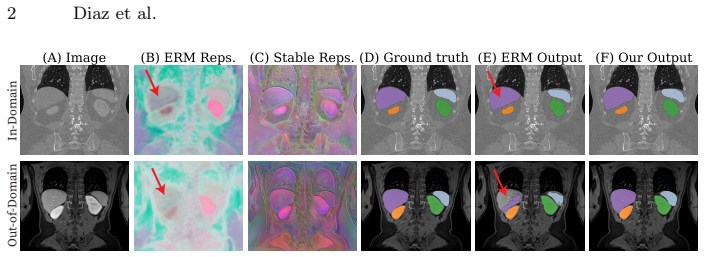
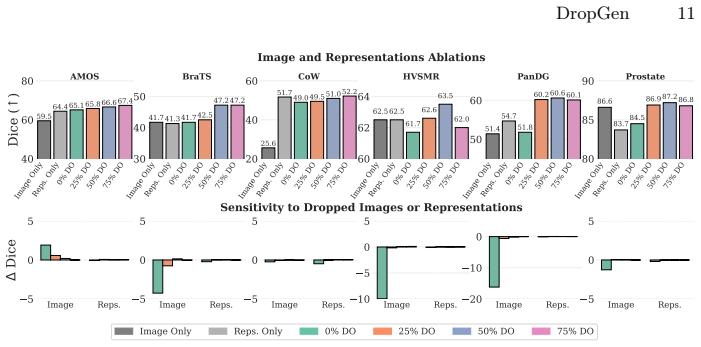
MaskGen presents a simple learning strategy that utilizes both source-domain image intensities and domain-stable foundation model representations to train robust segmentation models for 3D biomedical images, achieving strong gains in both fully supervised and few-shot segmentation across broad clinical shifts.
What carries the argument
MaskGen training strategy, which augments standard segmentation loss with domain-stable foundation model representations supplied as auxiliary inputs alongside source image intensities.
Load-bearing premise
Representations from existing foundation models remain sufficiently stable across biomedical domains to serve as reliable auxiliary signals without further adaptation.
What would settle it
An experiment on a new clinical shift dataset where MaskGen produces no accuracy improvement over a standard baseline while the foundation model features vary substantially across domains would falsify the central claim.
Figures




read the original abstract
We present MaskGen, a theoretically grounded and deliberately simple approach for domain generalization in 3D biomedical image segmentation. Modern segmentation models degrade sharply under shifts in modality, disease severity, clinical sites, and more, limiting their reliable adoption. Existing generalization methods address this using extreme augmentations, hand-engineered domain statistics mixing, or architectural redesigns that add significant implementation overhead while yielding inconsistent performance across biomedical settings. MaskGen instead presents a principled learning strategy with marginal overhead that utilizes both source-domain image intensities and domain-stable foundation model representations to train robust segmentation models. As a result, MaskGen achieves strong gains in both fully supervised and few-shot segmentation across broad clinical shifts in biomedical studies. Unlike prior approaches, MaskGen is architecture- and loss-agnostic, compatible with standard augmentation pipelines, easy to implement, and tackles arbitrary anatomical regions. Its implementation is freely available at https://github.com/sebodiaz/MaskGen.
Editorial analysis
A structured set of objections, weighed in public.
Referee Report
Summary. The manuscript introduces MaskGen, a simple learning strategy for domain generalization in 3D biomedical image segmentation. It argues that invariance-based methods are insufficient and instead trains segmenters on both source-domain image intensities and representations from foundation models that are posited to be domain-stable. The approach is presented as architecture- and loss-agnostic with low overhead, and the abstract claims strong performance gains in fully supervised and few-shot segmentation across clinical shifts in modality, severity, and sites.
Significance. If the performance claims are substantiated by rigorous, quantitative experiments with appropriate ablations, MaskGen could offer a practical, low-overhead alternative to existing generalization techniques in biomedical imaging. Its compatibility with standard pipelines and public code release would be strengths for reproducibility and adoption.
major comments (2)
- [Abstract] Abstract: the central claim of 'strong gains' in fully supervised and few-shot segmentation is asserted without any quantitative metrics, baseline comparisons, dataset details, or ablation results, making it impossible to assess whether the improvements are real, statistically significant, or attributable to the proposed mechanism.
- [Methods] Methods (foundation-model branch): the manuscript supplies no direct quantification of domain-stability for the foundation-model representations (e.g., feature-space distances, invariance metrics, or cross-shift correlation scores) under the tested clinical shifts; without such evidence or an ablation that removes the foundation-model input, it remains possible that any observed gains derive from other components rather than the claimed stability.
minor comments (1)
- [Methods] The manuscript would benefit from an explicit statement of the exact foundation models used and the precise manner in which their representations are fused with source intensities.
Simulated Author's Rebuttal
We thank the referee for the constructive feedback. We agree that the abstract requires quantitative support and that additional evidence is needed for the foundation-model branch. We will revise the manuscript to address both points directly.
read point-by-point responses
-
Referee: [Abstract] Abstract: the central claim of 'strong gains' in fully supervised and few-shot segmentation is asserted without any quantitative metrics, baseline comparisons, dataset details, or ablation results, making it impossible to assess whether the improvements are real, statistically significant, or attributable to the proposed mechanism.
Authors: We agree that the abstract should include concrete quantitative support. In the revised manuscript we will update the abstract to report specific performance metrics (e.g., mean Dice-score gains over the strongest baselines on the primary datasets) together with brief statements of the evaluation settings. Full tables with statistical significance, baseline comparisons, and ablation results already appear in the Experiments section and will be referenced more explicitly from the abstract. revision: yes
-
Referee: [Methods] Methods (foundation-model branch): the manuscript supplies no direct quantification of domain-stability for the foundation-model representations (e.g., feature-space distances, invariance metrics, or cross-shift correlation scores) under the tested clinical shifts; without such evidence or an ablation that removes the foundation-model input, it remains possible that any observed gains derive from other components rather than the claimed stability.
Authors: We acknowledge the absence of direct stability metrics. We will add a dedicated ablation that trains the identical segmentation architecture with and without the foundation-model branch, quantifying the generalization drop under each clinical shift. This isolates the contribution of the foundation-model input. If space allows we will also include a short supplementary analysis of feature-space distances across domains to support the stability claim. revision: yes
Circularity Check
No significant circularity in derivation chain
full rationale
The manuscript introduces MaskGen as an empirical training strategy that combines source intensities with representations from external foundation models. No equations, self-citations, or fitted parameters are presented that reduce the central performance claim to a tautology or to the inputs by construction. The domain-stability premise is treated as an external assumption rather than derived internally, and results are reported via standard supervised and few-shot experiments. This is consistent with a self-contained empirical contribution without load-bearing circular steps.
Axiom & Free-Parameter Ledger
axioms (1)
- domain assumption Representations extracted from existing foundation models are domain-stable across modality, site, and severity shifts in biomedical imaging.
Reference graph
Works this paper leans on
-
[1]
Nature communications13(1), 4128 (2022) 9, 12, 13, 14, 26, 27, 28
Antonelli, M., Reinke, A., Bakas, S., Farahani, K., Kopp-Schneider, A., Landman, B.A., Litjens, G., Menze, B., Ronneberger, O., Summers, R.M., et al.: The medical segmentation decathlon. Nature communications13(1), 4128 (2022) 9, 12, 13, 14, 26, 27, 28
work page 2022
-
[2]
Arjovsky, M., Bottou, L., Gulrajani, I., Lopez-Paz, D.: Invariant risk minimization. arXiv preprint arXiv:1907.02893 (2019) 4
work page internal anchor Pith review Pith/arXiv arXiv 1907
-
[3]
Medical image analysis86, 102789 (2023) 4
Billot, B., Greve, D.N., Puonti, O., Thielscher, A., Van Leemput, K., Fischl, B., Dalca, A.V., Iglesias, J.E., et al.: Synthseg: Segmentation of brain mri scans of any contrast and resolution without retraining. Medical image analysis86, 102789 (2023) 4
work page 2023
-
[4]
The Cancer Imaging Archive (2015)
Bloch, N., Madabhushi, A., Huisman, H., Freymann, J., Kirby, J., Grauer, M., Enquobahrie, A., Jaffe, C., Clarke, L., Farahani, K.: Nci-isbi 2013 challenge: Auto- mated segmentation of prostate structures. The Cancer Imaging Archive (2015). https://doi.org/10.7937/K9/TCIA.2015.zF0vlOPv , http://doi.org/10.7937/K9/ TCIA.2015.zF0vlOPv9
-
[5]
In: Proceedings of the IEEE/CVF International Conference on Computer Vision
Butoi, V.I., Ortiz, J.J.G., Ma, T., Sabuncu, M.R., Guttag, J., Dalca, A.V.: Uni- verseg: Universal medical image segmentation. In: Proceedings of the IEEE/CVF International Conference on Computer Vision. pp. 21438–21451 (2023) 2, 4
work page 2023
-
[6]
MONAI: An open-source framework for deep learning in healthcare
Cardoso, M.J., Li, W., Brown, R., Ma, N., Kerfoot, E., Wang, Y., Murrey, B., Myronenko, A., Zhao, C., Yang, D., et al.: Monai: An open-source framework for deep learning in healthcare. arXiv preprint arXiv:2211.02701 (2022) 32
work page internal anchor Pith review arXiv 2022
-
[7]
In: Proceedings of the AAAI conference on artificial intelligence
Chen, C., Dou, Q., Chen, H., Qin, J., Heng, P.A.: Synergistic image and feature adaptation: Towards cross-modality domain adaptation for medical image segmen- tation. In: Proceedings of the AAAI conference on artificial intelligence. vol. 33, pp. 865–872 (2019) 2, 3 16 Diaz et al
work page 2019
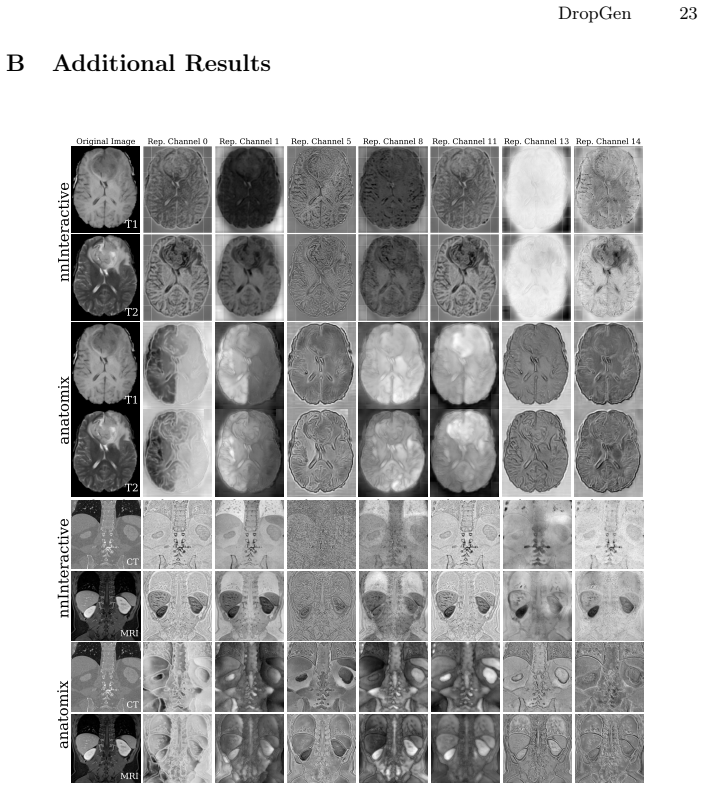
-
[8]
In: Proceedings of the IEEE/CVF Conference on Computer Vision and Pattern Recognition
Chen, D., Wang, D., Darrell, T., Ebrahimi, S.: Contrastive test-time adaptation. In: Proceedings of the IEEE/CVF Conference on Computer Vision and Pattern Recognition. pp. 295–305 (2022) 2, 3
work page 2022
-
[9]
arXiv preprint arXiv:2407.01419 (2024) 4
Chollet, E., Balbastre, Y., Mauri, C., Magnain, C., Fischl, B., Wang, H.: Neurovas- cular segmentation in soct with deep learning and synthetic training data. arXiv preprint arXiv:2407.01419 (2024) 4
-
[10]
Improved Regularization of Convolutional Neural Networks with Cutout
DeVries, T., Taylor, G.W.: Improved regularization of convolutional neural networks with cutout. arXiv preprint arXiv:1708.04552 (2017) 3, 9, 35
work page internal anchor Pith review arXiv 2017
-
[11]
In: Proceedings of the IEEE/CVF Winter Conference on Applications of Computer Vision
Dey, N., Abulnaga, M., Billot, B., Turk, E.A., Grant, E., Dalca, A.V., Golland, P.: Anystar: Domain randomized universal star-convex 3d instance segmentation. In: Proceedings of the IEEE/CVF Winter Conference on Applications of Computer Vision. pp. 7593–7603 (2024) 4
work page 2024
-
[12]
Dey, N., Billot, B., Wong, H.E., Wang, C.J., Ren, M., Grant, P.E., Dalca, A.V., Golland, P.: Learning general-purpose biomedical volume representations using randomized synthesis. In: International Conference on Learning Representations (2025) 2, 3, 4, 5, 8, 10, 13, 23, 24, 26, 33
work page 2025
-
[13]
In: International Conference on Medical Image Computing and Computer-Assisted Intervention
Diaz, S., Billot, B., Dey, N., Zhang, M., Abaci Turk, E., Grant, P.E., Golland, P., Adalsteinsson, E.: Robust fetal pose estimation across gestational ages via cross-population augmentation. In: International Conference on Medical Image Computing and Computer-Assisted Intervention. pp. 549–559. Springer (2025) 4
work page 2025
-
[14]
In: Proceedings of the IEEE/CVF Conference on Computer Vision and Pattern Recognition
Dong, H., Konz, N., Gu, H., Mazurowski, M.A.: Medical image segmentation with intent: Integrated entropy weighting for single image test-time adaptation. In: Proceedings of the IEEE/CVF Conference on Computer Vision and Pattern Recognition. pp. 5046–5055 (2024) 3
work page 2024
-
[15]
In: International conference on learning representations (2019) 14
Dosovitskiy, A., Djolonga, J.: You only train once: Loss-conditional training of deep networks. In: International conference on learning representations (2019) 14
work page 2019
-
[16]
Advances in Neural Information Processing Systems36, 18291–18324 (2023) 2, 4, 5, 6, 12, 13, 36
Eastwood, C., Singh, S., Nicolicioiu, A.L., Vlastelica Pogančić, M., von Kügelgen, J., Schölkopf, B.: Spuriosity didn’t kill the classifier: Using invariant predictions to harness spurious features. Advances in Neural Information Processing Systems36, 18291–18324 (2023) 2, 4, 5, 6, 12, 13, 36
work page 2023
-
[17]
In: 2025 IEEE 22nd International Symposium on Biomedical Imaging (ISBI)
Fu, J., Dalca, A.V., Fischl, B., Moreno, R., Hoffmann, M.: Learning accurate rigid registration for longitudinal brain mri from synthetic data. In: 2025 IEEE 22nd International Symposium on Biomedical Imaging (ISBI). pp. 1–5. IEEE (2025) 4
work page 2025
-
[18]
Imaging Neuroscience2, 1–22 (2024) 4
Gopinath, K., Hoopes, A., Alexander, D.C., Arnold, S.E., Balbastre, Y., Billot, B., Casamitjana, A., Cheng, Y., Chua, R.Y.Z., Edlow, B.L., et al.: Synthetic data in generalizable, learning-based neuroimaging. Imaging Neuroscience2, 1–22 (2024) 4
work page 2024
-
[19]
Ha, D., Dai, A., Le, Q.V.: Hypernetworks. arXiv preprint arXiv:1609.09106 (2016) 14
work page internal anchor Pith review arXiv 2016
-
[20]
He, Y., Guo, P., Tang, Y., Myronenko, A., Nath, V., Xu, Z., Yang, D., Zhao, C., Simon, B., Belue, M., et al.: Vista3d: Versatile imaging segmentation and annotation model for 3d computed tomography. arXiv e-prints pp. arXiv–2406 (2024) 2
work page 2024
-
[21]
Neural computation9(1), 1–42 (1997) 30
Hochreiter, S., Schmidhuber, J.: Flat minima. Neural computation9(1), 1–42 (1997) 30
work page 1997
-
[22]
arXiv preprint arXiv:2507.13458 (2025) 4
Hoffmann, M.: Domain-randomized deep learning for neuroimage analysis. arXiv preprint arXiv:2507.13458 (2025) 4
-
[23]
IEEE transactions on medical imaging41(3), 543–558 (2021) 4
Hoffmann, M., Billot, B., Greve, D.N., Iglesias, J.E., Fischl, B., Dalca, A.V.: Synthmorph: learning contrast-invariant registration without acquired images. IEEE transactions on medical imaging41(3), 543–558 (2021) 4
work page 2021
-
[24]
Imaging Neuroscience 2, 1–33 (2024) 4 DropGen 17
Hoffmann, M., Hoopes, A., Greve, D.N., Fischl, B., Dalca, A.V.: Anatomy-aware and acquisition-agnostic joint registration with synthmorph. Imaging Neuroscience 2, 1–33 (2024) 4 DropGen 17
work page 2024
-
[25]
Hoopes, A.: Voxelprompt: A vision-language agent for grounded medical image analysis. Ph.D. thesis, Massachusetts Institute of Technology (2025) 4
work page 2025
-
[26]
Hu, J., Shen, L., Albanie, S., Sun, G., Wu, E.: Squeeze-and-excitation networks (2017) 27
work page 2017
-
[27]
IEEE Transactions on Medical Imaging42(1), 233–244 (2022) 3
Hu, S., Liao, Z., Zhang, J., Xia, Y.: Domain and content adaptive convolution based multi-source domain generalization for medical image segmentation. IEEE Transactions on Medical Imaging42(1), 233–244 (2022) 3
work page 2022
-
[28]
In: European conference on computer vision
Huang, Z., Wang, H., Xing, E.P., Huang, D.: Self-challenging improves cross-domain generalization. In: European conference on computer vision. pp. 124–140. Springer (2020) 3, 9, 10, 36
work page 2020
-
[29]
Nature methods18(2), 203–211 (2021) 1, 9, 10, 32, 34
Isensee, F., Jaeger, P.F., Kohl, S.A., Petersen, J., Maier-Hein, K.H.: nnu-net: a self-configuring method for deep learning-based biomedical image segmentation. Nature methods18(2), 203–211 (2021) 1, 9, 10, 32, 34
work page 2021
-
[30]
arXiv preprint arXiv:2503.08373 (2025) 2, 4, 5, 13, 23, 24, 33
Isensee, F., Rokuss, M., Krämer, L., Dinkelacker, S., Ravindran, A., Stritzke, F., Hamm, B., Wald, T., Langenberg, M., Ulrich, C., et al.: nninteractive: Redefining 3d promptable segmentation. arXiv preprint arXiv:2503.08373 (2025) 2, 4, 5, 13, 23, 24, 33
-
[31]
Isensee, F., Ulrich, C., Wald, T., Maier-Hein, K.H.: Extending nnu-net is all you need. In: BVM workshop. pp. 12–17. Springer (2023) 34
work page 2023
-
[32]
In: International Conference on Medical Image Computing and Computer- Assisted Intervention
Isensee, F., Wald, T., Ulrich, C., Baumgartner, M., Roy, S., Maier-Hein, K., Jaeger, P.F.: nnu-net revisited: A call for rigorous validation in 3d medical image segmen- tation. In: International Conference on Medical Image Computing and Computer- Assisted Intervention. pp. 488–498. Springer (2024) 1, 8
work page 2024
-
[33]
Advances in neural information processing systems 35, 36722–36732 (2022) 9, 12, 13, 14, 27, 28, 29
Ji, Y., Bai, H., Ge, C., Yang, J., Zhu, Y., Zhang, R., Li, Z., Zhanng, L., Ma, W., Wan, X., et al.: Amos: A large-scale abdominal multi-organ benchmark for versatile medical image segmentation. Advances in neural information processing systems 35, 36722–36732 (2022) 9, 12, 13, 14, 27, 28, 29
work page 2022
-
[34]
Jiang, Y., Veitch, V.: Invariant and transportable representations for anti-causal domain shifts (2022) 2, 4, 5, 12, 13, 36
work page 2022
-
[35]
In: Proceedings of the IEEE/CVF conference on computer vision and pattern recognition
Kang, G., Jiang, L., Yang, Y., Hauptmann, A.G.: Contrastive adaptation network for unsupervised domain adaptation. In: Proceedings of the IEEE/CVF conference on computer vision and pattern recognition. pp. 4893–4902 (2019) 3
work page 2019
-
[36]
Medical Image Analysis68, 101907 (2021) 2, 3
Karani, N., Erdil, E., Chaitanya, K., Konukoglu, E.: Test-time adaptable neural networks for robust medical image segmentation. Medical Image Analysis68, 101907 (2021) 2, 3
work page 2021
-
[37]
On Large-Batch Training for Deep Learning: Generalization Gap and Sharp Minima
Keskar, N.S., Mudigere, D., Nocedal, J., Smelyanskiy, M., Tang, P.T.P.: On large- batch training for deep learning: Generalization gap and sharp minima. arXiv preprint arXiv:1609.04836 (2016) 30
work page internal anchor Pith review Pith/arXiv arXiv 2016
-
[38]
In: Proceedings of the IEEE/CVF international conference on computer vision
Kirillov, A., Mintun, E., Ravi, N., Mao, H., Rolland, C., Gustafson, L., Xiao, T., Whitehead, S., Berg, A.C., Lo, W.Y., et al.: Segment anything. In: Proceedings of the IEEE/CVF international conference on computer vision. pp. 4015–4026 (2023) 4
work page 2023
-
[39]
In: International conference on machine learning
Kornblith, S., Norouzi, M., Lee, H., Hinton, G.: Similarity of neural network representations revisited. In: International conference on machine learning. pp. 3519–3529. PMlR (2019) 24
work page 2019
-
[40]
In: 2024 IEEE International Symposium on Biomedical Imaging (ISBI)
Laso, P., Cerri, S., Sorby-Adams, A., Guo, J., Mateen, F., Goebl, P., Wu, J., Liu, P., Li, H.B., Young, S.I., et al.: Quantifying white matter hyperintensity and brain volumes in heterogeneous clinical and low-field portable mri. In: 2024 IEEE International Symposium on Biomedical Imaging (ISBI). pp. 1–5. IEEE (2024) 4 18 Diaz et al
work page 2024
-
[41]
Computers in biology and medicine60, 8–31 (2015) 9
Lemaître, G., Martí, R., Freixenet, J., Vilanova, J.C., Walker, P.M., Meriaudeau, F.: Computer-aided detection and diagnosis for prostate cancer based on mono and multi-parametric mri: a review. Computers in biology and medicine60, 8–31 (2015) 9
work page 2015
-
[42]
Advances in neural information processing systems31(2018) 30
Li, H., Xu, Z., Taylor, G., Studer, C., Goldstein, T.: Visualizing the loss landscape of neural nets. Advances in neural information processing systems31(2018) 30
work page 2018
-
[43]
Medical image analysis 18(2), 359–373 (2014) 9
Litjens, G., Toth, R., Van De Ven, W., Hoeks, C., Kerkstra, S., Van Ginneken, B., Vincent, G., Guillard, G., Birbeck, N., Zhang, J., et al.: Evaluation of prostate segmentation algorithms for mri: the promise12 challenge. Medical image analysis 18(2), 359–373 (2014) 9
work page 2014
-
[44]
In: Proceedings of the IEEE/CVF conference on computer vision and pattern recognition
Liu, Q., Chen, C., Qin, J., Dou, Q., Heng, P.A.: Feddg: Federated domain general- ization on medical image segmentation via episodic learning in continuous frequency space. In: Proceedings of the IEEE/CVF conference on computer vision and pattern recognition. pp. 1013–1023 (2021) 3, 9, 12, 13, 14, 27, 28, 29
work page 2021
-
[45]
Decoupled Weight Decay Regularization
Loshchilov, I., Hutter, F.: Decoupled weight decay regularization. arXiv preprint arXiv:1711.05101 (2017) 9
work page internal anchor Pith review Pith/arXiv arXiv 2017
-
[46]
IEEE transactions on medical imaging 34(10), 1993–2024 (2014) 14, 26, 27, 28
Menze, B.H., Jakab, A., Bauer, S., Kalpathy-Cramer, J., Farahani, K., Kirby, J., Burren, Y., Porz, N., Slotboom, J., Wiest, R., et al.: The multimodal brain tumor image segmentation benchmark (brats). IEEE transactions on medical imaging 34(10), 1993–2024 (2014) 14, 26, 27, 28
work page 1993
-
[47]
IEEE Transactions on Medical Imaging42(4), 1095–1106 (2022) 1, 3, 9, 14, 27, 28, 29, 35
Ouyang, C., Chen, C., Li, S., Li, Z., Qin, C., Bai, W., Rueckert, D.: Causality- inspired single-source domain generalization for medical image segmentation. IEEE Transactions on Medical Imaging42(4), 1095–1106 (2022) 1, 3, 9, 14, 27, 28, 29, 35
work page 2022
-
[48]
Scientific Data 11(1), 721 (2024) 9, 12, 13, 14, 27, 28, 29
Pace, D.F., Contreras, H.T., Romanowicz, J., Ghelani, S., Rahaman, I., Zhang, Y., Gao, P., Jubair, M.I., Yeh, T., Golland, P., et al.: Hvsmr-2.0: A 3d cardiovascular mr dataset for whole-heart segmentation in congenital heart disease. Scientific Data 11(1), 721 (2024) 9, 12, 13, 14, 27, 28, 29
work page 2024
-
[49]
SAM 2: Segment Anything in Images and Videos
Ravi, N., Gabeur, V., Hu, Y.T., Hu, R., Ryali, C., Ma, T., Khedr, H., Rädle, R., Rolland, C., Gustafson, L., et al.: Sam 2: Segment anything in images and videos. arXiv preprint arXiv:2408.00714 (2024) 4
work page internal anchor Pith review Pith/arXiv arXiv 2024
-
[50]
arXiv preprint arXiv:2010.05761 , year =
Rosenfeld, E., Ravikumar, P., Risteski, A.: The risks of invariant risk minimization. arXiv preprint arXiv:2010.05761 (2020) 4, 8
-
[51]
Cambridge university press (2014) 4
Shalev-Shwartz, S., Ben-David, S.: Understanding machine learning: From theory to algorithms. Cambridge university press (2014) 4
work page 2014
-
[52]
Machine Learning111(3), 895–915 (2022) 4
Shui, C., Wang, B., Gagné, C.: On the benefits of representation regularization in invariance based domain generalization. Machine Learning111(3), 895–915 (2022) 4
work page 2022
-
[53]
In: European conference on computer vision
Sun, B., Saenko, K.: Deep coral: Correlation alignment for deep domain adaptation. In: European conference on computer vision. pp. 443–450. Springer (2016) 3
work page 2016
-
[54]
In: International conference on machine learning
Sun, Y., Wang, X., Liu, Z., Miller, J., Efros, A., Hardt, M.: Test-time training with self-supervision for generalization under distribution shifts. In: International conference on machine learning. pp. 9229–9248. PMLR (2020) 3
work page 2020
-
[55]
arXiv preprint arXiv:2505.19659 (2025) 3
Tiwary, P., Bhattacharyya, K., et al.: Langdaug: Langevin data augmentation for multi-source domain generalization in medical image segmentation. arXiv preprint arXiv:2505.19659 (2025) 3
-
[56]
In: 2017 IEEE/RSJ international conference on intelligent robots and systems (IROS)
Tobin, J., Fong, R., Ray, A., Schneider, J., Zaremba, W., Abbeel, P.: Domain randomization for transferring deep neural networks from simulation to the real world. In: 2017 IEEE/RSJ international conference on intelligent robots and systems (IROS). pp. 23–30. IEEE (2017) 4 DropGen 19
work page 2017
-
[57]
In: Proceedings of the IEEE conference on computer vision and pattern recognition
Tzeng, E., Hoffman, J., Saenko, K., Darrell, T.: Adversarial discriminative domain adaptation. In: Proceedings of the IEEE conference on computer vision and pattern recognition. pp. 7167–7176 (2017) 3
work page 2017
-
[58]
In: Medical Imaging with Deep Learning
Valanarasu, J.M.J., Guo, P., Patel, V.M., et al.: On-the-fly test-time adaptation for medical image segmentation. In: Medical Imaging with Deep Learning. pp. 586–598. PMLR (2024) 3
work page 2024
-
[59]
IEEE transactions on neural networks10(5), 988–999 (1999) 4
Vapnik, V.N.: An overview of statistical learning theory. IEEE transactions on neural networks10(5), 988–999 (1999) 4
work page 1999
-
[60]
Tent: Fully test-time adaptation by entropy minimization.arXiv preprint arXiv:2006.10726, 2020
Wang, D., Shelhamer, E., Liu, S., Olshausen, B., Darrell, T.: Tent: Fully test-time adaptation by entropy minimization. arXiv preprint arXiv:2006.10726 (2020) 2, 3, 12, 13, 36
-
[61]
Weihsbach, C., Kruse, C.N., Bigalke, A., Heinrich, M.P.: Dg-tta: Out-of-domain medical image segmentation through augmentation, descriptor-driven domain gen- eralization, and test-time adaptation. Sensors25(17), 5603 (2025) 3
work page 2025
-
[62]
In: Proceedings of the IEEE/CVF International Conference on Computer Vision
Wong, H.E., Ortiz, J.J.G., Guttag, J., Dalca, A.V.: Multiverseg: Scalable inter- active segmentation of biomedical imaging datasets with in-context guidance. In: Proceedings of the IEEE/CVF International Conference on Computer Vision. pp. 20966–20980 (2025) 2
work page 2025
-
[63]
In: European Conference on Computer Vision
Wong, H.E., Rakic, M., Guttag, J., Dalca, A.V.: Scribbleprompt: fast and flexible interactive segmentation for any biomedical image. In: European Conference on Computer Vision. pp. 207–229. Springer (2024) 2, 4
work page 2024
-
[64]
IEEE Transactions on Medical Imaging43(9), 3098–3109 (2024) 3
Wu, J., Guo, D., Wang, G., Yue, Q., Yu, H., Li, K., Zhang, S.: Fpl+: Filtered pseudo label-based unsupervised cross-modality adaptation for 3d medical image segmentation. IEEE Transactions on Medical Imaging43(9), 3098–3109 (2024) 3
work page 2024
-
[65]
arXiv preprint arXiv:2007.13003 (2020) 3
Xu, Z., Liu, D., Yang, J., Raffel, C., Niethammer, M.: Robust and general- izable visual representation learning via random convolutions. arXiv preprint arXiv:2007.13003 (2020) 3
-
[66]
Yang, K., Musio, F., Ma, Y., Juchler, N., Paetzold, J.C., Al-Maskari, R., Höher, L., Li, H.B., Hamamci, I.E., Sekuboyina, A., Shit, S., Huang, H., Prabhakar, C., de la Rosa, E., Waldmannstetter, D., Kofler, F., Navarro, F., Menten, M., Ezhov, I., Rueckert, D., Vos, I., Ruigrok, Y., Velthuis, B., Kuijf, H., Hämmerli, J., Wurster, C., Bijlenga, P., Westphal...
work page 2024
-
[67]
In: International Conference on Medical Image Computing and Computer-Assisted Intervention
Zalevskyi, V., Sanchez, T., Roulet, M., Aviles Verdera, J., Hutter, J., Kebiri, H., Bach Cuadra, M.: Improving cross-domain brain tissue segmentation in fetal mri with synthetic data. In: International Conference on Medical Image Computing and Computer-Assisted Intervention. pp. 437–447. Springer (2024) 4
work page 2024
-
[68]
In: International Conference on Medical Image Computing and Computer-Assisted Intervention
Zhang, G., Qi, X., Yan, B., Wang, G.: Iplc: iterative pseudo label correction guided by sam for source-free domain adaptation in medical image segmentation. In: International Conference on Medical Image Computing and Computer-Assisted Intervention. pp. 351–360. Springer (2024) 3 20 Diaz et al
work page 2024
-
[69]
mixup: Beyond Empirical Risk Minimization
Zhang, H., Cisse, M., Dauphin, Y.N., Lopez-Paz, D.: mixup: Beyond empirical risk minimization. arXiv preprint arXiv:1710.09412 (2017) 3, 9, 10, 35
work page internal anchor Pith review Pith/arXiv arXiv 2017
-
[70]
In: Proceedings of the IEEE/CVF Conference on Computer Vision and Pattern Recognition (CVPR)
Zhang, X., Wu, Y., Angelini, E., Li, A., Guo, J., Rasmussen, J.M., O’Connor, T.G., Wadhwa, P.D., Jackowski, A.P., Li, H., Posner, J., Laine, A.F., Wang, Y.: Mapseg: Unified unsupervised domain adaptation for heterogeneous medical image segmen- tation based on 3d masked autoencoding and pseudo-labeling. In: Proceedings of the IEEE/CVF Conference on Compute...
work page 2024
-
[71]
arXiv preprint arXiv:2507.23110 (2025) 9, 12, 13, 14, 27, 28
Zhang, Z., Peng, L., Dou, W., Sun, C., Aktas, H.E., Bejar, A.M., Keles, E., Du- rak, G., Bagci, U.: Rethink domain generalization in heterogeneous sequence mri segmentation. arXiv preprint arXiv:2507.23110 (2025) 9, 12, 13, 14, 27, 28
-
[72]
Journal of machine learning research23(340), 1–49 (2022) 4
Zhao, H., Dan, C., Aragam, B., Jaakkola, T.S., Gordon, G.J., Ravikumar, P.: Fundamental limits and tradeoffs in invariant representation learning. Journal of machine learning research23(340), 1–49 (2022) 4
work page 2022
-
[73]
In: Proceedings of the IEEE/CVF Winter Conference on Applications of Computer Vision (WACV)
Zhao, X., Mithun, N.C., Rajvanshi, A., Chiu, H.P., Samarasekera, S.: Unsupervised domain adaptation for semantic segmentation with pseudo label self-refinement. In: Proceedings of the IEEE/CVF Winter Conference on Applications of Computer Vision (WACV). pp. 2399–2409 (January 2024) 3
work page 2024
-
[74]
Medical Image Analysis97, 103275 (2024) 3
Zheng, B., Zhang, R., Diao, S., Zhu, J., Yuan, Y., Cai, J., Shao, L., Li, S., Qin, W.: Dual domain distribution disruption with semantics preservation: Unsupervised domain adaptation for medical image segmentation. Medical Image Analysis97, 103275 (2024) 3
work page 2024
-
[75]
arXiv preprint arXiv:2104.02008 , year=
Zhou, K., Yang, Y., Qiao, Y., Xiang, T.: Domain generalization with mixstyle. arXiv preprint arXiv:2104.02008 (2021) 1, 2, 3, 9, 35
-
[76]
In: Proceedings of the IEEE/CVF conference on computer vision and pattern recognition
Zhou, Z., Qi, L., Yang, X., Ni, D., Shi, Y.: Generalizable cross-modality medical image segmentation via style augmentation and dual normalization. In: Proceedings of the IEEE/CVF conference on computer vision and pattern recognition. pp. 20856–20865 (2022) 2, 3, 9, 35
work page 2022
-
[77]
In: Proceedings of the IEEE/CVF international conference on computer vision
Zou, Y., Yu, Z., Liu, X., Kumar, B., Wang, J.: Confidence regularized self-training. In: Proceedings of the IEEE/CVF international conference on computer vision. pp. 5982–5991 (2019) 3 DropGen 21 A Proofs We first restate the propositions for completeness and then proceed with the proofs. Proposition 1 (Stationarity forces use of stable inputs).Given Assu...
work page 2019
-
[78]
from AMOS, representing inter-subject modality shifts. Representation channels (columns 2-7) were arbitrarily selected. Qualitatively, the penultimate output better preserves high-frequency details while retaining inter-domain stability. respectively. The illustrations indicate that, across either FLAIR vs. T2 or CT vs. MR, representations remain relative...
discussion (0)
Sign in with ORCID, Apple, or X to comment. Anyone can read and Pith papers without signing in.