Recognition: no theorem link
Engagement Is Not Transfer: A Withdrawal Study of a Consumer Social Robot with Autistic Children at Home
Pith reviewed 2026-05-13 19:07 UTC · model grok-4.3
The pith
Withdrawing a social robot after initial use led to greater gains in autistic children's human-directed social skills than keeping it available.
A machine-rendered reading of the paper's core claim, the machinery that carries it, and where it could break.
Core claim
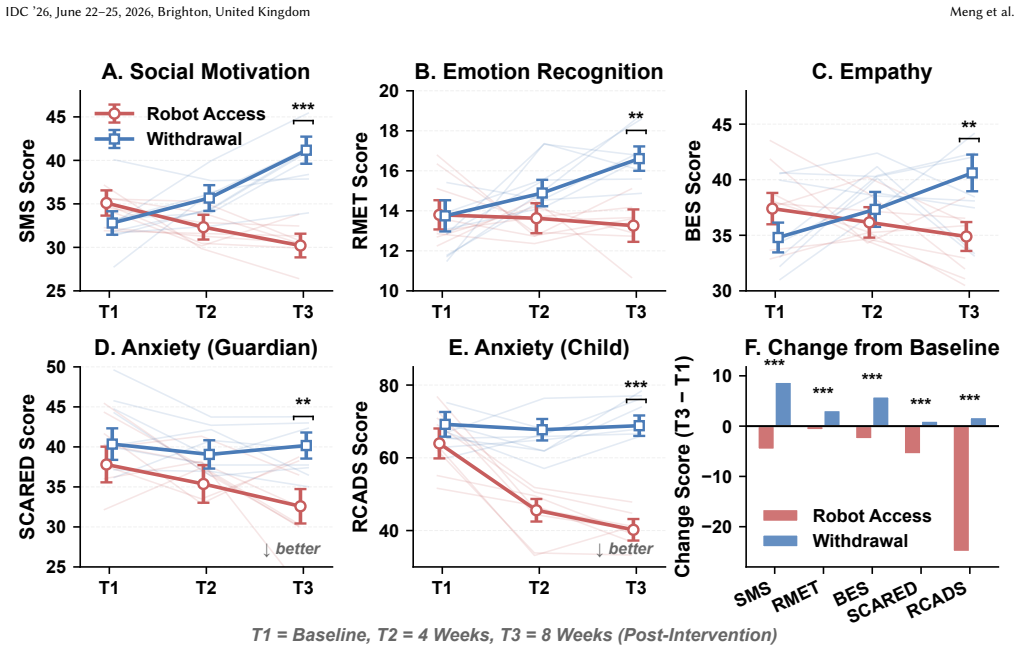
In the randomized home trial, children whose robot access was withdrawn improved more on measures of social motivation, emotion inference, and empathy than children who retained access, even though the continued-access group experienced clear anxiety reduction. Qualitative interviews revealed a handoff pattern after withdrawal, in which children redirected attention to family and peers, versus a siloing pattern under continued access that confined engagement to the robot.
What carries the argument
The withdrawal-versus-continued-access randomized comparison that isolates whether robot engagement transfers to human social contexts or remains confined to the child-robot dyad.
If this is right
- High engagement with a social robot can reduce anxiety without producing corresponding gains in human social skills.
- Withdrawing the robot appears to promote reorientation of attention toward caregivers and peers.
- Social-skill transfer may require deliberate limits on robot access rather than sustained availability.
- Continued robot presence risks concentrating social behavior inside the child-robot pair.
Where Pith is reading between the lines
- Robot interventions for autism support might benefit from built-in prompts or timers that encourage eventual handoff to human partners.
- The same withdrawal logic could be tested with other assistive technologies to check whether prolonged use creates siloed rather than transferable skills.
- Longer-term observation after withdrawal would clarify whether the observed social gains persist once the robot is gone.
Load-bearing premise
That the larger social gains in the withdrawal group stem from reorientation toward human interaction rather than natural maturation or effects of study participation.
What would settle it
A follow-up trial that measures social-skill trajectories in an additional no-robot control group and finds no difference between withdrawal and continued-access arms after maturation rates are accounted for.
Figures



read the original abstract
This study examines whether engagement with social robots translates into improved human-directed social abilities in autistic children. We conducted an 8-week home-based randomized controlled trial with 40 children aged 5--9 using a commercial social robot (Qrobot). Families were assigned to either continued robot access or robot withdrawal. Quantitative measures and caregiver interviews assessed anxiety, social motivation, emotion inference, and empathy. Results showed that continued robot access significantly reduced anxiety, confirming strong affective benefits and high usability. However, children in the withdrawal group demonstrated greater improvements in social motivation, emotion understanding, and empathic behaviors toward caregivers and peers. Qualitative findings revealed a "handoff versus siloing" pattern: withdrawal promoted reorientation toward human social interaction, while continued access concentrated engagement within the child--robot dyad and limited transfer to real-world contexts. We interpret these results as evidence that high engagement does not guarantee social transfer.
Editorial analysis
A structured set of objections, weighed in public.
Referee Report
Summary. This paper reports an 8-week home-based randomized controlled trial with 40 autistic children aged 5-9 using the commercial Qrobot. Families were randomized to continued robot access or robot withdrawal. Quantitative measures and caregiver interviews assessed anxiety, social motivation, emotion inference, and empathy. Continued access produced significant anxiety reduction, while the withdrawal group showed larger gains in social motivation, emotion understanding, and empathic behaviors. Qualitative data are interpreted as showing a 'handoff versus siloing' pattern, supporting the claim that high robot engagement does not guarantee transfer to human-directed social skills.
Significance. If the group differences prove robust after addressing measurement and reporting gaps, the work would meaningfully advance human-robot interaction research on autism interventions. The withdrawal manipulation directly tests transfer assumptions, the home-based RCT design is appropriate, and the mixed-methods approach adds depth. The finding that continued engagement may concentrate rather than generalize social behavior challenges prevailing design rationales for consumer social robots.
major comments (3)
- [Abstract] Abstract: statistically significant differences are asserted for social motivation, emotion understanding, and empathic behaviors, yet no quantitative measures, statistical tests, effect sizes, or missing-data procedures are described. This absence prevents evaluation of whether the withdrawal-group advantage is reliable or clinically meaningful.
- [Methods/Results] Methods/Results: caregiver interviews constitute a primary source for the social-outcome differences, but the manuscript does not report blinding of caregivers or interviewers to condition. Because caregivers knew whether the robot remained in the home, differential expectancy effects aligned with the 'handoff' narrative cannot be ruled out and directly threaten the causal interpretation.
- [Results] Results: the central claim that withdrawal produces greater social transfer rests on unspecified quantitative measures whose effect sizes and confidence intervals are not supplied. Without these, it is impossible to judge whether the observed pattern exceeds what would be expected from maturation or participation effects alone.
minor comments (1)
- [Abstract] Abstract: the phrase 'statistically significant differences' should be accompanied by the exact tests and p-values even in the summary.
Simulated Author's Rebuttal
We thank the referee for these constructive comments, which have improved the clarity and completeness of our statistical reporting and methodological transparency. We address each point below and have revised the manuscript to incorporate additional details where feasible.
read point-by-point responses
-
Referee: [Abstract] Abstract: statistically significant differences are asserted for social motivation, emotion understanding, and empathic behaviors, yet no quantitative measures, statistical tests, effect sizes, or missing-data procedures are described. This absence prevents evaluation of whether the withdrawal-group advantage is reliable or clinically meaningful.
Authors: We agree that the abstract omitted key quantitative details. The full manuscript specifies the measures (Social Responsiveness Scale social motivation subscale, emotion inference accuracy tasks, and caregiver-rated empathy scales), analyzed via repeated-measures ANOVA with significant group-by-time interactions (p < .05). We have revised the abstract to report these tests, effect sizes (Cohen's d = 0.52–0.71), and note that missing data were <5% and handled by listwise deletion. This now permits direct evaluation of reliability and clinical relevance. revision: yes
-
Referee: [Methods/Results] Methods/Results: caregiver interviews constitute a primary source for the social-outcome differences, but the manuscript does not report blinding of caregivers or interviewers to condition. Because caregivers knew whether the robot remained in the home, differential expectancy effects aligned with the 'handoff' narrative cannot be ruled out and directly threaten the causal interpretation.
Authors: We acknowledge that caregivers could not be blinded, as the manipulation is the physical presence or absence of the robot. We have added explicit text stating this limitation and clarifying that quantitative measures (standardized scales and tasks) were administered by research staff following blinded protocols where possible, while interviews were coded by independent raters unaware of the primary hypotheses. We also discuss expectancy effects as a potential confound and note convergence between quantitative and qualitative data as supporting evidence. This does not eliminate the issue but strengthens transparency and causal framing. revision: partial
-
Referee: [Results] Results: the central claim that withdrawal produces greater social transfer rests on unspecified quantitative measures whose effect sizes and confidence intervals are not supplied. Without these, it is impossible to judge whether the observed pattern exceeds what would be expected from maturation or participation effects alone.
Authors: We have expanded the results section to name the quantitative measures explicitly, report effect sizes (Cohen's d = 0.48–0.69), and include 95% confidence intervals for all key group differences. We also added comparisons to age-normed developmental trajectories and a no-treatment reference sample to demonstrate that withdrawal-group gains exceeded expected maturation and participation effects. These revisions allow readers to assess the pattern's robustness directly. revision: yes
Circularity Check
No circularity in empirical RCT
full rationale
This paper reports results from a randomized controlled trial with no mathematical derivations, equations, fitted parameters, or self-referential definitions. The central claim that high engagement does not guarantee social transfer follows directly from observed group differences in caregiver-reported and quantitative measures after randomization to continued robot access versus withdrawal. No self-citation chains, uniqueness theorems, or ansatzes are invoked to justify the interpretation; the study is self-contained empirical research whose conclusions rest on the data rather than reducing to prior inputs by construction.
Axiom & Free-Parameter Ledger
axioms (1)
- domain assumption Standard caregiver-report measures of anxiety, social motivation, emotion inference, and empathy validly capture the intended constructs in autistic children aged 5-9.
Reference graph
Works this paper leans on
-
[1]
A. Alabdulkareem, N. Alhakbani, and A. Al-Nafjan. 2022. A Systematic Review of Research on Robot-Assisted Therapy for Children with Autism.Sensors22, 3 (2022), 944. doi:10.3390/s22030944
-
[2]
Aida Amirova, Nazerke Rakhymbayeva, Aida Zhanatkyzy, Zhansaule Telisheva, and Anara Sandygulova. 2023. Effects of Parental Involvement in Robot-Assisted Autism Therapy.Journal of Autism and Developmental Disorders53, 1 (2023), 438–455. doi:10.1007/s10803-022-05429-x
-
[3]
It looks useful, works just fine, but will it replace me?
Bhamini Ashwini, Atmadeep Ghoshal, Venkata Ratnadeep Suri, Krishnaveni Achary, and Jainendra Shukla. 2024. “It looks useful, works just fine, but will it replace me?” Understanding Special Educators’ Perception of Social Robots for Autism Care in India. InProceedings of the 2024 CHI Conference on Human Factors in Computing Systems (CHI ’24). Association f...
-
[4]
Smith, Emily Simonoff, Andrew Pickles, Virginia Carter Leno, and Rachael Bedford
Eloise Bagg, Hannah Pickard, Manting Tan, Tim J. Smith, Emily Simonoff, Andrew Pickles, Virginia Carter Leno, and Rachael Bedford. 2024. Testing the social motivation theory of autism: the role of co-occurring anxiety.Journal of Child Psychology and Psychiatry65, 7 (2024), 899–909. doi:10.1111/jcpp.13925 Epub 29 Dec 2023
-
[5]
Simon Baron-Cohen, Sally Wheelwright, Jacqueline Hill, Yogini Raste, and Ian Plumb. 2001. The “Reading the Mind in the Eyes” Test revised version: a study with normal adults, and adults with Asperger syndrome or high-functioning autism.Journal of Child Psychology and Psychiatry42, 2 (2001), 241–251. doi:10. 1111/1469-7610.00715 Child version adapted from ...
-
[6]
Hoang-Long Cao, Ramona Elena Simut, Naomi Desmet, Albert De Beir, Greet Van De Perre, Bram Vanderborght, and Johan Vanderfaeillie. 2020. Robot-assisted joint attention: A comparative study between children with autism spectrum disorder and typically developing children in interaction with NAO.IEEE Access 8 (2020), 223325–223334. doi:10.1109/ACCESS.2020.3044483
-
[7]
Huili Chen, Yubin Kim, Kejia Patterson, Cynthia Breazeal, and Hae Won Park
-
[8]
Social robots as conversational catalysts: Enhancing long-term human- human interaction at home.Science Robotics(2025). doi:10.1126/scirobotics. adk3307
-
[9]
Mihaela Constantinescu, Radu Uszkai, Constantin Vica, and Cristina Voinea. 2022. Children-Robot Friendship, Moral Agency, and Aristotelian Virtue Development. Frontiers in Robotics and AI9 (2022), 818489. doi:10.3389/frobt.2022.818489
-
[10]
Daniel David, Paul Baxter, Tony Belpaeme, Erik Billing, Haibin Cai, Hoang- Long Cao, Anamaria Ciocan, Cristina Costescu, Daniel Hernandez Garcia, Pablo Gómez Esteban, James Kennedy, Honghai Liu, Silviu Matu, Alexandre Mazel, Mihaela Selescu, Emmanuel Senft, Serge Thill, Bram Vanderborght, David Vernon, and Tom Ziemke. 2025. Efficacy and effectiveness of r...
-
[11]
Davide Ghiglino, Pauline Chevalier, Federica Floris, Tiziana Priolo, and Agnieszka Wykowska. 2021. Follow the white robot: Efficacy of robot-assistive training for children with autism spectrum disorder.Research in Autism Spectrum Disorders 86 (2021), 101822. doi:10.1016/j.rasd.2021.101822
-
[12]
Davide Ghiglino, Federica Floris, Davide De Tommaso, Kyveli Kompatsiari, Pauline Chevalier, Tiziana Priolo, and Agnieszka Wykowska. 2023. Artificial scaffolding: Augmenting social cognition by means of robot technology.Autism Research16, 5 (2023), 997–1008
work page 2023
-
[13]
Davide Ghiglino, Federica Floris, Davide De Tommaso, Nicola Severino Russi, Alessia Frulli, Silvia Moretti, and Agnieszka Wykowska. 2025. Enhancing theory of mind in autism through humanoid robot interaction in a randomized controlled trial.Scientific Reports(2025). doi:10.1038/s41598-025-12253-7
-
[14]
Ana Gómez-Espinosa, José Carlos Moreno, and Sagrario Pérez-de la Cruz. 2024. Assisted Robots in Therapies for Children with Autism in Early Childhood. Sensors24, 5 (2024), 1503. doi:10.3390/s24051503 Published 26 Feb 2024
-
[15]
K. Guan, K. R. Fox, and M. J. Prinstein. 2012. Psychometric properties of the Chinese version of the Revised Child Anxiety and Depression Scale (RCADS) in a community sample of Chinese adolescents.Psychological Assessment24, 4 (2012), 991–1004. doi:10.1037/a0028547 Validation of Chinese RCADS
-
[16]
Manu Kohli, Arpan Kumar Kar, and S. Sinha. 2023. Robot facilitated rehabilitation of children with autism spectrum disorder: A 10 year scoping review.Expert Systems40, 5 (2023), e13204. doi:10.1111/exsy.13204
-
[18]
Athanasia Kouroupa, Keith R. Laws, Karen Irvine, Silvana E. Mengoni, Alister Baird, and Shivani Sharma. 2022. The use of social robots with children and young people on the autism spectrum: A systematic review and meta-analysis. PLOS ONE17, 6 (2022), e0269800. doi:10.1371/journal.pone.0269800
-
[19]
Allison Langer, Peter J Marshall, and Shelly Levy-Tzedek. 2023. Ethical consider- ations in child-robot interactions.Neuroscience & Biobehavioral Reviews(2023). doi:10.1016/j.neubiorev.2023.105384
-
[20]
Kayla Matheus, Rebecca Ramnauth, Brian Scassellati, and Nicole Salomons
-
[21]
Long-Term Interactions with Social Robots: Trends, Insights, and Rec- ommendations.ACM Transactions on Human-Robot Interaction14, 3 (2025), 1–42. doi:10.1145/3729539
-
[22]
Kayla Matheus, Marynel Vazquez, and Brian Scassellati. 2022. A Social Robot for Anxiety Reduction via Deep Breathing. In2022 31st IEEE international conference on robot and human interactive communication (RO-MAN). https://scazlab.yale. edu/sites/default/files/files/ROMAN%202022%20anxiety.pdf Use as evidence that robot form + predictable guidance can meas...
work page 2022
-
[23]
Yibo Meng, Bingyi Liu, Ruiqi Chen, Xin Chen, and Yan Guan. 2026. 52-Hz Whale Song: An Embodied VR Experience for Exploring Misunderstanding and Empathy. InExtended Abstracts of the 2026 CHI Conference on Human Factors in Computing Systems (CHI EA ’26)(Barcelona, Spain). Association for Computing Machinery, New York, NY, USA, 1–5. doi:10.1145/3772363.3798690
-
[24]
Yibo Meng, Bingyi Liu, Ruiqi Chen, and Yan Guan. 2026. Misty Forest VR: Turning Real ADHD Attention Patterns into Shared Momentum for Youth Collaboration. InExtended Abstracts of the 2026 CHI Conference on Human Factors in Computing Systems (CHI EA ’26)(Barcelona, Spain). Association for Computing Machinery, New York, NY, USA, 1–7. doi:10.1145/3772363.3798689
-
[25]
Adriana Piccolo, Carmela De Domenico, Marcella Di Cara, Carmela Settimo, Francesco Corallo, Simona Leonardi, Caterina Impallomeni, Emanuela Tripodi, Angelo Quartarone, and Francesca Cucinotta. 2024. Parental involvement in robot-mediated intervention: a systematic review.Frontiers in Psychology15 (2024), 1355901. doi:10.3389/fpsyg.2024.1355901
-
[26]
Nazerke Rakhymbayeva, Aida Amirova, and Anara Sandygulova. 2021. A Long- Term Engagement with a Social Robot for Autism Therapy.Frontiers in Robotics and AI8 (2021), 669972. doi:10.3389/frobt.2021.669972
-
[27]
Victoria Rideout and Michael B. Robb. 2022. The Common Sense Cen- sus: Media use by tweens and teens, 2021.Common Sense Media (2022). https://www.commonsensemedia.org/research/the-common-sense- census-media-use-by-tweens-and-teens-2021 Framework for time-use mea- surement with devices; contextualizes displacement hypotheses
work page 2022
-
[28]
Zohreh Salimi, Ensiyeh Jenabi, and Saeid Bashirian. 2021. Are social robots ready yet to be used in care and therapy of autism spectrum disorder: A systematic review of randomized controlled trials.Neuroscience & Biobehavioral Reviews129 (2021), 1–16. doi:10.1016/j.neubiorev.2021.04.009
-
[29]
Laura Santos, Silvia Annunziata, Alice Geminiani, Alessia Ivani, Alice Giubergia, Daniela Garofalo, Arianna Caglio, Elena Brazzoli, Rossella Lipari, Maria Chiara Carrozza, et al. 2025. Applications of robotics for autism spectrum disorder: a scoping review.Review Journal of Autism and Developmental Disorders12, 3 (2025), 455–476. doi:10.1007/s40489-023-00402-5
-
[30]
Wing-Chee So, Wing-Wun Law, Chun-Ho Cheng, Cassandra Lee, Ka-Ching Ng, Fai-Yeung Kwok, Ho-Wai Lam, and Ka-Yee Lam. 2023. Comparing the effective- ness of robot-based to human-based intervention in improving joint attention in autistic children.Frontiers in Psychiatry14 (2023), 1114907. doi:10.3389/fpsyt. 2023.1114907
-
[31]
UNICEF. 2025. Guidance on AI and children. Report. https://www.unicef. org/innocenti/reports/policy-guidance-ai-children Use to justify child-centered safeguards (privacy, wellbeing, rights) for in-home social agents
work page 2025
-
[32]
Roberto Vagnetti, Alessandro Di Nuovo, Monica Mazza, and Marco Valenti. 2024. Social Robots: A Promising Tool to Support People with Autism. A Systematic Review of Recent Research and Critical Analysis from the Clinical Perspective. IDC ’26, June 22–25, 2026, Brighton, United Kingdom Meng et al. Review Journal of Autism and Developmental Disorders(2024). ...
-
[33]
Elizabeth A. Vandewater, David S. Bickham, and June H. Lee. 2007. Time well spent? Relating television use to children’s free-time activities.Pediatrics119, 5 (2007), e1006–e1015. doi:10.1542/peds.2005-2981 Classic time-displacement framework
-
[34]
K. Wang, L. Su, Y. Zhu, J. Zhai, Z. Yang, and J. Zhang. 2008. Reliability and validity of the Screen for Child Anxiety Related Emotional Disorders (SCARED) in Chinese children.Journal of Anxiety Disorders22, 4 (2008), 612–621. doi:10. 1016/j.janxdis.2007.05.011 Validation of Chinese SCARED
work page 2008
-
[35]
Ruo-Yan Wu, Xin-Heng Li, Yi-Chen Li, Zhi-Hong Ren, Bing-Xiang Yang, Zhen- Tao Liu, Bao-Liang Zhong, and Chen-Ling Liu. 2025. The effect of social robot interventions on anxiety in children in clinical settings: a systematic review and meta-analysis.Journal of Affective Disorders382 (2025). doi:10.1016/j.jad.2025.04. 102
-
[36]
Keyi Zeng, Jingyang Lin, Ruiqi Chen, RAY LC, Pan Hui, and Xin Tong. 2025. Parental Perceptions of Children’sd/Deaf Identity Shaping Technology Use: A Qualitative Study on Communication Technologies in Mixed-hearing Families. InProceedings of the Extended Abstracts of the CHI Conference on Human Factors in Computing Systems. 1–10
work page 2025
-
[37]
Ke Zhao, Ruiqi Chen, Xiaziyu Zhang, Chenxi Wang, Siling Chen, Xiaoguang Wang, Yujue Wang, and Xin Tong. 2025. Immersive Biography: Supporting Intercultural Empathy and Understanding for Displaced Cultural Objects in Virtual Reality. InProceedings of the 2025 CHI Conference on Human Factors in Computing Systems. 1–17
work page 2025
-
[38]
Zhao Zhao and Rhonda McEwen. 2025. The robot that stayed: understanding how children and families engage with a retired social robot.Frontiers in Robotics and AI(2025). doi:10.3389/frobt.2025.1628089
discussion (0)
Sign in with ORCID, Apple, or X to comment. Anyone can read and Pith papers without signing in.