Recognition: 1 theorem link
· Lean TheoremNonlinear dispersive waves in the discrete modified KdV equation
Pith reviewed 2026-05-13 19:10 UTC · model grok-4.3
The pith
Quasi-continuum models approximate the spatial profiles and edge features of rarefaction and dispersive shock waves in the discrete modified KdV equation.
A machine-rendered reading of the paper's core claim, the machinery that carries it, and where it could break.
Core claim
Distinct quasi-continuum models are introduced that capture both the spatial profiles and the distinct edge features of rarefaction and dispersive shock waves in the discrete modified KdV equation; Whitham analysis on their periodic traveling waves produces a modulation system that reduces to a DSW-fitting method, while self-similar solutions of the dispersionless limits approximate the rarefaction waves, and both sets of predictions match numerical simulations of the discrete equation.
What carries the argument
Quasi-continuum models whose periodic traveling waves are analyzed via Whitham modulation equations, reduced to a pair of simple-wave ODEs that enable the DSW-fitting procedure.
If this is right
- The DSW-fitting method supplies explicit predictions for the leading and trailing edges of dispersive shock waves.
- Self-similar solutions of the dispersionless quasi-continuum systems approximate the structure and speed of rarefaction waves.
- The modulation equations derived from the quasi-continuum models close the system needed to track slow parameter variations in periodic traveling waves.
- Systematic numerical tests confirm that both the profiles and edge features are reproduced with good fidelity in the studied regimes.
Where Pith is reading between the lines
- The same reduction from modulation equations to DSW-fitting could be tested on other discrete nonlinear wave equations whose continuum limits are known.
- The approach suggests a route for analyzing initial-value problems with more complicated data than simple Riemann jumps by piecing together local self-similar and modulated-wave solutions.
- If the edge predictions remain reliable when the lattice spacing is varied, the models could serve as practical tools for designing discrete systems that support controlled dispersive shocks.
Load-bearing premise
The quasi-continuum models must retain enough of the original discrete lattice dynamics so that the Whitham modulation equations and resulting DSW-fitting remain accurate in the regimes studied.
What would settle it
High-resolution simulations of the discrete mKdV equation for a chosen Riemann problem that produce leading- or trailing-edge speeds or oscillation amplitudes differing measurably from the values predicted by the DSW-fitting method would show the approximation is inaccurate.
Figures




read the original abstract
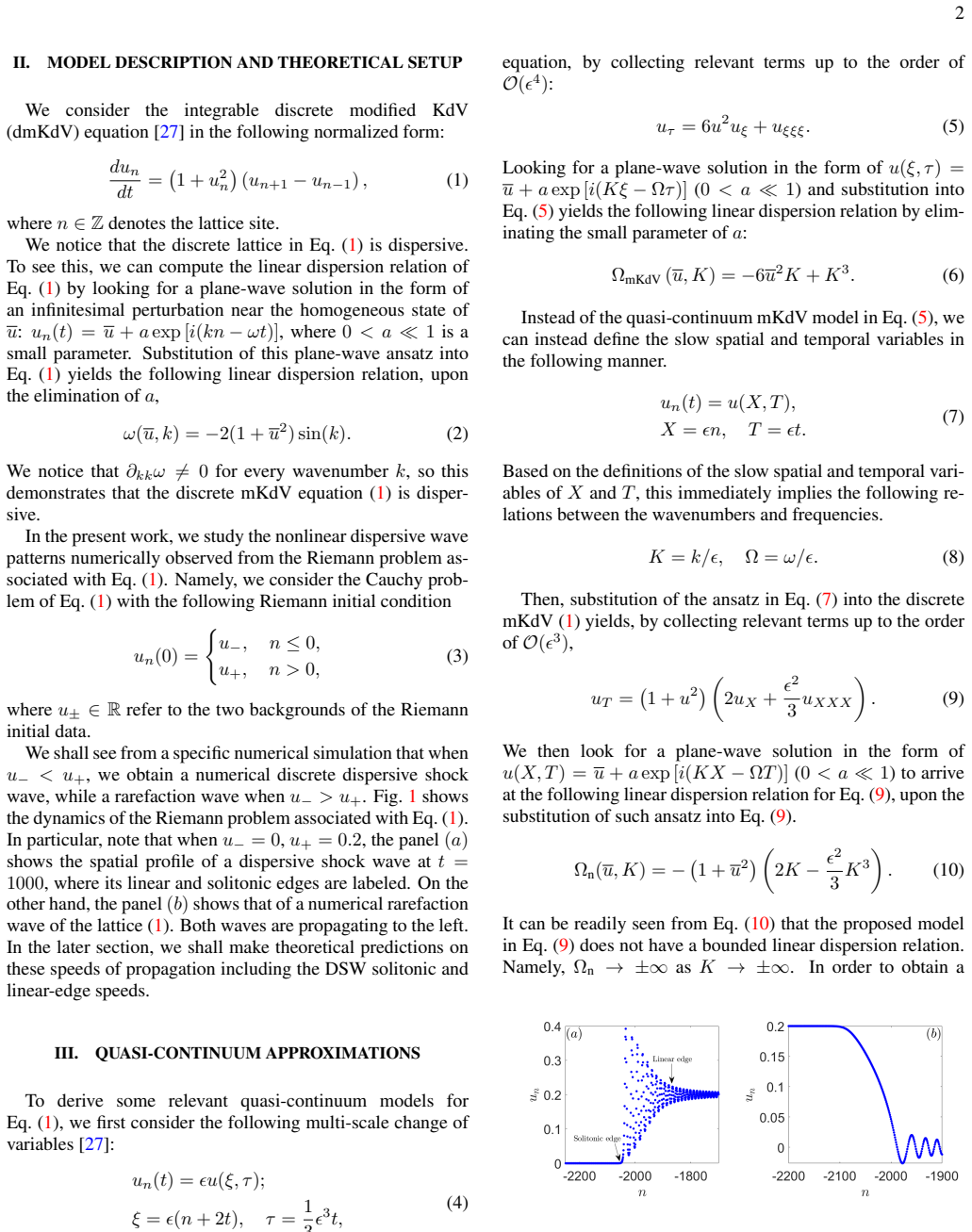
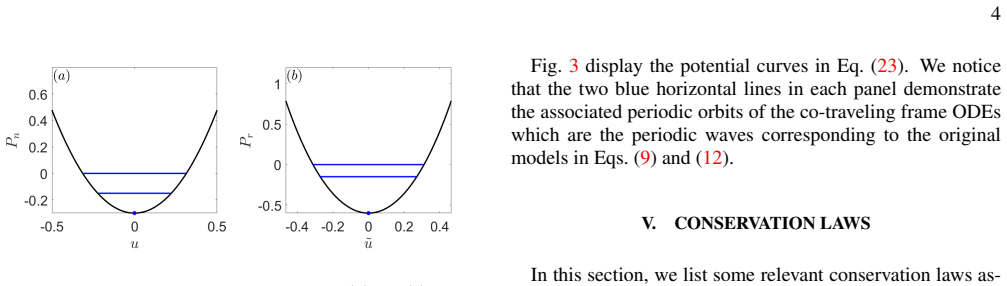
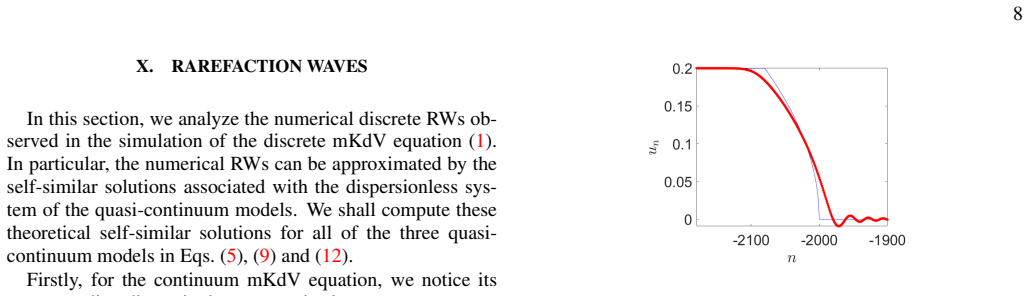
In this paper, we study the nonlinear dispersive waves including the rarefaction and dispersive shock waves in the discrete modified KdV equation through the numerical simulations of the dispersive Riemann problems. In particular, we propose distinct quasi-continuum models to approximate both the spatial profiles and distinct edge features of these two specific dispersive wave structures. Whitham analysis is performed to construct a closed system of partial differential equations which describe the slowly-varying dynamics of all the relevant parameters associated with the periodic traveling waves of the proposed quasi-continuum models. We then perform reduction on such modulation system to obtain a system of two simple-wave ordinary differential equations which lead to the DSW-fitting method that shall provide useful theoretical insights on different edge characteristics of the dispersive shock waves. Furthermore, we compute analytically the self-similar solutions corresponding to the dispersionless systems of the quasi-continuum models, which can be utilized to approximate the numerically observed rarefaction waves of the discrete mKdV equation. A systematic numerical comparison of these theoretical findings with their associated numerical counterparts finally demonstrate the good performance of the proposed quasi-continuum models in approximating both nonlinear dispersive wave patterns.
Editorial analysis
A structured set of objections, weighed in public.
Referee Report
Summary. The manuscript investigates nonlinear dispersive waves, specifically rarefaction waves and dispersive shock waves (DSWs), in the discrete modified Korteweg-de Vries (mKdV) equation. Through numerical simulations of dispersive Riemann problems, the authors propose distinct quasi-continuum models to approximate the spatial profiles and edge features of these waves. Whitham analysis is performed to derive a closed system of modulation PDEs for the parameters of periodic traveling waves in the models; this system is reduced to two simple-wave ODEs yielding a DSW-fitting procedure. Self-similar solutions of the associated dispersionless systems are derived to approximate rarefaction waves. Systematic numerical comparisons are presented to demonstrate the performance of the quasi-continuum models.
Significance. If the quasi-continuum approximations are shown to be accurate, the work supplies a practical theoretical framework for predicting edge speeds and profiles of rarefactions and DSWs in discrete nonlinear lattices. The combination of Whitham modulation theory with DSW-fitting and self-similar solutions offers concrete, testable predictions that can be compared directly to lattice simulations, potentially extending to other discrete integrable or near-integrable systems in nonlinear wave physics.
major comments (3)
- [Numerical comparisons] Numerical comparisons section (and abstract): the claim that the quasi-continuum models demonstrate 'good performance' is not supported by any quantitative metrics. No L2 or L-infinity error norms between theoretical and numerical profiles, no measured discrepancies in left/right DSW edge locations, no convergence tests with respect to lattice spacing, and no error bars on the plotted comparisons are reported. Without these, the strength of evidence for the central approximation claim remains unclear.
- [Quasi-continuum models and Whitham analysis] Quasi-continuum models and Whitham analysis section: the derivation of the modulation equations and the subsequent DSW-fitting procedure assumes that the chosen quasi-continuum truncations preserve the essential linear dispersion relation and nonlinear interactions of the original discrete mKdV. No explicit comparison (analytic or numerical) of the model's dispersion relation ω(k) against the exact discrete dispersion relation is provided across the relevant wavenumber range, nor are truncation-error bounds given. This verification is load-bearing for the accuracy of predicted edge characteristics.
- [DSW-fitting method] DSW-fitting reduction: the reduction of the full modulation system to two simple-wave ODEs is performed entirely within the quasi-continuum models. Because the models are constructed first and then compared to discrete simulations, any omitted lattice corrections that shift edge speeds would propagate directly into the fitted predictions. A brief sensitivity test or a priori estimate of how higher-order discrete terms affect the ODE solutions would be required to substantiate the method's reliability.
minor comments (3)
- [Introduction] Introduction: additional references to existing literature on discrete mKdV or quasi-continuum approximations for lattice equations would help situate the contribution.
- [Figures] Figures: the comparison plots would be clearer with zoomed insets focused on the leading and trailing edges of the DSWs and rarefaction fronts.
- [Model definitions] Notation: the symbols used for the quasi-continuum variables should be explicitly distinguished from the original discrete lattice variables to avoid reader confusion.
Simulated Author's Rebuttal
We thank the referee for the constructive and detailed report. We address each major comment point by point below, indicating where revisions will be made to improve the manuscript.
read point-by-point responses
-
Referee: [Numerical comparisons] Numerical comparisons section (and abstract): the claim that the quasi-continuum models demonstrate 'good performance' is not supported by any quantitative metrics. No L2 or L-infinity error norms between theoretical and numerical profiles, no measured discrepancies in left/right DSW edge locations, no convergence tests with respect to lattice spacing, and no error bars on the plotted comparisons are reported. Without these, the strength of evidence for the central approximation claim remains unclear.
Authors: We agree that the absence of quantitative error metrics weakens the presentation of the approximation quality. In the revised version we will add L2 and L-infinity norms between the quasi-continuum predictions and the lattice simulations for both rarefaction and DSW profiles, report measured discrepancies in the left and right edge locations, include convergence tests with respect to lattice spacing, and add error bars (or shaded regions) to the comparison plots. These additions will be placed in the numerical comparisons section and referenced in the abstract. revision: yes
-
Referee: [Quasi-continuum models and Whitham analysis] Quasi-continuum models and Whitham analysis section: the derivation of the modulation equations and the subsequent DSW-fitting procedure assumes that the chosen quasi-continuum truncations preserve the essential linear dispersion relation and nonlinear interactions of the original discrete mKdV. No explicit comparison (analytic or numerical) of the model's dispersion relation ω(k) against the exact discrete dispersion relation is provided across the relevant wavenumber range, nor are truncation-error bounds given. This verification is load-bearing for the accuracy of predicted edge characteristics.
Authors: The quasi-continuum models are obtained by Taylor expansion of the discrete difference operators, so they match the exact dispersion relation through a prescribed order by construction. We acknowledge that an explicit verification plot and truncation-error bounds would strengthen the justification. In the revision we will insert a new figure comparing the model's ω(k) to the exact discrete dispersion relation over the relevant wavenumber interval, together with an analytic estimate of the leading truncation error. revision: yes
-
Referee: [DSW-fitting method] DSW-fitting reduction: the reduction of the full modulation system to two simple-wave ODEs is performed entirely within the quasi-continuum models. Because the models are constructed first and then compared to discrete simulations, any omitted lattice corrections that shift edge speeds would propagate directly into the fitted predictions. A brief sensitivity test or a priori estimate of how higher-order discrete terms affect the ODE solutions would be required to substantiate the method's reliability.
Authors: We agree that the propagation of higher-order lattice corrections into the edge-speed predictions is a valid concern. Because the DSW-fitting is performed inside the truncated models, a full numerical sensitivity test would require re-deriving the modulation system at the next order, which lies outside the scope of the present study. However, we will add an a priori estimate of the leading-order correction to the edge speeds based on the truncation remainder, and we will discuss its expected magnitude relative to the observed numerical agreement. revision: partial
Circularity Check
No significant circularity; models derived then validated externally
full rationale
The paper proposes quasi-continuum models, performs Whitham modulation analysis on those models to obtain the DSW-fitting ODEs and self-similar rarefaction solutions, and then compares the resulting predictions to independent numerical simulations of the original discrete mKdV equation. No load-bearing step reduces by construction to a fitted parameter, self-citation, or renamed input; the numerical comparisons serve as external benchmarks. This is the standard non-circular workflow for approximation papers.
Axiom & Free-Parameter Ledger
Lean theorems connected to this paper
-
IndisputableMonolith/Foundation/RealityFromDistinction.leanreality_from_one_distinction unclear?
unclearRelation between the paper passage and the cited Recognition theorem.
We propose distinct quasi-continuum models... Whitham analysis... DSW-fitting method... self-similar solutions corresponding to the dispersionless systems
What do these tags mean?
- matches
- The paper's claim is directly supported by a theorem in the formal canon.
- supports
- The theorem supports part of the paper's argument, but the paper may add assumptions or extra steps.
- extends
- The paper goes beyond the formal theorem; the theorem is a base layer rather than the whole result.
- uses
- The paper appears to rely on the theorem as machinery.
- contradicts
- The paper's claim conflicts with a theorem or certificate in the canon.
- unclear
- Pith found a possible connection, but the passage is too broad, indirect, or ambiguous to say the theorem truly supports the claim.
Reference graph
Works this paper leans on
-
[1]
Nonlinear dispersive waves in the discrete modified KdV equation
associated with the dispersionless limit of the dispersive model. In the present work, we shall focus on a dispersive dis- crete lattice [27], the so-called discrete modified KdV equa- tion, stemming from the continuum modified Korteweg-De Vries (KdV) equation [28–30] which is an integrable system. In particular, we study, both analytically and numericall...
work page internal anchor Pith review Pith/arXiv arXiv 2026
-
[2]
M. Hoefer and M. Ablowitz. Dispersive shock waves.Scholar- pedia, 4(11):5562, 2009. revision #137922
work page 2009
-
[3]
Dispersive shock waves in periodic lattices
Su Yang, Sathyanarayanan Chandramouli, and Panayotis G. Kevrekidis. Dispersive shock waves in periodic lattices, arxiv:2511.14549. 2026
work page internal anchor Pith review Pith/arXiv arXiv 2026
-
[4]
Kevrekidis, Su Yang, and Sathyanarayanan Chandramouli
Shrohan Mohapatra, Panayotis G. Kevrekidis, Su Yang, and Sathyanarayanan Chandramouli. Dam breaks in the discrete nonlinear Schr¨odinger equation, arxiv:2507.11529. 2026
-
[5]
Sathyanarayanan Chandramouli, S. I. Mistakidis, G. C. Kat- simiga, and P. G. Kevrekidis. Dispersive shock waves in a one-dimensional droplet-bearing environment.Phys. Rev. A, 110:023304, Aug 2024
work page 2024
-
[6]
Su Yang, Gino Biondini, Christopher Chong, and Panayotis G. Kevrekidis. A regularized continuum model for travelling waves and dispersive shocks of the granular chain.Journal of Nonlinear Waves, 1:e2, 2025
work page 2025
-
[7]
Su Yang, Gino Biondini, Christopher Chong, and Panayotis G. Kevrekidis. First-order continuum models for nonlinear disper- sive waves in the granular crystal lattice.Studies in Applied Mathematics, 156(3):e70190, 2026
work page 2026
- [8]
-
[9]
Christopher Chong, Ari Geisler, Panayotis G. Kevrekidis, and Gino Biondini. Integrable approximations of dispersive shock waves of the granular chain.Wave Motion, 130:103352, 2024
work page 2024
-
[10]
Gino Biondini, Christopher Chong, and Panayotis Kevrekidis. On the whitham modulation equations for the Toda lattice and the quantitative characterization of its dispersive shocks.Phys- ica D: Nonlinear Phenomena, 469:134315, 2024
work page 2024
-
[11]
Brad Lee Holian, Hermann Flaschka, and David W. McLaugh- lin. Shock waves in the Toda lattice: Analysis.Phys. Rev. A, 24:2595–2623, Nov 1981
work page 1981
-
[12]
Su Yang. Quasi-continuum approximations for nonlinear dis- persive waves in general discrete conservation laws.Wave Mo- tion, 142:103695, 2026
work page 2026
-
[13]
Patrick Sprenger, Christopher Chong, Emmanuel Okyere, Michael Herrmann, P. G. Kevrekidis, and Mark A. Hoefer. Hy- drodynamics of a discrete conservation law.Studies in Applied Mathematics, 153(4), October 2024
work page 2024
-
[14]
Christopher Chong, Michael Herrmann, and P.G. Kevrekidis. Dispersive shock waves in lattices: A dimension reduction ap- proach.Physica D: Nonlinear Phenomena, 442:133533, 2022
work page 2022
-
[15]
Gino Biondini, Alexander Bivolcic, and Mark A. Hoefer. Mach reflection and expansion of two-dimensional dispersive shock waves.Phys. Rev. Lett., 135:067201, Aug 2025
work page 2025
-
[16]
H. Kim, E. Kim, C. Chong, P. G. Kevrekidis, and J. Yang. Demonstration of dispersive rarefaction shocks in hollow ellip- tical cylinder chains.Phys. Rev. Lett., 120:194101, May 2018
work page 2018
-
[17]
E. B. Herbold and V . F. Nesterenko. Shock wave structure in a strongly nonlinear lattice with viscous dissipation.Phys. Rev. E, 75:021304, Feb 2007
work page 2007
-
[18]
Stationary shocks in peri- odic highly nonlinear granular chains.Phys
Alain Molinari and Chiara Daraio. Stationary shocks in peri- odic highly nonlinear granular chains.Phys. Rev. E, 80:056602, Nov 2009
work page 2009
-
[19]
Gerald Beresford Whitham.Linear and nonlinear waves. John Wiley & Sons, 2011
work page 2011
-
[20]
Gino Biondini and Alexander Chernyavsky. Whitham modula- tion theory for the Zakharov–Kuznetsov equation and stability analysis of its periodic traveling wave solutions.Studies in Ap- 11 plied Mathematics, 152(2):596–617, 2024
work page 2024
-
[21]
Asela Abeya, Gino Biondini, and Mark A Hoefer. Whitham modulation theory for the defocusing nonlinear Schr ¨odinger equation in two and three spatial dimensions.Journal of Physics A: Mathematical and Theoretical, 56(2):025701, feb 2023
work page 2023
-
[22]
Mark J Ablowitz, Gino Biondini, and Igor Rumanov. Whitham modulation theory for (2 + 1)-dimensional equations of Kadomtsev–Petviashvili type.Journal of Physics A: Mathe- matical and Theoretical, 51(21):215501, apr 2018
work page 2018
-
[23]
Whitham modulation theory for the two-dimensional Benjamin-Ono equation.Phys
Mark Ablowitz, Gino Biondini, and Qiao Wang. Whitham modulation theory for the two-dimensional Benjamin-Ono equation.Phys. Rev. E, 96:032225, Sep 2017
work page 2017
-
[24]
G. A. El. Resolution of a shock in hyperbolic systems modified by weak dispersion.Chaos: An Interdisciplinary Journal of Nonlinear Science, 15(3):037103, 10 2005
work page 2005
-
[25]
R. Carretero-Gonz ´alez, D.J. Frantzeskakis, and P.G. Kevrekidis.Nonlinear Waves and Hamiltonian Systems: From One to Many Degrees of Freedom, from Discrete to Continuum. Oxford University Press, 2024
work page 2024
-
[26]
C. Chong and P.G. Kevrekidis.Coherent Structures in Granular Crystals: From Experiment and Modelling to Computation and Mathematical Analysis. SpringerBriefs in Physics. Springer In- ternational Publishing, 2018
work page 2018
-
[27]
G.A. El and M.A. Hoefer. Dispersive shock waves and mod- ulation theory.Physica D: Nonlinear Phenomena, 333:11–65,
-
[28]
Dispersive Hydrodynamics
-
[29]
Jinbing Chen and Dmitry E. Pelinovsky. Periodic waves in the discrete mKdV equation: Modulational instability and rogue waves.Physica D: Nonlinear Phenomena, 445:133652, 2023
work page 2023
-
[30]
Jinbing Chen and Dmitry E. Pelinovsky. Periodic travel- ling waves of the modified KdV equation and rogue waves on the periodic background.Journal of Nonlinear Science, 29(6):2797–2843, July 2019
work page 2019
-
[31]
Rogue periodic waves of the modified KdV equation.Nonlinearity, 31(5):1955, apr 2018
Jinbing Chen and Dmitry E Pelinovsky. Rogue periodic waves of the modified KdV equation.Nonlinearity, 31(5):1955, apr 2018
work page 1955
-
[32]
Uyen Le and Dmitry E. Pelinovsky. Periodic waves of the mod- ified KdV equation as minimizers of a new variational problem. SIAM Journal on Applied Dynamical Systems, 21(4):2518– 2534, 2022
work page 2022
-
[33]
Michel Peyrard and Martin D. Kruskal. Kink dynamics in the highly discrete sine-Gordon system.Physica D: Nonlinear Phenomena, 14(1):88–102, 1984
work page 1984
-
[34]
G. A. El, M. A. Hoefer, and M. Shearer. Dispersive and diffusive-dispersive shock waves for nonconvex conservation laws.SIAM Review, 59(1):3–61, 2017
work page 2017
- [35]
discussion (0)
Sign in with ORCID, Apple, or X to comment. Anyone can read and Pith papers without signing in.