Recognition: 2 theorem links
· Lean TheoremA polynomial bound for the minimal excluded minors for a surface
Pith reviewed 2026-05-13 19:13 UTC · model grok-4.3
The pith
Minimal excluded minors for a surface of genus g have order O(g^{8+ε}) for every ε>0.
A machine-rendered reading of the paper's core claim, the machinery that carries it, and where it could break.
Core claim
Let G be a minimal excluded minor for a surface of Euler genus g. Then the order of G is O(g^{8+ε}) for every ε>0. The argument rests on a new separator-based strengthening: for any contractible subgraph H of G whose separator has size s, some embedding of G contains O(log s) pairwise disjoint contractible nested cycles inside H. This separator-dependent count replaces earlier genus-dependent counts and yields the polynomial bound after standard reductions from the graph-minors machinery.
What carries the argument
Separator-based strengthening of nested contractible cycles: any contractible subgraph with a separator of size s contains O(log s) pairwise disjoint contractible nested cycles in some embedding of G.
If this is right
- The number of vertices in any minimal excluded minor for genus g grows at most polynomially in g.
- Recognition algorithms for surface embeddability inherit polynomial dependence on g from the size of the forbidden list.
- The asymptotic gap between upper and lower bounds on excluded-minor size shrinks from quasi-polynomial to polynomial.
- Any future improvement must focus on lowering the exponent 8 or removing the ε term.
Where Pith is reading between the lines
- The same separator-reduction technique may apply to other minor-closed families whose structural theorems currently depend on global parameters such as tree-width or genus.
- For small fixed g one could computationally enumerate excluded minors and test whether their sizes already obey the O(g^8) envelope.
- If the log s factor can be replaced by a constant, the exponent would drop further.
Load-bearing premise
The separator-based strengthening holds: every contractible subgraph with a separator of size s contains only O(log s) nested contractible cycles.
What would settle it
A concrete minimal excluded minor for some genus g whose number of vertices exceeds C·g^{8+ε} for a fixed constant C and sufficiently large g would falsify the claimed bound.
Figures




read the original abstract
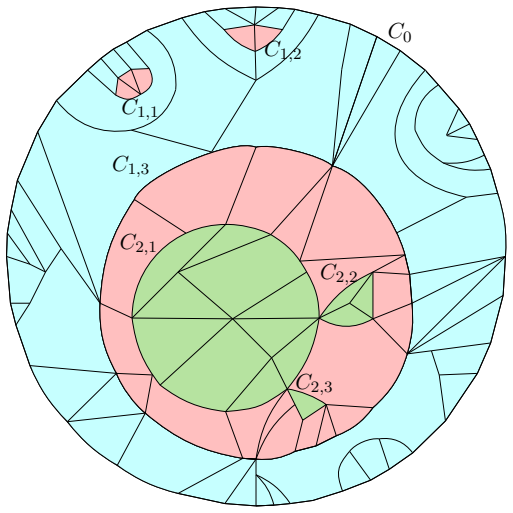
As part of the graph minor project, Robertson and Seymour showed in 1990 that the class of graphs that can be embedded in a given surface can be characterized by a finite set of minimal excluded minors. However, their proof, because existential, provides no explicit information about these excluded minors. In 1993, Seymour established the first upper bound on the order of such minimal excluded minors. Very recently, Houdaigoui and Kawarabayashi improved this result by deriving a quasi-polynomial upper bound. Despite this progress, the gap between this bound and the known linear lower bound $\Omega(g)$ (where $g$ denotes the genus) remains substantial. In particular, they conjectured that a polynomial upper bound should hold. In this paper, we confirm this conjecture by showing that the order of the minimal excluded minors for a surface of genus $g$ is $O(g^{8+\varepsilon})$ for every $\varepsilon >0$. This result significantly narrows the gap between the known lower and upper bounds, bringing the asymptotic behavior much closer to the conjectured optimum. Our approach introduces a new forbidden structure of minimal excluded minors. Let $G$ be a minimal excluded minor for a surface of Euler genus $g$. Houdaigoui and Kawarabayashi showed that $G$ contains $O(\log g)$ pairwise disjoint cycles that are contractible and nested in some embedding of $G$. We strengthen this result by proving a separator-based variant: for any contractible subgraph $H \subseteq G$ with a separator of size $s$ (with $H$ completely contained in one side), the subgraph $H$ contains $O(\log s)$ disjoint cycles that are contractible and nested in some embedding of $G$. This allows us to replace a genus-dependent bound with a separator-dependent one, which is the main new ingredient in deriving our polynomial bound.
Editorial analysis
A structured set of objections, weighed in public.
Referee Report
Summary. The paper proves that the minimal excluded minors for a surface of Euler genus g have order O(g^{8+ε}) for every ε>0. It strengthens the O(log g) nested contractible cycles result of Houdaigoui and Kawarabayashi to a separator-based version: any contractible subgraph H with a separator of size s contains O(log s) pairwise disjoint contractible nested cycles in some embedding of G. This replacement of the global genus parameter by the local separator size s is used to set up a recursion on the size of the minimal excluded minor whose solution yields the stated polynomial bound.
Significance. If the central lemma holds, the result is a substantial advance in the graph-minors project: it supplies the first polynomial upper bound on the order of minimal excluded minors for surfaces, confirming the conjecture of Houdaigoui and Kawarabayashi and reducing the gap to the known Ω(g) lower bound from quasi-polynomial to polynomial. The separator-based strengthening is a new combinatorial tool that may be reusable in other embedding and minor problems.
major comments (2)
- [proof of the separator lemma] The separator-based strengthening (abstract and the proof of the new lemma): the O(log s) bound on the number of nested contractible cycles must be shown to have a constant independent of the global genus g. Any hidden g-dependence would re-introduce super-polynomial factors when the recursion is solved over a sequence of separators whose sizes are themselves bounded only in terms of g.
- [main bound derivation] The size-recursion argument (the derivation of the O(g^{8+ε}) bound): when the lemma is applied to a contractible subgraph H whose own separator is a subgraph of the minimal excluded minor, the branching factor and depth of the recursion tree must be shown to remain polynomial after accounting for the ε. The current sketch does not explicitly bound the number of recursive calls generated by each separator.
minor comments (2)
- [abstract] The abstract alternates between 'genus g' and 'Euler genus g'; a single consistent terminology should be used throughout, with a brief reminder of the relation between the two notions.
- [statement of the new lemma] Notation for the embedding in which the cycles are nested should be introduced once and used uniformly; the current description leaves open whether the embedding is fixed or chosen depending on H.
Simulated Author's Rebuttal
We thank the referee for the careful reading and valuable comments on our manuscript. The points raised about constant independence in the separator lemma and explicit recursion bounds are well-taken, and we will revise the paper to address them directly.
read point-by-point responses
-
Referee: [proof of the separator lemma] The separator-based strengthening (abstract and the proof of the new lemma): the O(log s) bound on the number of nested contractible cycles must be shown to have a constant independent of the global genus g. Any hidden g-dependence would re-introduce super-polynomial factors when the recursion is solved over a sequence of separators whose sizes are themselves bounded only in terms of g.
Authors: The proof of the separator lemma establishes the O(log s) bound using only local properties of the contractible subgraph H and its separator of size s; the argument proceeds by iteratively finding contractible cycles via the separator and does not invoke the global genus g at any step. The constant in the O(log s) is therefore absolute. We will revise the manuscript to add an explicit statement of this independence together with a short paragraph outlining the proof structure that confirms the absence of g-dependence. revision: yes
-
Referee: [main bound derivation] The size-recursion argument (the derivation of the O(g^{8+ε}) bound): when the lemma is applied to a contractible subgraph H whose own separator is a subgraph of the minimal excluded minor, the branching factor and depth of the recursion tree must be shown to remain polynomial after accounting for the ε. The current sketch does not explicitly bound the number of recursive calls generated by each separator.
Authors: We agree the recursion sketch needs to be expanded. In the revision we will supply a complete analysis: each application of the lemma on a separator of size s produces at most O(log s) recursive subproblems, and the separator size decreases by a constant factor at each level (by removal of a cycle or reduction of the separator). Consequently the recursion depth is O(log g). The resulting total size is bounded by a polynomial whose degree is controlled by the choice of ε, which absorbs the logarithmic factors. We will insert this explicit bounding of branching factor and depth into the main bound derivation section. revision: yes
Circularity Check
Minor self-citation to prior quasi-polynomial result; new separator strengthening is independent
full rationale
The derivation introduces a new separator-based lemma (O(log s) nested contractible cycles for any contractible H with separator s) as the key ingredient to replace the prior O(log g) bound and obtain the O(g^{8+ε}) recursion. The cited O(log g) result from the same authors is used only for context and is not load-bearing for the polynomial improvement. No self-definitional equations, fitted parameters renamed as predictions, or reductions of the central claim to prior self-citations appear. The argument is self-contained against the stated combinatorial strengthening.
Axiom & Free-Parameter Ledger
axioms (1)
- standard math Robertson-Seymour theorem that every surface has finitely many minimal excluded minors
Lean theorems connected to this paper
-
IndisputableMonolith/Foundation/AlexanderDuality.leanalexander_duality_circle_linking unclear?
unclearRelation between the paper passage and the cited Recognition theorem.
We strengthen this result by proving a separator-based variant: for any contractible subgraph H ⊆ G with a separator of size s … the subgraph H contains O(log s) disjoint cycles that are contractible and nested
What do these tags mean?
- matches
- The paper's claim is directly supported by a theorem in the formal canon.
- supports
- The theorem supports part of the paper's argument, but the paper may add assumptions or extra steps.
- extends
- The paper goes beyond the formal theorem; the theorem is a base layer rather than the whole result.
- uses
- The paper appears to rely on the theorem as machinery.
- contradicts
- The paper's claim conflicts with a theorem or certificate in the canon.
- unclear
- Pith found a possible connection, but the passage is too broad, indirect, or ambiguous to say the theorem truly supports the claim.
Reference graph
Works this paper leans on
-
[1]
[AGK08] Isolde Adler, Martin Grohe, and Stephan Kreutzer. Computing excluded minors. In Proceedings of the Annual ACM-SIAM Symposium on Discrete Algorithms, pages 641– 650, 2008.doi:10.5555/1347082.1347153. [Arc80] Dan Archdeacon.A Kuratowski theorem for the projective plane. PhD thesis, The Ohio State University,
-
[2]
[Arc81] Dan Archdeacon. A Kuratowski theorem for the projective plane.Journal of Graph Theory, 5(3):243–246, 1981.doi:10.1002/jgt.3190050305. [BW86] Rainer Bodendiek and Klaus Wagner. A characterization of the minimal basis of the torus.Combinatorica, 6(3):245–260,
-
[3]
53 [CT21] Julia Chuzhoy and Zihan Tan
URL:https://doi.org/10.1145/2820609. 53 [CT21] Julia Chuzhoy and Zihan Tan. Towards tight(er) bounds for the excluded grid theorem. Journal of Combinatorial Theory, Series B, 146:219–265, 2021.doi:10.1016/j.jctb. 2020.09.010. [Dec78] Richard Decker.The genus of certain graphs. PhD thesis, The Ohio State University,
-
[4]
The genus of subgraphs ofK 8.Israel Journal of Mathematics, 11:452–455, 1972.doi:10.1007/BF02761469
[DH72] Richard Duke and Gary Haggard. The genus of subgraphs ofK 8.Israel Journal of Mathematics, 11:452–455, 1972.doi:10.1007/BF02761469. [FL89] Michael Fellows and Michael Langston. An analogue of the Myhill-Nerode theorem and its use in computing finite-basis characterizations.Annual Symposium on Foundations of Computer Science (Proceedings), pages 520...
-
[5]
[GKR13] Martin Grohe, Ken-ichi Kawarabayashi, and Bruce Reed
doi:10.1016/0095-8956(79)90022-4. [GKR13] Martin Grohe, Ken-ichi Kawarabayashi, and Bruce Reed. A simple algorithm for the graph minor decomposition – logic meets structural graph theory —. InPro- ceedings of the 2013 Annual ACM-SIAM Symposium on Discrete Algorithms (SODA), pages 414–431. Society for Industrial and Applied Mathematics, 2013.doi:10.1137/ 1...
-
[6]
The vertex separation number of a graph equals its path-width
[Kin92] Nancy Kinnersley. The vertex separation number of a graph equals its path-width. Information Processing Letters, 42(6):345–350, 1992.doi:10.1016/0020-0190(92) 90234-M. [KKR12] Ken-ichi Kawarabayashi, Yusuke Kobayashi, and Bruce Reed. The disjoint paths prob- lem in quadratic time.Journal of Combinatorial Theory, Series B, 102(2):424–435, 2012.doi:...
-
[7]
[KTW20] Ken-ichi Kawarabayashi, Robin Thomas, and Paul Wollan
doi:10.4171/JEMS/1133. [KTW20] Ken-ichi Kawarabayashi, Robin Thomas, and Paul Wollan. Quickly excluding a non- planar graph.to appear in Memoirs of the American Mathematical Society. Soc.,
-
[8]
doi:10.48550/arXiv.2010.12397. [Kur30] Kazimierz Kuratowski. Sur le probl` eme des courbes gauches en topologie.Fundamenta Mathematicae, 15(1):271–283,
-
[9]
London Mathe- matical Society Lecture Note Series
[Moh01] Bojan Mohar.Graph minors and graphs on surfaces, page 145–164. London Mathe- matical Society Lecture Note Series. Cambridge University Press, 2001.doi:10.1017/ CBO9780511721328.008. [MT01] Bojan Mohar and Carsten Thomassen.Graphs on surfaces. Baltimore, MD: Johns Hopkins University Press, 2001.doi:10.56021/9780801866890. [RS86a] Neil Robertson and...
-
[10]
URL:https://web.math.princeton.edu/ ~pds/papers/surfacebound/bound.pdf. [Tho97] Carsten Thomassen. A simpler proof of the excluded minor theorem for higher surfaces. Journal of Combinatorial Theory, Series B, 70(2):306–311, 1997.doi:10.1006/jctb. 1997.1761. [TUK94] Atsushi Takahashi, Shuichi Ueno, and Yoji Kajitani. Minimal acyclic forbidden minors for th...
discussion (0)
Sign in with ORCID, Apple, or X to comment. Anyone can read and Pith papers without signing in.