Recognition: 2 theorem links
· Lean TheoremSplit and Conquer Partial Deepfake Speech
Pith reviewed 2026-05-13 18:58 UTC · model grok-4.3
The pith
Splitting audio at detected boundaries and classifying each segment separately improves detection and localization of partial deepfakes.
A machine-rendered reading of the paper's core claim, the machinery that carries it, and where it could break.
Core claim
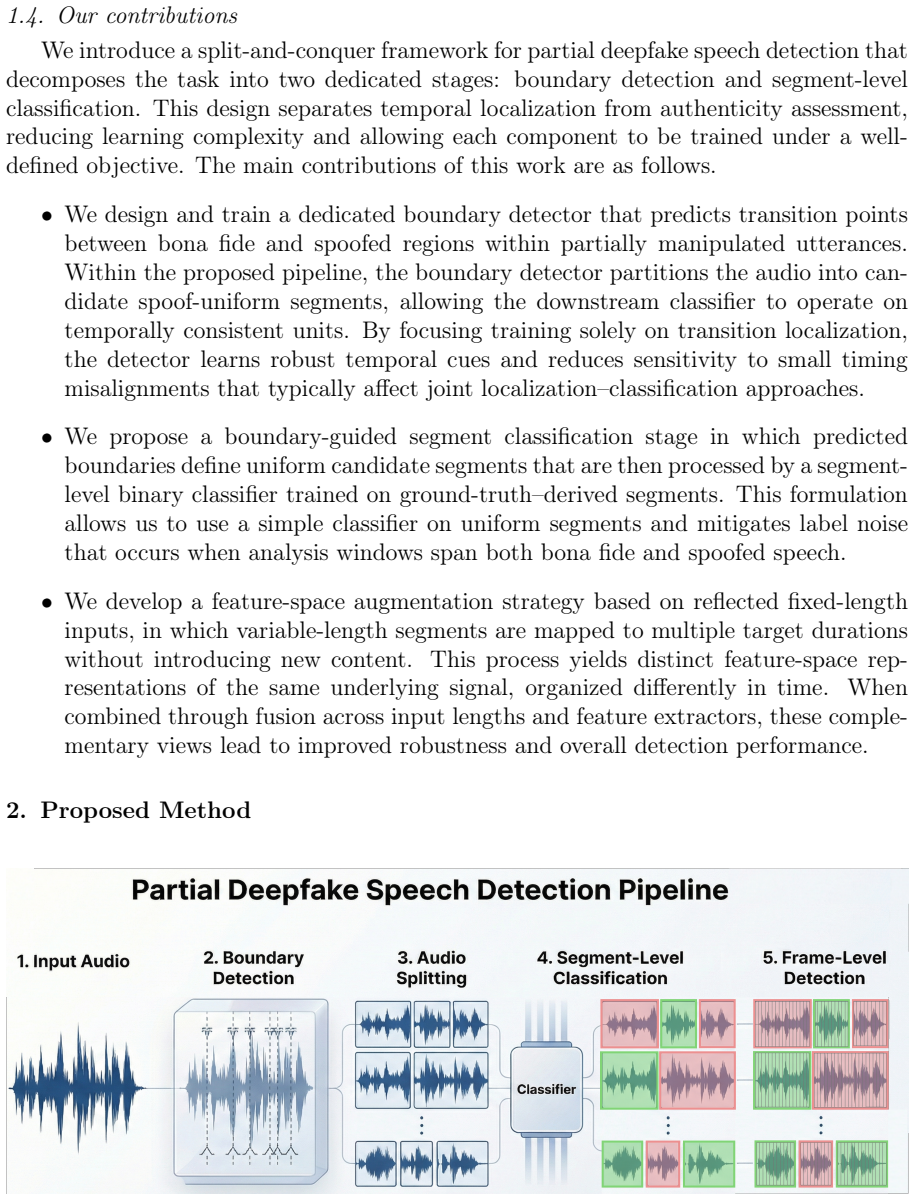
The central claim is that a dedicated boundary detector first identifies temporal transition points between bona fide and fake segments, after which each acoustically consistent segment is classified independently as real or fake; training each stage with multiple feature extractors, augmentations, and a reflection-based multi-length strategy, then fusing the outputs, produces state-of-the-art localization and detection on PartialSpoof across temporal resolutions and at the utterance level while also generalizing to the Half-Truth dataset.
What carries the argument
The split-and-conquer framework: a boundary detector that locates transition points to create consistent segments, followed by independent segment-level classification, with reflection-based multi-length training to produce diverse fixed-length representations from variable-duration inputs.
If this is right
- Spoofed regions can be localized at multiple temporal resolutions without requiring a single model to handle mixed audio.
- Utterance-level decisions improve because they are derived from the fused segment classifications rather than direct whole-utterance modeling.
- Each stage can be trained and augmented independently, allowing complementary feature extractors to be combined at inference time.
- The same two-stage structure yields state-of-the-art results on a second dataset, indicating the decomposition transfers to other partial-manipulation scenarios.
Where Pith is reading between the lines
- The approach could be adapted to video or multimodal deepfakes by replacing the audio boundary detector with a visual or cross-modal one.
- If boundary detection runs efficiently, the method may support streaming or low-latency applications where only recent audio needs re-evaluation.
- Similar split-and-conquer logic might help other detection tasks that currently struggle with variable-length or composite inputs.
- Performance on noisy or accented speech would test whether the segment consistency assumption holds outside clean benchmark conditions.
Load-bearing premise
A boundary detector can reliably locate the exact switch points so that every resulting segment contains only one type of content and can be classified correctly on its own.
What would settle it
A test set containing many short fake insertions or gradual transitions that cause the boundary detector to produce mixed-content segments would show large drops in both localization and utterance-level accuracy.
Figures


read the original abstract
Partial deepfake speech detection requires identifying manipulated regions that may occur within short temporal portions of an otherwise bona fide utterance, making the task particularly challenging for conventional utterance-level classifiers. We propose a split-and-conquer framework that decomposes the problem into two stages: boundary detection and segment-level classification. A dedicated boundary detector first identifies temporal transition points, allowing the audio signal to be divided into segments that are expected to contain acoustically consistent content. Each resulting segment is then evaluated independently to determine whether it corresponds to bona fide or fake speech. This formulation simplifies the learning objective by explicitly separating temporal localization from authenticity assessment, allowing each component to focus on a well-defined task. To further improve robustness, we introduce a reflection-based multi-length training strategy that converts variable-duration segments into several fixed input lengths, producing diverse feature-space representations. Each stage is trained using multiple configurations with different feature extractors and augmentation strategies, and their complementary predictions are fused to obtain improved final models. Experiments on the PartialSpoof benchmark demonstrate state-of-the-art performance across multiple temporal resolutions as well as at the utterance level, with substantial improvements in the accurate detection and localization of spoofed regions. In addition, the proposed method achieves state-of-the-art performance on the Half-Truth dataset, further confirming the robustness and generalization capability of the framework.
Editorial analysis
A structured set of objections, weighed in public.
Referee Report
Summary. The paper proposes a split-and-conquer framework for partial deepfake speech detection that first uses a dedicated boundary detector to identify temporal transitions between bona fide and spoofed segments, then classifies each resulting segment independently for authenticity. A reflection-based multi-length training strategy is introduced to handle variable segment durations by generating fixed-length inputs, with multiple feature extractors and augmentations whose predictions are fused. Experiments claim state-of-the-art performance on the PartialSpoof benchmark across temporal resolutions and at the utterance level, plus SOTA on the Half-Truth dataset.
Significance. If the empirical claims hold after proper validation, the separation of boundary detection from segment classification could provide a more modular and interpretable approach to partial deepfake detection, potentially improving localization accuracy and robustness over end-to-end utterance-level models. The multi-length training and fusion strategy might also generalize to other variable-length audio tasks.
major comments (3)
- [Abstract] Abstract and Experiments section: the central claim of state-of-the-art performance on PartialSpoof is asserted without any reported metrics (e.g., EER, AUC, or localization F1), baselines, or ablation studies, preventing assessment of whether gains are attributable to the split-and-conquer design.
- [§3.1] §3.1 (boundary detector): the framework assumes segments are internally consistent (all bona fide or all fake), but no standalone boundary-detection metrics (precision/recall/F1 at transition points) or error analysis are provided; moderate boundary errors would produce mixed-content segments whose labels become ill-defined.
- [§4] §4 (experiments): no oracle-boundary ablation is reported that replaces the learned detector with ground-truth transitions, so it is impossible to isolate the contribution of the boundary stage versus the segment classifier or dataset artifacts.
minor comments (2)
- [§3.2] Notation for segment lengths and reflection padding is introduced without a clear equation or diagram showing how variable inputs are mapped to fixed lengths.
- [§3.3] The fusion strategy for complementary predictions is described at a high level but lacks details on weighting or decision rules.
Simulated Author's Rebuttal
We thank the referee for the constructive feedback. We will revise the manuscript to include explicit metrics, standalone evaluations, and additional ablations as requested, which will strengthen the presentation of our split-and-conquer framework and its empirical results.
read point-by-point responses
-
Referee: [Abstract] Abstract and Experiments section: the central claim of state-of-the-art performance on PartialSpoof is asserted without any reported metrics (e.g., EER, AUC, or localization F1), baselines, or ablation studies, preventing assessment of whether gains are attributable to the split-and-conquer design.
Authors: We agree that the abstract and experiments section require explicit quantitative support for the SOTA claims. In the revised manuscript we will update the abstract to report key metrics including EER, AUC, and localization F1 on PartialSpoof, and we will expand the experiments section with direct comparisons to published baselines plus ablation studies that isolate the contributions of boundary detection, multi-length training, and fusion. revision: yes
-
Referee: [§3.1] §3.1 (boundary detector): the framework assumes segments are internally consistent (all bona fide or all fake), but no standalone boundary-detection metrics (precision/recall/F1 at transition points) or error analysis are provided; moderate boundary errors would produce mixed-content segments whose labels become ill-defined.
Authors: The PartialSpoof benchmark constructs utterances from internally consistent segments by design. We nevertheless acknowledge that independent evaluation of the boundary detector is necessary. In the revision we will add precision, recall, and F1 scores specifically for transition-point detection together with a short error analysis examining how boundary inaccuracies affect downstream segment classification. revision: yes
-
Referee: [§4] §4 (experiments): no oracle-boundary ablation is reported that replaces the learned detector with ground-truth transitions, so it is impossible to isolate the contribution of the boundary stage versus the segment classifier or dataset artifacts.
Authors: We agree that an oracle-boundary ablation is the cleanest way to quantify the boundary detector's contribution. We will add this experiment to the revised §4, reporting utterance-level and localization results when ground-truth transitions are supplied to the segment classifier, thereby separating the two stages from dataset-specific effects. revision: yes
Circularity Check
No circularity: empirical split-and-conquer framework evaluated on external benchmarks
full rationale
The paper describes an engineering framework that decomposes partial deepfake detection into a boundary detector followed by independent segment classification, trained with multi-length reflection augmentation and fused predictions. No equations, derivations, or first-principles results are presented anywhere in the manuscript. All performance claims rest on end-to-end experimental results on the external PartialSpoof and Half-Truth benchmarks rather than on any quantity that is defined in terms of itself or fitted to a subset and then re-predicted. The central premise (that accurate boundaries produce internally consistent segments) is an empirical assumption whose validity is tested only by the reported benchmark numbers; it does not reduce to a self-definition or self-citation chain. Consequently the work contains no load-bearing circular step.
Axiom & Free-Parameter Ledger
Lean theorems connected to this paper
-
IndisputableMonolith/Foundation/RealityFromDistinction.leanreality_from_one_distinction unclear?
unclearRelation between the paper passage and the cited Recognition theorem.
split-and-conquer framework that decomposes the problem into two stages: boundary detection and segment-level classification
-
IndisputableMonolith/Cost/FunctionalEquation.leanwashburn_uniqueness_aczel unclear?
unclearRelation between the paper passage and the cited Recognition theorem.
reflection-based multi-length training strategy
What do these tags mean?
- matches
- The paper's claim is directly supported by a theorem in the formal canon.
- supports
- The theorem supports part of the paper's argument, but the paper may add assumptions or extra steps.
- extends
- The paper goes beyond the formal theorem; the theorem is a base layer rather than the whole result.
- uses
- The paper appears to rely on the theorem as machinery.
- contradicts
- The paper's claim conflicts with a theorem or certificate in the canon.
- unclear
- Pith found a possible connection, but the passage is too broad, indirect, or ambiguous to say the theorem truly supports the claim.
Reference graph
Works this paper leans on
-
[1]
Asvspoof 2019: A large-scale public database of synthesized, converted and replayed speech,
M. Todisco, X. Wang, V. Vestman, M. Sahidullah, T. Kinnunen, J. Yamagishi, and N. Evans, “Asvspoof 2019: A large-scale public database of synthesized, converted and replayed speech,” inProc. Interspeech, 2019
work page 2019
-
[2]
Asvspoof 2021: Accelerating progress in spoofed and deepfake speech detection,
J. Yamagishi, X. Wang, M. Todisco, J. Patino, A. Nautsch, and N. Evans, “Asvspoof 2021: Accelerating progress in spoofed and deepfake speech detection,” inProc. ASVspoof Workshop, 2021
work page 2021
-
[3]
Asvspoof 5: Crowdsourced speech data, deepfakes, and adversarial attacks at scale,
X. Wang, H. Delgado, H. Tak, J.-w. Jung, H.-j. Shim, M. Todisco, I. Kukanov, X. Liu, M. Sahidullah, T. Kinnunenet al., “Asvspoof 5: Crowdsourced speech data, deepfakes, and adversarial attacks at scale,” 2024
work page 2024
-
[4]
Audio deepfake detection: A survey,
J. Yi, C. Wang, J. Tao, Z. Ni, X. Zhanget al., “Audio deepfake detection: A survey,” arXiv preprint arXiv:2308.14970, 2023
-
[5]
Audio deepfake detection: What has been achieved and what lies ahead,
B. Zhanget al., “Audio deepfake detection: What has been achieved and what lies ahead,”Sensors, vol. 25, no. 7, p. 1989, 2025
work page 1989
-
[6]
An initial in- vestigation for detecting partially spoofed audio,
L. Zhang, X. Wang, E. Cooper, J. Yamagishi, J. Patino, and N. Evans, “An initial in- vestigation for detecting partially spoofed audio,”arXiv preprint arXiv:2104.02518, 2021
-
[7]
Half-truth: A partially fake audio dataset for speech deepfake detection,
J. Yi, L. Chen, Z. Li, and Z. Wang, “Half-truth: A partially fake audio dataset for speech deepfake detection,” inProc. Interspeech, 2021
work page 2021
-
[8]
Constant Q cepstral coefficients: A spoofing countermeasure for automatic speaker verification,
M. Todisco, H. Delgado, and N. Evans, “Constant Q cepstral coefficients: A spoofing countermeasure for automatic speaker verification,”Computer Speech and Language, vol. 45, pp. 516–535, 2017
work page 2017
-
[9]
The ASVspoof 2017 challenge: Assessing the limits of replay spoofing attack detection,
T. Kinnunen, M. Sahidullah, H. Delgado, M. Todisco, N. Evans, J. Yamagishi, and K. A. Lee, “The ASVspoof 2017 challenge: Assessing the limits of replay spoofing attack detection,” inProc. Interspeech, 2017, pp. 2–6. 17
work page 2017
-
[10]
STC anti- spoofing systems for the ASVspoof 2019 challenge,
G. Lavrentyeva, S. Novoselov, A. Volkova, A. Gorlanov, and A. Kozlov, “STC anti- spoofing systems for the ASVspoof 2019 challenge,” inProc. Interspeech, 2019, pp. 1033–1037
work page 2019
-
[11]
Densely connected convolutional network for audio spoofing detection,
Z. Wang, S. Cui, X. Kang, W. Sun, and Z. Li, “Densely connected convolutional network for audio spoofing detection,” inProc. Asia–Pacific Signal and Information Processing Association Annual Summit and Conference (APSIPA ASC), 2020, pp. 1352–1360
work page 2020
-
[12]
Voice deepfake detection using the self- supervised pre-training model hubert,
L. Li, T. Lu, X. Ma, M. Yuan, and D. Wan, “Voice deepfake detection using the self- supervised pre-training model hubert,”Applied Sciences, vol. 13, no. 14, p. 8488, 2023
work page 2023
-
[13]
The vicomtech audio deepfake detection system based on wav2vec2 for the 2022 add challenge,
J. M. Martín-Doñas and J. R. Álvarez, “The vicomtech audio deepfake detection system based on wav2vec2 for the 2022 add challenge,” inProceedings of the Audio Deepfake Detection Challenge (ADD 2022), 2022
work page 2022
-
[14]
Multi-task learning in utterance- level and segmental-level spoof detection,
L. Zhang, X. Wang, E. Cooper, and J. Yamagishi, “Multi-task learning in utterance- level and segmental-level spoof detection,”arXiv preprint arXiv:2107.14132, 2021
-
[15]
Waveform boundary detection for partially spoofed speech,
W. Cai, C. Zhang, X. Wang, and J. Yamagishi, “Waveform boundary detection for partially spoofed speech,” inProc. IEEE ICASSP, 2023
work page 2023
-
[16]
Enhancing partially spoofed audio localization with boundary-aware attention mechanism,
J. Zhong, B. Li, and J. Yi, “Enhancing partially spoofed audio localization with boundary-aware attention mechanism,”arXiv preprint arXiv:2407.21611, 2024
-
[17]
Z. Cai and M. Li, “Integrating frame-level boundary detection and deepfake detec- tion for locating manipulated regions in partially spoofed audio forgery attacks,” Computer Speech & Language, vol. 85, p. 101597, 2024
work page 2024
-
[18]
Deep residual learning for image recognition,
K. He, X. Zhang, S. Ren, and J. Sun, “Deep residual learning for image recognition,” inProceedings of the IEEE Conference on Computer Vision and Pattern Recognition (CVPR), 2016, pp. 770–778
work page 2016
-
[19]
Unsupervised Cross-Lingual Representation Learning for Speech Recognition,
A. Conneau, A. Baevski, R. Collobert, A. Mohamed, and M. Auli, “Unsupervised Cross-Lingual Representation Learning for Speech Recognition,” inProceedings of Interspeech, 2020, pp. 2727–2731
work page 2020
-
[20]
XLS-R: Self-supervised cross- lingual speech representation learning at scale,
A. Babu, A. Tjandra, K. Lakhotia, Q. Xuet al., “XLS-R: Self-supervised cross- lingual speech representation learning at scale,” inProceedings of Interspeech, 2022, pp. 1–5
work page 2022
-
[21]
A study on data augmentation in voice anti-spoofing,
A. Cohen, I. Rimon, E. Aflalo, and H. H. Permuter, “A study on data augmentation in voice anti-spoofing,”Speech Communication, vol. 141, pp. 56–67, 2022
work page 2022
-
[22]
I. Rimon, O. Gal, and H. Permuter, “Unmasking deepfakes: Leveraging aug- mentations and features variability for deepfake speech detection,”arXiv preprint arXiv:2501.05545, 2025
-
[23]
L. Zhang, X. Wang, E. Cooper, N. Evans, and J. Yamagishi, “The partialspoof database and countermeasures for the detection of short fake speech segments em- bedded in an utterance,”IEEE/ACM Transactions on Audio, Speech, and Language Processing, vol. 31, pp. 813–825, 2022. 18
work page 2022
-
[24]
Coarse-to-fine proposal refinement framework for audio temporal forgery detection and localization,
J. Wu, W. Lu, X. Luo, R. Yang, Q. Wang, and X. Cao, “Coarse-to-fine proposal refinement framework for audio temporal forgery detection and localization,” inPro- ceedings of the 32nd ACM International Conference on Multimedia (MM ’24). Mel- bourne, VIC, Australia: Association for Computing Machinery, 2024, pp. 7395–7403
work page 2024
-
[25]
A contrastive study of phonetic variations in english and chinese,
M. Liao and N. Shen, “A contrastive study of phonetic variations in english and chinese,” inProceedings of the 2019 7th International Education, Economics, Social Science, Arts, Sports and Management Engineering Conference (IEESASM 2019). Guangzhou, China: CSP, 2019, pp. 2205–2208. [Online]. Available: http://166.62.7.99/conferences/LNEMSS/IEESASM%202019/...
work page 2019
discussion (0)
Sign in with ORCID, Apple, or X to comment. Anyone can read and Pith papers without signing in.