Recognition: 2 theorem links
· Lean TheoremTracing the relic nature of compact galaxies through their globular cluster systems
Pith reviewed 2026-05-13 18:06 UTC · model grok-4.3
The pith
Three compact massive galaxies match massive relic profiles through their globular cluster systems.
A machine-rendered reading of the paper's core claim, the machinery that carries it, and where it could break.
Core claim
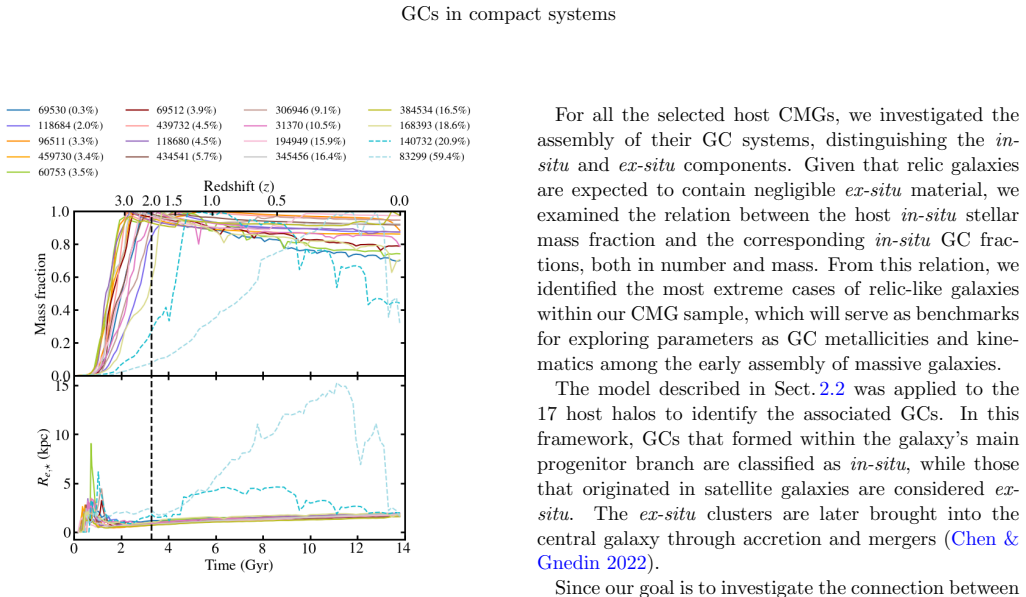
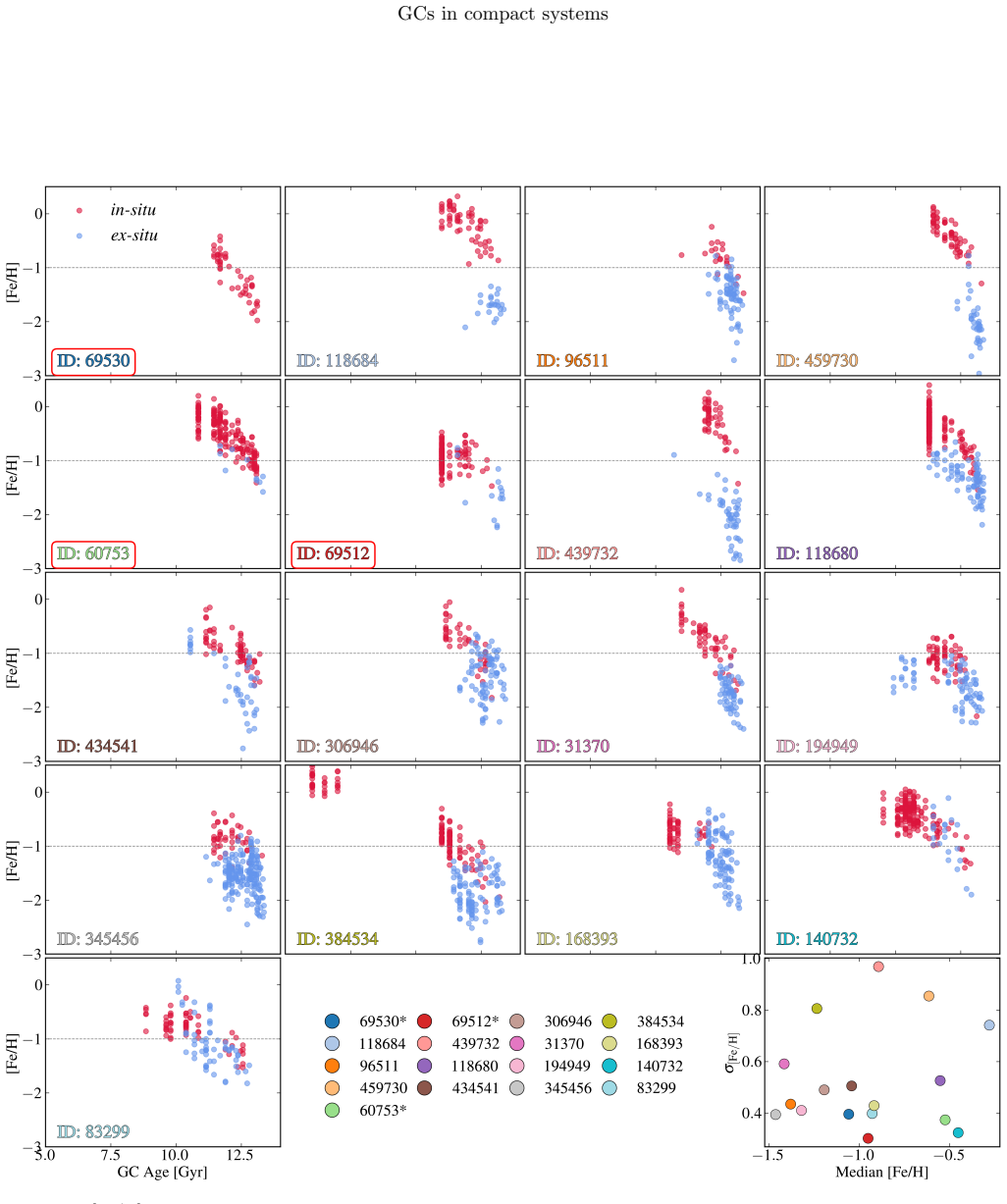
Combining stellar assembly histories with globular cluster properties reveals that the mass fraction of clusters traces early accretion events more robustly than the number fraction. Three of the seventeen compact massive galaxies display the expected relic signatures: predominantly in-situ cluster formation, narrow metallicity distributions, and compact spatial profiles. A clear correlation emerges between the host galaxy's stripped stellar fraction and the radial extent of its ex-situ globular cluster population.
What carries the argument
The synthetic globular cluster formation model that assigns clusters to stellar particles according to age and local conditions, supplying origin, metallicity, and positional information for each cluster.
If this is right
- Globular cluster mass fraction serves as a more reliable tracer of galaxy assembly history than number fraction.
- Spatial profiles of ex-situ globular clusters can indicate the extent of tidal stripping experienced by the host galaxy.
- The joint study of globular cluster populations and host stellar assembly provides a practical way to identify massive relic galaxies.
- Early-formed clusters preserve assembly signals better than later-accreted ones.
Where Pith is reading between the lines
- Surveys of globular cluster systems around nearby compact galaxies could be used to flag which ones are likely true relics with minimal late-time growth.
- The same GC-based stripping diagnostic might be applied to galaxies in dense cluster environments to map their dynamical histories.
- If the correlation between stripped fraction and ex-situ cluster extent holds in real data, it offers an observable route to quantify past tidal interactions without needing full merger trees.
Load-bearing premise
The synthetic model produces realistic positional, kinematic, and chemical properties for globular clusters that accurately reflect real galaxy assembly.
What would settle it
Comparison of the predicted in-situ fractions, metallicity widths, and spatial profiles for the three candidate relic galaxies against direct observations of massive compact galaxies known to have old stellar populations and little recent star formation.
Figures




read the original abstract
We investigate the synthetic model of globular cluster (GC) systems of 17 compact massive galaxies (CMGs) from the Illustris TNG100 simulation to explore their connection with massive relic galaxies, systems that have undergone little structural evolution across cosmic time. The co-evolution of the GC systems and their host galaxies is based on a GC formation and evolution model that assigns clusters to stellar particles according to age and local conditions, providing positional, kinematic, and chemical information for individual GCs. By combining stellar assembly histories, effective radius evolution, and GC properties such as in-situ vs. ex-situ origin, metallicity, and spatial distribution, we identify consistent signatures of early formation and late-time accretion. We find that the GC mass fraction traces the host assembly history more robustly than the GC number fraction, as massive clusters better preserve the imprint of the early accretion history. Three CMGs from TNG100 emerge as strong massive relic analogs, exhibiting high in-situ GC fractions, narrow metallicity distributions, and compact spatial distributions. A tight correlation between the host stripped fraction and the extent of the ex-situ GC population further reveals the possibility to consider GC spatial profiles as a signature to identify tidal stripping processes. These results indicate that the combined analysis of GC populations and host stellar assembly offers a robust diagnostic for identifying massive relic galaxies and constraining their evolutionary histories.
Editorial analysis
A structured set of objections, weighed in public.
Referee Report
Summary. The paper analyzes synthetic globular cluster (GC) systems for 17 compact massive galaxies (CMGs) drawn from the Illustris TNG100 simulation. Using a model that assigns GCs to stellar particles based on age and local conditions, it combines stellar assembly histories, effective-radius evolution, and GC properties (in-situ/ex-situ origin, metallicity, spatial distribution) to identify three CMGs as strong massive-relic analogs characterized by high in-situ GC fractions, narrow metallicity distributions, and compact spatial profiles. It further reports a tight correlation between the host stripped fraction and the extent of the ex-situ GC population, proposing GC spatial profiles as a diagnostic for tidal-stripping processes.
Significance. If the synthetic GC model is shown to reproduce observed GC properties, the work supplies a simulation-based diagnostic that links GC observables to assembly history and could help identify relic galaxies in surveys. The finding that GC mass fraction traces early accretion more robustly than number fraction is a concrete, potentially testable insight.
major comments (2)
- [§4] §4 (Results on relic identification): the claim that three specific CMGs are strong massive-relic analogs rests on the synthetic GC model producing realistic in-situ fractions, metallicity spreads, and radial profiles. The manuscript presents only internal TNG100 outputs and does not compare these quantities to observed GC systems in confirmed relics (e.g., NGC 1277, Mrk 1216), leaving open whether the reported signatures are robust or artifacts of the assignment rules.
- [§3] §3 (GC formation and evolution model): the assignment of clusters to stellar particles according to age and local conditions is central to all downstream claims, yet no external validation against observed GC metallicity distributions or spatial profiles in compact galaxies is provided. Without such a test, the assertion that GC spatial profiles trace stripping processes cannot be considered load-bearing.
minor comments (2)
- [§5] The abstract and §5 state that GC mass fraction is more robust than number fraction, but the quantitative difference (e.g., correlation coefficients) is not shown in a dedicated panel or table.
- [Figures 6-7] Figure captions for the correlation plots should explicitly state the number of CMGs used and whether error bars reflect Poisson or model uncertainties.
Simulated Author's Rebuttal
We thank the referee for the thoughtful and constructive report. The comments highlight important points regarding the robustness of our synthetic GC model and the identification of relic analogs. We address each major comment below. Where appropriate, we have made partial revisions to clarify limitations, add references to prior model validations, and expand the discussion of future observational tests. The core simulation-based analysis remains unchanged as it is internally consistent with TNG100.
read point-by-point responses
-
Referee: §4 (Results on relic identification): the claim that three specific CMGs are strong massive-relic analogs rests on the synthetic GC model producing realistic in-situ fractions, metallicity spreads, and radial profiles. The manuscript presents only internal TNG100 outputs and does not compare these quantities to observed GC systems in confirmed relics (e.g., NGC 1277, Mrk 1216), leaving open whether the reported signatures are robust or artifacts of the assignment rules.
Authors: We agree that direct comparison to observed GC systems in confirmed relics (NGC 1277, Mrk 1216) would provide stronger external validation. Our study is simulation-focused, deriving signatures from TNG100 assembly histories and the GC assignment model to identify consistent early-formation indicators. The three CMGs are selected based on internal metrics (high in-situ GC fractions, narrow metallicity spreads, compact profiles) that align with relic expectations from the simulation. In the revised manuscript we have added a dedicated paragraph in §4 and the conclusions explicitly noting the absence of direct observational matches, framing our results as predictions to be tested with future data on real relics, and emphasizing that the signatures are emergent from the simulation rather than claimed as universally robust. revision: partial
-
Referee: §3 (GC formation and evolution model): the assignment of clusters to stellar particles according to age and local conditions is central to all downstream claims, yet no external validation against observed GC metallicity distributions or spatial profiles in compact galaxies is provided. Without such a test, the assertion that GC spatial profiles trace stripping processes cannot be considered load-bearing.
Authors: The GC formation model in §3 follows established prescriptions (tied to stellar particle age, local density, and metallicity) previously implemented and tested in TNG-based studies for reproducing global GC properties such as mass functions and metallicity distributions. We do not introduce new external validation here because the work centers on applying the model to CMGs to explore assembly diagnostics. The correlation between stripped fraction and ex-situ GC extent is presented as an emergent simulation result and a proposed diagnostic, not a confirmed observational tool. In revision we have expanded §3 with additional references to prior model tests, clarified the assumptions, and softened the language around the stripping signature to indicate it as a testable prediction rather than a load-bearing claim. revision: partial
Circularity Check
No circularity: results are direct simulation outputs
full rationale
The paper applies a pre-existing GC formation model to TNG100 stellar particles and reports emergent properties (in-situ fractions, metallicity spreads, spatial profiles) as diagnostics for relic galaxies. No equation or step defines a quantity in terms of itself, renames a fitted parameter as a prediction, or reduces the central claim to a self-citation chain. The three CMG analogs and the stripped-fraction correlation are computed outputs, not tautological re-statements of the model's inputs.
Axiom & Free-Parameter Ledger
axioms (1)
- domain assumption GCs can be assigned to stellar particles according to age and local conditions to produce realistic positional, kinematic, and chemical properties.
Lean theorems connected to this paper
-
IndisputableMonolith/Constants.lean (c=1, ℏ, G as φ-powers)reality_from_one_distinction contradicts?
contradictsCONTRADICTS: the theorem conflicts with this paper passage, or marks a claim that would need revision before publication.
We assume the Planck Collaboration et al. (2016) parameters... H0 = 67.74 km s−1 Mpc−1, Ωm = 0.30, ΩΛ = 0.69
What do these tags mean?
- matches
- The paper's claim is directly supported by a theorem in the formal canon.
- supports
- The theorem supports part of the paper's argument, but the paper may add assumptions or extra steps.
- extends
- The paper goes beyond the formal theorem; the theorem is a base layer rather than the whole result.
- uses
- The paper appears to rely on the theorem as machinery.
- contradicts
- The paper's claim conflicts with a theorem or certificate in the canon.
- unclear
- Pith found a possible connection, but the passage is too broad, indirect, or ambiguous to say the theorem truly supports the claim.
Reference graph
Works this paper leans on
-
[1]
Alamo-Mart´ ınez, K. A., Chies-Santos, A. L., Beasley, M. A., et al. 2021, MNRAS, 503, 2406, doi: 10.1093/mnras/stab538
-
[2]
2024, Nature Astronomy, 8, 1310, doi: 10.1038/s41550-024-02327-3
Angeloudi, E., Falc´ on-Barroso, J., Huertas-Company, M., et al. 2024, Nature Astronomy, 8, 1310, doi: 10.1038/s41550-024-02327-3
-
[3]
Barro, G., Faber, S. M., P´ erez-Gonz´ alez, P. G., et al. 2013, ApJ, 765, 104, doi: 10.1088/0004-637X/765/2/104
-
[4]
2015, MNRAS, 453, 357, doi: 10.1093/mnras/stv1661
Bastian, N., & Lardo, C. 2015, MNRAS, 453, 357, doi: 10.1093/mnras/stv1661
-
[5]
Beasley, M. A. 2020, Globular Cluster Systems and Galaxy Formation, 245–277, doi: 10.1007/978-3-030-38509-5 9
-
[6]
A., Trujillo, I., Leaman, R., & Montes, M
Beasley, M. A., Trujillo, I., Leaman, R., & Montes, M. 2018, Nature, 555, 483, doi: 10.1038/nature25756
-
[7]
Blakeslee, J. P., Cantiello, M., & Peng, E. W. 2010, ApJ, 710, 51, doi: 10.1088/0004-637X/710/1/51
-
[8]
Blakeslee, J. P., Cho, H., Peng, E. W., et al. 2012, ApJ, 746, 88, doi: 10.1088/0004-637X/746/1/88
-
[9]
Brodie, J. P., & Strader, J. 2006, ARA&A, 44, 193, doi: 10.1146/annurev.astro.44.051905.092441
-
[10]
Cappellari, M., McDermid, R. M., Alatalo, K., et al. 2013, MNRAS, 432, 1862, doi: 10.1093/mnras/stt644
-
[11]
Caso, J. P., Ennis, A. I., & De B´ ortoli, B. J. 2024, MNRAS, 527, 6993, doi: 10.1093/mnras/stad3602
-
[12]
Chen, Y., & Gnedin, O. Y. 2022, MNRAS, 514, 4736, doi: 10.1093/mnras/stac1651 —. 2023, MNRAS, 522, 5638, doi: 10.1093/mnras/stad1328 —. 2024, MNRAS, 527, 3692, doi: 10.1093/mnras/stad3345
-
[13]
Chies-Santos, A. L., Larsen, S. S., Cantiello, M., et al. 2012, A&A, 539, A54, doi: 10.1051/0004-6361/201117169
-
[14]
Cho, H., Blakeslee, J. P., Chies-Santos, A. L., et al. 2016, ApJ, 822, 95, doi: 10.3847/0004-637X/822/2/95
-
[15]
Choksi, N., & Gnedin, O. Y. 2019, MNRAS, 488, 5409, doi: 10.1093/mnras/stz2097
-
[16]
Choksi, N., Gnedin, O. Y., & Li, H. 2018, MNRAS, 480, 2343, doi: 10.1093/mnras/sty1952
-
[17]
2005, ApJ, 626, 680, doi: 10.1086/430104
Daddi, E., Renzini, A., Pirzkal, N., et al. 2005, ApJ, 626, 680, doi: 10.1086/430104
-
[18]
Damjanov, I., Geller, M. J., & Sohn, J. 2025, ApJ, 982, 178, doi: 10.3847/1538-4357/ada3c5
-
[19]
Damjanov, I., McCarthy, P. J., Abraham, R. G., et al. 2009, ApJ, 695, 101, doi: 10.1088/0004-637X/695/1/101
-
[20]
Davison, T. A., Norris, M. A., Leaman, R., et al. 2021, MNRAS, 507, 3089, doi: 10.1093/mnras/stab2362
-
[21]
doi:10.1111/j.1365-2966.2009.15598.x , archivePrefix =
Dolag, K., Borgani, S., Murante, G., & Springel, V. 2009, MNRAS, 399, 497, doi: 10.1111/j.1365-2966.2009.15034.x
-
[22]
2020, A&A, 637, A27, doi: 10.1051/0004-6361/202037686 Ferr´ e-Mateu, A., Forbes, D
Fahrion, K., Lyubenova, M., Hilker, M., et al. 2020, A&A, 637, A27, doi: 10.1051/0004-6361/202037686 Ferr´ e-Mateu, A., Forbes, D. A., Romanowsky, A. J., Janz, J., & Dixon, C. 2018, MNRAS, 473, 1819, doi: 10.1093/mnras/stx2442 Ferr´ e-Mateu, A., Trujillo, I., Mart´ ın-Navarro, I., et al. 2017, Monthly Notices of the Royal Astronomical Society, 467, 1929, ...
-
[23]
Forbes, D. A., & Remus, R.-S. 2018, Monthly Notices of the Royal Astronomical Society, 479, 4760, doi: 10.1093/mnras/sty1767
-
[24]
Kelson, D. D. 2014, ApJ, 788, 72, doi: 10.1088/0004-637X/788/1/72
-
[25]
2018, MNRAS, 474, 3976, doi: 10.1093/mnras/stx3078
Genel, S., Nelson, D., Pillepich, A., et al. 2018, MNRAS, 474, 3976, doi: 10.1093/mnras/stx3078
-
[26]
Gieles, M., & Gnedin, O. Y. 2023, MNRAS, 522, 5340, doi: 10.1093/mnras/stad1287 Gr` ebol-Tom` as, P., Ferr´ e-Mateu, A., & Dom´ ınguez-S´ anchez, H. 2023a, MNRAS, 526, 4024, doi: 10.1093/mnras/stad2973 —. 2023b, MNRAS, 526, 4024, doi: 10.1093/mnras/stad2973
-
[27]
E., Morningstar, W., Gnedin, O
Harris, W. E., Morningstar, W., Gnedin, O. Y., et al. 2014, ApJ, 797, 128, doi: 10.1088/0004-637X/797/2/128
-
[28]
Huchra, J. P., & Geller, M. J. 1982, ApJ, 257, 423, doi: 10.1086/160000
-
[29]
Kang, J., & Lee, M. G. 2021, ApJ, 914, 20, doi: 10.3847/1538-4357/abf433
-
[30]
Kravtsov, A. V., & Gnedin, O. Y. 2005, ApJ, 623, 650, doi: 10.1086/428636
-
[31]
Kruijssen, J. M. D. 2015, Monthly Notices of the Royal Astronomical Society, 454, 1658, doi: 10.1093/mnras/stv2026
-
[32]
Larsen, S. S., Strader, J., & Brodie, J. P. 2012, A&A, 544, L14, doi: 10.1051/0004-6361/201219897
-
[33]
2019, ApJS, 240, 2, doi: 10.3847/1538-4365/aaecd4
Lee, S.-Y., Chung, C., & Yoon, S.-J. 2019, ApJS, 240, 2, doi: 10.3847/1538-4365/aaecd4
-
[34]
Li, H., & Gnedin, O. Y. 2019, MNRAS, 486, 4030, doi: 10.1093/mnras/stz1114
-
[35]
2023, A&A, 669, A95, doi: 10.1051/0004-6361/202243616
Lisiecki, K., Ma lek, K., Siudek, M., et al. 2023, A&A, 669, A95, doi: 10.1051/0004-6361/202243616
-
[36]
Moura, M. T., Chies-Santos, A. L., Furlanetto, C., Zhu, L., & Canossa-Gosteinski, M. A. 2024, MNRAS, 528, 353, doi: 10.1093/mnras/stae013
-
[37]
Furlanetto, C., & Beasley, M. A. 2025, A&A, 704, A287, doi: 10.1051/0004-6361/202555494
-
[38]
Muratov, A. L., & Gnedin, O. Y. 2010, ApJ, 718, 1266, doi: 10.1088/0004-637X/718/2/1266 14 GCs in compact systems
-
[39]
Naab, T., Johansson, P. H., & Ostriker, J. P. 2009, ApJL, 699, L178, doi: 10.1088/0004-637X/699/2/L178
-
[40]
First results from the IllustrisTNG simulations: the galaxy color bimodality
Nelson, D., Pillepich, A., Springel, V., et al. 2018, MNRAS, 475, 624, doi: 10.1093/mnras/stx3040
work page internal anchor Pith review doi:10.1093/mnras/stx3040 2018
-
[41]
2019, Computational Astrophysics and Cosmology, 6, 2, doi: 10.1186/s40668-019-0028-x
Nelson, D., Springel, V., Pillepich, A., et al. 2019, Computational Astrophysics and Cosmology, 6, 2, doi: 10.1186/s40668-019-0028-x
-
[42]
2010, ApJ, 725, 2312, doi: 10.1088/0004-637X/725/2/2312
Burkert, A. 2010, ApJ, 725, 2312, doi: 10.1088/0004-637X/725/2/2312
-
[43]
W., Jord´ an, A., Cˆ ot´ e, P., et al
Peng, E. W., Jord´ an, A., Cˆ ot´ e, P., et al. 2008, ApJ, 681, 197, doi: 10.1086/587951
-
[44]
2018b, MNRAS, 473, 4077, doi: 10.1093/mnras/stx2656
Pillepich, A., Springel, V., Nelson, D., et al. 2018, MNRAS, 473, 4077, doi: 10.1093/mnras/stx2656
work page internal anchor Pith review doi:10.1093/mnras/stx2656 2018
-
[45]
2019, MNRAS, 490, 3196, doi: 10.1093/mnras/stz2338
Pillepich, A., Nelson, D., Springel, V., et al. 2019, MNRAS, 490, 3196, doi: 10.1093/mnras/stz2338 Planck Collaboration, Ade, P. A. R., Aghanim, N., et al. 2016, A&A, 594, A13, doi: 10.1051/0004-6361/201525830
-
[46]
Reina-Campos, M., Keller, B. W., Kruijssen, J. M. D., et al. 2022, MNRAS, 517, 3144, doi: 10.1093/mnras/stac1934
-
[47]
Rodriguez-Gomez, V., Genel, S., Vogelsberger, M., et al. 2015, MNRAS, 449, 49, doi: 10.1093/mnras/stv264
-
[48]
Rodriguez-Gomez, V., Pillepich, A., Sales, L. V., et al. 2016a, MNRAS, 458, 2371, doi: 10.1093/mnras/stw456 —. 2016b, MNRAS, 458, 2371, doi: 10.1093/mnras/stw456
-
[49]
, year = 1976, month = jan, volume =
Schechter, P. 1976, ApJ, 203, 297, doi: 10.1086/154079
-
[50]
1978, ApJ, 225, 357, doi: 10.1086/156499
Searle, L., & Zinn, R. 1978, ApJ, 225, 357, doi: 10.1086/156499
-
[51]
2021, A&A, 646, A28, doi: 10.1051/0004-6361/202038936
Spiniello, C., Tortora, C., D’Ago, G., et al. 2021, A&A, 646, A28, doi: 10.1051/0004-6361/202038936
-
[52]
2024, MNRAS, 527, 8793, doi: 10.1093/mnras/stad3703
Spiniello, C., D’Ago, G., Coccato, L., et al. 2024, MNRAS, 527, 8793, doi: 10.1093/mnras/stad3703
-
[53]
doi:10.1111/j.1365-2966.2009.15598.x , archivePrefix =
Springel, V. 2010, MNRAS, 401, 791, doi: 10.1111/j.1365-2966.2009.15715.x
-
[54]
Springel, V., White, S. D. M., Tormen, G., & Kauffmann, G. 2001, MNRAS, 328, 726, doi: 10.1046/j.1365-8711.2001.04912.x
-
[55]
2018, MNRAS, 475, 676, doi: 10.1093/mnras/stx3304
Springel, V., Pakmor, R., Pillepich, A., et al. 2018, MNRAS, 475, 676, doi: 10.1093/mnras/stx3304
-
[56]
Forbes, D. A. 2005, AJ, 130, 1315, doi: 10.1086/432717
-
[57]
J., de Lorenzo-C´ aceres, A., et al
Trujillo, I., Cenarro, A. J., de Lorenzo-C´ aceres, A., et al. 2009, ApJL, 692, L118, doi: 10.1088/0004-637X/692/2/L118
-
[58]
2014, ApJL, 780, L20, doi: 10.1088/2041-8205/780/2/L20
Trujillo, I., Ferr´ e-Mateu, A., Balcells, M., Vazdekis, A., & S´ anchez-Bl´ azquez, P. 2014, ApJL, 780, L20, doi: 10.1088/2041-8205/780/2/L20
-
[59]
Usher, C., Brodie, J. P., Forbes, D. A., et al. 2019, MNRAS, 490, 491, doi: 10.1093/mnras/stz2596 van der Wel, A., Franx, M., van Dokkum, P. G., et al. 2014, The Astrophysical Journal, 788, 28, doi: 10.1088/0004-637X/788/1/28
-
[60]
Vanzella, E., Messa, M., Adamo, A., et al. 2025, arXiv e-prints, arXiv:2507.18699, doi: 10.48550/arXiv.2507.18699 Yıldırım, A., van den Bosch, R. C. E., van de Ven, G., et al. 2017, Monthly Notices of the Royal Astronomical Society, 468, 4216, doi: 10.1093/mnras/stx732
-
[61]
Zhu, L., Chies-Santos, A. L., Moura, M. T., & Shi, H. 2025, A&A, 698, A195, doi: 10.1051/0004-6361/202453083 15 Micheli T. Moura APPENDIX 16 GCs in compact systems T able 1.Global properties of the GC systems for each host galaxy. The first column lists the host IDs. Columns 2 and 3 show thein-situandex-situGC fractions computed by number (N GC), while co...
discussion (0)
Sign in with ORCID, Apple, or X to comment. Anyone can read and Pith papers without signing in.