Recognition: no theorem link
Agentic-MME: What Agentic Capability Really Brings to Multimodal Intelligence?
Pith reviewed 2026-05-13 19:25 UTC · model grok-4.3
The pith
Multimodal models reach only 56 percent accuracy on agentic tasks and drop to 23 percent on the hardest real-world problems.
A machine-rendered reading of the paper's core claim, the machinery that carries it, and where it could break.
Core claim
Agentic-MME supplies a process-verified evaluation framework that audits fine-grained intermediate states along dual S-axis and V-axis checkpoints rather than final answers alone, and quantifies efficiency via an overthinking metric relative to human trajectories. Using this framework, the best tested model, Gemini3-pro, reaches 56.3 percent overall accuracy across 418 real-world tasks but falls to 23.0 percent on level-three problems, demonstrating that existing multimodal models still cannot reliably solve problems that require coordinated visual expansion and knowledge expansion.
What carries the argument
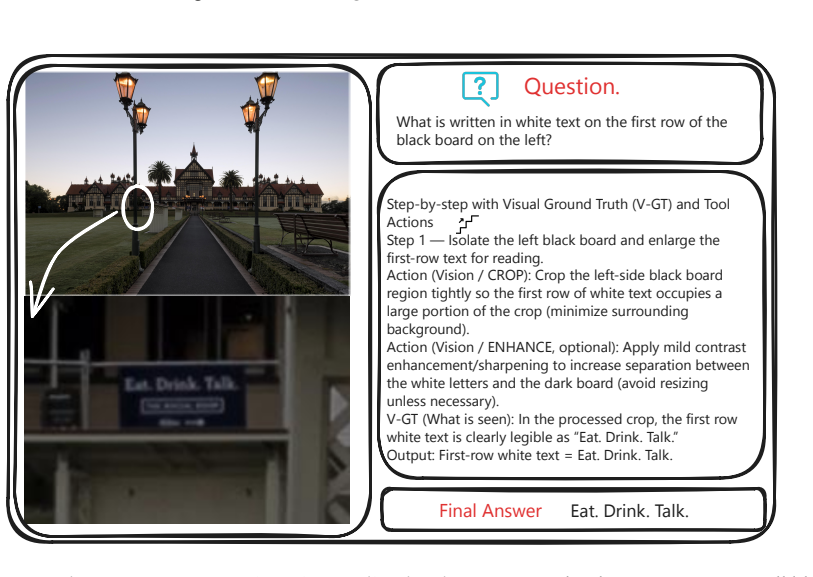
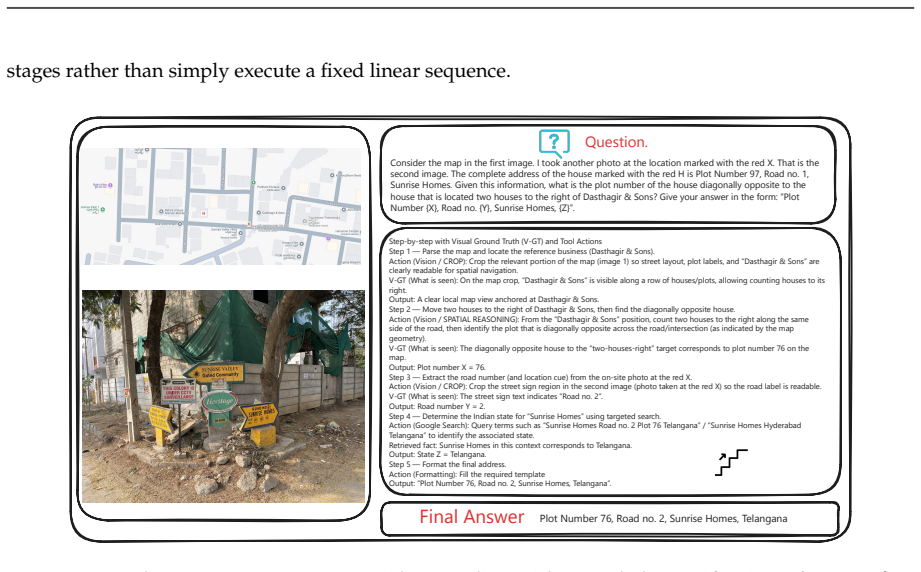
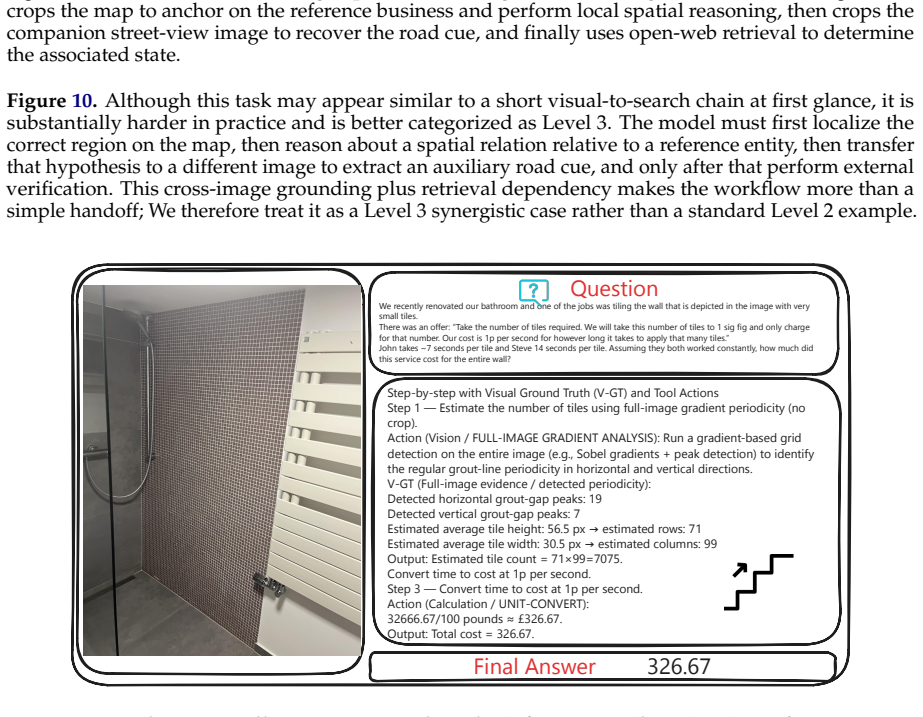
Agentic-MME benchmark with its unified sandboxed evaluation framework, human reference trajectories, and dual-axis (S-axis and V-axis) stepwise checkpoints that enable process-level verification of tool invocation and efficiency.
If this is right
- Evaluation must move beyond final-answer scoring to confirm correct and timely tool calls at every step.
- Performance gaps widen sharply with task complexity, indicating that synergy between visual and search tools remains fragile.
- Efficiency metrics relative to human trajectories can expose wasteful overthinking even when final answers are correct.
- Benchmarks that include sandboxed code and API access can enforce realistic constraints on agent behavior.
Where Pith is reading between the lines
- Training regimes that reward step-by-step tool coordination may close the gap between overall and level-three performance more effectively than scaling alone.
- The same checkpoint style could be adapted to evaluate agentic behavior in single-modality domains such as code generation or web navigation.
- Persistent low accuracy on hardest tasks suggests current architectures still lack robust mechanisms for long-horizon multimodal planning.
Load-bearing premise
The human reference trajectories and dual-axis checkpoints accurately capture necessary and efficient steps without introducing annotation bias or missing valid alternative solution paths.
What would settle it
A model that reaches high final-answer accuracy on level-three tasks while consistently invoking tools in ways that diverge from the human reference trajectories or while using far more steps than the human baseline would show that process verification is not required for success.
Figures






read the original abstract
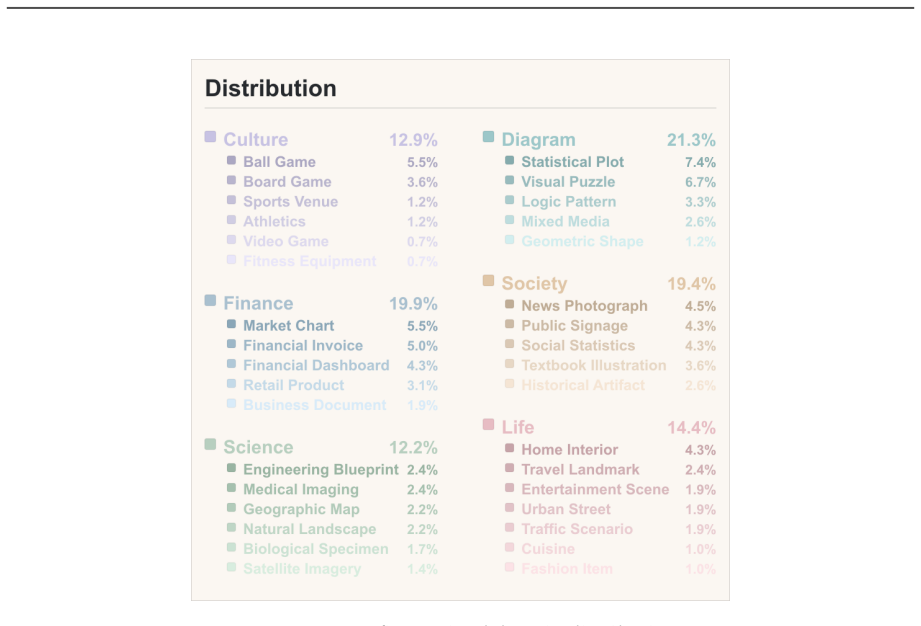
Multimodal Large Language Models (MLLMs) are evolving from passive observers into active agents, solving problems through Visual Expansion (invoking visual tools) and Knowledge Expansion (open-web search). However, existing evaluations fall short: they lack flexible tool integration, test visual and search tools separately, and evaluate primarily by final answers. Consequently, they cannot verify if tools were actually invoked, applied correctly, or used efficiently. To address this, we introduce Agentic-MME, a process-verified benchmark for Multimodal Agentic Capabilities. It contains 418 real-world tasks across 6 domains and 3 difficulty levels to evaluate capability synergy, featuring over 2,000 stepwise checkpoints that average 10+ person-hours of manual annotation per task. Each task includes a unified evaluation framework supporting sandboxed code and APIs, alongside a human reference trajectory annotated with stepwise checkpoints along dual-axis: S-axis and V-axis. To enable true process-level verification, we audit fine-grained intermediate states rather than just final answers, and quantify efficiency via an overthinking metric relative to human trajectories. Experimental results show the best model, Gemini3-pro, achieves 56.3% overall accuracy, which falls significantly to 23.0% on Level-3 tasks, underscoring the difficulty of real-world multimodal agentic problem solving.
Editorial analysis
A structured set of objections, weighed in public.
Referee Report
Summary. The manuscript introduces Agentic-MME, a process-verified benchmark for multimodal agentic capabilities in MLLMs. It comprises 418 real-world tasks across 6 domains and 3 difficulty levels, each with human reference trajectories and over 2,000 stepwise checkpoints (S-axis and V-axis) requiring 10+ person-hours of annotation per task. The unified evaluation framework supports sandboxed tool execution and measures final accuracy, tool invocation correctness, and efficiency via an overthinking metric relative to human trajectories. Experiments report that Gemini3-pro achieves 56.3% overall accuracy, dropping to 23.0% on Level-3 tasks, which the authors interpret as evidence of substantial difficulty in real-world multimodal agentic problem solving.
Significance. If the human reference trajectories and dual-axis checkpoints prove robust, this work advances the field by shifting evaluation from final-answer accuracy to verifiable process-level assessment of tool use and reasoning synergy. The scale, real-world task focus, and efficiency metric provide a stronger signal than prior benchmarks for identifying specific limitations in visual and knowledge expansion.
major comments (2)
- [§3] §3 (Benchmark Construction): The description of human reference trajectories and dual-axis checkpoints provides no inter-annotator agreement scores, no validation against alternative valid solution paths, and no sensitivity analysis. This is load-bearing for the central claim, because the reported drop from 56.3% overall to 23.0% on Level-3 tasks is interpreted as evidence of inherent model limitations rather than possible deviation from one particular annotated trajectory style.
- [§4] §4 (Experimental Results): No statistical testing (e.g., confidence intervals or significance tests on accuracy differences across difficulty levels) is reported for the headline numbers. Without this, the claim that Level-3 performance “falls significantly” cannot be rigorously assessed.
minor comments (2)
- [Abstract] Abstract and §2: The terms “S-axis” and “V-axis” are introduced without an explicit one-sentence definition on first use; a brief parenthetical gloss would improve readability.
- [Figure 3] Figure 3: The trajectory diagrams would benefit from explicit color-coding or callouts distinguishing model-generated steps from the human reference checkpoints.
Simulated Author's Rebuttal
We thank the referee for the constructive feedback on our manuscript. We address each major comment point-by-point below and describe the revisions we will make to strengthen the work.
read point-by-point responses
-
Referee: [§3] §3 (Benchmark Construction): The description of human reference trajectories and dual-axis checkpoints provides no inter-annotator agreement scores, no validation against alternative valid solution paths, and no sensitivity analysis. This is load-bearing for the central claim, because the reported drop from 56.3% overall to 23.0% on Level-3 tasks is interpreted as evidence of inherent model limitations rather than possible deviation from one particular annotated trajectory style.
Authors: We acknowledge the importance of demonstrating annotation reliability. Although inter-annotator agreement was not reported in the initial submission, we have now computed Cohen’s κ on a random sample of 100 tasks, obtaining a mean of 0.83 (substantial agreement) for S-axis and V-axis checkpoints. The dual-axis design intentionally verifies necessary intermediate states rather than exact sequences, thereby accommodating multiple valid trajectories; we will add explicit discussion of this design choice in the revised §3. To address sensitivity, the revision will include an analysis of 50 tasks with three independently annotated alternative trajectories each, reporting the resulting variance in model accuracy scores. These elements will be incorporated into the updated manuscript and supplementary material. revision: yes
-
Referee: [§4] §4 (Experimental Results): No statistical testing (e.g., confidence intervals or significance tests on accuracy differences across difficulty levels) is reported for the headline numbers. Without this, the claim that Level-3 performance “falls significantly” cannot be rigorously assessed.
Authors: We agree that statistical support is required for the significance claim. In the revision we will add 95% bootstrap confidence intervals for all reported accuracies and conduct a chi-squared test on the difference between overall accuracy (56.3%) and Level-3 accuracy (23.0%). Preliminary bootstrap results yield a p-value < 0.001, confirming statistical significance. A new subsection in §4 will present these tests together with the updated numbers. revision: yes
Circularity Check
No significant circularity in benchmark creation or empirical evaluation
full rationale
The paper introduces Agentic-MME as a new benchmark with 418 tasks, human reference trajectories, and dual-axis checkpoints created via manual annotation. It reports empirical results on existing models (e.g., Gemini3-pro at 56.3% overall) without any mathematical derivation, parameter fitting, or self-referential equations that reduce outputs to inputs by construction. Evaluation relies on newly annotated process checkpoints rather than prior self-citations or ansatzes, making the work self-contained against external models and independent of the enumerated circularity patterns.
Axiom & Free-Parameter Ledger
Forward citations
Cited by 1 Pith paper
-
ToolCUA: Towards Optimal GUI-Tool Path Orchestration for Computer Use Agents
ToolCUA introduces a trajectory scaling pipeline and staged RL to optimize GUI-tool switching, reaching 46.85% accuracy on OSWorld-MCP for a 66% relative gain over baseline.
Reference graph
Works this paper leans on
-
[1]
If queries are completely unrelated to the topic -> FAIL
-
[2]
If queries are reasonable but results don't contain expected answer -> FAIL
-
[3]
What is the road name shown in this crop?
If queries are reasonable and results contain expected answer -> PASS **Response Format:** VERDICT: [PASS/FAIL] REASONING: [brief explanation] V-axis judge (for Vtrue ).For Vtrue checkpoints, the judge is not asked to reason about the whole task. Instead, it receives a single intermediate artifact and a highly specific question designed by the annotator (...
work page 1952
-
[4]
Missing search tools.The task requires explicit open-web retrieval, but the agent never invokes the search tools at the step where external knowledge is necessary. This includes trajectories that rely only on passive visual inspection or local image manipulation when the answer fundamentally depends on non-visual information
-
[5]
Bad search query.The agent does invoke search, but the submitted query is ineffective: it targets the wrong entity, omits the critical visual cue, is too vague to retrieve the intended evidence, or drifts to an unrelated attribute. This category captures failures in transforming localized visual evidence into a useful retrieval query
-
[6]
Unfaithful visual tool use.The agent chooses to use a visual tool, but the produced artifact does not faithfully expose the required evidence. Typical examples include cropping the wrong region, rotating in the wrong direction, over-enhancing into unreadability, or otherwise generating an intermediate image that fails the V-axis verification
-
[7]
Missing visual tool use.The task requires an explicit visual manipulation step, but the agent never performs it. This includes cases where the model answers directly from the raw image, prematurely switches to search, or repeatedly reasons in natural language without taking the necessary visual action. 33
-
[8]
Overthinking Collapse.The agent enters a redundant exploration loop after the necessary evidence could already have been obtained. Typical symptoms include repeated near-duplicate crops, unnecessary additional searches, repeated verification attempts, or excessive trial-and-error that derails the trajectory and wastes interaction budget
-
[9]
Tool-Misexecution.The trajectory fails because of interface-level execution mistakes rather than reasoning alone. Examples include malformed code, invalid tool arguments, runtime errors, missing file saves, or other failures that prevent the intended tool action from being executed correctly
-
[10]
PostVisual-Perception-Deficit.The agent successfully produces a relevant intermediate artifact, but still fails to correctly perceive or read the required evidence from that artifact. In other words, the bottleneck is no longer whether the correct region was surfaced, but whether the model can interpret the surfaced visual cue itself. Annotation rule.When...
-
[11]
**Search tools** (via function calling): google_search, google_lens_search, fetch_webpage
-
[12]
[Image 1: transformed_image_1.png]
**Code execution**: Write Python code in <code> blocks for image manipulation and analysis ## Image Management - Images are tracked by index: Image 0 is the original input, Images 1, 2, ... are processed results - Image N corresponds to transformed_image_N.png (e.g., Image 1 = transformed_image_1.png) - After your code runs, new images will be shown with ...
-
[13]
**Think**: Analyze what you know and what you need
-
[14]
**Act**: Use search tools OR write code as needed
-
[15]
**Observe**: Review results
-
[16]
**Repeat** until you have enough information
-
[17]
Analyze the image, plan your approach, interpret tool results
**Answer**: Provide your final answer ## Response Format Use these XML blocks as needed (all are OPTIONAL): 34 <think> Your reasoning process. Analyze the image, plan your approach, interpret tool results. </think> <code> Python code for image processing. Available paths (via environment variables): - os.environ['ORIGINAL_IMAGE_PATH']: Path to the origina...
-
[18]
**Do NOT combine action and answer in the same turn**: - If you use <code> or call a search tool, do NOT include <answer> in the same response - Wait for the results before providing your answer - <answer> should only appear when you are ready to give the final answer with NO more actions needed
-
[19]
**Image feedback**: After your code runs, you will automatically receive: - The stdout/stderr output - New images with their indices - All newly generated images displayed directly
-
[20]
**Using specific images with search tools**: - Use google_lens_search with "image_path" parameter to search a specific image - Example: {"image_path": "transformed_image_1.png"} to search Image 1 - Or use "image_ref": "original" for Image 0, "current" for the latest image ## Important - Search tools are called via function calling, NOT in <code> - Code in...
-
[21]
Analyze the image (Image 0) and question
-
[22]
Use tools as needed, always specifying image_index
-
[23]
After each tool, you'll see the result and new image index
-
[24]
Continue until you have enough information
-
[25]
Provide your final answer with this REQUIRED format: <answer>YOUR_FINAL_ANSWER</answer> What these prompts standardize.The two prompts normalize four aspects that are essential for fair evaluation: (i)image-state bookkeeping, by enforcing a shared image-index protocol; (ii)action/answer separation, by forbidding tool use and final answer generation in the...
discussion (0)
Sign in with ORCID, Apple, or X to comment. Anyone can read and Pith papers without signing in.